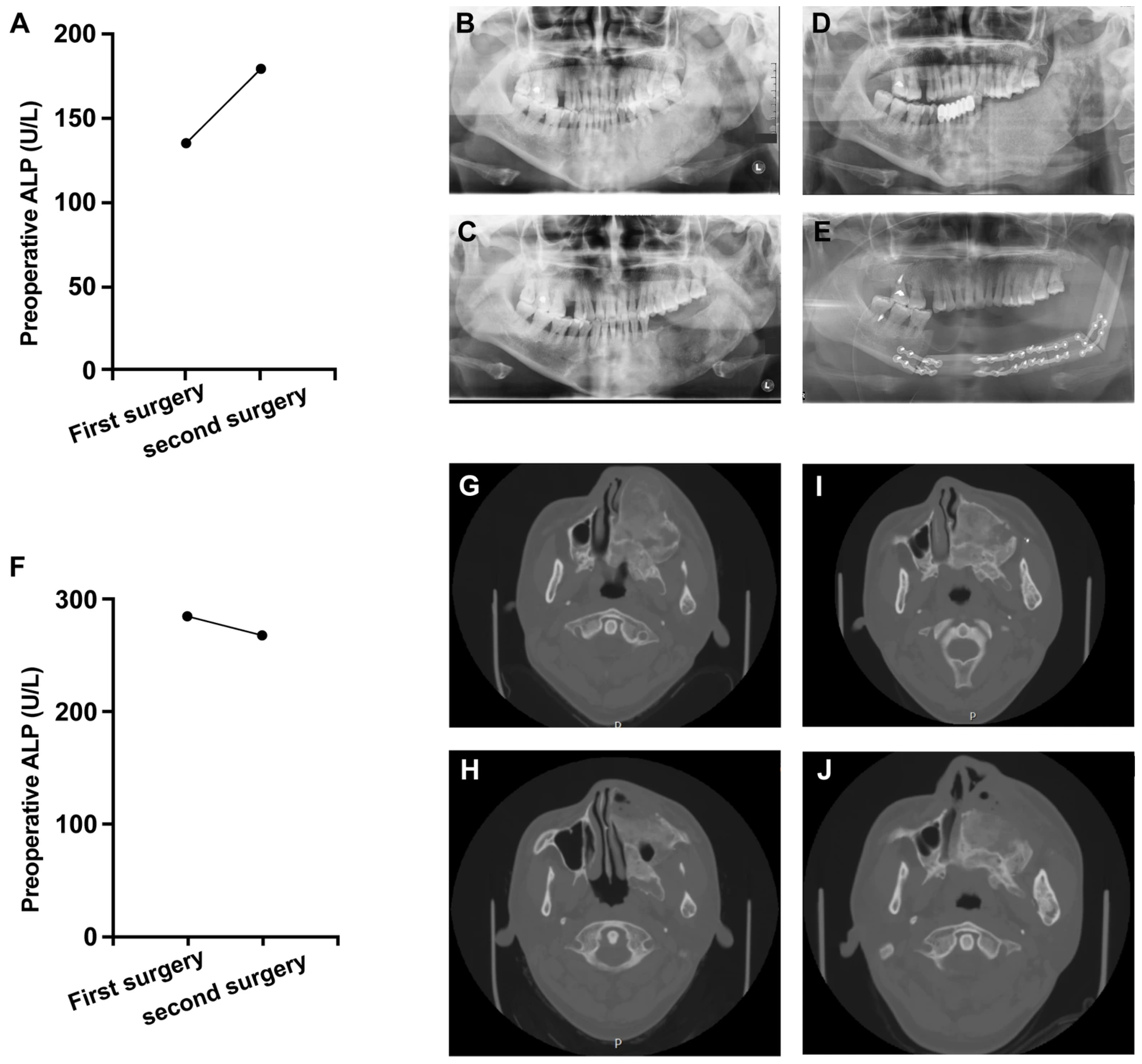
Bilateral Lesions Are Linked to Postoperative Regrowth in Craniofacial Fibrous Dysplasia: Alkaline Phosphatase as a Marker of Clinical Phenotype
Abstract
1. Introduction
2. Materials and Methods
2.1. Patients
2.2. Statistical Analysis
3. Results
3.1. Cohort Characteristics and Clinical Phenotypes
3.2. ALP Associations with Disease Phenotypes
3.3. Association Between Clinical Characteristics and Postoperative Disease Progression
4. Discussion
Author Contributions
Funding
Institutional Review Board Statement
Informed Consent Statement
Data Availability Statement
Conflicts of Interest
References
- Hartley, I.; Zhadina, M.; Collins, M.T.; Boyce, A.M. Fibrous Dysplasia of Bone and McCune-Albright Syndrome: A Bench to Bedside Review. Calcif. Tissue Int. 2019, 104, 517–529. [Google Scholar] [CrossRef]
- Riminucci, M.; Robey, P.G.; Saggio, I.; Bianco, P. Skeletal progenitors and the GNAS gene: Fibrous dysplasia of bone read through stem cells. J. Mol. Endocrinol. 2010, 45, 355–364. [Google Scholar] [CrossRef]
- Bianco, P.; Riminucci, M.; Majolagbe, A.; Kuznetsov, S.A.; Collins, M.T.; Mankani, M.H.; Corsi, A.; Bone, H.G.; Wientroub, S.; Spiegel, A.M.; et al. Mutations of the GNAS1 gene, stromal cell dysfunction, and osteomalacic changes in non-McCune-Albright fibrous dysplasia of bone. J. Bone Miner. Res. 2000, 15, 120–128. [Google Scholar] [CrossRef]
- Boyce, A.M.; Florenzano, P.; de Castro, L.F.; Collins, M.T. Fibrous Dysplasia/Mccune-Albright Syndrome; University of Washington: Seattle, WA, USA, 2019. [Google Scholar]
- Margaret Flanagan, A.; Fitzpatrick, S.; Nelson, B.L. Fibrous Dysplasia. In Head and Neck Tumours, 5th ed.; WHO: Geneva, Switzerland, 2022. [Google Scholar]
- Szymczuk, V.; Taylor, J.; Boyce, A.M. Craniofacial Fibrous Dysplasia: Clinical and Therapeutic Implications. Curr. Osteoporos. Rep. 2023, 21, 147–153. [Google Scholar] [CrossRef]
- Pereira, T.D.F.; Gomes, C.C.; Brennan, P.A.; Fonseca, F.P.; Gomez, R.S. Fibrous dysplasia of the jaws: Integrating molecular pathogenesis with clinical, radiological, and histopathological features. J. Oral Pathol. Med. 2019, 48, 3–9. [Google Scholar] [CrossRef] [PubMed]
- WHO. WHO Classification of Tumours of Soft Tissue and Bone: WHO Classification of Tumours; IARC Press: Lyon, France, 2013; Volume 5. [Google Scholar]
- Lee, J.S.; FitzGibbon, E.J.; Chen, Y.R.; Kim, H.J.; Lustig, L.R.; Akintoye, S.O.; Collins, M.; Kaban, L. Clinical guidelines for the management of craniofacial fibrous dysplasia. Orphanet J. Rare Dis. 2012, 7, S2. [Google Scholar] [CrossRef] [PubMed]
- Kusano, T.; Hirabayashi, S.; Eguchi, T.; Sugawara, Y. Treatment strategies for fibrous dysplasia. J. Craniofacial Surg. 2009, 20, 768–770. [Google Scholar] [CrossRef] [PubMed]
- Ma, J.; Liang, L.; Gu, B.; Zhang, H.; Wen, W.; Liu, H. A retrospective study on craniofacial fibrous dysplasia: Preoperative serum alkaline phosphatase as a prognostic marker? J. Cranio-Maxillofac. Surg. 2013, 41, 644–647. [Google Scholar] [CrossRef]
- Pan, K.S.; Taylor, J.; Szymczuk, V.; Boyce, A.M. Lesion Expansion in Gnathic Fibrous Dysplasia: Natural History, Indicators of Progression, and Response to Bisphosphonates. J. Bone Miner. Res. 2023, 38, 1465–1471. [Google Scholar] [CrossRef]
- Javaid, M.K.; Boyce, A.; Appelman-Dijkstra, N.; Ong, J.; Defabianis, P.; Offiah, A.; Arundel, P.; Shaw, N.; Pos, V.D.; Underhil, A.; et al. Best practice management guidelines for fibrous dysplasia/McCune-Albright syndrome: A consensus statement from the FD/MAS international consortium. Orphanet J. Rare Dis. 2019, 14, 139. [Google Scholar] [CrossRef]
- Chen, P.R.; Chuang, K.T.; Wang, P.F.; Yao, C.F.; Chou, P.Y.; Chen, Y.A.; Lin, C.C.H.; Huang, H.Y.; Chen, Y.R. Craniofacial fibrous dysplasia: Long-term postoperative outcomes in a retrospective case series with up to 40 years of follow-up. Bone 2026, 203, 117697. [Google Scholar] [CrossRef] [PubMed]
- Sweeney, K.; Kaban, L.B. Natural History and Progression of Craniofacial Fibrous Dysplasia: A Retrospective Evaluation of 114 Patients from Massachusetts General Hospital. J. Oral Maxillofac. Surg. 2020, 78, 1966–1980. [Google Scholar] [CrossRef] [PubMed]
- Sadeghi, S.M.; Hosseini, S.N. Spontaneous conversion of fibrous dysplasia into osteosarcoma. J. Craniofacial Surg. 2011, 22, 959–961. [Google Scholar] [CrossRef] [PubMed]
- Park, B.Y.; Cheon, Y.W.; Kim, Y.O.; Pae, N.S.; Lee, W.J. Prognosis for craniofacial fibrous dysplasia after incomplete resection: Age and serum alkaline phosphatase. Int. J. Oral Maxillofac. Surg. 2010, 39, 221–226. [Google Scholar] [CrossRef]
- Coleman, R.; Brown, J.; Terpos, E.; Lipton, A.; Smith, M.R.; Cook, R.; Major, P. Bone markers and their prognostic value in metastatic bone disease: Clinical evidence and future directions. Cancer Treat. Rev. 2008, 34, 629–639. [Google Scholar] [CrossRef]
- Meier, M.E.; Hagelstein-Rotman, M.; Streefland, T.C.M.; Winter, E.M.; Bravenboer, N.; Appelman-Dijkstra, N.M. Clinical value of RANKL, OPG, IL-6 and sclerostin as biomarkers for fibrous dysplasia/McCune-Albright syndrome. Bone 2023, 171, 116744. [Google Scholar] [CrossRef]
- Hussein, M.A.; Yun, I.S.; Kim, B.O.; Kim, Y.O. Craniofacial Fibrous Dysplasia: Retrospective Study on the Relationship Between the Tumor Volume Changes and the Circulating Serum Calcitonin and Serum Alkaline Phosphatase. Ann. Plast. Surg. 2017, 78, 289–293. [Google Scholar] [CrossRef]
- Wang, J.; Du, Z.; Li, D.; Yang, R.; Tang, X.; Yan, T.; Guo, W. Increasing serum alkaline phosphatase is associated with bone deformity progression for patients with polyostotic fibrous dysplasia. J. Orthop. Surg. Res. 2020, 15, 583. [Google Scholar] [CrossRef]
- Yamagishi, Y.; Okamoto, M.; Yoshimura, Y.; Kito, M.; Aoki, K.; Takahashi, J. Continued growth of locally aggressive fibrous dysplasia of 22 years duration after reaching adulthood: A case report. J. Surg. Case Rep. 2020, 2020, rjz406. [Google Scholar] [CrossRef]
- Burke, A.B.; Collins, M.T.; Boyce, A.M. Fibrous dysplasia of bone: Craniofacial and dental implications. Oral Dis. 2017, 23, 697–708. [Google Scholar] [CrossRef]
- Lo, S.F.; Roper, S.M. Nelson Textbook of Pediatrics; Robert, M.M.D., Kliegman, R.M., Blum, N.J., Tasker, R.C., Wilson, K.M., Schuh, A.M., Mack, C.L., Deardoff, M.A., Eds.; Elsevier: Amsterdam, The Netherlands, 2025; pp. 4472.e3–4472.e7. [Google Scholar]
- Boyce, A.M.; Burke, A.; Cutler Peck, C.; DuFresne, C.R.; Lee, J.S.; Collins, M.T. Surgical Management of Polyostotic Craniofacial Fibrous Dysplasia: Long-Term Outcomes and Predictors for Postoperative Regrowth. Plast. Reconstr. Surg. 2016, 137, 1833–1839. [Google Scholar] [CrossRef]
- Kim, Y.C.; Han, S.J.; Choi, J.W. Functional outcomes and recurrence determinants in craniofacial fibrous dysplasia: Insights from 3D computed tomography and comprehensive clinical evaluation. J. Plast. Reconstr. Aesthetic Surg. 2024, 92, 1–10. [Google Scholar] [CrossRef]
- Li, G.; Liu, H.; Pan, Z.; Cheng, L.; Dai, J. Predicting craniofacial fibrous dysplasia growth status: An exploratory study of a hybrid radiomics and deep learning model based on computed tomography images. Oral Surg. Oral Med. Oral Pathol. Oral Radiol. 2025, 139, 364–376. [Google Scholar] [CrossRef]


| Age | Value (U/L) | |
|---|---|---|
| 1–9 years | 145–420 | |
| 10–11 years | 140–560 | |
| Male | Female | |
| 12–13 years | 200–495 | 105–420 |
| 14–15 years | 130–525 | 70–230 |
| 16–19 years | 65–260 | 50–130 |
| >19 years | 45–125 | 50–135 |
| Items | N | Percent (%) |
|---|---|---|
| Age of onset | ||
| 0–16 years | 57 | 80.3 |
| >16 years | 14 | 19.7 |
| Gender | ||
| Male | 33 | 46.5 |
| Female | 38 | 53.5 |
| Age at surgery | ||
| 16–19 years | 14 | 19.7 |
| >19 years | 57 | 80.3 |
| Types of surgical procedures | ||
| Conservative bone contouring | 70 | 98.6 |
| Osteotomy | 1 | 1.4 |
| Laterality | ||
| Unilateral lesions | 52 | 73.2 |
| Bilateral lesions | 19 | 26.8 |
| Type | ||
| MFD | 28 | 39.4 |
| CFD | 15 | 21.2 |
| PFD | 28 | 39.4 |
| Symptoms | ||
| Deformity | 68 | 95.8 |
| Pain | 9 | 12.7 |
| Numbness | 3 | 4.2 |
| Prognosis | ||
| Active lesions | 6 | 8.5 |
| Stable lesions | 65 | 91.5 |
| Items | N (%) | Preoperative ALP | p-Value |
|---|---|---|---|
| Age at surgery | 0.001 | ||
| 16–19 years | 14 (19.72) | 244.00 (137.50, 411.25) | |
| >19 years | 57 (80.28) | 107.00 (79.46, 144.00) | |
| Age of onset | 0.030 | ||
| 0–16 years | 57 (80.28) | 114.00 (88.08, 200.00) | |
| >16 years | 14 (19.72) | 82.97 (61.92, 129.62) | |
| Gender | 0.588 | ||
| Male | 33 (46.48) | 114.00 (84.00, 167.00) | |
| Female | 38 (53.52) | 109.62 (85.00, 160.69) | |
| Laterality | 0.006 | ||
| Unilateral lesions | 52 (73.24) | 106.15 (78.54, 140.73) | |
| Bilateral lesions | 19 (26.76) | 176.00 (112.08, 364.46) | |
| Type | <0.001 | ||
| MFD | 28 (39.44) | 87.46 (72.77, 107.00) | |
| CFD | 15 (21.13) | 115.15 (88.19, 200.31) | |
| PFD | 28 (39.44) | 162.00 (113.98, 286.15) | |
| Prognosis | 0.061 | ||
| Active lesions | 6 (8.45) | 236.50 (151.13, 381.75) | |
| Stable lesions | 65 (91.55) | 107.00 (84.00, 156.00) |
| Items | N (%) | ALP Normal No. | ALP Abnormal No. | p-Value |
|---|---|---|---|---|
| Age at surgery | 23.00 (20.00, 29.00) | 25.00 (22.00, 31.00) | 21.50 (18.00, 25.75) | 0.010 |
| Age of onset | 12.00 (8.00, 15.00) | 13.00 (10.00, 16.00) | 10.00 (6.25, 12.75) | 0.018 |
| Gender | 0.322 | |||
| Male | 33 (46.48) | 17 (41.46) | 16 (53.33) | |
| Female | 38 (53.52) | 24 (58.54) | 14 (46.67) | |
| Laterality | 0.031 | |||
| Unilateral lesions | 52 (73.24) | 34 (82.93) | 18 (60.00) | |
| Bilateral lesions | 19 (26.76) | 7 (17.07) | 12 (40.00) | |
| Type | <0.001 | |||
| MFD | 28 (39.44) | 25 (60.98) | 3 (10.00) | |
| CFD | 15 (21.13) | 8 (19.51) | 7 (23.33) | |
| PFD | 28 (39.44) | 8 (19.51) | 20 (66.67) | |
| Prognosis | 0.090 | |||
| Active lesions | 6 (8.45) | 1 (2.44) | 5 (16.67) | |
| Stable lesions | 65 (91.55) | 40 (97.56) | 25 (83.33) |
| Items | N (%) | Active Lesions | Stable Lesions | p-Value |
|---|---|---|---|---|
| Age at surgery | 23.00 (20.00, 29.00) | 20.50 (17.25, 27.50) | 23.00 (20.00, 29.00) | 0.336 |
| Age of onset | 12.00 (8.00, 15.00) | 7.00 (5.25, 10.25) | 12.00 (9.00, 15.00) | 0.136 |
| Gender | 0.543 | |||
| Male | 33 (46.48) | 4 (66.67) | 29 (44.62) | |
| Female | 38 (53.52) | 2 (33.33) | 36 (55.38) | |
| Laterality | 0.005 | |||
| Unilateral lesions | 52 (73.24) | 1 (16.67) | 51 (78.46) | |
| Bilateral lesions | 19 (26.76) | 5 (83.33) | 14 (21.54) | |
| Type | 0.426 | |||
| MFD | 28 (39.44) | 1 (16.67) | 27 (41.54) | |
| CFD | 15 (21.13) | 1 (16.67) | 14 (21.54) | |
| PFD | 28 (39.44) | 4 (66.67) | 24 (36.92) | |
| ALP status | 0.090 | |||
| ALP normal no. | 41 (57.75) | 1 (16.67) | 40 (61.54) | |
| ALP abnormal no. | 30 (42.25) | 5 (83.33) | 25 (38.46) | |
| ALP levels | 110.23 (84.19, 166.31) | 236.50 (151.13, 381.75) | 107.00 (84.00, 156.00) | 0.061 |
Disclaimer/Publisher’s Note: The statements, opinions and data contained in all publications are solely those of the individual author(s) and contributor(s) and not of MDPI and/or the editor(s). MDPI and/or the editor(s) disclaim responsibility for any injury to people or property resulting from any ideas, methods, instructions or products referred to in the content. |
© 2026 by the authors. Licensee MDPI, Basel, Switzerland. This article is an open access article distributed under the terms and conditions of the Creative Commons Attribution (CC BY) license.
Share and Cite
Xue, J.; Liu, L.; Zhang, J.; Lou, Y.; Sun, L.; Li, T. Bilateral Lesions Are Linked to Postoperative Regrowth in Craniofacial Fibrous Dysplasia: Alkaline Phosphatase as a Marker of Clinical Phenotype. Diagnostics 2026, 16, 472. https://doi.org/10.3390/diagnostics16030472
Xue J, Liu L, Zhang J, Lou Y, Sun L, Li T. Bilateral Lesions Are Linked to Postoperative Regrowth in Craniofacial Fibrous Dysplasia: Alkaline Phosphatase as a Marker of Clinical Phenotype. Diagnostics. 2026; 16(3):472. https://doi.org/10.3390/diagnostics16030472
Chicago/Turabian StyleXue, Jiang, Longping Liu, Jianyun Zhang, Yue Lou, Lisha Sun, and Tiejun Li. 2026. "Bilateral Lesions Are Linked to Postoperative Regrowth in Craniofacial Fibrous Dysplasia: Alkaline Phosphatase as a Marker of Clinical Phenotype" Diagnostics 16, no. 3: 472. https://doi.org/10.3390/diagnostics16030472
APA StyleXue, J., Liu, L., Zhang, J., Lou, Y., Sun, L., & Li, T. (2026). Bilateral Lesions Are Linked to Postoperative Regrowth in Craniofacial Fibrous Dysplasia: Alkaline Phosphatase as a Marker of Clinical Phenotype. Diagnostics, 16(3), 472. https://doi.org/10.3390/diagnostics16030472