Dynamic Thyroglobulin Ratio as a Biomarker to Identify Papillary Thyroid Cancer Patients Who Would Benefit from a Low-Iodine Diet

 , and
, and
Abstract
1. Introduction
2. Materials and Methods
2.1. Patients
2.2. Measurement of Clinical Parameters at the Time of RAI Therapy or Follow-Up
2.3. Study Design
2.4. Statistical Analysis
3. Results
3.1. Patient Characteristics
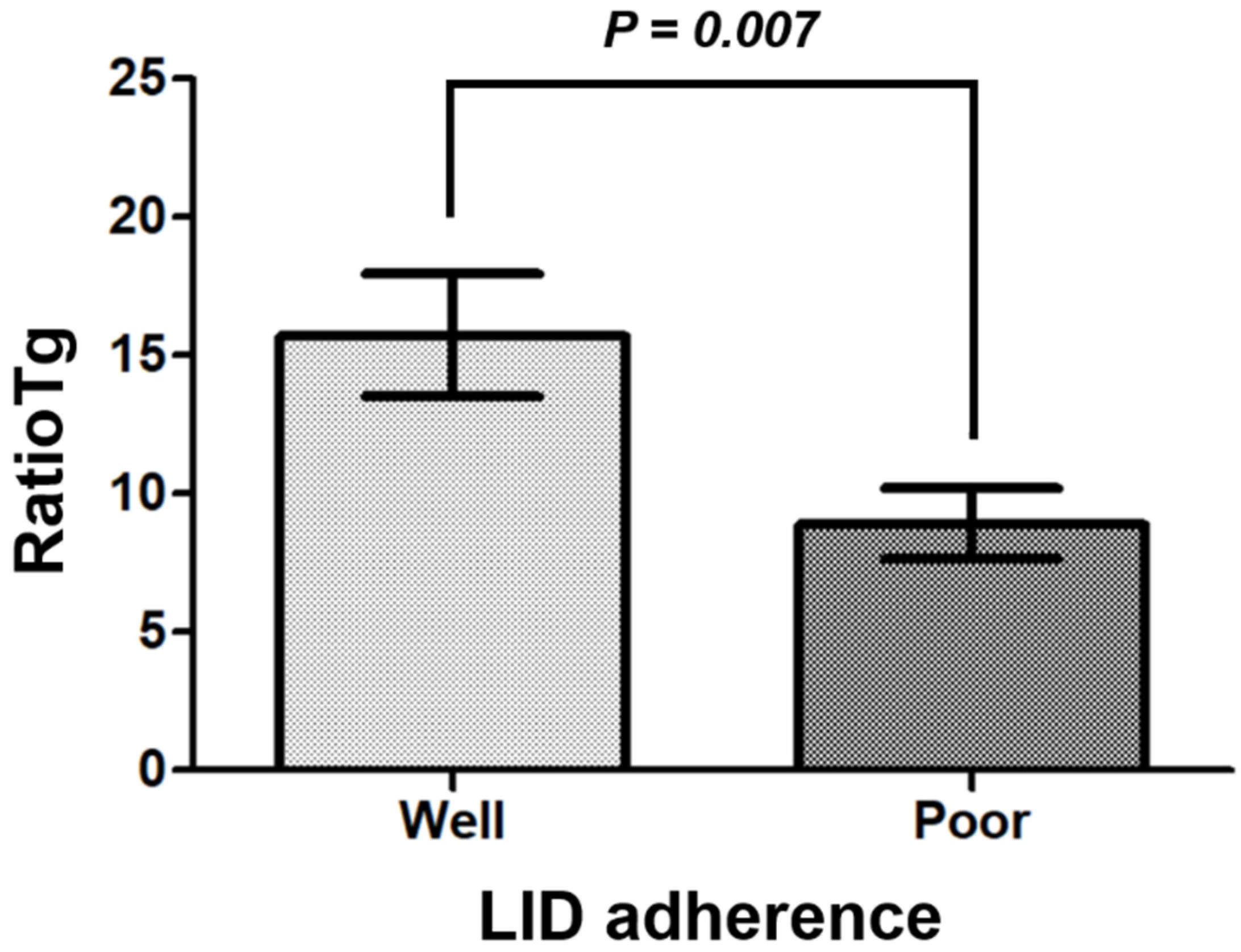
3.2. Comparison of ratioTg Values According to Low Iodine Diet Adherence
3.3. Factors Associated with RAI Response in All Patients
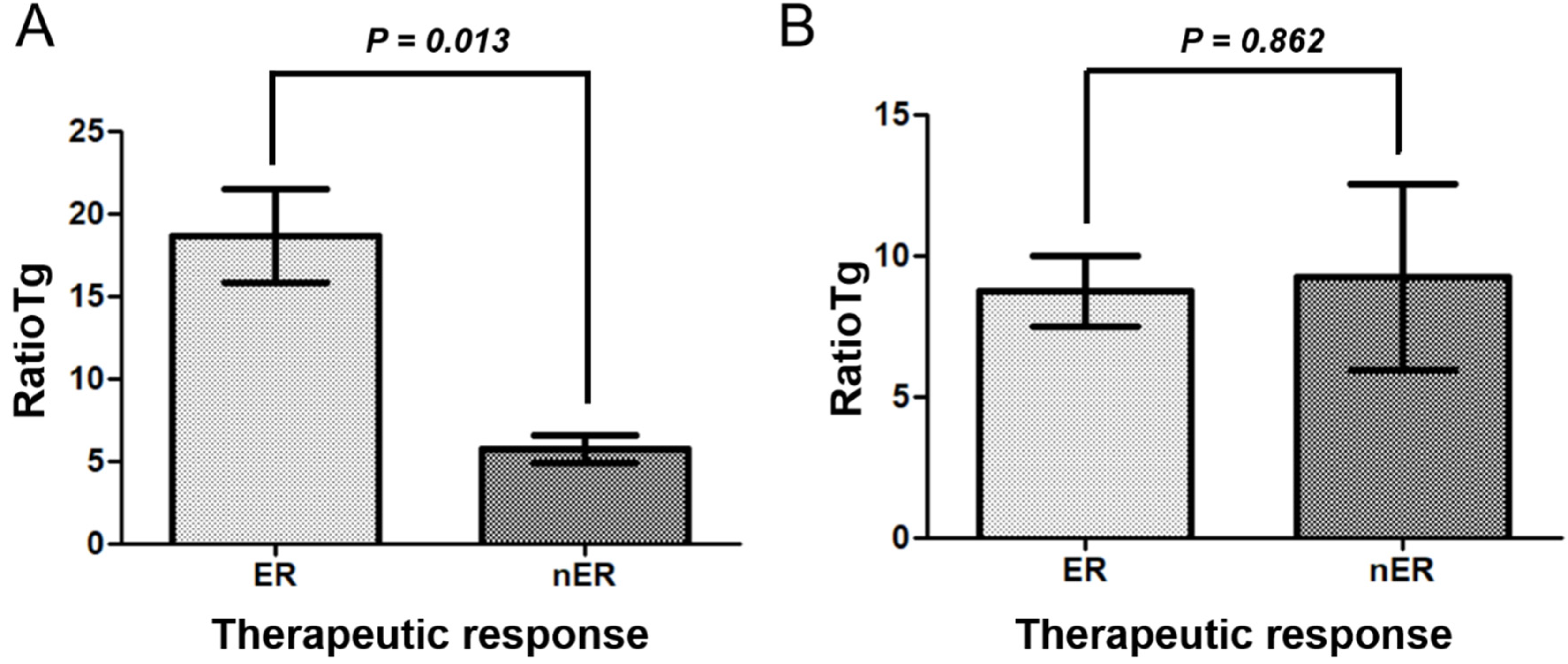
3.4. Association Between LID Adherence and Therapeutic Response According to ratioTg
3.5. Predictive Value of ratioTg in Relation to LID Adherence
4. Discussion
5. Conclusions
Author Contributions
Funding
Institutional Review Board Statement
Informed Consent Statement
Data Availability Statement
Acknowledgments
Conflicts of Interest
References
- Huang, J.; Ngai, C.H.; Deng, Y.; Pun, C.N.; Lok, V.; Zhang, L.; Xu, Q.; Lucero-Prisno, D.E.; Xu, W.; Zheng, Z.-J.; et al. Incidence and mortality of thyroid cancer in 50 countries: A joinpoint regression analysis of global trends. Endocrine 2023, 80, 355–365. [Google Scholar] [CrossRef] [PubMed]
- Schmidbauer, B.; Menhart, K.; Hellwig, D.; Grosse, J. Differentiated Thyroid Cancer-Treatment: State of the Art. Int. J. Mol. Sci. 2017, 18, 1292. [Google Scholar] [CrossRef] [PubMed]
- Haugen, B.R.; Alexander, E.K.; Bible, K.C.; Doherty, G.M.; Mandel, S.J.; Nikiforov, Y.E.; Pacini, F.; Randolph, G.W.; Sawka, A.M.; Schlumberger, M.; et al. 2015 American Thyroid Association Management Guidelines for Adult Patients with Thyroid Nodules and Differentiated Thyroid Cancer: The American Thyroid Association Guidelines Task Force on Thyroid Nodules and Differentiated Thyroid Cancer. Thyroid 2016, 26, 1–133. [Google Scholar] [CrossRef] [PubMed]
- Oh, S.W.; Park, S.; Chong, A.; Kim, K.; Bang, J.-I.; Seo, Y.; Hong, C.M.; Lee, S.-W. Radioactive Iodine Therapy in Differentiated Thyroid Cancer: Summary of the Korean Thyroid Association Guidelines 2024 from Nuclear Medicine Perspective, Part-II. Nucl. Med. Mol. Imaging 2025, 59, 8–26. [Google Scholar] [CrossRef] [PubMed]
- Tian, T.; Qi, Z.; Huang, S.; Wang, H.; Huang, R. Radioactive Iodine Therapy Decreases the Recurrence of Intermediate-Risk PTC With Low Thyroglobulin Levels. J. Clin. Endocrinol. Metab. 2023, 108, 2033–2041. [Google Scholar] [CrossRef] [PubMed]
- Kim, H.I.; Kim, B.; Hyeon, J.; Ko, N.G.M.; Jin, M.M.; Cho, J.H.M.; Han, J.M.P.; Suh, S.; Bae, J.C.; Chung, M.K.; et al. Impact of Therapeutic Radioactive Iodine on the Recurrence of Papillary Thyroid Cancer With Extranodal Extension in Metastatic Lymph Nodes: A Propensity Score-matched Analysis. Clin. Nucl. Med. 2025, 50, 830–839. [Google Scholar] [CrossRef] [PubMed]
- Liu, Y.; Wang, J.; Hu, X.; Pan, Z.; Xu, T.; Xu, J.; Jiang, L.; Huang, P.; Zhang, Y.; Ge, M. Radioiodine therapy in advanced differentiated thyroid cancer: Resistance and overcoming strategy. Drug Resist. Updat. 2023, 68, 100939. [Google Scholar] [CrossRef] [PubMed]
- Li, J.H.; He, Z.H.; Bansal, V.; Hennessey, J.V. Low iodine diet in differentiated thyroid cancer: A review. Clin. Endocrinol. 2016, 84, 3–12. [Google Scholar] [CrossRef] [PubMed]
- Herbert, G.; England, C.; Perry, R.; Whitmarsh, A.; Moore, T.; Searle, A.; Chotaliya, S.; Ness, A.; Beasley, M.; Atkinson, C. Impact of low iodine diets on ablation success in differentiated thyroid cancer: A mixed-methods systematic review and meta-analysis. Clin. Endocrinol. 2022, 97, 702–729. [Google Scholar] [CrossRef] [PubMed]
- Silaghi, H.; Lozovanu, V.; Georgescu, C.E.; Pop, C.; Nasui, B.A.; Cătoi, A.F.; Silaghi, C.A. State of the Art in the Current Management and Future Directions of Targeted Therapy for Differentiated Thyroid Cancer. Int. J. Mol. Sci. 2022, 23, 3470. [Google Scholar] [CrossRef] [PubMed]
- Filetti, S.; Durante, C.; Hartl, D.; Leboulleux, S.; Locati, L.; Newbold, K.; Papotti, M.; Berruti, A. Thyroid cancer: ESMO Clinical Practice Guidelines for diagnosis, treatment and follow-updagger. Ann. Oncol. 2019, 30, 1856–1883. [Google Scholar] [CrossRef] [PubMed]
- Haddad, R.I.; Bischoff, L.; Ball, D.; Bernet, V.; Blomain, E.; Busaidy, N.L.; Campbell, M.; Dickson, P.; Duh, Q.-Y.; Ehya, H.; et al. Thyroid Carcinoma, Version 2.2022, NCCN Clinical Practice Guidelines in Oncology. J. Natl. Compr. Cancer Netw. 2022, 20, 925–951. [Google Scholar] [CrossRef] [PubMed]
- Stevic, I.; Dembinski, T.C.; Pathak, K.A.; Leslie, W.D. Transient early increase in thyroglobulin levels post-radioiodine ablation in patients with differentiated thyroid cancer. Clin. Biochem. 2015, 48, 658–661. [Google Scholar] [CrossRef] [PubMed]
- Kim, H.K.; Lee, S.Y.; Lee, J.I.; Jang, H.W.; Kim, S.K.; Chung, H.S.; Tan, A.H.K.; Hur, K.Y.; Kim, J.H.; Chung, J.H.; et al. Usefulness of iodine/creatinine ratio from spot-urine samples to evaluate the effectiveness of low-iodine diet preparation for radioiodine therapy. Clin. Endocrinol. 2010, 73, 114–118. [Google Scholar] [CrossRef] [PubMed]
- Yoo, S.W.; Chowdhury, M.S.A.; Jeon, S.; Kang, S.-R.; Cho, S.-G.; Kim, J.; Lee, C.; Ryu, Y.J.; Song, H.-C.; Bom, H.-S.; et al. Optimization of Predictive Performance for the Therapeutic Response Using Iodine Scan-Corrected Serum Thyroglobulin in Patients with Differentiated Thyroid Carcinoma. Cancers 2020, 12, 262. [Google Scholar] [CrossRef] [PubMed]
- Zhu, Y.; Yang, X.; Liu, Z.; Zhang, Q.; Li, Z.; Hou, X.; Zhu, H. Predictive value of thyroglobulin after radioiodine therapy for excellent response to treatment in postoperative thyroid cancer. Nucl. Med. Commun. 2025, 46, 146–151. [Google Scholar] [CrossRef] [PubMed]
- Luo, H.; Tobey, A.; Auh, S.; Cochran, C.; Behairy, N.; Merino, M.; Zemskova, M.; Klubo-Gwiezdzinska, J. The utility of low-iodine diet in preparation for thyroid cancer therapy with radioactive iodine-A cohort study. Front. Pharmacol. 2022, 13, 791710. [Google Scholar] [CrossRef] [PubMed]
- Ito, S.; Iwano, S.; Kato, K.; Naganawa, S. Predictive factors for the outcomes of initial I-131 low-dose ablation therapy to Japanese patients with differentiated thyroid cancer. Ann. Nucl. Med. 2018, 32, 418–424. [Google Scholar] [CrossRef] [PubMed]
- Cao, J.; Yun, C.; Zhu, X.; Sun, Y.; Li, X.; Zhang, W. Could Urinary Iodine Be an Effective Predictive Factor for Thyroid Cancer After High Dose Radioactive Iodine Therapy? Endocr. Pract. 2022, 28, 586–592. [Google Scholar] [CrossRef] [PubMed]
- Reiners, C.; Drozd, V.; Yamashita, S. Hypothyroidism after radiation exposure: Brief narrative review. J. Neural Transm. 2020, 127, 1455–1466. [Google Scholar] [CrossRef] [PubMed]



| Variables | Values |
|---|---|
| Age (years) | |
| Mean ± SD (range) | 49.1 ± 12.5 (18–83) |
| Sex | |
| Male | 231 (25.8%) |
| Female | 664 (74.2%) |
| T stage | |
| T1 | 584 (65.2%) |
| T2 | 56 (6.3%) |
| T3 | 179 (20.0%) |
| T4 | 76 (8.5%) |
| N stage | |
| N0a or N0b | 186 (20.8%) |
| N1a | 492 (55.0%) |
| N1b | 217 (24.2%) |
| Diameter of the largest tumor (cm) | |
| Mean ± SD (range) | 1.3 ± 0.9 (0.1–7.0) |
| Multiplicity | |
| Solitary | 407 (45.5%) |
| Multiple | 488 (54.5%) |
| Gross extrathyroidal extension | |
| No | 650 (72.6%) |
| Yes | 245 (27.4%) |
| Number of metastatic lymph nodes | |
| Mean ± SD (range) | 4.3 ± 5.2 (0–36) |
| RAI dose | |
| Low does (≤1.85 GBq) | 452 (50.5%) |
| High does (≥3.70 GBq) | 443 (49.5%) |
| Pre-RAI Tg (ng/mL) | |
| Mean ± SEM (range) | 2.6 ± 0.4 (0.1–308.0) |
| RatioTg | |
| Mean ± SEM (range) | 13.4 ± 1.5 (0.007–1004.0) |
| Preparation method | |
| THW | 169 (18.9%) |
| rhTSH | 726 (81.1%) |
| Urine I/Cr ratio (μg/g Cr) | |
| <66.2 | 592 (66.1%) |
| ≥66.2 | 303 (33.9%) |
| Response assessment | |
| ER | 677 (75.6%) |
| nER | 218 (24.4%) |
| Variables | ER (n = 677) | nER (n = 218) | Univariate | Multivariate | |
|---|---|---|---|---|---|
| p Value | p Value | Odds Ratio (95% CI) | |||
| Age (years) | 0.971 | ||||
| <55 years | 445 (75.7%) | 143 (24.3%) | |||
| ≥55 years | 232 (75.6%) | 75 (24.4%) | |||
| Sex | < 0.001 | 0.008 | 1.710 (1.150–2.544) | ||
| Male | 150 (64.9%) | 81 (35.1%) | |||
| Female | 527 (79.4%) | 137 (20.6%) | |||
| T stage | 0.004 | 0.992 | 1.009 (0.175–5.832) | ||
| T1 + T2 | 501 (78.3%) | 139 (21.7%) | |||
| T3 + T4 | 176 (69.0%) | 79 (31.0%) | |||
| N stage | <0.001 | 0.238 | 1.235 (0.870–1.755) | ||
| N0a, N0b | 163 (87.6%) | 23 (12.4%) | |||
| N1a | 385 (78.3%) | 107 (21.7%) | |||
| N1b | 129 (59.4%) | 88 (40.6%) | |||
| Tumor size (cm) | < 0.001 | 0.005 | 1.766 (1.192–2.617) | ||
| ≤1.0 | 334 (81.9%) | 74 (18.1%) | |||
| >1.0 | 343 (70.4%) | 144 (29.6%) | |||
| Multiplicity | < 0.001 | 0.009 | 1.653 (1.134–2.408) | ||
| Solitary | 334 (82.1%) | 73 (17.9%) | |||
| Multiple | 343 (70.3%) | 145 (29.7%) | |||
| Gross extrathyroidal extension | 0.004 | 0.671 | 1.469 (0.250–8.648) | ||
| No | 508 (78.1%) | 142 (21.9%) | |||
| Yes | 169 (69.0%) | 76 (31.0%) | |||
| Number of metastatic lymph nodes | < 0.001 | 0.036 | 1.658 (1.035–2.659) | ||
| ≤5 | 536 (82.3%) | 115 (17.7%) | |||
| >5 | 141 (57.8%) | 103 (42.2%) | |||
| RAI dose (GBq) | 0.001 | 0.842 | 1.040 (0.706–1.532) | ||
| Low dose (≤1.85 GBq) | 364 (80.5%) | 88 (19.5%) | |||
| High dose (≥3.7 GBq) | 313 (70.7%) | 130 (29.3%) | |||
| Pre-RAI Tg (ng/mL) | < 0.001 | < 0.001 | 1.588 (1.422–1.774) | ||
| Mean ± SEM | 0.8 ± 0.1 | 8.3 ± 1.7 | |||
| RatioTg | < 0.001 | 0.200 | 0.994 (0.985–1.003) | ||
| Mean ± SEM | 15.5 ± 1.9 | 7.1 ± 1.3 | |||
| Urine I/Cr ratio (μg/g Cr) | 0.177 | ||||
| <66.2 | 456 (77.0%) | 136 (23.0%) | |||
| ≥66.2 | 221 (72.9%) | 82 (27.1%) | |||
| Preparation | 0.407 | ||||
| THW | 132 (78.1%) | 37 (21.9%) | |||
| rhTSH | 545 (75.1%) | 181 (24.9%) | |||
| Variables | ER (n = 474) | nER (n = 156) | Univariate | Multivariate | |
|---|---|---|---|---|---|
| p Value | p Value | Odds Ratio (95% CI) | |||
| Age (years) | 0.590 | ||||
| <55 years | 321 (75.9%) | 102 (24.1%) | |||
| ≥55 years | 153 (73.9%) | 54 (26.1%) | |||
| Sex | 0.003 | 0.068 | 1.558 (0.967–2.509) | ||
| Male | 117 (66.9%) | 58 (33.1%) | |||
| Female | 357 (78.5%) | 98 (21.5%) | |||
| T stage | 0.014 | 0.990 | 0.989 (0.172–5.675) | ||
| T1 + T2 | 347 (78.0%) | 98 (22.0%) | |||
| T3 + T4 | 127 (68.6%) | 58 (31.4%) | |||
| N stage | < 0.001 | 0.459 | 1.168 (0.774–1.762) | ||
| N0a, N0b | 109 (85.8%) | 18 (14.2%) | |||
| N1a | 276 (77.5%) | 80 (22.5%) | |||
| N1b | 89 (60.5%) | 58 (39.5%) | |||
| Tumor size (cm) | < 0.001 | 0.003 | 2.041 (1.278–3.261) | ||
| ≤1.0 | 228 (83.5%) | 45 (16.5%) | |||
| >1.0 | 246 (68.9%) | 111 (31.1%) | |||
| Multiplicity | < 0.001 | 0.013 | 1.740 (1.125–2.691) | ||
| Solitary | 245 (81.7%) | 55 (18.3%) | |||
| Multiple | 229 (69.4%) | 101 (30.6%) | |||
| Gross extrathyroidal extension | 0.013 | 0.798 | 1.262 (0.213–7.486) | ||
| No | 353 (77.9%) | 100 (22.1%) | |||
| Yes | 121 (68.4%) | 56 (31.6%) | |||
| Number of metastatic lymph nodes | < 0.001 | 0.057 | 1.719 (0.984–3.003) | ||
| ≤5 | 377 (81.3%) | 87 (18.8%) | |||
| >5 | 97 (58.4%) | 69 (41.6%) | |||
| RAI dose (GBq) | 0.004 | 0.827 | 0.949 (0.596–1.512) | ||
| Low dose (≤1.85 GBq) | 242 (80.4%) | 59 (19.6%) | |||
| High dose (≥3.7 GBq) | 232 (70.5%) | 97 (29.5%) | |||
| Pre-RAI Tg (ng/mL) | < 0.001 | <0.001 | 1.705 (1.474–1.973) | ||
| Mean ± SEM | 0.8 ± 1.3 | 5.2 ± 10.4 | |||
| Urine I/Cr ratio (μg/g Cr) | 0.045 | 0.003 | 2.004 (1.270–3.162) | ||
| <66.2 | 327 (77.7%) | 94 (22.3%) | |||
| ≥66.2 | 147 (70.3%) | 62 (29.7%) | |||
| Preparation | 0.507 | ||||
| THW | 103 (77.4%) | 30 (22.6%) | |||
| rhTSH | 371 (74.6%) | 126 (25.4%) | |||
| Variables | ER (n = 456) | nER (n = 136) | Univariate | Multivariate | |
|---|---|---|---|---|---|
| p Value | p Value | Odds Ratio (95% CI) | |||
| Age (years) | 0.740 | ||||
| <55 years | 334 (76.6%) | 102 (23.4%) | |||
| ≥55 years | 122 (78.2%) | 34 (21.8%) | |||
| Sex | < 0.001 | 0.024 | 1.745 (1.077–2.826) | ||
| Male | 114 (66.3%) | 58 (33.7%) | |||
| Female | 342 (81.4%) | 78 (18.6%) | |||
| T stage | 0.124 | ||||
| T1 + T2 | 340 (78.7%) | 92 (21.3%) | |||
| T3 + T4 | 116 (72.5%) | 44 (27.5%) | |||
| N stage | < 0.001 | 0.669 | 1.102 (0.705–1.723) | ||
| N0a, N0b | 97 (89.0%) | 12 (11.0%) | |||
| N1a | 269 (79.6%) | 69 (20.4%) | |||
| N1b | 90 (62.1%) | 55 (37.9%) | |||
| Tumor size (cm) | 0.062 | ||||
| ≤1.0 | 213 (80.7%) | 51 (19.3%) | |||
| >1.0 | 243 (74.1%) | 85 (25.9%) | |||
| Multiplicity | 0.004 | 0.036 | 1.675 (1.035–2.711) | ||
| Solitary | 218 (82.6%) | 46 (17.4%) | |||
| Multiple | 238 (72.6%) | 90 (27.4%) | |||
| Gross extrathyroidal extension | 0.118 | ||||
| No | 346 (78.6%) | 94 (21.4%) | |||
| Yes | 110 (72.4%) | 42 (27.6%) | |||
| Number of metastatic lymph nodes | < 0.001 | 0.027 | 1.928 (1.079–3.446) | ||
| ≤5 | 356 (83.2%) | 72 (16.8%) | |||
| >5 | 100 (61.0%) | 64 (39.0%) | |||
| RAI dose (GBq) | 0.171 | ||||
| Low dose (≤1.85 GBq) | 237 (79.5%) | 61 (20.5%) | |||
| High dose (≥3.7 GBq) | 219 (74.5%) | 75 (25.5%) | |||
| Pre-RAI Tg (ng/mL) | < 0.001 | < 0.001 | 1.632 (1.420–1.875) | ||
| Mean ± SEM | 0.8 ± 0.1 | 9.5 ± 2.5 | |||
| RatioTg | 0.013 | 0.030 | 0.979 (0.961–0.998) | ||
| Mean ± SEM | 18.7 ± 2.8 | 5.8 ± 0.8 | |||
| Preparation | 0.488 | ||||
| THW | 108 (79.4%) | 28 (20.6%) | |||
| rhTSH | 348 (76.3%) | 108 (23.7%) | |||
Disclaimer/Publisher’s Note: The statements, opinions and data contained in all publications are solely those of the individual author(s) and contributor(s) and not of MDPI and/or the editor(s). MDPI and/or the editor(s) disclaim responsibility for any injury to people or property resulting from any ideas, methods, instructions or products referred to in the content. |
© 2026 by the authors. Licensee MDPI, Basel, Switzerland. This article is an open access article distributed under the terms and conditions of the Creative Commons Attribution (CC BY) license.
Share and Cite
Yoo, S.W.; Na, Y.M.; Ryu, Y.J.; Kim, H.K.; Choi, H.-J.; Kwon, S.-Y. Dynamic Thyroglobulin Ratio as a Biomarker to Identify Papillary Thyroid Cancer Patients Who Would Benefit from a Low-Iodine Diet. Diagnostics 2026, 16, 456. https://doi.org/10.3390/diagnostics16030456
Yoo SW, Na YM, Ryu YJ, Kim HK, Choi H-J, Kwon S-Y. Dynamic Thyroglobulin Ratio as a Biomarker to Identify Papillary Thyroid Cancer Patients Who Would Benefit from a Low-Iodine Diet. Diagnostics. 2026; 16(3):456. https://doi.org/10.3390/diagnostics16030456
Chicago/Turabian StyleYoo, Su Woong, Yong Min Na, Young Jae Ryu, Hee Kyung Kim, Hyun-Jung Choi, and Seong-Young Kwon. 2026. "Dynamic Thyroglobulin Ratio as a Biomarker to Identify Papillary Thyroid Cancer Patients Who Would Benefit from a Low-Iodine Diet" Diagnostics 16, no. 3: 456. https://doi.org/10.3390/diagnostics16030456
APA StyleYoo, S. W., Na, Y. M., Ryu, Y. J., Kim, H. K., Choi, H.-J., & Kwon, S.-Y. (2026). Dynamic Thyroglobulin Ratio as a Biomarker to Identify Papillary Thyroid Cancer Patients Who Would Benefit from a Low-Iodine Diet. Diagnostics, 16(3), 456. https://doi.org/10.3390/diagnostics16030456