Machine Learning Applications for Venous Ulcer Assessment and Wound Care: A Review




Abstract
1. Introduction
2. Methods
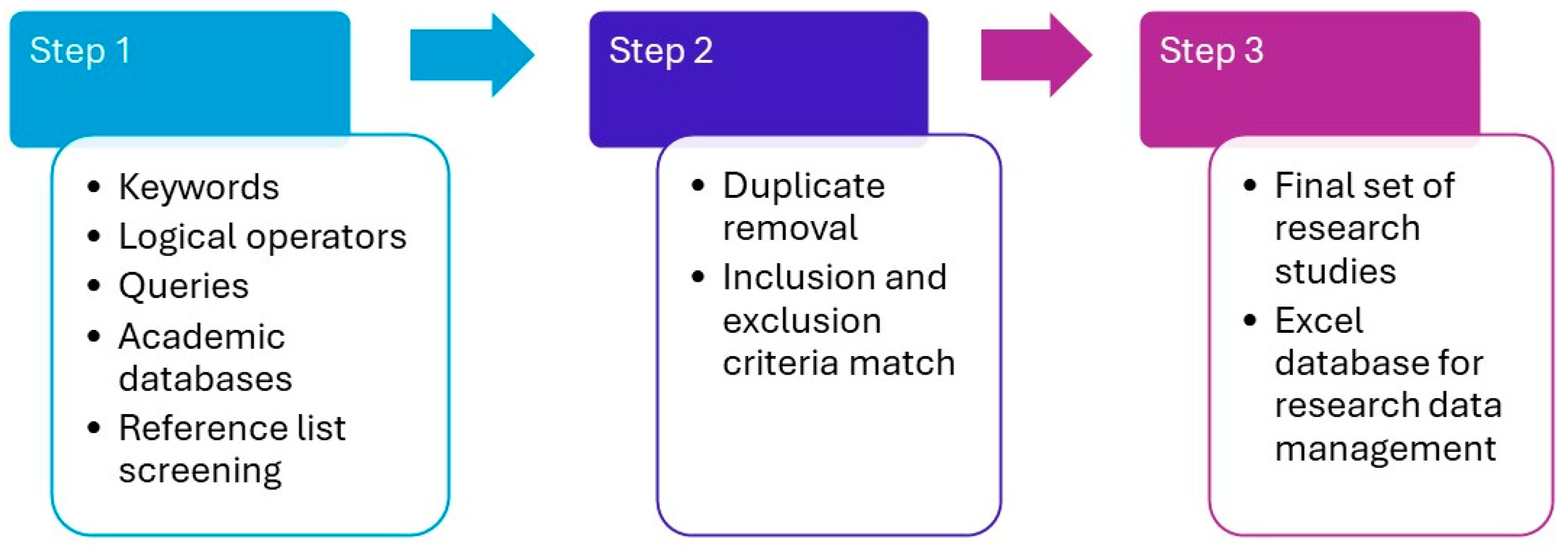
2.1. Searched Databases and Review Scope
2.2. Data Extraction Methodology
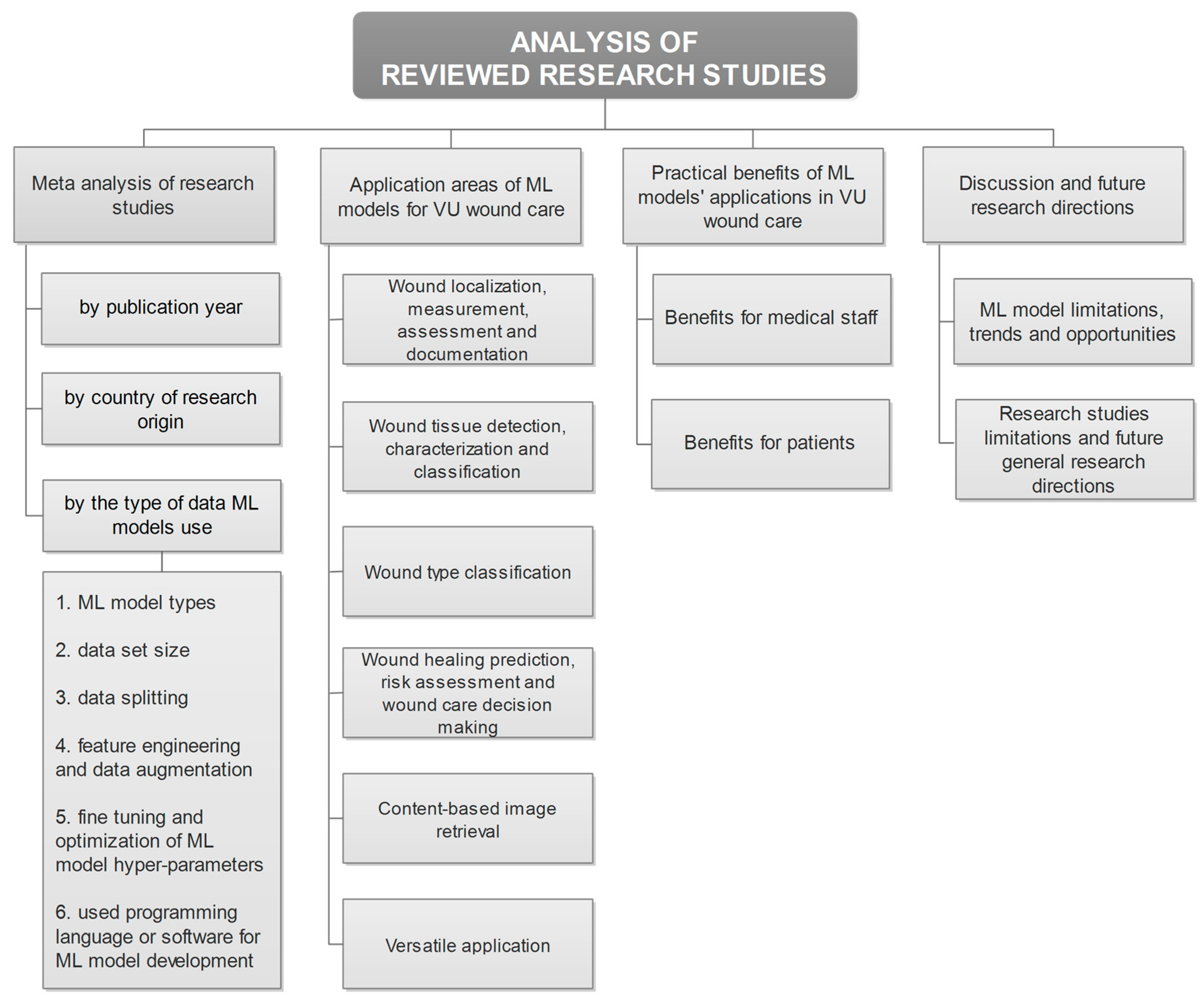
3. Analysis of Results
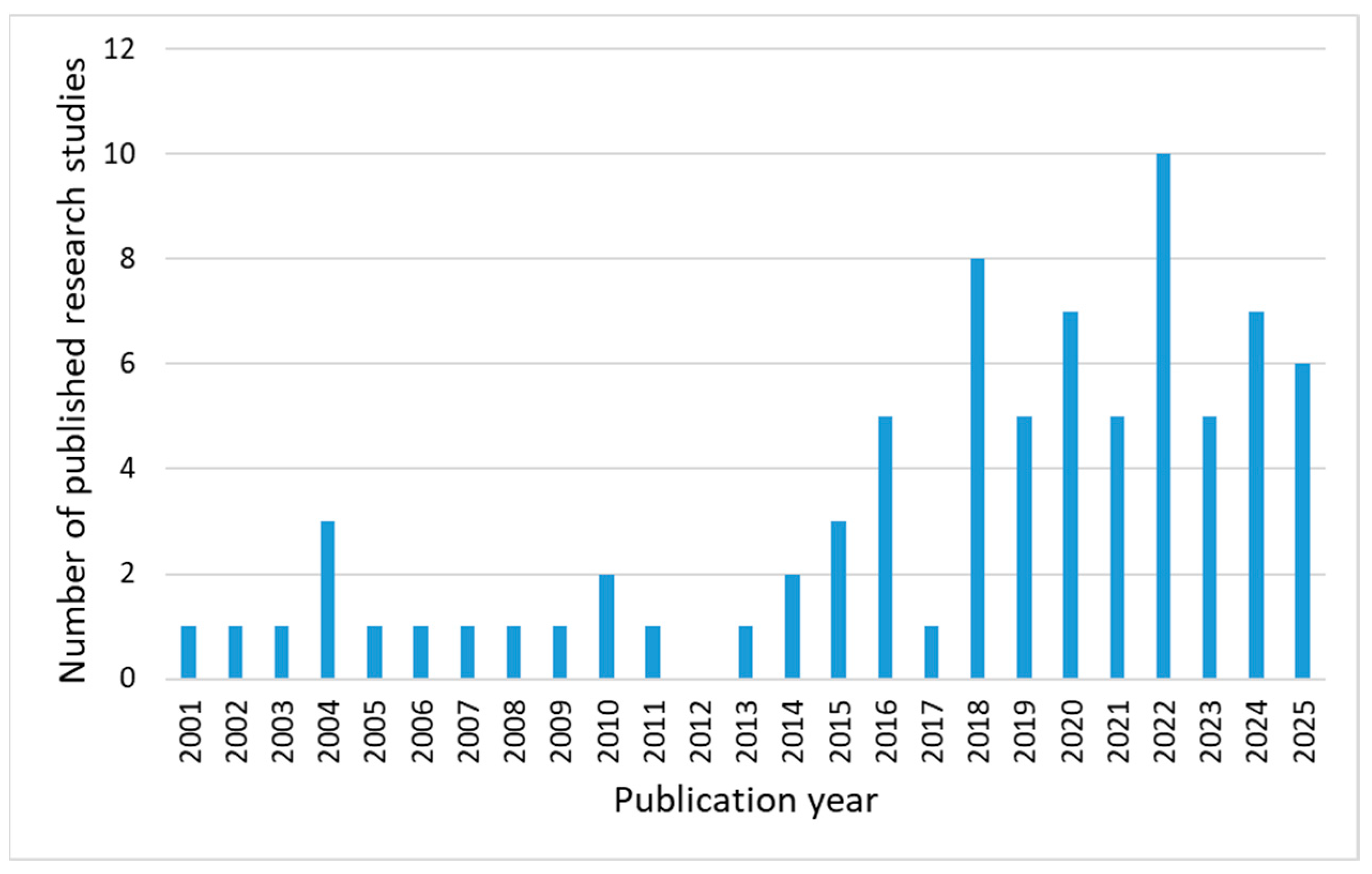
3.1. Meta-Analysis by Publication Year
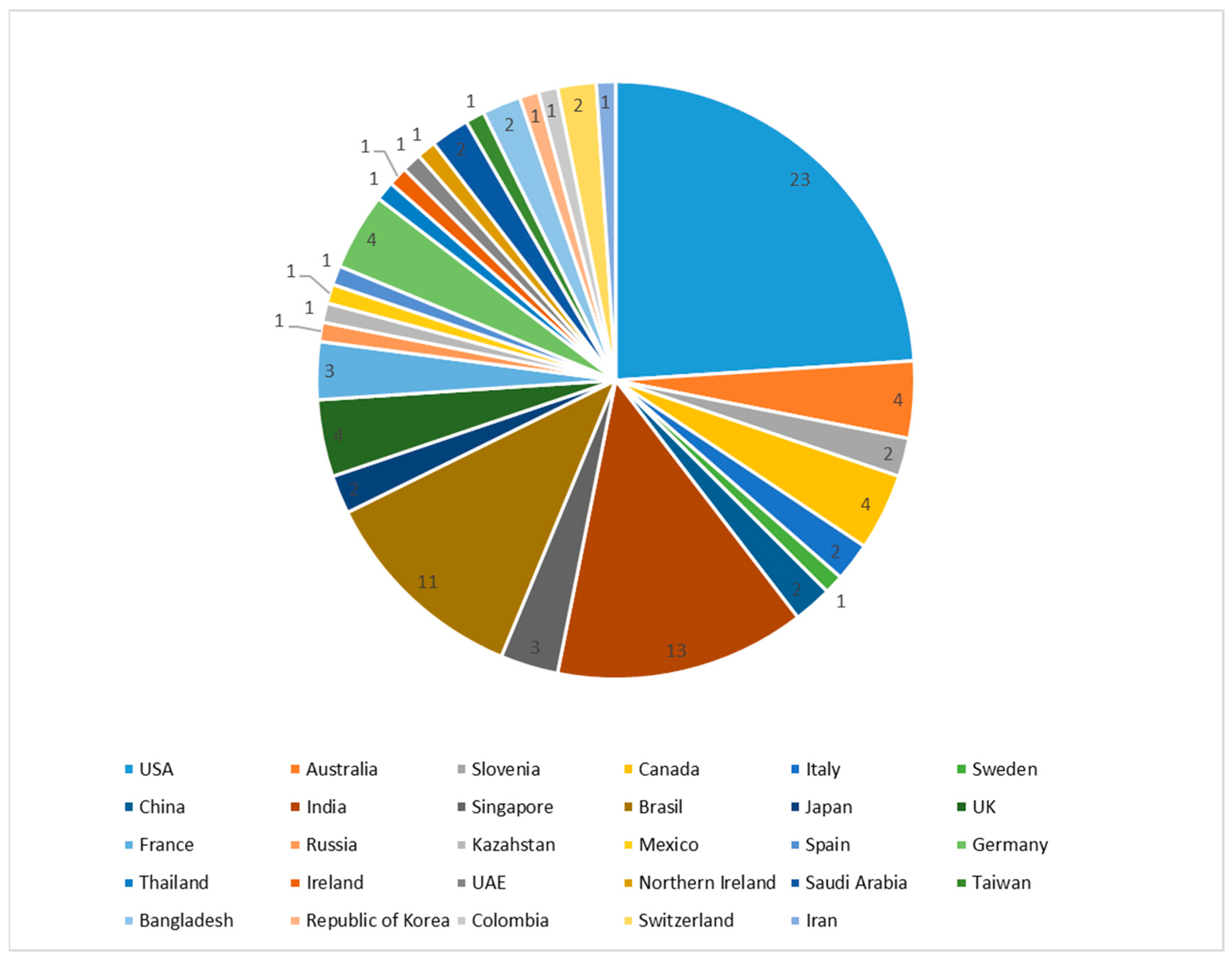
3.2. Meta-Analysis by Country of Research Origin
3.3. Meta-Analysis by the Type of Data ML Models Use
3.3.1. Data-Based ML Models
3.3.2. Image-Based ML Models
4. Application Areas of ML Models for VU Wound Care
4.1. Wound Localization, Measurement, Assessment, and Documentation
4.2. Wound Tissue Detection, Characterization, and Classification
4.3. Wound Type Classification
4.4. Wound Healing Prediction, Risk Assessment, and Wound Care Decision-Making
4.5. Content-Based Image Retrieval
4.6. Versatile Application
4.7. Benefits for Medical Staff and Patients
4.7.1. Benefits for Medical Staff and Healthcare Systems
4.7.2. Benefits for Patients
5. Discussion and Future Work
5.1. ML Model Limitations, Trends, and Opportunities
5.1.1. Limitations
5.1.2. Trends and Opportunities
5.2. Research Study Limitations and Future General Research Directions
5.2.1. Limitations
5.2.2. Future General Research Directions
6. Conclusions
Author Contributions
Funding
Institutional Review Board Statement
Informed Consent Statement
Data Availability Statement
Acknowledgments
Conflicts of Interest
Abbreviations
| AD | AdaBoost model |
| AI | Artificial intelligence |
| ANN | Artificial neural network |
| AU | Arterial ulcer |
| AUC | Area under the receiver operating characteristic curve |
| AW | Acute wounds |
| BNN | Bayesian neural network |
| BoVW | Bag-of-visual-words |
| CBIR | Content-based image retrieval |
| CBR | Case-based reasoning |
| cGAN | Conditional generative adversarial network |
| CNN | Convolutional neural network |
| CNR | Contrast-to-noise ratio |
| CPHM | Cox proportional hazards models |
| CT | Classification tree |
| CW | Chronic wounds |
| DC | Dice coefficient |
| DeiT | Data-efficient image transformers |
| DFU | Diabetic foot ulcer |
| DT | Decision tree |
| DTa | Decision table |
| DWH | Delayed wound healing |
| ELM | Extreme learning machine |
| EMR | Electronic medical record |
| FCN | Fully convolutional network |
| GAN | Generative adversarial network |
| GBDT | Gradient-boosted decision tree |
| GBT | Gradient boosted trees |
| GLM | General linear model |
| GMRNN | Gaussian mixture recurrent neural network |
| GPR | Gaussian process regression |
| HAN | Hierarchical attention network |
| HCI | Harrell’s concordance index (C-index) |
| HP | Healing prediction |
| ID | Infection detection |
| IoU | Intersection over union |
| JC | Jaccard coefficient |
| KNN | K-nearest neighbors |
| LR | Logistic regression |
| LSTM | Long short-term memory |
| MAE | Mean absolute error |
| MAP | Mean average precision |
| MCC | Matthew’s correlation coefficient |
| mIoU | Mean intersection over union |
| ML | Machine learning |
| NB | Naïve Bayes |
| NPV | Negative predictive value |
| POC | Point of care |
| PPV | Positive predictive value |
| PU | Pressure ulcer |
| QDA | Quadratic discriminant analysis |
| R-CNN | Region-based CNN |
| RE | Relative error |
| RF | Random forest |
| RPE | Relative percentage error |
| RT | Regression tree |
| SE | Sensitivity |
| SP | Specificity |
| SSD | Single-shot multibox detector |
| SU | Surgical ulcer |
| SVM | Support vector machine |
| SW | Surgical wounds |
| TF | Telemedicine framework |
| TPR | Treatment plan recommendation |
| TU | Toe ulcer |
| ViT | Visual transformers |
| VU | Venous ulcers |
| WA | Wound assessment |
| WC | Wound characterization |
| WCD | Wound care decision |
| WD | Wound documentation |
| WHA | Wound healing assessment |
| WHP | Wound healing prediction |
| WL | Wound localization |
| WM | Wound measurement |
| WRS | Wound risk stratification |
| WS | Wound segmentation |
| WSP | Wound stage prediction |
| WTC | Wound tissue classification |
| WTC | Wound type classification |
References
- Lee, J.W.; You, H.J.; Cha, J.H.; Lee, T.Y.; Kim, D.W. VGG19 demonstrates the highest accuracy rate in a nine-class wound classification task among various deep learning networks: A pilot study. Wounds 2024, 36, 8–14. [Google Scholar] [CrossRef]
- Khalil, A.; Elmogy, M.; Ghazal, M.; Burns, C.; El-Baz, A.A. Chronic wound healing assessment system based on different features modalities and non-negative matrix factorization (NMF) feature reduction. IEEE Access 2019, 7, 80110–80121. [Google Scholar] [CrossRef]
- Le, D.T.P.; Pham, T.D. Unveiling the role of artificial intelligence for wound assessment and wound healing prediction. Explor. Med. 2023, 4, 589–611. [Google Scholar] [CrossRef]
- Foomani, F.H.; Anisuzzaman, D.M.; Niezgoda, J.; Niezgoda, J.; Guns, W.; Gopalakrishnan, S.; Yu, Z. Synthesizing time-series wound prognosis factors from electronic medical records using generative adversarial networks. J. Biomed. Inform. 2022, 125, 103972. [Google Scholar] [CrossRef]
- Cho, S.K.; Mattke, S.; Gordon, H.; Sheridan, M.; Ennis, W. Development of a model to predict healing of chronic wounds within 12 weeks. Adv. Wound Care 2020, 9, 516–524. [Google Scholar] [CrossRef] [PubMed]
- Berezo, M.; Budman, J.; Deutscher, D.; Hess, C.T.; Smith, K.; Hayes, D. Predicting chronic wound healing time using machine learning. Adv. Wound Care 2022, 11, 281–296. [Google Scholar] [CrossRef]
- Reifs, D.; Casanova-Lozano, L.; Reig-Bolaño, R.; Grau-Carrion, S. Clinical validation of computer vision and artificial intelligence algorithms for wound measurement and tissue classification in wound care. Inform. Med. Unlocked 2023, 37, 101185. [Google Scholar] [CrossRef]
- Ngo, Q.C.; Ogrin, R.; Kumar, D.K. Computerised prediction of healing for venous leg ulcers. Sci. Rep. 2022, 12, 17962. [Google Scholar] [CrossRef] [PubMed]
- Margolis, D.J.; Allen-Taylor, L.; Hoffstad, O.; Berlin, J.A. The accuracy of venous leg ulcer prognostic models in a wound care system. Wound Repair Regen. 2004, 12, 163–168. [Google Scholar] [CrossRef]
- Salomé, G.M.; Ferreira, L.M. The impact of decongestive physical therapy and elastic bandaging on the control of pain in patients with venous ulcers. Rev. Colégio Bras. Cir. 2018, 45, e1385. [Google Scholar] [CrossRef]
- Anusha, D.N.; Bhavani, R.R. Classification of varicose ulcer tissue images. Adv. Nat. Appl. Sci. 2016, 10, 227–232. [Google Scholar]
- Rajathi, V.; Chinnasamy, A.; Selvakumari, P. DUTC Net: A novel deep ulcer tissue classification network with stage prediction and treatment plan recommendation. Biomed. Signal Process. Control 2024, 90, 105855. [Google Scholar] [CrossRef]
- Ajitha, K. SVM vs. KNN for Classification of histopathological images of varicose ulcer. Adv. Eng. Int. J. 2020, 3, 19–28. [Google Scholar]
- Bhavani, R.R.; Wiselin Jiji, G. Image registration for varicose ulcer classification using KNN classifier. Int. J. Comput. Appl. 2017, 40, 88–97. [Google Scholar] [CrossRef]
- Chan, K.S.; Liang, S.; Cho, Y.T.; Chan, Y.M.; Tan, A.H.M.; Muthuveerappa, S.; Lai, T.P.; Goh, C.C.; Joseph, A.; Hong, Q.; et al. Clinical validation of a machine-learning-based handheld 3-dimensional infrared wound imaging device in venous leg ulcers. Int. Wound J. 2022, 19, 436–446. [Google Scholar] [CrossRef] [PubMed]
- Taylor, R.J.; Taylor, A.D.; Smyth, J.V. Using an artificial neural network to predict healing times and risk factors for venous leg ulcers. J. Wound Care 2002, 11, 101–105. [Google Scholar] [CrossRef]
- Bui, U.T.; Finlayson, K.; Edwards, H. Risk factors for infection in patients with chronic leg ulcers: A survival analysis. Int. J. Clin. Pract. 2018, 72, e13263. [Google Scholar] [CrossRef]
- Michael, J.E.; Maier, M. Lower extremity ulcers. Vasc. Med. 2016, 21, 174–176. [Google Scholar] [CrossRef]
- Salenius, J.E.; Suntila, M.; Ahti, T.; Huhtala, H.; Vaalasti, A.; Salmi, T.T.; Kimpimäki, T. Long-term mortality among patients with chronic ulcers. Acta Derm. Venereol. 2021, 101, adv00455. [Google Scholar] [CrossRef]
- Olin, J.W.; Beusterien, K.M.; Childs, M.B.; Seavey, C.; McHugh, L.; Griffiths, R.I. Medical costs of treating venous stasis ulcers: Evidence from a retrospective cohort study. Vasc. Med. 1999, 4, 1–7. [Google Scholar] [CrossRef] [PubMed]
- Curti, N.; Merli, Y.; Zengarini, C.; Starace, M.; Rapparini, L.; Marcelli, E.; Carlini, G.; Buschi, D.; Castellani, G.C.; Piraccini, B.M.; et al. Automated prediction of photographic wound assessment tool in chronic wound images. J. Med. Syst. 2024, 48, 14. [Google Scholar] [CrossRef] [PubMed]
- Barakat-Johnson, M.; Jones, A.; Burger, M.; Leong, T.; Frotjold, A.; Randall, S.; Kim, B.; Fethney, J.; Coyer, F. Reshaping wound care: Evaluation of an artificial intelligence app to improve wound assessment and management amid the COVID-19 pandemic. Int. Wound J. 2022, 19, 1561–1577. [Google Scholar] [CrossRef] [PubMed]
- Kolasa, K.; Admassu, B.; Hołownia-Voloskova, M.; Kędzior, K.J.; Poirrier, J.E.; Perni, S. Systematic reviews of machine learning in healthcare: A literature review. Expert Rev. Pharmacoecon. Outcomes Res. 2024, 24, 63–115. [Google Scholar] [CrossRef]
- Frasca, M.; La Torre, D.; Pravettoni, G.; Cutica, I. Explainable and interpretable artificial intelligence in medicine: A systematic bibliometric review. Discov. Artif. Intell. 2024, 4, 15. [Google Scholar] [CrossRef]
- Thomsen, K.; Iversen, L.; Titlestad, T.L.; Winther, O. Systematic review of machine learning for diagnosis and prognosis in dermatology. J. Dermatolog. Treat. 2020, 31, 496–510. [Google Scholar] [CrossRef]
- Schaarup, C.; Pape-Haugaard, L.B.; Hejlesen, O.K. Models used in clinical decision support systems supporting healthcare professionals treating chronic wounds: Systematic literature review. JMIR Diabetes 2018, 3, e11. [Google Scholar] [CrossRef]
- Chen, M.Y.; Cao, M.Q.; Xu, T.Y. Progress in the application of artificial intelligence in skin wound assessment and prediction of healing time. Am. J. Transl. Res. 2024, 16, 2765–2776. [Google Scholar] [CrossRef]
- Reifs Jiménez, D.; Casanova-Lozano, L.; Grau-Carrión, S.; Reig-Bolaño, R. Artificial intelligence methods for diagnostic and decision-making assistance in chronic wounds: A systematic review. J. Med. Syst. 2025, 19, 29. [Google Scholar] [CrossRef]
- Pugalenthi, L.S.; Garapati, C.; Maddukuri, S.; Kanwal, F.; Kumar, J.; Asadimanesh, N.; Dadwal, S.; Ahluwalia, V.; Senapati, S.G.; Arunachalam, S.P. From data to decisions: AI in varicose veins—Predicting, diagnosing, and guiding effective management. J. Vasc. Dis. 2025, 4, 19. [Google Scholar] [CrossRef]
- Ahmed, A.; Xi, R.; Hou, M.; Shah, S.A.; Hameed, S. Harnessing big data analytics for healthcare: A comprehensive review of frameworks, implications, applications, and impacts. IEEE Access 2023, 11, 112891–112928. [Google Scholar] [CrossRef]
- Anisuzzaman, D.M.; Patel, Y.; Rostami, B.; Niezgoda, J.; Gopalakrishnan, S.; Yu, Z. Multi-modal wound classification using wound image and location by deep neural network. Sci. Rep. 2022, 12, 20057. [Google Scholar] [CrossRef]
- Cukjati, D.; Robnik-Šikonja, M.; Reberšek, S.; Kononenko, I.; Miklavčič, D. Prognostic factors in the prediction of chronic wound healing by electrical stimulation. Med. Biol. Eng. Comput. 2001, 39, 542–550. [Google Scholar] [CrossRef]
- Robnik-Šikonja, M.; Cukjati, D.; Kononenko, I. Comprehensible evaluation of prognostic factors and prediction of wound healing. Artif. Intell. Med. 2003, 29, 25–38. [Google Scholar] [CrossRef] [PubMed]
- Jung, K.; Covington, S.; Sen, C.K.; Januszyk, M.; Kirsner, R.S.; Gurtner, G.C.; Shah, N.H. Rapid identification of slow healing wounds. Wound Repair Regen. 2016, 24, 181–188. [Google Scholar] [CrossRef] [PubMed]
- Fife, C.E.; Horn, S.D. The wound healing index for predicting venous leg ulcer outcome. Adv. Wound Care 2020, 9, 68–77. [Google Scholar] [CrossRef] [PubMed]
- Kurd, S.K.; Hoffstad, O.J.; Bilker, W.B.; Margolis, D.J. Evaluation of the use of prognostic information for the care of individuals with venous leg ulcers or diabetic neuropathic foot ulcers. Wound Repair Regen. 2009, 17, 318–325. [Google Scholar] [CrossRef]
- Wu, J.; Chen, X.Y.; Zhang, H.; Xiong, L.D.; Lei, H.; Deng, S.H. Hyperparameter optimization for machine learning models based on Bayesian optimization. J. Electron. Sci. Technol. 2019, 17, 26–40. [Google Scholar] [CrossRef]
- Chino, D.Y.T.; Scabora, L.C.; Cazzolato, M.T.; Jorge, A.E.S.; Traina, C., Jr.; Traina, A.J.M. ICARUS: Retrieving skin ulcer images through bag-of-signatures. In Proceedings of the 2018 IEEE 31st International Symposium on Computer-Based Medical Systems, Karlstad, Sweden, 18–21 June 2018. [Google Scholar] [CrossRef]
- Blanco, G.; Traina, A.J.M.; Traina, C., Jr.; Azevedo-Marques, P.M.; Jorge, A.E.S.; de Oliveira, D.; Bedo, M.V.N. A superpixel-driven deep learning approach for the analysis of dermatological wounds. Comput. Methods Programs Biomed. 2020, 183, 105079. [Google Scholar] [CrossRef]
- Gupta, R.; Goldstone, L.; Eisen, S.; Ramachandram, D.; Cassata, A.; Fraser, R.D.J.; Ramirez-GarciaLuna, J.L.; Bartlett, R.; Allport, J. Towards an AI-based objective prognostic model for quantifying wound healing. IEEE J. Biomed. Health Inform. 2024, 28, 666–677. [Google Scholar] [CrossRef]
- Ramachandram, D.; Ramirez-GarciaLuna, J.L.; Fraser, R.D.J.; Martínez-Jiménez, M.A.; Arriaga-Caballero, J.E.; Allport, J. Fully automated wound tissue segmentation using deep learning on mobile devices: Cohort study. JMIR mHealth uHealth 2022, 10, e36977. [Google Scholar] [CrossRef]
- Lu, H.; Li, B.; Zhu, J.; Li, Y.; Li, Y.; Xu, X.; He, L.; Li, X.; Li, J.; Serikawa, S. Wound intensity correction and segmentation with convolutional neural networks. Concurr. Computat. Pract. Exper. 2017, 29, e3927. [Google Scholar] [CrossRef]
- Galushka, M.; Zheng, H.; Patterson, D.; Bradley, L. Case-based tissue classification for monitoring leg ulcer healing. In Proceedings of the 18th IEEE Symposium on Computer-Based Medical Systems (CBMS’05), Dublin, Ireland, 23–24 June 2005. [Google Scholar]
- Patel, Y.; Shah, T.; Dhar, M.K.; Zhang, T.; Niezgoda, J.; Gopalakrishnan, S.; Yu, Z. Integrated image and location analysis for wound classification: A deep learning approach. Sci. Rep. 2024, 14, 7043. [Google Scholar] [CrossRef]
- Rostami, B.; Anisuzzaman, D.M.; Wang, C.; Gopalakrishnan, S.; Niezgoda, J.; Yu, Z. Multiclass wound image classification using an ensemble deep CNN-based classifier. Comput. Biol. Med. 2021, 134, 104536. [Google Scholar] [CrossRef] [PubMed]
- Godeiro, V.; Neto, J.S.; Carvalho, B.; Santana, B.; Ferraz, J.; Gama, R. Chronic wound tissue classification using convolutional networks and color space reduction. In Proceedings of the 2018 IEEE International Workshop on Machine Learning for Signal Processing, Aalborg, Denmark, 17–20 September 2018. [Google Scholar] [CrossRef]
- Lo, Z.J.; Mak, M.H.W.; Liang, S.; Chan, Y.M.; Goh, C.C.; Lai, T.; Tan, A.; Thng, P.; Rodriguez, J.; Weyde, T.; et al. Development of an explainable artificial intelligence model for Asian vascular wound images. Int. Wound J. 2024, 21, e14565. [Google Scholar] [CrossRef]
- Howell, R.S.; Liu, H.H.; Khan, A.A.; Woods, J.S.; Lin, L.J.; Saxena, M.; Saxena, H.; Castellano, M.; Petrone, P.; Slone, E.; et al. Development of a method for clinical evaluation of artificial intelligence-based digital wound assessment tools. JAMA Netw. Open 2021, 4, e217234. [Google Scholar] [CrossRef]
- Chino, D.Y.T.; Scabora, L.C.; Cazzolato, M.T.; Jorge, A.E.S.; Traina, C., Jr.; Traina, A.J.M. Segmenting skin ulcers and measuring the wound area using deep convolutional networks. Comput. Methods Programs Biomed. 2020, 191, 105376. [Google Scholar] [CrossRef] [PubMed]
- Ohura, N.; Mitsuno, R.; Sakisaka, M.; Terabe, Y.; Morishige, Y.; Uchiyama, A.; Okoshi, T.; Shinji, I.; Takushima, A. Convolutional neural networks for wound detection: The role of artificial intelligence in wound care. J. Wound Care 2019, 28, S13–S24. [Google Scholar] [CrossRef]
- Anisuzzaman, D.M.; Patel, Y.; Niezgoda, J.A.; Gopalakrishnan, S.; Yu, Z. A mobile app for wound localization using deep learning. IEEE Access 2022, 10, 61398–61409. [Google Scholar] [CrossRef]
- Kolesnik, M.; Fexa, A. Segmentation of wounds in the combined color-texture feature space. In Proceedings of the SPIE 5370, Medical Imaging 2004: Image Processing, San Diego, CA, USA, 12 May 2004. [Google Scholar] [CrossRef]
- Kolesnik, M.; Fexa, A. How robust is the SVM wound segmentation? In Proceedings of the 7th Nordic Signal Processing Symposium—NORSIG 2006, Reykjavik, Iceland, 7–9 June 2006. [Google Scholar] [CrossRef]
- Curti, N.; Merli, Y.; Zengarini, C.; Giampieri, E.; Merlotti, A.; Dall’Olio, D.; Marcelli, E.; Bianchi, T.; Castellani, G. Effectiveness of semi-supervised active learning in automated wound image segmentation. Int. J. Mol. Sci. 2022, 24, 706. [Google Scholar] [CrossRef]
- Yadav, M.K.; Manohar, D.D.; Mukherjee, G.; Chakraborty, C. Segmentation of chronic wound areas by clustering techniques using selected color space. J. Med. Imaging Health Inform. 2013, 3, 22–29. [Google Scholar] [CrossRef]
- Silva, W.S.; Jasbick, D.L.; Wilson, R.E.; Azevedo-Marques, P.M.; Traina, A.J.M.; Santos, L.F.D.; Jorge, A.E.S.; de Oliveira, D.; Bedo, M.V.N. A two-phase learning approach for the segmentation of dermatological wounds. In Proceedings of the 2019 IEEE 32nd International Symposium on Computer-Based Medical Systems (CBMS), Cordoba, Spain, 5–7 June 2019. [Google Scholar] [CrossRef]
- Maity, M.; Dhane, D.; Bar, C.; Chakraborty, C.; Chatterjee, J. Assessment of segmentation techniques for chronic wound surface area detection. In Advanced Computational and Communication Paradigms, Advances in Intelligent Systems and Computing; Bhattacharyya, S., Chaki, N., Konar, D., Chakraborty, U., Singh, C., Eds.; Springer: Singapore, 2018; Volume 706, pp. 707–716. [Google Scholar] [CrossRef]
- Dhane, D.M.; Krishna, V.; Achar, A.; Bar, C.; Sanyal, K.; Chakraborty, C. Spectral clustering for unsupervised segmentation of lower extremity wound beds using optical images. J. Med. Syst. 2016, 40, 207. [Google Scholar] [CrossRef]
- Seixas, J.L., Jr.; Barbon, S., Jr.; Mantovani, R.G. Pattern recognition of lower member skin ulcers in medical images with Machine Learning Algorithms. In Proceedings of the 2015 IEEE 28th International Symposium on Computer-Based Medical Systems, Sao Carlos, Brazil, 22–25 June 2015. [Google Scholar] [CrossRef]
- Liu, Z.; Agu, E.; Pedersen, P.; Lindsay, C.; Tulu, B.; Strong, D. Chronic wound image augmentation and assessment using semi-supervised progressive multi-granularity EfficientNet. IEEE Open J. Eng. Med. Biol. 2023, 5, 404–420. [Google Scholar] [CrossRef]
- Liu, Z.; Agu, E.; Pedersen, P.; Lindsay, C.; Tulu, B.; Strong, D. Comprehensive assessment of fine-grained wound images using a patch-based CNN with context-preserving attention. IEEE Open J. Eng. Med. Biol. 2021, 2, 224–234. [Google Scholar] [CrossRef]
- Monroy, B.; Bacca, J.; Sanchez, K.; Arguello, H.; Castillo, S. Two-step deep learning framework for chronic wounds detection and segmentation: A case study in Colombia. In Proceedings of the 2021 XXIII Symposium on Image, Signal Processing and Artificial Vision, STSIVA 2021, Cartagena, Colombia, 15–17 September 2021. [Google Scholar] [CrossRef]
- Shi, Q.; Chen, W.; Pan, Y.; Yin, S.; Fu, Y.; Mei, J.; Xue, Z. An automatic classification method on chronic venous insufficiency images. Sci. Rep. 2018, 8, 17952. [Google Scholar] [CrossRef]
- Barulina, M.; Sanbaev, A.; Okunkov, S.; Ulitin, I.; Okoneshnikov, I. Deep learning approaches to automatic chronic venous disease classification. Mathematics 2022, 10, 3571. [Google Scholar] [CrossRef]
- Stefanelli, A.; Zahia, S.; Chanel, G.; Niri, R.; Pichon, S.; Probst, S. Developing an AI-powered wound assessment tool: A methodological approach to data collection and model optimization. BMC Med. Inform. Decis. Mak. 2025, 25, 297. [Google Scholar] [CrossRef] [PubMed]
- Niri, R.; Zahia, S.; Stefanelli, A.; Sharma, K.; Probst, S.; Pichon, S.; Chanel, G. Wound segmentation with U-Net using a dual attention mechanism and transfer learning. J. Imaging Inform. Med. 2025, 38, 3351–3365. [Google Scholar] [CrossRef] [PubMed]
- Mukherjee, R.; Manohar, D.D.; Das, D.K.; Achar, A.; Mitra, A.; Chakraborty, C. Automated tissue classification framework for reproducible chronic wound assessment. BioMed Res. Int. 2014, 2014, 851582. [Google Scholar] [CrossRef]
- Antunović, A.; Nyarko, E.K.; Filko, D. Wound tissue classification: A comparative analysis of deep neural network models. In Proceedings of the 2024 International Conference on Smart Systems and Technologies (SST), Osijek, Croatia, 16–18 October 2024. [Google Scholar] [CrossRef]
- Rajathi, V.; Bhavani, R.R.; Wiselin Jiji, G. Varicose ulcer(C6) wound image tissue classification using multidimensional convolutional neural networks. Imaging Sci. J. 2019, 67, 374–384. [Google Scholar] [CrossRef]
- Wannous, H.; Lucas, Y.; Treuillet, S. Enhanced assessment of the wound-healing process by accurate multiview tissue classification. IEEE Trans. Med. Imaging 2011, 30, 315–326. [Google Scholar] [CrossRef]
- Jaslin, A.M. Tissue classification of varicose ulcer based on features using an efficient CSVM classifier. Int. J. Emerg. Technol. Comput. Sci. Electron. 2018, 25, 116–121. [Google Scholar]
- Chakraborty, C. Computational approach for chronic wound tissue characterization. Inform. Med. Unlocked 2019, 17, 100162. [Google Scholar] [CrossRef]
- Nejati, H.; Ghazijahani, H.A.; Abdollahzadeh, M.; Malekzadeh, T.; Cheung, N.M.; Lee, K.H.; Low, L.L. Fine-grained wound tissue analysis using deep neural network. In Proceedings of the 2018 IEEE International Conference on Acoustics, Speech and Signal Processing (ICASSP), Calgary, AB, Canada, 15–20 April 2018. [Google Scholar]
- Pereira, S.M.; Frade, M.A.C.; Rangayyan, R.M.; de Azevedo Marques, P.M. Classification of dermatological ulcers based on tissue composition and color texture features. In Proceedings of the 4th International Symposium on Applied Sciences in Biomedical and Communication Technologies (ISABEL ’11), Barcelona, Spain, 26–29 October 2011. [Google Scholar] [CrossRef]
- Bedo, M.V.N.; Santos, L.F.D.; Oliveira, W.D.; Blanco, G.; Traina, A.J.M.; Frade, M.A.C.; Azevedo-Marques, P.M.; Traina, C., Jr. Color and texture influence on computer-aided diagnosis of dermatological ulcers. In Proceedings of the 2015 IEEE 28th International Symposium on Computer-Based Medical Systems, Sao Carlos, Brazil, 22–25 June 2015. [Google Scholar] [CrossRef]
- Zheng, H.; Bradley, L.; Patterson, D.; Galushka, M.; Winder, J. New protocol for leg ulcer tissue classification from colour images. In Proceedings of the 26th Annual International Conference of the IEEE Engineering in Medicine and Biology Society, San Francisco, CA, USA, 1–5 September 2004. [Google Scholar] [CrossRef]
- Wannous, H.; Treuillet, S.; Lucas, Y. Supervised tissue classification from color images for a complete wound assessment tool. In Proceedings of the 2007 29th Annual International Conference of the IEEE Engineering in Medicine and Biology Society, Lyon, France, 23–26 August 2007. [Google Scholar] [CrossRef]
- Wannous, H.; Treuillet, S.; Lucas, Y. Robust tissue classification for reproducible wound assessment in telemedicine environments. J. Electron. Imaging 2010, 19, 023002. [Google Scholar] [CrossRef]
- Sarp, S.; Kuzlu, M.; Pipattanasomporn, M.; Guler, O. Simultaneous wound border segmentation and tissue classification using a conditional generative adversarial network. J. Eng. 2021, 2021, 125–134. [Google Scholar] [CrossRef]
- Kabir, M.A.; Roy, N.; Hossain, M.E.; Featherston, J.; Ahmed, S. Deep learning for wound tissue segmentation: A comprehensive evaluation using a novel dataset. arXiv 2025, arXiv:2502.10652. [Google Scholar] [CrossRef]
- Aguirre Nilsson, C.; Velic, M. Classification of Ulcer Images Using Convolutional Neural Networks. Master’s Thesis, Chalmers University of Technology, Gothenburg, Sweden, June 2018. [Google Scholar]
- Huang, P.H.; Pan, Y.H.; Luo, Y.S.; Chen, Y.F.; Lo, Y.C.; Chen, T.P.; Perng, C.K. Development of a deep learning-based tool to assist wound classification. J. Plast. Reconstr. Aesthet. Surg. 2023, 79, 89–97. [Google Scholar] [CrossRef]
- Jahangir, M.Z.B.; Akter, S.; Nasim, M.A.A.; Gupta, K.D.; George, R. Deep learning for automated wound classification and segmentation. arXiv 2024, arXiv:2408.11064. [Google Scholar] [CrossRef]
- Malihi, L.; Hüsers, J.; Richter, M.L.; Moelleken, M.; Przysucha, M.; Busch, D.; Heggemann, J.; Hafer, G.; Wiemeyer, S.; Heidemann, G.; et al. Automatic wound type classification with convolutional neural networks. Stud. Health Technol. Inform. 2022, 295, 281–284. [Google Scholar] [CrossRef]
- Neuwieser, H.; Jami, N.V.S.J.; Meier, R.J.; Liebsch, G.; Felthaus, O.; Klein, S.; Schreml, S.; Berneburg, M.; Prantl, L.; Leutheuser, H.; et al. Interpreting venous and arterial ulcer images through the Grad-CAM lens: Insights and implications in CNN-based wound image classification. Diagnostics 2025, 15, 2184. [Google Scholar] [CrossRef]
- Mousa, R.; Matbooe, E.; Khojasteh, H.; Bengari, A.; Vahediahmar, M. Multi-modal wound classification using wound image and location by Xception and Gaussian Mixture Recurrent Neural Network (GMRNN). arXiv 2025, arXiv:2505.08086. [Google Scholar] [CrossRef]
- Ullah, S.; Javed, A.; Aljasem, M.; Saudagar, A.K.J. Eff-ReLU-Net: A deep learning framework for multiclass wound classification. BMC Med. Imaging 2025, 25, 257. [Google Scholar] [CrossRef] [PubMed]
- Mombini, H.; Tulu, B.; Strong, D.; Agu, E.; Nguyen, H.; Lindsay, C.; Loretz, L.; Pedersen, P.; Dunn, R. Design of a machine learning system for prediction of chronic wound management decisions. In Designing for Digital Transformation, Co-Creating Services with Citizens and Industry, DESRIST 2020, Lecture Notes in Computer Science; Hofmann, S., Müller, O., Rossi, M., Eds.; Springer: Cham, Switzerland, 2020; Volume 12388, pp. 15–27. [Google Scholar] [CrossRef]
- Nguyen, H.; Agu, E.; Tulu, B.; Strong, D.; Mombini, H.; Pedersen, P.; Lindsay, C.; Dunn, R.; Loretz, L. Machine learning models for synthesizing actionable care decisions on lower extremity wounds. Smart Health 2020, 18, 100139. [Google Scholar] [CrossRef] [PubMed]
- Estrela, V.V.; Herrmann, A.E. Content-Based Image Retrieval (CBIR) in Remote Clinical Diagnosis and Healthcare. In Encyclopedia of E-Health and Telemedicine; Cruz-Cunha, M.M., Miranda, I.M., Martinho, R., Rijo, R., Eds.; IGI Global Scientific Publishing: Hershey, PA, USA, 2016; Volume I, pp. 495–520. [Google Scholar] [CrossRef]
- Müller, H.; Michoux, N.; Bandon, D.; Geissbuhler, A. A review of content-based image retrieval systems in medical applications-clinical benefits and future directions. Int. J. Med. Inform. 2004, 73, 1–23. [Google Scholar] [CrossRef]
- Dorileo, E.A.; Frade, M.A.; Roselino, A.M.; Rangayyan, R.M.; Azevedo-Marques, P.M. Color image processing and content-based image retrieval techniques for the analysis of dermatological lesions. In Proceedings of the 2008 30th Annual International Conference of the IEEE Engineering in Medicine and Biology Society (EMBS 2008), Vancouver, BC, Canada, 20–24 August 2008. [Google Scholar] [CrossRef]
- Pereyra, L.C.; Pereira, S.M.; Souza, J.P.; Frade, M.A.C.; Rangayyan, R.M.; Azevedo-Marques, P.M. Characterization and pattern recognition of color images of dermatological ulcers: A pilot study. Comput. Sci. J. Mold. 2014, 22, 211–235. [Google Scholar]
- Blanco, G.; Bedo, M.V.N.; Cazzolato, M.T.; Santos, L.F.D.; Jorge, A.E.S.; Traina, C., Jr.; Azevedo-Marques, P.M.; Traina, A.J.M. A label-scaled similarity measure for content-based image retrieval. In Proceedings of the 2016 IEEE International Symposium on Multimedia (ISM), San Jose, CA, USA, 11–13 December 2016. [Google Scholar] [CrossRef]
- Jaganathan, Y.; Sanober, S.; Aldossary, S.M.A.; Aldosari, H. Validating wound severity assessment via region-anchored convolutional neural network model for mobile image-based size and tissue classification. Diagnostics 2023, 13, 2866. [Google Scholar] [CrossRef]
- Wang, C.; Yan, X.; Smith, M.; Kochhar, K.; Rubin, M.; Warren, S.M.; Wrobel, J.; Lee, H. A unified framework for automatic wound segmentation and analysis with deep convolutional neural networks. In Proceedings of the 2015 37th Annual International Conference of the IEEE Engineering in Medicine and Biology Society (EMBC 2015), Milan, Italy, 25–29 August 2015. [Google Scholar] [CrossRef]
- Chakraborty, C.; Gupta, B.; Ghosh, S.K.; Das, D.K.; Chakraborty, C. Telemedicine supported chronic wound tissue prediction using classification approaches. J. Med. Syst. 2016, 40, 68. [Google Scholar] [CrossRef]
- Li, F.; Wang, C.; Liu, X.; Peng, Y.; Jin, S. A composite model of wound segmentation based on traditional methods and deep neural networks. Comput. Intell. Neurosci. 2018, 2018, 4149103. [Google Scholar] [CrossRef]
- Quemy, A. Two-stage optimization for machine learning workflow. Inf. Syst. 2020, 92, 101483. [Google Scholar] [CrossRef]
- Subramani, B.; Veluchamy, M. Bilateral tone mapping scheme for color correction and contrast adjustment in nearly invisible medical images. Color Res. Appl. 2023, 48, 748–760. [Google Scholar] [CrossRef]
- Subramani, B.; Veluchamy, M.; Bhandari, A.K. Optimal fuzzy intensification system for contrast distorted medical images. IEEE Trans. Emerg. Top. Comp. Intell. 2023, 8, 992–1002. [Google Scholar] [CrossRef]
- Yang, H.; Ma, Y.; Khan, F.G.; Khan, A.; Ali, F.; AlZubi, A.A.; Zeng, H. Survey: Application and analysis of generative adversarial networks in medical images. Artif. Intell. Rev. 2024, 58, 39. [Google Scholar] [CrossRef]
- Zhao, C.; Guo, Y.; Li, L.; Yang, M. Non-invasive techniques for wound assessment: A comprehensive review. Int. Wound J. 2024, 21, e70109. [Google Scholar] [CrossRef] [PubMed]
- Palani, P.; Subramani, B.; Veluchamy, M. Adaptive degradation-aware medical image enhancement for multi-modal diagnostics. Biomed. Signal Process. Control 2026, 112, 108822. [Google Scholar] [CrossRef]
- Subramani, B.; Veluchamy, M. Contrast-Aware multiscale decomposition and noise suppression framework for reliable clinical measurements in degraded medical images. Measurement 2025, 257, 118746. [Google Scholar] [CrossRef]
- Cap, Q.H.; Fukuda, A.; Iyatomi, H. A practical framework for unsupervised structure preservation medical image enhancement. Biomed. Signal Process. Control 2025, 100, 106918. [Google Scholar] [CrossRef]
- Griffa, D.; Natale, A.; Merli, Y.; Starace, M.; Curti, N.; Mussi, M.; Castellani, G.; Melandri, D.; Piraccini, B.M.; Zengarini, C. Artificial intelligence in wound care: A narrative review of the currently available mobile apps for automatic ulcer segmentation. BioMedInformatics 2024, 4, 2321–2337. [Google Scholar] [CrossRef]
- Sirocchi, C.; Bogliolo, A.; Montagna, S. Medical-informed machine learning: Integrating prior knowledge into medical decision systems. BMC Med Inform. Decis. Mak. 2024, 24, 186. [Google Scholar] [CrossRef]



| Study | Wound Etiology | Dataset | Observation Period/Number of Patients | Publicly Available Data | Task | ML Models | Model Performance Measures | Software |
|---|---|---|---|---|---|---|---|---|
| [15] | VU | 222 images | 21 months/ 52 | No | WM | ML-based wound imaging device (WoundAide) | N/A | N/A |
| [21] | VU and other CW | 612 images | 31 months/ 474 | Yes | WA | CNN, LASSO regression | ρ | Python |
| [49] | VU and other CW | 446 images | 3 months/ 240 | No | WS, WM | CNN | JC, DC, precision, recall, RPE | Python |
| [50] | VU, DFU | 396 images | Not stated/ 440 | No | WS | CNN | AUC, DC, MCC, accuracy | Python |
| [51] | VU, DFU, PU | 1010 images (2 sources) | Not stated/ Not stated | Partially | WL | CNN (YOLOv3, SSD) | Precision, recall, DC, IoU, MAP | Python |
| [41] | VU, AU, PU | 469,000 images | Swift wound database | No | WS | CNN | mIoU, precision, recall, DC, SE, SP | Not stated |
| [22] | VU and other CW | 427 images | 11 months/ 290 | No | WD | ML-based wound imaging software (Tissue Analytics) | N/A | N/A |
| [42] | VU and other CW | Not stated | Medetec database | Yes | WS | CNN | CNR, accuracy rate | Not stated |
| [52] | VU and other CW | 96 images | 3 months/ 8 | No | WS | SVM | PE | SVMlight |
| [53] | VU and other CW | 73 images | Not stated/ Not stated | No | WS | SVM | PE | SVMlight |
| [54] | VU and other CW | 1564 images | 21 months/ 474 | Yes | WS | CNN (U-Net CNN, PSPNet) | DC, precision, recall | Python |
| [55] | VU and other CW | 77 images | Medetec wound database | Yes | WS | k-means | Accuracy, PPV, SE | Not stated |
| [56] | VU, AU | 217 images | Not stated/ Not stated | Yes | WS | k-NN, DT, RF, ANN, NB, BN, IBL | SE, SP, MAE, κ | Not stated |
| [57] | VU and other CW | 68 images (2 sources) | Not stated/ 42 | Partially | WS | k-means, FCM, GMM, RF | SE, SP, DC, JC | Not stated |
| [58] | VU, DFU, PU | 105 images (2 sources) | Not stated/ 64 | Partially | WS | k-means, FCM | Accuracy, PPV, Fleiss’ kappa | Matlab |
| [59] | VU | 33 images | Not stated/ 8 | No | WS | k-NN, SVM, RF, DT, ANN, NB, ELM | Accuracy, recall, precision, DC | R |
| [60] | VU, DFU, PU, SW | 1639 images | Not stated/ Not stated | No | WA | CNN (ResNet50, EfficientNetB0) | Accuracy, DC, SE, SP | Python |
| [61] | VU, DFU, PU, SW | 1639 images | Not stated/ Not stated | No | WA | CNN | Accuracy, DC, SE, SP | Python |
| [62] | VU and other CW | 188 images | Not stated/ Not stated | Yes | WS | CNN (YoloV4, U-net and MobileNetV2) | Precision, recall, DC | Python |
| [48] | VU and other CW | 199 images | Not stated/ 199 | Yes | WA | ML-based wound software (Droice Labs) | N/A | N/A |
| [63] | VU | 221 images | Not stated/ 217 | Yes | WA | SVM, k-means | Accuracy, κ, DC, ROC, AUC | Matlab |
| [64] | VU | 11,118 images | Not stated/ Not stated | No | WA | CNN, ViT | Precision, recall, DC | Python |
| [14] | VU | 1770 images | Not stated/ 150 | No | WA | k-NN | SE, SP, accuracy | Matlab |
| [65] | AW, VU and other CW | 4000 images | Not stated/ 42 | No | WA | CNN (ResNet50, ResNet101) | DC, JC, recall | Python |
| [66] | AW, VU and other CW | 2230 images | WTS, DFUC, FuSeg and STANDUP datasets | Partially | WS | CNN (dual attention U-Net model) | DC, JC | Python |
| Study | Wound Etiology | Dataset | Observation Period/Number of Patients | Publicly Available Data | Task | ML Models | Model Performance Measures | Software |
|---|---|---|---|---|---|---|---|---|
| [67] | VU and other CW | 74 images | Medetec wound database | Yes | WTC | SVM, NB | κ | Not stated |
| [69] | VU | 1250 images | Not stated/ Not stated | Yes | WTC | CNN | Accuracy, SP, SE | Matlab |
| [70] | VU and other CW | Several hundreds of images | Not stated/ Not stated | No | WTC | SVM, k-means, k-NN, fuzzy k-NN | SE, SP, accuracy, κ | Not stated |
| [11] | VU | 75 images | Not stated/ Not stated | No | WTC | SVM | Not stated | Not stated |
| [13] | VU | 33 histopathological images | Not stated/ Not stated | No | WC | SVM, k-NN | SE, SP, accuracy | NetBeans |
| [71] | VU | 20 images | Not stated/ Not stated | No | WTC | Cascade SVM | Accuracy | Matlab |
| [72] | VU and other CW | 203 images | Medetec wound database | Yes | WTC | FCM, LDA, DT, NB, RF | Accuracy | Matlab |
| [73] | VU and other CW | 350 images | Not stated/ Not stated | No | WTC | CNN (AlexNet), SVM | Accuracy | Matlab |
| [46] | VU and other CW | 30 images | Not stated/ Not stated | No | WTC | CNN (SegNet, U-net, FCN-32s and FCN-8s) | Accuracy, DC, SE, SP | Python |
| [43] | VU | Not stated | Not stated/ Not stated | No | WTC | CBR | Accuracy, κ | Not stated |
| [74] | VU | 172 images | Not stated/ Not stated | No | WTC | NB, ANN, DT, k-NN | SE, SP, AUC | Weka |
| [75] | VU, AU | 215 images | Not stated/ 63 | No | WTC | RF, NB, IBL, ANN, DTa | Accuracy, AUC, precision × recall graphs | Not stated |
| [76] | VU | 318 images | Not stated/ Not stated | No | WTC | k-NN | Accuracy | Not stated |
| [39] | VU, AU | 217 images | Not stated/ Not stated | Yes | WTC | RT, RF, NB, BN, IBL, ANN, SVM, CNN (InceptionV3, ResNet) | AUC, κ, MAE, SE, SP, DC | Weka |
| [77] | VU and other CW | 905 images | Not stated/ Not stated | No | WTC | SVM | Accuracy | Not stated |
| [78] | VU and other CW | Several hundreds of images | Not stated/ Not stated | No | WTC | SVM, k-means, k-NN, fuzzy k-NN | SE, SP, accuracy, κ | Not stated |
| [79] | VU and other CW | 13,000 images | eKare Inc. wound database | No | WTC | GAN, CNN (U-Net, PSPNet) | MSE, DC | Python |
| [80] | VU, DFU, PU | 147 images | DFU, Medetec wound databases | Yes | WTC | CNN (VGG16, ResNet50, DenseNet201, EfficientNetB7, MobileNetV2, InceptionV3, NASNetMobile, and Xception) | Precision, recall, specificity, DC, IoU, MCC, AUC | Python |
| Study | Wound Etiology | Dataset | Observation Period/Number of Patients | Publicly Available Data | Task | ML Models | Model Performance Measures | Software |
|---|---|---|---|---|---|---|---|---|
| [44] | VU, PU, SU, DFU | 1484 images | Medetec and AZH wound datasets | Yes | WTC | CNN | Accuracy, precision, recall, DC | Google Colab Pro Plus A100 |
| [81] | VU | 300 images | Not stated/ Not stated | No | WTC | CNN (VGG-19) | Accuracy, precision, recall | Python |
| [31] | VU, PU, SU, DFU | 1088 images | Medetec and AZH wound datasets | Yes | WTC | CNN, ANN, LSTM | Accuracy, precision, recall, DC | Python |
| [45] | VU, PU, SU, DFU | 400 images | Not stated/ 400 | Yes | WTC | CNN (AlexNet), ANN | Accuracy, precision, recall, DC | Matlab |
| [82] | VU and other CW | 2149 images | Not stated/ 1429 | No | WTC | CNN | Accuracy, SE, SP, AUC | Not stated |
| [1] | VU and other CW | 9077 images | 222 months/ Not stated | No | WTC | CNN (VGG-16, VGG-19, EfficientNet-B0, EfficientNet-B5, RepVGG-A0, and RepVGG-B0) | Accuracy | Not stated |
| [83] | VU and other CW | 256 images | Medetec and additional wound database | Partially | WTC | CNN (U-net) | Accuracy, DC, precision, recall | Not stated |
| [84] | VU, AU | 990 images | Not stated/ Not stated | No | WTC | CNN (The Xception) | Accuracy, precision, specificity, recall, F1-score | Python |
| [85] | VU, AU | 607 images | Not stated/ 72 | No | WTC | CNN (ResNet50, ResNeXt50, ConvNeXt, EfficientNetB2, EfficientNetV2) | Accuracy, precision, recall, F1-score | Python |
| [86] | VU, PU, DFU, SU | 730 images | AZH wound dataset | Yes | WTC | Multi-modal approach: CNN (Xception) + GMRNN | Accuracy, precision, recall, F1-score, specificity | Python |
| [87] | VU, PU, DFU, TU | 1095 images | Medetec and AZH wound datasets | Yes | WTC | CNN (Eff-ReLU-Net) | Accuracy, recall, precision, F1-score, ROC curve | Python |
| Study | Wound Etiology | Dataset | Observation Period/Number of Patients | Publicly Available Data | Task | ML Models | Model Performance Measures | Software |
|---|---|---|---|---|---|---|---|---|
| [88] | VU, PU, SU, DFU, AU | 2056 images | Not stated/ Not stated | No | WCD | DT, RF, SVM, XGboost | DC, AUC | Not stated |
| [5] | VU and other CW | 620,356 | 57 months/ 261,398 | No | WHP | LR, CT | AUC, AIC | SAS |
| [6] | VU and other CW | 1,220,576 | Not stated/ 461,293 | No | WHP | LR, RF, GBDT, DNN | AUC, accuracy, SE, SP, PPV, NPV, DC | Python, LightGBM |
| [34] | VU and other CW | 150,277 | 60 months/ 53,354 | No | DWH | LR, RF, GBDT | AUC, Brier score | R |
| [8] | VU | 64 images | 12 weeks/ 56 | Yes | WHP | BNN | AUC, SE, SP | Matlab |
| [9] | VU | Not stated | 13 years/ 20,793 | No | WHP | LR | AUC, Brier score, calibration, discrimination | Stata, SAS |
| [33] | VU and other CW | 300 | More than 10 years/ 214 | No | WHP | RT, CT | MSE, MAE, gain ratio | Java |
| [32] | VU and other CW | 300 | More than 10 years/ 214 | No | WHP | RT, CT | RE, accuracy | Java |
| [35] | VU | 10,942 | 9 years/ Not stated | No | WRS | LR | ROC, HCI | SAS |
| [40] | VU, PU, DFU, AU | 2,151,185 images | Not stated/ 98,407 | No | WHP | CNN, CPHM | mIOU, HCI, ROC | Python |
| [89] | VU, DFU, AU | 205 images | Not stated/ Not stated | No | WCD | DT, SVM, ANN, XGBoost, RF, HAN | Precision, recall, DC | Python |
| [16] | VU | 275 | 36 months/ 325 | No | WHP | ANN | Accuracy | Easy Neural Network |
| [4] | VU and other CW | 60 | Not stated/ 60 | No | WHP | GAN | Accuracy, AUC | Python |
| [36] | VU, DFU | >120,000 | 8 months/ 1506 | No | WHP | LR | odds ratio | Stata |
| [2] | VU and other CW | 377 images | Medetec wound database | Yes | WHA | GBT, NB, CNN, GLM, RF, DT, SVM | Accuracy, SE, PPV, DC, AUC | Matlab |
| Study | Wound Etiology | Dataset | Observation Period/Number of Patients | Publicly Available Data | Task | ML Models | Model Performance Measures | Software |
|---|---|---|---|---|---|---|---|---|
| [92] | VU, AU | 215 images | Not stated/ 63 | No | CBIR | k-NN | precision × recall graphs | Java |
| [38] | VU, AU | 217 images | Not stated/ 217 | No | CBIR | k-NN, SVM, DT, RF, ANN, AdaBoost, NB, QDA | Precision, recall, accuracy, DC | Python |
| [93] | VU and other CW | 172 images | Not stated/ Not stated | No | CBIR | GMM, k-NN, LR | Precision, AUC | Weka, Java, NetBeans |
| [94] | VU, AU | 186 images | Not stated/ Not stated | No | CBIR | RF | DC, precision × recall graphs | Not stated |
| Study | Wound Etiology | Dataset | Observation Period/Number of Patients | Publicly Available Data | Task | ML Models | Model Performance Measures | Software |
|---|---|---|---|---|---|---|---|---|
| [47] | VU and other CW | 2957 images | 48 months/ Not stated | No | WM, WS, WTC | CNN (DenseNet, MobileNet, ResNet, DeepLab, FPN, U-Net) | Accuracy, DC, AUC | Not stated |
| [95] | VU and other CW | 726 images | Not stated/ Not stated | No | WM, WS, WTC | R-CNN, k-means | Precision, recall, DC, AUC, PE | Not stated |
| [12] | VU | 1500 images | Not stated/ 150 | No | WTC, WSP, TPR | CNN | SE, SP, precision, recall, DC | Python |
| [96] | VU and other CW | 8000 images | NYU wound database | No | WS, ID, HP | CNN (ConvNet), SVM, GP | mIoU, accuracy, recall, DC, AUC, MAE | Not stated |
| [7] | VU and other CW | 726 images | Not stated/ Not stated | No | WM, WS, WTC | CNN (InceptionV3, Resnet50, VGG16, InceptionResnetV2) | RE, accuracy, DC | Matlab |
| [97] | VU and other CW | 60 images | Medetec and additional wound database | Partially | WTC, WSP, TF | LDA, DT, NB | Accuracy, PE | Not stated |
| Medical Staff and Healthcare Systems | Patients |
|---|---|
| 1. Improved assessment accuracy and objectivity 2. Time, resources, and cost efficiency 3. Enhanced decision support 4. Remote wound care capabilities 5. Improved training and education possibilities 6. Enhanced documentation and monitoring | 1. Improved access to wound care, patient comfort, and safety 2. Earlier detection and intervention with better treatment outcomes 3. Enhanced patient engagement and adherence 4. Reduced healthcare costs for patients 5. Personalized wound care |
Disclaimer/Publisher’s Note: The statements, opinions and data contained in all publications are solely those of the individual author(s) and contributor(s) and not of MDPI and/or the editor(s). MDPI and/or the editor(s) disclaim responsibility for any injury to people or property resulting from any ideas, methods, instructions or products referred to in the content. |
© 2026 by the authors. Licensee MDPI, Basel, Switzerland. This article is an open access article distributed under the terms and conditions of the Creative Commons Attribution (CC BY) license.
Share and Cite
Madić, M.; Vitković, N.; Damnjanović, Z.; Stojanović, S. Machine Learning Applications for Venous Ulcer Assessment and Wound Care: A Review. Diagnostics 2026, 16, 373. https://doi.org/10.3390/diagnostics16030373
Madić M, Vitković N, Damnjanović Z, Stojanović S. Machine Learning Applications for Venous Ulcer Assessment and Wound Care: A Review. Diagnostics. 2026; 16(3):373. https://doi.org/10.3390/diagnostics16030373
Chicago/Turabian StyleMadić, Miloš, Nikola Vitković, Zoran Damnjanović, and Sanja Stojanović. 2026. "Machine Learning Applications for Venous Ulcer Assessment and Wound Care: A Review" Diagnostics 16, no. 3: 373. https://doi.org/10.3390/diagnostics16030373
APA StyleMadić, M., Vitković, N., Damnjanović, Z., & Stojanović, S. (2026). Machine Learning Applications for Venous Ulcer Assessment and Wound Care: A Review. Diagnostics, 16(3), 373. https://doi.org/10.3390/diagnostics16030373