Review

Liquid Biopsy-Based Biomolecular Alterations for the Diagnosis of Triple-Negative Breast Cancer in Adults: A Scoping Review


by
Orieta Navarrete-Fernández
1,
Eddy Mora
2,3,
Josue Rivadeneira
1,
Víctor Herrera
4 and
Ángela L. Riffo-Campos
5,6,*
1
Universidad de La Frontera, Programa de Doctorado en Ciencias Médicas, Temuco 4780000, Chile
2
Universidad de Santiago de Chile, Postgrado de Anatomía Patológica, Santiago 8370003, Chile
3
Instituto de Investigaciones Médicas y Biotecnológicas, Universidad de Carabobo (IIMBUC), Valencia 2001, Venezuela
4
Hospital Clínico Félix Bulnes, Unidad de Patología Mamaria, Santiago 9110056, Chile
5
Universidad de La Frontera, Department of Chemical Engineering, Temuco 4780000, Chile
6
Center for Cancer Prevention and Control (CECAN), Santiago 8331150, Chile
*
Author to whom correspondence should be addressed.
Diagnostics 2026, 16(2), 360; https://doi.org/10.3390/diagnostics16020360 (registering DOI)
Submission received: 8 December 2025 / Revised: 11 January 2026 / Accepted: 15 January 2026 / Published: 22 January 2026
(This article belongs to the Special Issue Utilization of Liquid Biopsy in Cancer Diagnosis and Management 2025)

Abstract

Background/Objectives: Triple-negative breast cancer (TNBC) is an aggressive subtype, with limited diagnostic options and no targeted early detection tools. Liquid biopsy represents a minimally invasive approach for detecting tumor-derived molecular alterations in body fluids. This scoping review aimed to comprehensively synthesize all liquid biopsy-derived molecular biomarkers evaluated for the diagnosis of TNBC in adults. Methods: This review followed the Arksey and O’Malley framework and PRISMA-ScR guidelines. Systematic searches of PubMed, Scopus, Embase, and Web of Science identified primary human studies evaluating circulating molecular biomarkers for TNBC diagnosis. Non-TNBC, non-human, hereditary, treatment-response, and nonmolecular studies were excluded. Data on study design, patient characteristics, biospecimen type, analytical platforms, biomarker class, and diagnostic performance were extracted and synthesized descriptively by biomolecule class. Results: Thirty-two studies met the inclusion criteria, comprising 15 protein-based, 12 RNA-based, and 6 DNA-based studies (one reporting both protein and RNA). In total, 1532 TNBC cases and 3137 participants in the comparator group were analyzed. Protein biomarkers were the most frequently studied, although only APOA4 appeared in more than one study, with conflicting results. RNA-based biomarkers identified promising candidates, particularly miR-21, but validation cohorts were scarce. DNA methylation markers showed promising diagnostic accuracy yet lacked replication. Most studies were small retrospective case–control designs with heterogeneous comparators and inconsistent diagnostic reporting. Conclusions: Evidence for liquid biopsy-derived biomarkers in TNBC remains limited, heterogeneous, and insufficiently validated. No biomarker currently shows reproducibility suitable for clinical implementation. Robust, prospective, and standardized studies are needed to advance liquid biopsy-based diagnostics in TNBC.

1. Introduction

Breast cancer was the second most frequently diagnosed malignancy worldwide in 2022, second only to lung cancer, with an estimated 2.3 million new cases, representing 11.6% of all new cancer cases. It is the leading cause of cancer-related death in women, accounting for 15.4% of deaths (666,000 deaths) [1]. It is a heterogeneous disease with variable morphological and biological characteristics, resulting in different clinical behaviors and responses to therapy [2]. Immunophenotyping using immunohistochemistry allows for molecular classification based on the expression of nuclear estrogen receptors (ERs), progesterone receptors (PRs), human epidermal growth factor 2 (HER2), and Ki-67, which act as prognostic factors and have predictive values for therapy response. These markers allow breast cancer to be classified into the following subtypes: luminal A (ER and/or PR+, HER2−, Ki-67 low), luminal B (ER and/or PR+, HER2−, Ki-67 high) or (ER and/or PR+, HER2+), HER2-enriched (ER and PR−, HER2+), and triple-negative (ER−, PR−, HER2−). The triple-negative breast cancer (TNBC) subtype does not express any of the aforementioned markers and accounts for 15–20% of breast cancers. These tumors present a wide spectrum of morphologies, with most being high-grade and proliferation indices exceeding 80% [2,3]. They have a more aggressive clinical course, with an earlier age of presentation, a higher potential risk of metastasis, a worse clinical outcome with more frequent relapses, and a lower survival rate. This subtype includes various entities with different genetic, transcriptional, histological, and clinical profiles [4]. Therefore, early diagnosis is fundamental to enable effective and timely treatment with curative aims. Currently, breast cancer diagnosis relies primarily on imaging studies, mainly mammography and ultrasound, the latter being preferentially used in women under 40 years of age. However, mammography has reduced diagnostic performance in younger women due to high breast density, which lowers sensitivity and specificity and may lead to delayed detection and a larger tumor size at diagnosis [5]. Moreover, most screening programs begin at 50 years of age, leaving younger women outside routine screening despite representing a clinically relevant population for early detection [6].
In cases of suspicious findings, an image-guided biopsy is performed to obtain neoplastic tissue that allows for diagnosis and classification. Nonetheless, core biopsy may be limited by tissue volume and sampling representativeness, and diagnostic assessment can be further complicated by tissue fragmentation or distortion. Moreover, histological grade may be underestimated, and intratumoral heterogeneity may be missed, contributing to discordant prognostic or predictive biomarker results in some cases [7,8]. Another point to consider is the presence of access barriers that can delay breast cancer screening and diagnosis. In Latin America, travel distance and mobility constraints may contribute to delays in timely access to diagnostic and therapeutic services [9]. In addition, evidence from a longitudinal primary-care–linked breast cancer cohort shows that the health-system interval can be the longest component of the diagnostic trajectory, largely driven by limited access to diagnostic tests and waiting times [10]. Importantly, inequities may persist even in systems with universal health guarantees. For example, in Chile, administrative data show higher case-fatality ratios and lower survival among publicly insured patients compared with privately insured patients, and better survival for patients living in the Metropolitan Region, which may be partly related to the concentration of specialized centers and specialists in metropolitan areas [11]. Consistently, a real-world Chilean TNBC cohort in the Metropolitan Region reported socioeconomic gradients in presentation and outcomes, including lower screen detection in low-income groups and worse survival patterns aligned with access disparities [12].
Therefore, the development of diagnostic techniques that facilitate access and allow for early diagnosis is necessary. Liquid biopsy is a potential diagnostic technique, involving the collection of a sample of bodily fluid (blood, urine, or saliva, for example) and has the potential to allow the evaluation of the presence of tumor derivatives such as DNA, RNA, circulating tumor cells (CTCs), proteins, or extracellular vesicles (EVs) [13]. However, important limitations remain, including the need for standardized pre-analytical and analytical procedures, technically demanding workflows, and biological constraints such as low tumor fraction and high background cfDNA. As a result, liquid biopsy is currently viewed as complementary rather than fully substitutive to tissue-based diagnostics [14]. In early breast cancer, ctDNA often represents < 0.1% of total cfDNA and may be undetectable in approximately 90% of patients receiving neoadjuvant therapy; nonetheless, when detectable, it can precede clinical relapse by a median of ~7.9 months (up to 10.7 months), although detection rates in localized disease may range from ~50% to 62.5% [15].
Taken together, these diagnostic- and access-related challenges, together with the methodological and biological limitations inherent to liquid biopsy approaches, highlight the need for a comprehensive mapping and synthesis of the available evidence on liquid biopsy-derived biomarkers for the diagnosis of TNBC. Although liquid biopsy has been widely studied in breast cancer [16,17], TNBC-specific evidence is limited and largely restricted to reviews focused on selected biomarker types [18,19,20]. In this scoping review, our objective is to synthesize the available evidence on all types of liquid biopsy-derived biomarkers reported for the diagnosis of TNBC up to the end of 2024.

2. Materials and Methods

2.1. Protocol and Reporting

This scoping review was conducted in accordance with the methodological framework of Arksey and O’Malley and reported following the PRISMA-ScR checklist [21]. The protocol and eligibility criteria were pre-specified prior to study initiation.

2.2. Information Sources and Search

Five reviewers (O.N.-F., J.R., E.M., V.H., and A.L.R.-C.) independently developed and tested the search strategy and subsequently reached consensus on the final search strategy, which was then applied in Medline (via PubMed), Scopus, Embase, and Web of Science (WoS) up to 9 October 2024. The search strategies combined controlled vocabulary (MeSH, Emtree, and DeCS) with free-text terms related to “triple-negative breast cancer,” “liquid biopsy,” body fluids (“plasma,” “serum,” “blood,” “saliva,” “extracellular vesicles”), and molecular analytes (DNA, cfDNA, ctDNA, methylation, miRNA, lncRNA, mRNA, proteins/proteomics, lipids/lipidomics, and glycosylation), connected using Boolean operators (AND/OR/NOT). Reference lists of all included studies were also manually screened to identify additional relevant articles. Full search strategies are provided in Supplementary Table S1.

2.3. Eligibility Criteria

We included primary human studies in adults (≥18 years) that enrolled patients with triple-negative breast cancer (TNBC) and evaluated molecular alterations detectable in liquid biopsy (circulating-tumor-derived biological material in body fluids) exclusively in relation to diagnosis, without language restrictions. Excluded: in vivo/in vitro/in silico-only work or methodological study, without a validation cohort; case reports, tissue-only analyses, no liquid biopsy (not reflecting tumor-derived liquid biopsy signals), not molecular biomarkers, or not diagnostic molecular biomarkers; reviews, editorials, and letters; studies without a TNBC subgroup or in which data for TNBC could not be identified; analyses restricted to circulating tumor cell (CTC) counts without molecular characterization; hereditary or constitutional/germline studies; and studies focused on metastatic disease, treatment response, or non-diagnostic TNBC focus.

2.4. Study Selection and Data Extraction

Three reviewers (O.N.-F., J.R., and E.M.) independently screened titles and abstracts, with disagreements resolved by a third reviewer (A.L.R.-C.), with expertise in cancer molecular biology. Full-text assessment and data extraction were conducted by two reviewers (O.N.-F., and E.M.), both board-certified anatomical pathologists with expertise in breast pathology. Extracted data items included DOI, authorship, year, country, study design, sample size and age, biospecimen type, analytical technique, biomarker type, biomarker name/gene symbol, alteration type (e.g., hypermethylation, up-/down-regulation), and diagnostic performance metrics (p-values, AUC, sensitivity, specificity when reported). Extracted datasets are presented in Supplementary File S1 (Sheets A–E).

2.5. Synthesis of Results

Given heterogeneity across biomarkers, analytical platforms, comparators, and endpoints, results were synthesized descriptively and grouped by analyte or biomolecule class: DNA-, RNA-, and Protein-based. Emphasis was placed on studies reporting diagnostic performance (AUC, sensitivity, specificity). Where available, pre-analytical and analytical factors were also noted.

3. Results

3.1. Study Selection and Characteristics

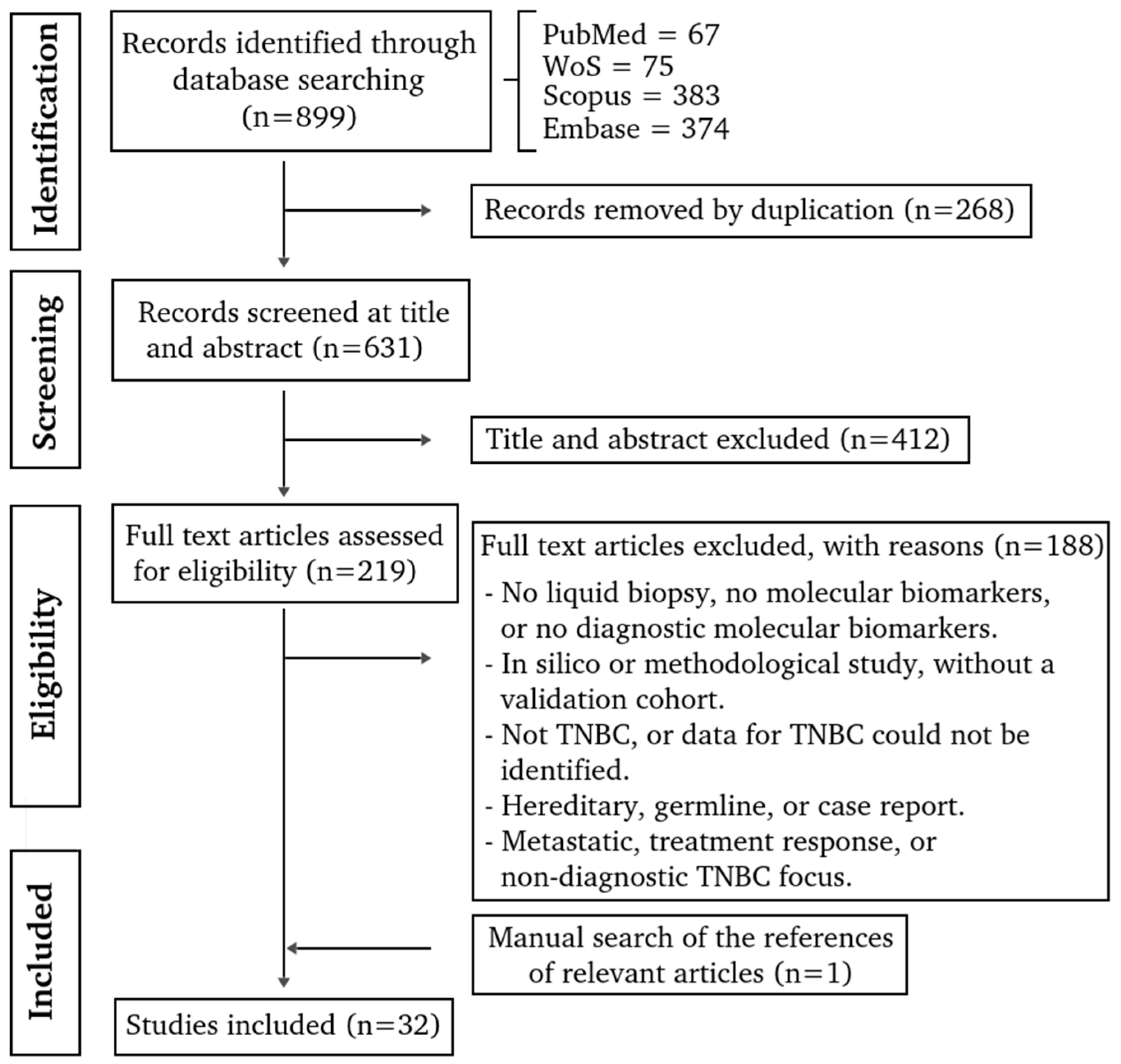
A total of 899 publications up to 9 October 2024 were identified (Figure 1). Duplicated articles (n = 268) and those that did not meet the inclusion criteria during the initial screening of titles and abstracts (n = 412), and full-text analysis (n = 188) were excluded (Supplementary File S1, Sheets A–C). Additionally, one article was incorporated by hand searching, by checking the reference lists of relevant studies (Supplementary File S1, Sheet D). Finally, 32 studies were examined in this scoping review (Supplementary File S1, Sheet E).
The study design was defined in 28 studies, with 19 case–control (including variants such as nested or retrospective case–control), and the remaining were described as pilot (n = 3, including variants), experimental (n = 2), cohorts (n = 2), cross-sectional, and multi-phase. The studies were conducted primarily in Asia (n = 17), followed by Europe (n = 7), North America (n = 4), Africa (n = 2), and South America (n = 2). Among the 32 eligible studies, serum was the most commonly analyzed biological specimen (n = 17), followed by plasma (n = 11), whole or peripheral blood fractions (n = 3), buffy coat (n = 1), and a few mixed sample types. Finally, protein-based biomarkers were the most frequently investigated, reported in 15 studies, followed by RNA-based biomarkers in 12 studies, whereas DNA-based molecular biomarkers were evaluated in only 6 studies [Table 1]. In one study, both protein-based and RNA-based biomarkers were reported. Of the 32 included studies, 17 reported the area under the receiver operating characteristic curve (AUC), while 14 and 13 studies provided data on sensitivity and specificity, respectively. Although protein-based studies were the most frequently reported, they largely identified single-study biomarkers with limited replication. RNA-based studies, particularly those focusing on miRNAs, showed comparatively greater consistency across independent studies, whereas DNA-based studies were fewer and mainly focused on methylation-based alterations, occasionally reporting higher diagnostic performance metrics but with limited external validation.

3.2. Patients’ Characteristics

Across the 32 studies, a total of 1532 TNBC cases and 3137 participants in the comparator group were analyzed. Comparator groups included healthy controls, benign breast disease, non-TNBC breast cancer, non-breast cancer participants, and, in one study, disease-free individuals. The approximate modal age was 52 years, with the majority of studies reporting mean or median ages within the 50–55-year range, with ages ranging from 21 to 93 years. Across the 32 studies, the median sample sizes were 29 TNBC cases and 48.5 controls per study. Regarding comparators, the most common study setups contrasted TNBC vs. healthy controls and TNBC vs. other breast cancer subtypes (e.g., luminal, HER2-positive); fewer studies included benign breast lesions or mixed comparator groups.

3.3. Novel Protein-Based Molecular Biomarkers Associated with TNBC Diagnosis

The fifteen studies reporting novel protein-based molecular biomarkers associated with TNBC diagnosis (including one mixed Protein + RNA study, Table 1) were published between 2012 and 2024. The studies included 621 patients with TNBC and 1664 compared group, for an overall cohort of 2285 participants. Across the studies with available data, the reported age range spanned from 26 to 86 years, the mean and modal ages were approximately 52 years. Only one study provided separate age distributions for TNBC and control groups, reporting a mean age of 43.7 ± 7.8 years for TNBC patients and 46.1 ± 10.4 years for controls (Table 1, Study [25]).
Most studies analyzed serum samples (n = 12), followed by plasma (n = 2), and whole blood fractions (n = 1). The predominant analytical techniques included ELISA-based assays, antibody microarrays, and proteomic mass spectrometry approaches (e.g., 2D-DIGE, MALDI-TOF-MS, LC–MS/MS, SWATH). These methodologies primarily aimed to identify circulating proteins differentially expressed in TNBC patients relative to healthy individuals or non-TNBC subtypes.
Among the 15 protein-based studies, at least 69 individual protein biomarkers were identified (Table 1), which could be grouped into 13 functional families, including apolipoproteins, complement components and regulators, immunoglobulins/autoantibodies, coagulation and protease inhibitors, acute-phase/transport proteins, extracellular matrix and adhesion molecules, growth factors/cytokines, and various signaling, enzymatic, and transcriptional regulators. Only APOA4 was reported in three independent studies, while TTR, FN1, APOC1, C3, and C9, were reported in two studies each. All other proteins were described in single studies.

3.4. Novel RNA-Based Molecular Biomarkers Associated with TNBC Diagnosis

Twelve studies investigated RNA-based molecular biomarkers (including one mixed Protein + RNA study). Across these investigations, the cumulative sample comprised 550 TNBC cases and 1009 participants in the comparator group, with mean per-study sample sizes of ~48 TNBC cases and ~84 comparator participants. Publication years ranged from 2015 to 2023 (mean 2018). Diagnostic performance metrics were variably reported: AUC was provided in nine studies, while sensitivity and specificity were each reported in six studies. Serum and plasma were the most frequently analyzed biological specimens, whereas urine was used in only one study, and RT-qPCR/qRT-PCR approaches predominated, often combined with discovery arrays. Among the 12 RNA-based studies, five reported multiple RNAs or RNA panels, while seven focused on individual RNA biomarkers, resulting in a total of 40 unique RNAs identified as differentially expressed biomarkers in TNBC (Table 1). Among candidate RNAs, miR-21 was the most frequently investigated across studies (n = 4), followed by miR-155 (n = 2), whereas other microRNAs (e.g., miR-126-5p, miR-205, miR-199a-5p) and lncRNAs (e.g., ANRIL, SOX2OT, ANRASSF1, UCA1, HIF1A-AS2, NRIL) were each reported by single studies.

3.5. Novel DNA-Based Molecular Biomarkers Associated with TNBC Diagnosis

A total of six studies investigated DNA-based molecular biomarkers associated with TNBC diagnosis, encompassing 389 patients with TNBC and 432 participants in the comparator group. Publication years ranged from 2015 to 2023 (mean 2020). Most studies were based on plasma-derived DNA samples, with volumes ranging from 5 to 20 mL, although buffy coat and serum extracellular vesicle (EV) DNA were also analyzed. The most frequently used analytical approaches included Illumina 450K/EPIC methylation arrays, methylation-specific PCR (MSP), digital droplet PCR (ddPCR), and next-generation sequencing (NGS) platforms.
Collectively, 26 unique genes were reported across studies (Table 1). Methylation-based biomarkers, reported in four studies, included cfDNA differentially methylated regions in SPAG6, IFFO1, SPHK2, TBCD/ZNF750, LINC10606 and CPXM1, as well as promoter methylation of APC, RARB2, LINC00299, and ADAM12. Mitochondrial DNA variants were identified in MT-ND1, MT-ND2, MT-ND3, MT-ND4, MT-ND4L, MT-ND5, MT-ND6, MT-CYTB, MT-CO1, MT-CO2, MT-CO3, RNR2, MT-ATP6, and MT-ATP8 (one study); and somatic mutations were examined in PIK3CA (one study). Only one study reported AUC (0.74) along with sensitivity (86%) and specificity (90%).

4. Discussion

This scoping review synthesizes, for the first time to our knowledge, all molecular classes of liquid biopsy-derived biomarkers evaluated specifically for the diagnosis of TNBC. Across 32 primary studies published between 2012 and 2024, we identified proteins, RNAs, and DNA alterations as the three major biomarker categories investigated. Collectively, these findings underscore both the growing interest in minimally invasive diagnostics for TNBC and the considerable methodological and biological gaps that continue to limit their clinical translation.
A consistent observation across studies was the substantial heterogeneity in biomarker biology, study design, and analytical methods. This variability reflects not only the intrinsic molecular complexity of TNBC [54] but also differences in sample processing, control groups, platforms, and reporting practices [55]. Protein-based biomarkers constituted the most frequently explored category (n = 15 studies), followed by RNA-based biomarkers (n = 11), while DNA-based biomarkers were less commonly evaluated (n = 6). Among RNA-derived candidates, miRNAs demonstrated comparatively stronger replication across independent studies. In contrast, somatic mutations were the least represented biomarker class (n = 1).
Despite being the predominant biomarker category, protein-based studies showed limited reproducibility. Only APOA4, whose precise biological function remains incompletely understood, was replicated in more than one independent study [25,26,34]; however, the direction of change was inconsistent. In two studies, APOA4 was significantly up regulated (p < 0.05) [25,26], whereas Santana et al. (2024) reported significant down regulation (p < 0.05) [34]. These discrepancies highlight the sensitivity of protein measurements to pre-analytical workflows, comparator group selection, and population-level variability, reinforcing the need for standardized approaches to quantify spatial, temporal, and inter-individual heterogeneity [55,56].
RNA-based biomarkers included several promising candidates, most notably miR-21, which was significantly up regulated in three of the four studies analyzed [38,40,43,47]. Biologically, the recurrent detection of miR-21 in TNBC is plausible. miR-21 functions as an oncomiR by directly targeting PTEN, thereby promoting activation of the PI3K/AKT signaling pathway, and has been associated with STAT3- and TGF-β–driven pro-invasive and pro-tumorigenic programs [57]. However, it has been validated in a limited number of samples, raising concerns about its reproducibility, generalizability, and suitability as a clinically reliable diagnostic biomarker [56]. Additional RNAs, including miR-199a-5p, miR-155, and miR-205 [38,40], as well as lncRNAs such as NRIL, HIF1A-AS2, and UCA1 [41], also demonstrated excellent diagnostic performance. Notably, miR-199a-5p achieved an individual AUC of 0.8838 [38], whereas the remaining markers, evaluated as part of multi-RNA panels, yielded AUC values exceeding 0.96 [40]. However, these values were reported in single studies only, underscoring the lack of external validation and the early-stage nature of this research field.
Among DNA-based biomarkers, only one study reported an AUC for a methylation panel [48] including SPAG6, LINC10606, and TBCD/ZNF750, which showed limited diagnostic performance (AUC: 0.74 in the validation set). The other three studies that analyzed methylation did not report AUC values. The 26 reported genes or loci primarily represent methylation-based classification signatures selected to distinguish TNBC from heterogeneous comparator groups, rather than recurrent TNBC-specific driver events. Although several loci map to pathways broadly involved in breast cancer biology, TNBC specificity remains largely unestablished. Nonetheless, some markers show biological plausibility in aggressive disease contexts, such as SPHK2, linked to pro-metastatic signaling [58], and ZNF750, associated with invasion-suppressive programs [59]. The absence of PIK3CA hotspot mutations in plasma is biologically consistent with their lower prevalence in TNBC compared with luminal subtypes [60]. To date, none were replicated across independent populations, batches, or analytical platforms.
When considered comparatively, protein-, RNA-, and DNA-based biomarkers capture complementary layers of TNBC biology but differ markedly in evidentiary maturity. Protein-based biomarkers dominate the literature, reflecting technical accessibility and established serum assays, yet they show the poorest reproducibility across studies. RNA-based biomarkers, particularly circulating miRNAs, exhibit comparatively greater consistency across independent cohorts, suggesting higher analytical robustness despite fewer studies. DNA-based biomarkers, mainly methylation-based alterations, occasionally report higher diagnostic performance metrics, but remain sparsely studied and largely unreplicated. The predominance of single-study biomarkers across all molecular classes reflects a fragmented evidence base where most discoveries remain unvalidated and therefore unsuitable for immediate clinical translation.
Beyond biomarker biology, study design limitations were pervasive. Most investigations employed retrospective case–control designs, which were vulnerable to spectrum bias and frequently overestimated diagnostic performance [61,62]. Diagnostic performance was inconsistently reported, with only 17 studies providing AUC values and even fewer reporting sensitivity or specificity. Validation cohorts were uncommon, and independent testing sets were rarely implemented. Clinical comparators were heterogeneous, often combining healthy individuals with patients with non-TNBC breast cancer, and demographic matching was generally inadequate, with only one study reporting age distributions separately for cases and controls. Sample sizes were typically small (median 29 TNBC cases and 35 controls), restricting subgroup analyses and limiting statistical robustness. Collectively, these issues hinder reproducibility, generalizability, and the translational potential of the biomarkers identified. Accordingly, the current body of evidence should be regarded as exploratory and hypothesis-generating rather than clinically definitive.

Strengths and Limitations

Strengths of this scoping review include a comprehensive multi-database search strategy, adherence to PRISMA-ScR guidelines, independent screening and data extraction, and structured reporting by biomarker class. However, limitations inherent to scoping reviews also apply: no meta-analysis was conducted, and the high heterogeneity across studies prevented quantitative synthesis of diagnostic accuracy. Because only published studies were included, publication bias cannot be ruled out.
From a clinical perspective, the primary limitation is the lack of validation in independent or prospective cohorts. Most biomarkers were evaluated exclusively in discovery populations, making their real-world diagnostic utility uncertain. Until robust external replication is achieved, none of the identified circulating biomarkers (protein-, RNA-, or DNA-based), can be considered ready for clinical implementation in TNBC diagnosis. Overall, these findings indicate that current translational barriers are driven primarily by methodological fragmentation, rather than by intrinsic limitations of any single biomarker class.
From a biological perspective, circulating biomarkers detected by liquid biopsy may originate not only from tumor cells but also from non-malignant components of the tumor microenvironment, including immune, stromal, and endothelial cells. In TNBC, which is characterized by prominent immune infiltration and stromal interactions, inflammatory and immune-related processes can substantially influence circulating biomolecule levels. As a result, some reported biomarkers may reflect tumor–host interactions rather than tumor-specific alterations, potentially reducing diagnostic specificity, particularly in early-stage disease or in the absence of tumor-enriched validation. Because most included studies did not specifically assess cellular origin, the relative contribution of tumor- versus microenvironment-derived signals could not be systematically evaluated within the scope of this review.

5. Conclusions

This scoping review synthesizes the existing evidence on liquid biopsy-derived molecular biomarkers for the diagnosis of triple-negative breast cancer up to 2024. Although numerous protein-, RNA-, and DNA-based candidates have been proposed, the current evidence remains constrained by methodological heterogeneity, small cohorts, inconsistent reporting, and a lack of external and prospective validation. At present, no biomarker demonstrates sufficient reproducibility or robustness for clinical diagnostic implementation in TNBC. Advancing the field will require well-designed, adequately powered, and standardized multi-phase studies that incorporate independent validation cohorts and harmonized pre-analytical and analytical protocols.

Supplementary Materials

The following supporting information can be downloaded at https://www.mdpi.com/article/10.3390/diagnostics16020360/s1, Table S1: Search strategy 10 October 2024. File S1: Supplementary File detailing the scoping review process, including (A) Identification, (B) Screening, (C) Eligibility, (D) Manual Search, and (E) Data Extraction.

Author Contributions

Conceptualization; visualization; writing—original draft preparation, O.N.-F., and Á.L.R.-C.; methodology, O.N.-F., J.R., E.M., V.H., and Á.L.R.-C.; formal analysis, O.N.-F.; data curation, O.N.-F.; writing—review and editing, O.N.-F., J.R., E.M., V.H., and Á.L.R.-C.; supervision; project administration; funding acquisition, Á.L.R.-C. All authors have read and agreed to the published version of the manuscript.

Funding

This work was supported by ANID FONDAP 152220002 (CECAN).

Institutional Review Board Statement

Not applicable.

Informed Consent Statement

Not applicable.

Data Availability Statement

The original contributions presented in this study are included in the article/Supplementary Material. Further inquiries can be directed to the corresponding author.

Conflicts of Interest

The authors declare no conflicts of interest.

Abbreviations

The following abbreviations are used in this manuscript:
AUCArea under the receiver operating characteristic curve
BCBreast cancer
cfDNACell-free DNA
CTCCirculating tumor cell
ctDNACirculating tumor DNA
ddPCRDigital droplet polymerase chain reaction
ELISAEnzyme-linked immunosorbent assay
EVsExtracellular vesicles
HILICHydrophilic interaction liquid chromatography
lncRNALong non-coding RNA
MALDI-TOF-MSMatrix-assisted laser desorption/ionization time-of-flight mass spectrometry
miRNAMicroRNA
MSPMethylation-specific polymerase chain reaction
NGSNext-generation sequencing
RT-qPCRReverse transcription quantitative polymerase chain reaction
SDS-PAGESodium dodecyl sulfate polyacrylamide gel electrophoresis
SRMSelected reaction monitoring
SWATHSequential window acquisition of all theoretical fragment ion spectra
TNBCTriple-negative breast cancer
WBWestern blot

References

  1. Bray, F.; Laversanne, M.; Sung, H.; Ferlay, J.; Siegel, R.L.; Soerjomataram, I.; Jemal, A. Global Cancer Statistics 2022: GLOBOCAN Estimates of Incidence and Mortality Worldwide for 36 Cancers in 185 Countries. CA Cancer J. Clin. 2024, 74, 229–263. [Google Scholar] [CrossRef] [PubMed]
  2. Tsang, J.Y.S.; Tse, G.M. Molecular Classification of Breast Cancer. Adv. Anat. Pathol. 2020, 27, 27–35. [Google Scholar] [CrossRef] [PubMed]
  3. Tan, P.H.; Ellis, I.; Allison, K.; Brogi, E.; Fox, S.B.; Lakhani, S.; Lazar, A.J.; Morris, E.A.; Sahin, A.; Salgado, R.; et al. The 2019 World Health Organization Classification of Tumours of the Breast. Histopathology 2020, 77, 181–185. [Google Scholar] [CrossRef] [PubMed]
  4. Derakhshan, F.; Reis-Filho, J.S. Pathogenesis of Triple-Negative Breast Cancer. Annu. Rev. Pathol. Mech. Dis. 2021, 17, 181–204. [Google Scholar] [CrossRef]
  5. Kwon, M.R.; Chang, Y.; Park, B.; Ryu, S.; Kook, S.H. Performance Analysis of Screening Mammography in Asian Women under 40 Years. Breast Cancer 2023, 30, 241–248. [Google Scholar] [CrossRef]
  6. Stibbards-Lyle, M.; Malinovska, J.; Badawy, S.; Schedin, P.; Rinker, K.D. Status of Breast Cancer Detection in Young Women and the Potential of Liquid Biopsy. Front. Oncol. 2024, 14, 1398196. [Google Scholar] [CrossRef]
  7. Bilous, M. Breast Core Needle Biopsy: Issues and Controversies. Mod. Pathol. 2010, 23, S36–S45. [Google Scholar] [CrossRef]
  8. Schnitt, S.J. Problematic Issues in Breast Core Needle Biopsies. Mod. Pathol. 2019, 32, 71–76. [Google Scholar] [CrossRef]
  9. Azeredo-da-Silva, A.F.; Zanotto, B.S.; Martins, F.; Navarro, N.; Alencar, R.; Medeiros, C. Health Care Accessibility and Mobility in Breast Cancer: A Latin American Perspective. BMC Health Serv. Res. 2024, 24, 764. [Google Scholar] [CrossRef]
  10. Sánchez Galindo, B.; López-Torres Hidalgo, J.; López González, Á.; Sánchez Martínez, C.M.; Castaño Díaz, M.; Rabanales Sotos, J. Intervalos de tiempo para el diagnóstico y tratamiento en pacientes con cáncer de mama [Time intervals for diagnosis and treatment in breast cancer patients]. Aten Primaria 2025, 57, 103153. (In Spanish) [Google Scholar] [CrossRef]
  11. Madariaga, B.; Mondschein, S.; Torres, S. Inequities in Breast Cancer Outcomes in Chile: An Analysis of Case Fatality Ratios and Survival Rates (2007–2018). PLoS ONE 2025, 20, e0325252. [Google Scholar] [CrossRef] [PubMed]
  12. Acevedo, F.; Walbaum, B.; Medina, L.; Merino, T.; Camus, M.; Puschel, K.; Ramírez, K.; Manzor, M.; Veglia, P.; Martinez, R.; et al. Clinical Characteristics, Risk Factors, and Outcomes in Chilean Triple-Negative Breast Cancer Patients: A Real-World Study. Breast Cancer Res. Treat. 2023, 197, 449–459. [Google Scholar] [CrossRef] [PubMed]
  13. Tay, T.K.Y.; Tan, P.H. Liquid Biopsy in Breast Cancer: A Focused Review. Arch. Pathol. Lab. Med. 2021, 145, 678–686. [Google Scholar] [CrossRef] [PubMed]
  14. Ma, L.; Guo, H.; Zhao, Y.; Liu, Z.; Wang, C.; Bu, J.; Sun, T.; Wei, J. Liquid Biopsy in Cancer: Current Status, Challenges and Future Prospects. Signal Transduct. Target. Ther. 2024, 9, 336. [Google Scholar] [CrossRef]
  15. Alba-Bernal, A.; Lavado-Valenzuela, R.; Domínguez-Recio, M.E.; Jiménez-Rodriguez, B.; Queipo-Ortuño, M.I.; Alba, E.; Comino-Méndez, I. Challenges and Achievements of Liquid Biopsy Technologies Employed in Early Breast Cancer. EBioMedicine 2020, 62, 103100. [Google Scholar] [CrossRef]
  16. Qiu, P.; Yu, X.; Zheng, F.; Gu, X.; Huang, Q.; Qin, K.; Hu, Y.; Liu, B.; Xu, T.; Zhang, T.; et al. Advancements in Liquid Biopsy for Breast Cancer: Molecular Biomarkers and Clinical Applications. Cancer Treat. Rev. 2025, 139, 102979. [Google Scholar] [CrossRef]
  17. Malik, S.; Zaheer, S. The Impact of Liquid Biopsy in Breast Cancer: Redefining the Landscape of Non-Invasive Precision Oncology. J. Liq. Biopsy 2025, 8, 100299. [Google Scholar] [CrossRef]
  18. Mazzeo, R.; Sears, J.; Palmero, L.; Bolzonello, S.; Davis, A.A.; Gerratana, L.; Puglisi, F. Liquid Biopsy in Triple-Negative Breast Cancer: Unlocking the Potential of Precision Oncology. ESMO Open 2024, 9, 103700. [Google Scholar] [CrossRef]
  19. Zaikova, E.; Cheng, B.Y.C.; Cerda, V.; Kong, E.; Lai, D.; Lum, A.; Bates, C.; Brok, W.D.; Kono, T.; Bourque, S.; et al. Circulating Tumour Mutation Detection in Triple-Negative Breast Cancer as an Adjunct to Tissue Response Assessment. NPJ Breast Cancer 2024, 10, 3. [Google Scholar] [CrossRef]
  20. Sheng, J.; Zong, X. Liquid Biopsy in TNBC: Significance in Diagnostics, Prediction, and Treatment Monitoring. Front. Oncol. 2025, 15, 1607960. [Google Scholar] [CrossRef]
  21. Levac, D.; Colquhoun, H.; O’Brien, K.K. Scoping Studies: Advancing the Methodology. Implement. Sci. 2010, 5, 69. [Google Scholar] [CrossRef] [PubMed]
  22. Li, C.I.; Mirus, J.E.; Zhang, Y.; Ramirez, A.B.; Ladd, J.J.; Prentice, R.L.; McIntosh, M.W.; Hanash, S.M.; Lampe, P.D. Discovery and Preliminary Confirmation of Novel Early Detection Biomarkers for Triple-Negative Breast Cancer Using Preclinical Plasma Samples from the Women’s Health Initiative Observational Study. Breast Cancer Res. Treat. 2012, 135, 611–618. [Google Scholar] [CrossRef] [PubMed]
  23. Liu, A.N.; Sun, P.; Liu, J.N.; Yu, C.Y.; Qu, H.J.; Jiao, A.H.; Zhang, L.M. Analysis of the Differences of Serum Protein Mass Spectrometry in Patients with Triple-Negative Breast Cancer and Non-Triple-Negative Breast Cancer. Tumor Biol. 2014, 35, 9751–9757. [Google Scholar] [CrossRef] [PubMed]
  24. Suman, S.; Basak, T.; Gupta, P.; Mishra, S.; Kumar, V.; Sengupta, S.; Shukla, Y. Quantitative Proteomics Revealed Novel Proteins Associated with Molecular Subtypes of Breast Cancer. J. Proteom. 2016, 148, 183–193. [Google Scholar] [CrossRef]
  25. Gajbhiye, A.; Dabhi, R.; Taunk, K.; Jagadeeshaprasad, M.G.; RoyChoudhury, S.; Mane, A.; Bayatigeri, S.; Chaudhury, K.; Santra, M.K.; Rapole, S. Multipronged Quantitative Proteomics Reveals Serum Proteome Alterations in Breast Cancer Intrinsic Subtypes. J. Proteom. 2017, 163, 1–13. [Google Scholar] [CrossRef]
  26. Del Pilar Chantada-Vázquez, M.; López, A.C.; Vence, M.G.; Vázquez-Estévez, S.; Acea-Nebril, B.; Calatayud, D.G.; Jardiel, T.; Bravo, S.B.; Núñez, C. Proteomic Investigation on the Bio-Corona of Au, Ag and Fe Nanoparticles for the Discovery of Triple-Negative Breast Cancer Serum Protein Biomarkers. J. Proteom. 2020, 212, 103581. [Google Scholar] [CrossRef]
  27. Fang, J.; Tao, T.; Zhang, Y.; Lu, H. A Barcode Mode Based on Glycosylation Sites of Membrane-Type Mannose Receptor as a New Potential Diagnostic Marker for Breast Cancer. Talanta 2019, 191, 21–26. [Google Scholar] [CrossRef]
  28. Chanana, P.; Pandey, A.K.; Yadav, B.S.; Kaur, J.; Singla, S.; Dimri, K.; Trehan, R.; Krishan, P. Significance of Serum Vascular Endothelial Growth Factor and Cancer Antigen 15.3 in Patients with Triple-Negative Breast Cancer. J. Radiother. Pract. 2014, 13, 60–67. [Google Scholar] [CrossRef]
  29. Cui, R.; Zou, J.; Zhao, Y.; Zhao, T.; Ren, L.; Li, Y. The Dual-Crosslinked Prospective Values of RAI14 for the Diagnosis and Chemosurveillance in Triple-Negative Breast Cancer. Ann. Med. 2023, 55, 820–836. [Google Scholar] [CrossRef]
  30. Song, D.; Yue, L.; Zhang, J.; Ma, S.; Zhao, W.; Guo, F.; Fan, Y.; Yang, H.; Liu, Q.; Zhang, D.; et al. Diagnostic and Prognostic Significance of Serum Apolipoprotein C-I in Triple-Negative Breast Cancer Based on Mass Spectrometry. Cancer Biol. Ther. 2016, 17, 635–647. [Google Scholar] [CrossRef]
  31. Luo, R.; Zheng, C.; Song, W.; Tan, Q.; Shi, Y.; Han, X. High-Throughput and Multi-Phase Identification of Autoantibodies in Diagnosing Early-Stage Breast Cancer and Subtypes. Cancer Sci. 2022, 113, 770–783. [Google Scholar] [CrossRef] [PubMed]
  32. Chaudhary, P.; Gibbs, L.D.; Maji, S.; Lewis, C.M.; Suzuki, S.; Vishwanatha, J.K. Serum Exosomal Annexin A2 Is Associated with African-American Triple-Negative Breast Cancer and Promotes Angiogenesis. Breast Cancer Res. 2020, 22, 11. [Google Scholar] [CrossRef] [PubMed]
  33. Schummer, M.; Thorpe, J.; Giraldez, M.D.; Bergan, L.; Tewari, M.; Urban, N. Evaluating Serum Markers for Hormone Receptor-Negative Breast Cancer. PLoS ONE 2015, 10, e0142911. [Google Scholar] [CrossRef] [PubMed]
  34. Santana, M.F.M.; Sawada, M.I.B.A.C.; Junior, D.R.S.; Giacaglia, M.B.; Reis, M.; Xavier, J.; Côrrea-Giannella, M.L.; Soriano, F.G.; Gebrim, L.H.; Ronsein, G.E.; et al. Proteomic Profiling of HDL in Newly Diagnosed Breast Cancer Based on Tumor Molecular Classification and Clinical Stage of Disease. Cells 2024, 13, 1327. [Google Scholar] [CrossRef]
  35. Bilir, C.; Engin, H.; Can, M.; Likhan, S.; Demirtas, D.; Kuzu, F.; Bayraktaroglu, T. Increased Serum Tumor Necrosis Factor Receptor-Associated Factor-6 Expression in Patients with Non-Metastatic Triple-Negative Breast Cancer. Oncol. Lett. 2015, 9, 2819–2824. [Google Scholar] [CrossRef]
  36. Chung, J.M.; Jung, Y.; Kim, Y.P.; Song, J.; Kim, S.; Kim, J.Y.; Kwon, M.; Yoon, J.H.; Kim, M.D.; Lee, J.K.; et al. Identification of the Thioredoxin-Like 2 Autoantibody as a Specific Biomarker for Triple-Negative Breast Cancer. J. Breast Cancer 2018, 21, 87–90. [Google Scholar] [CrossRef]
  37. Sharma, U.; Barwal, T.S.; Khandelwal, A.; Malhotra, A.; Rana, M.K.; Singh Rana, A.P.; Imyanitov, E.N.; Vasquez, K.M.; Jain, A. LncRNA ZFAS1 Inhibits Triple-Negative Breast Cancer by Targeting STAT3. Biochimie 2021, 182, 99–107. [Google Scholar] [CrossRef]
  38. Shin, V.Y.; Siu, J.M.; Cheuk, I.; Ng, E.K.; Kwong, A. Circulating Cell-Free miRNAs as Biomarkers for Triple-Negative Breast Cancer. Br. J. Cancer 2015, 112, 1751–1759. [Google Scholar] [CrossRef]
  39. Kahraman, M.; Röske, A.; Laufer, T.; Fehlmann, T.; Backes, C.; Kern, F.; Kohlhaas, J.; Schrörs, H.; Saiz, A.; Zabler, C.; et al. MicroRNA in Diagnosis and Therapy Monitoring of Early-Stage Triple-Negative Breast Cancer. Sci. Rep. 2018, 8, 11584. [Google Scholar] [CrossRef]
  40. Kumar, V.; Gautam, M.; Chaudhary, A.; Chaurasia, B. Impact of Three miRNA Signature as Potential Diagnostic Marker for Triple-Negative Breast Cancer Patients. Sci. Rep. 2023, 13, 21643. [Google Scholar] [CrossRef]
  41. Liu, M.; Xing, L.Q.; Liu, Y.J. A Three-Long Noncoding RNA Signature as a Diagnostic Biomarker for Differentiating Between Triple-Negative and Non-Triple-Negative Breast Cancers. Medicine 2017, 96, e6222. [Google Scholar] [CrossRef] [PubMed]
  42. Souza, K.C.B.; Evangelista, A.F.; Leal, L.F.; Souza, C.P.; Vieira, R.A.; Causin, R.L.; Neuber, A.C.; Pessoa, D.P.; Passos, G.A.S.; Reis, R.M.V.; et al. Identification of Cell-Free Circulating MicroRNAs for the Detection of Early Breast Cancer and Molecular Subtyping. J. Oncol. 2019, 2019, 8393769. [Google Scholar] [CrossRef] [PubMed]
  43. Ibrahim, A.M.; Said, M.M.; Hilal, A.M.; Medhat, A.M.; Abd Elsalam, I.M. Candidate Circulating MicroRNAs as Potential Diagnostic and Predictive Biomarkers for the Monitoring of Locally Advanced Breast Cancer Patients. Tumor Biol. 2020, 42, 1010428320963811. [Google Scholar] [CrossRef] [PubMed]
  44. Qattan, A.; Intabli, H.; Alkhayal, W.; Eltabache, C.; Tweigieri, T.; Amer, S.B. Robust Expression of Tumor Suppressor miRNAs let-7 and miR-195 Detected in Plasma of Saudi Female Breast Cancer Patients. BMC Cancer 2017, 17, 799. [Google Scholar] [CrossRef]
  45. Shaheen, J.; Shahid, S.; Shahzadi, S.; Akhtar, M.W.; Sadaf, S. Identification of Circulating miRNAs as Non-Invasive Biomarkers of Triple-Negative Breast Cancer in the Pakistani Population. Pak. J. Zool. 2019, 51, 1113–1121. [Google Scholar] [CrossRef]
  46. Du, Q.; Yang, Y.; Kong, X.; Lan, F.; Sun, J.; Zhu, H.; Ni, Y.; Pan, A. Circulating lncRNAs Acting as Diagnostic Fingerprints for Predicting Triple-Negative Breast Cancer. Int. J. Clin. Exp. Med. 2018, 11, 8139–8145. [Google Scholar]
  47. Ritter, A.; Hirschfeld, M.; Berner, K.; Rücker, G.; Jäger, M.; Weiss, D.; Medl, M.; Nöthling, C.; Gassner, S.; Asberger, J.; et al. Circulating Non-Coding RNA Biomarker Potential in Neoadjuvant Chemotherapy of Triple-Negative Breast Cancer? Int. J. Oncol. 2020, 56, 47–68. [Google Scholar] [CrossRef]
  48. Manoochehri, M.; Borhani, N.; Gerhäuser, C.; Assenov, Y.; Schönung, M.; Hielscher, T.; Christensen, B.C.; Lee, M.K.; Gröne, H.J.; Lipka, D.B.; et al. DNA Methylation Biomarkers for Noninvasive Detection of Triple-Negative Breast Cancer Using Liquid Biopsy. Int. J. Cancer 2023, 152, 1025–1035. [Google Scholar] [CrossRef]
  49. Swellam, M.; Abdelmaksoud, M.D.; Mahmoud, M.S.; Ramadan, A.; Abdel-Moneem, W.; Hefny, M.M. Aberrant Methylation of APC and RARβ2 Genes in Breast Cancer Patients. IUBMB Life 2015, 67, 61–68. [Google Scholar] [CrossRef]
  50. Lee, S.; Kim, H.Y.; Jung, Y.J.; Jung, C.S.; Im, D.; Kim, J.Y.; Lee, S.M.; Oh, S.H. Comparison of Mutational Profiles Between Triple-Negative and Hormone Receptor-Positive/Human Epidermal Growth Factor Receptor 2-Negative Breast Cancers in T2N0-1M0 Stage: Implications of TP53 and PIK3CA Mutations in Korean Early-Stage Breast Cancers. Curr. Probl. Cancer 2022, 46, 100843. [Google Scholar] [CrossRef]
  51. Manoochehri, M.; Jones, M.; Tomczyk, K.; Fletcher, O.; Schoemaker, M.J.; Swerdlow, A.J.; Borhani, N.; Hamann, U. DNA Methylation of the Long Intergenic Noncoding RNA 299 Gene in Triple-Negative Breast Cancer: Results from a Prospective Study. Sci. Rep. 2020, 10, 11762. [Google Scholar] [CrossRef]
  52. Vikramdeo, K.S.; Anand, S.; Sudan, S.K.; Pramanik, P.; Singh, S.; Godwin, A.K.; Singh, A.P.; Dasgupta, S. Profiling Mitochondrial DNA Mutations in Tumors and Circulating Extracellular Vesicles of Triple-Negative Breast Cancer Patients for Potential Biomarker Development. FASEB Bioadv. 2023, 5, 412–426. [Google Scholar] [CrossRef] [PubMed]
  53. Mendaza, S.; Ulazia-Garmendia, A.; Monreal-Santesteban, I.; Córdoba, A.; Azúa, Y.R.; Aguiar, B.; Beloqui, R.; Armendáriz, P.; Arriola, M.; Martín-Sánchez, E.; et al. ADAM12 Is a Potential Therapeutic Target Regulated by Hypomethylation in Triple-Negative Breast Cancer. Int. J. Mol. Sci. 2020, 21, 903. [Google Scholar] [CrossRef] [PubMed]
  54. Asleh, K.; Riaz, N.; Nielsen, T.O. Heterogeneity of Triple-Negative Breast Cancer: Current Advances in Subtyping and Treatment Implications. J. Exp. Clin. Cancer Res. 2022, 41, 265. [Google Scholar] [CrossRef] [PubMed]
  55. Gough, A.; Stern, A.M.; Maier, J.; Lezon, T.; Shun, T.Y.; Chennubhotla, C.; Schurdak, M.E.; Haney, S.A.; Taylor, D.L. Biologically Relevant Heterogeneity: Metrics and Practical Insights. SLAS Discov. 2017, 22, 213–237. [Google Scholar] [CrossRef]
  56. Hayes, D.F. Biomarker Validation and Testing. Mol. Oncol. 2015, 9, 960–966. [Google Scholar] [CrossRef]
  57. Fang, H.; Xie, J.; Zhang, M.; Zhao, Z.; Wan, Y.; Yao, Y. miRNA-21 promotes proliferation and invasion of triple-negative breast cancer cells through targeting PTEN. Am. J. Transl. Res. 2017, 9, 953–961. [Google Scholar] [PubMed] [PubMed Central]
  58. Shi, W.; Ma, D.; Cao, Y.; Hu, L.; Liu, S.; Yan, D.; Zhang, S.; Zhang, G.; Wang, Z.; Wu, J.; et al. SphK2/S1P Promotes Metastasis of Triple-Negative Breast Cancer through the PAK1/LIMK1/Cofilin1 Signaling Pathway. Front. Mol. Biosci. 2021, 8, 598218. [Google Scholar] [CrossRef]
  59. Cassandri, M.; Butera, A.; Amelio, I.; Lena, A.M.; Montanaro, M.; Mauriello, A.; Anemona, L.; Candi, E.; Knight, R.A.; Agostini, M.; et al. ZNF750 Represses Breast Cancer Invasion via Epigenetic Control of Prometastatic Genes. Oncogene 2020, 39, 4331–4343. [Google Scholar] [CrossRef]
  60. Cossu-Rocca, P.; Orrù, S.; Muroni, M.R.; Sanges, F.; Sotgiu, G.; Ena, S.; Pira, G.; Murgia, L.; Manca, A.; Uras, M.G.; et al. Analysis of PIK3CA Mutations and Activation Pathways in Triple-Negative Breast Cancer. PLoS ONE 2015, 10, e0141763. [Google Scholar] [CrossRef]
  61. Hall, J.A.; Brown, R.; Paul, J. An Exploration into Study Design for Biomarker Identification: Issues and Recommendations. Cancer Genom. Proteom. 2007, 4, 111–119. [Google Scholar]
  62. Ou, F.S.; Michiels, S.; Shyr, Y.; Adjei, A.A.; Oberg, A.L. Biomarker Discovery and Validation: Statistical Considerations. J. Thorac. Oncol. 2021, 16, 537–545. [Google Scholar] [CrossRef]
Figure 1. PRISMA flow diagram of the scoping review process.
Diagnostics 16 00360 g001
Table 1. Molecular biomarkers associated with diagnostic of TNBC.
Biomarker CategoryBiomarker(s)Alteration TypeSample Sizen Casesn ControlsBiofluidDetection MethodAUCp-ValueRef.
ProteinPanel: KIT, ITGB1, EFNA5, SRP54, FAS, BRCA1, XBP1, and othersUp-regulated562828PlasmaAntibody microarrayVariousp < 0.05[22]
ProteinTTR, SERPINA1, HPUp-regulated; Down-regulated603030Serum2D-DIGE;
MALDI-TOF-MS
NRp < 0.05[23]
ProteinFN1, A2M, C4BPAUp-regulated28820PlasmaiTRAQ;
WB;
ELISA
0.853A2M, C4BPA: p < 0.0001; FN1: p < 0.018[24]
ProteinPanel: CPN2, CO2, MYL6, HV101, APOA4, PI16, CXCL7, VTDB, IGJ, KNG1Up-regulated; Down-regulated391920Serum2D-DIGE/MALDI;
iTRAQ-LC-MS/MS;
SWATH;
WB;
SRM
NRp < 0.05[25]
ProteinPanel: APO1, CFH, VTNC, C3, C4A, C9, LGALS3BP, FCN3, RBP4, FN1, APOA4, ORM1, ZPI, TTR, APOC1, APOC3, IGHM, IG chainsUp-regulated; Down-regulated1688SerumNP exposure;
SDS-PAGE;
LC-MS/MS;
SWATH/SRM
NRp < 0.05[26]
ProteinMRGlycosylation pattern change5535110 *SerumIP;
SDS-PAGE;
HILIC;
MALDI-TOF-MS
NRp < 0.01[27]
ProteinVEGFIncreased serum concentration653035SerumELISANRp = 0.01 (size)
p = 0.03 (stage)
[28]
ProteinRAI14Increased serum concentration1064660 *SerumELISA0.934p < 1 × 10⁻⁴[29]
ProteinApoC-IIncreased serum concentration380165215 *SerumSELDI-TOF-MS;
qRT-PCR;
ELISA;
WB
0.908p < 1 × 10⁻⁴[30]
ProteinKJ901215, FAM49B, HYI, GARS, CRLF3Lower concentration panel389123776 *SerumSerology0.875p < 0.05[31]
ProteinANXA2Higher circulating concentrations12658179 *SerumWestern blot;
ELISA
1p < 1 × 10⁻⁴[32]
ProteinGDF15, PKM, SPARC, CA125, WFDC2, COL1A1, FN1, CTGF, S100A7, SPP1, CCL5, hsa-miR-135b, Anti-TP53, HOXA5, SFRP1Minimal diagnostic performance1152887BloodELISATP53 ≤ 0.63Non sig.[33]
ProteinApoA1, ApoA2, ApoC2, ApoC4, C3, CFB, IGLC2/3, GC, PLG, SERPINA3, IGHC1, C9, LRG1, C4BPanel changes12320204 *PlasmaUltracentrifugation;
LC-MS/MS
VariousVarious[34]
ProteinTRAF6Higher serum concentration391361 *SerumELISANRp = 0.010[35]
ProteinAnti-TXNL2Higher concentration201010SerumHuProt microarrayNRNR[36]
RNA (lncRNA)ZFAS1Up and down regulated804040Peripheral bloodRT2 lncRNA PCR Array;
qRT-PCR
NRp < 1 × 10⁻⁴[37]
RNA (miRNA)miR-199a-5p, miR-16, miR-21Down regulated32772255 *PlasmamiRNA arrays;
RT-qPCR
0.88p < 0.0001[38]
RNA (miRNA)miR-126-5pConcentration change422121PlasmaMicroarray;
RT-qPCR
0.814p = 1.4 × 10⁻⁵[39]
RNA (miRNA)miR-21, miR-155, miR-205Up and down regulated19013951SerumRT-qPCR0.961p < 1 × 10⁻⁴[40]
RNA (lncRNA)NRIL, HIF1A-AS2, UCA1Up regulated1002575 *SerumMicroarray;
RT-qPCR
0.934p < 0.01[41]
RNA (miRNA)miR-25-3pUp regulated811269 *SerumNanoString;
nCounter
0.74p ≤ 0.05[42]
RNA (miRNA)miR-21Up regulated50446 *PlasmaqRT-PCRNRNR[43]
RNA (miRNA)Initial and diagnostic panelSerum differential concentration1273691 *PlasmaRT-qPCRPanel = 0.929p = 0.0008–0.02[44]
RNA (miRNA)miR-135bMinimal diagnostic performance1152887BloodELISA;
RT-qPCR
NRNon sig.[33]
RNA (miRNA)miR-376c, miR-155, miR-17a, miR-10bUp regulated713734BloodRT-qPCR0.785p < 0.0001[45]
RNA (lncRNA)ANRIL, SOX2OT, ANRASSF1Up regulated340120220 *PlasmaqRT-PCR0.959ANRIL: p < 0.01; others: p < 0.05[46]
RNA (miRNA)Serum: let-7a, let-7e, miR-21, miR-15a, miR-17, miR-18a, miR-19b, miR-30b, GlyCCC2;
Urine: miR-18a, miR-19b, miR-30b, miR-222, miR-320, GlyCCC2
Increase and decrease in concentration361620Serum; UrineRT-qPCRNRp < 0.05[47]
DNA (cfDNA methylation)SPAG6, IFFO1, SPHK2;
TBCD/ZNF750, LINC10606, CPXM1
Hypermethylation and hypomethylation22313984PlasmaIllumina 450K/EPIC;
XGBoost;
ddPCR
Test = 0.78; Validation = 0.74p < 0.0001[48]
DNA (DNA methylation)Promoter methylation: APC, RARB2Promoter methylation (RARB2 methylated in TNBC)21671145 *SerumMSPNRp = 0.007 (RARB2)[49]
DNA (Mutations)PIK3CA hotspot mutationsNo plasma mutations321022PlasmaRT-PCRNR---[50]
DNA (Methylation)LINC00299 (cg06588802)Hypermethylation (leukocyte DNA)313154159Buffy coatddPCRNRp = 0.0025; p = 0.001 (tertile 1)[51]
DNA (mtDNA)mtDNA variants (ND1, ND2, ND3, ND4, ND4L, ND5, ND6, CYTB, CO1, CO2, CO3, RNR2, ATP6, ATP8)EV concentration; tumor-specific/shared EV mutations1899SerumNGS (Illumina NovaSeq, PE150)NRp < 0.0001 (EV concentration)[52]
DNA (cfDNA methylation)Promoter methylation: ADAM12Hypomethylation19613PlasmaIllumina 450K;
Pyrosequencing
NRNR[53]
All cases were TNBC patients; * may include healthy controls, not BC, non-TNBC, benign breast disease or free disease and luminal breast cancer; if not *, all controls were not BC participants; NR; Not reported. TNBC, Triple negative breast cancer; BC, Breast cancer; KIT, Mast/stem cell growth factor receptor; ITGB1, Integrin beta-1; EFNA5, Ephrin-A5; SRP54, Signal recognition particle 54 kDa; FAS, TNFR superfamily member 6 (Ab1); BRCA1, Breast and ovarian cancer susceptibility protein 1; XBP1, X box-binding protein 1; TTR, Transthyretin; SERPINA1, Alpha-1-antitrypsin; HP, Haptoglobin; FN1, Fibronectin; A2M, Alpha-2-macroglobulin; C4BPA, Complement component-4-binding protein-alpha; CFB, Complement factor-B; CPN2, Carboxypeptidase N subunit 2; CO2, Carbon dioxide; MYL6, Myosin light chain 6; HV101, Voltage-gated hydrogen channel 1; APOA4, Apolipoprotein A4; PI16, Peptidase inhibitor 16; CXCL7, Chemokine C-X-C motif Ligand 7; VTDB, Vitamin D-binding protein; IGJ, Immunoglobulin J chain; KNG1, Kininogen-1; APOL1, Apolipoprotein 1; CFH, Complement factor H-related; VTNC, Vitronectin; C3, Complement C3; C4A, Complement C4-A; C9, Complement C9; LGALS3BP, Galectin-3-binding protein, FCN3, Ficolin-3; RBP4, Retinol binding protein 4; ORM1, Orosomucoid; ZPI, protein Z-dependent protease inhibitor; APOC1, apolipoprotein C-I; APOC3, apolipoprotein C-III; IGHM, Immunoglobulin heavy constant mu; IG chains, Immunoglobulin chains; MR, Mannose receptor; MRC1, Mannose receptor C-type 1; VEGF, Vascular endothelial growth factor; CA15-3, Cancer antigen 15.3; RAI14, Retinoic acid induced 14; FAM49B, Family with sequence similarity 49, member B; HYI, Hydroxypyruvate isomerase; GARS, Glycyl-tRNA synthetase 1; CRLF3, Cytokine receptor-like factor 3; ANXA2, Annexin A2; GDF15, Growth differentiation factor 15; PKM, Pyruvate Kinase muscle; SPARC, Osteonectin; CA125, Cancer antigen 125; WFDC2, Human epididymis protein 4; COL1A1, Collagen type 1 alpha 1; CTGF, Connective tissue growth factor; S100A7, Psoriasin; SPP1, Osteoponin; CCL5, RANTES; HOXA5, Homeobox 5; SFRP1, Secreted frizzled-related protein 1; IGLC2/3, Immunoglobulin lambda constant 2/3; GC, Vitamin D-binding protein; PLG, Plasminogen; SERPINA3, Serpin family A member 3; IGHC1, Immunoglobulin Heavy Constant Gamma 1; C9, Complement Component 9; LRG1, Leucine-rich alpha-2-glycoprotein 1; C4B, Complement C4B; TWEAK, (TNF)-like weak inducer of apoptosis; TRAF6, TNF receptor-associated factor 6; Anti-TXNL2, Thioredoxin-like 2 autoantibody; lncRNA, long non-coding RNA; miRNA, microRNA; cfDNA, Circulating cell-free DNA; SPAG6: Sperm Associated Antigen 6; IFFO1, Intermediate Filament Family Orphan 1; SPHK2, Sphingosine Kinase 2; TBCD, Tubulin-specific chaperone D; ZNF750, Zinc Finger Protein 750; LINC10606, Long Intergenic Non-Protein Coding RNA 606; CPXM1, Carboxypeptidase X, M14 Family Member 1; APC, Adenomatous polyposis coli; RARB2, Retinoic Acid Receptor Beta; PIK3CA, Phosphatidylinositol-4,5-Bisphosphate 3-Kinase Catalytic Subunit Alpha; LINC00299, Long Intergenic Non-Protein Coding RNA 299; ND1, Ubiquinone Oxidoreductase Core Subunit 1; ND2, Ubiquinone Oxidoreductase Subunit 2; ND3, Ubiquinone Oxidoreductase Subunit 3; ND4, Ubiquinone Oxidoreductase Subunit 4; ND4L, Ubiquinone Oxidoreductase Subunit 4L; ND5, Ubiquinone Oxidoreductase Subunit 5; ND6, Ubiquinone Oxidoreductase Subunit 6; CYTB, Cytochrome b (complex III); CO1, Cytochrome c Oxidase Subunit 1; CO2, Cytochrome c Oxidase Subunit 2; CO3, Cytochrome c Oxidase Subunit 3; RNR2, 16S Ribosomal RNA; ATP6, ATP Synthase F0 Subunit 6; ATP8, ATP Synthase F0 Subunit 8; ADAM12, ADAM Metallopeptidase Domain 12.
Disclaimer/Publisher’s Note: The statements, opinions and data contained in all publications are solely those of the individual author(s) and contributor(s) and not of MDPI and/or the editor(s). MDPI and/or the editor(s) disclaim responsibility for any injury to people or property resulting from any ideas, methods, instructions or products referred to in the content.