Interesting Images

Beyond the Inflamed Appendix: Low-Grade Appendiceal Mucinous Neoplasm—Emphasis on Macroscopic Findings


Department of Pathology, University of Szeged, 6725 Szeged, Hungary
*
Author to whom correspondence should be addressed.
Diagnostics 2026, 16(2), 315; https://doi.org/10.3390/diagnostics16020315

Submission received: 21 December 2025 / Revised: 15 January 2026 / Accepted: 16 January 2026 / Published: 19 January 2026

Abstract

Low-grade appendiceal mucinous neoplasms (LAMNs) are uncommon epithelial tumors that frequently present with symptoms indistinguishable from acute appendicitis, yet may progress to pseudomyxoma peritonei with significant long-term morbidity. We report the case of a 51-year-old male who presented with periumbilical pain, nausea, and fever. Although clinical findings suggested acute appendicitis, abdominal ultrasound demonstrated cystic dilation of the appendix, raising suspicion for appendiceal mucocele. Appendectomy revealed a markedly cystic, pearly appendix with multifocal wall discontinuities and mucinous exudate, resulting in complete distortion of normal anatomy. Histological examination reflected LAMN with extra-appendiceal spread. Early postoperative reoperation due to free intra-abdominal fluid revealed pseudomyxoma peritonei. This case underscores the diagnostic challenge of LAMN, highlights the critical role of meticulous gross examination and complete embedding, and emphasizes that subtle macroscopic findings may herald clinically significant peritoneal dissemination.

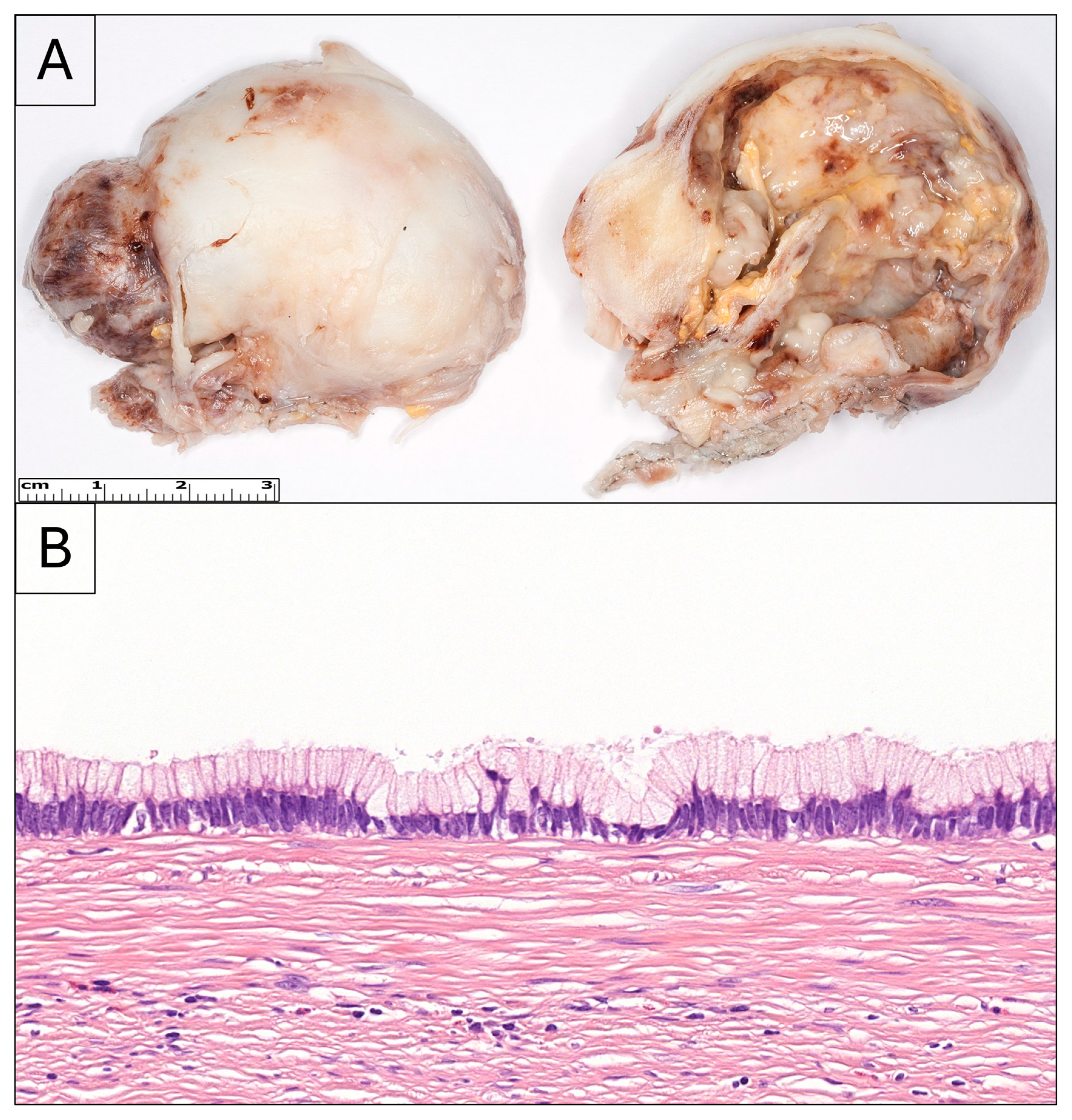
Figure 1. A 51-year-old male patient was admitted to the hospital due to periumbilical pain, nausea, and fever. The symptoms were consistent with acute appendicitis; however, abdominal ultrasound revealed cystic dilation of the appendix with intramural calcifications, suggestive of mucocele of 5 cm in greatest dimension. The patient was immediately operated on, and during median laparotomy, a large amount of free intraperitoneal fluid was present, with extensive serous–gelatinous deposits, suggestive of appendiceal perforation. During grossing, a cystically dilated appendectomy specimen, measuring 55 × 45 × 30 mm, was visible, with a pearly surface showing areas of discontinuity in multiple locations, with yellowish-white exudate also present (A). The appendix was completely distorted in shape, prohibiting proper orientation. On the cut surfaces, normal appendiceal tissue was not identifiable. In the completely embedded specimen, the appendiceal wall was edematously loosened, with minimal mucosa. Within the lumen, a flattened monolayer of mucinous epithelium was predominantly observed, with occasional filiform, multilayered, partially undulating, and partially pseudopapillary mucosal structures. Cytologic atypia was mild, with minimal mitotic activity. Furthermore, extracellular mucin was visible in the lumen and in the appendix wall. The lesion demonstrated an expansile (“pushing”) growth pattern, which manifested as transmural deposition of mucinous areas. Otherwise, the wall was fibrotic with mixed inflammatory infiltrates and regressive calcified changes ((B)-HE, 40×). Correlating with the macroscopic description, multiple perforations were also observed. Based on the histologic and macroscopic findings, a low-grade appendiceal mucinous neoplasm (LAMN) was diagnosed, with transmural expansile infiltration and extra-appendiceal spread. Due to a large amount of free intra-abdominal fluid with abdominal guarding, abdominal ultrasound was initiated, which revealed subhepatic and pelvic gelatinous fluid. The patient underwent reoperation four days after the initial surgery, during which a mucinous, gelatinous specimen was obtained from the vicinity of the round ligament of the liver and the adjacent liver margin. Histologically, mesothelial cells were identified embedded within abundant mucin, with occasional glandular structures exhibiting mild cytological atypia. Immunohistochemical analysis demonstrated positivity of the glandular components for KL-1 and BerEP4, findings that are consistent with pseudomyxoma peritonei (PMP) (pT4a-pM1b). Even though the lesion was incompletely excised, the patient refused both further surgical interventions and hyperthermic intraperitoneal chemotherapy (HIPEC); therefore, they have been clinically controlled with imaging since then, and no further distant metastases have been revealed. The follow-up is currently at 48 months. Based on the current WHO classification, LAMN is a mucinous neoplasm, histologically characterized by mucinous epithelial proliferation, extracellular mucin, and broad pushing margins [1]. It typically presents with symptoms mimicking appendicitis, sometimes with perforation, while peritoneal dissemination may cause abdominal distention, palpable masses, or umbilical hernias [1,2]. Imaging may show a fluid-filled appendiceal mass, occasionally with curvilinear wall calcification [1,3]. In cases of PMP, imaging may also detect deposits of mucin-density material on the peritoneal surface of abdominal viscera [4]. LAMNs most commonly occur in adults in their sixth decade and affect men and women equally [1,2,5]. The pathogenesis often involves KRAS and GNAS mutations, with rare mutations in other genes; however, typical colorectal carcinoma mutations are uncommon [1,6]. It has been suggested that the GNAS mutation carries significance in increased mucin production [6]. Macroscopically, the appendix may appear dilated or normal, sometimes with wall thickening, calcification, or gross perforation [1,2,7]. It has been reported that only 75% of appendiceal perforation related to LAMN is discovered during surgery; uncovering the remaining 25% relies on the meticulous grossing and microscopic examination of the pathologist [8]. Mucocele describes the gross phenomenon of cystic dilation of the appendix due to intraluminal accumulation of mucinous material; however, it can be the result of various neoplastic or non-neoplastic diseases of the appendix. A diameter of over 20 mm suggests neoplastic origin [9,10]. The uncertainty of the etiology of dilation warrants careful intraoperative handling to minimize the possibility of iatrogenic rupture, which may lead to invasive therapeutic consequences for the patient if eventually proved neoplastic [10]. It has been observed that approximately one-fourth of LAMNs present as a mucocele on abdominopelvic CT when this diagnostic modality is employed in the workup of acute abdominal pain [11]. In cases of perforation, mucin deposits are most often limited to a closed-off pocket in the periappendicular region, rather than diffusely embedding in the peritoneal cavity; although in instances of grossly visible rupture of the appendix, development of PMP is highly likely [9,12]. The presence of periappendicular mucin poses a five-fold risk of progression to PMP among perforated cases of LAMN [11]. Histologically, LAMNs show filiform or villous mucinous epithelium with tall cytoplasmic mucin vacuoles, mild atypia, fibrosis, hyalinization, and extracellular mucin dissection; they grow in a pushing, non-infiltrative pattern [1,2,13]. Ulceration is often present in LAMNs, which, if extensive, creates a diagnostic difficulty as little or no epithelium is examinable. This underlines the importance of complete embedding of the received specimen [9]. High-grade appendiceal mucinous neoplasms (HAMNs) are rare; they represent about 5% of mucinous neoplasms of the appendix, and exhibit similar architecture with high-grade cytologic features. Histologically, micropapillary and cribriform morphology and single-cell necrosis of epithelial cells may be present, and mitotic figures are often visible, including atypical mitoses [1,2,13]. However, the diagnosis of mucinous adenocarcinoma requires unequivocal evidence of invasive growth accompanied by a desmoplastic stromal reaction [1]. Differentiation among the above-mentioned histological entities is crucial, as potential routes of spread and prognosis are quite different. Mucinous adenocarcinoma carries the risk of lymphatic spread; AMNs do not show lymphatic invasion. HAMNs may have less favorable prognoses than LAMNs, but only in cases of perforation. The clinical outcome of unperforated LAMNs and HAMNs does not differ significantly [14]. The prognosis of LAMN depends on stage and patient age as well. In situ tumors carry virtually no risk of PMP progression [11]. Tumors confined to the appendix have an excellent outcome, while peritoneal dissemination carries a variable prognosis [1,15]. The cellularity of extra-appendicular mucin is a key factor; an unfavorable patient outcome is more likely if mucin deposits contain neoplastic cells, developing the aforementioned PMP [10]. Slow, yet continuous growth of implanted tumor cells and the formation of mucinous ascites are characteristic of PMP; however, it is unusual to find lymphatic metastasis or spread outside of the abdominopelvic cavity [9]. Prognosis can be improved with complete cytoreductive surgery (CRS) and HIPEC [1,13,15]. The term CRS describes the surgical removal of all macroscopically visible tumor deposits in the abdominopelvic cavity; the employment of HIPEC after CRS serves to destroy any microscopic residual tumor cells. It is worth noting that the use of HIPEC at present is not common practice and is available in select centers only [16]. Some suggest rigorous post-appendectomy surveillance in place of CRS and HIPEC [11]. PMP risk among patients diagnosed with LAMN is 4.9–23% [8,11,17,18,19]. The possible progression to PMP post surgery—be it appendectomy, cecectomy, or right hemicolectomy—is highest within the first three years, and most (75%) show at least suspicious features on MRI one year after surgery [8,11]. The average progression-free interval is 12.4 months [19]. The figure strikingly illustrates a classic yet frequently under-recognized diagnostic pitfall. The image vividly conveys how subtle-appearing gross lesions may conceal transmural mucin spread and impending peritoneal dissemination, underscoring the indispensable role of careful macroscopic examination and thorough sampling. Such extreme cystic dilation is not typical of acute appendicitis, and should therefore alert the grossing pathologist to the possibility of an underlying neoplastic or unusual process. Furthermore, it should be emphasized that the term “mucocele” refers solely to cystic dilation of the appendix. Its underlying cause may include adenoma, mucinous neoplasm, mucinous adenocarcinoma, or even non-neoplastic conditions; therefore, all potential etiologies must be carefully considered and thoroughly evaluated clinically. The absence of an obvious tumor mass further reinforces a critical teaching point: LAMNs are often diagnosed not by what is seen, but by what is lost—normal architecture. This case powerfully highlights why LAMNs deserve heightened clinical and pathological awareness: they commonly present with appendicitis-like symptoms, may appear deceptively indolent on gross inspection, yet carry the risk of lifelong morbidity once peritoneal dissemination occurs. This case also underscores that the decision to initiate HIPEC depends on the presence of perforation; therefore, LAMN specimens should be submitted in their entirety during gross examination. This case is notable in that, despite the patient’s refusal of further treatment, the observed progression-free survival exceeds the reported average more than twofold. The exceptional macroscopic documentation in the figure serves not only as a diagnostic guide, but also as a visual reminder that early recognition at the grossing table can alter staging, management, and prognosis.
Diagnostics 16 00315 g001

Author Contributions

Conceptualization: A.S.; investigation, data curation, and formal analysis: B.C., Á.F. and A.S.; writing—original draft preparation: B.C., Á.F. and A.S.; writing—review and editing: A.S.; visualization: B.C., Á.F. and A.S.; funding acquisition: A.S. All authors have read and agreed to the published version of the manuscript.

Funding

This work was supported by the University of Szeged, Faculty of Medicine Research Fund-Hetényi Géza Grant (IV-134-62-1/2024.SZAOK). Dr Anita Sejben was supported by the János Bolyai Research Fellowship of the Hungarian Academy of Sciences.

Institutional Review Board Statement

Ethical review and approval were waived for this paper due to this study using only non-identifiable data.

Informed Consent Statement

Informed consent has been obtained from the patient to publish this paper.

Data Availability Statement

The original contributions presented in this study are included in the article. Further inquiries can be directed to the corresponding author.

Acknowledgments

The authors gratefully acknowledge the assistance of Mihály Dezső in grossing photography.

Conflicts of Interest

The authors declare no conflicts of interest.

Abbreviations

The following abbreviations are used in this manuscript:
CRSCytoreductive surgery
GNASGuanine nucleotide-binding protein, alpha stimulating activity polypeptide
HAMNHigh-grade appendiceal mucinous neoplasm
HEHematoxylin and eosin
HIPECHyperthermic intraperitoneal chemotherapy
KL-1KL-1 cytokeratin
KRASKirsten rat sarcoma viral oncogene homolog
LAMNLow-grade appendiceal mucinous neoplasm
PMPPseudomyxoma peritonei
WHOWorld Health Organization

References

  1. WHO classification of tumours editorial board. WHO Classification of Tumours—Digestive System Tumours, 5th ed.; IARC: Lyon, France, 2019. [Google Scholar]
  2. Assarzadegan, N.; Montgomery, E. What is new in the 2019 World Health Organization (WHO) classification of tumors of the digestive system: Review of selected updates on neuroendocrine neoplasms, appendiceal Tumors, and molecular testing. Arch. Pathol. Lab Med. 2021, 145, 664–677. [Google Scholar] [CrossRef] [PubMed]
  3. Kelly, A.; O’Connor, S.; Kane, D.; Huang, C.C.; Mogal, H. Appendiceal incidentalomas: Prevalence, radiographic characteristics, management, and outcomes. Ann. Surg. Oncol. 2022, 29, 8265–8273. [Google Scholar] [CrossRef] [PubMed]
  4. Leonards, L.M.; Pahwa, A.; Patel, M.K.; Petersen, J.; Nguyen, M.J.; Jude, C.M. Neoplasms of the appendix: Pictorial review with clinical and pathologic correlation. Radiographics 2017, 37, 1059–1083. [Google Scholar] [CrossRef] [PubMed]
  5. Shaib, W.L.; Goodman, M.; Chen, Z.; Kim, S.; Brutcher, E.; Bekaii-Saab, T.; El-Rayes, B.F. Incidence and survival of appendiceal mucinous neoplasms: A SEER analysis. Am. J. Clin. Oncol. 2017, 40, 569–573. [Google Scholar] [CrossRef] [PubMed]
  6. Chezar, K.; Minoo, P. Appendiceal sessile serrated lesions are distinct from their right-sided colonic counterparts and may be precursors for appendiceal mucinous neoplasms. Hum. Pathol. 2022, 122, 40–49. [Google Scholar] [CrossRef] [PubMed]
  7. Grabill, N.; Louis, M.; Ray, J.W.; Tucker, A.; Walker, T.; Chambers, J. Incidental appendiceal mucocele discovery: A case series and literature review. Int. J. Surg. Case Rep. 2025, 131, 111281. [Google Scholar] [CrossRef] [PubMed]
  8. Mouawad, C.; Bardier, A.; Wagner, M.; Doat, S.; Djelil, D.; Fawaz, J.; Pocard, M. Active surveillance for low-grade appendiceal mucinous neoplasm (LAMN). Pleura Peritoneum 2023, 9, 31–37. [Google Scholar] [CrossRef] [PubMed]
  9. Carr, N.J.; Bibeau, F.; Bradley, R.F.; Dartigues, P.; Feakins, R.M.; Geisinger, K.R.; Gui, X.; Isaac, S.; Milione, M.; Misdraji, J.; et al. The histopathological classification, diagnosis and differential diagnosis of mucinous appendiceal neoplasms, appendiceal adenocarcinomas and pseudomyxoma peritonei. Histopathology 2017, 71, 847–858. [Google Scholar] [CrossRef] [PubMed]
  10. Singh, M.P. A general overview of mucocele of appendix. J. Fam. Med. Prim. Care 2020, 9, 5867–5871. [Google Scholar] [CrossRef] [PubMed]
  11. Hannan, E.; Roman, L.M.; O’Brien, L.; Mueller, A.; Staunton, O.; Shields, C.; Aird, J.; Mulsow, J. Surveillance of low-grade appendiceal mucinous neoplasms for progression to pseudomyxoma peritonei: Results from a structured surveillance programme. Color. Dis. 2024, 27, e17266. [Google Scholar] [CrossRef] [PubMed]
  12. Yantiss, R.K.; Shia, J.; Klimstra, D.S.; Hahn, H.P.; Odze, R.D.; Misdraji, J. Prognostic significance of localized extra-appendiceal mucin deposition in appendiceal mucinous neoplasms. Am. J. Surg. Pathol. 2009, 33, 248–255. [Google Scholar] [CrossRef] [PubMed]
  13. Köhler, F.; Matthes, N.; Rosenfeldt, M.; Kunzmann, V.; Germer, C.T.; Wiegering, A. Neoplasms of the appendix. Dtsch. Arztebl. Int. 2023, 120, 519–525. [Google Scholar] [CrossRef] [PubMed]
  14. Dartigues, P.; Kepenekian, V.; Illac-Vauquelin, C.; Verriele, V.; Fontaine, J.; Isaac, S.; Chevallier, A.; Valmary-Degano, S.; Laverriere, M.H.; Avérous, G.; et al. Insights into the Clinical Prognosis of High-grade Appendiceal Mucinous Neoplasms. Am. J. Surg. Pathol. 2025, 49, 499–507. [Google Scholar] [CrossRef] [PubMed]
  15. Polydorides, A.D.; Wen, X. Clinicopathologic parameters and outcomes of mucinous neoplasms confined to the appendix: A benign entity with excellent prognosis. Mod. Pathol. 2022, 35, 1732–1739. [Google Scholar] [CrossRef] [PubMed]
  16. Hoehn, R.S.; Rieser, C.J.; Choudry, M.H.; Melnitchouk, N.; Hechtman, J.; Bahary, N. Current management of appendiceal neoplasms. Am. Soc. Clin. Oncol. Educ. Book 2021, 41, 1–15. [Google Scholar] [CrossRef] [PubMed]
  17. Guaglio, M.; Sinukumar, S.; Kusamura, S.; Milione, M.; Pietrantonio, F.; Battaglia, L.; Guadagni, S.; Baratti, D.; Deraco, M. Clinical Surveillance After Macroscopically Complete Surgery for Low-Grade Appendiceal Mucinous Neoplasms (LAMN) with or Without Limited Peritoneal Spread: Long-Term Results in a Prospective Series. Ann. Surg. Oncol. 2018, 25, 878–884. [Google Scholar] [PubMed]
  18. Foster, J.M.; Sleightholm, R.L.; Wahlmeier, S.; Loggie, B.; Sharma, P.; Patel, A. Early identification of DPAM in at-risk low-grade appendiceal mucinous neoplasm patients: A new approach to surveillance for peritoneal metastasis. World J. Surg. Oncol. 2016, 14, 243. [Google Scholar] [CrossRef] [PubMed]
  19. Reiter, S.; Rog, C.J.; Alassas, M.; Ong, E. Progression to pseudomyxoma peritonei in patients with low grade appendiceal mucinous neoplasms discovered at time of appendectomy. Am. J. Surg. 2022, 223, 1183–1186. [Google Scholar] [CrossRef] [PubMed]
Disclaimer/Publisher’s Note: The statements, opinions and data contained in all publications are solely those of the individual author(s) and contributor(s) and not of MDPI and/or the editor(s). MDPI and/or the editor(s) disclaim responsibility for any injury to people or property resulting from any ideas, methods, instructions or products referred to in the content.