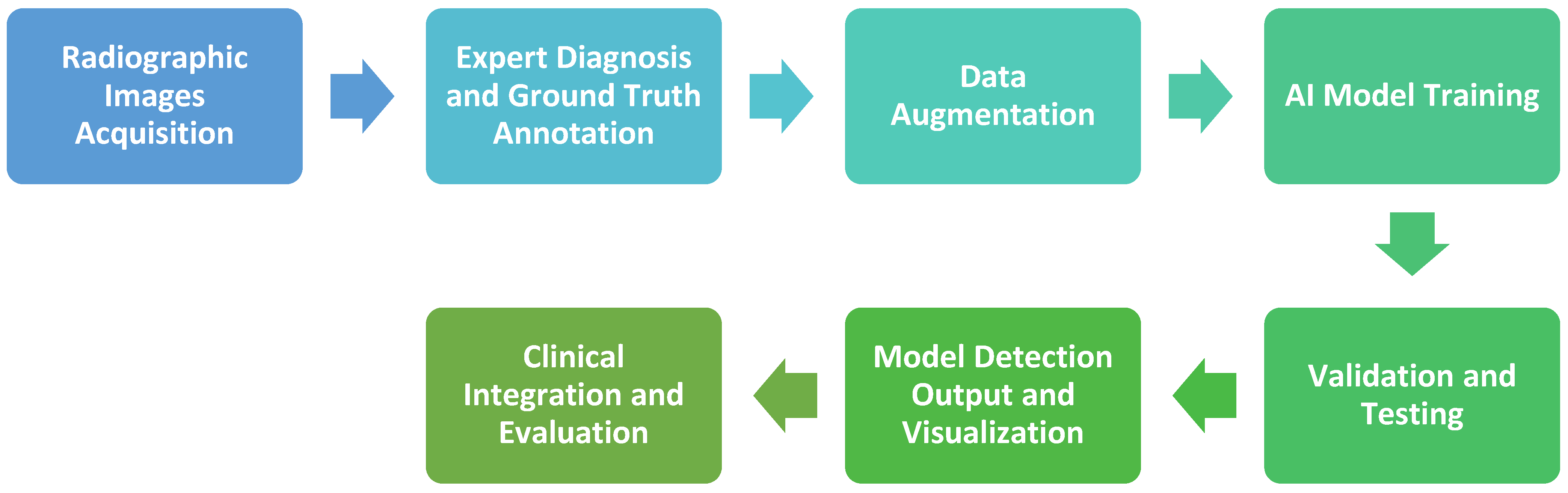
Detection of Periapical Lesions Using Artificial Intelligence: A Narrative Review

Abstract
1. Introduction
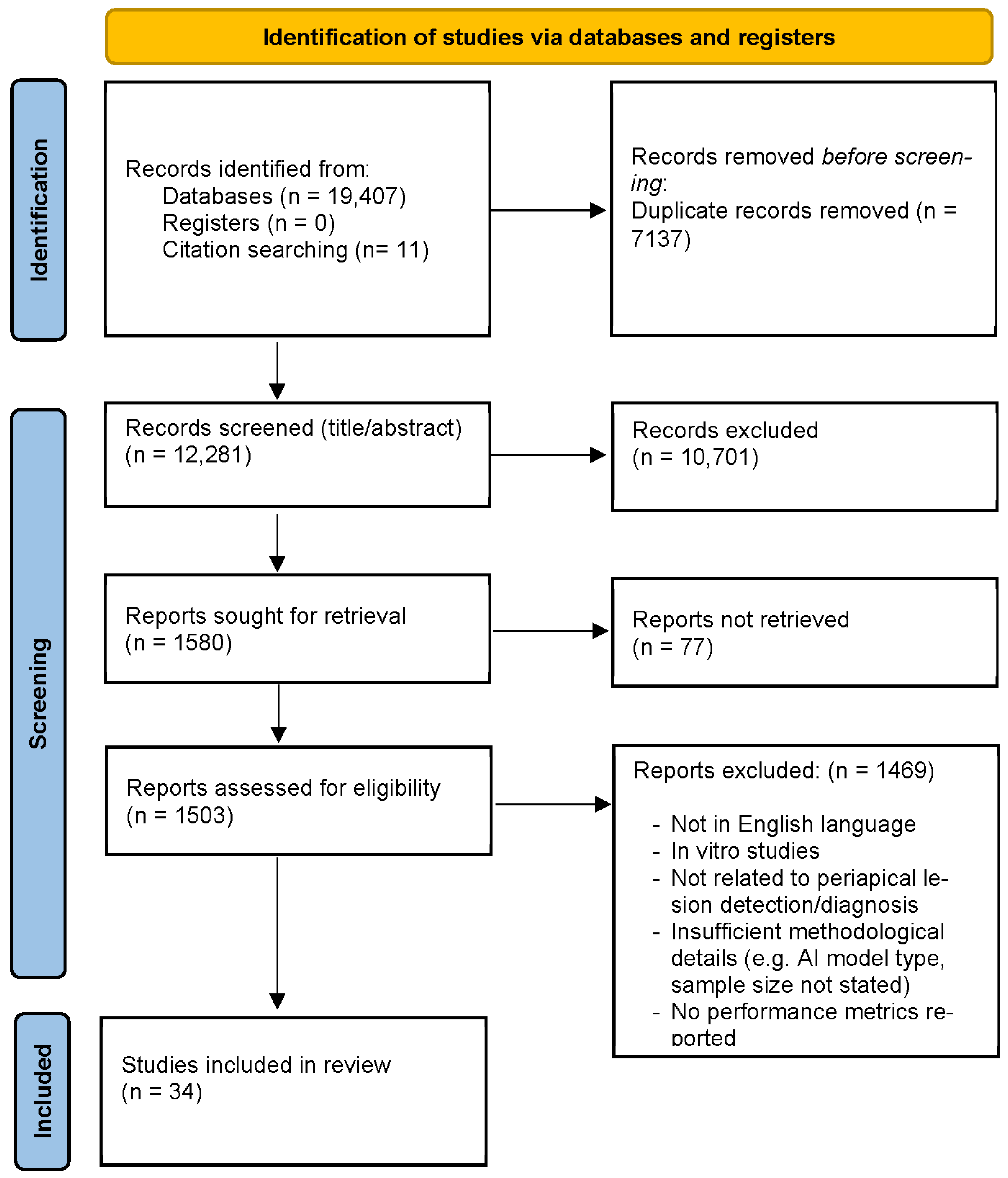
2. Methods of Literature Selection, Data Collection, and Synthesis
3. Results
3.1. AI-Based Systems Performance for Detecting Periapical Lesions Using Panoramic Images (OPG)

| Author (Year) | AI Model | Primary AI Model Task | Sample Number | Sensitivity | Specificity | Accuracy | Data Subgroups | Annotation of PALs |
|---|---|---|---|---|---|---|---|---|
| Krois et al. (2021) [28] | U-Net type, Deep CNN | Segmentation | 1300 OPG | 48.0% | 99.9% | NR | With or without root canal fillings and restorations | Four dental specialists and a master reviewer |
| Bayrakdar et al. (2022) [29] | U-Net (CranioCatch), Deep CNN | Segmentation | 470 OPG | 70% | NR | NR | None | Three expert dental radiologists |
| Kim et al. (2022) [23] | Fast R-CNN, Hybrid CNN | Detection + Classification | 10,000 OPG | 95.3% | 89.55 | Accuracy > 90% | 5 tooth-related diseases: Coronal, proximal, cervical caries, periapical radiolucency, and residual root | Expert maxillofacial radiologist |
| Zadrożny et al., (2022) [30] | Diagnocat, CNN | Classification | 30 OPGs | 39% | 98%% | NR | Different dental conditions (missing tooth, caries, filling, periapical lesion, periodontal bone loss, etc.) | Three independent evaluators with 12, 15, and 28 years of experience in dentistry |
| Song et al. (2022) [31] | U-Net (Deep CNN) | Segmentation | 180 Lesions (from 100 OPGs) | 82.6%, 80.8%, 74% (IoU intersection over union 0.3, 0.4, 0.5) | NR | NR | None | Three oral and maxillofacial radiologists (with >10 years of experience) |
| Güneç et al. (2023) [26] | DentisToday, CNN | Detection + Classification | 500 OPG | 97% | 63% | NR | Caries and Periapical lesions | Two specialist dentists with 10 years of experience |
| Ba-Hattab et al. (2023) [24] | Faster R-CNN detector + Inception-v3 classifier, Two-stage CNN | Detection + Classification | 713 OPG | 84.6% | 72.2% | 85.6% | None | Three examiners with >15 years of experience |
| Çelik et al. (2023) [25] | Faster R-CNN, RetinaNet, YOLOv3, SSD, Libra R-CNN, Dynamic R-CNN, Cascade R-CNN, FoveaBox, SABL, ATSS | Object Detection | 357 OPG | 0.743–0.918 across models (best: YOLOv3 = 0.918) | 0.76 (YOLOv3) | 0.673–0.812 | None | Oral and maxillofacial radiologist with >7 years of experience |
| İçöz et al. (2023) [32] | YOLOv3 Darknet model | Detection + Classification | 306 OPG | 98% | 56% (Precision) | NR | Maxilla vs. mandible Widened PL/uncertain AP vs. Clearly identified AP | oral and maxillofacial radiologists |
| Kazimierczak et al. (2024) [27] | Diagnocat, CNN | Object Detection | 49 OPG and CBCT from the same patients | OPG: 33.33% CBCT: 77.78%. | OPG: 98.43% CBCT: 99.83%. | OPG: 97.01% CBCT: 99.35% | None | Orthodontist and radiologist, each with >8 years of experience |
| Boztuna et al. (2024) [33] | U2-Net model, Deep U2-Net | Segmentation | 400 OPG | 85.4% | NR | 81% (F1-score) | None | A resident in oral and maxillofacial surgery and a dentomaxillofacial radiologist with >6 years of experience |
| Szabó et al. (2025) [34] | Diagnocat, CNN | Object Detection | 357 OPG | 78% | 100% | 89% | Group 1 (caries) Group 2 (coronal restoration) Group 3 (root-filled) | Two dentomaxillofacial radiologists (>10 years and >30 years of experience) |
| Pul et al. (2025) [35] | DentalXrai Pro, CNN | Detection + Classification | 50 OPG | 45.8% (AI-aided) vs. 46.0% (unaided). | 98.0% (AI-aided) vs. 95.7% (unaided). | 93.3% (AI-aided) vs. 91.6% (unaided) | Performance stratified by experience (junior ≤ 10 years, intermediate 11–15 years, senior > 15 years) | Two CBCT experts |
3.2. AI-Based Systems Performance for Detecting Periapical Lesions Using Intraoral Periapical Radiographs (IOPA)
| Author (Year) | AI Model | Primary AI Model Task | Sample Number | Sensitivity | Specificity | Accuracy | Data Subgroups | Annotation of PALs |
|---|---|---|---|---|---|---|---|---|
| Li et al. (2021) [36] | AlexNet/GoogLeNet/VGG19/ResNet50 | Classification | 460 images | 94.87% | 90.00% | 92.75% | None | Dental experts |
| Chen et al. (2021) [37] | Faster R-CNN | Object Detection and Classification | 2900 PA | 50–60% | NR | NR | Mild (<1 mm); Moderate (1–3 mm); Severe (>3 mm) | Manual bounding box labeling by a clinical expert (>5 years’ experience) |
| Ngoc et al. (2021) [38] | DentaVN | Object Detection | 130 radiographs | 89.5% | 97.9% | 95.6% | Teeth without root canal filling (Group I) and teeth with root canal filling (Group II) | Expert dentists |
| Hamdan et al. (2022) [39] | Denti.AI, Deep CNN | Object Detection | 68 periapical radiographs | 93.1% (by case) | 73.3% (by case) | NR | None | By CBCT confirmation |
| Moidu et al. (2022) [40] | YOLO version 3, CNN | Detection/Classification | 3000 periapical root areas | 92.1% | 76% | 86.3% | PAI scores 1–5 classified as healthy (1–2) vs. diseased (3–5) groups | Three endodontists |
| Ari et al. (2022) [41] | U-Net CNN (PyTorch library (version 1.4.0)) | Segmentation | 1169 periapical radiographs | 92% | NR | >90% | Multiple dental features segmented (caries, crowns, fillings, root fillings, PALs) | Research assistant (2 years) and dento-maxillofacial radiologist (12 years) |
| Chuo et al. (2022) [42] | AlexNet, GoogLeNet, ResNet50, ResNet101 | Object Detection | 490 periapical radiographs | 98.5% | 93.9% | Up to 96.21% | None | Dentists with >3 years of clinical experience |
| Issa et al. (2023) [43] | Diagnocat, CNN | Classification/Detection | 60 teeth, 20 periapical radiographs | 92.30% | 97.87% | 96.66% | Healthy vs. unhealthy | Oral and maxillofacial radiology expert (>10 years’ experience) and one trainee |
| Fatima et al. (2023) [44] | Lightweight Mask R-CNN with MobileNet-v2 Backbone | Segmentation | 534 periapical radiographs | NR | NR | 94% | Five lesion categories (primary endodontic, primary periodontal, secondary endo-perio, combined, etc.) | Expert radiologists and dentists |
| Nagareddy et al. (2024) [45] | Diagnocat, CNN | Object Detection | 30 anonymized digital periapical radiographs | 86.5% | 88.1% | 89.6% | NR | a senior oral-maxillofacial radiology expert + a trainee using the Periapical Index (PAI) |
| Wu et al. (2024) [46] | YOLOv8, CNN | Object detection + classification | 67 original periapical radiographs | 95% | NR | NR | Normal/Apical Lesion/Peri-endo Combined Lesion | Roboflow Annotation tool |
| Liu et al. (2025) [47] | ConvNeXt and ResNet34, CNN | Object Detection | 1305 PRs (1044 train, 261 validation, 800 test) | ConvNeXt: 98.49%; ResNet34: 84.38% | ConvNeXt: 84.11%; ResNet34: 78.13% | ConvNeXt: 91.25%; ResNet34: 81.63% | Novice dentists (A/B/C); diagnostic time reduction | Three oral radiologists (≥15 yr experience) |
| Allihaibi et al. (2025) [48] | Diagnocat, CNN | Detection + Classification | 339 teeth | 47.9% | 95.4% | 78.5% | None | Two calibrated endodontists and CBCT analysis |
| Ibraheem et al. (2025) [49] | Second Opinion, CNN-based CADe system | Object Detection | 300 periapical radiographs | 86.6% | 98.3% | NR | Evaluated 8 conditions (caries, PALs, crowns, restorations, etc.) | Two oral radiologists |
| Allihaibi et al. (2025) [50] | Diagnocat, CNN | Detection + Classification | 376 teeth | 67.3% (tooth level); 54.3% (root level) | 82.3% (tooth level); 86.7% (root level) | 76.3% (tooth level); 78.5% (root level) | Endodontic treatment outcomes (root-filled teeth) | Two experienced endodontists independently annotated; CBCT was used as the reference standard. |
3.3. AI-Based Systems Performance for Detecting Periapical Lesions Using Cone-Beam Computed Tomography (CBCT)
| Author (Year) | AI Model | Primary AI Model Task | Sample Number | Sensitivity | Specificity | Accuracy | Data Subgroups | Annotation of PALs |
|---|---|---|---|---|---|---|---|---|
| Hadzic et al. (2023) [56] | CNN is composed of SpatialConfiguration-Net and a modified U-Net | Detection and Segmentation | 195 CBCT | 86.7% | 84.3% | NR | Size: Periapical Index Score 1–5 | Two senior oral surgeons > 15 years of experience and one junior dentist |
| Fu et al. (2024) [55] | PAL-Net (3D CNN) | Detection and Segmentation | 279 CBCT | 97% | NR | NR | Volume mm3 | Two endodontists |
| Chau et al. (2025) [57] | CBCT-SAM without PPR | Detection and Segmentation | 185 CBCT | 68.31% | 99.88% | 98.9% | Upper/lower Incisors/canines /molars | Expert maxillofacial radiologist |
| CBCT-SAM | 72.36% | 99.87% | 98.9% | |||||
| Modified U-Net | 62.21% | 99.86% | 97.3% | |||||
| PAL-Net | 70.98% | 99.87% | 98.4% | |||||
| Allihaibi et al. (2025) [54] | Diagnocat, CNN | Detection | 134 molars (327 roots) | 93.9% | 65.2% | 79.1% | Lesion size S1 up to 3 mm S2 3–5 mm S3 > 5 mm | Two experienced endodontists |
| Calazans et al. (2022) [58] | DenseNet121 | Classification | 1000 CBCT slices, sagittal and coronal | 64.49% | 76.34% | 70% | -Without lesions -Lesions 0.5–1.9 mm in size -Lesions > 2 mm in size | A single oral and maxillofacial radiologist with 10 years of experience |
| VGG16 | 64.49% | 72.04% | 68% | |||||
| Kirnbauer et al. (2022) [12] | SpatialConfiguration-Net (localisation) + U-Net (segmentation), CNN | Classification and Segmentation | 144 CBCT | 97.1% | 88.0% | 97.3% | NR | Semi-automatic weighted total-variation segmentation; manual review and adjustment by oral-radiology surgeon |
3.4. Effect of Root Canal Filling Materials on AI Performance in CBCT Images Analysis
4. Cross Studies Trends in AI Performance
AI Assistance and Clinician Performance
5. Influence of Periapical Lesion Size on AI Performance
6. Influence of Tooth Type and Anatomical Surroundings on AI Performance
7. Conclusions
Funding
Institutional Review Board Statement
Informed Consent Statement
Data Availability Statement
Conflicts of Interest
References
- Nair, P.R. Light and electron microscopic studies of root canal flora and periapical lesions. J. Endod. 1987, 13, 29–39. [Google Scholar] [CrossRef]
- Ng, Y.L.; Mann, V.; Rahbaran, S.; Lewsey, J.; Gulabivala, K. Outcome of primary root canal treatment: Systematic review of the literature–Part 2. Influence of clinical factors. Int. Endod. J. 2008, 41, 6–31. [Google Scholar] [CrossRef]
- Ng, Y.L.; Mann, V.; Gulabivala, K. A prospective study of the factors affecting outcomes of nonsurgical root canal treatment: Part 1: Periapical health. Int. Endod. J. 2011, 44, 583–609. [Google Scholar] [CrossRef]
- Ekert, T.; Krois, J.; Meinhold, L.; Elhennawy, K.; Emara, R.; Golla, T.; Schwendicke, F. Deep learning for the radiographic detection of apical lesions. J. Endod. 2019, 45, 917–922. [Google Scholar] [CrossRef] [PubMed]
- Setzer, F.C.; Shi, K.J.; Zheng, Z.; Yan, H.; Yoon, H.; Mupparapu, M.; Li, J. Artificial intelligence for the computer-aided detection of periapical lesions in cone-beam computed tomographic images. J. Endod. 2020, 46, 987–993. [Google Scholar] [CrossRef] [PubMed]
- Cotti, E.; Schirru, E. Present status and future directions: Imaging techniques for the detection of periapical lesions. Int. Endod. J. 2022, 55, 1085–1099. [Google Scholar] [CrossRef] [PubMed]
- Kanagasingam, S.; Lim, C.X.; Yong, C.P.; Mannocci, F.; Patel, S. Diagnostic accuracy of periapical radiography and cone beam computed tomography in detecting apical periodontitis using histopathological findings as a reference standard. Int. Endod. J. 2017, 50, 417–426. [Google Scholar] [CrossRef]
- Lofthag-Hansen, S.; Huumonen, S.; Gröndahl, K.; Gröndahl, H.G. Limited cone-beam CT and intraoral radiography for the diagnosis of periapical pathology. Oral Surg. Oral Med. Oral Pathol. Oral Radiol. Endodontol. 2007, 103, 114–119. [Google Scholar] [CrossRef]
- Estrela, C.; Bueno, M.R.; Azevedo, B.C.; Azevedo, J.R.; Pécora, J.D. A new periapical index based on cone beam computed tomography. J. Endod. 2008, 34, 1325–1331. [Google Scholar] [CrossRef]
- Patel, S.; Durack, C.; Abella, F.; Shemesh, H.; Roig, M.; Lemberg, K. Cone beam computed tomography in endodontics—A review. Int. Endod. J. 2015, 48, 3–15. [Google Scholar] [CrossRef]
- Nardi, C.; Calistri, L.; Pradella, S.; Desideri, I.; Lorini, C.; Colagrande, S. Accuracy of orthopantomography for apical periodontitis without endodontic treatment. J. Endod. 2017, 43, 1640–1646. [Google Scholar] [CrossRef] [PubMed]
- Kirnbauer, B.; Hadzic, A.; Jakse, N.; Bischof, H.; Stern, D. Automatic detection of periapical osteolytic lesions on cone-beam computed tomography using deep convolutional neuronal networks. J. Endod. 2022, 48, 1434–1440. [Google Scholar] [CrossRef] [PubMed]
- Schwendicke, F.A.; Samek, W.; Krois, J. Artificial intelligence in dentistry: Chances and challenges. J. Dent. Res. 2020, 99, 769–774. [Google Scholar] [CrossRef] [PubMed]
- Ossowska, A.; Kusiak, A.; Świetlik, D. Artificial intelligence in dentistry—Narrative review. Int. J. Environ. Res. Public Health 2022, 19, 3449. [Google Scholar] [CrossRef]
- Pul, U.; Schwendicke, F. Artificial intelligence for detecting periapical radiolucencies: A systematic review and meta-analysis. J. Dent. 2024, 147, 105104. [Google Scholar] [CrossRef]
- Sadr, S.; Mohammad-Rahimi, H.; Motamedian, S.R.; Zahedrozegar, S.; Motie, P.; Vinayahalingam, S.; Dianat, O.; Nosrat, A. Deep learning for detection of periapical radiolucent lesions: A systematic review and meta-analysis of diagnostic test accuracy. J. Endod. 2023, 49, 248–261. [Google Scholar] [CrossRef]
- Bakhsh, A.A. A narrative review on the current uses of artificial intelligence in endodontics. Saudi Endod. J. 2024, 14, 164–171. [Google Scholar] [CrossRef]
- Dennis, D.; Suebnukarn, S.; Heo, M.S.; Abidin, T.; Nurliza, C.; Yanti, N.; Farahanny, W.; Prasetia, W.; Batubara, F.Y. Artificial intelligence application in endodontics: A narrative review. Imaging Sci. Dent. 2024, 54, 305. [Google Scholar] [CrossRef]
- Asiri, A.F.; Altuwalah, A.S. The role of neural artificial intelligence for diagnosis and treatment planning in endodontics: A qualitative review. Saudi Dent. J. 2022, 34, 270–281. [Google Scholar] [CrossRef]
- Bansal, R.K.; Arya, A.; Singh, B.; Singla, M. Comparative Efficiency of Artificial Intelligence in Detecting Periapical Lesions Using Periapical Radiographs, Orthopantomogram, and Cone-beam Computed Tomography: A Scoping Review. Indian J. Dent. Sci. 2025, 17, 32–37. [Google Scholar] [CrossRef]
- White, S.C.; Pharoah, M.J. Oral Radiology-E-Book: Principles and Interpretation; Elsevier Health Sciences: St. Louis, MO, USA, 2014. [Google Scholar]
- Bayrakdar, I.S.; Bilgir, E.; Kuran, A.; Celik, O.; Orhan, K. Artificial intelligence in panoramic radiography interpretation: A glimpse into the state-of-the-art radiologic examination method. Int. J. Comput. Dent. 2025, 28, 309. [Google Scholar]
- Kim, C.; Jeong, H.; Park, W.; Kim, D. Tooth-related disease detection system based on panoramic images and optimization through automation: Development study. JMIR Med. Inform. 2022, 10, e38640. [Google Scholar] [CrossRef] [PubMed]
- Ba-Hattab, R.; Barhom, N.; Osman, S.A.; Naceur, I.; Odeh, A.; Asad, A.; Al-Najdi, S.A.; Ameri, E.; Daer, A.; Silva, R.L.; et al. Detection of periapical lesions on panoramic radiographs using deep learning. Appl. Sci. 2023, 13, 1516. [Google Scholar] [CrossRef]
- Çelik, B.; Savaştaer, E.F.; Kaya, H.I.; Çelik, M.E. The role of deep learning for periapical lesion detection on panoramic radiographs. Dentomaxillofacial Radiol. 2023, 52, 20230118. [Google Scholar] [CrossRef]
- Güneç, H.G.; Ürkmez, E.Ş.; Danaci, A.; Dilmaç, E.; Onay, H.H.; Aydin, K.C. Comparison of artificial intelligence vs. junior dentists’ diagnostic performance based on caries and periapical infection detection on panoramic images. Quant. Imaging Med. Surg. 2023, 13, 7494. [Google Scholar] [CrossRef]
- Kazimierczak, W.; Wajer, R.; Wajer, A.; Kiian, V.; Kloska, A.; Kazimierczak, N.; Janiszewska-Olszowska, J.; Serafin, Z. Periapical lesions in panoramic radiography and CBCT imaging—Assessment of AI’s diagnostic accuracy. J. Clin. Med. 2024, 13, 2709. [Google Scholar] [CrossRef]
- Krois, J.; Garcia Cantu, A.; Chaurasia, A.; Patil, R.; Chaudhari, P.K.; Gaudin, R.; Gehrung, S.; Schwendicke, F. Generalizability of deep learning models for dental image analysis. Sci. Rep. 2021, 11, 6102. [Google Scholar] [CrossRef]
- Bayrakdar, I.S.; Orhan, K.; Çelik, Ö.; Bilgir, E.; Sağlam, H.; Kaplan, F.A.; Görür, S.A.; Odabaş, A.; Aslan, A.F.; Różyło-Kalinowska, I. AU-net approach to apical lesion segmentation on panoramic radiographs. BioMed. Res. Int. 2022, 2022, 7035367. [Google Scholar] [CrossRef]
- Zadrożny, Ł.; Regulski, P.; Brus-Sawczuk, K.; Czajkowska, M.; Parkanyi, L.; Ganz, S.; Mijiritsky, E. Artificial intelligence application in assessment of panoramic radiographs. Diagnostics 2022, 12, 224. [Google Scholar] [CrossRef]
- Song, I.S.; Shin, H.K.; Kang, J.H.; Kim, J.E.; Huh, K.H.; Yi, W.J.; Lee, S.S.; Heo, M.S. Deep learning-based apical lesion segmentation from panoramic radiographs. Imaging Sci. Dent. 2022, 52, 351. [Google Scholar] [CrossRef] [PubMed]
- İçöz, D.; Terzioğlu, H.; Özel, M.A.; Karakurt, R. Evaluation of an artificial intelligence system for the diagnosis of apical periodontitis on digital panoramic images. Niger. J. Clin. Pract. 2023, 26, 1085–1090. [Google Scholar] [CrossRef] [PubMed]
- Boztuna, M.; Firincioglulari, M.; Akkaya, N.; Orhan, K. Segmentation of periapical lesions with automatic deep learning on panoramic radiographs: An artificial intelligence study. BMC Oral Health 2024, 24, 1332. [Google Scholar] [CrossRef] [PubMed]
- Szabó, V.; Orhan, K.; Dobó-Nagy, C.; Veres, D.S.; Manulis, D.; Ezhov, M.; Sanders, A.; Szabó, B.T. Deep Learning-Based Periapical Lesion Detection on Panoramic Radiographs. Diagnostics 2025, 15, 510. [Google Scholar] [CrossRef]
- Pul, U.; Tichy, A.; Pitchika, V.; Schwendicke, F. Impact of Artificial Intelligence Assistance on Diagnosing Periapical Radiolucencies: A Randomized Controlled Trial. J. Dent. 2025, 160, 105868. [Google Scholar] [CrossRef]
- Li, C.W.; Lin, S.Y.; Chou, H.S.; Chen, T.Y.; Chen, Y.A.; Liu, S.Y.; Liu, Y.L.; Chen, C.A.; Huang, Y.C.; Chen, S.L.; et al. Detection of dental apical lesions using CNNs on periapical radiograph. Sensors 2021, 21, 7049. [Google Scholar] [CrossRef]
- Chen, H.; Li, H.; Zhao, Y.; Zhao, J.; Wang, Y. Dental disease detection on periapical radiographs based on deep convolutional neural networks. Int. J. Comput. Assist. Radiol. Surg. 2021, 16, 649–661. [Google Scholar] [CrossRef]
- Ngoc, V.T.; Viet, D.H.; Anh, L.K.; Minh, D.Q.; Nghia, L.L.; Loan, H.K.; Tuan, T.M.; Ngan, T.T.; Tra, N.T. Periapical lesion diagnosis support system based on X-ray images using machine learning technique. World J. Dent. 2021, 12, 189–193. [Google Scholar] [CrossRef]
- Hamdan, M.H.; Tuzova, L.; Mol, A.; Tawil, P.Z.; Tuzoff, D.; Tyndall, D.A. The effect of a deep-learning tool on dentists’ performances in detecting apical radiolucencies on periapical radiographs. Dentomaxillofacial Radiol. 2022, 51, 20220122. [Google Scholar] [CrossRef]
- Moidu, N.P.; Sharma, S.; Chawla, A.; Kumar, V.; Logani, A. Deep learning for categorization of endodontic lesion based on radiographic periapical index scoring system. Clin. Oral Investig. 2022, 26, 651–658. [Google Scholar] [CrossRef]
- Ari, T.; Sağlam, H.; Öksüzoğlu, H.; Kazan, O.; Bayrakdar, İ.Ş.; Duman, S.B.; Çelik, Ö.; Jagtap, R.; Futyma-Gąbka, K.; Różyło-Kalinowska, I.; et al. Automatic feature segmentation in dental periapical radiographs. Diagnostics 2022, 12, 3081. [Google Scholar] [CrossRef] [PubMed]
- Chuo, Y.; Lin, W.M.; Chen, T.Y.; Chan, M.L.; Chang, Y.S.; Lin, Y.R.; Lin, Y.J.; Shao, Y.H.; Chen, C.A.; Chen, S.L.; et al. A high-accuracy detection system: Based on transfer learning for apical lesions on periapical radiograph. Bioengineering 2022, 9, 777. [Google Scholar] [CrossRef] [PubMed]
- Issa, J.; Jaber, M.; Rifai, I.; Mozdziak, P.; Kempisty, B.; Dyszkiewicz-Konwińska, M. Diagnostic test accuracy of artificial intelligence in detecting periapical periodontitis on two-dimensional radiographs: A retrospective study and literature review. Medicina 2023, 59, 768. [Google Scholar] [CrossRef] [PubMed]
- Fatima, A.; Shafi, I.; Afzal, H.; Mahmood, K.; Díez, I.D.; Lipari, V.; Ballester, J.B.; Ashraf, I. Deep learning-based multiclass instance segmentation for dental lesion detection. Healthcare 2023, 11, 347. [Google Scholar] [CrossRef]
- Nagareddy, B.; Vadlamani, R.; Venkannagari, N.R.; Jain, S.; Basheer, S.N.; Murugesan, S. Comparison of the artificial intelligence versus traditional radiographic interpretation in detecting periapical periodontitis: A diagnostic accuracy study. J. Pharm. Bioallied Sci. 2024, 16, S3676–S3678. [Google Scholar] [CrossRef]
- Wu, P.Y.; Mao, Y.C.; Lin, Y.J.; Li, X.H.; Ku, L.T.; Li, K.C.; Chen, C.A.; Chen, T.Y.; Chen, S.L.; Tu, W.C.; et al. Precision Medicine for Apical Lesions and Peri-Endo Combined Lesions Based on Transfer Learning Using Periapical Radiographs. Bioengineering 2024, 11, 877. [Google Scholar] [CrossRef]
- Liu, J.; Jin, C.; Wang, X.; Pan, K.; Li, Z.; Yi, X.; Shao, Y.; Sun, X.; Yu, X. A comparative analysis of deep learning models for assisting in the diagnosis of periapical lesions in periapical radiographs. BMC Oral Health 2025, 25, 801. [Google Scholar] [CrossRef]
- Allihaibi, M.; Koller, G.; Mannocci, F. The detection of apical radiolucencies in periapical radiographs: A comparison between an artificial intelligence platform and expert endodontists with CBCT serving as the diagnostic benchmark. Int. Endod. J. 2025, 58, 1146–1157. [Google Scholar] [CrossRef]
- Ibraheem, W.I.; Jain, S.; Ayoub, M.N.; Namazi, M.A.; Alfaqih, A.I.; Aggarwal, A.; Meshni, A.A.; Almarghlani, A.; Alhumaidan, A.A. Assessment of the Diagnostic Accuracy of Artificial Intelligence Software in Identifying Common Periodontal and Restorative Dental Conditions (Marginal Bone Loss, Periapical Lesion, Crown, Restoration, Dental Caries) in Intraoral Periapical Radiographs. Diagnostics 2025, 15, 1432. [Google Scholar] [CrossRef]
- Allihaibi, M.; Koller, G.; Mannocci, F. Diagnostic accuracy of a commercial AI-based platform in evaluating endodontic treatment outcomes on periapical radiographs using CBCT as the reference standard. J. Endod. 2025, 51, 898–908.e8. [Google Scholar] [CrossRef]
- De Paula-Silva, F.W.; Wu, M.K.; Leonardo, M.R.; da Silva, L.A.; Wesselink, P.R. Accuracy of periapical radiography and cone-beam computed tomography scans in diagnosing apical periodontitis using histopathological findings as a gold standard. J. Endod. 2009, 35, 1009–1012. [Google Scholar] [CrossRef] [PubMed]
- Kruse, C.; Spin-Neto, R.; Evar Kraft, D.C.; Vaeth, M.; Kirkevang, L.L. Diagnostic accuracy of cone beam computed tomography used for assessment of apical periodontitis: An ex vivo histopathological study on human cadavers. Int. Endod. J. 2019, 52, 439–450. [Google Scholar] [CrossRef] [PubMed]
- Parker, J.M.; Mol, A.; Rivera, E.M.; Tawil, P.Z. Cone-beam computed tomography uses in clinical endodontics: Observer variability in detecting periapical lesions. J. Endod. 2017, 43, 184–187. [Google Scholar] [CrossRef] [PubMed]
- Allihaibi, M.; Koller, G.; Mannocci, F. Diagnostic Accuracy of an Artificial Intelligence-based Platform in Detecting Periapical Radiolucencies on Cone-Beam Computed Tomography Scans of Molars. J. Dent. 2025, 160, 105854. [Google Scholar] [CrossRef]
- Fu, W.T.; Zhu, Q.K.; Li, N.; Wang, Y.Q.; Deng, S.L.; Chen, H.P.; Shen, J.; Meng, L.Y.; Bian, Z. Clinically oriented CBCT periapical lesion evaluation via 3D CNN algorithm. J. Dent. Res. 2024, 103, 5–12. [Google Scholar] [CrossRef]
- Hadzic, A.; Urschler, M.; Press, J.N.; Riedl, R.; Rugani, P.; Štern, D.; Kirnbauer, B. Evaluating a Periapical Lesion Detection CNN on a Clinically Representative CBCT Dataset—A Validation Study. J. Clin. Med. 2023, 13, 197. [Google Scholar] [CrossRef]
- Chau, K.K.; Zhu, M.; AlHadidi, A.; Wang, C.; Hung, K.; Wohlgemuth, P.; Lam, W.Y.; Liu, W.; Yuan, Y.; Chen, H. A novel AI model for detecting periapical lesion on CBCT: CBCT-SAM. J. Dent. 2025, 153, 105526. [Google Scholar] [CrossRef]
- Calazans, M.A.; Ferreira, F.A.; Alcoforado, M.D.; Santos, A.D.; Pontual, A.D.; Madeiro, F. Automatic classification system for periapical lesions in cone-beam computed tomography. Sensors 2022, 22, 6481. [Google Scholar] [CrossRef]


Disclaimer/Publisher’s Note: The statements, opinions and data contained in all publications are solely those of the individual author(s) and contributor(s) and not of MDPI and/or the editor(s). MDPI and/or the editor(s) disclaim responsibility for any injury to people or property resulting from any ideas, methods, instructions or products referred to in the content. |
© 2026 by the author. Licensee MDPI, Basel, Switzerland. This article is an open access article distributed under the terms and conditions of the Creative Commons Attribution (CC BY) license.
Share and Cite
Aloufi, A.S. Detection of Periapical Lesions Using Artificial Intelligence: A Narrative Review. Diagnostics 2026, 16, 301. https://doi.org/10.3390/diagnostics16020301
Aloufi AS. Detection of Periapical Lesions Using Artificial Intelligence: A Narrative Review. Diagnostics. 2026; 16(2):301. https://doi.org/10.3390/diagnostics16020301
Chicago/Turabian StyleAloufi, Alaa Saud. 2026. "Detection of Periapical Lesions Using Artificial Intelligence: A Narrative Review" Diagnostics 16, no. 2: 301. https://doi.org/10.3390/diagnostics16020301
APA StyleAloufi, A. S. (2026). Detection of Periapical Lesions Using Artificial Intelligence: A Narrative Review. Diagnostics, 16(2), 301. https://doi.org/10.3390/diagnostics16020301