Evolving Paradigms in Gastric Cancer Staging: From Conventional Imaging to Advanced MRI and Artificial Intelligence

 , , , ,
Abstract
1. Introduction
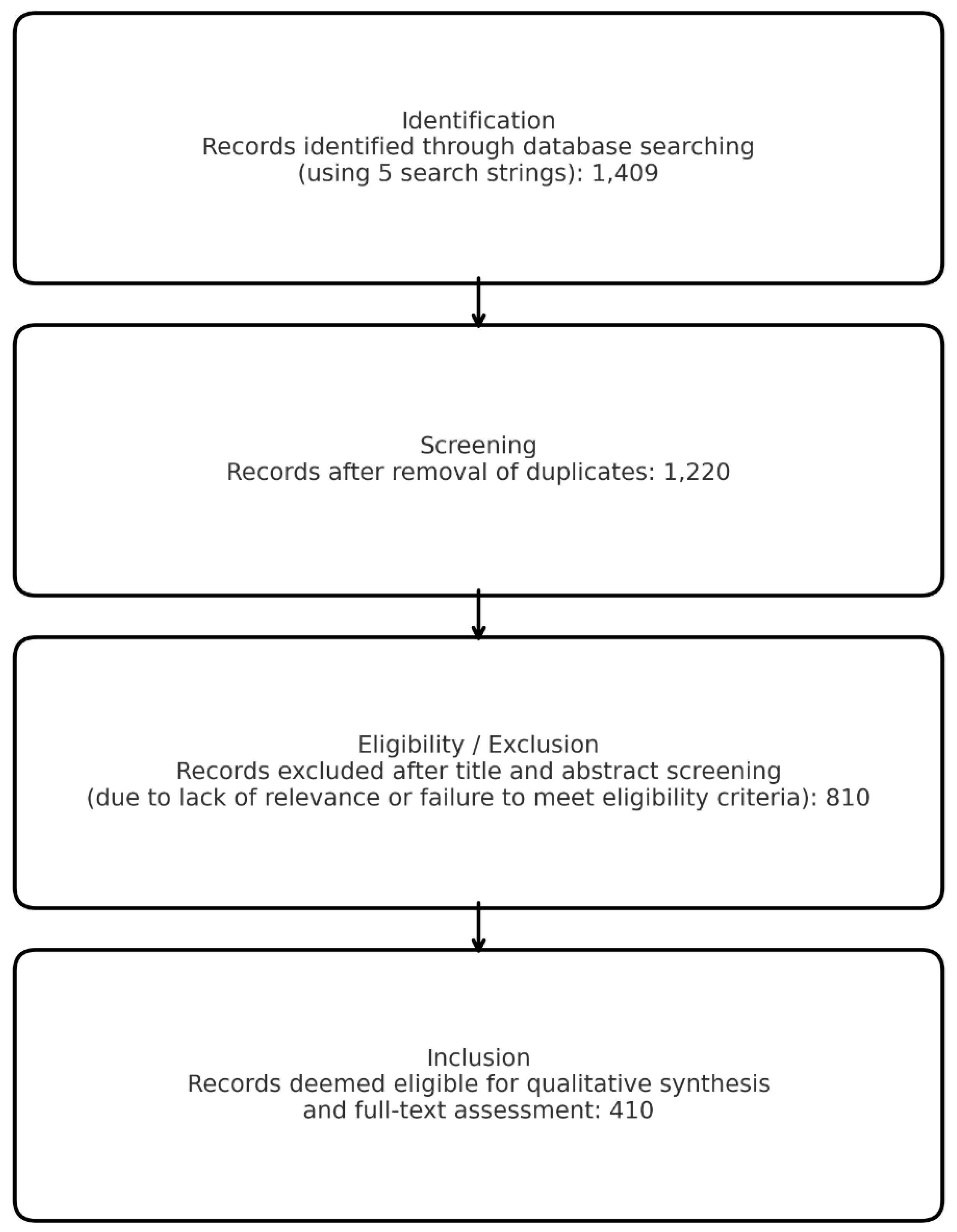
2. Literature Search Strategy and Selection
2.1. Study Selection
- (1)
- [gastric cancer AND (“CT” OR “computed tomography”) AND (“staging” OR “diagnostic accuracy”)].
- (2)
- [gastric cancer AND (“EUS” OR “endoscopic ultrasound”) AND (“T staging”)].
- (3)
- [gastric cancer AND (“PET” OR “FDG PET/CT” OR “FAPI”) AND (“lymph node” OR “metastasis”)].
- (4)
- [gastric cancer AND (“MRI” OR “DWI” OR “IVIM” OR “DCE-MRI”) AND (“staging” OR “peritoneal metastasis”)].
- (5)
- [gastric cancer AND (“radiomics” OR “artificial intelligence” OR “machine learning”) AND (“staging” OR “prediction”)].
2.2. Inclusion Criteria
2.3. Exclusion Criteria
2.4. Final Dataset
- (1)
- CT-based staging and radiomics (including Δ-radiomics and lymph-node prediction models);
- (2)
- EUS performance for T staging and early gastric cancer stratification;
- (3)
- PET/CT and PET/MRI (FDG and FAPI) for nodal and metastatic assessment;
- (4)
- MRI techniques, including DWI, perfusion imaging, and comparative accuracy vs. CT and EUS;
- (5)
- Hybrid or multimodality approaches, including radiomics-based fusion models;
- (6)
- High-quality meta-analyses relevant to each imaging domain.
3. Results
3.1. Overview of Included Studies
3.2. CT-Based Staging Performance
3.2.1. T Staging with Contrast-Enhanced CT
3.2.2. Limitations in Diffuse Histotypes
3.3. EUS Performance in T Staging
3.4. EUS After Neoadjuvant Therapy
3.5. PET/CT and PET/MRI Findings
3.5.1. FDG PET/CT Sensitivity for T and N Staging
3.5.2. Detection of Distant Metastases (M Staging)
3.5.3. FAPI PET
3.5.4. PET/MRI
3.6. MRI and Diffusion-Weighted Imaging (DWI/IVIM)
3.6.1. DWI, ADC, and IVIM Metrics
3.6.2. DCE-MRI and Perfusion Analysis
3.6.3. Whole-Body DWI (WB-DWI/MRI)
3.6.4. Integrated Modality Evaluation and Multimodality Trends
3.6.5. Histotype-Driven Diagnostic Variability
3.6.6. Summary of Key Evidence
4. Discussion
4.1. CT as First-Line Modality: Essential but Insufficient in Challenging Scenarios
4.2. EUS Retains Superiority for Early T Staging but Is Limited in Advanced Disease
4.3. PET/CT and Emerging PET Tracers: High Specificity, Limited Sensitivity in Diffuse Histotypes
4.4. MRI: The Most Promising Modality for Future Staging Algorithms
4.4.1. Superior Soft-Tissue Characterization
4.4.2. Quantitative Biomarkers: ADC, DWI, and IVIM
4.4.3. MRI for Nodal Staging
4.4.4. MRI for Peritoneal Metastases
4.4.5. MRI After Neoadjuvant Therapy
4.4.6. Radiomics and Artificial Intelligence: Toward Precision Imaging in GC
4.4.7. Current Challenges and Pitfalls in AI-Driven Staging
4.4.8. Influence of Histotype on Imaging Accuracy
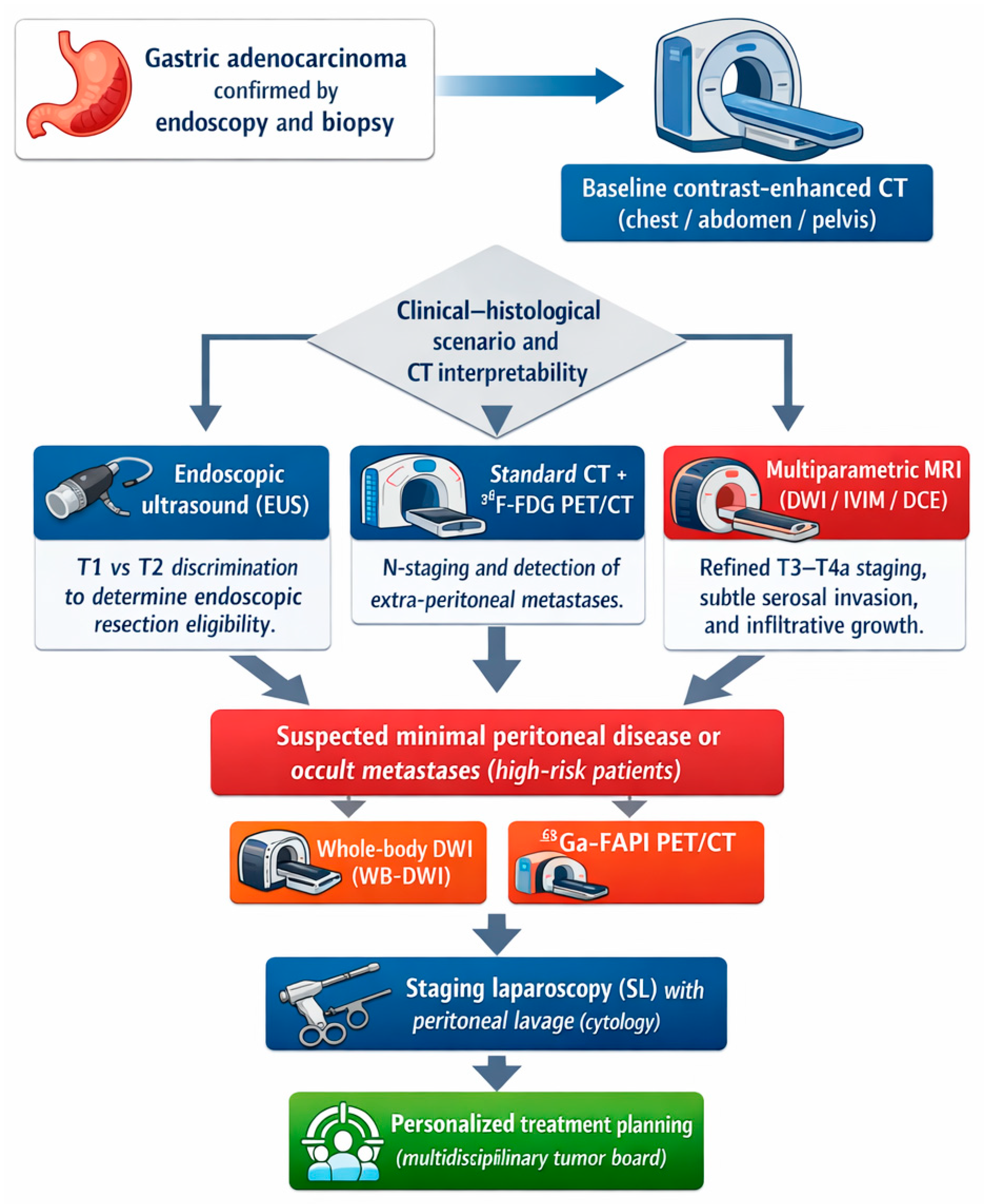
4.4.9. Integrated Multimodality Approach: Redefining the Staging Workflow
4.4.10. Key Gaps and Future Directions
4.4.11. Summary of Implications
5. Conclusions
Author Contributions
Funding
Institutional Review Board Statement
Informed Consent Statement
Data Availability Statement
Acknowledgments
Conflicts of Interest
References
- López Sala, P.; Leturia Etxeberria, M.; Inchausti Iguíñiz, E.; Astiazaran Rodríguez, A.; Aguirre Oteiza, M.I.; Zubizarreta Etxaniz, M. Gastric adenocarcinoma: A review of the TNM classification system and ways of spreading. Radiologia (Engl. Ed.) 2023, 65, 66–80. [Google Scholar] [CrossRef]
- Hayes, T.; Smyth, E.; Riddell, A.; Allum, W. Staging in Esophageal and Gastric Cancers. Hematol. Oncol. Clin. N. Am. 2017, 31, 427–440. [Google Scholar] [CrossRef] [PubMed]
- Coburn, N.; Cosby, R.; Klein, L.; Knight, G.; Malthaner, R.; Mamazza, J.; Mercer, C.D.; Ringash, J. Staging and surgical approaches in gastric cancer: A systematic review. Cancer Treat. Rev. 2018, 63, 104–115. [Google Scholar] [CrossRef]
- Badgwell, B.; Das, P.; Ajani, J. Treatment of localized gastric and gastroesophageal adenocarcinoma: The role of accurate staging and preoperative therapy. J. Hematol. Oncol. 2017, 10, 149. [Google Scholar] [CrossRef]
- Fabbi, M.; Milani, M.S.; Giacopuzzi, S.; De Werra, C.; Roviello, F.; Santangelo, C.; Galli, F.; Benevento, A.; Rausei, S. Adherence to Guidelines for Diagnosis, Staging, and Treatment for Gastric Cancer in Italy According to the View of Surgeons and Patients. J. Clin. Med. 2024, 13, 4240. [Google Scholar] [CrossRef]
- Coburn, N.; Cosby, R.; Klein, L.; Knight, G.; Malthaner, R.; Mamazza, J.; Mercer, C.D.; Ringash, J. Staging and surgical approaches in gastric cancer: A clinical practice guideline. Curr. Oncol. 2017, 24, 324–331. [Google Scholar] [CrossRef]
- Shimada, H.; Fukagawa, T.; Haga, Y.; Okazumi, S.I.; Oba, K. Clinical TNM staging for esophageal, gastric, and colorectal cancers in the era of neoadjuvant therapy: A systematic review of the literature. Ann. Gastroenterol. Surg. 2021, 5, 404–418. [Google Scholar] [CrossRef]
- Graziosi, L.; Marino, E.; Donini, A. Survival comparison in gastric cancer patients between 7th and 8th edition of the AJCC TNM staging system: The first western single center experience. Eur. J. Surg. Oncol. 2019, 45, 1105–1108. [Google Scholar] [PubMed]
- Tang, C.; Pan, Q.; Xu, Z.; Zhou, X.; Wang, Y. Gastric schwannoma with giant ulcer and lymphadenopathy mimicking gastric cancer: A case report. BMC Gastroenterol. 2020, 20, 36. [Google Scholar] [CrossRef] [PubMed]
- Mikami, J.; Kimura, Y.; Makari, Y.; Fujita, J.; Kishimoto, T.; Sawada, G.; Nakahira, S.; Nakata, K.; Tsujie, M.; Ohzato, H. Clinical outcomes and prognostic factors for gastric cancer patients with bone metastasis. World J. Surg. Oncol. 2017, 15, 8. [Google Scholar] [CrossRef]
- Wang, Y.; Zhang, J.; Guo, S.; Dong, Z.; Meng, X.; Zheng, G.; Yang, D.; Zheng, Z.; Zhao, Y. Implication of lymph node staging in migration and different treatment strategies for stage T2N0M0 and T1N1M0 resected gastric cancer: A SEER population analysis. Clin. Transl. Oncol. 2019, 21, 1499–1509. [Google Scholar]
- Park, J.M.; Kim, M.K.; Chi, K.C.; Kim, J.H.; Lee, S.H.; Lee, E.J. Aberrant loss of dickkopf-3 in gastric cancer: Can it predict lymph node metastasis preoperatively? World J. Surg. 2015, 39, 1018–1025. [Google Scholar] [CrossRef]
- Kosuga, T.; Konishi, T.; Kubota, T.; Shoda, K.; Konishi, H.; Shiozaki, A.; Okamoto, K.; Fujiwara, H.; Kudou, M.; Arita, T.; et al. Value of Prognostic Nutritional Index as a Predictor of Lymph Node Metastasis in Gastric Cancer. Anticancer Res. 2019, 39, 6843–6849. [Google Scholar] [CrossRef]
- Li, J.H.; Shen, W.Z.; Gu, X.Q.; Hong, W.K.; Wang, Z.Q. Prognostic value of EUS combined with MSCT in predicting the recurrence and metastasis of patients with gastric cancer. Jpn J. Clin. Oncol. 2017, 47, 487–493. [Google Scholar] [CrossRef][Green Version]
- Birla, R.; Gandea, C.; Hoara, P.; Caragui, A.; Marica, C.; Vasiliu, E.; Constantinoiu, S. Clinical and Therapeutic Implications of the 8th Edition TNM Classification of Adenocarcinomas of the Esophagogastric Junction. Chirurgia 2018, 113, 747–757. [Google Scholar] [CrossRef]
- Nonoshita, T.; Otsuka, S.; Inagaki, M.; Iwagaki, H. Complete Response Obtained with S-1 Plus CDDP Therapy in a Patient with Multiple Liver Metastases from Gastric Cancer. Hiroshima J. Med. Sci. 2015, 64, 65–69. [Google Scholar] [PubMed]
- Morgagni, P.; Bencivenga, M.; Carneiro, F.; Cascinu, S.; Derks, S.; Di Bartolomeo, M.; Donohoe, C.; Eveno, C.; Gisbertz, S.; Grimminger, P.; et al. International consensus on the management of metastatic gastric cancer: Step by step in the foggy landscape: Bertinoro Workshop, November 2022. Gastric Cancer 2024, 27, 649–671. [Google Scholar] [PubMed]
- Fujiya, K.; Tokunaga, M.; Makuuchi, R.; Nishiwaki, N.; Omori, H.; Takagi, W.; Hirata, F.; Hikage, M.; Tanizawa, Y.; Bando, E.; et al. Early detection of nonperitoneal recurrence may contribute to survival benefit after curative gastrectomy for gastric cancer. Gastric Cancer 2017, 20, 141–149. [Google Scholar]
- Hori, S.; Honda, M.; Kobayashi, H.; Kawamura, H.; Takiguchi, K.; Muto, A.; Yamazaki, S.; Teranishi, Y.; Shiraso, S.; Kono, K.; et al. A grading system for predicting the prognosis of gastric cancer with liver metastasis. Jpn J. Clin. Oncol. 2021, 51, 1601–1607. [Google Scholar] [PubMed]
- Li, B.; Zhang, F.; Niu, Q.; Liu, J.; Yu, Y.; Wang, P.; Zhang, S.; Zhang, H.; Wang, Z. A molecular classification of gastric cancer associated with distinct clinical outcomes and validated by an XGBoost-based prediction model. Mol. Ther. Nucleic Acids 2023, 31, 224–240. [Google Scholar] [CrossRef]
- Fuchs, C.S.; Niedzwiecki, D.; Mamon, H.J.; Tepper, J.E.; Ye, X.; Swanson, R.S.; Enzinger, P.C.; Haller, D.G.; Dragovich, T.; Alberts, S.R.; et al. Adjuvant Chemoradiotherapy with Epirubicin, Cisplatin, and Fluorouracil Compared with Adjuvant Chemoradiotherapy with Fluorouracil and Leucovorin After Curative Resection of Gastric Cancer: Results from CALGB 80101 (Alliance). J. Clin. Oncol. 2017, 35, 3671–3677. [Google Scholar] [CrossRef]
- Shen, L.L.; Zheng, H.L.; Ding, F.H.; Lu, J.; Chen, Q.Y.; Xu, B.B.; Xue, Z.; Lin, J.; Huang, C.M.; Zheng, C.H. Delta computed tomography radiomics features-based nomogram predicts long-term efficacy after neoadjuvant chemotherapy in advanced gastric cancer. Radiol. Med. 2023, 128, 402–414. [Google Scholar]
- Dilawar, H.; Ahmed, A.; Habib, S.; Iqbal, J.; Abdul Rehman, T.; Hadi, I.; Nisa, N.; Fatima, S. Gastric Metastasis from Invasive Lobular Breast Cancer, Resembling Primary Gastric Cancer. J. Nucl. Med. Technol. 2024, 52, 68–70. [Google Scholar]
- Murokawa, T.; Sakamoto, S.; Tabuchi, M.; Sui, K.; Ozaki, K.; Matsumoto, M.; Iwata, J.; Okabayashi, T.; Yoshida, H. Favorable Outcome of Repeated Salvage Surgeries for Rare Metastasis to the Ligamentum Teres Hepatis and the Upper Abdominal Wall in a Stage IV Gastric Cancer Patient. Acta Med. Okayama 2023, 77, 553–559. [Google Scholar]
- Li, W.; Zhu, H.; Dong, H.Z.; Qin, Z.K.; Huang, F.L.; Yu, Z.; Liu, S.Y.; Wang, Z.; Chen, J.Q. Impact of body composition parameters, age, and tumor staging on gastric cancer prognosis. Eur. J. Cancer Prev. 2025, 34, 267–275. [Google Scholar] [PubMed]
- Arslan, H.; Fatih Özbay, M.; Çallı, İ.; Doğan, E.; Çelik, S.; Batur, A.; Bora, A.; Yavuz, A.; Bulut, M.D.; Özgökçe, M.; et al. Contribution of diffusion weighted MRI to diagnosis and staging in gastric tumors and comparison with multi-detector computed tomography. Radiol. Oncol. 2017, 51, 23–29. [Google Scholar] [CrossRef] [PubMed]
- Joo, I.; Lee, J.M.; Kim, J.H.; Shin, C.I.; Han, J.K.; Choi, B.I. Prospective comparison of 3T MRI with diffusion-weighted imaging and MDCT for the preoperative TNM staging of gastric cancer. J. Magn. Reson. Imaging 2015, 41, 814–821. [Google Scholar] [CrossRef]
- Zhang, H.Y.; Aimaiti, M.; Bai, L.; Yuan, M.Q.; Zhu, C.C.; Yan, J.J.; Cai, J.H.; Dong, Z.Y.; Zhang, Z.Z. Bi-phase CT radiomics nomogram for the preoperative prediction of pylorus lymph node metastasis in non-pyloric gastric cancer patients. Abdom. Radiol. 2025, 50, 608–618. [Google Scholar] [CrossRef]
- Küpeli, A.; Bulut, E.; Cansu, A.; Güner, A.; Soytürk, M.; Danışan, G. Contribution of DECT in detecting serosal invasion of gastric cancer. Turk. J. Med. Sci. 2019, 49, 782–788. [Google Scholar]
- Song, L.; Jin, Z.; Zhang, W.; Zhang, Y. Gastric large cell neuroendocrine carcinoma with venous tumor thrombus: The value of PET/CT and contrast-enhanced computed tomography. Clin. Imaging 2015, 39, 325–328. [Google Scholar] [CrossRef]
- Chen, H.; Pang, Y.; Li, J.; Kang, F.; Xu, W.; Meng, T.; Shang, Q.; Zhao, J.; Guan, Y.; Wu, H.; et al. Comparison of [68Ga]Ga-FAPI and [18F]FDG uptake in patients with gastric signet-ring-cell carcinoma: A multicenter retrospective study. Eur. Radiol. 2023, 33, 1329–1341. [Google Scholar]
- Jiang, C.; Fang, W.; Wei, N.; Ma, W.; Dai, C.; Liu, R.; Cai, A.; Feng, Q. Node Reporting and Data System Combined with Computed Tomography Radiomics Can Improve the Prediction of Nonenlarged Lymph Node Metastasis in Gastric Cancer. J. Comput. Assist. Tomogr. 2025, 49, 215–224. [Google Scholar] [CrossRef]
- Shi, C.; Yan, J.; Yu, Y.; Hu, C. Radiomics Analysis to Predict Lymphovascular Invasion of Gastric Cancer Based on Iodine-Based Material Decomposition Images and Virtual Monoenergetic Images. J. Comput. Assist. Tomogr. 2024, 48, 175–183. [Google Scholar] [CrossRef]
- Leeman, M.F.; Patel, D.; Anderson, J.; OʼNeill, J.R.; Paterson-Brown, S. Multidetector Computed Tomography Versus Staging Laparoscopy for the Detection of Peritoneal Metastases in Esophagogastric Junctional and Gastric Cancer. Surg. Laparosc. Endosc. Percutaneous Tech. 2017, 27, 369–374. [Google Scholar] [CrossRef]
- Kiran, M.Y.; Ercan, L.D.; Karatay, E.; Has Simsek, D.; Sanli, Y. Unusual Metastasis of Signet-Ring Cell Gastric Cancer That Could Not Be Detected with 18 F-FDG PET But with 68 Ga-FAPI PET/CT. Clin. Nucl. Med. 2024, 49, e215–e216. [Google Scholar] [PubMed]
- Guan, X.; Lu, N.; Zhang, J. Accurate preoperative staging and HER2 status prediction of gastric cancer by the deep learning system based on enhanced computed tomography. Front. Oncol. 2022, 12, 950185. [Google Scholar] [CrossRef] [PubMed]
- Song, B.I.; Kim, H.W.; Won, K.S.; Ryu, S.W.; Sohn, S.S.; Kang, Y.N. Preoperative Standardized Uptake Value of Metastatic Lymph Nodes Measured by 18F-FDG PET/CT Improves the Prediction of Prognosis in Gastric Cancer. Medicine 2015, 94, e1037. [Google Scholar] [CrossRef]
- Pan, B.; Zhang, W.; Chen, W.; Zheng, J.; Yang, X.; Sun, J.; Sun, X.; Chen, X.; Shen, X. Establishment of the Radiologic Tumor Invasion Index Based on Radiomics Splenic Features and Clinical Factors to Predict Serous Invasion of Gastric Cancer. Front. Oncol. 2021, 11, 682456. [Google Scholar] [CrossRef]
- Yu, T.; Wang, X.; Zhao, Z.; Liu, F.; Liu, X.; Zhao, Y.; Luo, Y. Prediction of T stage in gastric carcinoma by enhanced CT and oral contrast-enhanced ultrasonography. World J. Surg. Oncol. 2015, 13, 184. [Google Scholar] [CrossRef]
- Sacerdotianu, V.M.; Ungureanu, B.S.; Iordache, S.; Filip, M.M.; Pirici, D.; Liliac, I.M.; Saftoiu, A. Accuracy of Endoscopic Ultrasonography for Gastric Cancer Staging. Curr. Health Sci. J. 2022, 48, 88–94. [Google Scholar] [PubMed]
- de Nucci, G.; Gabbani, T.; Impellizzeri, G.; Deiana, S.; Biancheri, P.; Ottaviani, L.; Frazzoni, L.; Mandelli, E.D.; Soriani, P.; Vecchi, M.; et al. Linear EUS Accuracy in Preoperative Staging of Gastric Cancer: A Retrospective Multicenter Study. Diagnostics 2023, 13, 1842. [Google Scholar] [CrossRef] [PubMed]
- Tsujii, Y.; Kato, M.; Inoue, T.; Yoshii, S.; Nagai, K.; Fujinaga, T.; Maekawa, A.; Hayashi, Y.; Akasaka, T.; Shinzaki, S.; et al. Integrated diagnostic strategy for the invasion depth of early gastric cancer by conventional endoscopy and EUS. Gastrointest. Endosc. 2015, 82, 452–459. [Google Scholar] [CrossRef]
- Redondo-Cerezo, E.; Martínez-Cara, J.G.; Jiménez-Rosales, R.; Valverde-López, F.; Caballero-Mateos, A.; Jérvez-Puente, P.; Ariza-Fernández, J.L.; Úbeda-Muñoz, M.; López-de-Hierro, M.; de Teresa, J. Endoscopic ultrasound in gastric cancer staging before and after neoadjuvant chemotherapy. A comparison with PET-CT in a clinical series. United Eur. Gastroenterol. J. 2017, 5, 641–647. [Google Scholar]
- Filik, M.; Kir, K.M.; Aksel, B.; Soyda, Ç.; Özkan, E.; Küçük, Ö.N.; İbiş, E.; Akgül, H. The Role of 18F-FDG PET/CT in the Primary Staging of Gastric Cancer. Mol. Imaging Radionucl. Ther. 2015, 24, 15–20. [Google Scholar]
- Dębiec, K.; Wydmański, J.; d’Amico, A.; Gorczewska, I.; Krzywon, A.; Cortez, A.J.; Pelak, M.J. The application of 18F-FDG-PET/CT in gastric cancerstaging and factors affecting its sensitivity. Hell. J. Nucl. Med. 2021, 24, 66–74. [Google Scholar] [PubMed]
- De Vuysere, S.; Vandecaveye, V.; De Bruecker, Y.; Carton, S.; Vermeiren, K.; Tollens, T.; De Keyzer, F.; Dresen, R.C. Accuracy of whole-body diffusion-weighted MRI (WB-DWI/MRI) in diagnosis, staging and follow-up of gastric cancer, in comparison to CT: A pilot study. BMC Med. Imaging 2021, 21, 18. [Google Scholar]
- Joo, I.; Lee, J.M.; Han, J.K.; Yang, H.K.; Lee, H.J.; Choi, B.I. Dynamic contrast-enhanced MRI of gastric cancer: Correlation of the perfusion parameters with pathological prognostic factors. J. Magn. Reson. Imaging 2015, 41, 1608–1614. [Google Scholar]
- Giganti, F.; Salerno, A.; Ambrosi, A.; Chiari, D.; Orsenigo, E.; Esposito, A.; Albarello, L.; Mazza, E.; Staudacher, C.; Del Maschio, A.; et al. Prognostic utility of diffusion-weighted MRI in oesophageal cancer: Is apparent diffusion coefficient a potential marker of tumour aggressiveness? Radiol. Med. 2016, 121, 173–180. [Google Scholar] [CrossRef]
- Renzulli, M.; Clemente, A.; Spinelli, D.; Ierardi, A.M.; Marasco, G.; Farina, D.; Brocchi, S.; Ravaioli, M.; Pettinari, I.; Cescon, M.; et al. Gastric Cancer Staging: Is It Time for Magnetic Resonance Imaging? Cancers 2020, 12, 1402. [Google Scholar] [CrossRef]
- Russo, A.; Marinelli, L.; Patanè, V.; Alessandrella, M.; Pezzella, M.C.; Troiani, T.; Brancaccio, G.; Scharf, C.; Argenziano, G.; Cappabianca, S.; et al. Whole-body magnetic resonance imaging for cutaneous melanoma staging: A scientific review. World J. Clin. Oncol. 2025, 16, 109206. [Google Scholar] [CrossRef] [PubMed]
- Reginelli, A.; Patanè, V.; Urraro, F.; Russo, A.; De Chiara, M.; Clemente, A.; Atripaldi, U.; Balestrucci, G.; Buono, M.; D’Ippolito, E.; et al. Magnetic Resonance Imaging Evaluation of Bone Metastases Treated with Radiotherapy in Palliative Intent: A Multicenter Prospective Study on Clinical and Instrumental Evaluation Assessment Concordance (MARTE Study). Diagnostics 2023, 13, 2334. [Google Scholar] [CrossRef]
- Li, C.F.; Zheng, J.; Xue, Y.W. The value of contrast-enhanced computed tomography in predicting gastric cancer recurrence and metastasis. Cancer Biomark. 2017, 19, 327–333. [Google Scholar]
- Saito, T.; Kurokawa, Y.; Takiguchi, S.; Miyazaki, Y.; Takahashi, T.; Yamasaki, M.; Miyata, H.; Nakajima, K.; Mori, M.; Doki, Y. Accuracy of multidetector-row CT in diagnosing lymph node metastasis in patients with gastric cancer. Eur. Radiol. 2015, 25, 368–374. [Google Scholar]
- Ungureanu, B.S.; Sacerdotianu, V.M.; Turcu-Stiolica, A.; Cazacu, I.M.; Saftoiu, A. Endoscopic Ultrasound vs. Computed Tomography for Gastric Cancer Staging: A Network Meta-Analysis. Diagnostics 2021, 11, 134. [Google Scholar] [CrossRef]
- Wang, J.; Li, X.; Zhang, Z.; Jing, C.; Li, J. Clinical Research of Combined Application of DCEUS and Dynamic Contrast-Enhanced MSCT in Preoperative cT Staging of Gastric Cancer. J. Oncol. 2021, 2021, 9868585. [Google Scholar] [PubMed]
- Giganti, F.; Orsenigo, E.; Arcidiacono, P.G.; Nicoletti, R.; Albarello, L.; Ambrosi, A.; Salerno, A.; Esposito, A.; Petrone, M.C.; Chiari, D.; et al. Preoperative locoregional staging of gastric cancer: Is there a place for magnetic resonance imaging? Prospective comparison with EUS and multidetector computed tomography. Gastric Cancer 2016, 19, 216–225. [Google Scholar]
- Méndez, R.J.; Martín-Garre, S. MRI for Local-Regional Staging of Gastric Cancer: A Promising Approach. Radiology 2024, 312, e241384. [Google Scholar] [CrossRef] [PubMed]
- Hong, Y.; Li, X.; Liu, Z.; Fu, C.; Nie, M.; Chen, C.; Feng, H.; Gan, S.; Zeng, Q. Predicting tumor invasion depth in gastric cancer: Developing and validating multivariate models incorporating preoperative IVIM-DWI parameters and MRI morphological characteristics. Eur. J. Med. Res. 2024, 29, 431. [Google Scholar] [PubMed]
- Li, J.; Zhang, H.; Bei, T.; Wang, Y.; Ma, F.; Wang, S.; Li, H.; Qu, J. Advanced diffusion-weighted MRI models for preoperative prediction of lymph node metastasis in resectable gastric cancer. Abdom. Radiol. 2025, 50, 1057–1068. [Google Scholar] [CrossRef]
- Zeng, Q.; Hong, Y.; Cheng, J.; Cai, W.; Zhuo, H.; Hou, J.; Wang, L.; Lu, Y.; Cai, J. Quantitative study of preoperative staging of gastric cancer using intravoxel incoherent motion diffusion-weighted imaging as a potential clinical index. Eur. J. Radiol. 2021, 141, 109627. [Google Scholar] [CrossRef]
- Tang, L.; Wang, X.J.; Baba, H.; Giganti, F. Gastric cancer and image-derived quantitative parameters: Part 2-a critical review of DCE-MRI and 18F-FDG PET/CT findings. Eur. Radiol. 2020, 30, 247–260. [Google Scholar]
- Zhu, Y.; Zhou, Y.; Zhang, W.; Xue, L.; Li, Y.; Jiang, J.; Zhong, Y.; Wang, S.; Jiang, L. Value of quantitative dynamic contrast-enhanced and diffusion-weighted magnetic resonance imaging in predicting extramural venous invasion in locally advanced gastric cancer and prognostic significance. Quant. Imaging Med. Surg. 2021, 11, 328–340. [Google Scholar] [CrossRef] [PubMed]
- Findlay, J.M.; Antonowicz, S.; Segaran, A.; El Kafsi, J.; Zhang, A.; Bradley, K.M.; Gillies, R.S.; Maynard, N.D.; Middleton, M.R. Routinely staging gastric cancer with 18F-FDG PET-CT detects additional metastases and predicts early recurrence and death after surgery. Eur. Radiol. 2019, 29, 2490–2498. [Google Scholar] [PubMed]
- Altini, C.; Niccoli Asabella, A.; Di Palo, A.; Fanelli, M.; Ferrari, C.; Moschetta, M.; Rubini, G. 18F-FDG PET/CT role in staging of gastric carcinomas: Comparison with conventional contrast enhancement computed tomography. Medicine 2015, 94, e864. [Google Scholar] [CrossRef]
- Wang, C.; Guo, W.; Zhou, M.; Zhu, X.; Ji, D.; Li, W.; Liu, X.; Tao, Z.; Zhang, X.; Zhang, Y.; et al. The Predictive and Prognostic Value of Early Metabolic Response Assessed by Positron Emission Tomography in Advanced Gastric Cancer Treated with Chemotherapy. Clin. Cancer Res. 2016, 22, 1603–1610. [Google Scholar] [CrossRef]
- Lee, D.H.; Kim, S.H.; Im, S.A.; Oh, D.Y.; Kim, T.Y.; Han, J.K. Multiparametric fully-integrated 18-FDG PET/MRI of advanced gastric cancer for prediction of chemotherapy response: A preliminary study. Eur. Radiol. 2016, 26, 2771–2778. [Google Scholar]
- Yoon, I.; Bae, J.S.; Yoo, J.; Lee, D.H.; Kim, S.H. Added value of [18F]FDG PET/MRI over MDCT alone in the staging of recurrent gastric cancer. Eur. Radiol. 2021, 31, 7834–7844. [Google Scholar] [PubMed]
- Huang, D.; Wu, J.; Zhong, H.; Li, Y.; Han, Y.; He, Y.; Chen, Y.; Lin, S.; Pang, H. [68Ga]Ga-FAPI PET for the evaluation of digestive system tumors: Systematic review and meta-analysis. Eur. J. Nucl. Med. Mol. Imaging 2023, 50, 908–920. [Google Scholar] [CrossRef]
- Du, T.; Zhang, S.; Cui, X.M.; Hu, R.H.; Wang, H.Y.; Jiang, J.J.; Zhao, J.; Zhong, L.; Jiang, X.H. Comparison of [68Ga]Ga-DOTA-FAPI-04 and [18F]FDG PET/MRI in the Preoperative Diagnosis of Gastric Cancer. Can. J. Gastroenterol. Hepatol. 2023, 2023, 6351330. [Google Scholar] [CrossRef]
- Ruan, D.; Zhao, L.; Cai, J.; Xu, W.; Sun, L.; Li, J.; Zhang, J.; Chen, X.; Chen, H. Evaluation of FAPI PET imaging in gastric cancer: A systematic review and meta-analysis. Theranostics 2023, 13, 4694–4710. [Google Scholar] [CrossRef]
- Kuten, J.; Levine, C.; Shamni, O.; Pelles, S.; Wolf, I.; Lahat, G.; Mishani, E.; Even-Sapir, E. Head-to-head comparison of [68Ga]Ga-FAPI-04 and [18F]-FDG PET/CT in evaluating the extent of disease in gastric adenocarcinoma. Eur. J. Nucl. Med. Mol. Imaging 2022, 49, 743–750. [Google Scholar]
- Zhang, A.Q.; Zhao, H.P.; Li, F.; Liang, P.; Gao, J.B.; Cheng, M. Computed tomography-based deep-learning prediction of lymph node metastasis risk in locally advanced gastric cancer. Front. Oncol. 2022, 12, 969707. [Google Scholar] [PubMed]
- Fan, L.; Li, J.; Zhang, H.; Yin, H.; Zhang, R.; Zhang, J.; Chen, X. Machine learning analysis for the noninvasive prediction of lymphovascular invasion in gastric cancer using PET/CT and enhanced CT-based radiomics and clinical variables. Abdom. Radiol. 2022, 47, 1209–1222. [Google Scholar]
- Chen, D.; Zhou, R.; Li, B. Preoperative Prediction of Her-2 and Ki-67 Status in Gastric Cancer Using 18F-FDG PET/CT Radiomics Features of Visceral Adipose Tissue. Br. J. Hosp. Med. 2024, 85, 1–18. [Google Scholar] [CrossRef]
- Chen, W.; Wang, S.; Dong, D.; Gao, X.; Zhou, K.; Li, J.; Lv, B.; Li, H.; Wu, X.; Fang, M.; et al. Evaluation of Lymph Node Metastasis in Advanced Gastric Cancer Using Magnetic Resonance Imaging-Based Radiomics. Front. Oncol. 2019, 9, 1265. [Google Scholar] [CrossRef] [PubMed]
- Xue, X.Q.; Yu, W.J.; Shao, X.L.; Li, X.F.; Niu, R.; Zhang, F.F.; Shi, Y.M.; Wang, Y.T. Radiomics model based on preoperative 18F-fluorodeoxyglucose PET predicts N2-3b lymph node metastasis in gastric cancer patients. Nucl. Med. Commun. 2022, 43, 340–349. [Google Scholar]
- Li, C.; Qin, Y.; Zhang, W.H.; Jiang, H.; Song, B.; Bashir, M.R.; Xu, H.; Duan, T.; Fang, M.; Zhong, L.; et al. Deep learning-based AI model for signet-ring cell carcinoma diagnosis and chemotherapy response prediction in gastric cancer. Med. Phys. 2022, 49, 1535–1546. [Google Scholar]
- Garbarino, G.M.; Polici, M.; Caruso, D.; Laghi, A.; Mercantini, P.; Pilozzi, E.; van Berge Henegouwen, M.I.; Gisbertz, S.S.; van Grieken, N.C.T.; Berardi, E.; et al. Radiomics in Oesogastric Cancer: Staging and Prediction of Preoperative Treatment Response: A Narrative Review and the Results of Personal Experience. Cancers 2024, 16, 2664. [Google Scholar] [CrossRef]
- Brown, A.E.; Nakakura, E.K. Optimal Staging for Gastric Cancer Starts with High-Resolution Computed Tomography. JAMA Surg. 2021, 156, e215330. [Google Scholar] [CrossRef]
- Mazzei, M.A.; Bagnacci, G.; Gentili, F.; Capitoni, I.; Mura, G.; Marrelli, D.; Petrioli, R.; Brunese, L.; Cappabianca, S.; Catarci, M.; et al. Structured and shared CT radiological report of gastric cancer: A consensus proposal by the Italian Research Group for Gastric Cancer (GIRCG) and the Italian Society of Medical and Interventional Radiology (SIRM). Eur. Radiol. 2022, 32, 938–949. [Google Scholar] [CrossRef]
- Bai, L.; Liu, W.; Di, S.; Xu, C. Clinical study of CT enhanced scan in preoperative TNM staging of advanced gastric cancer and the effect of misdiagnosis rate. Panminerva Med. 2023, 65, 259–260. [Google Scholar]
- Shi, C.; Liu, B.; Yan, J.; Liu, H.; Pan, Z.; Yao, W.; Yan, F.; Zhang, H. Gastric Cancer: Preoperative TNM Staging with Individually Adjusted Computed Tomography Scanning Phase. J. Comput. Assist. Tomogr. 2016, 40, 160–166. [Google Scholar]
- Luo, M.; Lv, Y.; Guo, X.; Song, H.; Su, G.; Chen, B. Value and impact factors of multidetector computed tomography in diagnosis of preoperative lymph node metastasis in gastric cancer: A PRISMA-compliant systematic review and meta-analysis. Medicine 2017, 96, e7769. [Google Scholar] [CrossRef]
- Loch, F.N.; Beyer, K.; Kreis, M.E.; Kamphues, C.; Rayya, W.; Schineis, C.; Jahn, J.; Tronser, M.; Elsholtz, F.H.J.; Hamm, B.; et al. Diagnostic performance of Node Reporting and Data System (Node-RADS) for regional lymph node staging of gastric cancer by CT. Eur. Radiol. 2024, 34, 3183–3193. [Google Scholar]
- Yamamoto, A.; Kawaguchi, Y.; Shiraishi, K.; Akaike, H.; Shimizu, H.; Furuya, S.; Hosomura, N.; Amemiya, H.; Kawaida, H.; Sudo, M.; et al. The impact of histological type on the accuracy of preoperative N staging in patients with gastric cancer. World J. Surg. Oncol. 2019, 17, 130. [Google Scholar] [CrossRef]
- Jiang, M.; Wang, X.; Shan, X.; Pan, D.; Jia, Y.; Ni, E.; Hu, Y.; Huang, H. Value of multi-slice spiral computed tomography in the diagnosis of metastatic lymph nodes and N-stage of gastric cancer. J. Int. Med. Res. 2019, 47, 281–292. [Google Scholar]
- DI Girolamo, M.; Carbonetti, F.; Bonome, P.; Grossi, A.; Mazzuca, F.; Masoni, L. Hydro-MDCT for Gastric Adenocarcinoma Staging. A Comparative Study with Surgical and Histopathological Findings for Selecting Patients for Echo-endoscopy. Anticancer Res. 2020, 40, 3401–3410. [Google Scholar] [PubMed]
- Kagedan, D.J.; Frankul, F.; El-Sedfy, A.; McGregor, C.; Elmi, M.; Zagorski, B.; Dixon, M.E.; Mahar, A.L.; Vasilevska-Ristovska, J.; Helyer, L.; et al. Negative predictive value of preoperative computed tomography in determining pathologic local invasion, nodal disease, and abdominal metastases in gastric cancer. Curr. Oncol. 2016, 23, 273–279. [Google Scholar] [CrossRef] [PubMed]
- Fairweather, M.; Jajoo, K.; Sainani, N.; Bertagnolli, M.M.; Wang, J. Accuracy of EUS and CT imaging in preoperative gastric cancer staging. J. Surg. Oncol. 2015, 111, 1016–1020. [Google Scholar] [CrossRef] [PubMed]
- Nie, R.C.; Yuan, S.Q.; Chen, X.J.; Chen, S.; Xu, L.P.; Chen, Y.M.; Zhu, B.Y.; Sun, X.W.; Zhou, Z.W.; Chen, Y.B. Endoscopic ultrasonography compared with multidetector computed tomography for the preoperative staging of gastric cancer: A meta-analysis. World J. Surg. Oncol. 2017, 15, 113. [Google Scholar] [CrossRef]
- Kim, J.; Chung, H.; Kim, J.L.; Lee, E.; Kim, S.G. Hierarchical Analysis of Factors Associated with T Staging of Gastric Cancer by Endoscopic Ultrasound. Dig. Dis. Sci. 2021, 66, 612–618. [Google Scholar]
- Lee, K.G.; Shin, C.I.; Kim, S.G.; Choi, J.; Oh, S.Y.; Son, Y.G.; Suh, Y.S.; Kong, S.H.; Lee, H.J.; Kim, S.H.; et al. Can endoscopic ultrasonography (EUS) improve the accuracy of clinical T staging by computed tomography (CT) for gastric cancer? Eur. J. Surg. Oncol. 2021, 47, 1969–1975. [Google Scholar] [CrossRef]
- Malibari, N.; Hickeson, M.; Lisbona, R. PET/Computed Tomography in the Diagnosis and Staging of Gastric Cancers. PET Clin. 2015, 10, 311–326. [Google Scholar] [CrossRef]
- Kaneko, Y.; Murray, W.K.; Link, E.; Hicks, R.J.; Duong, C. Improving patient selection for 18F-FDG PET scanning in the staging of gastric cancer. J. Nucl. Med. 2015, 56, 523–529. [Google Scholar] [CrossRef] [PubMed]
- Gertsen, E.C.; Borggreve, A.S.; Brenkman, H.J.F.; Verhoeven, R.H.A.; Vegt, E.; van Hillegersberg, R.; Siersema, P.D.; Ruurda, J.P. Evaluation of the Implementation of FDG-PET/CT and Staging Laparoscopy for Gastric Cancer in The Netherlands. Ann. Surg. Oncol. 2021, 28, 2384–2393. [Google Scholar]
- Kawanaka, Y.; Kitajima, K.; Fukushima, K.; Mouri, M.; Doi, H.; Oshima, T.; Niwa, H.; Kaibe, N.; Sasako, M.; Tomita, T.; et al. Added value of pretreatment 18F-FDG PET/CT for staging of advanced gastric cancer: Comparison with contrast-enhanced MDCT. Eur. J. Radiol. 2016, 85, 989–995. [Google Scholar] [CrossRef] [PubMed]
- de Jongh, C.; van der Meulen, M.P.; Gertsen, E.C.; Brenkman, H.J.F.; van Sandick, J.W.; van Berge Henegouwen, M.I.; Gisbertz, S.S.; Luyer, M.D.P.; Nieuwenhuijzen, G.A.P.; van Lanschot, J.J.B.; et al. Impact of 18FFDG-PET/CT and Laparoscopy in Staging of Locally Advanced Gastric Cancer: A Cost Analysis in the Prospective Multicenter PLASTIC-Study. Ann. Surg. Oncol. 2024, 31, 4005–4017. [Google Scholar]
- Giganti, F.; Ambrosi, A.; Chiari, D.; Orsenigo, E.; Esposito, A.; Mazza, E.; Albarello, L.; Staudacher, C.; Del Maschio, A.; De Cobelli, F. Apparent diffusion coefficient by diffusion-weighted magnetic resonance imaging as a sole biomarker for staging and prognosis of gastric cancer. Chin. J. Cancer Res. 2017, 29, 118–126. [Google Scholar] [CrossRef]
- Hou, B.; Guo, T.; Gao, J.; Cao, Y.; Lu, H.; Ma, T.; Zhang, Y.; Zhao, H. The value of the radiological diameter-to-thickness ratio in patients with HER2-positive resectable advanced gastric cancer: Implications for long survival and stage migration. Abdom. Radiol. 2024, 49, 3797–3810. [Google Scholar] [CrossRef] [PubMed]
- Pang, L.; Wang, J.; Fan, Y.; Xu, R.; Bai, Y.; Bai, L. Correlations of TNM staging and lymph node metastasis of gastric cancer with MRI features and VEGF expression. Cancer Biomark. 2018, 23, 53–59. [Google Scholar]
- Yan, L.; Qu, J.; Li, J.; Zhang, H.; Lu, Y.; Gao, J. Predicting T and N Staging of Resectable Gastric Cancer According to Whole Tumor Histogram Analysis About a Non-Cartesian k-Space Acquisition DCE-MRI: A Feasibility Study. Cancer Manag. Res. 2021, 13, 7951–7960. [Google Scholar]
- Zheng, D.; Liu, Y.; Liu, J.; Li, K.; Lin, M.; Schmidt, H.; Xu, B.; Tian, J. Improving MR sequence of 18F-FDG PET/MR for diagnosing and staging gastric Cancer: A comparison study to 18F-FDG PET/CT. Cancer Imaging 2020, 20, 39. [Google Scholar] [PubMed]
- Reginelli, A.; Giacobbe, G.; Del Canto, M.T.; Alessandrella, M.; Balestrucci, G.; Urraro, F.; Russo, G.M.; Gallo, L.; Danti, G.; Frittoli, B.; et al. Peritoneal Carcinosis: What the Radiologist Needs to Know. Diagnostics 2023, 13, 1974. [Google Scholar] [CrossRef]
- Dong, D.; Fang, M.J.; Tang, L.; Shan, X.H.; Gao, J.B.; Giganti, F.; Wang, R.P.; Chen, X.; Wang, X.X.; Palumbo, D.; et al. Deep learning radiomic nomogram can predict the number of lymph node metastasis in locally advanced gastric cancer: An international multicenter study. Ann. Oncol. 2020, 31, 912–920. [Google Scholar] [CrossRef]
- HajiEsmailPoor, Z.; Tabnak, P.; Baradaran, B.; Pashazadeh, F.; Aghebati-Maleki, L. Diagnostic performance of CT scan-based radiomics for prediction of lymph node metastasis in gastric cancer: A systematic review and meta-analysis. Front. Oncol. 2023, 13, 1185663. [Google Scholar]
- Reginelli, A.; Nardone, V.; Giacobbe, G.; Belfiore, M.P.; Grassi, R.; Schettino, F.; Del Canto, M.; Grassi, R.; Cappabianca, S. Radiomics as a New Frontier of Imaging for Cancer Prognosis: A Narrative Review. Diagnostics 2021, 11, 1796. [Google Scholar] [CrossRef] [PubMed]
- Liu, S.; Shi, H.; Ji, C.; Zheng, H.; Pan, X.; Guan, W.; Chen, L.; Sun, Y.; Tang, L.; Guan, Y.; et al. Preoperative CT texture analysis of gastric cancer: Correlations with postoperative TNM staging. Clin. Radiol. 2018, 73, 756.e1–756.e9. [Google Scholar] [CrossRef] [PubMed]
- Wang, L.; Gong, J.; Huang, X.; Lin, G.; Zheng, B.; Chen, J.; Xie, J.; Lin, R.; Duan, Q.; Lin, W. CT-based radiomics nomogram for preoperative prediction of No.10 lymph nodes metastasis in advanced proximal gastric cancer. Eur. J. Surg. Oncol. 2021, 47, 1458–1465. [Google Scholar] [CrossRef]
- Liu, B.; Zhang, D.; Wang, H.; Wang, H.; Zhang, P.; Zhang, D.; Zhang, Q.; Zhang, J. The predictive potential of contrast-enhanced computed tomography based radiomics in the preoperative staging of cT4 gastric cancer. Quant. Imaging Med. Surg. 2022, 12, 5222–5238. [Google Scholar] [CrossRef]
- Dong, D.; Tang, L.; Li, Z.Y.; Fang, M.J.; Gao, J.B.; Shan, X.H.; Ying, X.J.; Sun, Y.S.; Fu, J.; Wang, X.X.; et al. Development and validation of an individualized nomogram to identify occult peritoneal metastasis in patients with advanced gastric cancer. Ann. Oncol. 2019, 30, 431–438. [Google Scholar] [CrossRef]
- Liu, C.; Li, L.; Chen, X.; Huang, C.; Wang, R.; Liu, Y.; Gao, J. Intratumoral and peritumoral radiomics predict pathological response after neoadjuvant chemotherapy against advanced gastric cancer. Insights Imaging 2024, 15, 23. [Google Scholar]
- Li, Y.; Cheng, Z.; Gevaert, O.; He, L.; Huang, Y.; Chen, X.; Huang, X.; Wu, X.; Zhang, W.; Dong, M.; et al. A CT-based radiomics nomogram for prediction of human epidermal growth factor receptor 2 status in patients with gastric cancer. Chin. J. Cancer Res. 2020, 32, 62–71. [Google Scholar] [CrossRef]
- An, C.; Park, Y.W.; Ahn, S.S.; Han, K.; Kim, H.; Lee, S.K. Radiomics machine learning study with a small sample size: Single random training-test set split may lead to unreliable results. PLoS ONE 2021, 16, e0256152. [Google Scholar]
- Collins, G.S.; Moons, K.G.M.; Dhiman, P.; Riley, R.D.; Beam, A.L.; Van Calster, B.; Ghassemi, M.; Liu, X.; Reitsma, J.B.; van Smeden, M.; et al. TRIPOD+AI statement: Updated guidance for reporting clinical prediction models that use regression or machine learning methods. BMJ 2024, 385, e078378. [Google Scholar]
- Mongan, J.; Moy, L.; Kahn, C.E., Jr. Checklist for Artificial Intelligence in Medical Imaging (CLAIM): A Guide for Authors and Reviewers. Radiol. Artif. Intell. 2020, 2, e200029. [Google Scholar] [CrossRef]
- Fukagawa, T. Role of staging laparoscopy for gastric cancer patients. Ann. Gastroenterol. Surg. 2019, 3, 496–505. [Google Scholar] [CrossRef]
- Yoshikawa, K.; Shimada, M.; Higashijima, J.; Tokunaga, T.; Nishi, M.; Takasu, C.; Kashihara, H.; Eto, S.; Yoshimoto, T. Usefulness of Diagnostic Staging Laparoscopy for Advanced Gastric Cancer. Am. Surg. 2023, 89, 685–690. [Google Scholar] [PubMed]
- Rawicz-Pruszyński, K.; Mielko, J.; Pudło, K.; Lisiecki, R.; Skoczylas, T.; Murawa, D.; Polkowski, W.P. Yield of staging laparoscopy in gastric cancer is influenced by Laurén histologic subtype. J. Surg. Oncol. 2019, 120, 1148–1153. [Google Scholar] [CrossRef] [PubMed]
- Solaini, L.; Bencivenga, M.; D’Ignazio, A.; Milone, M.; Marino, E.; De Pascale, S.; Rosa, F.; Sacco, M.; Fumagalli Romario, U.; Graziosi, L.; et al. Which gastric cancer patients could benefit from staging laparoscopy? A GIRCG multicenter cohort study. Eur. J. Surg. Oncol. 2022, 48, 1778–1784. [Google Scholar] [PubMed]
- van Hootegem, S.J.M.; Chmelo, J.; van der Sluis, P.C.; Lagarde, S.M.; Phillips, A.W.; Wijnhoven, B.P.L. The yield of diagnostic laparoscopy with peritoneal lavage in gastric adenocarcinoma: A retrospective cohort study. Eur. J. Surg. Oncol. 2024, 50, 108233. [Google Scholar]
- Ikoma, N.; Blum, M.; Chiang, Y.J.; Estrella, J.S.; Roy-Chowdhuri, S.; Fournier, K.; Mansfield, P.; Ajani, J.A.; Badgwell, B.D. Yield of Staging Laparoscopy and Lavage Cytology for Radiologically Occult Peritoneal Carcinomatosis of Gastric Cancer. Ann. Surg. Oncol. 2016, 23, 4332–4337. [Google Scholar] [CrossRef] [PubMed]



| Author, Year | Modality/Theme | Key Contribution | Relevance to Gastric Cancer Staging | Level of Evidence (OCEBM) |
|---|---|---|---|---|
| Arslan et al., 2017 [26] | MRI (Advanced sequences, Staging Review) | DWI/perfusion MRI outperforms CT in T/N staging; Defines best MRI sequences for standardization. | Establishes MRI as emerging standard; provides standardization guidance. | Moderate |
| Joo et al., 2015 [27] | PET/MRI vs. MDCT | PET/MRI improves T staging and resectability | Supports hybrid imaging | High |
| Zhang et al., 2025 [28] | CT texture analysis | Texture features correlate with T stage | Early radiomics evidence in CT | Moderate |
| Küpeli et al., 2019 [29] | Dual-energy CT | DECT improves depiction of serosal invasion | Improves T4 differentiation | High |
| Song et al., 2015 [30] | PET/CT & CECT | PET improves M staging; CT is superior for T | Establishes complementarity | Low |
| Chen et al., 2023 [31] | PET/MR FAPI vs. FDG | FAPI has higher lesion contrast | Beneficial in scirrhous/diffuse types | High |
| Jiang et al., 2025 [32] | Radiomics (LN metastasis) | PET radiomics improves LN staging | Improving LN staging | Moderate |
| Shi et al., 2024 [33] | CT + PET radiomics | Predicts lymphovascular invasion | Pre-operative biologic risk profiling | High |
| Hayes et al., 2017 [2] | Staging principles | Synthesizes role of CT, EUS, and PET | Benchmark recommendations | Moderate |
| Leeman et al., 2017 [34] | Peritoneal metastasis detection | Laparoscopy can be superior to imaging | Essential comparison for PM detection | High |
| Kiran et al., 2024 [35] | PET/FAPI vs. FDG | Confirms FAPI superiority | Robust pooled evidence | High |
| Guan et al., 2022 [36] | HER2 expression and radiomics | Deep learning in high HER2 expression | Enhance the preoperative staging using AI | Moderate |
| Song et al., 2015 [37] | PET volumetric parameters | MTV/TLG prognostic for survival | PET-derived prognostic modeling | Moderate |
| Shen et al., 2023 [22] | Delta radiomics for advanced gastric cancer | Radiomics improves PM prediction | Quantitative enhancement | Moderate |
| Mikami et al., 2017 [10] | Bone lesions detection | Marrow uptake correlates with recurrence | Systemic disease imaging | Moderate |
| Modality | Key Evidence Sources | T-Stage Accuracy | N-Stage Accuracy | M-Stage Accuracy/Specific Role | Notes/Strengths/Limitations |
|---|---|---|---|---|---|
| Contrast-Enhanced CT (CECT) | Hayes 2017 [2]; Yu 2015 [39]; Li 2017 [52]; Saito 2015 [53] | 65–80% for T3–T4; limited for T1–T2 | 50–70% | Moderate for distant metastasis, good for liver/lung | First-line modality; limited soft-tissue contrast; difficulty differentiating T2–T3 and assessing serosa (T4a). |
| Dual-Energy CT (DECT) | Küpeli 2019 [29] | Up to 85% for serosal invasion | 60–75% | Comparable to CT; enhanced iodine mapping for tumor conspicuity | Better depiction of mural infiltration; emerging modality. |
| EUS (Endoscopic Ultrasound) | Sacerdotianu 2022 [40]; Li 2017 [14]; Ungureanu 2021 [54]; de Nucci 2023 [41] | 75–90% overall; best for T1–T2 | 50–65% | Not routinely used for M staging | Superior performance for depth of invasion in early GC; operator-dependent; reduced accuracy after neoadjuvant therapy. |
| Double Contrast-Enhanced US | Wang 2021 [55] | 82–90% | 65–75% | Limited | Useful when EUS is unavailable; performance similar to EUS for T staging. |
| MRI (conventional + DWI) | Arslan 2017 [26]; Joo 2015 [47]; Giganti 2016 [56]; Méndez 2024 [57] | 80–95% for T3–T4; best for serosal invasion (T4a) | 65–85% (DWI improves N staging) | Moderately useful for PM; better than CT for occult metastasis | Superior soft-tissue contrast; robust for distinguishing T2/T3 and T3/T4. |
| Whole-Body DWI/WB-MRI | De Vuysere 2021 [46] | — | — | 90–94% for metastatic disease; high sensitivity for PM | Superior non-invasive alternative to staging laparoscopy for peritoneal metastases. |
| IVIM-DWI/advanced MRI models | Hong 2024 [58]; Li 2025 [59]; Zeng 2021 [60] | 85–92% (improves differentiation of T2 vs. T3) | 75–90% | Helpful for micro-metastatic spread | Quantitative microvascular/tissue diffusion biomarkers. |
| DCE-MRI (perfusion MRI) | Giganti 2016 [56]; Tang 2020 [61]; Zhu 2021 [62] | 80–93% | — | Limited | Perfusion metrics correlate with aggressiveness and extramural venous invasion. |
| FDG-PET/CT | Findlay 2019 [63]; Altini 2015 [64]; Wang 2016 [65] | Poor for T staging | 55–65% | High specificity for M staging; 70–90% | Essential for distant metastasis; limited sensitivity for signet-ring/diffuse types. |
| FDG-PET/MRI | Lee 2016 [66]; Yoon 2021 [67] | 70–80% | 70–80% | Improved M staging vs. CT | Benefits from MRI’s soft-tissue contrast; useful for evaluating resectability. |
| FAPI-PET (68Ga-FAPI and FAPI-74) | Huang 2023 [68]; Du 2023 [69]; Ruan 2023 [70]; Kuten 2022 [71] | Superior lesion-to-background ratios; not used for T staging | Potentially high | Superior non-term imaging test for peritoneal metastasis; detects occult lesions missed by CT/MRI/FDG | Excellent sensitivity for scirrhous and mucinous GC; rapidly emerging as a transformative modality. |
| CT Radiomics | Zhang 2022 [72]; Fan 2022 [73]; Chen 2024 [74] | Improves T-stage discrimination (AUC 0.80–0.92) | AUC 0.78–0.90 for LN metastasis | Predicts PM when combined with clinical variables | Extracts intratumoral heterogeneity not visible on CT. |
| MRI Radiomics | Chen 2019 [75]; Li 2025 [59] | T-stage AUC up to 0.94 | N-stage AUC 0.88–0.93 | Predicts EVMI and prognosis | Higher dimensionality than CT; more stable features. |
| PET Radiomics/PET–CT Radiomics | Xue 2022 [76] | — | AUC 0.82–0.90 | Improves detection of PM and prognosis | Quantitative metabolic features outperform simple SUV metrics. |
| AI/Deep Learning (CT, MRI, PET) | Li 2022 [77]; Garbarino 2024 [78] | AUC 0.85–0.95 for T staging | AUC 0.88–0.94 for N staging | Predicts PM, TRG response, and survival | Next-generation predictive tools; highest AUC values are typically reported for binary classification tasks (e.g., T4 vs. non-T4, N+ vs. N−), but models require multicenter validation. |
| Modality | Key Strengths | Main Limitations/Notes |
|---|---|---|
| CT | Good first-line modality for global staging | Limited accuracy in diffuse or poorly cohesive subtypes, nodal staging, and detection of small distant metastases |
| EUS | Highest accuracy for early disease (T1–T2) and for selecting candidates for endoscopic resection | Reduced performance in advanced tumors, cardia/pylorus lesions, and after neoadjuvant therapy |
| FDG PET/CT | High specificity for distant metastases and useful to confirm unexpected extra-peritoneal disease | Poor sensitivity for diffuse histotypes and peritoneal metastasis, with low uptake in signet-ring/diffuse gastric cancer |
| MRI | Superior soft-tissue contrast and excellent performance for peritoneal metastasis and nodal staging, providing quantitative biomarkers (e.g., ADC, IVIM, DCE) predictive of tumor biology and a robust platform for radiomics and deep learning models | Still less available than CT, and protocol/post-processing standardization is ongoing |
| FAPI PET | Higher uptake than FDG in low-uptake and stroma-rich tumors and an emerging role in staging, particularly for diffuse gastric cancer | Evidence is still preliminary, with limited availability and lack of long-term outcome data |
| Radiomics/AI | Promising tools for robust quantitative staging and risk stratification, especially when using multiparametric MRI and CT datasets | Clinical implementation is limited by small, often single-centre cohorts, methodological heterogeneity, and scarce external validation |
Disclaimer/Publisher’s Note: The statements, opinions and data contained in all publications are solely those of the individual author(s) and contributor(s) and not of MDPI and/or the editor(s). MDPI and/or the editor(s) disclaim responsibility for any injury to people or property resulting from any ideas, methods, instructions or products referred to in the content. |
© 2026 by the authors. Licensee MDPI, Basel, Switzerland. This article is an open access article distributed under the terms and conditions of the Creative Commons Attribution (CC BY) license.
Share and Cite
Balestrucci, G.; Patanè, V.; Giordano, N.; Russo, A.; Urraro, F.; Nardone, V.; Cappabianca, S.; Reginelli, A. Evolving Paradigms in Gastric Cancer Staging: From Conventional Imaging to Advanced MRI and Artificial Intelligence. Diagnostics 2026, 16, 284. https://doi.org/10.3390/diagnostics16020284
Balestrucci G, Patanè V, Giordano N, Russo A, Urraro F, Nardone V, Cappabianca S, Reginelli A. Evolving Paradigms in Gastric Cancer Staging: From Conventional Imaging to Advanced MRI and Artificial Intelligence. Diagnostics. 2026; 16(2):284. https://doi.org/10.3390/diagnostics16020284
Chicago/Turabian StyleBalestrucci, Giovanni, Vittorio Patanè, Nicoletta Giordano, Anna Russo, Fabrizio Urraro, Valerio Nardone, Salvatore Cappabianca, and Alfonso Reginelli. 2026. "Evolving Paradigms in Gastric Cancer Staging: From Conventional Imaging to Advanced MRI and Artificial Intelligence" Diagnostics 16, no. 2: 284. https://doi.org/10.3390/diagnostics16020284
APA StyleBalestrucci, G., Patanè, V., Giordano, N., Russo, A., Urraro, F., Nardone, V., Cappabianca, S., & Reginelli, A. (2026). Evolving Paradigms in Gastric Cancer Staging: From Conventional Imaging to Advanced MRI and Artificial Intelligence. Diagnostics, 16(2), 284. https://doi.org/10.3390/diagnostics16020284