Article

Does the Integration of Inflammatory Markers with Clinical Scoring Systems Improve the Prediction of Neurosurgical Intervention in Emergency Department Patients Diagnosed with Traumatic Subarachnoid Hemorrhage?


1
Department of Emergency Medicine, Istanbul Göztepe Prof. Dr. Süleyman Yalçın City Hospital, 34722 Istanbul, Türkiye
2
Department of Emergency Medicine, Istanbul Bahçelievler State Hospital, 34180 Istanbul, Türkiye
*
Author to whom correspondence should be addressed.
Diagnostics 2026, 16(18), 2949; https://doi.org/10.3390/diagnostics16182949

Submission received: 19 August 2026 / Revised: 6 September 2026 / Accepted: 10 September 2026 / Published: 12 September 2026
(This article belongs to the Special Issue Brain Injury: Diagnostic and Prognostic Insights)

Abstract

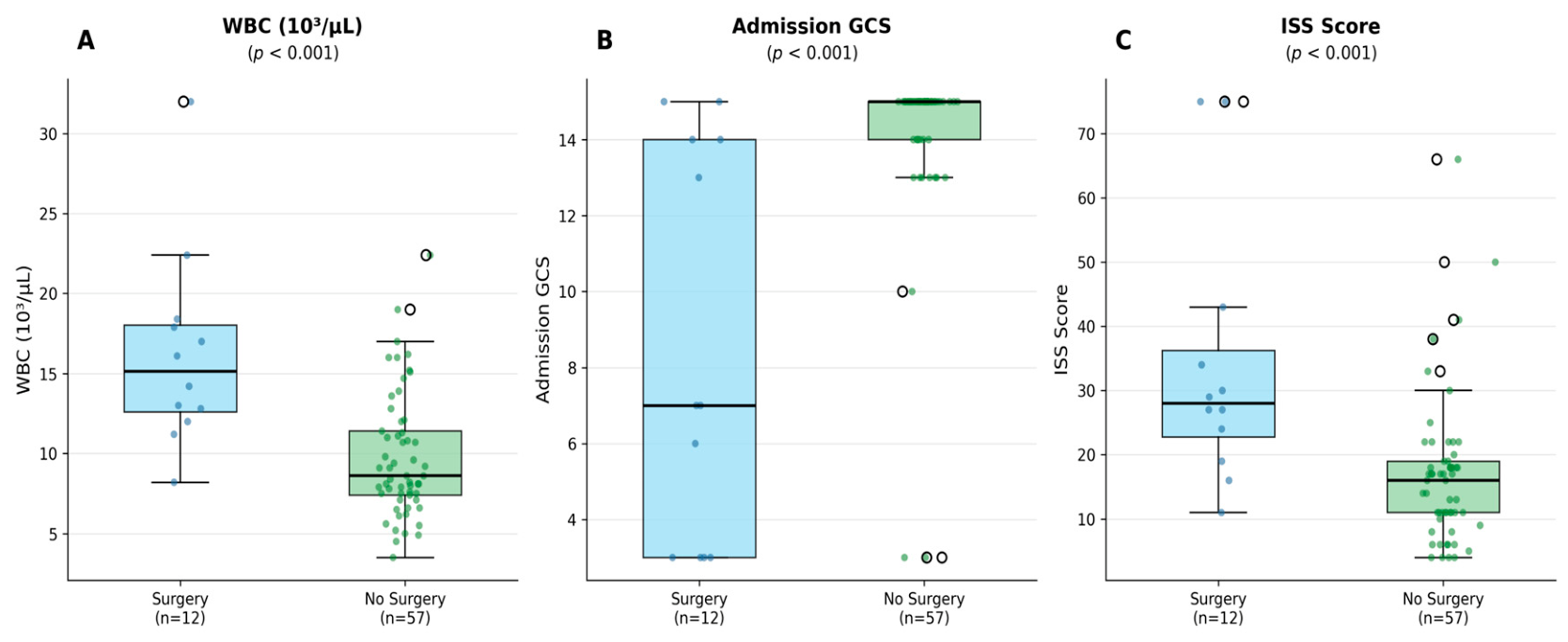
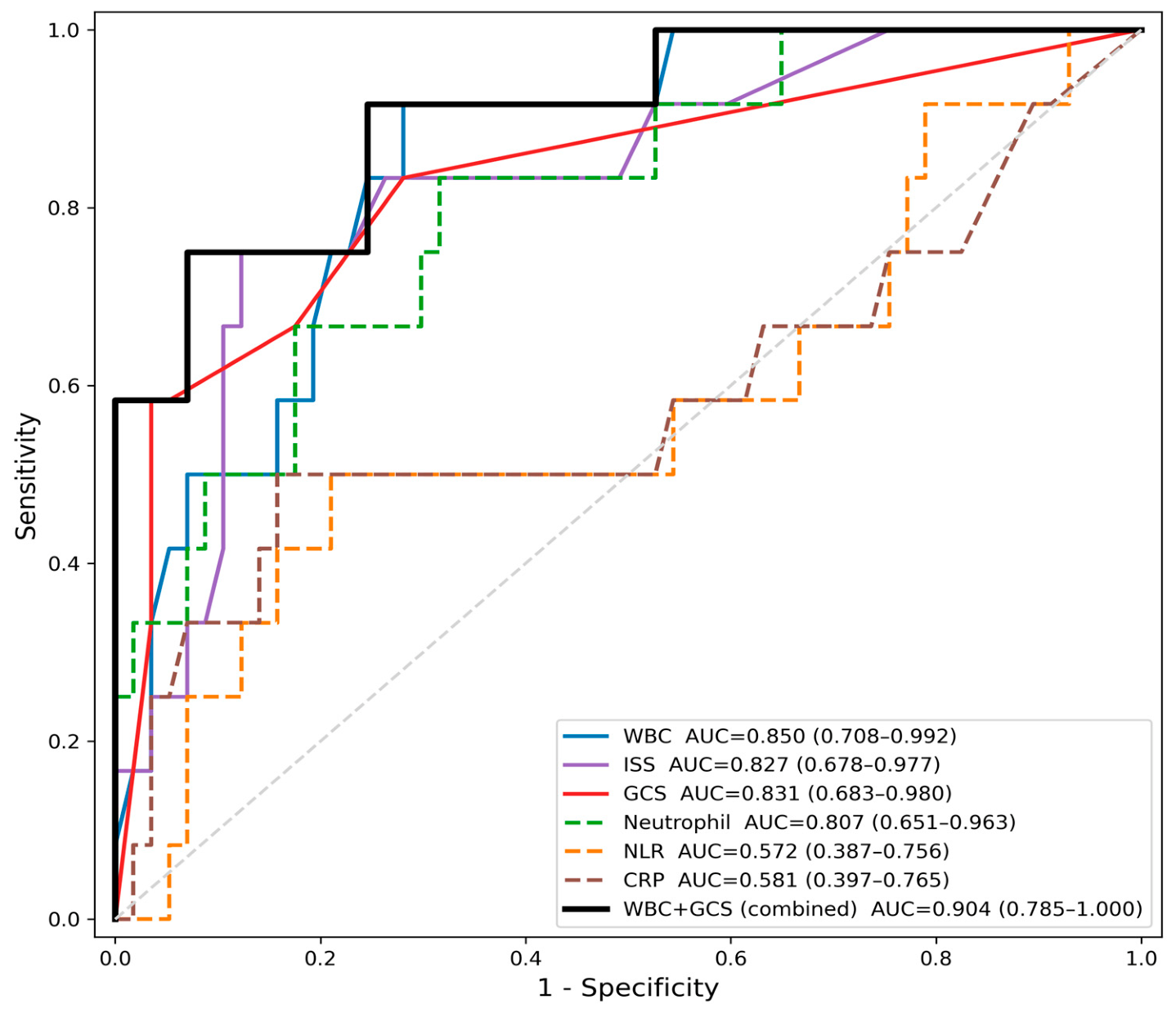
Background/Objectives: Traumatic subarachnoid hemorrhage (tSAH) is one of the most frequent intracranial findings in moderate-to-severe traumatic brain injury. This study evaluated whether integrating systemic inflammatory markers—white blood cell count (WBC), neutrophil count, neutrophil-to-lymphocyte ratio (NLR), and C-reactive protein (CRP)—with the Glasgow Coma Scale (GCS) and Injury Severity Score (ISS) improves the prediction of neurosurgical intervention in adult tSAH patients, compared with clinical scores alone. Methods: This single-center retrospective cohort study included 69 adult patients (age ≥ 18 years) with computed tomography (CT)-confirmed tSAH treated between January and December 2023. Patients younger than 18 years were excluded a priori given age-specific reference ranges for WBC and lymphocyte count. Neurosurgical intervention was defined as any cranial or therapeutic intracranial vascular procedure directly addressing the intracranial pathology; patients whose only procedure was unrelated to the intracranial injury were classified as non-surgical. Patients were stratified into surgery (n = 12) and no-surgery (n = 57) groups. Diagnostic accuracy was assessed by receiver operating characteristic (ROC) curve analysis with DeLong pairwise comparisons; logistic regression estimated odds ratios (ORs). Results: WBC (area under the curve [AUC] = 0.850), GCS (AUC = 0.831), and ISS (AUC = 0.827) were the strongest individual predictors; neutrophil count was also significant (AUC = 0.807), while NLR and CRP were not discriminatory. The combined WBC + GCS model achieved an AUC = 0.904 (sensitivity 75.0%, specificity 93.0%), without statistically significant superiority over either predictor alone (DeLong p = 0.571 and p = 0.455, respectively). In multivariable analysis, both WBC (OR = 3.951, p = 0.006) and GCS (OR = 0.331, p = 0.002) were independent predictors of neurosurgical intervention. A sensitivity analysis excluding the single endovascular-intervention case (n = 68) yielded materially unchanged results. Conclusions: WBC and GCS were independently associated with neurosurgical intervention in this exploratory adult tSAH cohort. The combined model showed numerically higher discrimination than either predictor alone, although this incremental difference was not statistically significant. Given the small event count, these findings should be regarded as hypothesis-generating; internal and external validation in larger cohorts is required before clinical application.
Keywords: traumatic subarachnoid hemorrhage; neurosurgical procedures; inflammatory markers; white blood cell count; Glasgow Coma Scale; Injury Severity Score; emergency department; receiver operating characteristic curve traumatic subarachnoid hemorrhage; neurosurgical procedures; inflammatory markers; white blood cell count; Glasgow Coma Scale; Injury Severity Score; emergency department; receiver operating characteristic curve