1. Introduction
Endometriosis is a multifaceted disease that is classed as a chronic, debilitating condition. It has a significant clinical impact, affecting approximately 1 in 10 women globally [
1]. Endometriosis comprises three distinct phenotypes: superficial endometriosis, endometriomas, and deep endometriosis. According to the severity, amount, location, depth, and size of growth, it is divided into four stages, ranging from minimal, mild, moderate, and severe disease. Regardless of this classification, the prognosis of clinical outcomes and symptomatology remains ineffective [
2]. It is a chronic condition, characterised by chronic abdominal pain and/or chronic pelvic pain (CPP). Endometriosis is diagnosed via a surgical procedure that locates the endometrium outside of the uterus [
3]. Studies have shown that more than 60% of women diagnosed with endometriosis report CPP, and these patients are 13 times more likely to experience abdominal pain than healthy individuals. Despite this, endometriosis displays an array of non-specific symptoms ranging from gynaecological and gastrointestinal conditions [
4]. Studies reveal an average diagnostic delay of 11.7 years in the USA and 8 years in the UK. Furthermore, the delay in diagnosis is greater in women reporting pelvic pain in comparison to infertility, implying that pelvic symptoms require more attention and consideration [
5,
6]. Despite the similarities in symptoms, the disease remains poorly understood, and current studies demonstrate no correlation between the extent of disease and symptomatology. Multiple ongoing research projects are currently in the works due to the poor efficacy of hormonal therapy. Endometriosis is one of the most common non-cancerous gynaecological proliferations in premenopausal women, affecting 10–15% of reproductive-aged women. Medical professionals face difficulties in diagnosis and treatment [
7].
The evolving role of artificial intelligence (AI) can be observed in all aspects of life, especially in the health sector. Modern technologies have facilitated the growth of different AI-assisted strategies in healthcare. The digital revolution catalyses the progress of AI in medicine with new possibilities [
8]. Reflecting its broad utility, the implications of AI can be visualised in the field of Obstetrics and Gynaecology, extending from foetal monitoring to reproductive medicine. Given the versatility and effectiveness, it holds substantial promise in improving the diagnostic workflow of endometriosis. Although there are publications that separately consider the application of artificial intelligence in sonographic diagnosis or in the analysis of biomarkers for endometriosis, there is a lack of comprehensive work integrating these approaches and critically evaluating their help for clinical practice. The present article seeks to fill this gap by comparing traditional diagnostic steps with the latest AI-assisted methods and pointing out both their advantages and limitations in diagnosis, prognosis and research, to help further the knowledge in endometriosis and consequently overcome the difficulties clinicians face and the devastating impact it carries [
9]. By integrating imaging, molecular biomarkers, histopathology and large language model applications, this review provides a multidisciplinary perspective intended to support both clinical interpretation and computational development in endometriosis diagnosis.
2. Materials and Methods
A comprehensive literature search was conducted following the PRISMA guidelines (
Supplementary Materials File S1) for scoping reviews to identify studies evaluating the application of artificial intelligence (AI) in the diagnostic workflow of endometriosis. The search was performed in Medline (via PubMed) and Google Scholar, covering publications from database inception to August 2025. The search strategy used combinations of the following keywords and Boolean operators: (“artificial intelligence” OR “machine learning” OR “deep learning” OR “neural networks” OR “natural language processing”) AND (“endometriosis” OR “deep endometriosis” OR “endometrioma” OR “pelvic pain”) AND (“diagnosis” OR “detection” OR “classification” OR “biomarker” OR “multi-omics” OR “ultrasound” OR “MRI” OR “histopathology”).
Additional manual searches were performed using the reference lists of relevant reviews and primary studies to capture articles not indexed in databases. Only peer-reviewed, full-text articles written in English were included. Conference abstracts, preprints, editorials, commentaries, and animal studies were excluded.
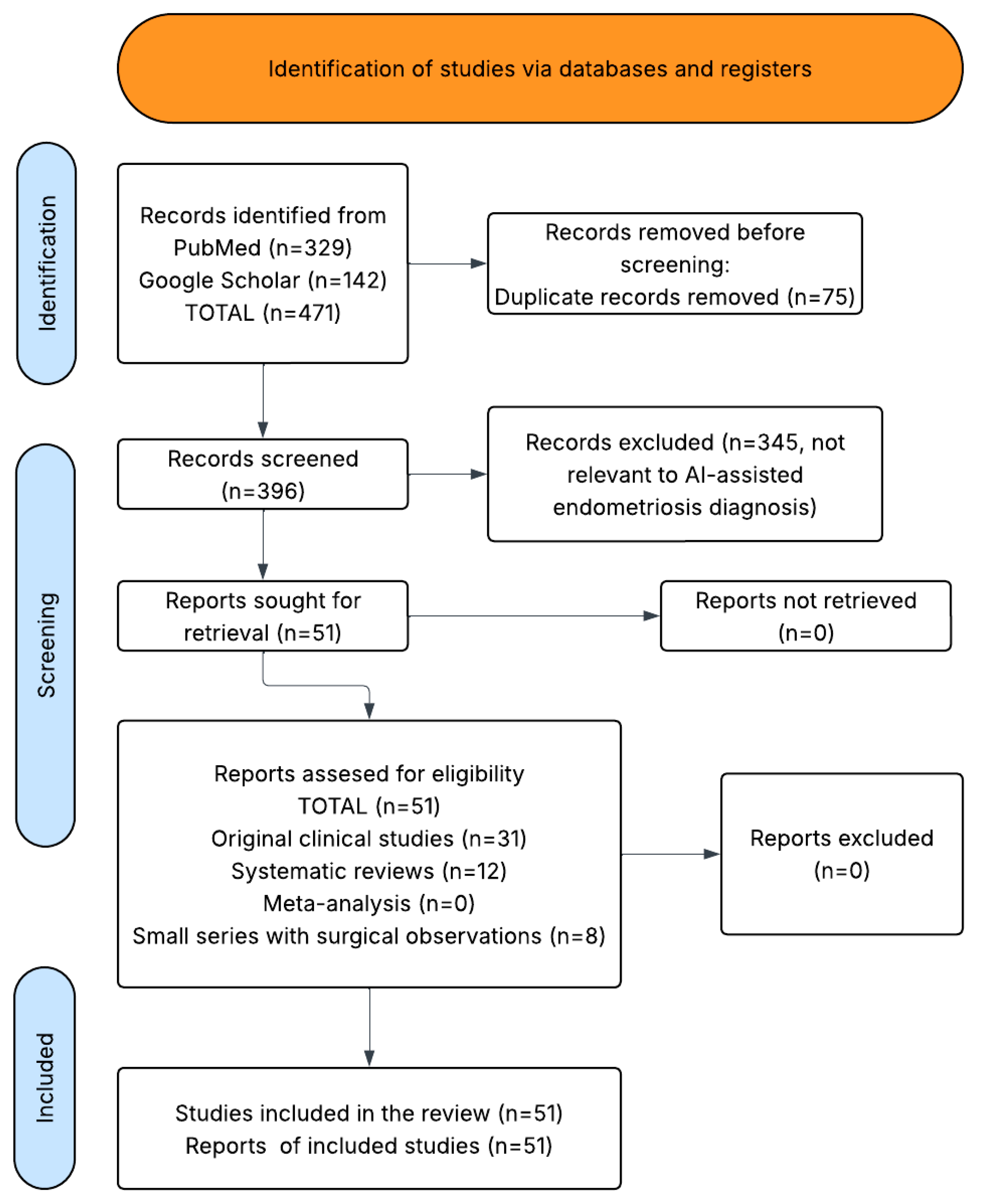
Screening and Selection: After removal of 75 duplicate records, 396 records were screened by two independent reviewers (J.G. and U.K.) based on titles and abstracts. Records were excluded at title and abstract screening if they were not related to AI-assisted endometriosis diagnosis, did not address diagnostic applications, or did not meet the predefined inclusion criteria. Full texts of potentially relevant papers were assessed for eligibility. Disagreements were resolved by consensus or consultation with a senior reviewer (D.M.).
Eligibility criteria:
Inclusion: Studies reporting the use of AI-based methods for detection, diagnosis, classification, prediction, or biomarker identification in endometriosis (including imaging, molecular, histopathology, or language-based tools).
Exclusion: Studies unrelated to diagnostic use (e.g., AI in treatment prediction only), non-original data, or insufficient methodological detail.
Data Extraction and Synthesis:
For each included study, the following variables were extracted: author, year, country, study design, population size, input modality (TVUS, MRI, histopathology, serum/omics, text data), AI technique or algorithm used, validation method, and diagnostic performance metrics (sensitivity, specificity, AUC).
Studies were grouped into four thematic domains for structured synthesis:
- (1)
Symptom-based and risk prediction models;
- (2)
AI-assisted imaging (TVUS/MRI);
- (3)
Histopathology and digital tissue analysis;
- (4)
Molecular and multi-omics biomarkers.
Within each domain, study findings were qualitatively summarised, and methodological consistency and validation approaches were compared.
Quality and Reproducibility Assessment: Given the heterogeneity of the included studies, formal meta-analysis was not performed. Methodological quality was assessed qualitatively using predefined domains relevant to the study type. Diagnostic accuracy studies were assessed using QUADAS-2-based criteria, including patient selection, index test, reference standard, flow and timing, validation strategy and risk of bias. Review articles were considered using AMSTAR-2-based criteria where applicable, including clarity of research question, search strategy, study selection and synthesis approach. Additional reproducibility factors were recorded for AI-based studies, including dataset size, input modality, algorithm type, internal or external validation, reported performance metrics and clinical applicability (
Figure 1).
Figure 1.
PRISMA flowchart summarising the study selection process, including records identified, duplicates removed, records screened, reports assessed for eligibility and final studies included in the review.
Figure 1.
PRISMA flowchart summarising the study selection process, including records identified, duplicates removed, records screened, reports assessed for eligibility and final studies included in the review.
3. Results
3.1. Artificial Intelligence
AI refers to a diverse range of applications used across various fields. Machine learning (ML) is an integral component of AI, which teaches computers to complete tasks without a predetermined specific programming of such tasks. It undergoes continuous enhancements via increased exposure to more data. This enables the systems to observe patterns and similarities by recognising objects from texts, images, or even acoustic data and extracting the information required [
10]. Deep learning (DL) is a branch of ML that is difficult to comprehend, as it does not require any human input and it learns using sophisticated algorithms known as artificial neural networks. These models are particularly useful for analysing complex medical data, such as ultrasound images or histopathology slides, where manual interpretation may be time-consuming or subjective [
11]. Numerous forms of AI are available, consisting of natural language processing (NLP) and large language models (LLM), which are AI systems trained on large volumes of text to understand and generate human-like language. Both forms are capable of understanding human language and generating human-like language [
12]. AI could help decrease the major diagnostic delay in endometriosis [
9].
Popular LLMs, such as Chat Generative Pre-trained Transformer (GPT) and other medically oriented chatbot systems, have also been explored in relation to endometriosis information delivery [
13]. Their main potential role is currently supportive, particularly in improving patient education, awareness and access to general medical information [
12,
14]. More broadly, LLMs have shown potential in general medical question-answering and diagnostic reasoning tasks, including complex clinical cases and medical licencing-style examinations [
15,
16]. However, their diagnostic value remains indirect and limited. Studies assessing chatbot responses to endometriosis-related questions have reported variable accuracy, especially when answers are compared with guideline-based recommendations [
17,
18]. Therefore, LLMs should not be considered validated diagnostic tools for endometriosis at present, but rather adjunctive educational technologies requiring further evaluation before clinical integration (
Table 1 and
Table 2).
Table 1.
Representative overview of selected emerging AI-related topics in endometriosis diagnosis and research. The table highlights key examples across symptom-based prediction, imaging analysis and molecular biomarker studies rather than listing all included studies.
Table 1.
Representative overview of selected emerging AI-related topics in endometriosis diagnosis and research. The table highlights key examples across symptom-based prediction, imaging analysis and molecular biomarker studies rather than listing all included studies.
| Topics of Investigation | Study | Methodology | Clinical Utility |
|---|
| Symptom-based prediction | Bendifallah et al. [19] | Application of machine learning algorithm trained on 16 clinical and patient-reported symptom features to diagnose cases of endometriosis. | Early screening tool |
| Symptom-based predictive model | Nnoaham et al. [20] | Prospective, observational, two-phase multicentre study utilising 25-item questionnaire prior to surgery. | Help in early referrals for laparoscopy and prioritisation of surgical resources |
| Symptom-based diagnostic tool | Nnoaham et al. [21] | Integrated two multicentre studies from the GSWH and WHSS to develop and validate predictive models. | Early diagnosis and management |
| Assess automatic diagnosis of POD obliteration using TVUS | Macais et al. [22] | Two expert sonologists recorded TVUS videos dividing them into: training, validation and testing datasets and were assessed using pre-trained neural network | Non-invasive diagnosis of POD obliteration |
| Enhance POD obliteration from MRI by extracting diagnostic features from ultrasound via unpaired data | Zhang et al. [23] | A teacher model was created utilising TVUS data, and a student model was pre-trained with 3D masked auto-encoder, then fine-tuned using knowledge distillation. | Improving MRI based non-invasive diagnosis when ultrasound is unavailable |
| Non-invasive blood-based diagnostic model using panel of nine genes | Su et al. [24] | A nine-gene panel was created to differentiate patients with endometriosis from healthy individuals | Earlier non-invasive diagnosis using peripheral blood testing |
| Non-invasive diagnostic tool | Moustafa et al. [25] | Validate a panel of serum microRNAs from 100 symptomatic women undergoing gynaecologic surgery | Very accurate, minimally invasive serum-based diagnostics which can be applied preoperatively |
| Non-invasive biomarkers; persistent organic pollutants (POP) | Matta et al. [26] | Use ML algorithms to identify key POP biomarkers linked to deep endometriosis | Future biomarker screening for helpful diagnosis in endometriosis |
| Non-invasive biomarkers; plasma cytokines | Knific et al. [27] | Investigate whether plasma cytokine can differentiate women with endometriosis from controls using ML classifiers | Future alternative biomarker source for non-invasive diagnosis |
| Non-invasive biomarkers; programmed cell-death-related genes | Xie et al. [28] | Identify programmed cell-death-related gene biomarkers using bioinformatics and ML approaches | Non-invasive, multi-omics gene targets holding potential for diagnostics |
Table 2.
Comparative summary of selected AI-based diagnostic studies in endometriosis, including AI application, dataset or modality, validation strategy, reported performance metrics and clinical applicability or limitations.
Table 2.
Comparative summary of selected AI-based diagnostic studies in endometriosis, including AI application, dataset or modality, validation strategy, reported performance metrics and clinical applicability or limitations.
| Study | AI Application | Dataset/Modality | Validation | Performance | Clinical Applicability/
Limitation |
|---|
| Bendifallah et al. [19] | Symptom-based ML screening | 1126 patients, 608 controls, clinical and symptom features | Training and validation sets | Sensitivity 0.82–1.00, specificity 0–0.80, AUC 0.50–0.89 | Potential screening tool, but variable specificity and external validation required |
| Nnoaham et al. [20] | Symptom-based prediction model | Multicentre pre-laparoscopy cohort | Multicentre validation | AUC 68.3 for any-stage disease, AUC 84.9 for stage III/IV disease | More useful for advanced disease, limited accuracy for early-stage disease |
| Maicas et al. [22] | DL analysis of TVUS sliding sign | TVUS videos for POD obliteration | Training, validation and test sets | Accuracy 99.9%, specificity 90% | Promising for standardising TVUS interpretation, dependent on expert video acquisition |
| Zhang et al. [23,29] | Knowledge distillation from TVUS to MRI | TVUS and MRI datasets | Internal validation | MRI AUC improved from 65.0% to 90.6% | May improve MRI interpretation, but requires external/prospective validation |
| Guerriero et al. [30] | ML detection of rectosigmoid deep endometriosis | 222 training cases, 110 test cases, ultrasound markers | Train/test split | Accuracy 73%, AUC 0.82 | Moderate performance, may assist but cannot replace expert assessment |
| Bendifallah et al. [31] | Salivary miRNA ML model | Salivary miRNA profile | Cross-validation | Sensitivity 96.7%, specificity 100%, AUC 98.3% | Highly promising non-invasive test but needs independent validation |
| Su et al. [24] | Gene-expression diagnostic model | Tissue and blood transcriptomic datasets | Model validation datasets | AUC 0.920 tissue, AUC 0.942 blood | Potential blood-based diagnostic tool, needs prospective clinical validation |
| Moustafa et al. [25] | Serum miRNA classifier | 100 symptomatic surgical patients | Surgical diagnosis reference | Classifier accuracy 0.94 | Promising preoperative biomarker panel, limited by small sample size |
| Knific et al. [27] | Cytokine-based ML model | 116 endometriosis patients, 94 controls | Internal testing | Sensitivity 40%, specificity 65%, AUC 0.61 | Limited diagnostic value based on current evidence |
| Stegmann et al. [32] | Lesion prediction model | 114 women, 487 lesions | Internal validation | Sensitivity 88.4%, specificity 24.6% | May support intraoperative assessment, but low specificity limits clinical utility |
3.2. Enhanced Endometriosis Prediction
In clinical pathways, an immediate application of AI is to prioritise patients using history and symptom profiles, supporting earlier screening and referral decisions. Early work explored whether endometriosis could be predicted non-invasively using symptoms, clinical examination and ultrasound findings. In one study, clinical information was collected from 90 women before laparoscopy or laparotomy to build a classification tree. Ovarian endometriosis was correctly classified in 100% of cases using ultrasound and examination findings, with no false positives; however, only 38% of non-ovarian endometriosis was correctly classified [
33].
Building on this symptom-based approach, Bendifallah et al. investigated ML algorithms using 16 clinical and patient-reported features, including patient history, demographics, phenotypes and treatment data. The model was developed using data from the Ziwig Health platform, which included 1126 patients with endometriosis and 608 controls [
19]. Sensitivity ranged from 0.82 to 1.00, specificity from 0 to 0.80 and AUC from 0.50 to 0.89 across training and validation sets. This study suggests that an ML-based algorithm may be useful as a screening tool for healthcare practitioners and may support patient involvement in earlier recognition of symptoms and shared decision-making [
19].
Similarly, Nnoaham et al. developed a symptom-based model to predict endometriosis before first laparoscopy. Prediction of any-stage endometriosis was limited, with an AUC of 68.3, whereas prediction of stage III/IV disease was stronger, with an AUC of 84.9, sensitivity of 75.8% and specificity of 75.8% [
20].
Since the symptoms vary within different populations, two multicentre studies, the Global Study of Women’s Health (GSWH) and Women’s Health Symptom Survey (WHSS), were initiated to collect standardised, epidemiological data and develop a symptom-based diagnostic tool. A six-week pilot study conducted in Oxford, United Kingdom, showed endometriosis was found in 47.4% of 27 participants. These studies aim to develop a validated, symptom-based diagnostic tool that will prove beneficial across the globe [
21]. Despite the heterogeneity of the disease, studies are ongoing to focus on clinical prediction models for successful surgery. For instance, the CRESCENDO (Creating Prediction Model to predict Surgical Success in Endometriosis). AI looks promising in identifying reliable predictors [
34]. Multivariate logistic regression was utilised to predict the possibilities of voiding dysfunction post-surgery. Clinical and imaging features were used to create these models. Patient’s surgical plans could be tailored according to the individual risk [
35]. Application of AI helps expand knowledge about predictors of successful treatments, improving the standard of care, while simultaneously respecting patient autonomy [
31,
35].
Building on these symptom- and risk-based prediction models, the next section focuses on imaging-based AI applications, which aim to enhance diagnostic accuracy and address delays caused by the limitations of current radiological expertise and workflows.
3.3. AI in Diagnosis
Once patients are triaged, imaging plays a crucial role in confirming diagnosis and defining disease extent. Diagnostic imaging delays contribute to misdiagnosis and treatment delays, as symptoms are also associated with other conditions. A study consisting of 11,793 patients demonstrated that 35.3% of patients experienced diagnostic delay of 3–5 years. These patients also suffered from pre-diagnosis endometriosis-related symptoms and required more healthcare services, resulting in higher costs [
36]. The International Deep Endometriosis Analysis (IDEA) group is a consensus published in 2016 to help describe sonographic patterns of different phenotypes of endometriosis to encourage global consistency for descriptions of endometriosis ultrasound location and extent [
37]. Using this consensus, AI-assisted models utilising subtypes of DL, referred to as transfer learning and deep neural networks, have been generated. Maicas et al. created Kinetics-400, applying a technique known as transfer learning (where knowledge from a large, general dataset is adapted to a new medical task) with a dataset of 306,245 videos showing multiple human actions. In transfer learning, the pre-trained models hold the ability to adapt to a new task where they can apply their knowledge to different domains of interest, which is particularly valuable in gynaecological imaging, where large annotated datasets are often unavailable. In this instance, transvaginal ultrasound (TVUS) videos were used. It is difficult to assess the exact relationship between the kinetics-400 dataset and the TVUS dataset, as this approach relies on complex neural network architectures that do not easily reveal the features being used, making direct interpretation challenging. However, the model demonstrated an accuracy of 88.8% with a specificity of 90.0% in categorising pouch of Douglas (POD) obliteration, validated by two expert ultrasound specialists. Although the IDEA group has recommended routine evaluation of POD obliteration, there are no radiology societies suggesting the same [
22]. In another study implementing the IDEA consensus, Zhang et al. developed a knowledge distillation training method using TVUS and POD obliteration from MRI scans. The foundations were built upon TVUS due to its superiority in detecting POD obliteration. Subsequently, the student model was trained on MRI, which underwent fine-tuning, following a knowledge distillation approach (where a ‘teacher’ model guides a new model to learn efficiently from smaller datasets), improving the diagnostic area under the receiver operating characteristic curve from 65.0% to 90.6%. This study highlights the benefits of combining imaging datasets in AI algorithms and the potential it holds for future applications in endometriosis imaging signs and locations [
23].
The ability to relay knowledge across TVUS and magnetic resonance imaging (MRI) is one of its advantages, which helps in non-invasive diagnosis of endometriosis by identification of POD obliteration [
38]. Despite this advantage, there are insufficient clinicians with expertise in the diagnosis of image-based endometriosis. Additionally, most patients will not undergo both TVUS and MRI scans, and the detection of POD obliteration is far more challenging on MRI. To overcome this, Zhang et al. created a high-performance TVUS analysis model with an AUC of 96.9% as a mentor to train similar models on MRI images. This approach amplified the performance on MRI images from an AUC of 65% to 90.6% [
29]. Another study examined the accuracy of TVUS and MRI in the identification of deep pelvic endometriosis; however, it required radiologists with more than 10 years of experience in gynaecological imaging studies to accomplish an accuracy of 88% on TVUS and 55% on MRI [
38]. Seven different traditional ML models trained on the US “soft marker” for the prediction of rectosigmoid endometriosis were used on a training set of 222 people and a test set including 110 people. Neural Net demonstrated 73% accuracy and an AUC of 0.82 with similar results to the sigmoid model [
30]. Currently, the technology may not be completely ready for automated image analysis, but the results look promising, providing hope for AI models to replicate human performance and aid in screening of patients with a high likelihood of endometriosis diagnosis, guiding them to correct referrals and further care [
3].
Beyond imaging, tissue-level and molecular analyses offer a different layer of diagnostic information, providing opportunities for AI to support histopathological interpretation, biomarker identification, and a deeper understanding of disease heterogeneity.
3.4. Molecular Pathology
Histopathology remains the gold standard for confirming endometriosis, and recent advances are bringing AI into this domain. The diagnosis of endometriosis is confirmed by examination of biopsy samples stained with haematoxylin and eosin (H&E); however, the heterogeneity of endometriosis may produce false-negative results. Modern methods are being adopted to improve the detection of endometriosis, thereby enhancing the treatment decisions [
39]. Recent developments in digital pathology create avenues for automatic detection, quantification, and stratification of cells within endometrial tissues. Utilising QuPath software, a widely used open-source tool for automated slide analysis, 26 tissue samples were extracted from patients undergoing laparoscopy for suspected endometriosis. Immunohistochemistry (IHC) was employed to detect cytokeratin (epithelial cells) and CD10 (stromal cells) markers.
Recent developments in digital pathology create opportunities for automated detection, quantification and stratification of cells within endometriosis tissue. Using QuPath, an open-source digital pathology platform, McKinnon et al. analysed 26 tissue samples from patients undergoing laparoscopy for suspected endometriosis. Immunohistochemistry was used to identify cytokeratin-positive epithelial cells and CD10-positive stromal cells. Through computer-assisted image analysis, the study quantified epithelial and stromal cell populations and reported greater stromal cell abundance in deeply infiltrating endometriosis compared with superficial peritoneal lesions (
p = 0.0477), as well as a positive correlation between endometrial cell count and abdominal pain score (
p = 0.0005) [
40]. This demonstrates how digital image analysis can provide more objective and reproducible histological characterisation than manual assessment alone.
Similarly, Korman et al. developed an ML- and DL-based image-analysis pipeline for multiplex-stained endometrial tissue sections using a six-plex immunohistochemistry panel consisting of PanCK, CD10, calretinin, Ki67, DAPI and α-SMA. The AI-based approach enabled automated tissue segmentation and identification of epithelial, stromal and immune cell populations across individual slides, supporting objective and reproducible quantification beyond traditional manual microscopy [
41].
B-cell lymphoma 6 (BCL6) was initially described in large B-cell lymphoma as a locus disrupted by chromosomal translocations, and it functions as a crucial regulator of both normal and cancerous lymphocyte biology. It orchestrates B-cell germinal centre (GC) formation, maintenance, suppresses DNA checkpoints, and promotes proliferation, therefore contributing to lymphomagenesis. Alongside B-cells, BCL6 is exclusively expressed in follicular helper T cells (TFH), where it serves as a lineage-defining transcription factor essential for TFH differentiation and maintenance [
42]. Recent studies demonstrate the promise of BCL-6 as a diagnostic biomarker for the detection of endometriosis in women [
42,
43]. Previous studies employed a semi-quantitative scoring system known as HSCORE to analyse the IHC staining; however, it consisted of limitations, such as lack of objectivity, robustness, and reproducibility, impacting intra- and inter-observer variability. Squatrito et al. investigated the expression of BCL-6 in varying degrees of endometrial tissues of women and fertility status using both traditional and digital-assisted tools. The comparative analysis demonstrated that the HSCORE was significantly higher (3.625) compared to controls (2.095), achieving a
p value of 0.0053. Regarding digital image analysis, infertile women with stage IV endometriosis displayed greater intensity of BCL6 expression, suggesting a higher and more heterogeneous expression. Furthermore, the positive correlation between HSCORE values and digital image analysis results validates the reliability of digital-assisted methods [
44].
Beyond histopathology, multi-omics approaches, such as transcriptomics and miRNA profiling, are emerging as powerful tools for uncovering molecular signatures of endometriosis, with AI playing a central role in managing and interpreting these high-dimensional datasets.
3.5. Multi-Omics in Endometriosis
Molecular analyses, particularly miRNA-based diagnostics, are increasingly being investigated for their potential to complement imaging and histopathology. Novel studies relative to microRNA(miRNA) are currently under investigation for their potential role as a non-invasive diagnostic tool [
45]. The use of saliva as a disease biomarker is a trending subject due to its stability, as it is not affected by coagulation. Salivary miRNAs are currently under examination to find specific miRNAs for endometriosis. The capability of AI to analyse a large quantity of datasets allow for augmenting of diagnostic processes. The Random Forest algorithm was deployed on 109 miRNAs. Following feature selection and cross-validation, the diagnostic miRNA signature obtained 96.7% sensitivity, 100% specificity, and an AUC of 98.3%. This signifies the potential for a readily available non-invasive tool reducing delay in diagnosis [
31]. Su et al. utilised 10 binary classification algorithms to develop a nine-gene panel endometriosis messenger RNA score (EMScore) to differentiate patients with or without endometriosis. The results were promising, with the areas under the receiver operator characteristic curve of the diagnostic model being 0.920 for tissue samples and 0.942 for blood samples [
24]. A prospective study consisting of 100 subjects demonstrated increased levels of 4 serum miRNAs: miR-125b-5p, miR-150-5p, miR-342-3p, and miR-451a. The receiver operating characteristic areas under the curve ranged from 0.68 to 0.92. Application of a classifier resulted in a higher accuracy score of 0.94. According to the American Society of Reproductive Medicine staging, all miRNAs could be differentiated in stages I/II from the control group and stage III/IV from the control group. Results also showed that the phase of the menstrual cycle or hormonal therapies had no significant effect on the expression of miRNAs. The brilliance of AI in diagnosing endometriosis through serum miRNA analysis holds great benefits, such as decreased time to diagnosis, surgical risk, disease progression, and the healthcare costs [
25].
Integrating these molecular and omics-based findings with presurgical assessment methods represents the next step toward comprehensive, personalised diagnostic pathways for endometriosis (
Table 3).
Table 3.
Summary of molecular and multi-omics biomarkers investigated for AI-assisted endometriosis diagnosis, including biomarker category, specific biomarker or panel, sample type, analytical approach and diagnostic relevance.
Table 3.
Summary of molecular and multi-omics biomarkers investigated for AI-assisted endometriosis diagnosis, including biomarker category, specific biomarker or panel, sample type, analytical approach and diagnostic relevance.
| Biomarker Category | Specific Biomarkers/Panel | Sample Type | AI/Analytical Approach | Diagnostic Relevance |
|---|
| Salivary miRNAs [31] | Selected diagnostic signature from 109 miRNAs | Saliva | Random Forest with feature selection and cross-validation | Non-invasive diagnotic signature with high reported sensitivity, specificity and AUC |
| Gene-expression panel [24] | Nine-gene EMScore panel | Tissue and blood | Ten binary classification algorithms | Differentiated endometriosis from controls with high AUC in tissue and blood samples |
| Serum miRNAs [25] | miR-125b-5p, miR-150-5p, miR-342-3p and miR-451a | Serum | miRNA classifier | Minimally invasive preoperative biomarker panel |
| Persistent organic pollutants [26] | Organochlorine persistent organic pollutant patterns | Biomarker/exposure dataset | Five ML models | Potential association with deep endometriosis and biomarker discovery |
| Plasma cytokines [27] | Plasma cytokine profiles | Plasma | ML classifiers | Limited diagnostic performance in current evidence |
| Programmed cell-death-related genes [28] | TNFSF12, PDK2 and AP3M1 | Gene-expression/bioinformatic datasets | Mendelian randomisation and ML | Candidate molecular biomarkers for diagnosis and personalised treatment research |
3.6. Presurgical and Molecular Diagnostics in Endometriosis
Presurgical and molecular diagnostic strategies aim to bridge the gap between early detection and definitive diagnosis, combining laboratory insights with clinical evaluation. Current laparoscopy with histological confirmation remains the ideal diagnostic and therapeutic choice; however, it does pose surgical risk. Extensive research for reliable biomarkers will be highly beneficial in treatment decisions [
46]. Traditional linear and regression models may lead to unstable and unreliable results when variables are correlated. Application of innovative ML models may enhance epidemiological research to improve the results. In a retrospective case study, five AI models helped in the identification of connections between different organochlorine persistent organic pollutants. These algorithms demonstrate the ability of AI to handle complex data [
26]. Various genes have been discovered to help explain the pathogenesis of endometriosis; however, functional validation of such vast data requires great effort. Using natural language processing of the PubMed database integrated with text mining of AI allows for candidate gene prioritisation. Among the 15,207 endometriosis-related genes, 724 genes were retrieved and ranked according to priority. MAPK1 was one of the top five genes with a very high score of 0.988 (measured on a score of 0 to 1). These could be valuable in the research of diagnostic biomarkers and therapeutics of endometriosis [
47]. Other biomarkers are also being analysed for their involvement in endometriosis. As it is an inflammatory process, different cytokines were assessed for their relevance. In this study, ML algorithms were employed to validate the hypothesis that models trained on fewer proteins would yield better results. Additionally, the models also checked for any relationship between the 116 patients with endometriosis and the 94 controls. The results were unsatisfactory, showing a sensitivity of 40%, specificity of 65% and AUC of 0.61, exposing the limited potential of cytokines for the diagnosis of endometriosis [
27]. Past studies have shown that patients with endometriosis demonstrate abnormal activation or inhibition of programmed cell death (PCD), leading to pathological cell death. To identify biomarkers involved in endometriosis, this study utilised Mendelian randomisation and machine learning algorithms. It concluded three essential biomarkers with upregulation of TNFSF12 and PDK2 genes, with downregulation of AP3M1. Not only does this prove useful for early diagnosis, but it also opens up new avenues for personalised treatment as molecular docking studies show increased binding affinity with current drugs in clinical practice [
28].
The presurgical diagnostic methods increase the accuracy of endometriosis; however, ultrasound, MRI, and additional lab tests lack adequate sensitivity and specificity [
32]. Based on the 2000 ACOG Practice Bulletin [
46] and the 2005 ACOG Committee Opinion [
48], it is acceptable to diagnose endometriosis based solely on visual findings at laparoscopy. Positive histological findings are not necessary for diagnosis in all cases. Rather, it is done to confirm the suspicions of the surgeon during surgery, and the decision lies in their hands [
49]. Visual assessment shows intra-physician variability with high rates of misdiagnosis and poor correlation with the histologic findings [
50,
51]. Stegmann and colleagues created a model utilising lesion characteristics to aid in identifying high and low probability lesions. The data consisted of 114 women with complete data on 487 lesions and achieved a sensitivity of 88.4% and specificity of 24.6%. It correctly classified a lesion with 66.5% success [
32].
4. Discussion
AI in endometriosis can gain valuable insights into the disease itself as well as the diagnostics. This could potentially help lessen the burden and the impact it carries in the healthcare system. The application of AI could be advantageous in the diagnosis, treatment, and follow-up of endometriosis if under the supervision of a gynaecologist. As this was one of the first to assess the knowledge of ChatGPT associated with endometriosis, more research is required, for example, public understanding of its answers, subjective answers, and the time frame of the study, as the internet is constantly updated with new information [
17]. Even though the answers from LLMs are being evaluated by experts, they could be affected by the personal opinions of the experts. To mitigate bias, guidelines were integrated into the evaluation process. It is important to note that the 10 sample questions do not consist of what the patients might ask about endometriosis, and reading levels vary between patients; therefore, the structures of the questions may be different. Additionally, there are no validated models to assess the LLM answers [
18].
4.1. Clinical Readiness and Comparative Performance
4.1.1. Current AI Variability Across Domains
Across the different domains reviewed, including TVUS-based imaging, biomarker panels, molecular approaches, and chatbot evaluations, there is considerable variability in study design and methodological rigour. Many studies rely on retrospective data or convenience samples, often with limited sample sizes that reduce statistical power and external validity. Direct comparative analyses between modalities are scarce, making it difficult to determine their relative strengths and weaknesses. In several cases, internal validation methods were applied, but external validation and head-to-head comparisons are largely absent. These limitations should be considered when interpreting reported performance metrics, as they may overestimate real-world effectiveness.
4.1.2. Symptom-Based Tools and Imaging
Non-invasive diagnostic tools based on symptoms, signs, and ultrasound findings have proven beneficial in ovarian endometriosis; however, a large proportion of women experience infertility and pain and therefore, these symptoms alone are not reliable [
33]. Some of the studies were based on self-questionnaires, and over 50% of the 1140 patients did not complete the survey. Asking individuals if they had endometriosis could introduce bias as well. It is vital to note that approximately 20% of endometriosis patients may be asymptomatic, which could potentially invalidate the questions. The validation set also did not include symptomatic patients with normal clinical examination and MRI features [
19]. To avoid overfitting of the small sample, the bootstrap method and cross-validation were carried out. Before translation into clinical practice, external validation is crucial, yet it was not applied in this study [
20]. Current clinical standards in sonographic diagnostics rely heavily on expert-performed transvaginal ultrasound following the IDEA consensus, which provides a structured approach for assessing endometriosis location and extent. While this remains the gold standard for preoperative imaging, it is limited by operator dependency and variability in interpretation. Emerging AI-assisted approaches, particularly those using transfer learning and neural network models to analyse the sliding sign, aim to standardise image interpretation and improve detection of pouch of Douglas obliteration. These methods offer the potential to complement established TVUS protocols by enhancing diagnostic accuracy and reproducibility, especially in settings with limited specialist expertise. Utilisation of pre-existing data excludes the possibility of choices of data and matching of factors in development and external validation data sets [
34]. Overfitting in AI is a common problem, and to overcome this, smaller training sets are used; however, this decreases its diagnostic performance with low variability in TVUS. To ensure good data, performing a sliding sign and correctly recording the video clip is essential for the model to study from. The sonologists should be well trained on the sliding sign, as the foundations of the AI are built upon this. Only one brand of ultrasound machine was used in this study. To diversify the results, different ultrasound machines, sonographers, and radiologists should be used. Additionally, the high rate of endometriosis could be related to the location, as this place specialises in gynaecology [
22]. As these studies often originate from specialised centres with experienced operators and homogenous populations, their findings may not fully reflect real-world variability or performance in broader clinical settings. Larger, multicentre cohorts are therefore essential to confirm these early observations.
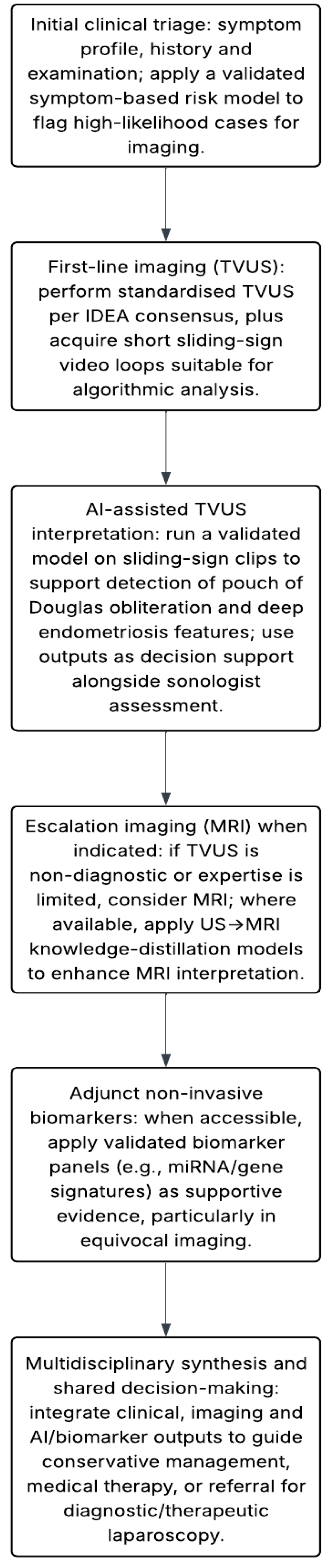
Comparison with guideline-based workflow: Conventional pathways prioritise clinician-performed TVUS per IDEA consensus, selective MRI, and clinical judgement to determine the need for laparoscopy. The AI-enabled pathway retains these steps but adds standardised video acquisition and algorithmic decision support at the TVUS stage, optional AI-assisted MRI interpretation, and selective use of validated non-invasive biomarkers to improve triage in equivocal cases. Thus, AI functions as an adjunct to reduce operator dependency, enhance reproducibility, and potentially shorten time to diagnosis, while remaining anchored to current guidelines.
4.1.3. Clinical Readiness
Although AI applications in imaging modalities, such as TVUS and MRI, as well as biomarker-based approaches, are relatively well developed with measurable diagnostic performance and initial external validation, other areas remain less mature. NLP and large language models are still at a proof-of-concept stage, with limited evaluation of clinical integration or real-world reliability. Similarly, molecular diagnostic approaches, while promising, are restricted by small sample sizes, limited standardisation, and a lack of large-scale validation. This discrepancy highlights the varying readiness levels of different AI applications, with imaging and biomarker tools being closer to potential clinical translation, whereas NLP/LLMs and molecular diagnostics require further foundational work before routine clinical use can be envisaged.
4.2. Limitations of Current Evidence
While numerous proof-of-concept studies have demonstrated promising diagnostic performance, several interlinked factors continue to impede clinical translation. First, the predominance of small, single-centre datasets leads to model overfitting and limits external validity. Second, the absence of standardised data acquisition protocols, particularly for ultrasound and molecular biomarkers, hinders reproducibility and cross-centre comparisons. Third, the lack of multicentre external validation and head-to-head modality comparisons prevents robust benchmarking against existing clinical standards. Fourth, ethical and regulatory frameworks specific to AI in gynaecology remain underdeveloped, creating uncertainty around accountability and safety. Finally, clinician trust and workflow integration have not yet been systematically addressed. Together, these limitations explain why AI remains confined to research settings rather than routine diagnostic pathways in endometriosis.
Data Harmonisation and Standardisation
Data harmonisation and standardisation remain major barriers to the clinical translation of AI-based endometriosis diagnostics. Imaging models require consistent acquisition protocols, anatomical definitions, and annotation standards, particularly for TVUS sliding-sign assessment and MRI-based detection of pouch of Douglas obliteration [
22,
23,
37]. Similarly molecular, and multi-omics models are affected by differences in sample type, sequencing or assay platform, pre-processing pipeline, feature selection and batch-effect correction, which may limit reproducibility across centres [
24,
25,
27,
28,
31]. Future studies should therefore prioritise standardised data collection, transparent pre-processing methods and multicentre validation to ensure that AI models remain robust across different populations, platforms, and clinical settings.
Real-world implementation also requires attention to population diversity, device variability and regulatory oversight. Models developed in specialist centres or homogeneous cohorts may not perform equally across different populations, ethnic groups, symptom profiles or healthcare settings [
19,
20,
22]. Imaging-based AI tools may also be affected by differences in ultrasound or MRI equipment, acquisition protocols, operator expertise and image quality, which can reduce reproducibility when applied outside the development environment [
22,
23,
37]. Before clinical deployment, AI systems should therefore undergo local validation, regulatory review, continuous performance monitoring and clear governance regarding accountability, data privacy and safe clinician oversight [
9,
11,
12].
4.3. Explainability, Workflow Integration and Clinician Trust
In addition to accuracy and validation, real-world implementation requires careful consideration of model interpretability, integration into existing gynaecological workflows, and clinician trust [
11]. This is particularly important in imaging and molecular diagnostics, where algorithmic outputs may be difficult to verify without a transparent explanation. In imaging-based models, explainable AI approaches, including visual heatmaps or saliency-based localisation, may help demonstrate which anatomical regions or sonographic features contributed to the model output [
22,
23]. In molecular and multi-omics models, feature-importance approaches may help identify which genes, miRNAs, cytokines or biomarker patterns drive classification [
24,
25,
27]. Such transparency is essential to support clinical accountability, reduce inappropriate reliance on automated outputs, and promote acceptance of AI as a decision-support tool rather than a standalone diagnostic replacement [
11].
4.4. Future Directions
To provide a structured pathway for future work, the opportunities identified in this review can be organised into short-, medium-, and long-term priorities. In the short term, emphasis should be placed on improving dataset quality, standardising imaging protocols, and ensuring external validation of existing models across diverse populations. Medium-term priorities should focus on integrating explainable AI tools into clinical workflows, establishing regulatory and ethical frameworks, and developing multicentre collaborations to enhance generalisability. In the longer term, the aim should be to combine multimodal data, including imaging, biomarkers, molecular signatures, and NLP/LLM outputs, into unified diagnostic platforms supported by robust clinical trials. This staged approach will help translate current proof-of-concept advances into safe, reliable, and widely adopted clinical tools.
5. Proposed AI-Enabled Diagnostic Workflow
A stepwise AI-enabled diagnostic workflow summarising how AI can augment current practice is proposed. For clinical implementation, the proposed AI-enabled workflow should be integrated as a decision-support pathway rather than a standalone diagnostic system. This would require regulatory approval, local validation within existing gynaecological services, standardised TVUS/MRI acquisition protocols, secure data infrastructure, and clear governance regarding data privacy and clinical accountability [
11,
22,
23,
37]. Clinician training would also be essential to ensure correct image acquisition, interpretation of AI outputs and appropriate communication of uncertainty to patients [
22,
37]. Cost considerations, including software integration, equipment compatibility, staff training and maintenance, should be evaluated before wider adoption, particularly in settings with limited specialist imaging expertise [
9,
36] (
Figure 2).
Figure 2.
Proposed AI-enabled diagnostic workflow for endometriosis, illustrating how symptom-based triage, standardised TVUS, AI-assisted imaging interpretation, MRI escalation, non-invasive biomarkers and multidisciplinary decision-making may support existing diagnostic pathways.
Figure 2.
Proposed AI-enabled diagnostic workflow for endometriosis, illustrating how symptom-based triage, standardised TVUS, AI-assisted imaging interpretation, MRI escalation, non-invasive biomarkers and multidisciplinary decision-making may support existing diagnostic pathways.
6. Conclusions
AI has the potential to assist in identifying previously unrecognised patterns, which could enhance diagnostic pathways as evidence and validation grow. Recent advancements in biomarkers, for instance, BCL6 expression, programmed cell-death-related genes and persistent organic pollutants, are expanding the non-invasive diagnostic tools. In parallel, AI has shown significant potential in the clinical approach to endometriosis, ranging from symptom-based prediction to assessment of POD obliteration using TVUS. Studies have exhibited its potential, and it could potentially serve as a valuable tool in research and diagnostics, improving the delay, and the significant negative impact it holds onto women.
These innovations show a clear path towards earlier diagnosis and individualised risk stratification; however, further studies are required to fully unveil the true nature of the disease. Even though AI-driven methods have not been subject to randomised controlled clinical trials, their potential to transform healthcare is evident. As the world of research continues to expand, AI holds the power to recognise previously unidentified patterns.
Despite all the advantages, AI carries common pitfalls, such as overfitting, small sample sizes, lack of external validation and lower AUC scores. As datasets and technologies are constantly evolving, it is only a matter of time before AI can combat these limitations and refine itself. However, it is imperative that strict regulations are put in place before AI is translated into everyday practice. A multidisciplinary framework uniting molecular diagnostics with AI algorithms may ultimately improve the quality of life in women.
Author Contributions
Conceptualisation, J.G., D.M. and U.K.; methodology, J.G. and U.K.; validation, D.M. and K.B.; data analysis, G.M. and U.K.; investigation, E.P. and V.A.; resources, J.G. and K.B.; data curation, J.G.; writing—original draft preparation, J.G. and U.K.; writing—review and editing, J.G., V.A. and G.M.; visualisation, K.B.; supervision, D.M.; project administration, E.P. All authors have read and agreed to the published version of the manuscript.
Funding
This research received no external funding.
Institutional Review Board Statement
Not applicable.
Informed Consent Statement
Not applicable.
Data Availability Statement
No new data were created or analyzed in this study. Data sharing is not applicable to this article.
Conflicts of Interest
The authors declare no conflicts of interest.
Abbreviations
The following abbreviations are used in this manuscript:
| AI | Artificial Intelligence |
| CPP | Chronic Pelvic Pain |
| USA | United States of America |
| UK | United Kingdom |
| ML | Machine Learning |
| DL | Deep Learning |
| NLP | Natural Language Processing |
| LLM | Large Language Model |
| GPT | Generative Pre-Trained Transformer |
| GPT-4 | Generative Pre-Trained Transformer 4 |
| ESHRE | European Society of Human Reproduction and Embryology |
| AUC | Area Under the Curve |
| GSWH | Global Study of Women’s Health |
| WHSS | Women’s Health Symptom Survey |
| CRESCENDO | Creating Prediction Model to Predict Surgical Success in Endometriosis |
| IDEA | International Deep Endometriosis Analysis |
| TVUS | Transvaginal Ultrasound |
| POD | Pouch of Douglas |
| MRI | Magnetic Resonance Imaging |
| US | Ultrasound |
| IHC | Immunohistochemistry |
| CD10 | Cluster of Differentiation 10 |
| DIE | Deeply Infiltrating Endometriosis |
| DAPI | 4′,6-diamidino-2-phenylindole |
| SMA | Smooth Muscle Actin |
| BCL6 | B-cell Lymphoma 6 |
| GC | Germinal Centre |
| TFH | T Follicular Helper |
| HSCORE | Histological Score |
| RNA | Ribonucleic Acid |
| MAPK1 | Mitogen-Activated Protein Kinase 1 |
| PCD | Programmed Cell Death |
| TNFSF12 | Tumour Necrosis Factor Superfamily Member 12 |
| PDK2 | Pyruvate Dehydrogenase Kinase 2 |
| ACOG | American College of Obstetricians and Gynecologists |
References
- Maddern, J.; Grundy, L.; Castro, J.; Brierley, S.M. Pain in Endometriosis. Front. Cell Neurosci. 2020, 14, 590823. [Google Scholar] [CrossRef]
- Mehedintu, C.; Plotogea, M.N.; Ionescu, S.; Antonovici, M. Endometriosis still a challenge. J. Med. Life 2014, 7, 349–357. [Google Scholar]
- Dungate, B.; Tucker, D.R.; Goodwin, E.; Yong, P.J. Assessing the Utility of artificial intelligence in endometriosis: Promises and pitfalls. Womens Health 2024, 20, 17455057241248121. [Google Scholar] [CrossRef]
- Ballard, K.D.; Seaman, H.E.; de Vries, C.S.; Wright, J.T. Can symptomatology help in the diagnosis of endometriosis? Findings from a national case-control study—Part 1. BJOG 2008, 115, 1382–1391. [Google Scholar] [CrossRef]
- Hadfield, R.; Mardon, H.; Barlow, D.; Kennedy, S. Delay in the diagnosis of endometriosis: A survey of women from the USA and the UK. Hum. Reprod. 1996, 11, 878–880. [Google Scholar] [CrossRef]
- Ballard, K.; Lowton, K.; Wright, J. What’s the delay? A qualitative study of women’s experiences of reaching a diagnosis of endometriosis. Fertil. Steril. 2006, 86, 1296–1301. [Google Scholar] [CrossRef]
- Fukunaga, M. Uterus-like mass in the uterine cervix: Superficial cervical endometriosis with florid smooth muscle metaplasia? Virchows Arch. 2001, 438, 302–305. [Google Scholar] [CrossRef] [PubMed]
- Wang, F.; Preininger, A. AI in Health: State of the Art, Challenges, and Future Directions. Yearb. Med. Inform. 2019, 28, 16–26. [Google Scholar] [CrossRef] [PubMed]
- Sivajohan, B.; Elgendi, M.; Menon, C.; Allaire, C.; Yong, P.; Bedaiwy, M.A. Clinical use of artificial intelligence in endometriosis: A scoping review. npj Digit. Med. 2022, 5, 109. [Google Scholar] [CrossRef]
- Weichert, J.; Welp, A.; Scharf, J.L.; Dracopoulos, C.; Becker, W.H.; Gembicki, M. The Use of Artificial Intelligence in Automation in the Fields of Gynaecology and Obstetrics—An Assessment of the State of Play. Geburtshilfe Frauenheilkd. 2021, 81, 1203–1216. [Google Scholar] [CrossRef]
- Babic, B.; Gerke, S.; Evgeniou, T.; Cohen, I.G. Beware explanations from AI in health care. Science 2021, 373, 284–286. [Google Scholar] [CrossRef]
- Sahni, N.R.; Carrus, B. Artificial Intelligence in U.S. Health Care Delivery. N. Engl. J. Med. 2023, 389, 348–358. [Google Scholar] [CrossRef]
- Goodman, R.S.; Patrinely, J.R.; Stone, C.A., Jr.; Zimmerman, E.; Donald, R.R.; Chang, S.S.; Berkowitz, S.T.; Finn, A.P.; Jahangir, E.; Scoville, E.A.; et al. Accuracy and Reliability of Chatbot Responses to Physician Questions. JAMA Netw. Open 2023, 6, e2336483. [Google Scholar] [CrossRef]
- Cetera, G.E.; Tozzi, A.E.; Chiappa, V.; Castiglioni, I.; Merli, C.E.M.; Vercellini, P. Artificial Intelligence in the Management of Women with Endometriosis and Adenomyosis: Can Machines Ever Be Worse Than Humans? J. Clin. Med. 2024, 13, 2950. [Google Scholar] [CrossRef]
- Kanjee, Z.; Crowe, B.; Rodman, A. Accuracy of a Generative Artificial Intelligence Model in a Complex Diagnostic Challenge. JAMA 2023, 330, 78–80. [Google Scholar] [CrossRef]
- Kung, T.H.; Cheatham, M.; Medenilla, A.; Sillos, C.; De Leon, L.; Elepaño, C.; Madriaga, M.; Aggabao, R.; Diaz-Candido, G.; Maningo, J.; et al. Performance of ChatGPT on USMLE: Potential for AI-assisted medical education using large language models. PLoS Digit. Health 2023, 2, e0000198. [Google Scholar] [CrossRef] [PubMed]
- Ozgor, B.Y.; Simavi, M.A. Accuracy and reproducibility of ChatGPT’s free version answers about endometriosis. Int. J. Gynaecol. Obstet. 2024, 165, 691–695. [Google Scholar] [CrossRef] [PubMed]
- Cohen, N.D.; Ho, M.; McIntire, D.; Smith, K.; Kho, K.A. A comparative analysis of generative artificial intelligence responses from leading chatbots to questions about endometriosis. AJOG Glob. Rep. 2024, 5, 100405. [Google Scholar] [CrossRef] [PubMed]
- Bendifallah, S.; Puchar, A.; Suisse, S.; Delbos, L.; Poilblanc, M.; Descamps, P.; Golfier, F.; Touboul, C.; Dabi, Y.; Daraï, E. Machine learning algorithms as new screening approach for patients with endometriosis. Sci. Rep. 2022, 12, 639. [Google Scholar] [CrossRef] [PubMed]
- Nnoaham, K.E.; Hummelshoj, L.; Kennedy, S.H.; Jenkinson, C.; Zondervan, K.T.; World Endometriosis Research Foundation Women’s Health Symptom Survey Consortium. Developing symptom-based predictive models of endometriosis as a clinical screening tool: Results from a multicenter study. Fertil. Steril. 2012, 98, 692–701.e5. [Google Scholar] [CrossRef]
- Nnoaham, K.E.; Sivananthan, S.; Hummelshoj, L.; Jenkinson, C.; Webster, P.; Kennedy, S.H.; Zondervan, K.T. Multi-Centre Studies of the Global Impact of Endometriosis and the Predictive Value of Associated Symptoms. J. Endometr. 2009, 1, 36–45. [Google Scholar] [CrossRef] [PubMed]
- Maicas, G.; Leonardi, M.; Avery, J.; Panuccio, C.; Carneiro, G.; Hull, M.L.; Condous, G. Deep learning to diagnose pouch of Douglas obliteration with ultrasound sliding sign. Reprod. Fertil. 2021, 2, 236–243. [Google Scholar] [CrossRef]
- Zhang, Y.; Wang, H.; Butler, D.; To, M.S.; Avery, J.; Hull, M.L.; Carneiro, G. Distilling missing modality knowledge from ultrasound for endometriosis diagnosis with magnetic resonance images. In 2023 IEEE 20th International Symposium on Biomedical Imaging (ISBI); IEEE: New York, NY, USA, 2023; pp. 1–5. [Google Scholar]
- Su, D.; Guo, Y.; Yang, R.; Fang, Z.; Lu, X.; Xu, Q.; Teng, Y.; Sun, H.; Yang, C.; Dong, J.; et al. Identifying a panel of nine genes as novel specific model in endometriosis noninvasive diagnosis. Fertil. Steril. 2024, 121, 323–333. [Google Scholar] [CrossRef]
- Moustafa, S.; Burn, M.; Mamillapalli, R.; Nematian, S.; Flores, V.; Taylor, H.S. Accurate diagnosis of endometriosis using serum microRNAs. Am. J. Obstet. Gynecol. 2020, 223, 557.e1–557.e11. [Google Scholar] [CrossRef] [PubMed]
- Matta, K.; Vigneau, E.; Cariou, V.; Mouret, D.; Ploteau, S.; Le Bizec, B.; Antignac, J.-P.; Cano-Sancho, G. Associations between persistent organic pollutants and endometriosis: A multipollutant assessment using machine learning algorithms. Environ. Pollut. 2020, 260, 114066. [Google Scholar] [CrossRef]
- Knific, T.; Fishman, D.; Vogler, A.; Gstöttner, M.; Wenzl, R.; Peterson, H.; Rižner, T.L. Multiplex analysis of 40 cytokines do not allow separation between endometriosis patients and controls. Sci. Rep. 2019, 9, 16738. [Google Scholar] [CrossRef] [PubMed]
- Xie, Z.W.; He, Y.; Feng, Y.X.; Wang, X.H. Identification of programmed cell death-related genes and diagnostic biomarkers in endometriosis using a machine learning and Mendelian randomization approach. Front. Endocrinol. 2024, 15, 1372221. [Google Scholar] [CrossRef]
- Zhang, Y.; Wang, H.; Butler, D.; To, M.-S.; Avery, J.; Hull, M.L.; Carneiro, G. Distilling missing modality knowledge from ultrasound for endometriosis diagnosis with magnetic resonance images. arXiv 2023, arXiv:2307.02000. [Google Scholar] [CrossRef]
- Guerriero, S.; Pascual, M.; Ajossa, S.; Neri, M.; Musa, E.; Graupera, B.; Rodriguez, I.; Alcazar, J.L. Artificial intelligence (AI) in the detection of rectosigmoid deep endometriosis. Eur. J. Obstet. Gynecol. Reprod. Biol. 2021, 261, 29–33. [Google Scholar] [CrossRef] [PubMed]
- Bendifallah, S.; Suisse, S.; Puchar, A.; Delbos, L.; Poilblanc, M.; Descamps, P.; Golfier, F.; Jornea, L.; Bouteiller, D.; Touboul, C.; et al. Salivary MicroRNA Signature for Diagnosis of Endometriosis. J. Clin. Med. 2022, 11, 612. [Google Scholar] [CrossRef]
- Stegmann, B.J.; Funk, M.J.; Sinaii, N.; Hartmann, K.E.; Segars, J.; Nieman, L.K.; Stratton, P. A logistic model for the prediction of endometriosis. Fertil. Steril. 2009, 91, 51–55. [Google Scholar] [CrossRef]
- Eskenazi, B.; Warner, M.; Bonsignore, L.; Olive, D.; Samuels, S.; Vercellini, P. Validation study of nonsurgical diagnosis of endometriosis. Fertil. Steril. 2001, 76, 929–935. [Google Scholar] [CrossRef]
- Marlin, N.; Rivas, C.; Allotey, J.; Dodds, J.; Horne, A.; Ball, E. Development and Validation of Clinical Prediction Models for Surgical Success in Patients With Endometriosis: Protocol for a Mixed Methods Study. JMIR Res. Protoc. 2021, 10, e20986. [Google Scholar] [CrossRef]
- Vesale, E.; Roman, H.; Abo, C.; Benoit, L.; Tuech, J.-J.; Darai, E.; Bendifallah, S. Predictive approach in managing voiding dysfunction after surgery for deep endometriosis: A personalized nomogram. Int. Urogynecol J. 2021, 32, 1205–1212. [Google Scholar] [CrossRef]
- Surrey, E.; Soliman, A.M.; Trenz, H.; Blauer-Peterson, C.; Sluis, A. Impact of Endometriosis Diagnostic Delays on Healthcare Resource Utilization and Costs. Adv. Ther. 2020, 37, 1087–1099. [Google Scholar] [CrossRef]
- Guerriero, S.; Condous, G.; van den Bosch, T.; Valentin, L.; Leone, F.P.G.; Van Schoubroeck, D.; Exacoustos, C.; Installé, A.J.F.; Martins, W.P.; Abrao, M.S.; et al. Systematic approach to sonographic evaluation of the pelvis in women with suspected endometriosis, including terms, definitions and measurements: A consensus opinion from the International Deep Endometriosis Analysis (IDEA) group. Ultrasound Obstet. Gynecol. 2016, 48, 318–332. [Google Scholar] [CrossRef] [PubMed]
- Indrielle-Kelly, T.; Frühauf, F.; Fanta, M.; Burgetova, A.; Lavu, D.; Dundr, P.; Cibula, D.; Fischerova, D. Diagnostic Accuracy of Ultrasound and MRI in the Mapping of Deep Pelvic Endometriosis Using the International Deep Endometriosis Analysis (IDEA) Consensus. BioMed Res. Int. 2020, 2020, 3583989. [Google Scholar] [CrossRef]
- Potlog-Nahari, C.; Feldman, A.L.; Stratton, P.; E Koziol, D.; Segars, J.; Merino, M.J.; Nieman, L.K. CD10 immunohistochemical staining enhances the histological detection of endometriosis. Fertil. Steril. 2004, 82, 86–92. [Google Scholar] [CrossRef]
- McKinnon, B.D.; Nirgianakis, K.; Ma, L.; Wotzkow, C.A.; Steiner, S.; Blank, F.; Mueller, M.D. Computer-Aided Histopathological Characterisation of Endometriosis Lesions. J. Pers. Med. 2022, 12, 1519. [Google Scholar] [CrossRef]
- E Korman, S.; Vissers, G.; Gorris, M.A.J.; Verrijp, K.; Verdurmen, W.P.R.; Simons, M.; Taurin, S.; Sater, M.; Nap, A.W.; Brock, R. Artificial intelligence-based tissue segmentation and cell identification in multiplex-stained histological endometriosis sections. Hum. Reprod. 2025, 40, 450–460. [Google Scholar] [CrossRef] [PubMed]
- Louwen, F.; Kreis, N.N.; Ritter, A.; Friemel, A.; Solbach, C.; Yuan, J. BCL6, a key oncogene, in the placenta, pre-eclampsia and endometriosis. Hum. Reprod. Update 2022, 28, 890–909. [Google Scholar] [CrossRef]
- Evans-Hoeker, E.; Lessey, B.A.; Jeong, J.W.; Savaris, R.F.; Palomino, W.A.; Yuan, L.; Schammel, D.P.; Young, S.L. Endometrial BCL6 Overexpression in Eutopic Endometrium of Women With Endometriosis. Reprod. Sci. 2016, 23, 1234–1241. [Google Scholar] [CrossRef]
- Squatrito, M.; Blacher, S.; Henry, L.; Labied, S.; Noel, A.; Nisolle, M.; Munaut, C. Comparison of Morphological and Digital-Assisted Analysis for BCL6 Endometrial Expression in Women with Endometriosis. J. Clin. Med. 2022, 11, 6164. [Google Scholar] [CrossRef] [PubMed]
- Agrawal, S.; Tapmeier, T.; Rahmioglu, N.; Kirtley, S.; Zondervan, K.; Becker, C. The miRNA Mirage: How Close Are We to Finding a Non-Invasive Diagnostic Biomarker in Endometriosis? A Systematic Review. Int. J. Mol. Sci. 2018, 19, 599. [Google Scholar] [CrossRef]
- Rogers, P.A.; Adamson, G.D.; Al-Jefout, M.; Becker, C.M.; D’Hooghe, T.M.; Dunselman, G.A.; Fazleabas, A.; Giudice, L.C.; Horne, A.W.; Hull, M.L.; et al. Research Priorities for Endometriosis. Reprod. Sci. 2017, 24, 202–226. [Google Scholar] [CrossRef] [PubMed]
- Bouaziz, J.; Mashiach, R.; Cohen, S.; Kedem, A.; Baron, A.; Zajicek, M.; Feldman, I.; Seidman, D.; Soriano, D. How Artificial Intelligence Can Improve Our Understanding of the Genes Associated with Endometriosis: Natural Language Processing of the PubMed Database. Biomed. Res. Int. 2018, 2018, 6217812. [Google Scholar] [CrossRef] [PubMed]
- ACOG Committee on Practice Bulletins—Gynecology. ACOG practice bulletin. Medical management of endometriosis. Number 11, December 1999 (replaces Technical Bulletin Number 184, September 1993). Clinical management guidelines for obstetrician-gynecologists. Int. J. Gynaecol. Obstet. 2000, 71, 183–196. [Google Scholar] [CrossRef]
- American College of Obstetricians and Gynecologists. ACOG Committee Opinion. Number 310, April 2005. Endometriosis in adolescents. Obstet. Gynecol. 2005, 105, 921–927. [Google Scholar]
- Martin, D.C. Endometriosis: Correlation between histologic and visual findings at laparoscopy. Am. J. Obstet. Gynecol. 2003, 188, 1663–1664. [Google Scholar] [CrossRef]
- Buchweitz, O.; Wülfing, P.; Malik, E. Interobserver variability in the diagnosis of minimal and mild endometriosis. Eur. J. Obstet. Gynecol. Reprod. Biol. 2005, 122, 213–217. [Google Scholar] [CrossRef]
- Page, M.J.; McKenzie, J.E.; Bossuyt, P.M.; Boutron, I.; Hoffmann, T.C.; Mulrow, C.D.; Shamseer, L.; Tetzlaff, J.M.; Akl, E.A.; Brennan, S.E.; et al. The PRISMA 2020 statement: An updated guideline for reporting systematic reviews. BMJ 2021, 372, n71. [Google Scholar] [CrossRef] [PubMed]
| Disclaimer/Publisher’s Note: The statements, opinions and data contained in all publications are solely those of the individual author(s) and contributor(s) and not of MDPI and/or the editor(s). MDPI and/or the editor(s) disclaim responsibility for any injury to people or property resulting from any ideas, methods, instructions or products referred to in the content. |




 ,
,