This is an early access version, the complete PDF, HTML, and XML versions will be available soon.
Article

Real-World Insights in Designing SteatoStat: An End-to-End Deep Learning Pipeline for Hepatic Steatosis Quantification


by
Nagalakshmi Jegannathan
1,†,
Xiaoman Zhang
2,†,
Jia Xuan Seow
1,
Menghan Zhou
2,
Long Wang
2,
Guo Lin Goh
3,
Seow Ye Heng
1,
Tony De Rong Ng
4,
Rick Siow Mong Goh
2,
Huazhu Fu
2,
Yong Liu
2,
Lionel Tim-Ee Cheng
5,6,
George Boon Bee Goh
7,
Dean Tai
8,
Chee Leong Cheng
1,
Wei Keat Wan
1,
Tony Kiat Hon Lim
1,6,
Li Yan Khor
1,6 and
Wei Qiang Leow
1,3,6,*
1
Department of Anatomical Pathology, Singapore General Hospital, Singapore 169856, Singapore
2
Institute of High-Performance Computing, Agency for Science, Technology and Research, Singapore 138632, Singapore
3
School of Biological Sciences, Nanyang Technological University, Singapore 637551, Singapore
4
Ministry of Health Holdings, Singapore 139691, Singapore
5
Department of Cardiothoracic and Abdominal Radiology, Singapore General Hospital, Singapore 169608, Singapore
6
Duke-NUS Medical School, Singapore 169857, Singapore
7
Department of Gastroenterology and Hepatology, Singapore General Hospital, Singapore 169608, Singapore
8
HistoIndex Pte., Ltd., Singapore 117674, Singapore
*
Author to whom correspondence should be addressed.
These authors contributed equally to this work.
Diagnostics 2026, 16(12), 1825; https://doi.org/10.3390/diagnostics16121825 (registering DOI)

Submission received: 28 January 2026 / Revised: 9 June 2026 / Accepted: 9 June 2026 / Published: 12 June 2026
(This article belongs to the Special Issue Artificial Intelligence for Health and Medicine—2nd Edition)

Abstract

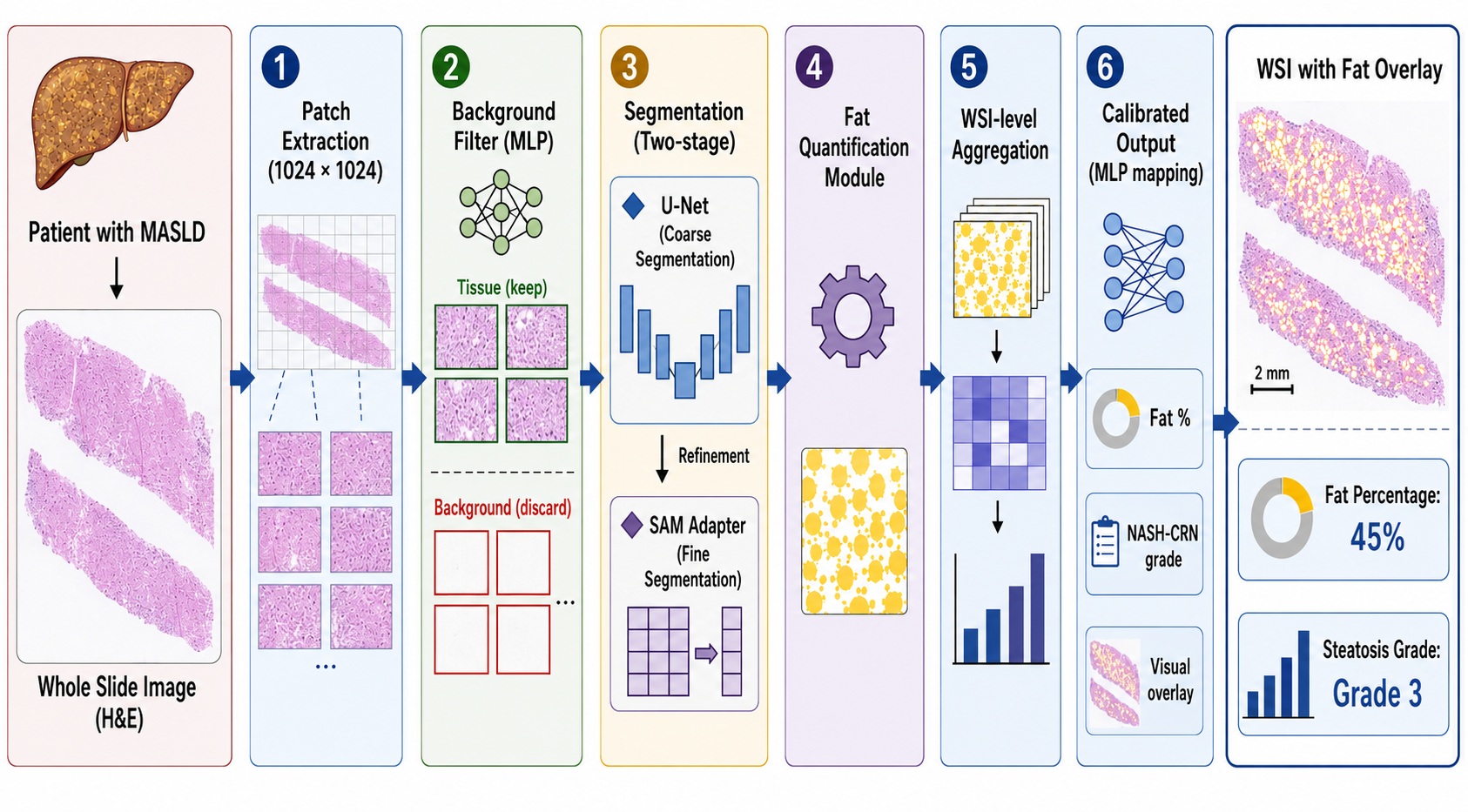
Background: Metabolic dysfunction-associated steatotic liver disease (MASLD) is a significant and escalating global health concern, with an estimated prevalence of 30%. Current assessments of hepatic steatosis, a hallmark of MASLD, rely on semi-quantitative grading by pathologists, which is inherently limited by inter-observer variability. Objective: To address this limitation, we developed a novel deep learning pipeline, named SteatoStat, to standardize and enhance the quantification of hepatic steatosis in patients with MASLD. Method: The SteatoStat pipeline employs and integrates multiple components such as file format standardization, rule-based cell filtering, and multiple segmentation models across various liver structures, resulting in an output of a continuous quantitative measure of steatosis percentage and translated into steatosis grades. Results: We report a high degree of accuracy and reliability with SteatoStat achieving the following performance metrics (DICE score = 0.8955, AUROC = 0.9928, F1 score = 0.8990). When benchmarked against expert pathologists, the weighted Kappa coefficient is 0.837. Furthermore, in comparison with an existing, well-established model, SteatoStat demonstrated a weighted Kappa coefficient = 0.765. Conclusions: These robust findings underscore its potential clinical utility in providing a standardized objective quantification of hepatic steatosis. Future directions include enhancing the model’s generalizability and its clinical integration through validation on independent, multi-institutional datasets.
Keywords: deep learning pipeline; hepatic steatosis; MASLD; segmentation model deep learning pipeline; hepatic steatosis; MASLD; segmentation model
Graphical Abstract