1. Introduction
The CIMT is an important indicator of atherosclerosis progression and the risk of future cardiovascular events, including stroke and myocardial infarction. Elevated CIMT is directly associated with increased vascular stiffness and plaque burden, making its accurate measurement essential for patient risk stratification and monitoring therapeutic effectiveness [
1]. CIMT can be assessed using various non-invasive medical imaging modalities. While magnetic resonance imaging provides excellent soft tissue contrast, its high cost and limited accessibility restrict its routine clinical use. Computed tomography offers detailed visualization but involves exposure to ionizing radiation. For routine clinical practice, B-mode ultrasound remains the gold standard. It offers a cost-effective, real-time, and safe method to visualize the carotid artery wall structure. To ensure standardized assessment and reliability, international consensus guidelines such as the Mannheim Consensus recommend measuring CIMT on the far wall of the common carotid artery (CCA) over the straight segment located approximately 10 to 30 mm proximal to the carotid bulb [
2].
Despite the advantages of ultrasound imaging, manual CIMT measurement is inherently time-consuming, tedious, and highly prone to inter- and intra-observer variability. These factors significantly limit its utility in large-scale clinical trials and routine practice. To overcome these limitations, automated segmentation techniques leveraging artificial intelligence have been extensively studied. In particular, deep learning has emerged as the leading approach for precise and robust medical image analysis. U-Net has become a standard model for medical image segmentation [
3,
4,
5,
6]. Subsequently, numerous variants, including ResUNet, UNet++, Attention U-Net, and the transformer-based TransUNet, have been proposed and have demonstrated significant performance improvements across diverse tasks [
7,
8,
9,
10,
11].
Recent studies have applied U-Net variants to CIMT or carotid ultrasound image segmentation. For example, Ottakath et al. proposed a framework termed
Refined Intima-Media Segmentation to improve boundary reconstruction performance [
12]. Jain et al. successfully segmented pathological regions, including plaques, using an attention-based U-Net [
13]. In addition, Al Qurri and Almekkawy introduced a novel attention module that outperformed vanilla U-Net across multiple datasets [
14]. Further, Biswas et al. compared traditional techniques with neural-network-based methods, highlighting both the potential and limitations of automated CIMT measurement [
15]. More recently, Tian et al. quantitatively analyzed the radial arterial tracking performance in the short-axis view by comparing several U-Net family models [
16].
However, despite these advances, many comparative studies have not yet jointly examined critical aspects, such as boundary reconstruction quality, real-time inference speed, and model parameter counts. Furthermore, direct head-to-head evaluation of the U-Net family models on CIMT ultrasound images remains limited. In this study, we quantitatively compared the performance of U-Net and its variants using a publicly available carotid ultrasound dataset in which all models were trained and tested under an identical experimental protocol. The evaluation metrics included Dice/IoU scores, precision, recall, pixel-wise accuracy, training time, inference speed, and parameter counts. Through this, we aimed to provide a comprehensive characterization of each model, thereby clarifying the relative strengths and limitations of automated CIMT measurements.
1.1. Basic U-Net Architecture
1.1.1. Overview of the Basic U-Net Architecture [3]
U-Net has a U-shaped symmetric structure composed only of convolutional layers consisting of a contracting path on the left and an expansive path on the right. U-Net was designed based on the concepts of double convolutional blocks, an encoder, a decoder, and skip connections. With this configuration, U-Net can effectively perform the pixel-wise segmentation of input images and has shown excellent performance, particularly in the medical imaging field. In addition, to address the lack of large training datasets for medical imaging problems, effective network training with a small number of images was devised by leveraging data augmentation.
1.1.2. Encoder–Decoder Structure
The encoder functions as a contracting path based on convolutional neural networks (CNNs), which utilize learnable filters (kernels) to capture hierarchical spatial patterns—ranging from low-level edges to high-level semantic features. The encoder extracts these features from the input image via convolution operations and pooling, while gradually reducing the spatial resolution. Each encoder stage applies a double convolutional block consisting of two 3 × 3 convolution layers, followed by a 2 × 2 max-pooling operation that halved the height and width of the feature maps. With each downsampling step through pooling, the number of channels (feature maps) doubles, and richer representations are learned. The features hierarchically extracted by the encoder from low-to high-level representations are stored such that they can be used in the decoder stage.
Conversely, the decoder proceeds in the opposite direction to the encoder, progressively restoring the low-resolution feature maps to output a segmentation result of the same size as the original input. At each decoder stage, features are upsampled to double the resolution and concatenated with the skip connection features stored from the corresponding encoder stage. A double convolutional block is then applied again to the concatenated features so that the interactions among the combined information can restore the fine details necessary for segmentation. At each decoder stage, the number of channels is halved, reversing encoder doubling, such that only as many channels as the number of target classes remain in the final output. Finally, a 1 × 1 convolution layer produced the final per-pixel class probabilities or labels to obtain the segmentation map.
1.1.3. Skip Connection
The skip connections of U-Net directly deliver high-resolution feature maps extracted from the encoder to the decoder. The feature maps obtained immediately before pooling at each encoder stage are stored and later concatenated with the upsampled feature maps at the corresponding decoder stage, thereby integrating fine details from the original image with high-level semantic information. Through these skip connections, multiresolution features can be effectively fused so that delicate parts, such as segmentation boundaries, can be accurately reconstructed. In other words, skip connections compensate for the localization information lost in deep networks to achieve high localization accuracy.
1.2. Overview of U-Net Variants
To improve the segmentation accuracy in medical imaging, various variants have been proposed to enhance the basic U-Net structure. Representative examples include ResUNet, which introduces residual connections to enable the training of deeper networks, and R2U-Net, which improves performance with efficient parameters using a recurrent residual structure [
15]. UNet++ provides richer feature information through hierarchical and dense connections [
17], whereas Attention U-Net introduces an attention mechanism that selectively focuses on important regions [
18]. More recently, Transformer-based TransUNet addresses long-range dependency issues and has gained attention [
12]; UNext combines convolution and MLP to achieve a lightweight model while maintaining high performance [
13]. The structural characteristics and performance-enhancing elements of these variants are examined in the following subsections.
1.2.1. ResUNet [11]
ResUNet extends the basic U-Net model by introducing residual connections, replacing U-Net’s convolutional blocks with residual blocks, which add the block input to its output as a skip connection. These residual connections facilitate gradient flow during training, mitigate vanishing gradients in deep networks, and enable the training of deeper architectures. By combining U-Net’s strong segmentation capacity with ResNet’s stable training characteristics, ResUNet can effectively capture fine image details and improve the convergence and segmentation performance.
1.2.2. UNet++ [7,8]
UNet++, also known as a Nested U-Net, is a model that hierarchically redesigns the skip connections of U-Net. While the original U-Net directly connects features at the same resolution between the encoder and decoder, UNet++ inserts additional convolutional layers between them, forming multistage nested skip pathways. This nested dense skip pathway gradually reduces the semantic gap between the encoder and decoder, effectively fusing features across multiple resolutions. In actual experiments, UNet++ has demonstrated an average IoU improvement of approximately 3.9 points over the basic U-Net, validating the effectiveness of this structural refinement.
1.2.3. Attention U-Net [9]
Attention U-Net introduces attention gates into the skip connections of U-Net. Using a gating signal that combines features propagated from the encoder with contextual information on the decoder side, this model assigns higher weights to important spatial regions in the feature maps to pass through skip connections, while suppressing irrelevant parts. This attention mechanism enables better discrimination between target structures and backgrounds, thereby improving segmentation accuracy, even for small structures and complex scenes.
1.2.4. TransUNet [10]
TransUNet is a hybrid model that integrates Transformers into the U-Net architecture to compensate for the locality limitations of the convolution-based U-Net. In this model, a Vision Transformer is introduced into the encoder, and the input image is tokenized into patches and processed using a self-attention mechanism to extract global contextual information. The extracted global feature representation is fused with high-resolution CNN feature maps via skip connections in the decoder to restore the fine spatial information. With this design, TransUNet has shown outstanding accuracy, surpassing existing CNN-based models in various medical imaging tasks.
1.2.5. UNext [19]
UNext is a lightweight convolution–MLP hybrid U-Net proposed for fast medical image segmentation. The early encoder used convolution layers to extract features; in the latent space, the feature maps were tokenized and processed by MLP blocks, performing MLP-based representation learning instead of conventional convolutions. This design makes the model highly lightweight, reducing parameter counts to approximately 1/72 and computations to approximately 1/68 of traditional models, while maintaining high accuracy.
1.2.6. Inception U-Net [20,21]
Inception U-Net applies inception modules to the encoder and decoder of a basic U-Net to simultaneously extract features at multiple scales. Each Inception module performs 1 × 1, 3 × 3, and 5 × 5 convolutions, with a pooling path in parallel, and concatenates the results along the channel dimension to provide rich multiscale information. The 1 × 1 convolution reduces the dimensionality before the larger-kernel convolutions to reduce computation, after which the large-kernel convolutions capture wide-receptive-field information. This structure can effectively capture both small and large lesions, thereby improving the medical image segmentation performance.
1.2.7. Attention Res-U-Net [22]
The attention Res-U-Net combines attention mechanisms with the Res-U-Net architecture to selectively focus on important regions. Using an attention block that combines a gating signal and an input feature map, attention weights that indicate the importance of each spatial location are computed. The computed weights were applied element-wise to the feature maps that passed through skip connections, suppressing unnecessary information and emphasizing meaningful regions.
1.2.8. SE U-Net [23,24]
SE U-Net integrates squeeze-and-excitation (SE) blocks into the basic U-Net structure to strengthen its ability to learn interchannel dependencies. In the squeeze stage, the global average pooling compresses the spatial information of each channel into a single value to form a channel-wise statistical vector. In the excitation stage, this statistical vector is used to learn channel-wise weights, thereby enabling the network to emphasize important channels and suppress unnecessary ones.
1.2.9. Dense U-Net [25,26]
Dense U-Net incorporates DenseNet’s dense and transition blocks within the U-Net structure to reinforce feature reuse and compensate for resolution loss. The network comprises a symmetric dense downsampling path and a dense upsampling path. Within each dense block, every layer is connected to all of the previous layers to maximize feature utilization. Each dense block comprises BN → 1 × 1 Conv (channel reduction) → 3 × 3 Conv (feature extraction) → Dropout with four densely connected layers. Transition blocks are composed of BN → 1 × 1 Conv → 2 × 2 Max Pooling to perform inter-stage transitions and resolution reduction. In the upsampling path, the merge operations and dense blocks restore the resolution and ultimately produce a full-resolution output.
2. Materials and Methods
2.1. Dataset and Preprocessing
For the multi-institutional analysis, we used the CUBS dataset publicly available on Mendeley Data [
27]. CUBS included far-wall segments of the left and right CCA in B-mode ultrasound images collected from a total of 1088 patients (mean age: 62 ± 11 years; 50% female). The study population comprised two distinct cohorts: 694 participants recruited from the general population in Cyprus (inclusion criterion: age > 40 years) and 394 patients enrolled from a Hypertension Outpatient Clinic in Pisa, representing a group with higher cardiovascular risk factors. The dataset provides up to two images per patient (yielding 2176 total frames), along with segmentation masks manually annotated by three experts. Ultrasound scans were performed using a Philips ATL HDI-5000 duplex scanner with an L12-5 MHz linear array probe (1388 images from 694 patients in Cyprus) and an Esaote MyLab25 system with an LA523 4–13 MHz linear probe (788 images from 394 patients in Pisa), following the Mannheim consensus guidelines for standardized CCA image acquisition [
28]. Among the three experts, the annotations from Analyst A1 (>10 years of clinical experience) were selected as the ground truth (GT), as this expert provided the most complete and consistent annotations across the entire dataset. Regarding data selection, multiple clips were originally acquired, and expert operators selected the single best frame per side based on the highest qualitative visual contrast between the lumen and intima-media complex, thereby excluding images with poor visibility or artifacts that prevented reliable annotation. No further exclusion criteria were applied in our study to maintain the standard benchmark configuration.
The images were provided in TIFF format in 8-bit grayscale, with an average resolution of 720 × 576 pixels. One or multiple frames were provided per patient and the total file size was approximately 378 MB. To address speckle noise and inherently low-contrast vascular boundaries in ultrasound, we applied contrast-limited adaptive histogram equalization (CLAHE), which has been shown to enhance edge definition while avoiding noise amplification compared with global histogram equalization approaches [
29,
30]. Subsequently, all images and masks were resized to 256 × 256 pixels, and the pixel values were normalized to the range [0, 1]. For data splitting, we applied a patient-level stratified split into 80% for training (870 patients) and 20% for validation (218 patients) to prevent the same patient images from appearing in both training and validation.
2.2. Network Architectures
Detailed architectural specifications and the complete source code for all implemented models are publicly available in our GitHub online repository [
31]. All models follow the standard architectural configurations described in
Section 1, with minor adjustments to accommodate the specific input resolution of the CUBS dataset. To provide a clear overview of the architectural diversity, we summarize the key characteristics of the implemented U-Net variants in
Table 1. Each model modifies the standard U-Net backbone by incorporating distinct mechanisms—such as residual connections, attention gates, transformers, or MLP blocks—to address specific segmentation challenges including boundary delineation, long-range dependencies, and computational efficiency.
The filter configuration in
Table 1 specifies the number of filters in each layer in the encoder path. The decoder path generally follows this configuration in reverse order to restore spatial resolution. However, some hybrid models exhibit structural asymmetry to improve efficiency: TransUNet uses a purely CNN-based decoder without Transformer layers, and UNeXt employs simple convolutional upsampling in the decoder, omitting the tokenized MLP blocks present in the encoder. While most networks utilize a standard 3 × 3 kernel size for feature extraction, certain architectures adopt different kernel sizes tailored to their design: DenseUNet employs a 7 × 7 convolution in the initial layer to achieve a larger receptive field, while InceptionUNet utilizes parallel multi-scale kernels (1 × 1, 3 × 3, and 5 × 5). In addition, ResNet-based models and UNeXt incorporate 1 × 1 convolutions for residual connections or pointwise operations to reduce computational cost.
The parameter counts reported in this study may vary depending on the initial number of channels and the network depth used in the model implementation and may differ from those reported in prior publications. However, all models were trained and evaluated under identical settings to ensure fairness in the relative comparisons.
2.3. Hyperparameter Settings
All models were trained for 50 epochs with a batch size of 8. We applied the Adam optimization algorithm with an initial learning rate of 1 × 10
−4. We used binary cross-entropy as the loss function for the per-pixel error:
where
is the total number of pixels,
is the model output for the
-th pixel,
is the ground truth label, and
is the sigmoid fuction.
2.4. Segmentation Performance Metrics
To quantitatively evaluate the accuracy of the segmented regions, we calculated the Precision, Recall, Accuracy, and Dice/IoU scores, where TP, FP, TN, and FN denote the true positives, false positives, true negatives, and false negatives, respectively.
- •
Precision is the proportion of predictions labeled positive by the model that are actually positive.
- •
Recall is the proportion of actual positive instances that the model correctly predicts as positive.
- •
Accuracy is the proportion of all cases the model classifies correctly:
- •
Dice score is defined as twice the size of the intersection of the predicted and ground truth regions divided by the sum of their sizes.
- •
IoU is defined as the size of the intersection divided by the size of the union of the two regions (intersection over union). All take values in [0, 1]; higher values indicate better agreement between the prediction and ground truth, with 1 indicating perfect segmentation.
2.5. Measurement of Training and Inference Time
To compare the computational efficiency across the models, we measured both the training and inference times. The training time was recorded until each epoch was completed and converted into the mean training time per epoch. The inference time was measured on the validation dataset with a batch size fixed at 1 and reported as the average time per single ultrasound image. This allows for the quantitative evaluation of the training efficiency and real-time applicability per model.
2.6. Experimental Environment
All experiments were conducted in Python 3.10.16, using the PyTorch 2.5.1 deep-learning framework. The hardware used was a laptop equipped with an RTX 4060 Laptop GPU with 8 GB VRAM (NVIDIA, Santa Clara, CA, USA) and an Ryzen 7 7840HS APU processor (AMD, Santa Clara, CA, USA). We also used CUDA 12.1 and cuDNN 9.1.0 for the GPU-accelerated computation.
3. Results
3.1. Performance Comparison
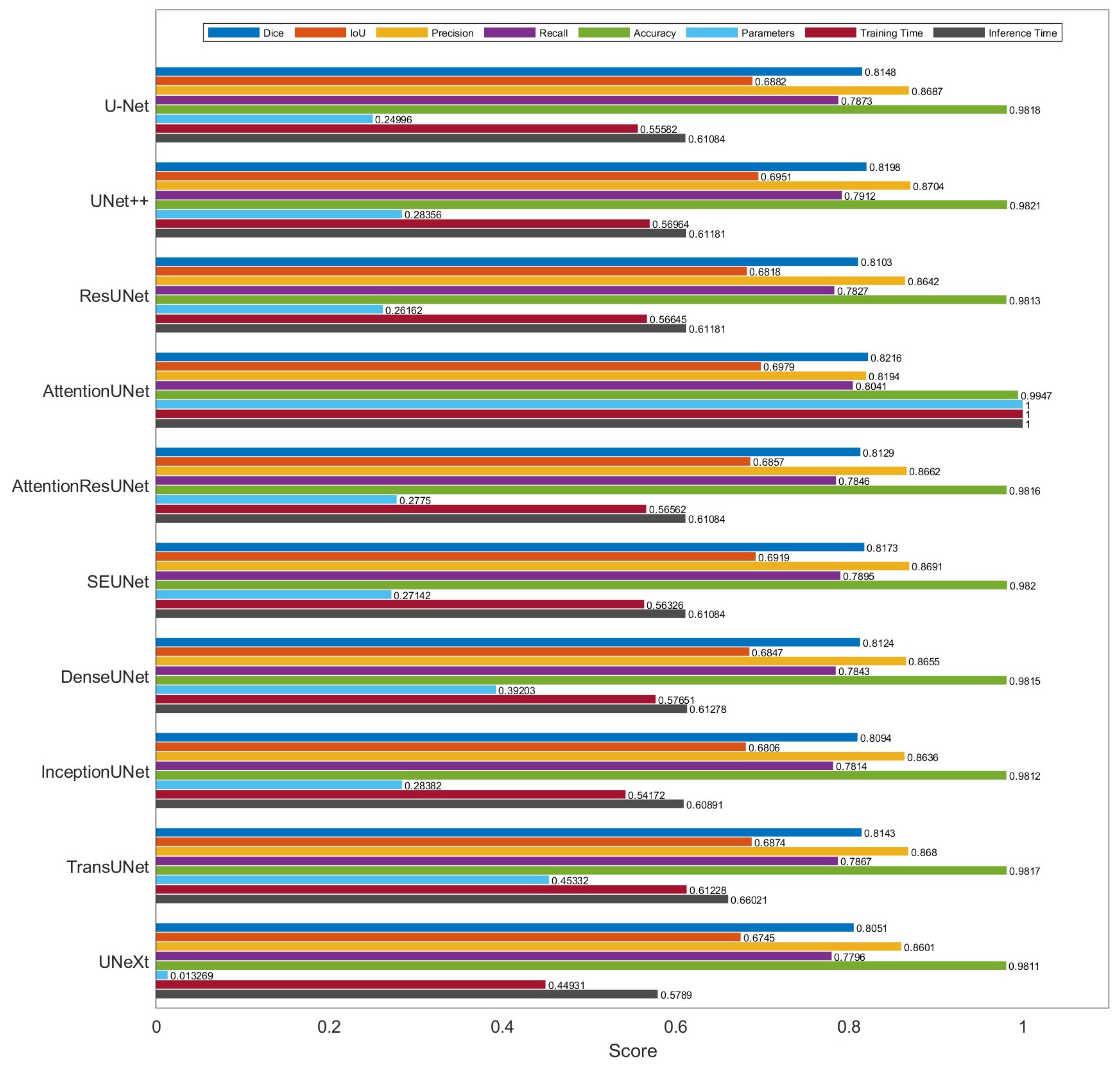
Segmentation performance was evaluated using Precision, Recall, Accuracy, Dice and IoU scores, whereas the real-time efficiency was assessed based on parameter counts, training time, mean epoch time, and inference time.
Table 2 shows the number of parameters of the U-Net variants. Most U-Net-family models have approximately 8–9 million parameters, but Attention U-Net has the highest at approximately 31.4 million. Conversely, UNext had only about 420 thousand parameters, confirming its extremely lightweight structure. This shows large differences across the models in terms of computational complexity and resource requirements.
Table 3 summarizes the segmentation performance in terms of Dice and IoU scores. All models showed stable performance with Dice ≥ 0.80 and IoU ≥ 0.67. The attention U-Net achieved the highest performance, and UNet++ and SE U-Net were slightly superior to the basic U-Net. UNext had the lowest scores but maintained a respectable performance relative to its extremely small parameter count.
Table 4 presents comparisons of the segmentation performances in terms of Precision, Recall, and Accuracy. Most models maintained a balance between Precision and Recall, and Accuracy above 98%. The attention U-Net had the highest recall but a relatively lower precision, showing a tendency toward oversegmentation. The other models maintained balanced Precision and Recall, demonstrating stable segmentation performance.
Table 5 presents a comparison of the computational time per model. Most models required approximately 40 s per epoch, whereas Attention U-Net required approximately 72 s, which was the longest. Conversely, UNext was the fastest, at about 32 s per epoch with a total training time of about 27 min; this model also had the shortest inference time. In other words, the Attention U-Net stands out in terms of accuracy, whereas UNext stands out in terms of speed and efficiency.
Segmentation performance (
Table 3 and
Table 4) and the real-time efficiency (
Table 2 and
Table 5) are summarized in
Figure 1. Note that the parameter counts, training time, and inference time are all normalized with respect to Attention U-Net.
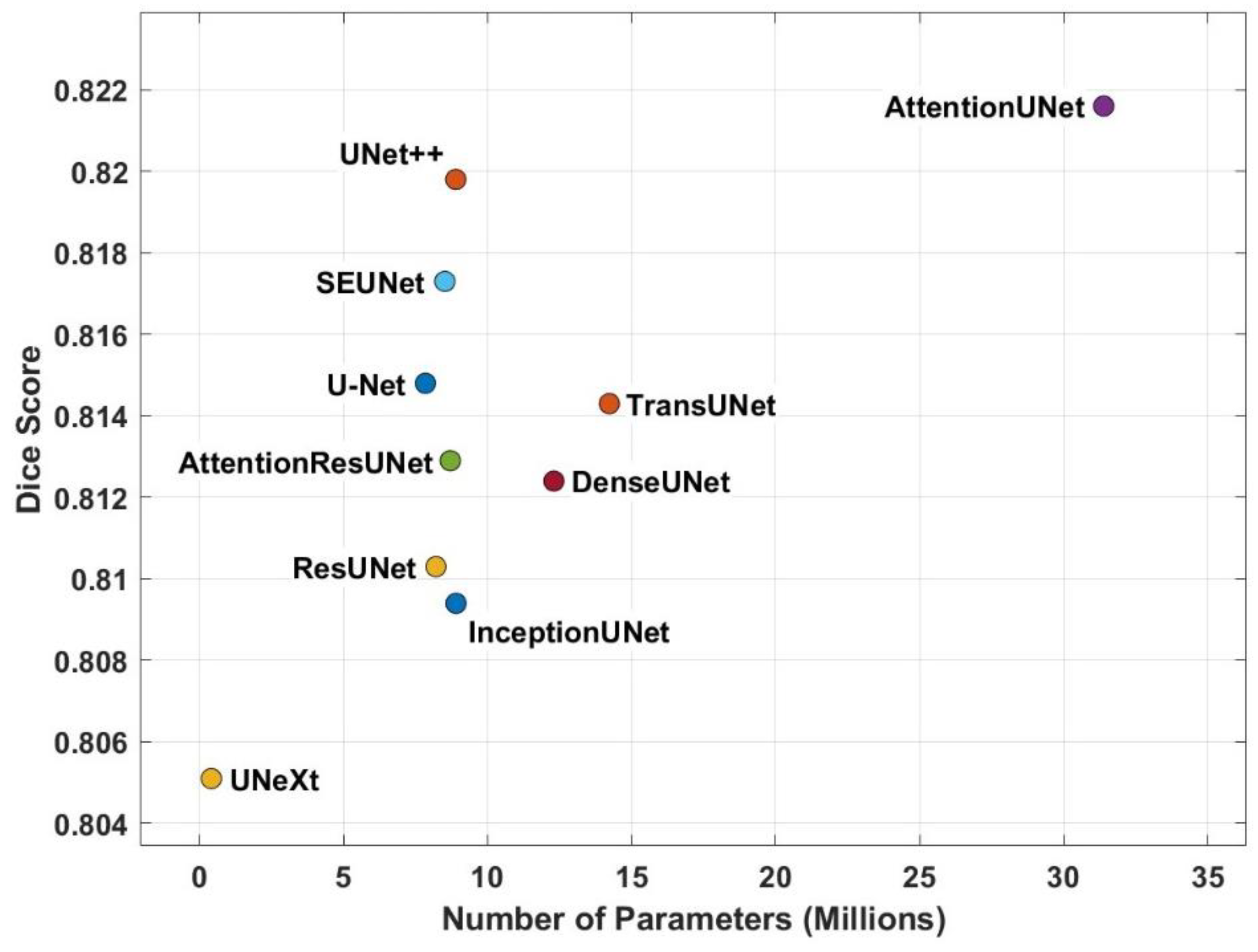
Figure 2 summarizes the number of parameters and dice scores for several U-Net variants. The results highlight a clear tradeoff between the model complexity and segmentation accuracy. Attention U-Net achieved the highest Dice score (~0.822); however, this gain came at the cost of a markedly larger parameter count (>30 M), implying heavier computational and memory requirements during both training and deployment. In contrast, UNext achieved competitive accuracy with the smallest parameter footprint, suggesting strong potential for resource-constrained or real-time applications, where inference speed and memory efficiency are critical.
Intermediate models, such as UNet++ and SEUNet, demonstrated relatively high Dice scores while maintaining moderate parameter sizes, which may offer a more balanced compromise between accuracy and computational burden. These observations indicate that the optimal model selection should be guided not only by raw segmentation performance but also by practical considerations, such as hardware constraints and deployment scenarios.
3.2. Visualization
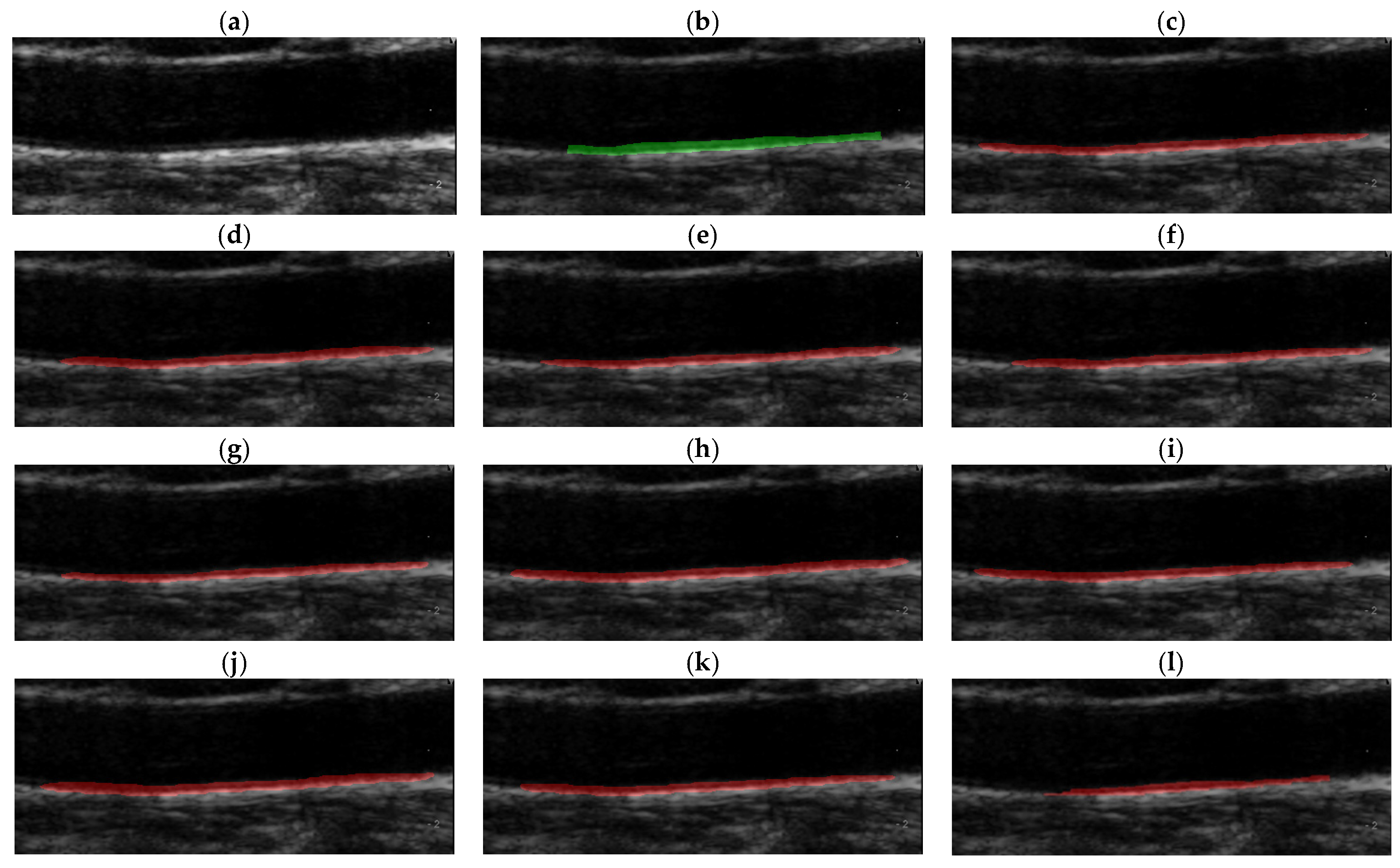
Because the model outputs were fixed at 256 × 256 pixels, we used bilinear interpolation to upsample them to match the original ultrasound image size (e.g., 720 × 576 pixels). This smoothly enlarges the probability map, thereby allowing for seamless alignment with the original image. In contrast, because the GT mask must retain the binary pixel values (0/1), we applied the nearest-neighbor interpolation. This approach converts the model output and GT appropriately to ensure consistency in visual comparisons.
Figure 3 presents the CIMT segmentation results of a representative image. We utilized OpenCV 4.11 for mask generation and applied region filtering to remove small fragments. The U-Net and Attention U-Net generally exhibited stable and respectable performances. U-Net reproduced the overall contours reasonably well, but the boundaries appeared somewhat irregular in areas of high curvature, whereas U-Net captured thin structures relatively well, but showed a tendency towards thicker (over-segmented) boundaries in some cases. Interestingly, UNet++ tended to reconstruct the shape of the vascular lumen more smoothly and naturally than the GT itself, which can be interpreted as compensating for the observer variability inherent in manual GT. Conversely, UNext, despite its extremely small parameter count, reproduced the overall contours well, but showed boundary discontinuities at some endpoints, indicating somewhat limited fine-boundary reconstruction.
4. Discussion
Although U-Net variants are widely used in medical image segmentation, systematic comparisons for CIMT boundary segmentation under consistent experimental settings have remained limited. As a result, performance differences reported across studies could not be readily attributed to architectural choices versus dataset- or protocol-specific factors. This study addresses this gap by providing a standardized and reproducible benchmark on a public dataset under uniform training and evaluation settings.
Jain et al. [
13] proposed an attention-based U-Net specifically tailored for plaque segmentation in carotid ultrasound images, emphasizing its utility in stroke risk stratification. While their model demonstrated enhanced segmentation of pathological regions, our study focuses on a broader comparison of U-Net variants for CIMT segmentation, where precise boundary delineation for thickness measurement is critical, rather than targeting plaque regions, thereby providing a more generalized evaluation.
Al Qurri and Almekkawy [
14] introduced a novel spatial attention mechanism that improved performance across various datasets. In contrast, we implemented multiple established variants including Attention U-Net as part of a comprehensive benchmark under uniform training and evaluation settings using the public CUBS dataset, ensuring fair model-to-model comparisons.
Biswas et al. [
15] presented a qualitative review contrasting traditional and neural network-based CIMT measurement techniques, highlighting the clinical potential of automation. Our work complements this by offering quantitative validation of segmentation accuracy and real-time performance metrics across U-Net variants. In addition, to facilitate reproducibility and future extensions, we have publicly released our source code and experimental configurations [
31].
Lastly, Tian et al. [
16] investigated U-Net family models for radial artery tracking in short-axis views. Their focus on arterial tracking differs from our emphasis on CIMT boundary segmentation, yet both studies underscore the importance of selecting suitable architectures based on anatomical and clinical contexts. Collectively, these distinctions highlight the unique contribution of our study as a systematic, reproducible analysis of U-Net variants for CIMT segmentation on a standardized public dataset.
Furthermore, our analysis of computational efficiency provides critical insights for the deployment of deep learning models on resource-constrained devices, such as portable or point-of-care ultrasound systems [
32]. With the increasing adoption of handheld ultrasound devices in primary care and remote settings, there is a growing demand for lightweight algorithms that can operate with limited processing power and battery life [
33]. While complex models like Attention U-Net offer peak performance, their high computational cost may hinder real-time deployment on mobile hardware. In contrast, our findings indicate that efficient architectures such as UNeXt achieve competitive accuracy with significantly lower latency, making them highly suitable for embedded systems where computational resources are limited. This trade-off is consistent with recent trends in mobile health AI, emphasizing the need to balance model complexity with accessibility and real-time capability [
34].
A primary limitation of the present evaluation stems from the restricted scope of the CUBS dataset [
28]. Our analysis was confined to the far-wall segments of the CCA, covering both the right and left arteries of the 1088 subjects. This inherent constraint limits the generalizability of the reported results to other anatomically and clinically critical segments of the carotid tree, such as the carotid bulb or the internal carotid artery, which are known to be preferential sites for plaque formation and pronounced thickening. Consequently, validation studies incorporating a wider range of carotid segments are necessary to assess the clinical utility of the evaluated automated methods for plaque characterization and stenosis grading.
Future research will focus on incorporating multi-observer consensus labels, addressing inter-observer variability, and extending our analysis to fully automated CIMT measurement pipelines integrated with end-to-end clinical decision support.
5. Conclusions
In this study, we performed a systematic and fair comparison of U-Net and nine of its widely used variants for automated CIMT segmentation in carotid B-mode ultrasound images. By training all models under identical conditions using a multi-center public database, we demonstrated the relative strengths and limitations of each architecture in terms of segmentation accuracy, boundary reconstruction characteristics, computational cost, and real-time applicability. Our findings confirmed that Attention U-Net achieved the highest Dice and IoU scores, whereas UNet++ provided notably smooth boundary reconstruction through its nested skip-connection design. In contrast, UNeXt showed competitive accuracy despite having the smallest parameter count and fastest inference time, implying strong suitability for real-time clinical applications or embedded ultrasound systems. Therefore, the selection of an appropriate CIMT segmentation model should consider both clinical requirements and system-level constraints, such as hardware availability and the need for real-time analysis. Overall, this work offers valuable reference information for both researchers and clinicians by highlighting performance trade-offs among state-of-the-art U-Net variants.
Author Contributions
Conceptualization, D.C.P.; methodology, S.J. (Seungju Jeong), M.P. and D.C.P.; software, S.J. (Seungju Jeong) and M.P.; validation, S.J. (Seungju Jeong), M.P. and D.C.P.; formal analysis, S.J. (Seungju Jeong) and M.P.; investigation, S.J. (Seungju Jeong) and M.P.; resources, D.C.P.; data curation, S.J. (Seungju Jeong) and M.P.; writing—original draft preparation, S.J. (Seungju Jeong) and M.P.; writing—review and editing, D.C.P. and S.J. (Sumin Jeong); visualization, S.J. (Seungju Jeong) and M.P.; supervision, D.C.P. and S.J. (Sumin Jeong); project administration, D.C.P.; funding acquisition, D.C.P. and S.J. (Sumin Jeong). All authors have read and agreed to the published version of the manuscript.
Funding
This work was partly supported by the Institute of Information & Communications Technology Planning & Evaluation (IITP)-Innovative Human Resource Development for Local Intellectualization program grant funded by the Korea government (MSIT) (IITP-2025-RS-2020-II201612, 50%) and by the National Korea Maritime & Ocean University Research Fund in 2025 (50%).
Institutional Review Board Statement
All data used in this study were obtained from the publicly available CUBS repository (accessed at
https://data.mendeley.com/datasets/fpv535fss7/1), which has been de-identified and approved for research use by the Ethics Committee of the Cyprus Institute of Neurology and Genetics and the Institutional Ethics Committee of the University of Pisa. The original data collection followed ethical guidelines for medical research, with patient consent obtained for the initial data collection. For secondary analysis of this publicly available de-identified dataset, no additional IRB approval was required as per institutional guidelines.
Informed Consent Statement
Not applicable.
Data Availability Statement
Acknowledgments
During the preparation of this manuscript/study, the authors used ChatGPT5 for the purposes of English grammar check. The authors have reviewed and edited the output and take full responsibility for the content of this publication.
Conflicts of Interest
The authors declare no conflicts of interest.
Abbreviations
The following abbreviations are used in this manuscript:
| CIMT | Carotid intima-media thickness |
| CUBS | Carotid ultrasound boundary study |
| CCA | Common carotid artery |
| CNN | Convolutional neural network |
| IOU | Intersection over union |
| TP | True positives |
| FP | False positives |
| TN | True negatives |
| FN | False negatives |
| SE | Squeeze-and-excitation |
| CLAHE | Contrast-limited adaptive histogram equalization |
| GT | Ground Truth |
References
- Willeit, P.; Tschiderer, L.; Allara, E.; Reuber, K.; Seekircher, L.; Gao, L.; Liao, X.; Lonn, E.; Gerstein, H.C.; Yusuf, S.; et al. Carotid Intima-Media Thickness Progression as Surrogate Marker for Cardiovascular Risk: Meta-Analysis of 119 Clinical Trials Involving 100,667 Patients. Circulation 2020, 142, 621–642. [Google Scholar] [CrossRef] [Scilit] [PubMed]
- Touboul, P.J.; Hennerici, M.G.; Meairs, S.; Adams, H.; Amarenco, P.; Bornstein, N.; Csiba, L.; Desvarieux, M.; Ebrahim, S.; Hernandez Hernandez, R.; et al. Mannheim Carotid Intima-Media Thickness and Plaque Consensus (2004–2006–2011). An Update on Behalf of the Advisory Board of the 3rd, 4th and 5th Watching the Risk Symposia. Cerebrovasc. Dis. 2012, 34, 290–296. [Google Scholar] [CrossRef] [Scilit] [PubMed]
- Ronneberger, O.; Fischer, P.; Brox, T. U-Net: Convolutional networks for biomedical image segmentation. arXiv 2015, arXiv:1505.04597. [Google Scholar] [CrossRef] [Scilit]
- Azad, R.; Aghdam, E.K.; Rouland, A.; Jia, Y.; Abad, A.H.; Bozorgpour, A.; Karimijafarbiglou, S.; Cohen, J.P.; Adeli, E.; Merhof, D. Medical image segmentation review: The success of U-Net. arXiv 2022, arXiv:2211.14830. [Google Scholar] [CrossRef] [Scilit] [PubMed]
- Kugelman, J.; Allman, J.; Read, S.A.; Vincent, S.J.; Tong, J.; Kalloniatis, M.; Chen, F.K.; Collins, M.J.; Alonso-Caneiro, D. A comparison of deep learning U-Net architectures for posterior segment OCT retinal layer segmentation. Sci. Rep. 2022, 12, 14888. [Google Scholar] [CrossRef] [Scilit]
- Park, J.H.; Seo, E.; Choi, W.; Lee, S.J. Ultrasound deep learning for monitoring of flow–vessel dynamics in murine carotid artery. Ultrasonics 2022, 120, 106636. [Google Scholar] [CrossRef] [Scilit]
- Zhou, Z.; Siddiquee, M.M.R.; Tajbakhsh, N.; Liang, J. UNet++: A nested U-Net architecture for medical image segmentation. In Deep Learning in Medical Image Analysis and Multimodal Learning for Clinical Decision Support (DLMIA/ML-CDS 2018); Lecture Notes in Computer Science; Stoyanov, D., Taylor, Z., Carneiro, G., Syeda-Mahmood, T., Martel, A., Maier-Hein, L., Tavares, J.M.R.S., Bradley, A., Papa, J.P., Belagiannis, V., Eds.; Springer: Cham, Switzerland, 2018; Volume 11045, pp. 3–11. [Google Scholar] [CrossRef] [Scilit]
- Zhou, Z.; Siddiquee, M.M.R.; Tajbakhsh, N.; Liang, J. UNet++: Redesigning skip connections to exploit multiscale features in image segmentation. IEEE Trans. Med. Imaging 2020, 39, 1856–1867. [Google Scholar] [CrossRef] [Scilit]
- Oktay, O.; Schlemper, J.; Le Folgoc, L.; Lee, M.; Heinrich, M.; Misawa, K.; Mori, K.; McDonagh, S.; Hammerla, N.Y.; Kainz, B.; et al. Attention U-Net: Learning where to look for the pancreas. arXiv 2018, arXiv:1804.03999. [Google Scholar] [CrossRef] [Scilit]
- Chen, J.; Lu, Y.; Yu, Q.; Luo, X.; Adeli, E.; Wang, Y.; Lu, L.; Yuille, A.L.; Zhou, Y. TransUNet: Transformers make strong encoders for medical image segmentation. arXiv 2021, arXiv:2102.04306. [Google Scholar] [CrossRef] [Scilit]
- He, K.; Zhang, X.; Ren, S.; Sun, J. Deep residual learning for image recognition. In Proceedings of the 2016 IEEE Conference on Computer Vision and Pattern Recognition (CVPR), Las Vegas, NV, USA, 27–30 June 2016; IEEE: New York, NY, USA, 2016; pp. 770–778. [Google Scholar] [CrossRef] [Scilit]
- Ottakath, N.; Akbari, Y.; Al Maadeed, S.A.; Chowdhury, M.E.H.; Zughaier, S.; Bouridane, A.; Sadasivuni, K.K. MSEUnet: Refined intima-media segmentation of the carotid artery based on a multi-scale approach using patch-wise dice loss. Biomed. Signal Process. Control 2025, 100, 107077. [Google Scholar] [CrossRef] [Scilit]
- Jain, P.K.; Dubey, A.; Saba, L.; Khanna, N.N.; Laird, J.R.; Nicolaides, A.; Fouda, M.M.; Suri, J.S.; Sharma, N. Attention-based UNet deep learning model for plaque segmentation in carotid ultrasound for stroke risk stratification: An artificial intelligence paradigm. J. Cardiovasc. Dev. Dis. 2022, 9, 326. [Google Scholar] [CrossRef] [Scilit]
- Al Qurri, A.; Almekkawy, M. Improved UNet with attention for medical image segmentation. Sensors 2023, 23, 8589. [Google Scholar] [CrossRef] [Scilit] [PubMed]
- Biswas, M.; Saba, L.; Omerzu, T.; Johri, A.M.; Khanna, N.N.; Viskovic, K.; Mavrogeni, S.; Laird, J.R.; Pareek, G.; Miner, M.; et al. A review on joint carotid intima-media thickness and plaque area measurement in ultrasound for cardiovascular/stroke risk monitoring: Artificial intelligence framework. J. Digit. Imaging 2021, 34, 581–604. [Google Scholar] [CrossRef] [Scilit] [PubMed]
- Tian, Y.; Gao, R.; Shi, X.; Lang, J.; Xue, Y.; Wang, C.; Zhang, Y.; Shen, L.; Yu, C.; Zhou, Z. U-Net and its variants based automatic tracking of radial artery in ultrasonic short-axis views: A pilot study. Diagnostics 2024, 14, 2358. [Google Scholar] [CrossRef] [Scilit] [PubMed]
- Xiao, X.; Zhang, J.; Shao, Y.; Liu, J.; Shi, K.; He, C.; Kong, D. Deep learning-based medical ultrasound image and video segmentation methods: Overview, frontiers, and challenges. Sensors 2025, 25, 2361. [Google Scholar] [CrossRef] [Scilit]
- Loizou, C.P.; Pattichis, C.S.; Nicolaides, A.N.; Pantziaris, M. Manual and automated media and intima thickness measurements of the common carotid artery. IEEE Trans. Ultrason. Ferroelectr. Freq. Control 2009, 56, 983–994. [Google Scholar] [CrossRef] [Scilit]
- Valanarasu, J.M.J.; Patel, V.M. UNeXt: MLP-based rapid medical image segmentation network. arXiv 2022, arXiv:2203.04967. [Google Scholar] [CrossRef] [Scilit]
- Zhang, Z.; Wu, C.; Coleman, S.; Kerr, D. DENSE-Inception U-net for medical image segmentation. Comput. Methods Programs Biomed. 2020, 192, 105395. [Google Scholar] [CrossRef] [Scilit]
- Punn, N.S.; Agarwal, S. Inception U-Net architecture for semantic segmentation to identify nuclei in microscopy cell images. ACM Trans. Multimedia Comput. Commun. Appl. 2020, 16, 1–15. [Google Scholar] [CrossRef] [Scilit]
- Maji, D.; Sigedar, P.; Singh, M. Attention Res-UNet with Guided Decoder for semantic segmentation of brain tumors. Biomed. Signal Process. Control 2022, 71, 103077. [Google Scholar] [CrossRef] [Scilit]
- Hu, J.; Shen, L.; Sun, G. Squeeze-and-excitation networks. In Proceedings of the IEEE/CVF Conference on Computer Vision and Pattern Recognition (CVPR), Salt Lake City, UT, USA, 18–23 June 2018; pp. 7132–7141. [Google Scholar] [CrossRef] [Scilit]
- Guha Roy, A.; Navab, N.; Wachinger, C. Recalibrating fully convolutional networks with spatial and channel “squeeze & excitation” blocks. IEEE Trans. Med. Imaging 2019, 38, 540–549. [Google Scholar] [CrossRef] [Scilit]
- Cai, S.; Tian, Y.; Lui, H.; Zeng, H.; Wu, Y.; Chen, G. Dense-UNet: A novel multiphoton in vivo cellular image segmentation model based on a convolutional neural network. Quant. Imaging Med. Surg. 2020, 10, 1275–1285. [Google Scholar] [CrossRef] [Scilit] [PubMed]
- Huang, G.; Liu, Z.; van der Maaten, L.; Weinberger, K.Q. Densely connected convolutional networks. arXiv 2016, arXiv:1608.06993. [Google Scholar] [CrossRef] [Scilit]
- Meiburger, K.M.; Zahnd, G.; Faita, F.; Loizou, C.; Carvalho, C.; Steinman, D.; Gibello, L.; Bruno, R.M.; Marzola, F.; Clarenbach, R.; et al. Dataset for “Carotid Ultrasound Boundary Study (CUBS): An open multi-center analysis of computerized intima-media thickness measurement systems and their clinical impact”. Mendeley Data 2021, 1. [Google Scholar] [CrossRef]
- Meiburger, K.M.; Zahnd, G.; Faita, F.; Loizou, C.P.; Carvalho, C.; Steinman, D.A.; Gibello, L.; Bruno, R.M.; Marzola, F.; Clarenbach, R.; et al. Carotid Ultrasound Boundary Study (CUBS): An Open Multicenter Analysis of Computerized Intima-Media Thickness Measurement Systems and Their Clinical Impact. Ultrasound Med. Biol. 2021, 47, 2442–2455. [Google Scholar] [CrossRef] [Scilit]
- Singh, P.; Mukundan, R.; De Ryke, R. Feature enhancement in medical ultrasound videos using contrast-limited adaptive histogram equalization. J. Digit. Imaging 2020, 33, 273–285. [Google Scholar] [CrossRef] [Scilit]
- Kalpana, G.; Deepa, N.; Dhinakaran, D. Advanced image preprocessing and context-aware spatial decomposition for enhanced breast cancer segmentation. MethodsX 2025, 14, 103224. [Google Scholar] [CrossRef] [Scilit]
- Jeong, S. CIMT Segmentation with U-Net Variants. GitHub Repository. 2025. Available online: https://github.com/JEongSJ-jsj/CIMT-Segmentation-Unet_variation (accessed on 28 November 2025).
- Baribeau, Y.; Sharkey, A.; Chaudhary, O.; Krumm, S.; Fatima, H.; Mahmood, F.; Matyal, R. Handheld Point-of-Care Ultrasound Probes: The New Generation of POCUS. J. Cardiothorac. Vasc. Anesth. 2020, 34, 3139–3145. [Google Scholar] [CrossRef] [Scilit]
- Zhou, Y.J.; Guo, L.H.; Bo, X.W.; Sun, L.P.; Zhang, Y.F.; Chai, H.H.; Ye, R.Z.; Peng, C.Z.; Qin, C.; Xu, H.X. Tele-Mentored Handheld Ultrasound System for General Practitioners: A Prospective, Descriptive Study in Remote and Rural Communities. Diagnostics 2023, 13, 2932. [Google Scholar] [CrossRef] [Scilit]
- Xu, Y.; Khan, T.M.; Song, Y.; Meijering, E. Edge deep learning in computer vision and medical diagnostics: A comprehensive survey. Artif. Intell. Rev. 2025, 58, 93. [Google Scholar] [CrossRef] [Scilit]
| Disclaimer/Publisher’s Note: The statements, opinions and data contained in all publications are solely those of the individual author(s) and contributor(s) and not of MDPI and/or the editor(s). MDPI and/or the editor(s) disclaim responsibility for any injury to people or property resulting from any ideas, methods, instructions or products referred to in the content. |