
Artificial Intelligence-Based Automated Analysis for Pleural Effusion Detection on Thoracic Ultrasound: A Systematic Review

 ,
,  , , , , ,
  ,
,  and
and
Abstract
1. Introduction
2. Methods
2.1. Review Design
2.2. Research Question
2.3. Eligibility Criteria
2.3.1. Population
2.3.2. Index Test
2.3.3. Reference Standard
2.4. Outcomes
2.5. Eligible Studies
2.6. Information Sources and Search Strategy
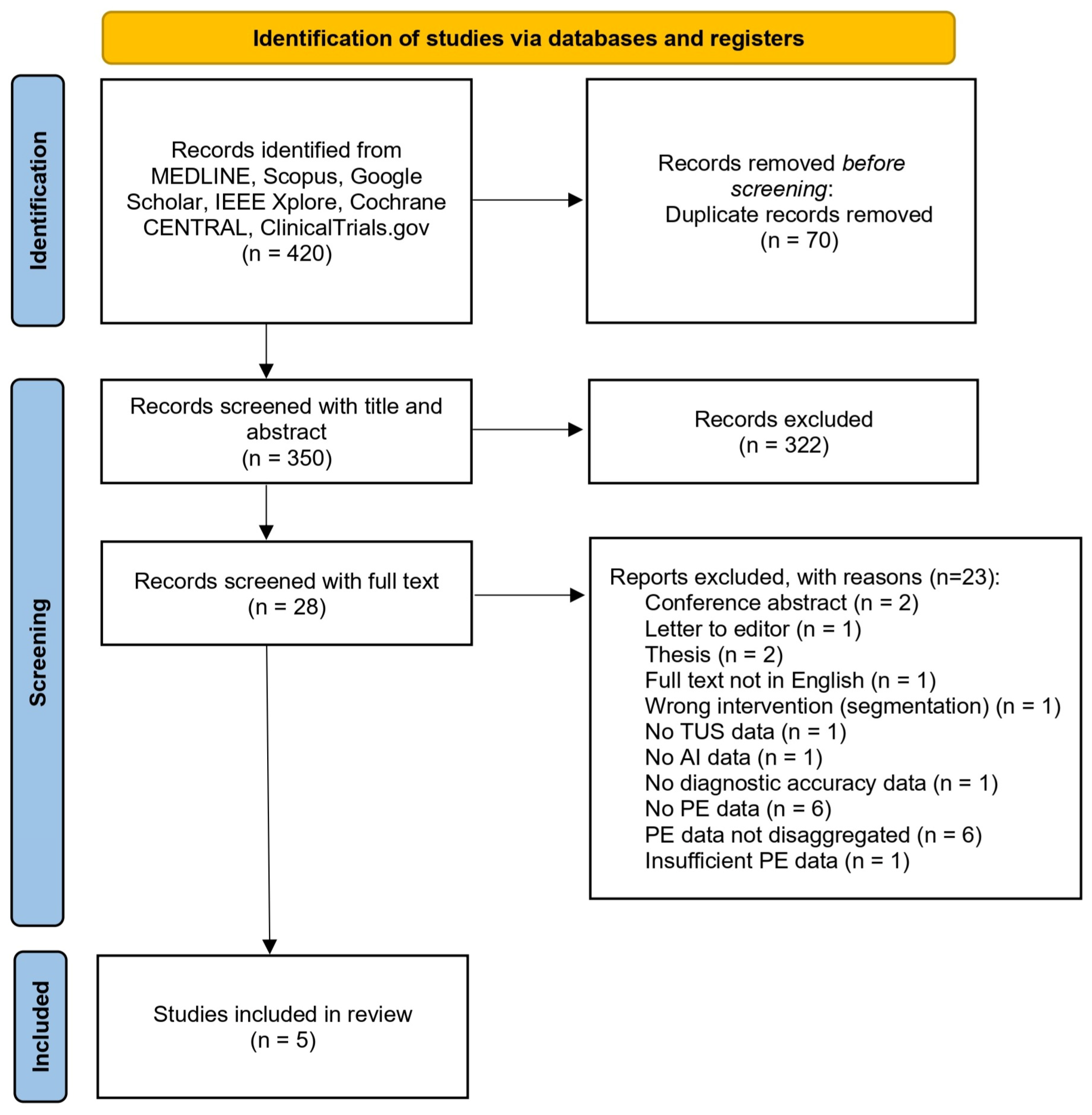
2.7. Study Selection and Screening
2.8. Data Extraction
- Study characteristics: author, year, country, study design (prospective/retrospective), clinical setting, and single- versus multicenter status.
- Patient characteristics: demographics, clinical features, prevalence and characteristics of pleural effusion (size, complexity), and relevant subgroups (e.g., ICU patients).
- Ultrasound technical specifications: probe type, ultrasound system, and acquisition protocols.
- AI system details: model architecture, input data type (still images, frames, or video), level of automation, pre-processing and data augmentation steps, multi-model or multi-label configurations and explainability and interpretability methods.
- Reference standard applied.
- Diagnostic performance metrics: sensitivity, specificity, PPV, NPV, overall accuracy, and AUC.
- Subgroup or secondary analyses.
2.9. Risk of Bias and Quality Assessment
2.10. Certainty of Evidence
2.11. Data Synthesis
3. Results
3.1. Study Characteristics and Settings
3.2. Ultrasound Technical Specifications and Acquisition Protocols
3.3. AI System Architecture and Data Processing
3.4. Validation Strategies and Dataset Splitting
3.5. Diagnostic Performance Metrics
3.6. Specialised Model Configurations and Clinical Applications
3.7. Performance by Effusion Characteristics
3.8. Statistical Significance and Comparative Analyses
3.9. Explainability and Interpretability: A Critical Gap in Clinical Translation
3.10. Risk of Bias
3.11. Certainty of Evidence (GRADE)
4. Discussion
4.1. Interpretation of Findings
4.2. Study Limitations and Methodological Considerations
4.3. Implications for Clinical Practice
4.4. Research Gaps and Future Directions
5. Conclusions
Supplementary Materials
Author Contributions
Funding
Institutional Review Board Statement
Informed Consent Statement
Data Availability Statement
Conflicts of Interest
Abbreviations
| AI | Artificial intelligence |
| AG | Attention gate |
| AUC | Area under the curve |
| B0 | Baseline model variant of EfficientNet |
| B-lines | Vertical artefacts in lung ultrasound |
| BLUE | Bedside Lung Ultrasound in Emergency |
| CI | Confidence interval (defined in tables, standard but explicitly included) |
| CNN | Convolutional neural network |
| CT | Computed tomography |
| DICOM | Digital Imaging and Communications in Medicine |
| DL | Deep learning |
| F1-score | Harmonic mean of precision and recall |
| GRADE | Grading of Recommendations, Assessment, Development and Evaluations |
| ICMJE | International Committee of Medical Journal Editors |
| ICU | Intensive care unit |
| IPD | Individual participant data |
| LUS | Lung ultrasound |
| ML | Machine learning |
| NPV | Negative predictive value |
| PACS | Picture Archiving and Communication System |
| PE | Pleural effusion |
| Pleff-Net | PLeural EFFusion neural NETwork |
| PNG | Portable Network Graphics format |
| POCUS | Point-of-care ultrasound |
| PPV | Positive predictive value |
| PRISMA | Preferred Reporting Items for Systematic Reviews and Meta-Analyses |
| PROSPERO | International Prospective Register of Systematic Reviews |
| QUADAS-2 | Quality Assessment of Diagnostic Accuracy Studies 2 |
| Reg-STN | Regularised Spatial Transformer Network |
| ResNet | Residual neural network |
| RGB | Red–green–blue colour model |
| TUS | Thoracic ultrasound |
| U-net | U-shaped convolutional network architecture |
References
- Feller-Kopman, D.; Light, R. Pleural Disease. N. Engl. J. Med. 2018, 378, 740–751. [Google Scholar] [CrossRef]
- Roberts, M.E.; Rahman, N.M.; Maskell, N.A.; Bibby, A.C.; Blyth, K.G.; Corcoran, J.P.; Edey, A.; Evison, M.; de Fonseka, D.; Hallifax, R.; et al. British Thoracic Society Guideline for pleural disease. Thorax 2023, 78, 1143–1156. [Google Scholar] [CrossRef]
- Elsheikh, A.; Bhatnagar, M.; Rahman, N.M. Diagnosis and management of pleural infection. Breathe 2024, 19, 230146. [Google Scholar] [CrossRef]
- Ferreiro, L.; Toubes, M.E.; José, M.E.S.; Suárez-Antelo, J.; Golpe, A.; Valdés, L. Advances in pleural effusion diagnostics. Expert Rev. Respir. Med. 2020, 14, 51–66. [Google Scholar] [CrossRef] [PubMed]
- Light, R.W. Pleural Diseases, 5th ed.; Lippincott Williams & Wilkins: Philadelphia, PA, USA, 2007; ISBN 978-0-7817-6957-0. [Google Scholar]
- Bedawi, E.O.; Ricciardi, S.; Hassan, M.; Gooseman, M.R.; Asciak, R.; Castro-Añón, O.; Armbruster, K.; Bonifazi, M.; Poole, S.; Harris, E.K.; et al. ERS/ESTS statement on the management of pleural infection in adults. Eur. Respir. J. 2023, 61, 2201062. [Google Scholar] [CrossRef] [PubMed]
- Feller-Kopman, D.J.; Reddy, C.B.; DeCamp, M.M.; Diekemper, R.L.; Gould, M.K.; Henry, T.; Iyer, N.P.; Lee, Y.C.G.; Lewis, S.Z.; Maskell, N.A.; et al. Management of Malignant Pleural Effusions. An Official ATS/STS/STR Clinical Practice Guideline. Am. J. Respir. Crit. Care Med. 2018, 198, 839–849. [Google Scholar] [CrossRef]
- Chang, C.H.; Ost, D.E. Malignant pleural disease: A pragmatic guide to diagnosis. Curr. Opin. Pulm. Med. 2022, 28, 282–287. [Google Scholar] [CrossRef]
- Mummadi, S.R.; Stoller, J.K.; Lopez, R.; Kailasam, K.; Gillespie, C.T.; Hahn, P.Y. Epidemiology of Adult Pleural Disease in the United States. Chest 2021, 160, 1534–1551. [Google Scholar] [CrossRef] [PubMed]
- Bodtger, U.; Hallifax, R.J. Epidemiology: Why is pleural disease becoming more common? In Pleural Disease, 1st ed.; Maskell, N.A., Laursen, C.B., Lee, Y.C.G., Rahman, N.M., Eds.; European Respiratory Society: Lausanne, Switzerland, 2020; Available online: http://publications.ersnet.org/lookup/doi/10.1183/2312508X.10022819 (accessed on 4 August 2025).
- Vakil, E.; Taghizadeh, N.; Tremblay, A. The Global Burden of Pleural Diseases. Semin. Respir. Crit. Care Med. 2023, 44, 417–425. [Google Scholar] [CrossRef]
- Hallifax, R.J.; Talwar, A.; Wrightson, J.M.; Edey, A.; Gleeson, F.V. State-of-the-art: Radiological investigation of pleural disease. Respir. Med. 2017, 124, 88–99. [Google Scholar] [CrossRef]
- Brogi, E.; Gargani, L.; Bignami, E.G.; Barbariol, F.; Marra, A.; Forfori, F.; Vetrugno, L. Thoracic ultrasound for pleural effusion in the intensive care unit: A narrative review from diagnosis to treatment. Crit. Care 2017, 21, 325. [Google Scholar] [CrossRef] [PubMed]
- Chopra, A.; Hu, K.; Feller-Kopman, D.; Judson, M.A. Pleural fluid analysis: Maximizing diagnostic yield in the pleural effusion evaluation. Chest 2025, 168, 828–838. [Google Scholar] [CrossRef]
- Gayen, S. Malignant pleural effusion: Presentation, diagnosis, and management. Am. J. Med. 2022, 135, 1188–1192. [Google Scholar] [CrossRef] [PubMed]
- Corcoran, J.P.; Hallifax, R.J.; Mercer, R.M.; Yousuf, A.; Asciak, R.; Hassan, M.; Piotrowska, H.E.; Psallidas, I.; Rahman, N.M. Thoracic ultrasound as an early predictor of pleurodesis success in malignant pleural effusion. Chest 2018, 154, 1115–1120. [Google Scholar] [CrossRef] [PubMed]
- Pathak, T.; Parmar, M.S. (F)utility of computed tomography of the chest in the presence of pleural effusion. Pleura Peritoneum 2017, 2, 181–186. [Google Scholar] [CrossRef]
- Yang, L.; Wang, K.; Li, W.; Liu, D. Chest ultrasound is better than CT in identifying septated effusion of patients with pleural disease. Sci. Rep. 2024, 14, 11964. [Google Scholar] [CrossRef]
- Tewari, K.; Pelluru, S.; Mishra, D.; Pahuja, N.; Mohapatra, A.R.; Sharma, J.; Thapa, O.B.; Multani, M. Comparison of efficacy of lung ultrasound and chest X-ray in diagnosing pulmonary edema and pleural effusion in ICU patients: A single centre, prospective, observational study. Open J. Anesthesiol. 2024, 14, 41–50. [Google Scholar] [CrossRef]
- Velmahos, G.C.; Demetriades, D.; Chan, L.; Tatevossian, R.; Cornwell, E.E.; Yassa, N.; Murray, J.A.; Asensio, J.A.; Berne, T.V. Predicting the need for thoracoscopic evacuation of residual traumatic hemothorax: Chest radiograph is insufficient. J. Trauma 1999, 46, 65–70. [Google Scholar] [CrossRef]
- Zaki, H.A.; Albaroudi, B.; Shaban, E.E.; Shaban, A.; Elgassim, M.; Almarri, N.D.; Basharat, K.; Azad, A.M. Advancement in pleura effusion diagnosis: A systematic review and meta-analysis of point-of-care ultrasound versus radiographic thoracic imaging. Ultrasound J. 2024, 16, 3. [Google Scholar] [CrossRef]
- Patel, K.M.; Ullah, K.; Patail, H.; Ahmad, S. Ultrasound for pleural disease. Beyond a pocket of pleural fluid. Ann. Am. Thorac. Soc. 2021, 18, 749–756. [Google Scholar] [CrossRef]
- Hassan, M.; Mercer, R.M.; Rahman, N.M. Thoracic ultrasound in the modern management of pleural disease. Eur. Respir. Rev. 2020, 29, 190136. [Google Scholar] [CrossRef]
- Marchi, G.; SzaboSzabo, G.; Koukaki, E.; De Wever, W.; Grabczak, E.M.; Juul, A.D. ERS International Congress 2025: Highlights from the Clinical Techniques, Imaging and Endoscopy Assembly. ERJ Open Res. 2025; in press. [Google Scholar]
- Marchi, G.; Cucchiara, F.; Gregori, A.; Biondi, G.; Guglielmi, G.; Serradori, M.; Gherardi, M.; Gabbrielli, L.; Pistelli, F.; Carrozzi, L. Thoracic Ultrasound for Pre-Procedural Dynamic Assessment of Non-Expandable Lung: A Non-Invasive, Real-Time and Multifaceted Diagnostic Tool. J. Clin. Med. 2025, 14, 2062. [Google Scholar] [CrossRef] [PubMed]
- Colares, P.d.F.B.; Mafort, T.T.; Sanches, F.M.; Monnerat, L.B.; Menegozzo, C.A.M.; Mariani, A.W. Thoracic ultrasound: A review of the state-of-the-art. J. Bras. Pneumol. 2024, 50, e20230395. [Google Scholar] [CrossRef]
- Marchi, G.; Cinquini, S.; Tannura, F.; Guglielmi, G.; Gelli, R.; Pantano, L.; Cenerini, G.; Wandael, V.; Vivaldi, B.; Coltelli, N.; et al. Intercostal Artery Screening with Color Doppler Thoracic Ultrasound in Pleural Procedures: A Potential Yet Underexplored Imaging Modality for Minimizing Iatrogenic Bleeding Risk in Interventional Pulmonology. J. Clin. Med. 2025, 14, 6326. [Google Scholar] [CrossRef]
- Marchi, G. Exploring pleural effusion characterization with quantitative thoracic ultrasound imaging: A viewpoint on the investigational role of pixel-based echogenicity analysis in transudate and exudate differentiation. Breathe 2025, 21, 250282. [Google Scholar] [CrossRef] [PubMed]
- Laursen, C.B.; Clive, A.; Hallifax, R.; Pietersen, P.I.; Asciak, R.; Davidsen, J.R.; Bhatnagar, R.; Bedawi, E.O.; Jacobsen, N.; Coleman, C.; et al. European Respiratory Society statement on thoracic ultrasound. Eur. Respir. J. 2021, 57, 2001519. [Google Scholar] [CrossRef]
- Alaswad, M.; Abady, E.M.A.; Darawish, S.M.; Barabrah, A.M.; Okesanya, O.J.; Zehra, S.A.; Aponte, Y.; Alkubati, S.A.; Alsabri, M. Point-of-Care Ultrasound in Pediatric Emergency Care in Low-Resource Settings: A Literature Review of Applications, Successes, and Future Directions. Curr. Treat. Options Pediatr. 2025, 11, 7. [Google Scholar] [CrossRef]
- Ameen, F.W.; Bonyan, F.A.; Al-Rubaye, S.A.M. Comparing Point-Of-Care Ultrasound Versus CT scan for Pleural Effusion Detection in The Emergency Department of Baghdad Teaching Hospital. J. Port Sci. Res. 2024, 7, 51–68. [Google Scholar] [CrossRef]
- Bella, F.M.; Bonfichi, A.; Esposito, C.; Zanza, C.; Bellou, A.; Sfondrini, D.; Voza, A.; Piccioni, A.; Di Sabatino, A.; Savioli, G. Extended Focused Assessment with Sonography for Trauma in the Emergency Department: A Comprehensive Review. J. Clin. Med. 2025, 14, 3457. [Google Scholar] [CrossRef]
- Barbera, P.; Campo, I.; Derchi, L.E.; Bertolotto, M. Emergency Ultrasound in Trauma Patients: Beware of Pitfalls and Artifacts! J. Emerg. Med. 2021, 60, 368–376. [Google Scholar] [CrossRef]
- Böck, U.; Seibel, A. Lung ultrasound in cardiological intensive care and emergency medicine (part 2): Pneumothorax, ventilation disorders and the BLUE protocol; Lungensonographie in der kardiologischen Intensiv- und Notfallmedizin (Teil 2): Pneumothorax, Belüftungsstörungen und das BLUE-Protokoll. Kardiologie 2023, 17, 264–276. [Google Scholar] [CrossRef]
- Lichtenstein, D.A. Lung Ultrasound in the Critically Ill. J. Med. Ultrasound 2009, 17, 125–142. [Google Scholar] [CrossRef]
- Lichtenstein, D. Novel approaches to ultrasonography of the lung and pleural space: Where are we now? Breathe 2017, 13, 100–111. [Google Scholar] [CrossRef]
- Lichtenstein, D.A. BLUE-Protocol and FALLS-Protocol. Chest 2015, 147, 1659–1670. [Google Scholar] [CrossRef]
- Laursen, C.B.; Via, G.; Basille, D.; Bhatnagar, R.; Jenssen, C.; Konge, L.; Mongodi, S.; Pietersen, P.I.; Prosch, H.; Rahman, N.M.; et al. Thoracic Ultrasound—EFSUMB Training Recommendations, a position paper. Ultraschall Med. 2025, 46, 560–567. [Google Scholar] [CrossRef] [PubMed]
- Pietersen, P.I.; Bhatnagar, R.; Rahman, N.M.; Maskell, N.; Wrightson, J.M.; Annema, J.; Crombag, L.; Farr, A.; Tabin, N.; Slavicky, M.; et al. Evidence-based training and certification: The ERS thoracic ultrasound training programme. Breathe 2023, 19, 230053. [Google Scholar] [CrossRef] [PubMed]
- Bajwa, J.; Munir, U.; Nori, A.; Williams, B. Artificial intelligence in healthcare: Transforming the practice of medicine. Future Healthc. J. 2021, 8, e188–e194. [Google Scholar] [CrossRef] [PubMed]
- Alhejaily, A.-M.G. Artificial intelligence in healthcare (Review). Biomed. Rep. 2025, 22, 11. [Google Scholar] [CrossRef]
- Causio, F.A.; DE Angelis, L.; Diedenhofen, G.; Talio, A.; Baglivo, F. Perspectives on AI use in medicine: Views of the Italian Society of Artificial Intelligence in Medicine. J. Prev. Med. Hyg. 2024, 65, E285–E289. [Google Scholar] [CrossRef]
- Marchi, G.; Gambini, G.; Guglielmi, G.; Pistelli, F.; Carrozzi, L. Valutazione comparativa di modelli linguistici di grandi dimensioni per il supporto all’educazione sanitaria del paziente con BPCO: Uno studio pneumologico internazionale delle risposte generate da ChatGPT-4, Claude 3.5 Sonnet e Gemini 1.5 Advanced. Recent. Progress. Med. 2025, 116, 571–572. [Google Scholar] [CrossRef]
- Mienye, I.D.; Obaido, G.; Jere, N.; Mienye, E.; Aruleba, K.; Emmanuel, I.D.; Ogbuokiri, B. A survey of explainable artificial intelligence in healthcare: Concepts, applications, and challenges. Inform. Med. Unlocked 2024, 51, 101587. [Google Scholar] [CrossRef]
- Ali, S.; Abuhmed, T.; El-Sappagh, S.; Muhammad, K.; Alonso-Moral, J.M.; Confalonieri, R.; Guidotti, R.; Del Ser, J.; Díaz-Rodríguez, N.; Herrera, F. Explainable Artificial Intelligence (XAI): What we know and what is left to attain Trustworthy Artificial Intelligence. Inf. Fusion 2023, 99, 101805. [Google Scholar] [CrossRef]
- Al-Anazi, S.; Al-Omari, A.; Alanazi, S.; Marar, A.; Asad, M.; Alawaji, F.; Alwateid, S. Artificial intelligence in respiratory care: Current scenario and future perspective. Ann. Thorac. Med. 2024, 19, 117–130. [Google Scholar] [CrossRef] [PubMed]
- Cellina, M.; Cacioppa, L.M.; Cè, M.; Chiarpenello, V.; Costa, M.; Vincenzo, Z.; Pais, D.; Bausano, M.V.; Rossini, N.; Bruno, A.; et al. Artificial Intelligence in Lung Cancer Screening: The Future Is Now. Cancers 2023, 15, 4344. [Google Scholar] [CrossRef]
- Ishiwata, T.; Yasufuku, K. Artificial intelligence in interventional pulmonology. Curr. Opin. Pulm. Med. 2024, 30, 92–98. [Google Scholar] [CrossRef]
- Marchi, G. Artificial Intelligence in Interventional Pulmonology: Promise Versus Proof. Respiration 2025, 1–4, online ahead of print. [Google Scholar] [CrossRef]
- Drummond, D.; Adejumo, I.; Hansen, K.; Poberezhets, V.; Slabaugh, G.; Hui, C.Y. Artificial intelligence in respiratory care: Perspectives on critical opportunities and challenges. Breathe 2024, 20, 230189. [Google Scholar] [CrossRef]
- Marchi, G.; Fanni, S.C.; Mercier, M.; Cefalo, J.; Salerni, C.; Ferioli, M.; Candoli, P.; Romei, C.; Gori, L.; Cucchiara, F.; et al. Artificial intelligence and radiomics in drug-induced interstitial lung disease. ERJ Open Res. 2025; in press. [Google Scholar]
- Carvalho, C.; Van Heumen, S.; Funke, F.; Heuvelmans, M.A.; Serino, M.; Frille, A.; Marchi, G.; Koukaki, E.; Hardavella, G.; Catarata, M.J. The role of interventional pulmonology in management of pulmonary nodules during lung cancer screening. Breathe 2025, 21, 240256. [Google Scholar] [CrossRef] [PubMed]
- Gorini, G.; Puliti, D.; Picozzi, G.; Giovannoli, J.; Veronesi, G.; Pistelli, F.; Senore, C.; Tessa, C.; Cavigli, E.; Bisanzi, S.; et al. CCM-ITALUNG2 pilot on lung cancer screening in Italy: Recruitment, integration with smoking cessation and baseline results. Radiol. Medica 2025. [Google Scholar] [CrossRef]
- Alsharqi, M.; Edelman, E.R. Artificial Intelligence in Cardiovascular Imaging and Interventional Cardiology: Emerging Trends and Clinical Implications. J. Soc. Cardiovasc. Angiogr. Interv. 2025, 4, 102558. [Google Scholar] [CrossRef]
- Föllmer, B.; Williams, M.C.; Dey, D.; Arbab-Zadeh, A.; Maurovich-Horvat, P.; Volleberg, R.H.J.A.; Rueckert, D.; Schnabel, J.A.; Newby, D.E.; Dweck, M.R.; et al. Roadmap on the use of artificial intelligence for imaging of vulnerable atherosclerotic plaque in coronary arteries. Nat. Rev. Cardiol. 2024, 21, 51–64. [Google Scholar] [CrossRef] [PubMed]
- Marchi, G.; Mercier, M.; Cefalo, J.; Salerni, C.; Ferioli, M.; Candoli, P.; Gori, L.; Cucchiara, F.; Cenerini, G.; Guglielmi, G.; et al. Advanced imaging techniques and artificial intelligence in pleural diseases: A narrative review. Eur. Respir. Rev. 2025, 34, 240263. [Google Scholar] [CrossRef]
- Addala, D.N.; Rahman, N.M. Man versus Machine in Pleural Diagnostics: Does Artificial Intelligence Provide the Solution? Ann. ATS 2024, 21, 202–203. [Google Scholar] [CrossRef]
- Baloescu, C.; Bailitz, J.; Cheema, B.; Agarwala, R.; Jankowski, M.; Eke, O.; Liu, R.; Nomura, J.; Stolz, L.; Gargani, L.; et al. Artificial Intelligence–Guided Lung Ultrasound by Nonexperts. JAMA Cardiol. 2025, 10, 245. [Google Scholar] [CrossRef]
- Boccatonda, A.; Piscaglia, F. New perspectives on the use of artificial intelligence in the ultrasound evaluation of lung diseases. J. Ultrasound 2024, 27, 429–431. [Google Scholar] [CrossRef] [PubMed]
- Camacho, J.J.; Munoz, M.; Genovés, V.; Herraiz, J.L.; Ortega, I.; Belarra, A.; González, R.; Sánchez, D.; Giacchetta, R.C.; Trueba-Vicente, Á. Artificial Intelligence and Democratization of the Use of Lung Ultrasound in COVID-19: On the Feasibility of Automatic Calculation of Lung Ultrasound Score. Int. J. Transl. Med. 2022, 2, 17–25. [Google Scholar] [CrossRef]
- Marchi, G. The road less travelled: Thoracic ultrasound, advanced imaging, and artificial intelligence for early diagnosis of non-expandable lung in malignant pleural effusion. Breathe 2025, 21, 250179. [Google Scholar] [CrossRef]
- Chu, D.; Liteplo, A.; Duggan, N.; Hutchinson, A.B.; Shokoohi, H. Artificial intelligence in lung ultrasound. Curr. Pulmonol. Rep. 2024, 13, 127–134. [Google Scholar] [CrossRef]
- Su, T.; Tang, S.; Li, Y.; Zhong, L.; Wang, Y.; Zhang, Y.; Guo, B. Application of Deep Learning-Based Artificial Intelligence Model in Lung Ultrasound for Pediatric Lobar Pneumonia. researchsquare.com. 2025. Available online: https://www.researchsquare.com/article/rs-6410448/latest (accessed on 4 August 2025).
- Nekoui, M.; Bolouri, S.S.; Forouzandeh, A.; Dehghan, M.; Zonoobi, D.; Jaremko, J.L.; Buchanan, B.; Nagdev, A.; Kapur, J. Enhancing lung Ultrasound Diagnostics: A clinical study on an Artificial Intelligence Tool for the detection and quantification of A-Lines and B-Lines. Diagnostics 2024, 14, 2526. [Google Scholar] [CrossRef]
- Kim, J.; Maranna, S.; Watson, C.; Parange, N. A scoping review on the integration of artificial intelligence in point-of-care ultrasound: Current clinical applications. Am. J. Emerg. Med. 2025, 92, 172–181. [Google Scholar] [CrossRef]
- Point of Care Ultrasound Lung Artificial Intelligence (AI) Validation Data Collection Study. 2021. Available online: https://clinicaltrials.gov/study/NCT04891705 (accessed on 11 September 2021).
- Resühr, D.; Garnett, C. The Good, the Bad, and the Ugly of AI in Medical Imaging. EMJ Radiol. 2025, 6, 53–55. [Google Scholar] [CrossRef]
- Yang, Y.; Zhang, H.; Gichoya, J.W.; Katabi, D.; Ghassemi, M. The limits of fair medical imaging AI in real-world generalization. Nat. Med. 2024, 30, 2838–2848. [Google Scholar] [CrossRef] [PubMed]
- Ennab, M.; Mcheick, H. Enhancing interpretability and accuracy of AI models in healthcare: A comprehensive review on challenges and future directions. Front. Robot. AI 2024, 11, 1444763. [Google Scholar] [CrossRef]
- Abgrall, G.; Holder, A.L.; Chelly Dagdia, Z.; Zeitouni, K.; Monnet, X. Should AI models be explainable to clinicians? Crit. Care 2024, 28, 301. [Google Scholar] [CrossRef]
- Abbas, Q.; Jeong, W.; Lee, S.W. Explainable AI in Clinical Decision Support Systems: A Meta-Analysis of Methods, Applications, and Usability Challenges. Healthcare 2025, 13, 2154. [Google Scholar] [CrossRef]
- Sadeghi, Z.; Alizadehsani, R.; Cifci, M.A.; Kausar, S.; Rehman, R.; Mahanta, P.; Bora, P.K.; Almasri, A.; Alkhawaldeh, R.S.; Hussain, S.; et al. A review of Explainable Artificial Intelligence in healthcare. Comput. Electr. Eng. 2024, 118, 109370. [Google Scholar] [CrossRef]
- Vani, M.S.; Sudhakar, R.V.; Mahendar, A.; Ledalla, S.; Radha, M.; Sunitha, M. Personalized health monitoring using explainable AI: Bridging trust in predictive healthcare. Sci. Rep. 2025, 15, 31892. [Google Scholar] [CrossRef]
- Mohapatra, R.K.; Jolly, L.; Dakua, S.P. Advancing explainable AI in healthcare: Necessity, progress, and future directions. Comput. Biol. Chem. 2025, 119, 108599. [Google Scholar] [CrossRef]
- Schiavo, J.H. PROSPERO: An International Register of Systematic Review Protocols. Med. Ref. Serv. Q. 2019, 38, 171–180. [Google Scholar] [CrossRef]
- Page, M.J.; McKenzie, J.E.; Bossuyt, P.M.; Boutron, I.; Hoffmann, T.C.; Mulrow, C.D.; Shamseer, L.; Tetzlaff, J.M.; Akl, E.A.; Brennan, S.E.; et al. The PRISMA 2020 statement: An updated guideline for reporting systematic reviews. BMJ 2021, 372, n71. [Google Scholar] [CrossRef]
- Ayturan, K.; Sarıkamış, B.; Akşahin, M.F.; Kutbay, U. SPHERE: Benchmarking YOLO vs. CNN on a Novel Dataset for High-Accuracy Solar Panel Defect Detection in Renewable Energy Systems. Appl. Sci. 2025, 15, 4880. [Google Scholar] [CrossRef]
- Ouzzani, M.; Hammady, H.; Fedorowicz, Z.; Elmagarmid, A. Rayyan—A web and mobile app for systematic reviews. Syst. Rev. 2016, 5, 210. [Google Scholar] [CrossRef]
- Whiting, P.F.; Rutjes, A.W.S.; Westwood, M.E.; Mallett, S.; Deeks, J.J.; Reitsma, J.B.; Leeflang, M.M.G.; Sterne, J.A.C.; Bossuyt, P.M.M.; QUADAS-2 Group. QUADAS-2: A Revised Tool for the Quality Assessment of Diagnostic Accuracy Studies. Ann. Intern. Med. 2011, 155, 529–536. [Google Scholar] [CrossRef] [PubMed]
- Prasad, M. Introduction to the GRADE tool for rating certainty in evidence and recommendations. Clin. Epidemiol. Glob. Health 2024, 25, 101484. [Google Scholar] [CrossRef]
- Tsai, C.-H.; van der Burgt, J.; Vukovic, D.; Kaur, N.; Demi, L.; Canty, D.; Wang, A.; Royse, A.; Royse, C.; Haji, K.; et al. Automatic deep learning-based pleural effusion classification in lung ultrasound images for respiratory pathology diagnosis. Phys. Med. 2021, 83, 38–45. [Google Scholar] [CrossRef]
- Chen, J.; Shen, M.; Hou, S.; Duan, X.; Yang, M.; Cao, Y.; Qin, W.; Niu, Q.; Li, Q.; Zhang, Y. Intelligent interpretation of four lung ultrasonographic features with split attention based deep learning model. Biomed. Signal Process. Control 2023, 81, 104228. [Google Scholar] [CrossRef]
- Huang, L.; Lin, Y.; Cao, P.; Zou, X.; Qin, Q.; Lin, Z.; Liang, F.; Li, Z. Automated detection and segmentation of pleural effusion on ultrasound images using an Attention U-net. J. Appl. Clin. Med. Phys. 2024, 25, e14231. [Google Scholar] [CrossRef]
- Hong, D.; Choi, H.; Hong, W.; Kim, Y.; Kim, T.J.; Choi, J.; Ko, S.-B.; Park, C.M. Deep-learning model accurately classifies multi-label lung ultrasound findings, enhancing diagnostic accuracy and inter-reader agreement. Sci. Rep. 2024, 14, 22228. [Google Scholar] [CrossRef]
- Chaudhary, R.; Ho, J.; Smith, D.; Hossain, S.; Hargun, J.; VanBerlo, B.; Murphy, N.; Prager, R.; Rikhraj, K.; Tschirhart, J.; et al. Diagnostic accuracy of an automated classifier for the detection of pleural effusions in patients undergoing lung ultrasound. Am. J. Emerg. Med. 2025, 90, 142–150. [Google Scholar] [CrossRef]
- Yanar, E.; Hardalaç, F.; Ayturan, K. CELM: An Ensemble Deep Learning Model for Early Cardiomegaly Diagnosis in Chest Radiography. Diagnostics 2025, 15, 1602. [Google Scholar] [CrossRef]
- Marchi, G. Decoding the “black-box”: Explainable artificial intelligence towards trustworthy advancement in respiratory medicine. Breathe, 2025; in press. [Google Scholar]
- Akmal, H.; Hardalaç, F.; Ayturan, K. A Fetal Well-Being Diagnostic Method Based on Cardiotocographic Morphological Pattern Utilizing Autoencoder and Recursive Feature Elimination. Diagnostics 2023, 13, 1931. [Google Scholar] [CrossRef] [PubMed]


| Study | Year | Study Design and Centre | Reference Standard | Patient Number | Original Format + Data Number (n) | Dataset Split (Training/Validation/Testing) | Setting | Ultrasound Machine(s) | Ultrasound Probe(s) | Clinical Indication |
|---|---|---|---|---|---|---|---|---|---|---|
| Tsai et al. [81] | 2021 | Retrospective, single-centre | Expert clinician interpretation (iLungScan™ validated by LUS experts) | 70 | Still images: 99,209 from 623 videos | 10-fold cross-validation (90% training, 10% testing) | Hospital (Royal Melbourne Hospital) | SonoSite X-Porte | 1–5 MHz phased array transducer (rP19xp) | Image evidence of pleural effusion or normal lungs |
| Chen et al. [82] | 2023 | Prospective, single-centre | Two experienced ultrasonographers (>5 years experience) | 3966 | Still images: 5545 total (1394 pleural effusion) | Simple train-test split (80% training, 20% testing) | Hospital ultrasound department | LOGIQ E9 (GE, Wauwatosa, WI) | Convex probe (2.8–5.0 MHz) | Routine LUS following Blue Protocol |
| Huang et al. [83] | 2024 | Retrospective, single-centre | Manual annotation by two experienced sonographers | 848 | Still images: 1440 (800 positive, 640 negative) expanded to 5760 with augmentation | 10-fold cross-validation (90% training, 10% testing) | Hospital (ultrasound departments from PACS) | 25 models (Philips IU22, EsaoteMyLabTwice, Philips Epiq7C, GE, others) | Not reported | General ultrasound examinations |
| Hong et al. [84] | 2024 | Retrospective, multi-centre | Expert radiologist interpretation; chest CT for observer performance test | 1898 total (1645 development + 146 temporal + 54 external 1 + 53 external 2) | Still images: 7580 from 1645 patients | Training: Validation: Internal test = 8:1:1 plus external validation | Multi-centre: Seoul National University Hospital and Chung-Ang University Hospital | LOGIQ E9 (GE), EPIQ 5G/7G (Philips), RS80A (Samsung) | High-resolution linear (7–11 MHz) or convex (3–5 MHz) | Patients undergoing thoracentesis, critically ill ICU patients |
| Chaudhary et al. [85] | 2025 | Retrospective, multi-centre | Expert LUS interpretation (fellowship-trained expert and Critical Care physician) | 785 | Video clips: 1664 total (566 with effusion) deconstructed into 313,109 frames | 85% development, 15% holdout with 10-fold cross-validation | Two Canadian tertiary hospitals (emergency department, ICU, hospital ward) | Mindray (n = 348), Sonosite (n = 1298), Philips (n = 14), Esaote (n = 3) | Phased array (n = 1395), Curved linear (n = 158), Linear (n = 2) | Routine LUS following Blue Protocol |
| Study | Model Type | Classification Software | Additional AI Tools in Pipeline | Classifier Final Format | Training Dataset | AI Algorithm Type | Input Data Format | Pre-Processing Steps | Software Implementation | Explainability Approach and Evaluation |
|---|---|---|---|---|---|---|---|---|---|---|
| Tsai et al. [81] | Classification | Deep learning CNN with Regularised Spatial Transformer Network (Reg-STN) | Spatial Transformer Network for weakly supervised localisation | Binary (pleural effusion/no pleural effusion) | Same institution, 99,209 images from 623 videos | Deep learning using Reg-STN with CNN | Still images from videos | DICOM decompression, overlay removal, cropping to ultrasound sector | Custom implementation based on Roy et al. architecture | Spatial transformer localization (not visualized); no clinical validation; explanation quality not assessed |
| Chen et al. [82] | Classification | Deep learning CNN (ResNet-based with Split-Attention) | Split-Attention mechanism, Mish activation function, simplified focal loss | Multi-class (A-line, B-line, pulmonary consolidation, pleural effusion) | 4436 images from total 5545 | Deep learning CNN with Split-Attention | Still images (DICOM format, single RGB channel) | Standardisation, irrelevant fields removed | Custom model (source code to be published on GitHub) | Grad-CAM visualization; limited visual inspection; explanation quality not assessed |
| Huang et al. [83] | Segmentation + Classification | Attention U-net and U-net models | Attention gates (AGs) for improved feature extraction | Binary with segmentation | Same institution, 5184 images for training (2592 + 2592 annotated) | Deep learning—Attention U-net and U-net | Still images standardised to 128 × 128 × 1 pixels | RGB to greyscale, uint8 to float32 conversion, horizontal flipping for augmentation | TensorFlow and Keras | Attention mechanism (not visualized); no clinical validation; explanation quality not assessed |
| Hong et al. [84] | Classification | Convolutional Neural Network using EfficientNet-B0 | Transfer learning with ImageNet pre-trained weights | Multi-label (normal, B-lines, consolidation, pleural effusion) | 7580 images from 1645 patients | Deep learning CNN using EfficientNet-B0 | Still images resized to 224 × 224 pixels, RGB channels | DICOM pseudonymisation, conversion to PNG, normalisation for ImageNet weights | Custom model (code available at GitHub) | Grad-CAM (minimal analysis); no clinical validation; explanation quality not assessed |
| Chaudhary et al. [85] | Classification | Convolutional Neural Network | Frame-level CNN with clip-level prediction algorithms (average, contiguous, majority vote) | Binary with adaptable thresholds for clinical scenarios | 668 patients, 1425 clips, 266,670 frames | Deep learning CNN | Video clips deconstructed into frames | Frame extraction, masking, contrast adjustment (±20%), grid distortion (up to 25%) | Pleff-Net (PLeuralEFFusion neural NETwork) | Grad-CAM + temporal confidence plotting; visual inspection only; explanation quality not assessed |
| Study | Primary Outcome | Model Version | Sensitivity (%) | Specificity (%) | Accuracy (%) | AUC | PPV (%) | Additional Performance Metrics |
|---|---|---|---|---|---|---|---|---|
| Tsai et al. [81] | Pleural effusion detection | Video-based approach | Not reported individually | Not reported individually | 91.12% (mean), 95.68% (best fold) | Not reported | Not reported | F1-score: 87.71% (best), 40.02% (worst); Precision: 87.29% (best), 38.85% (worst); Recall: 88.14% (best), 41.26% (worst) |
| Tsai et al. [81] | Pleural effusion detection | Frame-based approach | Not reported individually | Not reported individually | 92.38% (mean), 96.75% (best fold) | Not reported | Not reported | F1-score: 90.47% (best), 34.98% (worst); Precision: 92.76% (best), 42.82% (worst); Recall: 88.28% (best), 29.57% (worst) |
| Chen et al. [82] | Multi-class classification (Class W—pleural effusion) | ResNet with Split-Attention | 96.39% | 100.00% | 96.39% | 99.80% | 100.00% | Overall multi-class: 98.27% sensitivity, 99.41% specificity, 98.20% accuracy, 99.76% macro AUC |
| Huang et al. [83] | Pleural effusion detection and segmentation | Attention U-net | 97% (range 91–100%) | 91% (range 84–98%) | 94% (range 91–98%) | 0.98 (range 0.95–1.0) | 93% (range 89–99%) | F1-score: 95% (range 92–98%); Dice coefficient: 0.86 (range 0.83–0.90) |
| Huang et al. [83] | Pleural effusion detection and segmentation | U-net | 97% (range 93–100%) | 86% (range 77–94%) | 92% (range 90–95%) | 0.97 (range 0.96–1.0) | 90% (range 85–95%) | F1-score: 93% (range 91–96%); Dice coefficient: 0.82 (range 0.79–0.86) |
| Hong et al. [84] | Multi-label classification (temporal test) | EfficientNet-B0 | 82.3% | 87.9% | 86.2% | 0.94 (95% CI: 0.93–0.95) | Not reported | Internal test: 86.9% sensitivity, 85.6% specificity; External test 1: 85.5% sensitivity, 76.5% specificity; External test 2: 70.6% sensitivity, 86.1% specificity |
| Chaudhary et al. [85] | Binary classification (holdout set) | General model | 90.3%(95% CI: 83.0–94.6%) | 89.0% (95% CI: 82.6–93.2%) | 89.5% (95% CI: 85.0–92.8%) | 93.9% (95% CI: 93.7–94.2%) | Not reported | Large effusion model: 95.5% sensitivity; Trauma model: 98.0% sensitivity, 67.0% specificity |
| Study/Year | Patient Selection | Index Test | Reference Standard | Flow & Timing | Patient Selection Applicability | Index Test Applicability | Reference Standard Applicability |
|---|---|---|---|---|---|---|---|
| Tsai et al./2021 [81] | H | H | L | L | L | L | L |
| Chen et al./2023 [82] | H | H | L | L | L | L | L |
| Huang et al./2024 [83] | H | H | L | L | L | L | L |
| Hong et al./2024 [84] | H | H | L | L | L | L | L |
| Chaudhary et al./2025 [85] | H | H | L | L | L | L | L |
Disclaimer/Publisher’s Note: The statements, opinions and data contained in all publications are solely those of the individual author(s) and contributor(s) and not of MDPI and/or the editor(s). MDPI and/or the editor(s) disclaim responsibility for any injury to people or property resulting from any ideas, methods, instructions or products referred to in the content. |
© 2026 by the authors. Licensee MDPI, Basel, Switzerland. This article is an open access article distributed under the terms and conditions of the Creative Commons Attribution (CC BY) license.
Share and Cite
Marchi, G.; Gabbrielli, L.; Gherardi, M.; Serradori, M.; Baglivo, F.; Fanni, S.C.; Cefalo, J.; Salerni, C.; Guglielmi, G.; Pistelli, F.; et al. Artificial Intelligence-Based Automated Analysis for Pleural Effusion Detection on Thoracic Ultrasound: A Systematic Review. Diagnostics 2026, 16, 147. https://doi.org/10.3390/diagnostics16010147
Marchi G, Gabbrielli L, Gherardi M, Serradori M, Baglivo F, Fanni SC, Cefalo J, Salerni C, Guglielmi G, Pistelli F, et al. Artificial Intelligence-Based Automated Analysis for Pleural Effusion Detection on Thoracic Ultrasound: A Systematic Review. Diagnostics. 2026; 16(1):147. https://doi.org/10.3390/diagnostics16010147
Chicago/Turabian StyleMarchi, Guido, Luciano Gabbrielli, Marco Gherardi, Massimiliano Serradori, Francesco Baglivo, Salvatore Claudio Fanni, Jacopo Cefalo, Carmine Salerni, Giacomo Guglielmi, Francesco Pistelli, and et al. 2026. "Artificial Intelligence-Based Automated Analysis for Pleural Effusion Detection on Thoracic Ultrasound: A Systematic Review" Diagnostics 16, no. 1: 147. https://doi.org/10.3390/diagnostics16010147
APA StyleMarchi, G., Gabbrielli, L., Gherardi, M., Serradori, M., Baglivo, F., Fanni, S. C., Cefalo, J., Salerni, C., Guglielmi, G., Pistelli, F., Carrozzi, L., & Mondoni, M. (2026). Artificial Intelligence-Based Automated Analysis for Pleural Effusion Detection on Thoracic Ultrasound: A Systematic Review. Diagnostics, 16(1), 147. https://doi.org/10.3390/diagnostics16010147