A Specific Haplotype of the MMP2 Gene Promoter May Increase the Risk of Developing Cerebral Palsy

 , , , , , , , ,
Abstract
1. Introduction
2. Materials and Methods
2.1. Participants
2.2. DNA Extraction and Genotyping
2.3. Statistical Analysis
3. Results
3.1. Clinical Characteristics of the Study Group
3.2. Genotype and Allele Frequencies
3.3. Associations of MMP2 Genotypes with Neurological Outcomes
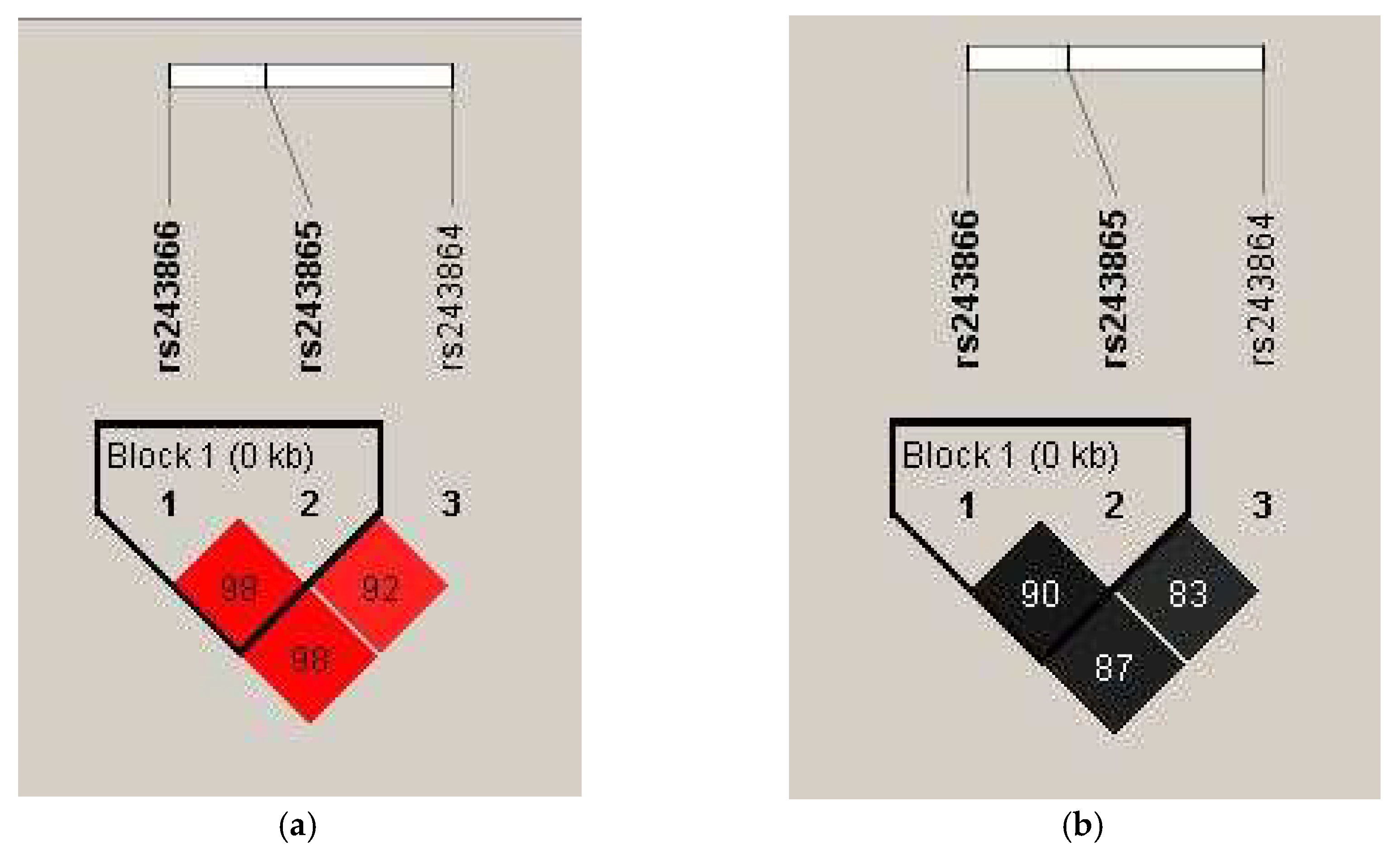
3.4. Haplotype Analysis
4. Discussion
5. Conclusions
Author Contributions
Funding
Institutional Review Board Statement
Informed Consent Statement
Data Availability Statement
Acknowledgments
Conflicts of Interest
References
- Gillam-Krakauer, M.; Shah, M.; Gowen, C.W., Jr. Birth Asphyxia. In StatPearls; StatPearls Publishing: Treasure Island, FL, USA, 2025. [Google Scholar]
- Hakobyan, M.; Dijkman, K.P.; Laroche, S.; Naulaers, G.; Rijken, M.; Steiner, K.; van Straaten, H.L.M.; Swarte, R.M.C.; Ter Horst, H.J.; Zecic, A.; et al. Outcome of Infants with Therapeutic Hypothermia after Perinatal Asphyxia and Early-Onset Sepsis. Neonatology 2019, 115, 127–133. [Google Scholar] [CrossRef] [PubMed]
- Viaroli, F.; Cheung, P.Y.; O’Reilly, M.; Polglase, G.R.; Pichler, G.; Schmolzer, G.M. Reducing Brain Injury of Preterm Infants in the Delivery Room. Front. Pediatr. 2018, 6, 290. [Google Scholar] [CrossRef] [PubMed]
- Distefano, G.; Pratico, A.D. Actualities on molecular pathogenesis and repairing processes of cerebral damage in perinatal hypoxic-ischemic encephalopathy. Ital. J. Pediatr. 2010, 36, 63. [Google Scholar] [CrossRef] [PubMed]
- Novak, I.; Morgan, C.; Adde, L.; Blackman, J.; Boyd, R.N.; Brunstrom-Hernandez, J.; Cioni, G.; Damiano, D.; Darrah, J.; Eliasson, A.C.; et al. Early, Accurate Diagnosis and Early Intervention in Cerebral Palsy: Advances in Diagnosis and Treatment. JAMA Pediatr. 2017, 171, 897–907. [Google Scholar] [CrossRef]
- Graham, H.K.; Rosenbaum, P.; Paneth, N.; Dan, B.; Lin, J.P.; Damiano, D.L.; Becher, J.G.; Gaebler-Spira, D.; Colver, A.; Reddihough, D.S.; et al. Cerebral palsy. Nat. Rev. Dis. Primers 2016, 2, 15082. [Google Scholar] [CrossRef]
- eurUS.brain group; Agut, T.; Alarcon, A.; Cabañas, F.; Bartocci, M.; Martinez-Biarge, M.; Horsch, S. Preterm white matter injury: Ultrasound diagnosis and classification. Pediatr. Res. 2020, 87, 37–49. [Google Scholar] [CrossRef]
- Horber, V.; Grasshoff, U.; Sellier, E.; Arnaud, C.; Krageloh-Mann, I.; Himmelmann, K. The Role of Neuroimaging and Genetic Analysis in the Diagnosis of Children With Cerebral Palsy. Front. Neurol. 2020, 11, 628075. [Google Scholar] [CrossRef]
- Wolosowicz, M.; Prokopiuk, S.; Kaminski, T.W. The Complex Role of Matrix Metalloproteinase-2 (MMP-2) in Health and Disease. Int. J. Mol. Sci. 2024, 25, 13691. [Google Scholar] [CrossRef]
- Behl, T.; Kaur, G.; Sehgal, A.; Bhardwaj, S.; Singh, S.; Buhas, C.; Judea-Pusta, C.; Uivarosan, D.; Munteanu, M.A.; Bungau, S. Multifaceted Role of Matrix Metalloproteinases in Neurodegenerative Diseases: Pathophysiological and Therapeutic Perspectives. Int. J. Mol. Sci. 2021, 22, 1413. [Google Scholar] [CrossRef]
- Svedin, P.; Hagberg, H.; Savman, K.; Zhu, C.; Mallard, C. Matrix metalloproteinase-9 gene knock-out protects the immature brain after cerebral hypoxia-ischemia. J. Neurosci. 2007, 27, 1511–1518. [Google Scholar] [CrossRef]
- Rosenberg, G.A. Matrix metalloproteinases and their multiple roles in neurodegenerative diseases. Lancet Neurol. 2009, 8, 205–216. [Google Scholar] [CrossRef]
- Gajewska, B.; Sliwinska-Mosson, M. Association of MMP-2 and MMP-9 Polymorphisms with Diabetes and Pathogenesis of Diabetic Complications. Int. J. Mol. Sci. 2022, 23, 10571. [Google Scholar] [CrossRef]
- Samah, N.; Ugusman, A.; Hamid, A.A.; Sulaiman, N.; Aminuddin, A. Role of Matrix Metalloproteinase-2 in the Development of Atherosclerosis among Patients with Coronary Artery Disease. Mediat. Inflamm. 2023, 2023, 9715114. [Google Scholar] [CrossRef] [PubMed]
- Miller, S.A.; Dykes, D.D.; Polesky, H.F. A simple salting out procedure for extracting DNA from human nucleated cells. Nucleic Acids Res. 1988, 16, 1215. [Google Scholar] [CrossRef] [PubMed]
- Gabriel, S.B.; Schaffner, S.F.; Nguyen, H.; Moore, J.M.; Roy, J.; Blumenstiel, B.; Higgins, J.; DeFelice, M.; Lochner, A.; Faggart, M.; et al. The structure of haplotype blocks in the human genome. Science 2002, 296, 2225–2229. [Google Scholar] [CrossRef] [PubMed]
- Friedman, J.M.; van Essen, P.; van Karnebeek, C.D.M. Cerebral palsy and related neuromotor disorders: Overview of genetic and genomic studies. Mol. Genet. Metab. 2022, 137, 399–419. [Google Scholar] [CrossRef]
- Gunn, A.J.; Bennet, L. Fetal hypoxia insults and patterns of brain injury: Insights from animal models. Clin. Perinatol. 2009, 36, 579–593. [Google Scholar] [CrossRef]
- Chakkarapani, E.; de Vries, L.S.; Ferriero, D.M.; Gunn, A.J. Neonatal encephalopathy and hypoxic-ischemic encephalopathy: The state of the art. Pediatr. Res. 2025. [Google Scholar] [CrossRef]
- Torn, A.E.; Hesselman, S.; Johansen, K.; Agren, J.; Wikstrom, A.K.; Jonsson, M. Outcomes in children after mild neonatal hypoxic ischaemic encephalopathy: A population-based cohort study. BJOG Int. J. Obstet. Gynaecol 2023, 130, 1602–1609. [Google Scholar] [CrossRef]
- de Vries, L.S.; Groenendaal, F. Patterns of neonatal hypoxic-ischaemic brain injury. Neuroradiology 2010, 52, 555–566. [Google Scholar] [CrossRef]
- Volpe, J.J. Cerebral white matter injury of the premature infant-more common than you think. Pediatrics 2003, 112, 176–180. [Google Scholar] [CrossRef] [PubMed]
- Rees, P.; Callan, C.; Chadda, K.R.; Vaal, M.; Diviney, J.; Sabti, S.; Harnden, F.; Gardiner, J.; Battersby, C.; Gale, C.; et al. Preterm Brain Injury and Neurodevelopmental Outcomes: A Meta-analysis. Pediatrics 2022, 150, e2022057442. [Google Scholar] [CrossRef]
- Glass, H.C.; Nash, K.B.; Bonifacio, S.L.; Barkovich, A.J.; Ferriero, D.M.; Sullivan, J.E.; Cilio, M.R. Seizures and magnetic resonance imaging-detected brain injury in newborns cooled for hypoxic-ischemic encephalopathy. J. Pediatr. 2011, 159, 731–735.e1. [Google Scholar] [CrossRef]
- Horber, V.; Sellier, E.; Horridge, K.; Rackauskaite, G.; Andersen, G.L.; Virella, D.; Ortibus, E.; Dakovic, I.; Hensey, O.; Radsel, A.; et al. The Origin of the Cerebral Palsies: Contribution of Population-Based Neuroimaging Data. Neuropediatrics 2020, 51, 113–119. [Google Scholar] [CrossRef]
- Gerrie, S.K.; Frayn, C.S.; Navarro, O.M. Differential Diagnosis of Echogenic Lesions at Neonatal Head US. Radiographics 2025, 45, e240065. [Google Scholar] [CrossRef]
- Price, S.J.; Greaves, D.R.; Watkins, H. Identification of novel, functional genetic variants in the human matrix metalloproteinase-2 gene: Role of Sp1 in allele-specific transcriptional regulation. J. Biol. Chem. 2001, 276, 7549–7558. [Google Scholar] [CrossRef]
- Xu, Z.; Taylor, J.A. SNPinfo: Integrating GWAS and candidate gene information into functional SNP selection for genetic association studies. Nucleic Acids Res. 2009, 37, W600–W605. [Google Scholar] [CrossRef]
- Ward, L.D.; Kellis, M. HaploReg: A resource for exploring chromatin states, conservation, and regulatory motif alterations within sets of genetically linked variants. Nucleic Acids Res. 2012, 40, D930–D934. [Google Scholar] [CrossRef]
- Khan, A.; Fornes, O.; Stigliani, A.; Gheorghe, M.; Castro-Mondragon, J.A.; van der Lee, R.; Bessy, A.; Cheneby, J.; Kulkarni, S.R.; Tan, G.; et al. JASPAR 2018: Update of the open-access database of transcription factor binding profiles and its web framework. Nucleic Acids Res. 2018, 46, D260–D266. [Google Scholar] [CrossRef]
- O’Callaghan, M.E.; Maclennan, A.H.; Gibson, C.S.; McMichael, G.L.; Haan, E.A.; Broadbent, J.L.; Baghurst, P.A.; Goldwater, P.N.; Dekker, G.A.; Australian Collaborative Cerebral Palsy Research, G. Genetic and clinical contributions to cerebral palsy: A multi-variable analysis. J. Paediatr. Child. Health 2013, 49, 575–581. [Google Scholar] [CrossRef]
- Moon, J.B.; Kim, J.C.; Yoon, B.H.; Romero, R.; Kim, G.; Oh, S.Y.; Kim, M.; Shim, S.S. Amniotic fluid matrix metalloproteinase-8 and the development of cerebral palsy. J. Perinat. Med. 2002, 30, 301–306. [Google Scholar] [CrossRef]
- Salah, M.M.; Abdelmawla, M.A.; Eid, S.R.; Hasanin, R.M.; Mostafa, E.A.; Abdelhameed, M.W. Role of Matrix Metalloproteinase-9 in Neonatal Hypoxic-Ischemic Encephalopathy. Open Access Maced. J. Med. Sci. 2019, 7, 2114–2118. [Google Scholar] [CrossRef] [PubMed]
- Maqsood, K.; Chuhdary, W.; Naveed, H.; Roohi, N. Matrix metalloproteinases and biochemical dysregulation in pediatric cerebral palsy: A clinical perspective. Egypt. Pediatr. Assoc. Gaz. 2025, 73, 58. [Google Scholar] [CrossRef]
- Nemska, S.; Serio, S.; Larcher, V.; Beltrame, G.; Portinaro, N.M.; Bang, M.L. Whole Genome Expression Profiling of Semitendinosus Tendons from Children with Diplegic and Tetraplegic Cerebral Palsy. Biomedicines 2023, 11, 2918. [Google Scholar] [CrossRef]
- Handsfield, G.G.; Williams, S.; Khuu, S.; Lichtwark, G.; Stott, N.S. Muscle architecture, growth, and biological Remodelling in cerebral palsy: A narrative review. BMC Musculoskelet. Disord. 2022, 23, 233. [Google Scholar] [CrossRef]
- Ocenasova, A.; Shawkatova, I.; Javor, J.; Parnicka, Z.; Minarik, G.; Kralova, M.; Kiralyova, I.; Mikolaskova, I.; Durmanova, V. MMP2 rs243866 and rs2285053 Polymorphisms and Alzheimer’s Disease Risk in Slovak Caucasian Population. Life 2023, 13, 882. [Google Scholar] [CrossRef] [PubMed]
- Seo, J.H.; Guo, S.; Lok, J.; Navaratna, D.; Whalen, M.J.; Kim, K.W.; Lo, E.H. Neurovascular matrix metalloproteinases and the blood-brain barrier. Curr. Pharm. Des. 2012, 18, 3645–3648. [Google Scholar] [CrossRef] [PubMed]
- Bednarek, N.; Svedin, P.; Garnotel, R.; Favrais, G.; Loron, G.; Schwendiman, L.; Hagberg, H.; Morville, P.; Mallard, C.; Gressens, P. Increased MMP-9 and TIMP-1 in mouse neonatal brain and plasma and in human neonatal plasma after hypoxia-ischemia: A potential marker of neonatal encephalopathy. Pediatr. Res. 2012, 71, 63–70. [Google Scholar] [CrossRef]
- Ranasinghe, H.S.; Williams, C.E.; Christophidis, L.J.; Mitchell, M.D.; Fraser, M.; Scheepens, A. Proteolytic activity during cortical development is distinct from that involved in hypoxic ischemic injury. Neuroscience 2009, 158, 732–744. [Google Scholar] [CrossRef]


| Variable | With CP N (%)/X ± SD | Without CP N (%)/X ± SD | p Value | |
|---|---|---|---|---|
| Clinical trait | Gender M/F | 68/36 | 62/46 | 0.233 |
| GA (weeks) | 34.1 ± 4.8 | 33.9 ± 4.9 | 0.847 | |
| Birth weight (g) | 2346.5 ± 1002.4 | 2369.9 ± 1047.9 | 0.869 | |
| AS 5′ | 6.2 ± 2.2 | 6.6 ± 2.2 | 0.223 | |
| Risk factors for CP and comorbidities | HIE | 81 (79.4) | 21 (19.8) | 0.000 |
| IVH | 27 (26.5) | 6 (5.7) | 0.000 | |
| Developmental delay | 104 (100) | 59 (54.6) | 0.000 | |
| Sepsis | 8 (8.1) | 10 (9.8) | 0.685 | |
| Neonatal convulsions | 37 (36.6) | 30 (28.0) | 0.185 | |
| Epilepsy | 48 (47.5) | 6 (5.7) | 0.000 | |
| Pathological findings in neuroimaging | Ultrasound | 84 (79.2) | 15 (15.2) | 0.000 |
| MRI | 68 (81.9) | 20 (20.0) | 0.000 |
| SNP (rsID) | Genotypes/Alleles | Frequency n (%) |
|---|---|---|
| −1575 G/A (rs243866) | GG | 133 (62.7) |
| GA | 73 (34.5) | |
| AA | 6 (2.8) | |
| G | 339 (80.0) | |
| A | 85 (20.0) | |
| −1306 C/T (rs243865) | CC | 130 (61.3) |
| CT | 74 (34.9) | |
| TT | 8 (3.8) | |
| C | 334 (78.8) | |
| T | 90 (21.2) | |
| −790 T/G (rs243864) | TT | 128 (60.4) |
| TG | 76 (35.8) | |
| GG | 8 (3.8) | |
| T | 332 (78.3) | |
| G | 92 (21.7) |
| SNP (rsID) | Genotypes/ Alleles | HIE n (%) | P | CP n (%) | p | ||
|---|---|---|---|---|---|---|---|
| Yes | No | Yes | No | ||||
| −1575 G/A (rs243866) | GG | 54 (53.5) | 75 (70.8) | 53 (51.0) | 80 (74.1) | ||
| GA+AA | 47 (46.5) | 31 (29.2) | 0.010 | 51 (49.0) | 28 (25.9) | 0.001 | |
| G | 154 (76.2) | 176 (83.0) | 155 (74.5) | 184 (85.2) | |||
| A | 48 (23.8) | 36 (17.0) | 0.111 | 53 (25.5) | 32 (14.8) | 0.008 | |
| −1306 C/T (rs243865) | CC | 54 (53.5) | 72 (67.9) | 53 (51.0) | 77 (71.3) | ||
| CT+TT | 47 (46.5) | 34 (32.1) | 0.033 | 51 (49.0) | 31 (28.7) | 0.002 | |
| C | 153 (75.7) | 172 (81.1) | 150 (73.5) | 180 (83.3) | |||
| T | 49 (24.3) | 40 (18.9) | 0.726 | 54 (26.5) | 36 (16.7) | 0.019 | |
| −790 T/G (rs243864) | TT | 52 (51.5) | 72 (67.9) | 51 (49.0) | 76 (71.0) | ||
| TG+GG | 49 (48.5) | 34 (32.1) | 0.016 | 53 (51.0) | 31 (29.0) | 0.001 | |
| T | 150 (74.3) | 173 (81.6) | 151 (72.6) | 179 (83.6) | |||
| G | 52 (25.7) | 39 (18.4) | 0.092 | 57 (27.4) | 35 (16.4) | 0.008 | |
| SNP (rsID) | Genotypes/Alleles | Ultrasound n (%) | p | MRI n (%) | p | ||
|---|---|---|---|---|---|---|---|
| Path | Norm | Path | Norm | ||||
| −1575 G/A (rs243866) | GG | 59 (55.7) | 68 (68.7) | 42 (50.6) | 73 (73.0) | ||
| GA+AA | 47 (44.3) | 31 (31.3) | 0.055 | 41 (49.4) | 27 (27.0) | 0.002 | |
| G | 164 (77.4) | 162 (81.8) | 124 (74.7) | 168 (84.0) | |||
| A | 48 (22.6) | 36 (18.2) | 0.319 | 42 (25.3) | 32 (16.0) | 0.038 | |
| −1306 C/T (rs243865) | CC | 58 (54.7) | 66 (66.7) | 41 (49.4) | 71 (71.0) | ||
| CT+TT | 48 (45.3) | 33 (33.3) | 0.080 | 42 (50.6) | 29 (29.0) | 0.003 | |
| C | 162 (76.4) | 159 (80.3) | 122 (73.5) | 165 (82.5) | |||
| T | 50 (23.6) | 39 (19.7) | 0.402 | 44 (26.5) | 35 (17.5) | 0.037 | |
| −790 T/G (rs243864) | TT | 56 (52.8) | 65 (66.3) | 39 (47.0) | 70 (70.7) | ||
| TG+GG | 50 (47.2) | 33 (33.7) | 0.050 | 44 (53.0) | 29 (29.3) | 0.001 | |
| T | 159 (75.0) | 158 (80.6) | 119 (71.7) | 165 (83.3) | |||
| G | 53 (25.0) | 38 (19.4) | 0.214 | 47 (28.3) | 33 (16.7) | 0.007 | |
| Haplotype | All | CP (%) | p | All | MRI (%) | p | ||
|---|---|---|---|---|---|---|---|---|
| Yes | No | Path | Norm | |||||
| GCT | 76.9 | 72.1 | 81.5 | 0.022 | 76.5 | 70.5 | 81.5 | 0.013 |
| ATG | 19.8 | 25.5 | 14.3 | 0.004 | 19.9 | 25.3 | 15.5 | 0.019 |
| GCG | 1.7 | 1.9 | 1.9 | 0.679 | 1.7 | 3.0 | 0.0 | 0.063 |
| GTT | 1.2 | 0.0 | 1.4 | 0.191 | 1.4 | 1.2 | 1.5 | 0.808 |
Disclaimer/Publisher’s Note: The statements, opinions and data contained in all publications are solely those of the individual author(s) and contributor(s) and not of MDPI and/or the editor(s). MDPI and/or the editor(s) disclaim responsibility for any injury to people or property resulting from any ideas, methods, instructions or products referred to in the content. |
© 2025 by the authors. Licensee MDPI, Basel, Switzerland. This article is an open access article distributed under the terms and conditions of the Creative Commons Attribution (CC BY) license (https://creativecommons.org/licenses/by/4.0/).
Share and Cite
Djuranovic Uklein, A.; Cerovac, N.; Perovic, D.; Maksimovic, N.; Jekic, B.; Grk, M.; Dusanovic Pjevic, M.; Rasic, M.; Stojanovski, N.; Pesic, M.; et al. A Specific Haplotype of the MMP2 Gene Promoter May Increase the Risk of Developing Cerebral Palsy. Diagnostics 2025, 15, 3178. https://doi.org/10.3390/diagnostics15243178
Djuranovic Uklein A, Cerovac N, Perovic D, Maksimovic N, Jekic B, Grk M, Dusanovic Pjevic M, Rasic M, Stojanovski N, Pesic M, et al. A Specific Haplotype of the MMP2 Gene Promoter May Increase the Risk of Developing Cerebral Palsy. Diagnostics. 2025; 15(24):3178. https://doi.org/10.3390/diagnostics15243178
Chicago/Turabian StyleDjuranovic Uklein, Ana, Natasa Cerovac, Dijana Perovic, Nela Maksimovic, Biljana Jekic, Milka Grk, Marija Dusanovic Pjevic, Milica Rasic, Natasa Stojanovski, Milica Pesic, and et al. 2025. "A Specific Haplotype of the MMP2 Gene Promoter May Increase the Risk of Developing Cerebral Palsy" Diagnostics 15, no. 24: 3178. https://doi.org/10.3390/diagnostics15243178
APA StyleDjuranovic Uklein, A., Cerovac, N., Perovic, D., Maksimovic, N., Jekic, B., Grk, M., Dusanovic Pjevic, M., Rasic, M., Stojanovski, N., Pesic, M., Novakovic, I., & Damnjanovic, T. (2025). A Specific Haplotype of the MMP2 Gene Promoter May Increase the Risk of Developing Cerebral Palsy. Diagnostics, 15(24), 3178. https://doi.org/10.3390/diagnostics15243178