Interesting Images

68Ga-NY104 PET/CT in the Differential Diagnosis of FDG-Negative Renal Masses: A Two-Case Illustration of Clear Cell Carcinoma Versus Renal Hemangioma

1
Department of Nuclear Medicine, Peking Union Medical College Hospital, Peking Union Medical College, Chinese Academy of Medical Sciences, Beijing 100730, China
2
Department of Urology, Peking Union Medical College Hospital, Peking Union Medical College, Chinese Academy of Medical Sciences, Beijing 100730, China
3
Department of Pathology, Peking Union Medical College Hospital, Peking Union Medical College, Chinese Academy of Medical Sciences, Beijing 100730, China
*
Authors to whom correspondence should be addressed.
These authors contributed equally to this work.
Diagnostics 2025, 15(23), 3049; https://doi.org/10.3390/diagnostics15233049

Submission received: 17 October 2025 / Revised: 18 November 2025 / Accepted: 26 November 2025 / Published: 29 November 2025
(This article belongs to the Section Medical Imaging and Theranostics)

Abstract

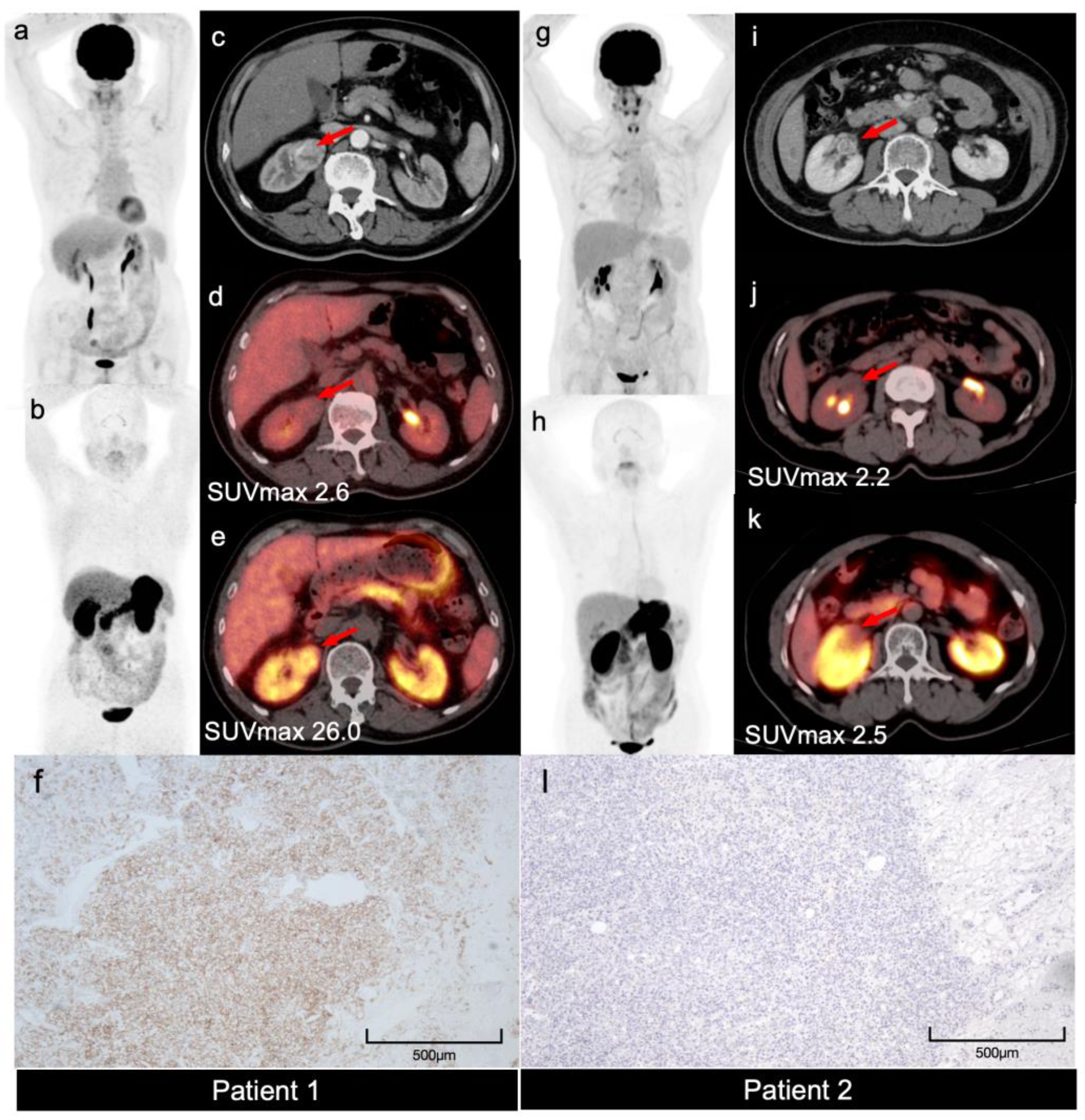
FDG PET/CT often underperforms in characterizing hyper-enhancing, FDG-non-avid renal masses. We present two cases illustrating the potential of 68Ga-NY104, a novel small-molecule tracer targeting carbonic anhydrase IX (CAIX), for this differential diagnosis. Both patients presented with a hyper-enhancing right renal mass suspicious for clear cell renal carcinoma (ccRCC) and subsequently underwent both 18F-FDG and 68Ga-NY104 PET/CT, with histopathology and CAIX immunohistochemistry (IHC) as the reference standard. On 18F-FDG, both lesions were non-avid (SUVmax 2.6 and 2.2, Tumor-to-Liver Ratio [TLR] 0.87 and 0.69, respectively). However, on 68Ga-NY104 PET/CT, Patient 1 (a 65-year-old man) showed intense, homogeneous uptake (SUVmax 26.0, TLR 4.64), while Patient 2 (a 67-year-old woman) showed negligible uptake (SUVmax 2.5, TLR 0.68). It was consistent with histopathology and IHC results that Patient 1 was CAIX-positive ccRCC, while Patient 2 was CAIX-negative hemangioma. Our preliminary cases suggest the potential utility of CAIX-targeted PET/CT imaging with 68Ga-NY104 in differentiating ccRCC from benign mimickers like renal hemangioma, which warrants further prospective evaluation.

Figure 1. Two patients with right renal mass found during routine examination were presented. For Patient 1 (a 65-year-old man, (af)), contrast-enhanced CT (CECT) revealed a 4.1 cm heterogeneously hyper-enhancing lesion ((c), arrow) peaking in the corticomedullary phase (mean attenuation 86.3 HU). For Patient 2 (a 67-year-old woman, (gl)), CECT revealed a 2.2 cm lesion that also demonstrated heterogeneous, avid enhancement ((i), arrow) peaking in the nephrographic phase (mean attenuation 106 HU). Both lesions raised suspicion of clear cell renal cell carcinoma (ccRCC). For image analysis, scans were performed on a time-of-flight PET/CT scanner (Polestar m680, Sino Union Healthcare Inc., Beijing, China) at 60 min post-injection of approximately 370 MBq 18F-FDG or 200 MBq 68Ga-NY104. Images were reconstructed using an ordered subsets expectation maximization algorithm (2 iterations, 10 subsets, 192 × 192 matrix) and corrected for CT-based attenuation, dead time, random events, and scatter. Tumor-to-Liver Ratios (TLR) were calculated based on SUVmax. We defined “FDG non-avid” a priori as a TLR < 1.2. PET/CT with 18F-FDG (Patient 1, MIP, (a), fusion, (d), arrow; Patient 2, MIP, (g), fusion, (j), arrow) was performed. Both lesions were FDG non-avid (SUVmax, Patient 1, 2.6, Patient 2, 2.2; TLR, 0.87 and 0.69, respectively). To further characterize the lesions, PET/CT with 68Ga-NY104, a small molecule PET tracer targeting carbonic anhydrase IX (CAIX), was also performed. While Patient 1 showed heterogeneous avid uptake of 68Ga-NY104 (MIP, (b), fusion, (e), arrow, SUVmax 26.0, TLR 4.64), indicating CAIX overexpression, Patient 2 demonstrated minimal, background-level uptake (MIP, (h), fusion, (k), arrow, SUVmax 2.5, TLR 0.68). Both patients underwent surgery within a month after the PET/CT scans. Patient 1 was confirmed to be ccRCC (WHO Grade 1), while Patient 2 was hemangioma. The CAIX expression was also confirmed using immunohistochemical staining, with diffuse expression in Patient 1 (f) and no expression in Patient 2 (l). Clear cell RCC (ccRCC) is the most common histological subtype of renal cancer [1,2]. While multiparametric MRI (mpMRI) remains the non-invasive reference, it has known pitfalls in differentiating ccRCC from benign mimickers like oncocytoma and hemangioma [3]. FDG PET/CT, which is often used for staging in other types of cancer [4], has limited sensitivity in detecting RCC due to the relatively low glucose metabolism of RCC cells [5]. CAIX is overexpressed in over 90% of ccRCC due to von Hippel–Lindau (VHL) mutation, making it an ideal target for molecular imaging [6,7,8]. Our cases demonstrated that CAIX-targeted PET/CT imaging using 68Ga-NY104 may aid in diagnosing ccRCC and in the differential diagnosis of hyper-enhancing lesions mimicking ccRCC. This tracer contributes to the broader PET landscape for RCC (which includes PSMA [9] and SSTR [10] targets) and may have future theranostic potential in selecting patients for CAIX-directed therapies. However, potential false negatives (in CAIX-negative ccRCC) and false positives (from other hypoxic lesions) should be taken into consideration. Meanwhile, the limitations of this two-case report are clear, including selection bias. Further investigations on other ccRCC mimickers such as oncocytoma, chromophobe, and papillary RCC are warranted. As a novel tracer, 68Ga-NY104 is currently for research only and not yet commercially available.
Diagnostics 15 03049 g001

Author Contributions

Conceptualization, X.Y., Y.X. and W.Z.; formal analysis, X.Y., G.Z. and J.C.; data curation, X.Y. and Y.X.; writing—original draft preparation, X.Y.; writing—review and editing, Y.X., W.Z. and L.H.; supervision, W.Z. and L.H. All authors have read and agreed to the published version of the manuscript.

Funding

This research received no external funding.

Institutional Review Board Statement

According to our institutional regulations, formal IRB review and approval were waived for this type of anonymized case report.

Informed Consent Statement

Written informed consent was obtained from all subjects involved in the study to publish this paper and the accompanying de-identified images.

Data Availability Statement

The raw data supporting the conclusions of this article (including the de-identified DICOM series, anonymized pathology reports, and IHC images) will be made available from the corresponding author on request.

Conflicts of Interest

The authors declare no conflicts of interest.

References

  1. Linehan, W.M.; Ricketts, C.J. The Cancer Genome Atlas of renal cell carcinoma: Findings and clinical implications. Nat. Rev. Urol. 2019, 16, 539–552. [Google Scholar] [CrossRef] [PubMed]
  2. Motzer, R.J.; Jonasch, E.; Agarwal, N.; Alva, A.; Baine, M.; Beckermann, K.; Carlo, M.I.; Choueiri, T.K.; Costello, B.A.; Derweesh, I.H.; et al. Kidney cancer, version 3.2022, NCCN clinical practice guidelines in oncology. J. Natl. Compr. Cancer Netw. 2022, 20, 71. [Google Scholar] [CrossRef] [PubMed]
  3. Laothamatas, I.; Al Mubarak, H.; Reddy, A.; Wax, R.; Badani, K.; Taouli, B.; Bane, O.; Lewis, S. Multiparametric MRI of Solid Renal Masses: Principles and Applications of Advanced Quantitative and Functional Methods for Tumor Diagnosis and Characterization. Magn. Reson. Imaging 2023, 58, 342–359. [Google Scholar] [CrossRef] [PubMed]
  4. Hsieh, J.J.; Purdue, M.P.; Signoretti, S.; Swanton, C.; Albiges, L.; Schmidinger, M.; Heng, D.Y.; Larkin, J.; Ficarra, V. Renal cell carcinoma. Nat. Rev. Dis. Primers 2017, 3, 17009. [Google Scholar] [CrossRef] [PubMed]
  5. Zhao, Y.; Wu, C.; Li, W.; Chen, X.; Li, Z.; Liao, X.; Cui, Y.; Zhao, G.; Liu, M.; Fu, Z. 2-[18F]FDG PET/CT parameters associated with WHO/ISUP grade in clear cell renal cell carcinoma. Eur. J. Nucl. Med. Mol. Imaging 2021, 48, 570–579. [Google Scholar] [CrossRef] [PubMed]
  6. Pastorekova, S.; Gillies, R.J. The role of carbonic anhydrase IX in cancer development: Links to hypoxia, acidosis, and beyond. Cancer Metastasis Rev. 2019, 38, 65–77. [Google Scholar] [CrossRef] [PubMed]
  7. Courcier, J.; de la Taille, A.; Nourieh, M.; Leguerney, I.; Lassau, N.; Ingels, A. Carbonic Anhydrase IX in Renal Cell Carcinoma, Implications for Disease Management. Int. J. Mol. Sci. 2020, 21, 7146. [Google Scholar] [CrossRef] [PubMed]
  8. Zhu, W.; Li, X.; Zheng, G.; Bai, C.; Ji, Z.; Zhang, H.; Xing, H.; Zhang, Y.; Huo, L. Preclinical and pilot clinical evaluation of a small-molecule carbonic anhydrase IX targeting PET tracer in clear cell renal cell carcinoma. Eur. J. Nucl. Med. Mol. Imaging 2023, 50, 3116–3125. [Google Scholar] [CrossRef] [PubMed]
  9. Muselaers, S.; Erdem, S.; Bertolo, R.; Ingels, A.; Kara, Ö.; Pavan, N.; Roussel, E.; Pecoraro, A.; Marchioni, M.; Carbonara, U.; et al. PSMA PET/CT in Renal Cell Carcinoma: An Overview of Current Literature. J. Clin. Med. 2022, 11, 1829. [Google Scholar] [CrossRef] [PubMed]
  10. Mansour, N.; Rangan, K.; Tiling, R.; Rübenthaler, J.; Fabritius, M.P. 68Ga-DOTATOC PET/CT in Pancreatic Metastasis from Clear Cell Renal Cell Carcinoma. Clin. Nucl. Med. 2023, 48, 712–713. [Google Scholar] [CrossRef] [PubMed]
Disclaimer/Publisher’s Note: The statements, opinions and data contained in all publications are solely those of the individual author(s) and contributor(s) and not of MDPI and/or the editor(s). MDPI and/or the editor(s) disclaim responsibility for any injury to people or property resulting from any ideas, methods, instructions or products referred to in the content.