A Composite Risk Score Based on VI-RADS, Tumor Contact Length, and CYFRA 21-1 for Prognostic Stratification in Bladder Cancer
 , , ,
, , ,  and
and
Abstract
1. Introduction
2. Materials and Methods
2.1. Study Population
2.2. Image Acquisition
2.3. Techniques and Procedures in TURBT
2.4. Serum Collection
2.5. Study Workflow and Statistical Methods
2.6. Outcome of Treatment
2.7. Statistical Analyses
3. Results
4. Discussion
5. Conclusions
Author Contributions
Funding
Institutional Review Board Statement
Informed Consent Statement
Data Availability Statement
Acknowledgments
Conflicts of Interest
Abbreviations
| VI-RADS | The Vesical Imaging-Reporting and Data System |
| BC | Bladder cancer |
| MRI | Magnetic resonance imaging |
| MIBC | Muscle-invasive bladder cancer |
| NMIBC | Non-muscle-invasive bladder cancer |
| CYFRA 21-1 | Cytokeratin 19 fragment |
| TCL | Tumor contact length |
| TURBT | Transurethral resection of bladder tumor |
| IRB | Institutional Review Board |
| T2WI | T2-weighted imaging |
| DWI | Diffusion-weighted imaging |
| DCE | Dynamic contrast-enhanced |
| ROC | Receiver operating characteristic |
| OS | Overall survival |
| HR | Hazard ratio |
| CI | Confidence interval |
| ICC | Intraclass correlation coefficient |
| AUC | Area under the curve |
| IQR | Interquartile range |
| DL | Deep learning |
References
- Panebianco, V.; Narumi, Y.; Altun, E.; Bochner, B.H.; Efstathiou, J.A.; Hafeez, S.; Huddart, R.; Kennish, S.; Lerner, S.; Montironi, R.; et al. Multiparametric Magnetic Resonance Imaging for Bladder Cancer: Development of VI-RADS (Vesical Imaging-Reporting and Data System). Eur. Urol. 2018, 74, 294–306. [Google Scholar] [CrossRef]
- Del Giudice, F.; Flammia, R.S.; Pecoraro, M.; Moschini, M.; D’Andrea, D.; Messina, E.; Pisciotti, L.M.; De Berardinis, E.; Sciarra, A.; Panebianco, V. The Accuracy of Vesical Imaging-Reporting and Data System (VI-RADS): An Updated Comprehensive Multi-Institutional, Multi-Readers Systematic Review and Meta-Analysis from Diagnostic Evidence into Future Clinical Recommendations. World J. Urol. 2022, 40, 1617–1628. [Google Scholar] [CrossRef]
- Doshi, C.; Zahir, M.; Dadabhoy, A.; Escobar, D.; Xia, L.; Daneshmand, S. Serum Tumor Markers for Muscle-Invasive Bladder Cancer in Clinical Practice: A Narrative Review. Cancers 2025, 17, 728. [Google Scholar] [CrossRef] [PubMed]
- Sundström, B.E.; Stigbrand, T.I. Cytokeratins and Tissue Polypeptide Antigen. Int. J. Biol. Markers 1994, 9, 102–108. [Google Scholar] [CrossRef] [PubMed]
- Huang, Y.L.; Chen, J.; Yan, W.; Zang, D.; Qin, Q.; Deng, A.M. Diagnostic Accuracy of Cytokeratin-19 Fragment (CYFRA 21-1) for Bladder Cancer: A Systematic Review and Meta-Analysis. Tumour Biol. 2015, 36, 3137–3145. [Google Scholar] [CrossRef]
- Senga, Y.; Kimura, G.; Hattori, T.; Yoshida, K. Clinical Evaluation of Soluble Cytokeratin 19 Fragments (CYFRA 21-1) in Serum and Urine of Patients with Bladder Cancer. Urology 1996, 48, 703–710. [Google Scholar] [CrossRef] [PubMed]
- Ikuma, S.; Akatsuka, J.; Kaneko, G.; Takeda, H.; Endo, Y.; Kimura, G.; Kondo, Y. Prognostic Utility of Combining VI-RADS Scores and CYFRA 21-1 Levels in Bladder Cancer: A Retrospective Single-Center Study. Curr. Oncol. 2025, 32, 415. [Google Scholar] [CrossRef]
- Ozden, E.; Turgut, A.T.; Yesil, M.; Gögüs, C.; Gögüs, O. A New Parameter for Staging Bladder Carcinoma: Ultrasonographic Contact Length and Height-to-Length Ratio. J. Ultrasound Med. 2007, 26, 1137–1142. [Google Scholar] [CrossRef]
- Selvaraju, A.; Patbamniya, N.K.; Kumar, M.; Seth, A.; Kaushal, S.; Das, C.J. Preoperative Prediction of Muscle Invasion in Bladder Cancer in the Indian Population Using the Vesical Imaging-Reporting and Data System (VI-RADS) Score and Individual Multiparametric Magnetic Resonance Imaging (MRI) Characteristics. Clin. Radiol. 2025, 84, 106862. [Google Scholar] [CrossRef]
- Ahn, H.; Kim, T.M.; Hwang, S.I.; Lee, H.J.; Choe, G.; Hong, S.K.; Byun, S.-S.; Oh, J.J. Tumor Contact Length with Bladder Wall Provides Effective Risk Stratification for Lesions with a VIRADS Score of 2–3. Eur. Radiol. 2023, 33, 8417–8425. [Google Scholar] [CrossRef]
- Akcay, A.; Yagci, A.B.; Celen, S.; Ozlulerden, Y.; Turk, N.S.; Ufuk, F. VI-RADS Score and Tumor Contact Length in MRI: A Potential Method for the Detection of Muscle Invasion in Bladder Cancer. Clin. Imaging 2021, 77, 25–36. [Google Scholar] [CrossRef]
- Sylvester, R.J.; van der Meijden, A.P.M.; Oosterlinck, W.; Witjes, J.A.; Bouffioux, C.; Denis, L.; Newling, D.W.W.; Kurth, K. Predicting Recurrence and Progression in Individual Patients with Stage Ta T1 Bladder Cancer Using EORTC Risk Tables: A Combined Analysis of 2596 Patients from Seven EORTC Trials. Eur. Urol. 2006, 49, 466–475; discussion 475–477. [Google Scholar] [CrossRef] [PubMed]
- Noh, T.I.; Shim, J.S.; Kang, S.G.; Sung, D.J.; Cheon, J.; Sim, K.C.; Kang, S.H. Comparison between Biparametric and Multiparametric MRI in Predicting Muscle Invasion by Bladder Cancer Based on the VI-RADS. Sci. Rep. 2022, 12, 20689. [Google Scholar] [CrossRef]
- Shariat, S.F.; Karakiewicz, P.I.; Palapattu, G.S.; Lotan, Y.; Rogers, C.G.; Amiel, G.E.; Vazina, A.; Gupta, A.; Bastian, P.J.; Sagalowsky, A.I.; et al. Outcomes of Radical Cystectomy for Transitional Cell Carcinoma of the Bladder: A Contemporary Series from the Bladder Cancer Research Consortium. J. Urol. 2006, 176, 2414–2422. [Google Scholar] [CrossRef] [PubMed]
- Soukup, V.; Čapoun, O.; Cohen, D.; Hernández, V.; Burger, M.; Compérat, E.; Gontero, P.; Lam, T.; Mostafid, A.H.; Palou, J.; et al. Risk Stratification Tools and Prognostic Models in Non-muscle-invasive Bladder Cancer: A Critical Assessment from the European Association of Urology Non-muscle-invasive Bladder Cancer Guidelines Panel. Eur. Urol. Focus 2020, 6, 479–489. [Google Scholar] [CrossRef]
- Yu, R.; Cai, L.; Cao, Q.; Liu, P.; Gong, Y.; Li, K.; Wu, Q.; Zhang, Y.; Li, P.; Yang, X.; et al. Development and Validation of an MRI-Based Nomogram for Preoperative Detection of Muscle Invasion in VI-RADS 3. J. Magn. Reson. Imaging 2023, 58, 1602–1613. [Google Scholar] [CrossRef]
- Zhuang, J.; Cai, L.; Sun, H.; Wu, Q.; Li, K.; Yu, R.; Cao, Q.; Li, P.; Yang, X.; Lu, Q. Vesical Imaging Reporting and Data System (VI-RADS) Could Predict the Survival of Bladder-Cancer Patients Who Received Radical Cystectomy. Sci. Rep. 2023, 13, 21502. [Google Scholar] [CrossRef]
- Wang, H.J.; Pui, M.H.; Guan, J.; Li, S.R.; Lin, J.H.; Pan, B.; Guo, Y. Comparison of Early Submucosal Enhancement and Tumor Stalk in Staging Bladder Urothelial Carcinoma. AJR Am. J. Roentgenol. 2016, 207, 797–803. [Google Scholar] [CrossRef]
- Li, Q.; Cao, B.; Liu, K.; Sun, H.; Ding, Y.; Yan, C.; Wu, P.-Y.; Dai, C.; Rao, S.; Zeng, M.; et al. Detecting the Muscle Invasiveness of Bladder Cancer: An Application of Diffusion Kurtosis Imaging and Tumor Contact Length. Eur. J. Radiol. 2022, 150, 110329. [Google Scholar] [CrossRef]
- Mady, E.A. Cytokeratins as Serum Markers in Egyptian Bladder Cancer: A Comparison of CYFRA 21-1, TPA and TPS. Int. J. Biol. Markers 2001, 16, 130–135. [Google Scholar] [CrossRef] [PubMed]
- Fatela-Cantillo, D.; Fernández-Suárez, A.; Menéndez, V.; Galán, J.A.; Filella, X. Low Utility of CYFRA 21-1 Serum Levels for Diagnosis and Follow-Up in Bladder Cancer Patients. J. Clin. Lab. Anal. 2005, 19, 167–171. [Google Scholar] [CrossRef] [PubMed]
- Andreadis, C.; Touloupidis, S.; Galaktidou, G.; Kortsaris, A.H.; Boutis, A.; Mouratidou, D. Serum CYFRA 21-1 in Patients with Invasive Bladder Cancer and Its Relevance as a Tumor Marker during Chemotherapy. J. Urol. 2005, 174, 1771–1775; discussion 1775–1776. [Google Scholar] [CrossRef]
- Washino, S.; Hirai, M.; Matsuzaki, A.; Kobayashi, Y. Clinical Usefulness of CEA, CA19-9, and CYFRA 21-1 as Tumor Markers for Urothelial Bladder Carcinoma. Urol. Int. 2011, 87, 420–428. [Google Scholar] [CrossRef]
- Kuang, L.I.; Song, W.J.; Qing, H.M.; Yan, S.; Song, F.L. CYFRA21-1 Levels Could Be a Biomarker for Bladder Cancer: A Meta-Analysis. Genet. Mol. Res. 2015, 14, 10441–10449. [Google Scholar] [CrossRef] [PubMed]
- Huang, H.; Huang, Y.; Kaggie, J.D.; Cai, Q.; Yang, P.; Wei, J.; Wang, L.; Guo, Y.; Lu, H.; Wang, H.; et al. Multiparametric MRI-Based Deep Learning Radiomics Model for Assessing 5-Year Recurrence Risk in Non-Muscle Invasive Bladder Cancer. J. Magn. Reson. Imaging 2025, 61, 1442–1456. [Google Scholar] [CrossRef] [PubMed]
- Wang, B.; Gong, Z.; Su, P.; Zhen, G.; Zeng, T.; Ye, Y. Multi-Machine Learning Model Based on Radiomics Features to Predict Prognosis of Muscle-Invasive Bladder Cancer. BMC Cancer 2025, 25, 1116. [Google Scholar] [CrossRef]
- Yang, G.; Bai, J.; Hao, M.; Zhang, L.; Fan, Z.; Wang, X. Enhancing Recurrence Risk Prediction for Bladder Cancer Using Multi-Sequence MRI Radiomics. Insights Imaging 2024, 15, 88. [Google Scholar] [CrossRef]
- Cao, T.; Li, N.; Guo, C.; Zhang, H.; Chen, L.; Wu, K.; Liang, L.; Wang, X.; Shen, W. CT-based Radiomics of Intratumoral and Peritumoral Regions to Predict the Recurrence Risk in Patients with Non-muscle-invasive Bladder Cancer within Two Years after TURBT. Curr. Med. Imaging. 2025, 21, E15734056350444. [Google Scholar] [CrossRef]
- Park, K.J.; Lee, J.-L.; Yoon, S.-K.; Heo, C.; Park, B.W.; Kim, J.K. Radiomics-Based Prediction Model for Outcomes of PD-1/PD-L1 Immunotherapy in Metastatic Urothelial Carcinoma. Eur. Radiol. 2020, 30, 5392–5403. [Google Scholar] [CrossRef]
- Wang, W.; Wang, K.; Qiu, J.; Li, W.; Wang, X.; Zhang, Y.; Wang, X.; Wu, J. MRI-Based Radiomics Analysis of Bladder Cancer: Prediction of Pathological Grade and Histological Variant. Clin. Radiol. 2023, 78, e889–e897. [Google Scholar] [CrossRef]



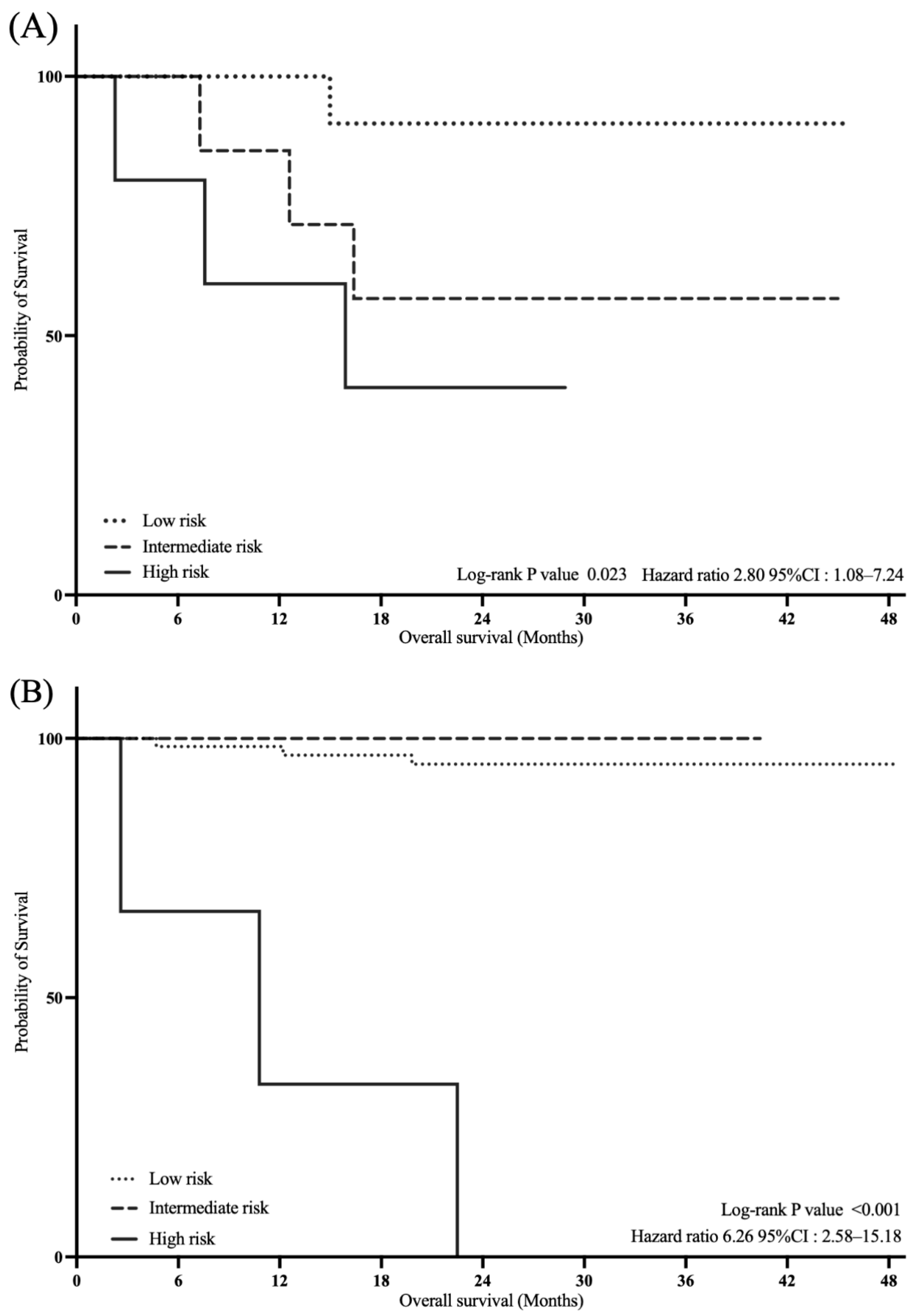
| Total n = 101 | Low Risk (Score ≤ 1) n = 81 | Intermediate Risk (Score 2) n = 12 | High Risk (Score 3) n = 8 | p-Value | |
|---|---|---|---|---|---|
| Baseline Characteristics | |||||
| Age | 0.875 | ||||
| Median, [IQR] | 73.0 [64.5–81.0] | 73.0 [64.5–81.0] | 74.5 [58.5–82.5] | 72.5 [69.0–82.5] | |
| Mean ± SD (years) | 72.1 ± 10.3 | 71.9 ± 10.1 | 72.3 ± 12.3 | 73.9 ± 9.6 | |
| Sex | 0.942 | ||||
| Men, n, (%) | 84 (83.2) | 67 (82.7) | 10 (83.3) | 7 (87.5) | |
| Women, n, (%) | 17 (16.8) | 14 (17.3) | 2 (16.7) | 1 (12.5) | |
| VI-RADS | <0.001 | ||||
| Score 1, n, (%) | 16 (15.8) | 16 (19.8) | 0 (0) | 0 (0) | |
| Score 2, n, (%) | 37 (36.6) | 37 (45.7) | 0 (0) | 0 (0) | |
| Score 3, n, (%) | 15 (14.9) | 15 (18.5) | 0 (0) | 0 (0) | |
| Score 4, n, (%) | 5 (5.0) | 2 (2.5) | 2 (16.7) | 1 (12.5) | |
| Score 5, n, (%) | 28 (27.7) | 11 (13.6) | 10 (83.3) | 7 (87.5) | |
| TCL | <0.001 | ||||
| Median, [IQR] | 14.32, [8.53–27.11] | 12.04, [7.20–17.16] | 53.72, [44.73–74.54] | 68.94, [48.00–85.74] | |
| Mean ± SD (mm) | 23.02 ± 22.61 | 13.14 ± 7.52 | 59.60 ± 18.08 | 68.28 ± 19.47 | |
| CYFRA 21-1 | <0.001 | ||||
| Median, [IQR] | 1.0, [1.0–1.5] | 1.0, [1.0–1.3] | 1.35, [1.0–1.7] | 3.10, [2.4–5.0] | |
| Mean ± SD (ng/mL) | 1.64 ± 0.21 | 1.20 ± 0.38 | 2.81 ± 5.11 | 4.35 ± 3.27 | |
| Pathological Findings | |||||
| T-stage | <0.001 | ||||
| NMIBC, n, (%) | 70 (69.3) | 67 (82.7) | 2 (16.7) | 1 (12.5) | |
| MIBC, n, (%) | 31 (30.7) | 14 (17.3) | 10 (83.3) | 7 (87.5) | |
| Tumor grade | 0.012 | ||||
| High, n, (%) | 68 (67.3) | 49 (60.5) | 11 (91.7) | 8 (100) | |
| Low, n, (%) | 33 (32.7) | 32 (39.5) | 1 (8.3) | 0 (0) | |
| Carcinoma in situ | |||||
| Presence, n, (%) | 10 (9.9) | 10 (100) | 0 (0) | 0 (0) | |
| Absence, n, (%) | 91 (90.1) | 0 (0) | 0 (0) | 0 (0) | 0.254 |
| Imaging Findings Metastasis | |||||
| Organ, n, (%) | 4 (4.0) | 1 (1.2) | 2 (16.7) | 1 (12.5) | 0.016 |
| Lymph node, n, (%) | 5 (5.0) | 1 (1.2) | 3 (25.0) | 1 (12.5) | 0.001 |
| Treatment Variables | |||||
| Systemic chemotherapy | <0.001 | ||||
| GC, n, (%) | 16 (15.8) | 9 (11.1) | 6 (50.0) | 1 (12.5) | |
| GCb, n, (%) | 3 (3.0) | 0 (0) | 1 (8.3) | 2 (25.0) | |
| Pembrolizumab, n, (%) | 4 (4.0) | 1 (1.2) | 2 (16.7) | 1 (12.5) | |
| Avelmab, n, (%) | 3 (3.0) | 1 (1.2) | 2 (16.7) | 0 (0) | |
| Enfortumab Vedotin, n, (%) | 1 (0.9) | 0 (0) | 1 (8.3) | 0 (0) | |
| Cystectomy, n, (%) | 13 (12.9) | 7 (8.6) | 2 (16.7) | 4 (50.0) | 0.004 |
| Univariate HR (95% CI) | p-Value | Multivariate HR (95% CI) | p-Value | |
|---|---|---|---|---|
| Age | 1.00 (0.95–1.06) | 0.928 | – | – |
| MIBC | 6.05 (1.86–19.69) | 0.003 | 0.98 (0.15–6.21) | 0.978 |
| High grade | 38.68 (0.31–4829.82) | 0.138 | – | – |
| Lymph node or organ metastasis | 4.25 (1.17–15.48) | 0.028 | 2.83 (0.63–12.73) | 0.175 |
| VI-RADS ≥ 3 | 6.51 (1.44–29.38) | 0.015 | 4.18 (0.54–32.15) | 0.170 |
| TCL ≥ 40 mm | 8.36 (2.72–25.66) | <0.001 | 1.26 (0.24–6.76) | 0.786 |
| CYFRA 21-1 ≥ 2.1 ng/mL | 14.02 (4.56–43.12) | <0.001 | 11.80 (2.92–47.73) | <0.001 |
| Systemic chemotherapy | 2.49 (0.81–7.62) | 0.110 | – | – |
| Cystectomy | 3.03 (0.93–9.83) | 0.066 | – | – |
Disclaimer/Publisher’s Note: The statements, opinions and data contained in all publications are solely those of the individual author(s) and contributor(s) and not of MDPI and/or the editor(s). MDPI and/or the editor(s) disclaim responsibility for any injury to people or property resulting from any ideas, methods, instructions or products referred to in the content. |
© 2025 by the authors. Licensee MDPI, Basel, Switzerland. This article is an open access article distributed under the terms and conditions of the Creative Commons Attribution (CC BY) license (https://creativecommons.org/licenses/by/4.0/).
Share and Cite
Ikuma, S.; Akatsuka, J.; Kaneko, G.; Takeda, H.; Endo, Y.; Kimura, G.; Kondo, Y. A Composite Risk Score Based on VI-RADS, Tumor Contact Length, and CYFRA 21-1 for Prognostic Stratification in Bladder Cancer. Diagnostics 2025, 15, 2968. https://doi.org/10.3390/diagnostics15232968
Ikuma S, Akatsuka J, Kaneko G, Takeda H, Endo Y, Kimura G, Kondo Y. A Composite Risk Score Based on VI-RADS, Tumor Contact Length, and CYFRA 21-1 for Prognostic Stratification in Bladder Cancer. Diagnostics. 2025; 15(23):2968. https://doi.org/10.3390/diagnostics15232968
Chicago/Turabian StyleIkuma, Shunsuke, Jun Akatsuka, Godai Kaneko, Hayato Takeda, Yuki Endo, Go Kimura, and Yukihiro Kondo. 2025. "A Composite Risk Score Based on VI-RADS, Tumor Contact Length, and CYFRA 21-1 for Prognostic Stratification in Bladder Cancer" Diagnostics 15, no. 23: 2968. https://doi.org/10.3390/diagnostics15232968
APA StyleIkuma, S., Akatsuka, J., Kaneko, G., Takeda, H., Endo, Y., Kimura, G., & Kondo, Y. (2025). A Composite Risk Score Based on VI-RADS, Tumor Contact Length, and CYFRA 21-1 for Prognostic Stratification in Bladder Cancer. Diagnostics, 15(23), 2968. https://doi.org/10.3390/diagnostics15232968