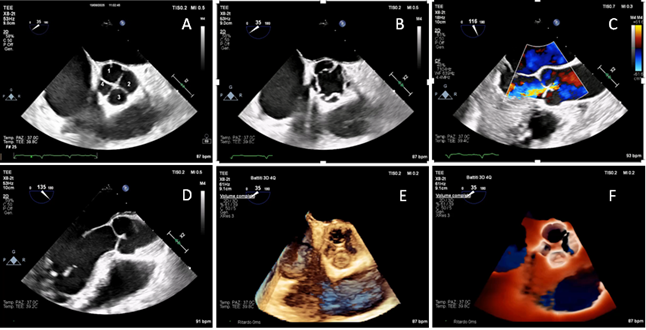
Type F Quadricuspid Aortic Valve at Three-Dimensional Transoesophageal Echocardiography
 , ,
, ,  , ,
, , 
Abstract

Supplementary Materials
Author Contributions
Funding
Institutional Review Board Statement
Informed Consent Statement
Data Availability Statement
Conflicts of Interest
Abbreviations
| QAV | Quadricuspid aortic valve |
References
- Hurwitz, L.E.; Roberts, W.C. Quadricuspid semilunar valve. Am. J. Cardiol. 1973, 31, 623–626. [Google Scholar] [CrossRef] [PubMed]
- Tsang, M.Y.; Abudiab, M.M.; Ammash, N.M.; Naqvi, T.Z.; Edwards, W.D.; Nkomo, V.T.; Pellikka, P.A. Quadricuspid Aortic Valve: Characteristics, Associated Structural Cardiovascular Abnormalities, and Clinical Outcomes. Circulation 2016, 133, 312–319. [Google Scholar] [CrossRef] [PubMed]
- Feldman, B.J.; Khandheria, B.K.; Warnes, C.A.; Seward, J.B.; Taylor, C.L.; Tajik, A.J. Incidence, description and functional assessment of isolated quadricuspid aortic valves. Am. J. Cardiol. 1990, 65, 937–938. [Google Scholar] [CrossRef] [PubMed]
- Manuel, A.M.; Ladeiras-Lopes, R.; Ribeiro, J.; Ferreira, N.D.; Faria, R.; Carvalho, M.; Ferreira, W.; Ferraz, R.; Gonçalves, F.; Batista, A.; et al. Prevalence, multimodality imaging characterization, and mid-term prognosis of quadricuspid aortic valves: An analysis of eight cases, based on 160 004 exams performed during 12 years in a tertiary care hospital. Eur. Heart J. Cardiovasc. Imaging 2021, 22, 765–776. [Google Scholar] [CrossRef] [PubMed]
- Zhang, J.; Fang, F.; Xia, Z.; Zhu, W.; Tsang, C.T.; Ren, Q.; Huang, J.; Guo, R.; Gu, W.; Xuan, H.; et al. Clinical Outcomes in Patients With Quadricuspid vs Bicuspid Aortic Valve. JAMA Netw. Open 2025, 8, e2524915. [Google Scholar] [CrossRef] [PubMed]
- Scrofani, R.; Pettinari, M.; Vanelli, P.; Biasi, S.; Antona, C. Type F quadricuspid aortic valve: Surgical treatment of a rare cause of aortic valve disease. J. Cardiovasc. Med. 2008, 9, 311–313. [Google Scholar] [CrossRef] [PubMed]
- Garg, P.; Kamaruddin, H.; Orme, R.; Watt, V. Type F Congenital Quadricuspid Aortic Valve: A Very Rare Case Diagnosed by 3-dimenional Transoesophageal Echocardiography. Open Cardiovasc. Med. J. 2014, 8, 23–25. [Google Scholar] [CrossRef] [PubMed]
- Yuan, S.M. Quadricuspid Aortic Valve: A Comprehensive Review. Braz. J. Cardiovasc. Surg. 2016, 31, 454–460. [Google Scholar] [CrossRef] [PubMed]
- Saith, S.; Saith, S.; Murthy, A. Quadricuspid Aortic Valve: An Introduction for Clinicians. Cardiol. Res. 2022, 13, 2–10. [Google Scholar] [CrossRef] [PubMed]
- De Kerchove, L.; Momeni, M.; Aphram, G.; Watremez, C.; Bollen, X.; Jashari, R.; Boodhwani, M.; Astarci, P.; Noirhomme, P.; El Khoury, G. Free margin length and coaptation surface area in normal tricuspid aortic valve: An anatomical study. Eur. J. Cardiothorac. Surg. 2018, 53, 1040–1048. [Google Scholar] [CrossRef] [PubMed]
Disclaimer/Publisher’s Note: The statements, opinions and data contained in all publications are solely those of the individual author(s) and contributor(s) and not of MDPI and/or the editor(s). MDPI and/or the editor(s) disclaim responsibility for any injury to people or property resulting from any ideas, methods, instructions or products referred to in the content. |
© 2025 by the authors. Licensee MDPI, Basel, Switzerland. This article is an open access article distributed under the terms and conditions of the Creative Commons Attribution (CC BY) license (https://creativecommons.org/licenses/by/4.0/).
Share and Cite
Barbarossa, A.; Coraducci, F.; Tagliati, C.; Capestro, F.; Orazi, B.; Guerra, F.; Di Eusanio, M.; Dello Russo, A. Type F Quadricuspid Aortic Valve at Three-Dimensional Transoesophageal Echocardiography. Diagnostics 2025, 15, 2792. https://doi.org/10.3390/diagnostics15212792
Barbarossa A, Coraducci F, Tagliati C, Capestro F, Orazi B, Guerra F, Di Eusanio M, Dello Russo A. Type F Quadricuspid Aortic Valve at Three-Dimensional Transoesophageal Echocardiography. Diagnostics. 2025; 15(21):2792. https://doi.org/10.3390/diagnostics15212792
Chicago/Turabian StyleBarbarossa, Alessandro, Francesca Coraducci, Corrado Tagliati, Filippo Capestro, Barbara Orazi, Federico Guerra, Marco Di Eusanio, and Antonio Dello Russo. 2025. "Type F Quadricuspid Aortic Valve at Three-Dimensional Transoesophageal Echocardiography" Diagnostics 15, no. 21: 2792. https://doi.org/10.3390/diagnostics15212792
APA StyleBarbarossa, A., Coraducci, F., Tagliati, C., Capestro, F., Orazi, B., Guerra, F., Di Eusanio, M., & Dello Russo, A. (2025). Type F Quadricuspid Aortic Valve at Three-Dimensional Transoesophageal Echocardiography. Diagnostics, 15(21), 2792. https://doi.org/10.3390/diagnostics15212792