Review

Microwave Radiometry for the Diagnosis and Monitoring of Inflammatory Arthritis

by
Katerina Laskari
1,*,
Elias Siores
2,3,
Maria G. Tektonidou
1 and
Petros P. Sfikakis
1
1
Rheumatology Unit, 1st Department of Propaedeutic Internal Medicine, Joint Academic Rheumatology Program, University of Athens, Medical School, National & Kapodistrian University of Athens Medical School, 75 Mikras Asias Street, Goudi, 11527 Athens, Greece
2
University of West Attica, 12243 Athens, Greece
3
Institute of Materials Research and Innovation, University of Bolton, Bolton BL3 5AB, UK
*
Author to whom correspondence should be addressed.
Diagnostics 2023, 13(4), 609; https://doi.org/10.3390/diagnostics13040609

Submission received: 20 January 2023 / Accepted: 3 February 2023 / Published: 7 February 2023
(This article belongs to the Special Issue Medical Microwave Radiometry for R&D and Practical Applications)

Abstract

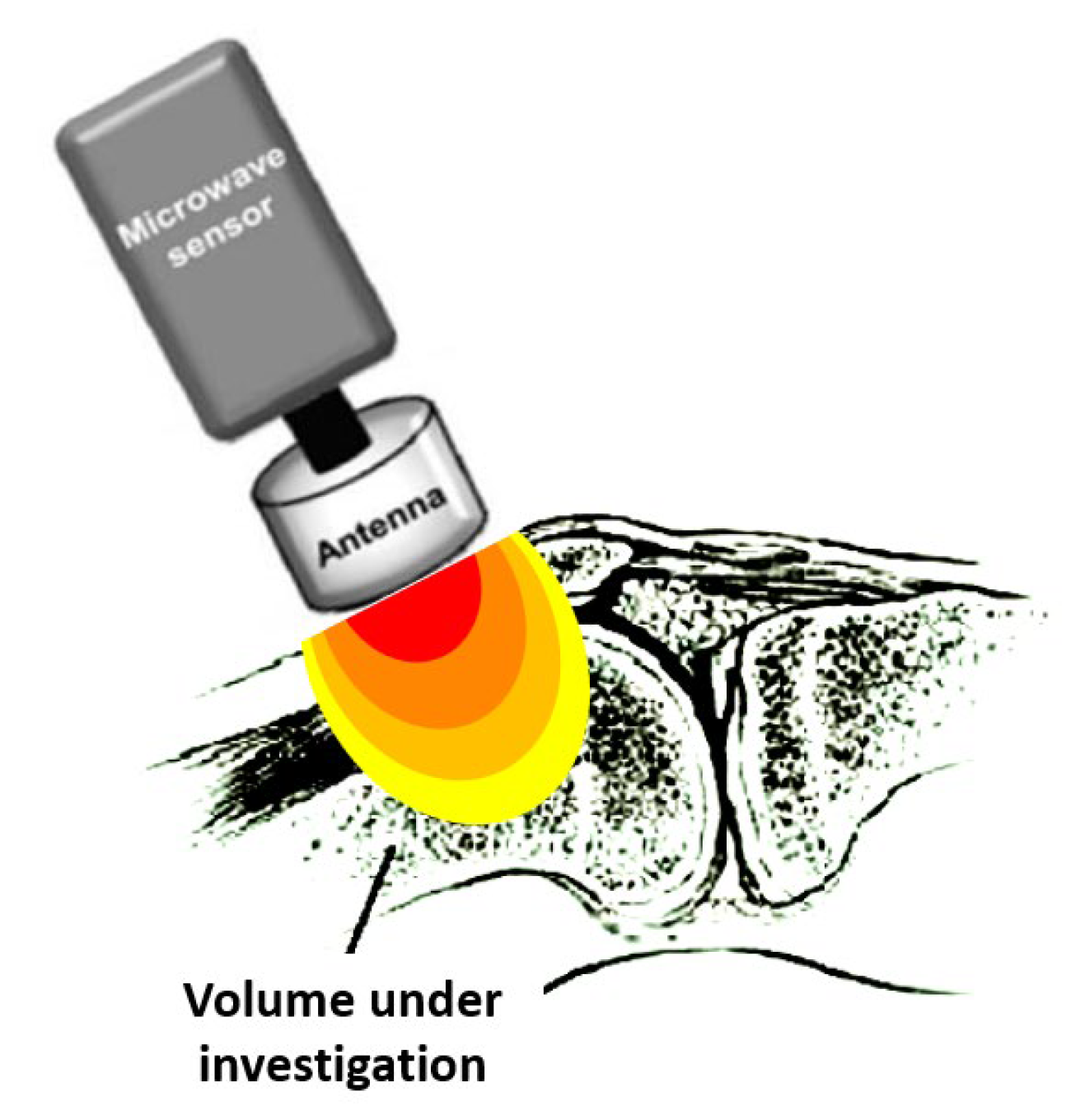
The ability of microwave radiometry (MWR) to detect with high accuracy in-depth temperature changes in human tissues is under investigation in various medical fields. The need for non-invasive, easily accessible imaging biomarkers for the diagnosis and monitoring of inflammatory arthritis provides the background for this application in order to detect the local temperature increase due to the inflammatory process by placing the appropriate MWR sensor on the skin over the joint. Indeed, a number of studies reviewed herein have reported interesting results, suggesting that MWR is useful for the differential diagnosis of arthritis as well as for the assessment of clinical and subclinical inflammation at the individual large or small joint level and the patient level. MWR showed higher agreement with musculoskeletal ultrasound, used as a reference, than with clinical examination in rheumatoid arthritis (RA), while it also appeared useful for the assessment of back pain and sacroiliitis. Further studies with a larger number of patients are warranted to confirm these findings, taking into account the current limitations of the available MWR devices. This may lead to the production of easily accessible and inexpensive MWR devices that will provide a powerful impetus for personalized medicine.
Keywords: microwave radiometry; synovitis; imaging biomarker; ultrasound; rheumatoid arthritis; osteoarthritis; sacroiliitis microwave radiometry; synovitis; imaging biomarker; ultrasound; rheumatoid arthritis; osteoarthritis; sacroiliitis