Article

Retinal Blood-Vessel Extraction Using Weighted Kernel Fuzzy C-Means Clustering and Dilation-Based Functions


Technology and Business Information System Unit, Mahasarakham Business School, Mahasarakham University, Mahasarakham 44150, Thailand
Diagnostics 2023, 13(3), 342; https://doi.org/10.3390/diagnostics13030342

Submission received: 18 November 2022 / Revised: 4 January 2023 / Accepted: 9 January 2023 / Published: 17 January 2023
(This article belongs to the Section Machine Learning and Artificial Intelligence in Diagnostics)

Abstract

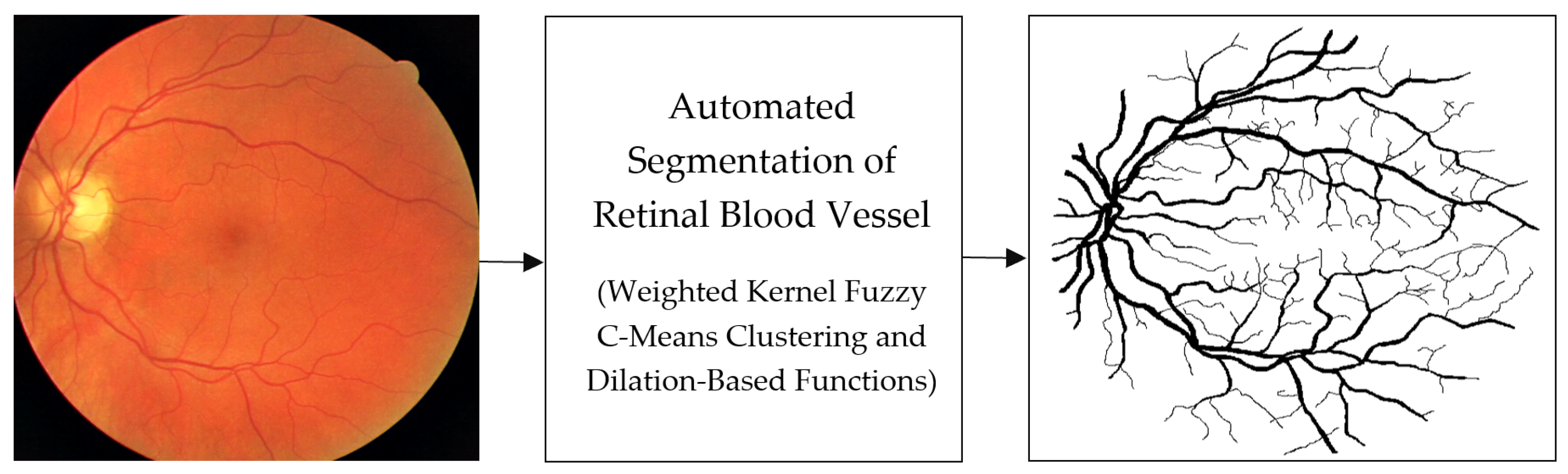
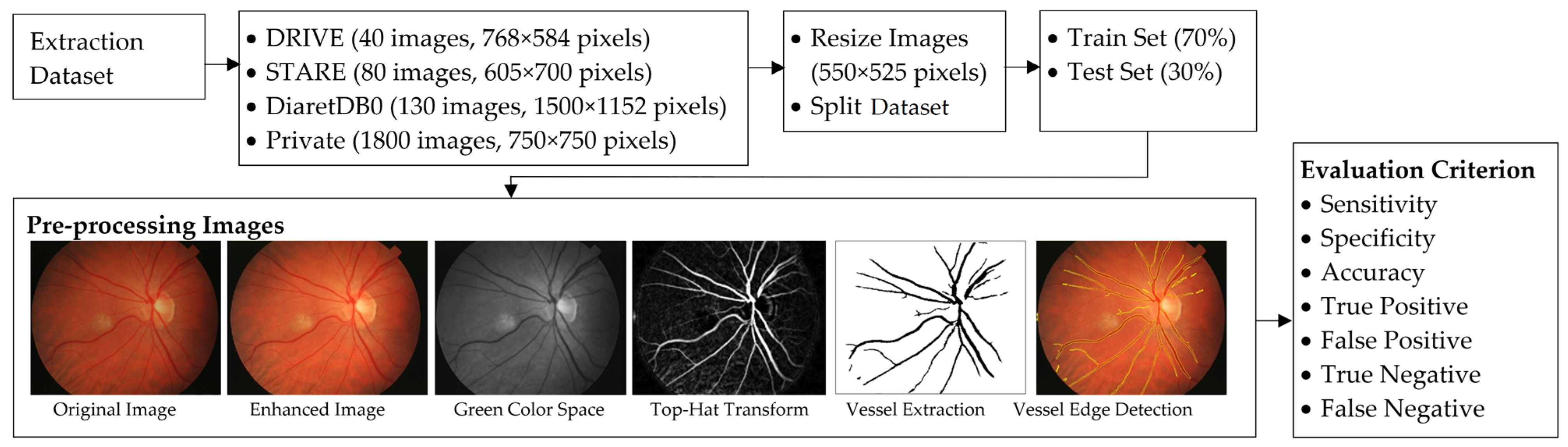
Automated blood-vessel extraction is essential in diagnosing Diabetic Retinopathy (DR) and other eye-related diseases. However, the traditional methods for extracting blood vessels tend to provide low accuracy when dealing with difficult situations, such as extracting both micro and large blood vessels simultaneously with low-intensity images and blood vessels with DR. This paper proposes a complete preprocessing method to enhance original retinal images before transferring the enhanced images to a novel blood-vessel extraction method by a combined three extraction stages. The first stage focuses on the fast extraction of retinal blood vessels using Weighted Kernel Fuzzy C-Means (WKFCM) Clustering to draw the vessel feature from the retinal background. The second stage focuses on the accuracy of full-size images to achieve regional vessel feature recognition of large and micro blood vessels and to minimize false extraction. This stage implements the mathematical dilation operator from a trained model called Dilation-Based Function (DBF). Finally, an optimal parameter threshold is empirically determined in the third stage to remove non-vessel features in the binary image and improve the overall vessel extraction results. According to evaluations of the method via the datasets DRIVE, STARE, and DiaretDB0, the proposed WKFCM-DBF method achieved sensitivities, specificities, and accuracy performances of 98.12%, 98.20%, and 98.16%, 98.42%, 98.80%, and 98.51%, and 98.89%, 98.10%, and 98.09%, respectively.
Keywords: retinal blood vessel extraction; Weighted Kernel Fuzzy C-Means Clustering; Dilation-Based Function; diabetic retinopathy retinal blood vessel extraction; Weighted Kernel Fuzzy C-Means Clustering; Dilation-Based Function; diabetic retinopathy