Review

Homeobox Gene Expression Dysregulation as Potential Diagnostic and Prognostic Biomarkers in Bladder Cancer

by
Fee-Wai Chin
1,
Soon-Choy Chan
2,* and
Abhi Veerakumarasivam
3,*
1
Department of Biomedical Sciences, Faculty of Medicine and Health Sciences, Universiti Putra Malaysia (UPM), Serdang 43400, Selangor, Malaysia
2
School of Liberal Arts, Science and Technology, Perdana University, Kuala Lumpur 50490, Malaysia
3
School of Medical and Life Sciences, Sunway University, Bandar Sunway 47500, Selangor, Malaysia
*
Authors to whom correspondence should be addressed.
Diagnostics 2023, 13(16), 2641; https://doi.org/10.3390/diagnostics13162641

Submission received: 30 May 2023 / Revised: 7 July 2023 / Accepted: 10 July 2023 / Published: 10 August 2023
(This article belongs to the Special Issue Advanced Diagnosis and Treatment Strategies for Bladder Cancer)

Abstract

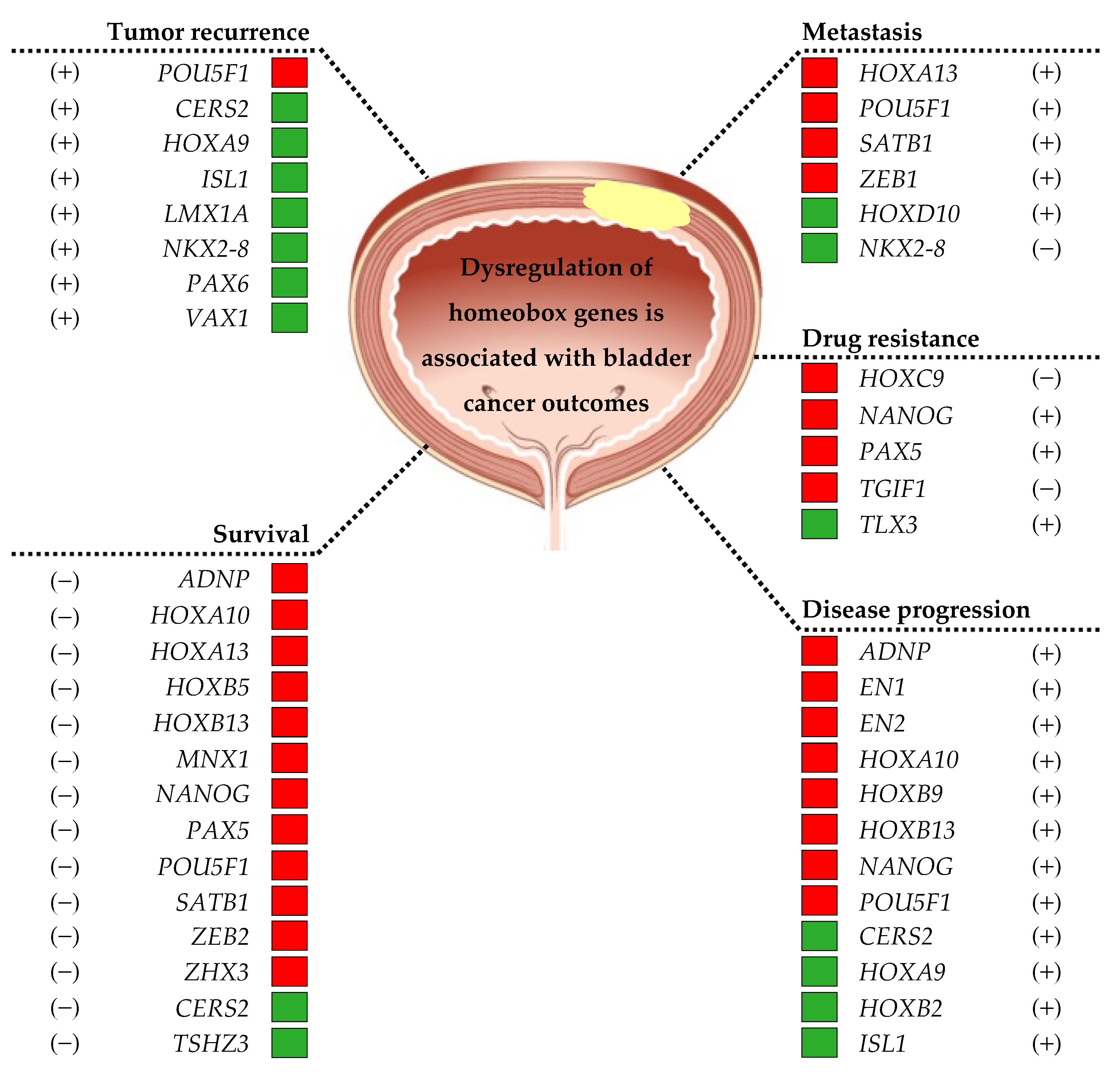
Homeobox genes serve as master regulatory transcription factors that regulate gene expression during embryogenesis. A homeobox gene may have either tumor-promoting or tumor-suppressive properties depending on the specific organ or cell lineage where it is expressed. The dysregulation of homeobox genes has been reported in various human cancers, including bladder cancer. The dysregulated expression of homeobox genes has been associated with bladder cancer clinical outcomes. Although bladder cancer has high risk of tumor recurrence and progression, it is highly challenging for clinicians to accurately predict the risk of tumor recurrence and progression at the initial point of diagnosis. Cystoscopy is the routine surveillance method used to detect tumor recurrence. However, the procedure causes significant discomfort and pain that results in poor surveillance follow-up amongst patients. Therefore, the development of reliable non-invasive biomarkers for the early detection and monitoring of bladder cancer is crucial. This review provides a comprehensive overview of the diagnostic and prognostic potential of homeobox gene expression dysregulation in bladder cancer.
Keywords: biomarker; bladder cancer; diagnosis; homeobox genes; prognosis; tumorigenesis biomarker; bladder cancer; diagnosis; homeobox genes; prognosis; tumorigenesis