Interesting Images

Reversible Tumor Progression Induced by a Dexamethasone Course for Severe COVID-19 during Immune Checkpoint Inhibitor Treatment

1
Sorbonne Université, INSERM, Institut Pierre Louis d’Epidémiologie et de Santé Publique (iPLESP), Assistance Publique-Hôpitaux de Paris (AP-HP), Pitié Salpêtrière Hospital, Department of Medical Oncology, Institut Universitaire de Cancérologie, CLIP2 Galilée, 75013 Paris, France
2
Residual Tumor & Response to Treatment Laboratory, RT2Lab, INSERM, U932 Immunity and Cancer, Institut Curie, 75005 Paris, France
3
Sorbonne Université, Department of Radiology, Assistance Publique-Hôpitaux de Paris (AP-HP), Pitié Salpêtrière Hospital, 75004 Paris, France
4
Service d’Oncologie Médicale, CHU Gabriel Montpied, Université Clermont Auvergne, 63000 Clermont-Ferrand, France
*
Author to whom correspondence should be addressed.
These authors contributed equally to this work.
Diagnostics 2022, 12(8), 1933; https://doi.org/10.3390/diagnostics12081933

Submission received: 28 June 2022 / Revised: 4 August 2022 / Accepted: 7 August 2022 / Published: 10 August 2022
(This article belongs to the Special Issue Immune-Related Adverse Events Diagnosis and Immunotherapy in Cancer)

Abstract

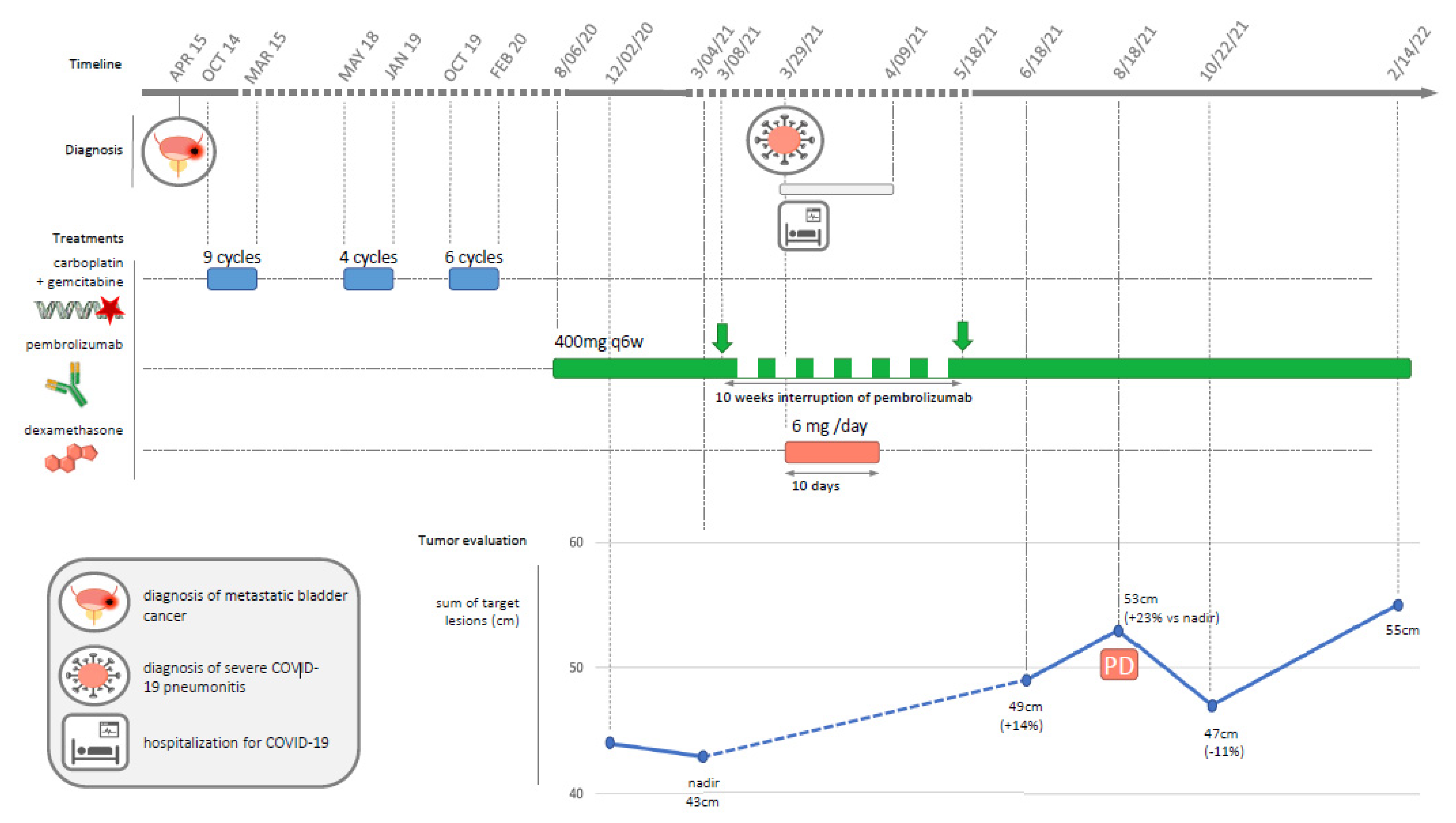
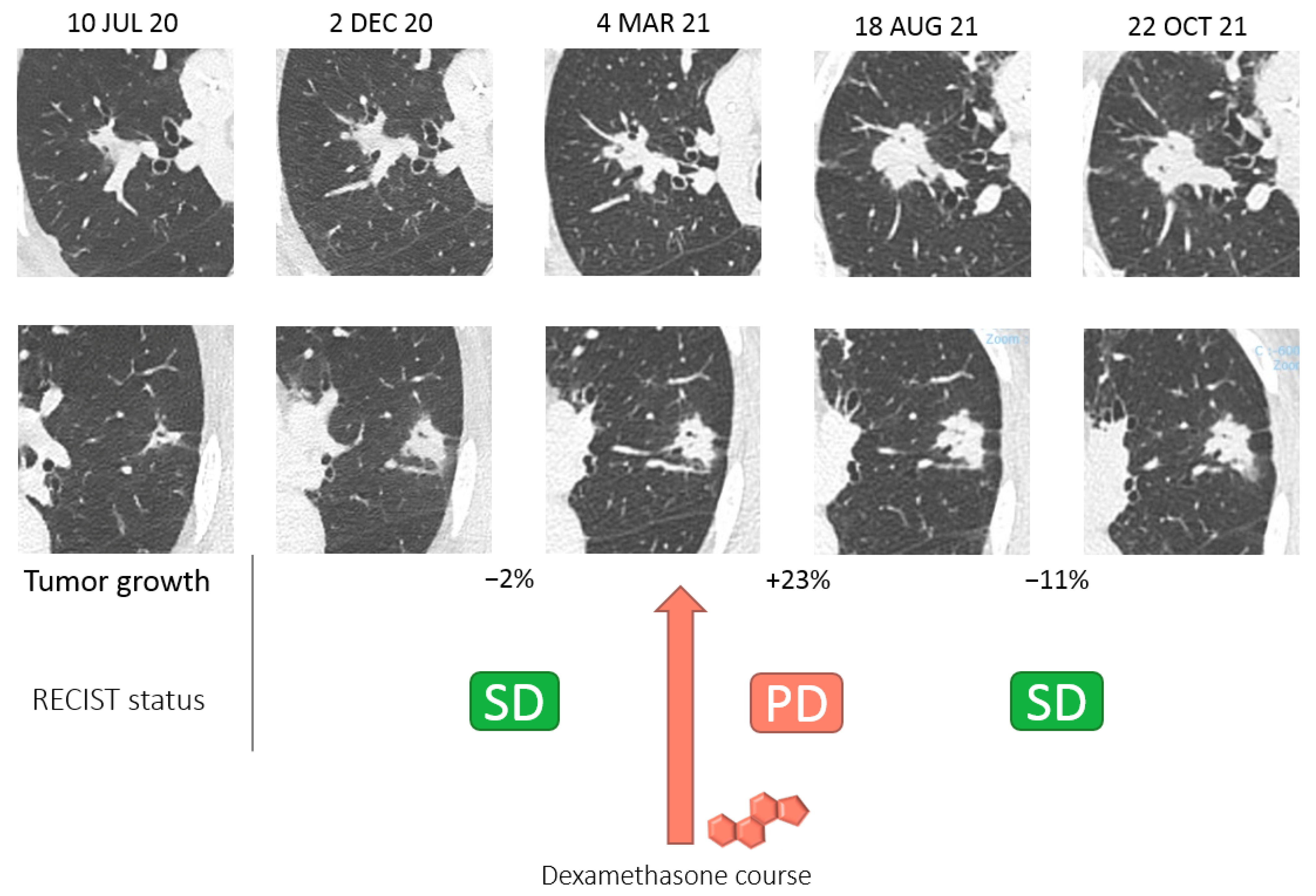
Immunotherapies and immune checkpoint inhibitors (ICI) represent the latest revolution in oncology. Several studies have reported an association between the use of corticosteroids and poorer outcomes for patients treated with ICIs. However, it has been never established whether corticoid-induced tumor progression under ICI treatment could be reversible. We report herein transient tumor progression induced by dexamethasone for a patient treated with pembrolizumab for metastatic bladder cancer. An 82-year-old man was treated with pembrolizumab as a second-line treatment for metastatic urothelial carcinoma with stable disease for 8 months as the best tumoral response. He experienced severe coronavirus disease 2019 (COVID-19) infection and was treated with high-dose dexamethasone for ten days according to the RECOVERY protocol. Following this episode, radiological CT-scan evaluation showed tumor progression. Pembrolizumab was maintained, and subsequent radiological evaluation showed tumor shrinkage. This case highlights that the antagonistic effect of glucocorticoids with ICI efficacy is transient and can be reverted when corticoids are withdrawn. Clinicians should be aware that tumor progression in the context of the intercurrent use of systemic corticosteroids can be temporary and should be interpreted with caution, and ICI continuation could be considered for some patients. Insights: The antagonistic effect of glucocorticoids with ICI efficacy is transient and can be reverted when corticoids are withdrawn. Tumor progression in the context of the intercurrent use of systemic corticosteroids can be temporary and should be interpreted with caution, and ICI continuation could be considered for some patients.
Keywords: immunotherapy; immune checkpoint inhibitors; COVID-19; pseudoprogression; corticosteroids immunotherapy; immune checkpoint inhibitors; COVID-19; pseudoprogression; corticosteroids