Article

Clinical Model for the Prediction of Severe Liver Fibrosis in Adult Patients with Type II Diabetes Mellitus
by
Ovidiu Paul Calapod
1,*,
Andreea Maria Marin
1,
Anca Pantea Stoian
2,3,* and
Carmen Fierbinteanu-Braticevici
1,4
1
Department of Gastroenterology, “Carol Davila” University of Medicine and Pharmacy, 050474 Bucharest, Romania
2
Department of Diabetes, Nutrition and Metabolic Diseases, ”Carol Davila” University of Medicine and Pharmacy, 050474 Bucharest, Romania
3
“Prof. Dr. N. C. Paulescu” National Institute of Diabetes, Nutrition and Metabolic Diseases, 030167 Bucharest, Romania
4
Emergency University Hospital of Bucharest, 050098 Bucharest, Romania
*
Authors to whom correspondence should be addressed.
Diagnostics 2022, 12(8), 1829; https://doi.org/10.3390/diagnostics12081829

Submission received: 13 June 2022 / Revised: 26 July 2022 / Accepted: 27 July 2022 / Published: 29 July 2022
(This article belongs to the Special Issue Non-alcoholic Fatty Liver Disease: Diagnosis and Management)

Abstract

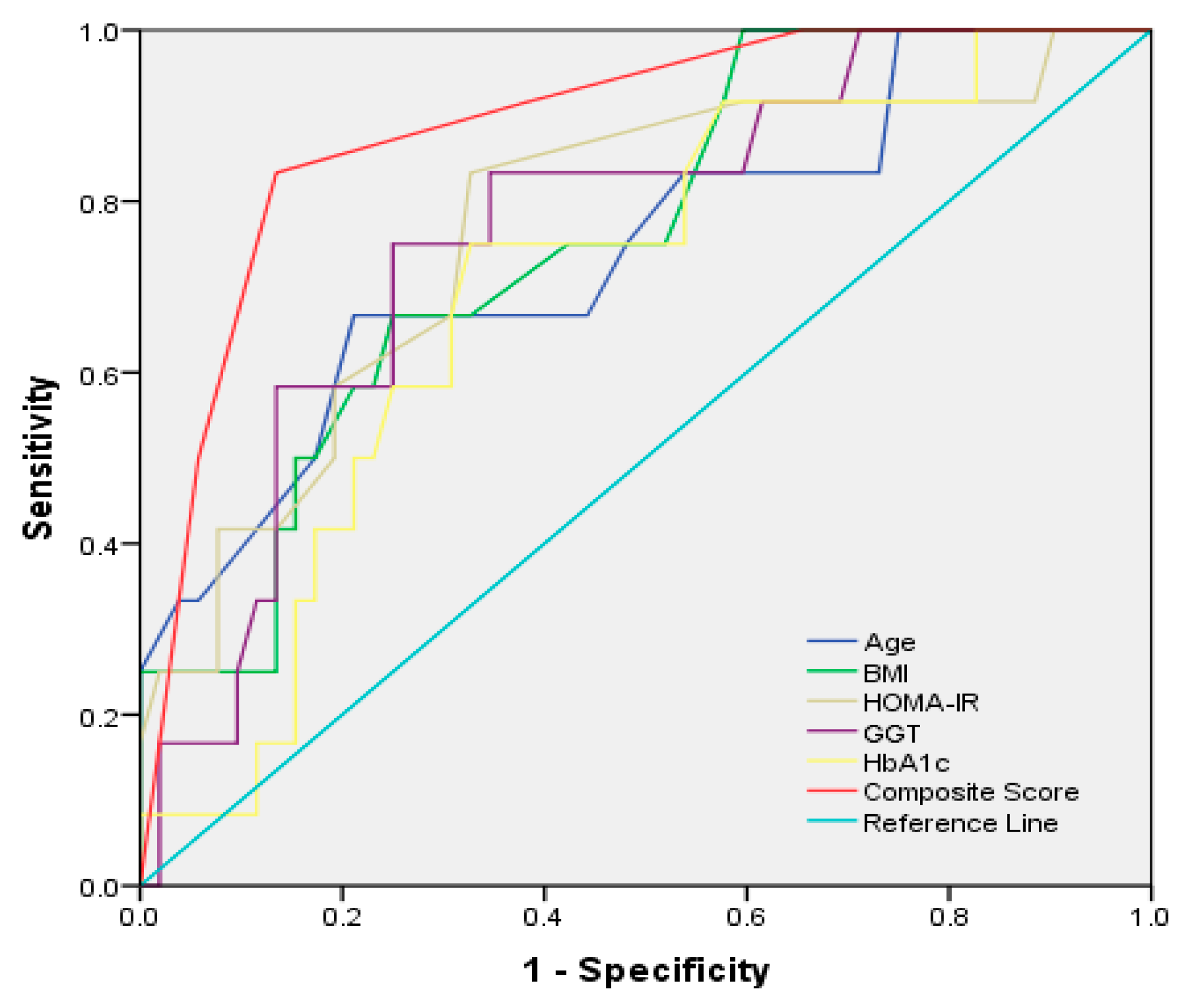
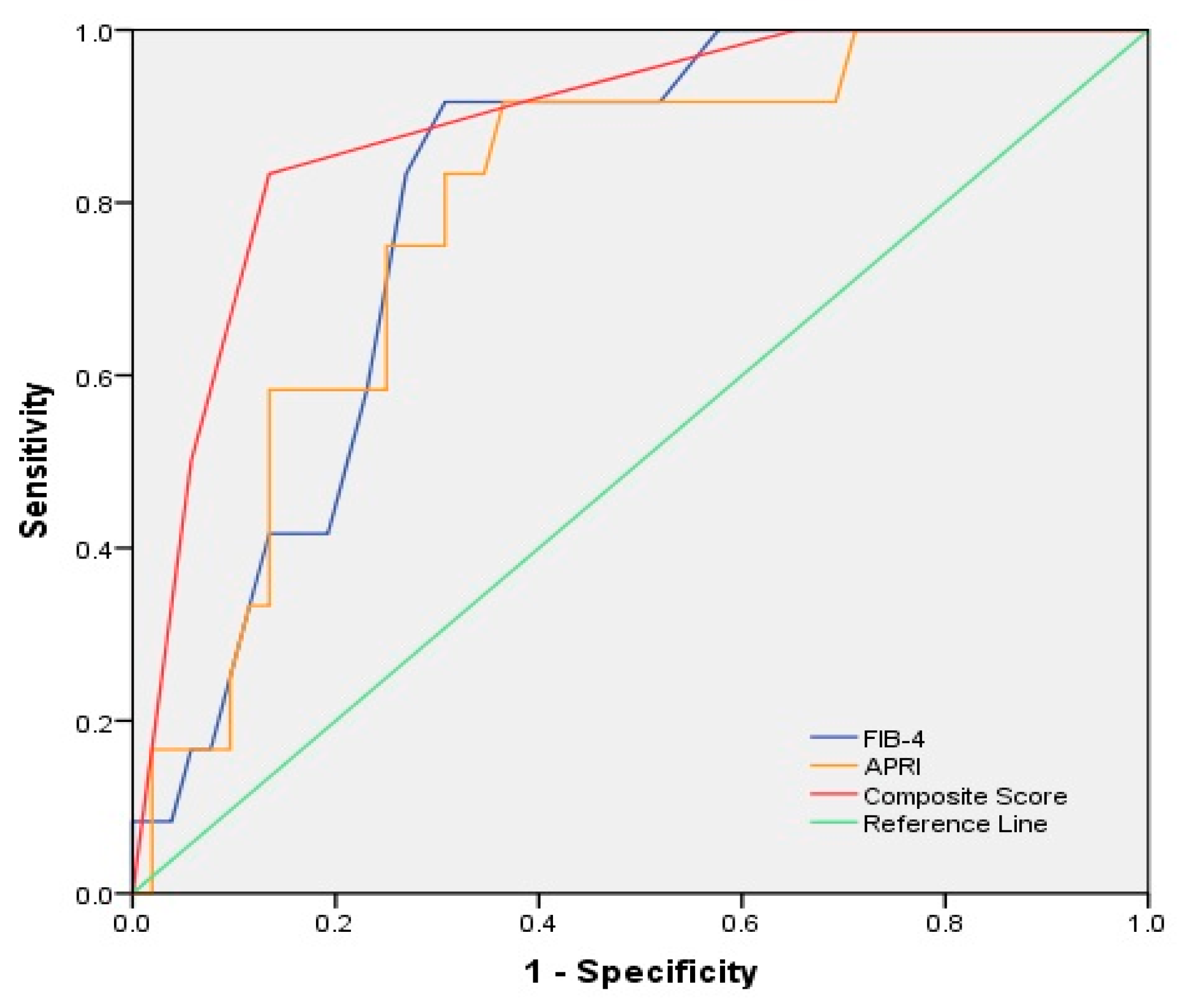
Background and Objectives: Non-alcoholic fatty liver disease (NAFLD)-related severe liver fibrosis is associated with a higher risk of progressing to decompensated cirrhosis and hepatic failure and developing NAFLD-related hepatocellular carcinoma (HCC), particularly in populations with diabetes. Our pilot study aims to evaluate the performances of various noninvasive methods in predicting liver fibrosis in a population of patients with diabetes and to establish a new scoring system for the prediction of severe fibrosis (>F3). Materials and Methods: A total of 175 patients with diabetes were enrolled for liver fibrosis evaluation. Using the degree of agreement (concordance) between a noninvasive score based on serum biomarkers (NAFLD fibrosis score) and point shear-wave elastography (pSWE) as the reference method, we generated receiver operating characteristic (ROC) curves and performed a multivariate analysis to predict severe liver fibrosis. Results: In our population of patients with diabetes, gamma-glutamyltransferase (GGT), age, body mass index (BMI), the homeostatic model assessment of insulin resistance (HOMA-IR), and glycosylated hemoglobin (HbA1C) were significant predictors for the diagnosis of the F3/F4 group (area under the ROC: 0.767, 0.743, 0.757, 0.772, and 0.7, respectively; p < 0.005 for all). Moreover, the combined composite score (the sum of GGT, age, BMI, HOMA index, and HbA1C) had the highest diagnostic performance at a cut-off value of 3 (AUROC—0.899; p < 0001). The sensitivity, specificity, negative predictive value (NPV), and positive predictive value (PPV) were 91.20%, 79%, 79%, and 89%, respectively, and 89% of patients were correctly classified as having severe liver fibrosis. In contrast with the Fibrosis 4 (FIB-4) score and the AST-to-platelet ratio index (APRI), the composite score had the best accuracy in discriminating advanced fibrosis. Conclusions: The proposed composite score had a reliable and acceptable diagnostic accuracy in identifying patients with diabetes at risk of having severe fibrosis using readily available laboratory and clinical data.
Keywords: pSWE; liver fibrosis; diabetes pSWE; liver fibrosis; diabetes