Brief Report

Harmonization of Determination of SARS-CoV-2 Antibodies: Is It Always Possible?
Laboratory Medicine Unit, Ospedale dell’Angelo, and Regional Center for Biomarkers, Department of Clinical Pathology, Azienda ULSS 3 Serenissima, Mestre, 30122 Venice, Italy
Diagnostics 2022, 12(2), 483; https://doi.org/10.3390/diagnostics12020483

Submission received: 22 January 2022 / Revised: 5 February 2022 / Accepted: 10 February 2022 / Published: 14 February 2022
(This article belongs to the Section Diagnostic Microbiology and Infectious Disease)

Abstract

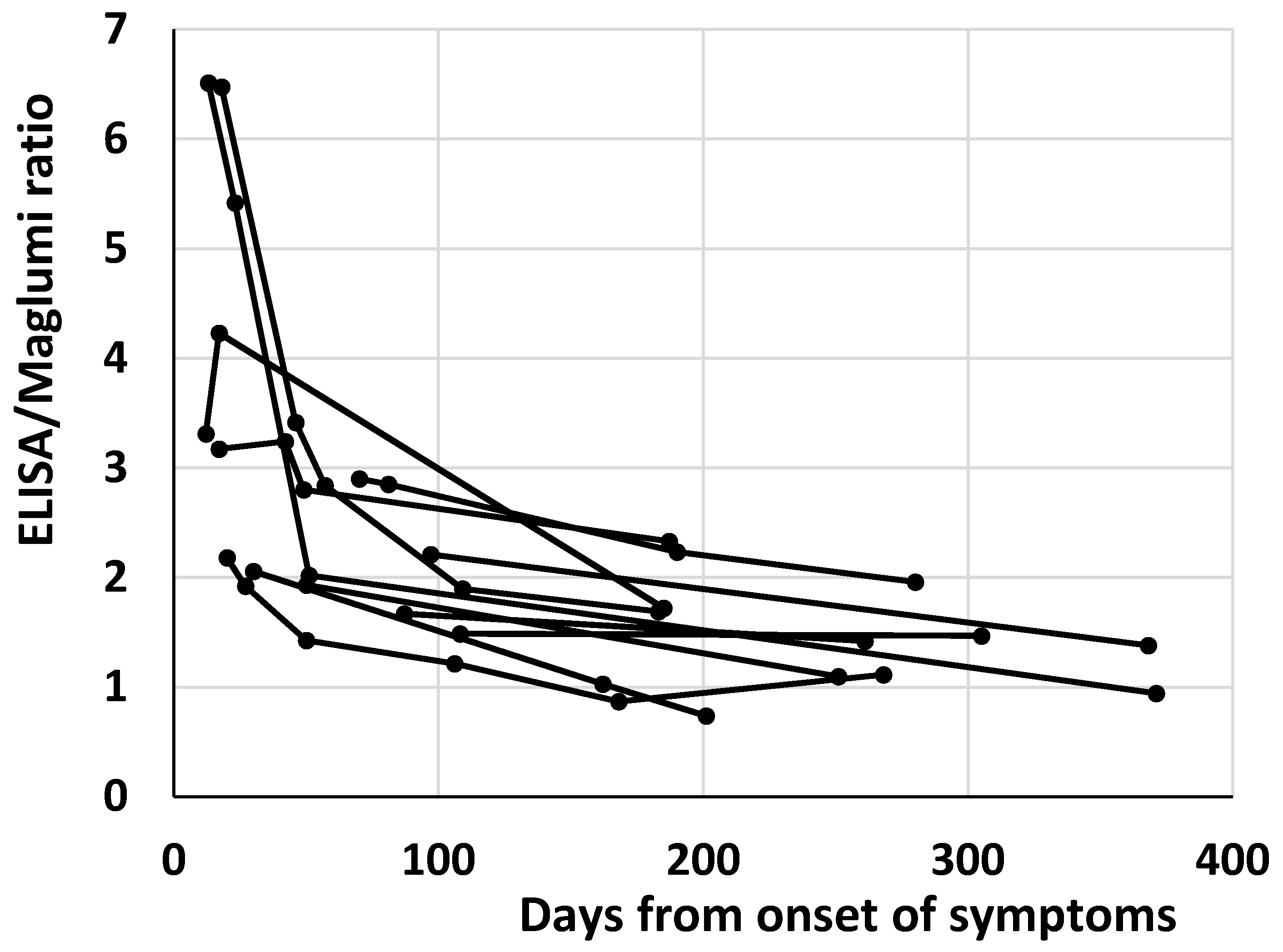
A WHO standard was prepared with the aim of harmonizing assays detecting antibodies against SARS-CoV-2, but the issue is currently being debated. We re-evaluated a previously studied set of cases (108 specimens of 48 patients and 60 specimens of 20 vaccinated subjects, collected after 14 days from the first dose and 14 days and 3 months after a second dose of the Comirnaty BNT162b2 vaccine), calculating the ratios between the results of two methods (SARS-CoV-2 IgG anti-RBD, SNIBE, and anti-SARS-CoV-2 QuantiVac ELISA IgG, Euroimmun). In the vaccinated subjects, the ratios of the results between methods according to the WHO standard were relatively dispersed, but the harmonization results were good. On the other hand, in patient samples, the variability between tests was very high, and the harmonization was unsatisfactory (median ratios between methods 2.23, 10th–90th percentile: 1.1–5.6). Interestingly, in patient samples, the harmonization depends on the time from the onset of symptoms and greatly improves after 6 months since the diagnosis. Forty patient specimens and thirty-one of the vaccinated subjects after the second dose were also evaluated with a third method (Access SARS-CoV-2 IgG (1st IS), Beckman Coulter), obtaining a similar trend. We can conclude that the actual effectiveness of harmonization between methods may vary depending on the scenario in which they will be used.
Keywords: SARS-CoV-2; antibodies assays; harmonization; COVID-19 SARS-CoV-2; antibodies assays; harmonization; COVID-19