Article

Deep Active Learning for Automatic Segmentation of Maxillary Sinus Lesions Using a Convolutional Neural Network


1
Department of Orthodontics, Korea University Guro Hospital, Seoul 08308, Korea
2
Department of Oral and Maxillofacial Surgery, Korea University Guro Hospital, Seoul 08308, Korea
3
Department of Oral and Maxillofacial Surgery, Korea University Anam Hospital, Seoul 02841, Korea
4
Department of Radiology, Korea University Anam Hospital, Seoul 02841, Korea
*
Authors to whom correspondence should be addressed.
These authors contributed equally to this work.
Diagnostics 2021, 11(4), 688; https://doi.org/10.3390/diagnostics11040688

Submission received: 26 March 2021 / Revised: 8 April 2021 / Accepted: 9 April 2021 / Published: 12 April 2021
(This article belongs to the Special Issue Artificial Intelligence in Oral Health)

Abstract

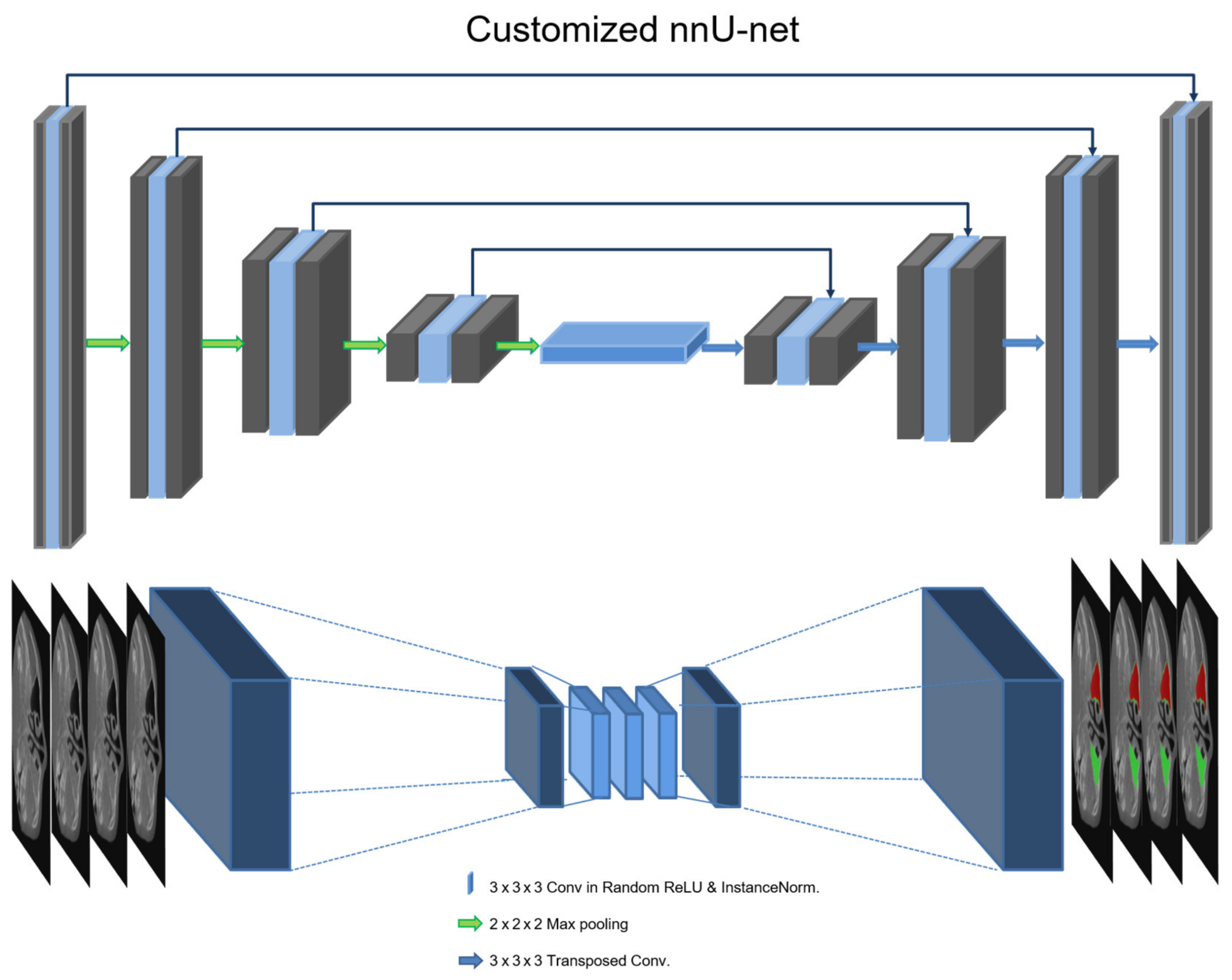
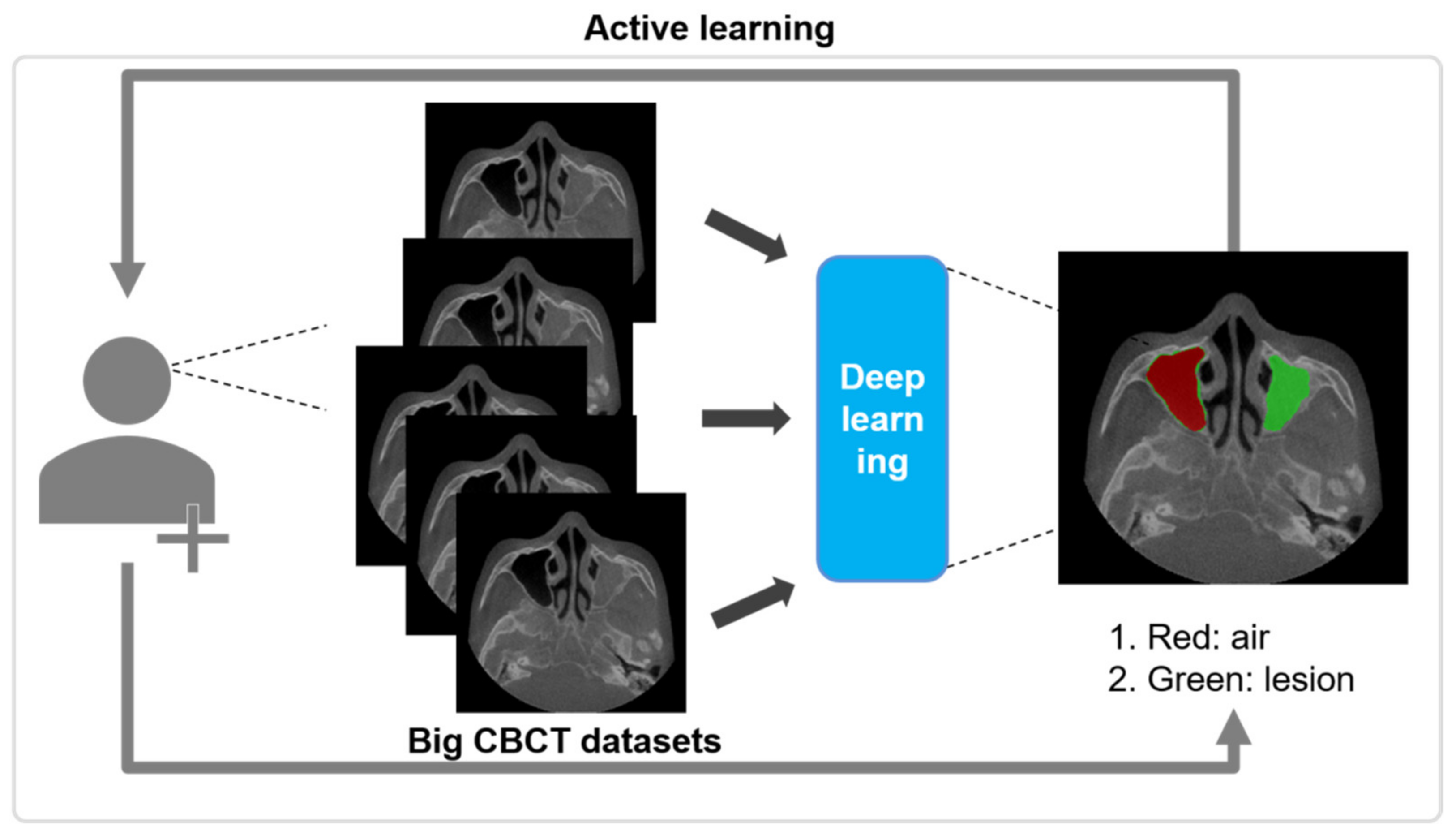
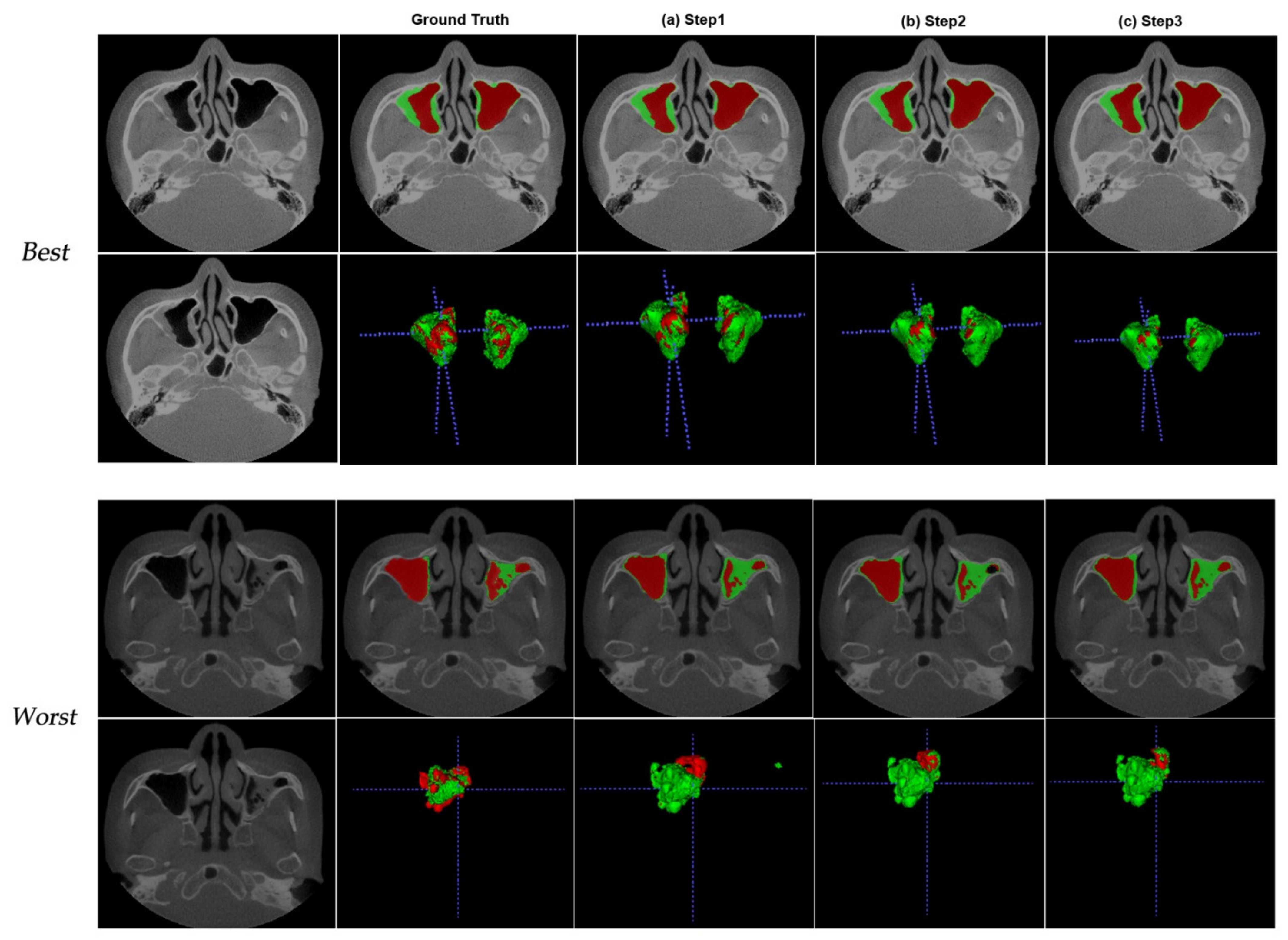
The aim of this study was to segment the maxillary sinus into the maxillary bone, air, and lesion, and to evaluate its accuracy by comparing and analyzing the results performed by the experts. We randomly selected 83 cases of deep active learning. Our active learning framework consists of three steps. This framework adds new volumes per step to improve the performance of the model with limited training datasets, while inferring automatically using the model trained in the previous step. We determined the effect of active learning on cone-beam computed tomography (CBCT) volumes of dental with our customized 3D nnU-Net in all three steps. The dice similarity coefficients (DSCs) at each stage of air were 0.920 ± 0.17, 0.925 ± 0.16, and 0.930 ± 0.16, respectively. The DSCs at each stage of the lesion were 0.770 ± 0.18, 0.750 ± 0.19, and 0.760 ± 0.18, respectively. The time consumed by the convolutional neural network (CNN) assisted and manually modified segmentation decreased by approximately 493.2 s for 30 scans in the second step, and by approximately 362.7 s for 76 scans in the last step. In conclusion, this study demonstrates that a deep active learning framework can alleviate annotation efforts and costs by efficiently training on limited CBCT datasets.
Keywords: active learning; maxillary sinusitis; convolutional neural network; deep learning; segmentation active learning; maxillary sinusitis; convolutional neural network; deep learning; segmentation