Trajectories in Oxidative Stress and Corticosteroids Insensitivity in Patient with High Risk of Severe Asthma: Use of FeNO as Biomarker of Respiratory Epithelial Barrier Distress

 , ,
, ,  , , , , ,
  ,
,
Abstract
1. Introduction
2. Materials and Methods
2.1. Study Population
- •
- Triple Positive: simultaneous positivity of FeNO, BEC, and IgE.
- •
- Eos+ FeNO+: elevated eosinophil and nitric oxide levels.
- •
- EoS+ IgE+: positivity for eosinophils and IgE, typically associated with the young allergic phenotype.
- •
- FeNO+ IgE+: elevated nitric oxide and IgE levels with a normal eosinophil count.
- •
- Triple Negative: negativity for all biomarkers considered (non-T2 phenotype).
- •
- Eos− FeNO+: isolated elevation of FeNO in the absence of blood eosinophilia.
2.2. Statistical Analysis
3. Results
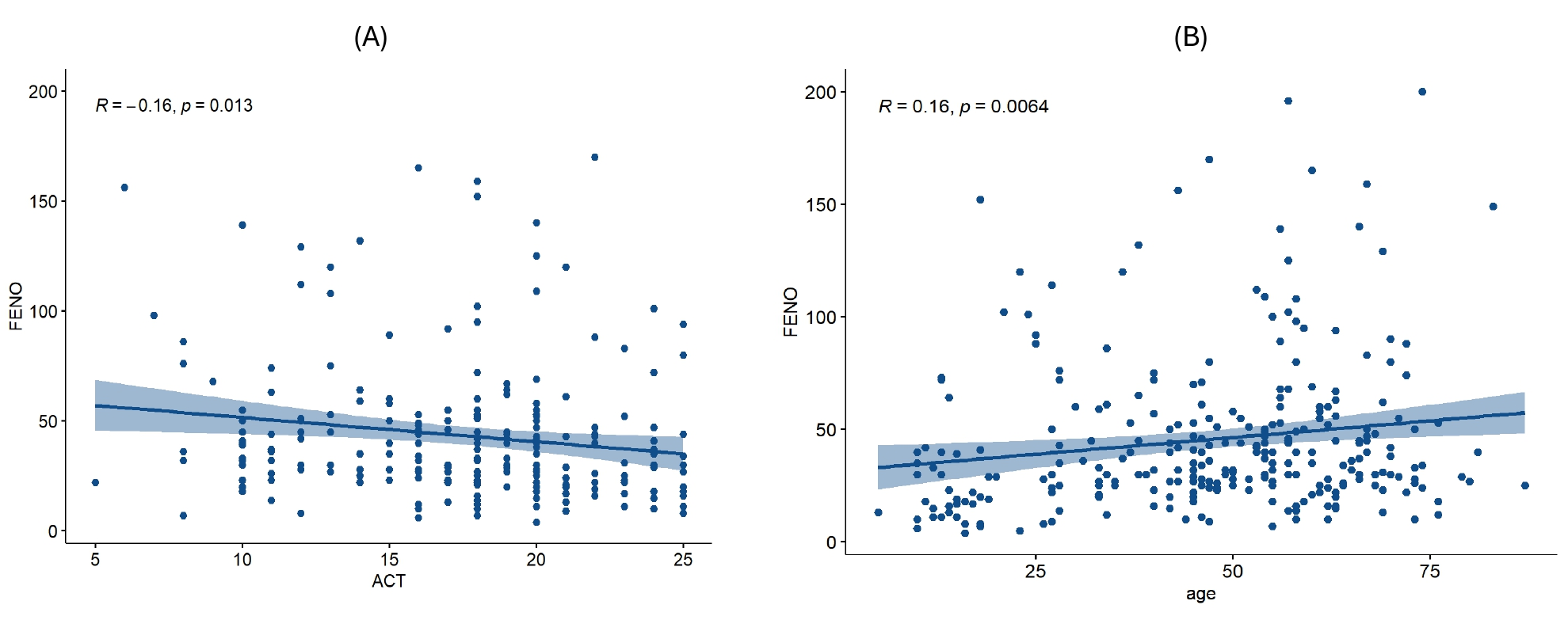
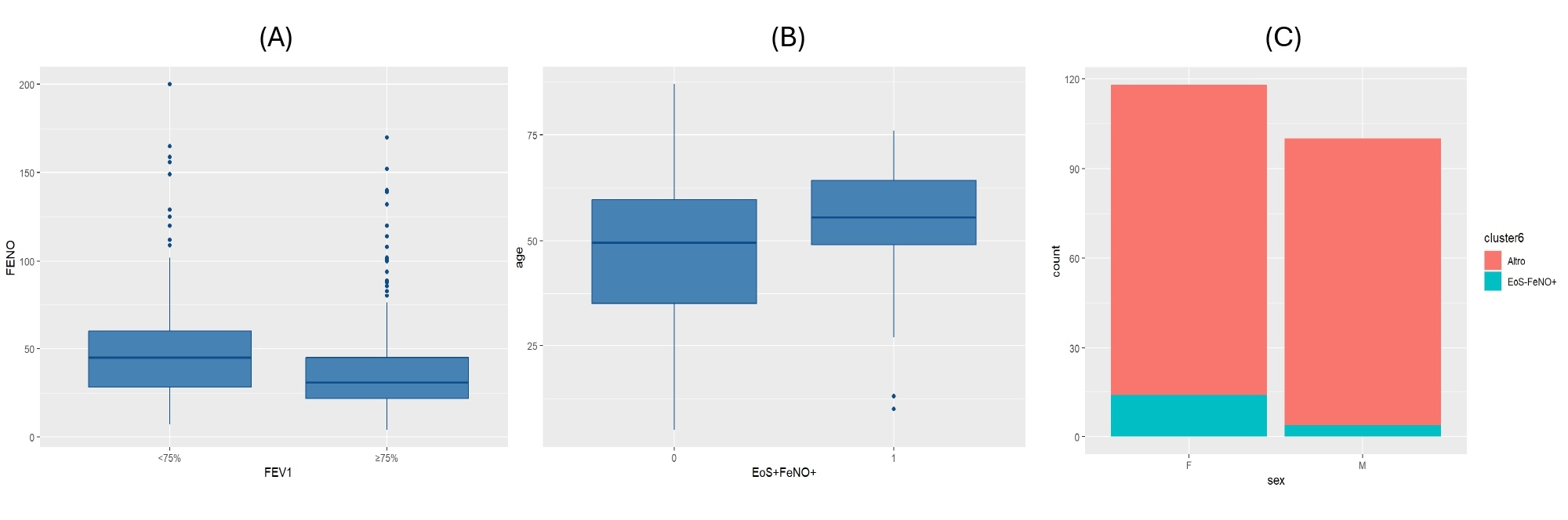
3.1. FeNO Correlation to Clinical and Biological Variables
3.2. Symptomatic Resilience and Corticosteroid Insensitivity Through Group Analysis

| Variable | Triple Positive | EoS+ FeNO+ | EoS+ IgE+ | FeNO+ IgE+ | Triple Negative | EoS- FeNO+ |
|---|---|---|---|---|---|---|
| Numberof patients | 81 | 56 | 23 | 37 | 4 | 18 |
| age (median [IQR]) | 54.5 [42.8, 61.0] | 55.5 [49.0, 64.2] | 33.0 [14.5, 47.0] | 47.0 [34.0, 60.0] | 57.5 [54.5, 59.2] | 47.0 [34.5, 62.0] |
| Age groups (%) | ||||||
| age < 18 (%) | 3 (3.8) | 2 (3.6) | 10 (43.5) | 1 (2.7) | 0 (0.0) | 0 (0.0) |
| age ≥ 18 < 45 (%) | 19 (23.8) | 7 (12.5) | 4 (17.4) | 11 (29.7) | 0 (0.0) | 6 (33.3) |
| age ≥ 45 < 65 (%) | 42 (52.5) | 35 (62.5) | 8 (34.8) | 15 (40.5) | 4 (100.0) | 9 (50.0) |
| age ≥ 65 (%) | 16 (20.0) | 12 (21.4) | 1 (4.3) | 10 (27.0) | 0 (0.0) | 3 (16.7) |
| sex = M (%) | 41 (50.6) | 24 (42.9) | 12 (52.2) | 17 (47.2) | 2 (50.0) | 4 (22.2) |
| BMI (median [IQR]) | 25.0 [23.2, 28.0] | 26.5 [23.0, 29.0] | 24.2 [19.4, 26.5] | 24.6 [21.2, 28.5] | 26.0 [23.5, 26.3] | 24.0 [22.0, 26.5] |
| BMI groups (%) | ||||||
| BMI < 16 (%) | 0 (0.0) | 0 (0.0) | 0 (0.0) | 0 (0.0) | 0 (0.0) | 0 (0.0) |
| BMI ≥ 16 < 18.50 (%) | 4 (5.4) | 0 (0.0) | 3 (15.0) | 3 (8.8) | 0 (0.0) | 0 (0.0) |
| BMI ≥ 18.50 < 25 (%) | 29 (39.2) | 16 (41.0) | 8 (40.0) | 14 (41.2) | 2 (66.7) | 8 (57.1) |
| BMI ≥ 25 < 30 (%) | 30 (40.5) | 16 (41.0) | 7 (35.0) | 11 (32.4) | 1 (33.3) | 4 (28.6) |
| BMI ≥ 30 (%) | 11 (14.9) | 7 (17.9) | 2 (10.0) | 6 (17.6) | 0 (0.0) | 2 (14.3) |
| Diagnosis of severe asthma (%) | 41 (50.6) | 41 (73.2) | 7 (30.4) | 16 (43.2) | 2 (50.0) | 14 (77.8) |
| FEV1 = ≥75% (%) | 47 (60.3) | 30 (54.5) | 20 (87.0) | 25 (71.4) | 2 (50.0) | 9 (52.9) |
| FEV1 reversibility (%) | 51 (76.1) | 32 (71.1) | 14 (73.7) | 24 (75.0) | 2 (50.0) | 11 (84.6) |
| Eosinophils (%) | ||||||
| EOS ≥ 0 < 250 (%) | 0 (0.0) | 0 (0.0) | 0 (0.0) | 31 (100.0) | 4 (100.0) | 18 (100.0) |
| EOS ≥ 1500 (%) | 1 (1.2) | 2 (3.6) | 0 (0.0) | 0 (0.0) | 0 (0.0) | 0 (0.0) |
| EOS ≥ 250 < 500 (%) | 40 (49.4) | 29 (51.8) | 14 (60.9) | 0 (0.0) | 0 (0.0) | 0 (0.0) |
| EOS ≥ 500 < 1500 (%) | 40 (49.4) | 25 (44.6) | 9 (39.1) | 0 (0.0) | 0 (0.0) | 0 (0.0) |
| FeNO (median [IQR]) | 44.0 [30.0, 61.0] | 44.0 [35.0, 57.2] | 16.0 [11.0, 18.5] | 40.0 [30.0, 92.0] | 15.0 [12.8, 17.0] | 48.0 [30.0, 59.0] |
| FeNO (%) | ||||||
| FeNO < 25 (%) | 0 (0.0) | 0 (0.0) | 23 (100.0) | 0 (0.0) | 4 (100.0) | 0 (0.0) |
| FeNO ≥ 25 < 50 (%) | 49 (60.5) | 35 (62.5) | 0 (0.0) | 23 (62.2) | 0 (0.0) | 9 (50.0) |
| FeNO ≥ 50 (%) | 32 (39.5) | 21 (37.5) | 0 (0.0) | 14 (37.8) | 0 (0.0) | 9 (50.0) |
| IgE (%) | ||||||
| IgE < 100 (%) | 0 (0.0) | 32 (100.0) | 0 (0.0) | 0 (0.0) | 4 (100.0) | 12 (100.0) |
| IgE ≥ 100 < 200 (%) | 31 (38.3) | 0 (0.0) | 5 (21.7) | 10 (27.0) | 0 (0.0) | 0 (0.0) |
| IgE ≥ 200 (%) | 50 (61.7) | 0 (0.0) | 18 (78.3) | 27 (73.0) | 0 (0.0) | 0 (0.0) |
| ACT (median [IQR]) | 17.0 [12.5, 20.0] | 18.0 [14.0, 20.0] | 20.5 [16.2, 22.8] | 17.0 [14.0, 21.0] | 20.0 [18.8, 22.0] | 15.0 [11.0, 18.0] |
| ACT < 20 (%) | 52 (73.2) | 23 (56.1) | 10 (45.5) | 20 (60.6) | 2 (50.0) | 13 (86.7) |
| Allergies (%) | ||||||
| Mono-sensitivity (%) | 16 (20.0) | 12 (21.8) | 3 (13.0) | 9 (24.3) | 0 (0.0) | 3 (18.8) |
| Multi-sensitivity (%) | 48 (60.0) | 14 (25.5) | 14 (60.9) | 19 (51.4) | 2 (50.0) | 4 (25.0) |
| Nothing | 16 (20.0) | 29 (52.7) | 6 (26.1) | 9 (24.3) | 2 (50.0) | 9 (56.2) |
| Exacerbations ≤ 2 (%) | 34 (42.0) | 26 (46.4) | 14 (60.9) | 15 (40.5) | 4 (100.0) | 9 (50.0) |
| Hospitalizations (%) | 14 (17.5) | 14 (25.0) | 3 (13.0) | 9 (24.3) | 0 (0.0) | 3 (16.7) |
| T2 Comorbidities (%) | 50 (62) | 28 (50) | 14 (61) | 17 (46) | 1 (25) | 9 (50) |
| Atopic Dermatitis (%) | 8 (16.0) | 0 (0.0) | 3 (21.4) | 1 (5.9) | 0 (0.0) | 0 (0.0) |
| Eosinofilic Esofagitis (%) | 0 (0.0) | 1 (3.6) | 1 (7.1) | 0 (0.0) | 0 (0.0) | 0 (0.0) |
| CRS with or without NP (%) | 42 (84.0) | 27 (96.4) | 10 (71.4) | 16 (94.1) | 1 (100.0) | 9 (100.0) |
| Non T2 comorbidity (%) | 11 (37.9) | 4 (21.1) | 0 (0.0) | 1 (20.0) | 0 (0.0) | 3 (60.0) |
| ICS Therapy (%) | ||||||
| High-dose ICS (%) | 65 (80.2) | 43 (78.2) | 13 (56.5) | 22 (59.5) | 3 (75.0) | 14 (77.8) |
| Low-dose ICS (%) | 4 (4.9) | 5 (9.1) | 1 (4.3) | 6 (16.2) | 1 (25.0) | 1 (5.6) |
| Medium-dose ICS (%) | 12 (14.8) | 7 (12.7) | 9 (39.1) | 9 (24.3) | 0 (0.0) | 3 (16.7) |
| salbutamol use ≥ 2 (%) | 43 (82.7) | 27 (84.4) | 9 (90.0) | 14 (77.8) | 0 (NaN) | 7 (77.8) |
| OCS dose = ≥7.5 (%) | 27 (81.8) | 17 (81.0) | 4 (80.0) | 9 (69.2) | 0 (NaN) | 3 (75.0) |
| OCS duration (%) | 11 (32.4) | 4 (21.1) | 3 (60.0) | 4 (30.8) | 0 (NaN) | 0 (0.0) |
4. Discussion
4.1. Biomarker Correlations and Epidemiological Trends
4.2. Clinical–Biological Mismatch and Corticosteroid Resistance
4.3. Limitations of the Study
5. Conclusions
Author Contributions
Funding
Institutional Review Board Statement
Informed Consent Statement
Data Availability Statement
Conflicts of Interest
References
- Wenzel, S.E. Asthma phenotypes: The evolution from clinical to molecular approaches. Nat. Med. 2012, 18, 716–725. [Google Scholar] [CrossRef] [Scilit] [PubMed]
- Haldar, P.; Pavord, I.D.; Shaw, D.E.; Berry, M.A.; Thomas, M.; Brightling, C.E.; Wardlaw, A.J.; Green, R.H. Group analysis and clinical asthma phenotypes. Am. J. Respir. Crit. Care Med. 2008, 178, 218–224. [Google Scholar] [CrossRef] [Scilit] [PubMed] [PubMed Central]
- Darveaux, J.; Busse, W.W. Biologics in asthma—The next step toward personalized treatment. J. Allergy Clin. Immunol. Pract. 2015, 3, 152–160. [Google Scholar] [CrossRef] [Scilit] [PubMed] [PubMed Central]
- Price, D.B.; Trudo, F.; Voorham, J.; Xu, X.; Kerkhof, M.; Ling Zhi Jie, J.; Tran, T.N. Adverse outcomes from initiation of systemic corticosteroids for asthma: Long-term observational study. J. Asthma Allergy 2018, 11, 193–204. [Google Scholar] [CrossRef] [Scilit] [PubMed] [PubMed Central]
- Maniscalco, M.; Candia, C.; Ambrosino, P.; Matera, M.G.; Cazzola, M. Fractional exhaled nitric oxide in monitoring biological treatment for severe asthma in adults: Clinical implications and future perspectives. Respir. Med. 2026, 252, 108647. [Google Scholar] [CrossRef] [Scilit] [PubMed]
- Guida, G.; Bagnasco, D.; Carriero, V.; Bertolini, F.; Ricciardolo, F.L.M.; Nicola, S.; Brussino, L.; Nappi, E.; Paoletti, G.; Canonica, G.W.; et al. Critical evaluation of asthma biomarkers in clinical practice. Front. Med. 2022, 9, 969243. [Google Scholar] [CrossRef] [Scilit] [PubMed] [PubMed Central]
- Busse, W.W.; E Wenzel, S.; Casale, T.B.; FitzGerald, J.M.; Rice, M.S.; Daizadeh, N.; Deniz, Y.; Patel, N.; Harel, S.; Rowe, P.J.; et al. Baseline FeNO as a prognostic biomarker for subsequent severe asthma exacerbations in patients with uncontrolled, moderate-to-severe asthma receiving placebo in the LIBERTY ASTHMA QUEST study: A post-hoc analysis. Lancet Respir. Med. 2021, 9, 1165–1173. [Google Scholar] [CrossRef] [Scilit] [PubMed]
- Caruso, C.; Colantuono, S.; Ciasca, G.; Basile, U.; Di Santo, R.; Bagnasco, D.; Passalacqua, G.; Caminati, M.; Michele, S.; Senna, G.; et al. Different aspects of severe asthma in real life: Role of Staphylococcus aureus enterotoxins and correlation to comorbidities and disease severity. Allergy 2023, 78, 131–140. [Google Scholar] [CrossRef] [Scilit] [PubMed]
- Haldar, P.; Brightling, C.E.; Hargadon, B.; Gupta, S.; Monteiro, W.; Sousa, A.; Marshall, R.P.; Bradding, P.; Green, R.H.; Wardlaw, A.J.; et al. Mepolizumab and exacerbations of refractory eosinophilic asthma. N. Engl. J. Med. 2009, 360, 973–984, Erratum in N. Engl. J. Med. 2011, 364, 588. [Google Scholar] [CrossRef] [Scilit] [PubMed] [PubMed Central]
- Bacharier, L.B.; Pavord, I.D.; Maspero, J.F.; Jackson, D.J.; Fiocchi, A.G.; Mao, X.; Jacob-Nara, J.A.; Deniz, Y.; Laws, E.; Mannent, L.P.; et al. Blood eosinophils and fractional exhaled nitric oxide are prognostic and predictive biomarkers in childhood asthma. J. Allergy Clin. Immunol. 2024, 154, 101–110. [Google Scholar] [CrossRef] [Scilit] [PubMed]
- Pedroletti, C.; Högman, M.; Meriläinen, P.; Nordvall, L.S.; Hedlin, G.; Alving, K. Nitric oxide airway diffusing capacity and mucosal concentration in asthmatic schoolchildren. Pediatr. Res. 2003, 54, 496–501. [Google Scholar] [CrossRef] [Scilit] [PubMed]
- Olin, A.C.; Rosengren, A.; Thelle, D.S.; Lissner, L.; Bake, B.; Torén, K. Height, age, and atopy are associated with fraction of exhaled nitric oxide in a large adult general population sample. Chest 2006, 130, 1319–1325. [Google Scholar] [CrossRef] [Scilit] [PubMed]
- Nguyen, V.N.; Chavannes, N.H. Correlation between fractional exhaled nitric oxide and Asthma Control Test score and spirometry parameters in on-treatment-asthmatics in Ho Chi Minh City. J. Thorac. Dis. 2020, 12, 2197–2209. [Google Scholar] [CrossRef] [Scilit] [PubMed] [PubMed Central]
- Gao, Y.; Li, Z.; Wu, N.; Jiang, C.; Liu, Y.; Zhou, S.; Ning, A.; Li, S.; Chu, M.; Chang, Q. The change of FeNO is correlated with asthma control and lung function. Heliyon 2024, 10, e38875. [Google Scholar] [CrossRef] [Scilit] [PubMed] [PubMed Central]
- Denton, E.; Price, D.B.; Tran, T.N.; Canonica, G.W.; Menzies-Gow, A.; FitzGerald, J.M.; Sadatsafavi, M.; Perez de Llano, L.; Christoff, G.; Quinton, A.; et al. Group Analysis of Inflammatory Biomarker Expression in the International Severe Asthma Registry. J. Allergy Clin. Immunol. Pract. 2021, 9, 2680–2688.e7, Erratum in J. Allergy Clin. Immunol. Pract. 2021, 9, 4182. https://doi.org/10.1016/j.jaip.2021.09.006. [Google Scholar] [CrossRef] [Scilit] [PubMed]
- Lommatzsch, M.; Klein, M.; Stoll, P.; Virchow, J.C. Type 2 biomarker expression (FeNO and blood eosinophils) is higher in severe adult-onset than in severe early-onset asthma. Allergy 2021, 76, 3199–3202. [Google Scholar] [CrossRef] [Scilit] [PubMed]
- Zhang, X.; Xu, Z.; Lin, J.; Xie, G.; Lv, C.; Zhang, M. Sex differences of small airway function and fractional exhaled nitric oxide in patients with mild asthma. Ann. Allergy Asthma Immunol. 2023, 130, 187–198.e3. [Google Scholar] [CrossRef] [Scilit] [PubMed]
- Meulmeester, F.L.; Mailhot-Larouche, S.; Celis-Preciado, C.; Lemaire-Paquette, S.; Ramakrishnan, S.; E Wechsler, M.; Brusselle, G.; Corren, J.; Hardy, J.; E Diver, S.; et al. Inflammatory and clinical risk factors for asthma attacks (ORACLE2): A patient-level meta-analysis of control groups of 22 randomised trials. Lancet Respir. Med. 2025, 13, 505–516. [Google Scholar] [CrossRef] [Scilit] [PubMed]
- McGeachie, M.J.; Yates, K.P.; Zhou, X.; Guo, F.; Sternberg, A.L.; Van Natta, M.L.; Wise, R.A.; Szefler, S.J.; Sharma, S.; Kho, A.T.; et al. Patterns of Growth and Decline in Lung Function in Persistent Childhood Asthma. N. Engl. J. Med. 2016, 374, 1842–1852. [Google Scholar] [CrossRef] [Scilit] [PubMed] [PubMed Central]
- Castro, M.; Papi, A.; Porsbjerg, C.; Lugogo, N.L.; E Brightling, C.; González-Barcala, F.-J.; Bourdin, A.; Ostrovskyy, M.; Staevska, M.; Chou, P.C.; et al. Effect of dupilumab on exhaled nitric oxide, mucus plugs, and functional respiratory imaging in patients with type 2 asthma (VESTIGE): A randomised, double-blind, placebo-controlled, phase 4 trial. Lancet Respir. Med. 2025, 13, 208–220, Erratum in Lancet Respir. Med. 2025, 13, e22. https://doi.org/10.1016/S2213-2600(25)00077-3. [Google Scholar] [CrossRef] [Scilit] [PubMed]
- Laidlaw, T.M.; Menzies-Gow, A.; Caveney, S.; Han, J.K.; Martin, N.; Israel, E.; Lee, J.K.; Llanos, J.-P.; Martin, N.; Megally, A.; et al. Tezepelumab Efficacy in Patients with Severe, Uncontrolled Asthma with Comorbid Nasal Polyps in NAVIGATOR. J. Asthma Allergy 2023, 16, 915–932, Erratum in J. Asthma Allergy 2023, 16, 1053–1054. https://doi.org/10.2147/JAA.S441410. [Google Scholar] [CrossRef] [Scilit] [PubMed] [PubMed Central]
- Barnes, P.J. Corticosteroid resistance in patients with asthma and chronic obstructive pulmonary disease. J. Allergy Clin. Immunol. 2013, 131, 636–645. [Google Scholar] [CrossRef] [Scilit] [PubMed]
- Matsuda, M.; Shimora, H.; Sannomiya, Y.; Nabe, T. Roles of group 2 innate lymphoid cells in development of steroid-resistant severe asthma and their therapeutic targets. Immunol. Lett. 2026, 280, 107174. [Google Scholar] [CrossRef] [Scilit] [PubMed]
- Canonica, G.W.; Blasi, F.; Crimi, N.; Paggiaro, P.; Papi, A.; Fanelli, F.; Stassaldi, A.; Furneri, G. Defining type 2 asthma and patients eligible for dupilumab in Italy: A biomarker-based analysis. Clin. Mol. Allergy 2021, 19, 5. [Google Scholar] [CrossRef] [Scilit] [PubMed] [PubMed Central]
- Kupczyk, M.; Dahlén, B.; Sterk, P.J.; Nizankowska-Mogilnicka, E.; Papi, A.; Bel, E.H.; Chanez, P.; Howarth, P.H.; Holgate, S.T.; Brusselle, G.; et al. Stability of phenotypes defined by physiological variables and biomarkers in adults with asthma. Allergy 2014, 69, 1198–1204. [Google Scholar] [CrossRef] [Scilit] [PubMed]


Disclaimer/Publisher’s Note: The statements, opinions and data contained in all publications are solely those of the individual author(s) and contributor(s) and not of MDPI and/or the editor(s). MDPI and/or the editor(s) disclaim responsibility for any injury to people or property resulting from any ideas, methods, instructions or products referred to in the content. |
© 2026 by the authors. Licensee MDPI, Basel, Switzerland. This article is an open access article distributed under the terms and conditions of the Creative Commons Attribution (CC BY) license.
Share and Cite
Caruso, C.; Baglivo, I.; Cataldo, E.; Fabbroni, L.; Zavarella, M.A.; Colantuono, S.; Camiciottoli, G.; Carpagnano, G.E.; Di Marco, A.; Di Michele, L.; et al. Trajectories in Oxidative Stress and Corticosteroids Insensitivity in Patient with High Risk of Severe Asthma: Use of FeNO as Biomarker of Respiratory Epithelial Barrier Distress. Life 2026, 16, 1203. https://doi.org/10.3390/life16071203
Caruso C, Baglivo I, Cataldo E, Fabbroni L, Zavarella MA, Colantuono S, Camiciottoli G, Carpagnano GE, Di Marco A, Di Michele L, et al. Trajectories in Oxidative Stress and Corticosteroids Insensitivity in Patient with High Risk of Severe Asthma: Use of FeNO as Biomarker of Respiratory Epithelial Barrier Distress. Life. 2026; 16(7):1203. https://doi.org/10.3390/life16071203
Chicago/Turabian StyleCaruso, Cristiano, Ilaria Baglivo, Emanuele Cataldo, Ludovica Fabbroni, Maria Antonietta Zavarella, Stefania Colantuono, Gianna Camiciottoli, Giovanna Elisiana Carpagnano, Antonio Di Marco, Loreta Di Michele, and et al. 2026. "Trajectories in Oxidative Stress and Corticosteroids Insensitivity in Patient with High Risk of Severe Asthma: Use of FeNO as Biomarker of Respiratory Epithelial Barrier Distress" Life 16, no. 7: 1203. https://doi.org/10.3390/life16071203
APA StyleCaruso, C., Baglivo, I., Cataldo, E., Fabbroni, L., Zavarella, M. A., Colantuono, S., Camiciottoli, G., Carpagnano, G. E., Di Marco, A., Di Michele, L., Furci, F., Magni, C., Martino, L., Mastinu, A., Micucci, C., Scichilone, N., Tazza, R., Pacilio, R., & Miraglia Del Giudice, M. (2026). Trajectories in Oxidative Stress and Corticosteroids Insensitivity in Patient with High Risk of Severe Asthma: Use of FeNO as Biomarker of Respiratory Epithelial Barrier Distress. Life, 16(7), 1203. https://doi.org/10.3390/life16071203