Biomarkers in Diabetic Kidney Disease: Early Detection, Prognostic Assessment, and Integration with Multi-Omics Signatures

Abstract
1. Introduction
2. Methodology
3. Pathophysiology of Diabetic Kidney Disease
4. Traditional Biomarkers of Diabetic Kidney Disease

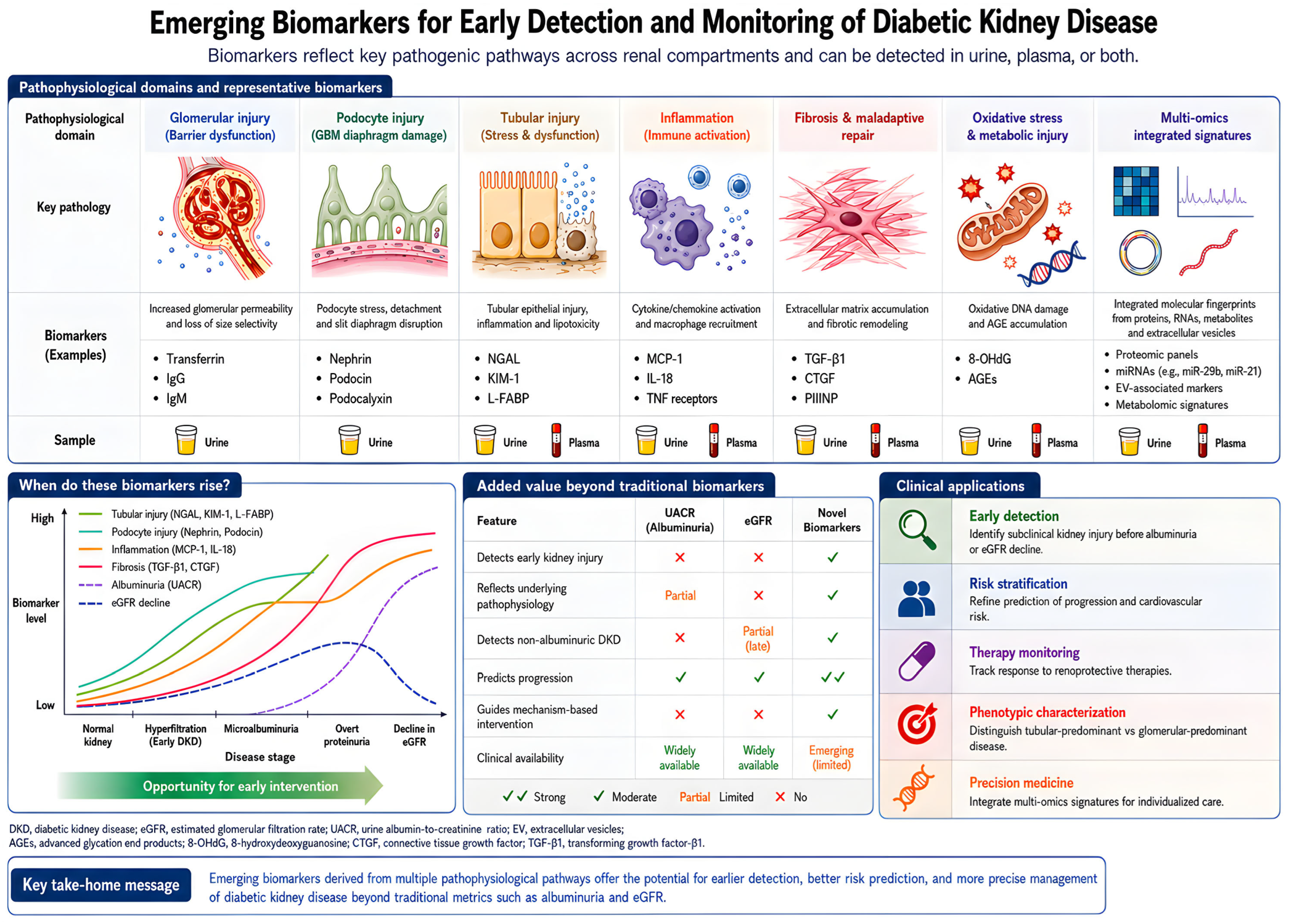
| Feature | Albuminuria (UACR) | eGFR | Emerging Biomarkers |
|---|---|---|---|
| Detection of early kidney injury | Limited | Not sensitive | Improved sensitivity |
| Reflection of pathophysiology | Partial (mainly glomerular) | Functional only | Multi-compartment |
| Detection of non-albuminuric DKD | Absent | Limited (late detection) | Improved |
| Sensitivity to dynamic changes | Moderate | Low | Potentially high |
| Prediction of disease progression | Established | Established | Independent and additive |
| Risk stratification | Established | Established | Enhanced (multimarker approaches) |
| Guidance of mechanism-based therapy | Limited | Limited | Emerging potential |
| Capture of disease heterogeneity | Limited | Limited | Improved |
| Utility for precision medicine | Minimal | Minimal | Exploratory; not yet clinically actionable |
| Clinical availability | Widely available | Widely available | Limited |
5. Emerging Biomarkers in Diabetic Kidney Disease
5.1. Protein and Membrane Biomarkers of Glomerular Filtration Barrier Integrity
5.2. Tubular Injury Biomarkers: Indicators of Early Tubulointerstitial Damage
5.3. Markers of Inflammation and Oxidative Stress
5.4. Markers of Fibrosis and Extracellular Matrix (ECM) Remodeling
5.5. Markers of Oxidative and Metabolic Stress
| Biomarker | Pathway | Sample | Stage Detected | Main Clinical Utility | Evidence Level | Incremental Value Beyond UACR/eGFR | Clinical Readiness | Major Limitation |
|---|---|---|---|---|---|---|---|---|
| Transferrin | Glomerular permeability | Urine | Pre-albuminuria | Early detection of glomerular injury; prediction of incident microalbuminuria | Meta-analysis and longitudinal studies | Uncertain | Emerging clinical candidate | Limited specificity and lack of assay standardization |
| IgG/IgM | Glomerular barrier disruption | Urine | Early–Advanced | Reflect glomerular permeability changes and predict progression | Cohort studies | Limited | Experimental | High biological variability and absence of validated cut-offs |
| Nephrin | Podocyte injury | Urine | Very early | Detection of podocyte injury before overt proteinuria | Cohort studies and systematic review/meta-analysis | Uncertain | Emerging clinical candidate | Assay variability and lack of reference ranges |
| Podocin, Podocalyxin, CD2AP, Synaptopodin | Podocyte injury | Urine | Very early | Detection of podocyte stress and detachment | Small observational studies | Not established | Research-use only | Insufficient longitudinal validation |
| NGAL | Tubular injury | Urine/Plasma | Early–Advanced | Detection of tubular injury; prediction of eGFR decline and DKD progression | Meta-analyses and prospective cohorts | Moderate | Advanced clinical validation | Assay heterogeneity and variable performance in very early disease |
| KIM-1 | Tubular injury | Urine/Plasma | Early | Detection of proximal tubular injury and improved risk stratification | Multiple cohorts and prospective studies | Moderate | Advanced clinical validation | Lack of standardized thresholds and variable effect sizes |
| L-FABP | Tubular stress/hypoxia | Urine | Early | Early detection of tubular stress and prediction of progression | Longitudinal studies and meta-analysis | Moderate | Emerging clinical candidate | Limited external validation |
| TNFR1/TNFR2 | Inflammation/TNF signaling | Plasma | Early–Progressive | Prediction of kidney function decline, ESKD, and mortality | Large prospective cohorts with independent replication | Strong | Near-clinical implementation | Limited standardization and implementation frameworks |
| MCP-1 (CCL2) | Inflammation | Urine/Plasma | Early | Prediction of microalbuminuria and adverse renal outcomes | Cohort studies and ROADMAP analysis | Limited–Moderate | Emerging clinical candidate | Not kidney-specific; influenced by systemic inflammation |
| IL-18 | Inflammasome activation | Urine | Early | Marker of inflammatory kidney injury | Cohort studies and mechanistic evidence | Limited | Experimental | Limited specificity and validation |
| suPAR | Immune activation | Plasma | Early–Progressive | Risk stratification and disease progression assessment | Observational and biopsy-based studies | Limited–Moderate | Emerging clinical candidate | Limited prospective validation |
| TGF-β1 | Fibrosis | Plasma/Urine | Progressive | Reflects profibrotic activity and disease progression | Clinical and biopsy studies | Limited | Experimental | Complex biology and lack of standardized thresholds |
| CTGF | Fibrosis | Plasma/Urine | Advanced | Associated with fibrosis burden and ESKD risk | Clinical association studies | Limited | Experimental | Limited utility for early disease detection |
| Extracellular vesicles | Multi-pathway injury | Urine | Very early | Molecular characterization of renal injury | Exploratory studies | Not established | Research-use only | Lack of standardization and reproducibility |
| Urinary miRNAs/lncRNAs | Epigenetic regulation | Urine | Very early | Early molecular signatures of DKD and precision phenotyping | Exploratory studies and meta-analyses | Not established | Research-use only | Technical variability and normalization challenges |
- UACR and eGFR remain the cornerstone biomarkers for the diagnosis, staging, and monitoring of diabetic kidney disease and should continue to guide routine clinical decision-making.
- TNFR1 and TNFR2 currently show the strongest prognostic evidence among emerging biomarkers, consistently predicting kidney function decline, progression to end-stage kidney disease, and mortality independent of conventional risk factors.
- NGAL and KIM-1 are the most clinically mature tubular injury biomarkers and may provide complementary information on tubulointerstitial injury and disease progression.
- L-FABP, nephrin, transferrin, MCP-1, and suPAR are promising adjunctive biomarkers, but require further multicenter validation, assay harmonization, and demonstration of incremental clinical utility before routine implementation.
- IL-18, TGF-β1, and CTGF remain investigational, with current evidence insufficient to support clinical use outside research settings.
- Podocyte-derived proteins, extracellular vesicles, and urinary non-coding RNAs should currently be considered research-use biomarkers, although they may contribute to future precision-nephrology approaches.
- No emerging biomarker currently has sufficient evidence to replace UACR or eGFR. The most realistic near-term application is incorporation into multimarker risk-stratification models integrating glomerular, tubular, inflammatory, and fibrotic pathways.
- Future research should prioritize assay standardization, external validation across diverse populations, demonstration of cost-effectiveness, and evaluation of clinical utility in biomarker-guided therapeutic strategies.
5.6. Non-Albuminuric Diabetic Kidney Disease: Implications for Biomarker-Based Detection and Risk Stratification
| Biomarker | Evidence Level | Independent Validation | Added Value Beyond UACR/eGFR | Commercial Assay Availability | Clinical Feasibility | Main Limitation | Current Readiness |
|---|---|---|---|---|---|---|---|
| TNFR-1 | High | Multiple cohorts | Strong | Yes | High | Limited biomarker-guided intervention data | Closest to implementation |
| TNFR-2 | High | Multiple cohorts | Strong | Yes | High | Limited biomarker-guided intervention data | Closest to implementation |
| CKD273 | High | Multicenter validation | Strong | Limited availability | Moderate | Cost, accessibility, specialized platform | Advanced validation |
| KIM-1 | Moderate–High | Several cohorts | Moderate | Yes | High | Assay standardization and variable effect size | Emerging |
| NGAL | Moderate | Multiple studies | Moderate | Yes | High | Limited DKD specificity; stage-dependent performance | Emerging |
| L-FABP | Moderate | Several cohorts | Moderate | Limited/region-dependent | Moderate | Limited external validation and assay availability | Emerging |
| suPAR | Moderate | Growing evidence | Moderate | Yes | Moderate | Uncertain DKD specificity; influenced by systemic inflammation | |
| Nephrin | Low–Moderate | Limited replication | Potentially high | Limited | Moderate | Limited replication and assay standardization | Investigational |
| EV-derived biomarkers | Moderate | Limited | Potentially high | No | Low–Moderate | Lack of standardized isolation and analysis methods | Emerging research |
| miRNA panels | Early–Moderate | Limited | Potentially high | No | Low | Reproducibility, normalization, and platform variability | Research stage |
| Metabolomic signatures | Moderate | Several cohorts/meta-analyses | Potentially high | No | Low–Moderate | High analytical complexity and limited DKD specificity | Research stage |
6. From Single Biomarkers to Multi-Omics Signatures in DKD
6.1. MicroRNAs (miRNAs)
6.2. Proteomic Signatures in Diabetic Kidney Disease: Diagnostic, Prognostic, and Therapeutic Implications
6.3. Metabolomic Profiling in Diabetic Kidney Disease: From Molecular Mechanisms to Precision Medicine
| Biomarker/Omics Platform | Representative Biomarkers/Signatures | Primary Biological Processes Represented | Reported Performance and Evidence | Current Interpretation in DKD | Major Constraints and Translational Challenges |
|---|---|---|---|---|---|
| Transcriptomics/RNA analysis | lncRNAs, miR-21, miR-29, miR-192, miR-377 | Control of fibrosis, inflammation, oxidative stress, podocyte injury, endothelial dysfunction and extracellular matrix remodeling. | A recent meta-analysis showed that the sensitivity and specificity of miRNAs for early DKD were 0.76 and 0.74, respectively, and the AUC was 0.79 [208]. Combined miR-192 + miR-29c had sensitivity and specificity of 0.92 and 0.89, respectively, but with limited data [208]. | Mostly used as research-use biomarkers. miR-21 is mechanistically powerful but not DKD-specific. miR-29c and miR-192 seem more promising in combination. | Small and varied studies, multiple sample sources, different RNA extraction and normalization procedures, no consensus cut-offs, low cell-type specificity and uncertain DKD specificity. |
| Proteomics | CKD273 urinary peptide classifier | Remodeling of the extracellular matrix, fibrosis, tubular damage, inflammation and vascular dysfunction. | The most validated urinary proteomics classifier for DKD. In the PRIORITY trial, 1775 type 2 diabetes patients were enrolled to identify patients at increased risk before the onset of microalbuminuria using CKD273 [218,266]. | It is the most clinically advanced omics-based classifier to date, but should be used as an addition to albuminuria, eGFR and clinical risk factors rather than a stand-alone test. | High cost, limited availability of CE-MS, requirement for harmonized processes, variable performance in clinical settings and currently undetermined direct impact on treatment decisions. |
| Proteomics | KRIS inflammatory signature | Chronic inflammation, immunological activation, endothelial dysfunction and gradual renal deterioration. | A total of 17 circulating inflammatory proteins were linked to progressive renal deterioration and ESRD in type 1 and type 2 diabetes [231]. | An important feature of prognostic research. It supports the role of inflammation in DKD progression but is not considered DKD-specific. | Inflammatory proteins may also reflect systemic inflammation, cardiovascular disease, infection or concomitant CKD. Further external confirmation is required. |
| Proteomics | Collagen peptides in urine | Tissue remodeling and renal fibrosis; extracellular matrix turnover. | Urinary collagen-derived peptides have been linked to biopsy-proven renal fibrosis [215]. | Potential non-invasive measure of structural damage and fibrosis burden. In clinical practice, it is typically employed as part of a wider proteomic profile. | It requires specialized platforms, careful bioinformatic interpretation and subsequent validation using histology and long-term renal outcomes. |
| Extracellular vesicles/tubular indicators/proteomics | Urinary exosomal UMOD mRNA and uromodulin | Tubular integrity, tubular stress and early tubular dysfunction. | In 100 participants, Barr et al. reported increased urinary exosomal UMOD mRNA and urinary uromodulin in patients with type 2 diabetes prior to microalbuminuria [232]. | A potential indication of early tubular involvement in kidney disease. It should be described as a research biomarker at this time, not a proven clinical diagnostic. | Small sample size, unclear cut-offs, possible differences among CKD stages and need for prospective validation in other populations. |
| Extracellular vesicles | EV podocyte and tubular cell cargo: mRNA, miRNA, proteins and lipids | Cell-to-cell communication, podocyte injury, tubular stress, inflammation, fibrosis, oxidative stress and cellular healing mechanisms. | Urinary EVs are increasingly explored for liquid biopsy in DKD. The data are robust in a biological sense but largely exploratory [209,232] | Can integrate transcriptomic and proteomic data from kidney cells. Could be valuable for early phenotyping and mechanistic research. | Strong pre-analytical sensitivity: urine collection, hydration, time of day, activity, nutrition, glycosuria, UTI, hematuria, storage, isolation method, RNA extraction and normalization may affect the results. |
| Proteomics | Complement proteins (CFH, C2, C5a, C6, C7) | Activation of complement, inflammation, endothelial injury and immune-mediated kidney damage. | Urinary proteomic data prospectively associated complement proteins with DKD progression, with validation in an independent cohort [228]. | May contribute to the improvement of future prognostic models, especially in patients with inflammatory or complement-related patterns of progression. | Assay standardization, clinical thresholds, disease specificity and integration into routine decision-making are still to be determined. |
| Proteomics | Cathepsin D | Lysosomal dysfunction, tubular stress and tubulointerstitial inflammation. | In type 1 diabetes, urinary cathepsin D peptides and protein levels were correlated with rapid reduction in eGFR and more severe tubulointerstitial inflammation [233]. | Potential indication of a more aggressive tubulointerstitial phenotype of DKD. | Limited large-scale validation, limited specificity and questionable added value over established tubular markers. |
| Metabolomics | TCA metabolites/mitochondrial energy metabolites | Mitochondrial malfunction, energy metabolism alterations, oxidative stress and metabolic reprogramming. | Repeatedly reported in DKD metabolomic investigations, but most signals suggest pathway-level metabolic stress, not a particular DKD-specific molecule [243,244,245]. | Useful for understanding renal metabolic stress and for creating risk panels, particularly when paired with clinical factors. | High biological variability and impact of food, medication, glucose control, renal function and platform differences. |
| Metabolomics | Tryptophan metabolites in the kynurenine pathway | Inflammation, immunological activation, endothelial dysfunction and oxidative stress. | Reported in investigations of DKD and CKD development as part of inflammatory and metabolic markers [247,248,249]. | Potential pathway marker, more valuable for mechanistic interpretation than DKD-specific diagnosis. | Not DKD-specific. May be influenced by systemic inflammation, microbiota activity, reduced renal clearance and comorbidity. |
| Metabolomics | Myo-inositol | Tubular malfunction, osmotic stress and defective glucose-linked metabolism. | Associated with trajectories of eGFR and risk of progression to ESRD in long-term studies [252,253]. | Best viewed as part of a panel of metabolites, not in isolation. Candidate prognostic metabolite. | Must be confirmed in larger and ethnically diverse cohorts. Thresholds and standardization of assays are not well established. |
| Metabolomics | 3-hydroxyisobutyrate, aconitic acid and amino acid metabolites | Amino acid metabolism dysregulation, mitochondrial stress, energy metabolism and systemic metabolic damage. | Related to longitudinal deterioration in renal function and likelihood of progression in cohorts [252,253]. | May add prognostic risk stratification to UACR, eGFR and clinical factors. | These metabolites are not specific for DKD and repeatability across platforms and cohorts remains to be established. |
| Metabolomics/lipidomics | Lipid mediators and lipidomic signatures | Lipotoxicity, mitochondrial damage, inflammation, insulin resistance and endothelial dysfunction. | Integrated omics and machine-learning studies have demonstrated dysregulated lipid metabolism in patients at higher risk for DKD [261,262]. | May help define high-risk metabolic phenotypes and guide future tailored treatment methods. | Difficult interpretation, cost, limited availability, influence of diet and medicines, and need for external validation. |
| Integrated multi-omics strategies | Combined transcriptomic, proteomic, EV-derived, metabolomic, lipidomic, genomic and clinical markers | Inflammation, fibrosis, oxidative stress, endothelial dysfunction, mitochondrial injury, tubular stress and extracellular matrix remodeling. | Multi-omics models can improve molecular phenotyping and risk classification in specific cohorts, but performance depends on data quality, cohort composition and validation technique [258,261,262]. | Currently exploratory; best used for research, cohort enrichment, and hypothesis generation. May contribute to precision-medicine and systems-nephrology frameworks if validated, but is not yet established for this purpose. | High expense, bioinformatic complexity, risk of overfitting, lack of routine clinical applicability and lack of large-scale validation in non-European and varied populations. |
7. Clinical Implications
8. Limitations and Challenges
9. Conclusions, Translational Challenges and Future Directions
Author Contributions
Funding
Data Availability Statement
Acknowledgments
Conflicts of Interest
References
- Rossing, P.; Caramori, M.L.; Chan, J.C.N.; Heerspink, H.J.L.; Hurst, C.; Khunti, K.; Liew, A.; Michos, E.D.; Navaneethan, S.D.; Olowu, W.A.; et al. KDIGO 2022 Clinical Practice Guideline for Diabetes Management in Chronic Kidney Disease. Kidney Int. 2022, 102, S1–S127. [Google Scholar] [CrossRef] [Scilit] [PubMed]
- Tsai, J.-L.; Chen, C.-H.; Wu, M.-J.; Tsai, S.-F. New Approaches to Diabetic Nephropathy from Bed to Bench. Biomedicines 2022, 10, 876. [Google Scholar] [CrossRef] [Scilit] [PubMed]
- Umanath, K.; Lewis, J.B. Update on Diabetic Nephropathy: Core Curriculum 2018. Am. J. Kidney Dis. 2018, 71, 884–895. [Google Scholar] [CrossRef] [Scilit] [PubMed]
- Hang, X.; Ma, J.; Wei, Y.; Wang, Y.; Zang, X.; Xie, P.; Zhang, L.; Zhao, L. Renal Microcirculation and Mechanisms in Diabetic Kidney Disease. Front. Endocrinol. 2025, 16, 1580608. [Google Scholar] [CrossRef] [Scilit] [PubMed]
- American Diabetes Association Professional Practice Committee; ElSayed, N.A.; McCoy, R.G.; Aleppo, G.; Balapattabi, K.; Beverly, E.A.; Briggs Early, K.; Bruemmer, D.; Echouffo-Tcheugui, J.B.; Ekhlaspour, L.; et al. 11. Chronic Kidney Disease and Risk Management: Standards of Care in Diabetes—2025. Diabetes Care 2025, 48, S239–S251. [Google Scholar] [CrossRef] [Scilit] [PubMed]
- The Italian Diabetes Society and the Italian Society of Nephrology; Pugliese, G.; Penno, G.; Natali, A.; Barutta, F.; Di Paolo, S.; Reboldi, G.; Gesualdo, L.; De Nicola, L. Diabetic Kidney Disease: New Clinical and Therapeutic Issues. Joint Position Statement of the Italian Diabetes Society and the Italian Society of Nephrology on “The Natural History of Diabetic Kidney Disease and Treatment of Hyperglycemia in Patients with Type 2 Diabetes and Impaired Renal Function”. J. Nephrol. 2020, 33, 9–35. [Google Scholar] [CrossRef] [Scilit] [PubMed]
- Kaygusuz, Y.; Özbek, D.A.; Erdut, A.; Abanoz, R.; Korkut, M.G.; Özdede, M.; Uyaroğlu, O.A.; Özmen, F.; Yeter, H.H.; Yıldırım, T.; et al. Urinary Biomarker Profiles Define Divergent Pathways in Albuminuric and Non-Albuminuric Diabetic Kidney Disease. Kidney Dis. 2026, 12, 330–345. [Google Scholar] [CrossRef] [Scilit] [PubMed]
- Sinha, S.K.; Nicholas, S.B. Pathomechanisms of Diabetic Kidney Disease. J. Clin. Med. 2023, 12, 7349. [Google Scholar] [CrossRef] [Scilit] [PubMed]
- Barrera-Chimal, J.; Jaisser, F. Pathophysiologic Mechanisms in Diabetic Kidney Disease: A Focus on Current and Future Therapeutic Targets. Diabetes Obes. Metab. 2020, 22, 16–31. [Google Scholar] [CrossRef] [Scilit] [PubMed]
- Lassén, E.; Daehn, I.S. Molecular Mechanisms in Early Diabetic Kidney Disease: Glomerular Endothelial Cell Dysfunction. Int. J. Mol. Sci. 2020, 21, 9456. [Google Scholar] [CrossRef] [Scilit] [PubMed]
- Wang, Y.; Wang, J.; Chen, H. Risk Stratification in Diabetic Kidney Disease: A Review of Prediction Models for Methodological Advances and Clinical Application. J. Transl. Med. 2026, 24, 326. [Google Scholar] [CrossRef] [Scilit] [PubMed]
- Soltani-Fard, E.; Taghvimi, S.; Karimi, F.; Vahedi, F.; Khatami, S.H.; Behrooj, H.; Deylami Hayati, M.; Movahedpour, A.; Ghasemi, H. Urinary Biomarkers in Diabetic Nephropathy. Clin. Chim. Acta 2024, 561, 119762. [Google Scholar] [CrossRef] [Scilit] [PubMed]
- Zhang, H.; Wang, K.; Zhao, H.; Qin, B.; Cai, X.; Wu, M.; Li, J.; Wang, J. Diabetic Kidney Disease: From Pathogenesis to Multimodal Therapy–Current Evidence and Future Directions. Front. Med. 2025, 12, 1631053. [Google Scholar] [CrossRef] [Scilit] [PubMed]
- Ratan, Y.; Rajput, A.; Pareek, A.; Pareek, A.; Singh, G. Comprehending the Role of Metabolic and Hemodynamic Factors Alongside Different Signaling Pathways in the Pathogenesis of Diabetic Nephropathy. Int. J. Mol. Sci. 2025, 26, 3330. [Google Scholar] [CrossRef] [Scilit] [PubMed]
- Yuan, X.; Jia, M.; Zhou, L.; Hou, G.; Zhang, B.; Ouyang, X.; Huang, Y. The Endothelial Glycocalyx: The First Line of Defense in the Prevention and Treatment of Kidney Diseases. Kidney Med. 2025, 7, 101122. [Google Scholar] [CrossRef] [Scilit] [PubMed]
- Ćurko-Cofek, B.; Jenko, M.; Taleska Stupica, G.; Batičić, L.; Krsek, A.; Batinac, T.; Ljubačev, A.; Zdravković, M.; Knežević, D.; Šoštarič, M.; et al. The Crucial Triad: Endothelial Glycocalyx, Oxidative Stress, and Inflammation in Cardiac Surgery—Exploring the Molecular Connections. Int. J. Mol. Sci. 2024, 25, 10891. [Google Scholar] [CrossRef] [Scilit] [PubMed]
- Thomas, H.Y.; Ford Versypt, A.N. Pathophysiology of Mesangial Expansion in Diabetic Nephropathy: Mesangial Structure, Glomerular Biomechanics, and Biochemical Signaling and Regulation. J. Biol. Eng. 2022, 16, 19. [Google Scholar] [CrossRef] [Scilit] [PubMed]
- Doumani, G.; Theofilis, P.; Vordoni, A.; Thymis, V.; Liapis, G.; Smirloglou, D.; Kalaitzidis, R.G. Diabetic Kidney Disease: From Pathophysiology to Regression of Albuminuria and Kidney Damage: Is It Possible? Int. J. Mol. Sci. 2025, 26, 8224. [Google Scholar] [CrossRef] [Scilit] [PubMed]
- Liu, S.; Yuan, Y.; Xue, Y.; Xing, C.; Zhang, B. Podocyte Injury in Diabetic Kidney Disease: A Focus on Mitochondrial Dysfunction. Front. Cell Dev. Biol. 2022, 10, 832887. [Google Scholar] [CrossRef] [Scilit] [PubMed]
- Lin, Y.; Tian, J. Research on Podocyte Injury Mechanisms in Diabetic Nephropathy: A Bibliometric and Knowledge-Map Analysis from 2000 to 2024. Front. Endocrinol. 2025, 16, 1578045. [Google Scholar] [CrossRef] [Scilit] [PubMed]
- Geng, J.; Ma, S.; Tang, H.; Zhang, C. Pathogenesis and Therapeutic Perspectives of Tubular Injury in Diabetic Kidney Disease: An Update. Biomedicines 2025, 13, 1424. [Google Scholar] [CrossRef] [Scilit] [PubMed]
- Satirapoj, B. Tubulointerstitial Biomarkers for Diabetic Nephropathy. J. Diabetes Res. 2018, 2018, 2852398. [Google Scholar] [CrossRef] [Scilit] [PubMed]
- Fiseha, T.; Tamir, Z. Urinary Markers of Tubular Injury in Early Diabetic Nephropathy. Int. J. Nephrol. 2016, 2016, 4647685. [Google Scholar] [CrossRef] [Scilit] [PubMed]
- Yan, L.-J. NADH/NAD+ Redox Imbalance and Diabetic Kidney Disease. Biomolecules 2021, 11, 730. [Google Scholar] [CrossRef] [Scilit] [PubMed]
- Jin, Q.; Liu, T.; Qiao, Y.; Liu, D.; Yang, L.; Mao, H.; Ma, F.; Wang, Y.; Peng, L.; Zhan, Y. Oxidative Stress and Inflammation in Diabetic Nephropathy: Role of Polyphenols. Front. Immunol. 2023, 14, 1185317. [Google Scholar] [CrossRef] [Scilit] [PubMed]
- Liu, X.; Zhang, C.; Fu, Y.; Xie, L.; Kong, Y.; Yang, X. Inflammation, Apoptosis, and Fibrosis in Diabetic Nephropathy: Molecular Crosstalk in Proximal Tubular Epithelial Cells and Therapeutic Implications. Curr. Issues Mol. Biol. 2025, 47, 885. [Google Scholar] [CrossRef] [Scilit] [PubMed]
- Kato, M.; Natarajan, R. Epigenetics and Epigenomics in Diabetic Kidney Disease and Metabolic Memory. Nat. Rev. Nephrol. 2019, 15, 327–345. [Google Scholar] [CrossRef] [Scilit] [PubMed]
- Kushwaha, K.; Sharma, S.; Gupta, J. Metabolic Memory and Diabetic Nephropathy: Beneficial Effects of Natural Epigenetic Modifiers. Biochimie 2020, 170, 140–151. [Google Scholar] [CrossRef] [Scilit] [PubMed]
- Maiti, A.K. Development of Biomarkers and Molecular Therapy Based on Inflammatory Genes in Diabetic Nephropathy. Int. J. Mol. Sci. 2021, 22, 9985. [Google Scholar] [CrossRef] [Scilit] [PubMed]
- Jang, C.M.; Hyun, Y.Y.; Lee, K.B.; Kim, H. Insulin Resistance Is Associated with the Development of Albuminuria in Korean Subjects without Diabetes. Endocrine 2015, 48, 203–210. [Google Scholar] [CrossRef] [Scilit] [PubMed]
- Claudel, S.E.; Verma, A. Albuminuria in Cardiovascular, Kidney, and Metabolic Disorders: A State-of-the-Art Review. Circulation 2025, 151, 716–732. [Google Scholar] [CrossRef] [Scilit] [PubMed]
- Mori, K.P.; Yokoi, H.; Kasahara, M.; Imamaki, H.; Ishii, A.; Kuwabara, T.; Koga, K.; Kato, Y.; Toda, N.; Ohno, S.; et al. Increase of Total Nephron Albumin Filtration and Reabsorption in Diabetic Nephropathy. J. Am. Soc. Nephrol. 2017, 28, 278–289. [Google Scholar] [CrossRef] [Scilit] [PubMed]
- Gembillo, G.; Soraci, L.; Messina, R.; Lo Cicero, L.; Spadaro, G.; Cuzzola, F.; Calderone, M.; Ricca, M.F.; Di Piazza, S.; Sudano, F.; et al. Urinary Biomarkers of Diabetic Kidney Disease. World J. Diabetes 2026, 17, 110502. [Google Scholar] [CrossRef] [Scilit] [PubMed]
- Böger, C.A.; Chen, M.-H.; Tin, A.; Olden, M.; Köttgen, A.; de Boer, I.H.; Fuchsberger, C.; O’Seaghdha, C.M.; Pattaro, C.; Teumer, A.; et al. CUBN Is a Gene Locus for Albuminuria. J. Am. Soc. Nephrol. 2011, 22, 555–570. [Google Scholar] [CrossRef] [Scilit] [PubMed]
- García-Carro, C.; Vergara, A.; Bermejo, S.; Azancot, M.A.; Sánchez-Fructuoso, A.I.; Sánchez de la Nieta, M.D.; Agraz, I.; Soler, M.J. How to Assess Diabetic Kidney Disease Progression? From Albuminuria to GFR. J. Clin. Med. 2021, 10, 2505. [Google Scholar] [CrossRef] [Scilit] [PubMed]
- Shi, S.; Ni, L.; Gao, L.; Wu, X. Comparison of Nonalbuminuric and Albuminuric Diabetic Kidney Disease Among Patients With Type 2 Diabetes: A Systematic Review and Meta-Analysis. Front. Endocrinol. 2022, 13, 871272. [Google Scholar] [CrossRef] [Scilit] [PubMed]
- Fernando, K.; Connolly, D.; Darcy, E.; Evans, M.; Hinchliffe, W.; Holmes, P.; Strain, W.D. Advancing Cardiovascular, Kidney, and Metabolic Medicine: A Narrative Review of Insights and Innovations for the Future. Diabetes Ther. 2025, 16, 1155–1176. [Google Scholar] [CrossRef] [Scilit] [PubMed]
- Cho, S.; Huh, H.; Park, S.; Lee, S.; Jung, S.; Kim, M.; Lee, K.-N.; Paek, J.H.; Park, W.Y.; Jin, K.; et al. Impact of Albuminuria on the Various Causes of Death in Diabetic Patients: A Nationwide Population-Based Study. Sci. Rep. 2023, 13, 295. [Google Scholar] [CrossRef] [Scilit] [PubMed]
- De Boer, I.H.; Khunti, K.; Sadusky, T.; Tuttle, K.R.; Neumiller, J.J.; Rhee, C.M.; Rosas, S.E.; Rossing, P.; Bakris, G. Diabetes Management in Chronic Kidney Disease: A Consensus Report by the American Diabetes Association (ADA) and Kidney Disease: Improving Global Outcomes (KDIGO). Diabetes Care 2022, 45, 3075–3090. [Google Scholar] [CrossRef] [Scilit] [PubMed]
- Medina-Urrutia, A.; Juárez-Rojas, J.G.; Posadas-Sánchez, R.; Jorge-Galarza, E.; Cardoso-Saldaña, G.; Vargas-Alarcón, G.; Martínez-Alvarado, R.; Posadas-Romero, C. Microalbuminuria and Its Association with Subclinical Atherosclerosis in the Mexican Mestizo Population: The GEA Study. Rev. Investig. Clin. 2016, 68, 262–268. [Google Scholar] [CrossRef] [Scilit]
- Raja, P.; Maxwell, A.P.; Brazil, D.P. The Potential of Albuminuria as a Biomarker of Diabetic Complications. Cardiovasc. Drugs Ther. 2021, 35, 455–466. [Google Scholar] [CrossRef] [Scilit] [PubMed]
- Goto, H.; Takamura, T. Metabolic Dysfunction-Associated Steatotic Liver Disease Complicated by Diabetes: Pathophysiology and Emerging Therapies. J. Obes. Metab. Syndr. 2025, 34, 224–238. [Google Scholar] [CrossRef] [Scilit] [PubMed]
- Chen, D.; Yan, L.; Wu, T.; Zhao, J.; Xu, X.; Xu, W.; Zhang, H.; Xiao, M. Current Status of Research on the Risk Factors and Pathogenesis of Metabolic Dysfunction-Associated Steatotic Liver Disease. Front. Endocrinol. 2026, 17, 1819756. [Google Scholar] [CrossRef] [Scilit] [PubMed]
- Zhu, P.; Lewington, S.; Haynes, R.; Emberson, J.; Landray, M.J.; Cherney, D.; Woodward, M.; Baigent, C.; Herrington, W.G.; Staplin, N. Cross-Sectional Associations between Central and General Adiposity with Albuminuria: Observations from 400,000 People in UK Biobank. Int. J. Obes. 2020, 44, 2256–2266. [Google Scholar] [CrossRef] [Scilit] [PubMed]
- Qin, Z.; Chang, K.; Yang, Q.; Yu, Q.; Liao, R.; Su, B. The Association between Weight-Adjusted-Waist Index and Increased Urinary Albumin Excretion in Adults: A Population-Based Study. Front. Nutr. 2022, 9, 941926. [Google Scholar] [CrossRef] [Scilit] [PubMed]
- Lin, W.-Y.; Pi-Sunyer, F.X.; Liu, C.-S.; Li, C.-I.; Davidson, L.E.; Li, T.-C.; Lin, C.-C. Central Obesity and Albuminuria: Both Cross-Sectional and Longitudinal Studies in Chinese. PLoS ONE 2012, 7, e47960. [Google Scholar] [CrossRef] [Scilit] [PubMed]
- Chandie Shaw, P.K.; Berger, S.P.; Mallat, M.; Frölich, M.; Dekker, F.W.; Rabelink, T.J. Central Obesity Is an Independent Risk Factor for Albuminuria in Nondiabetic South Asian Subjects. Diabetes Care 2007, 30, 1840–1844. [Google Scholar] [CrossRef] [Scilit] [PubMed]
- Kambham, N.; Markowitz, G.S.; Valeri, A.M.; Lin, J.; D’Agati, V.D. Obesity-Related Glomerulopathy: An Emerging Epidemic. Kidney Int. 2001, 59, 1498–1509. [Google Scholar] [CrossRef] [Scilit] [PubMed]
- Moriconi, D.; Mengozzi, A.; Duranti, E.; Cappelli, F.; Taddei, S.; Nannipieri, M.; Bruno, R.M.; Virdis, A. The Renal Resistive Index Is Associated with Microvascular Remodeling in Patients with Severe Obesity. J. Hypertens. 2023, 41, 1092–1099. [Google Scholar] [CrossRef] [Scilit] [PubMed]
- Han, F.; Hou, N.; Miao, W.; Sun, X. Correlation of Ultrasonographic Measurement of Intrarenal Arterial Resistance Index with Microalbuminuria in Nonhypertensive, Nondiabetic Obese Patients. Int. Urol. Nephrol. 2013, 45, 1039–1045. [Google Scholar] [CrossRef] [Scilit] [PubMed]
- Calabia, J.; Torguet, P.; Garcia, I.; Martin, N.; Mate, G.; Marin, A.; Molina, C.; Valles, M. The Relationship Between Renal Resistive Index, Arterial Stiffness, and Atherosclerotic Burden: The Link Between Macrocirculation and Microcirculation. J. Clin. Hypertens. 2014, 16, 186–191. [Google Scholar] [CrossRef] [Scilit] [PubMed]
- Li, X.; Xia, M.; Ma, H.; Hu, Y.; Yan, H.; He, W.; Lin, H.; Zhao, N.Q.; Gao, J.; Gao, X. Liver Fat Content Is Independently Associated with Microalbuminuria in a Normotensive, Euglycaemic Chinese Population: A Community-Based, Cross-Sectional Study. BMJ Open 2021, 11, e044237. [Google Scholar] [CrossRef] [Scilit] [PubMed]
- Wijarnpreecha, K.; Thongprayoon, C.; Boonpheng, B.; Panjawatanan, P.; Sharma, K.; Ungprasert, P.; Pungpapong, S.; Cheungpasitporn, W. Nonalcoholic Fatty Liver Disease and Albuminuria: A Systematic Review and Meta-Analysis. Eur. J. Gastroenterol. Hepatol. 2018, 30, 986–994. [Google Scholar] [CrossRef] [Scilit] [PubMed]
- Buchwinkler, L.; Keller, F.; Thöni, S.; Eder, S.; Mayer, G. Variability and Misclassification of Albuminuria in Patients with Type 2 Diabetes Mellitus. Sci. Rep. 2025, 15, 19785. [Google Scholar] [CrossRef] [Scilit] [PubMed]
- Résimont, G.; Cavalier, E.; Radermecker, R.P.; Delanaye, P. Albuminuria in Diabetic Patients: How to Measure It?—A Narrative Review. J. Lab. Precis. Med. 2022, 7, 4. [Google Scholar] [CrossRef] [Scilit]
- Panteghini, M.; Wielgosz, R.; Miller, W.G. A Comprehensive Analysis of Metrological Traceability Tools for Urine Albumin Measurements. Clin. Chem. 2026, 72, 535–545. [Google Scholar] [CrossRef] [Scilit] [PubMed]
- Bjornstad, P.; Cherney, D.Z.; Maahs, D.M. Update on Estimation of Kidney Function in Diabetic Kidney Disease. Curr. Diab. Rep. 2015, 15, 57. [Google Scholar] [CrossRef] [Scilit] [PubMed]
- Qin, Y.; Zhang, S.; Shen, X.; Zhang, S.; Wang, J.; Zuo, M.; Cui, X.; Gao, Z.; Yang, J.; Zhu, H.; et al. Evaluation of Urinary Biomarkers for Prediction of Diabetic Kidney Disease: A Propensity Score Matching Analysis. Ther. Adv. Endocrinol. 2019, 10, 2042018819891110. [Google Scholar] [CrossRef] [Scilit] [PubMed]
- Li, B.; Wang, J.; Ye, W. A Meta-Analysis of Urinary Transferrin for Early Diagnosis of Diabetic Nephropathy. Lab. Med. 2024, 55, 413–419. [Google Scholar] [CrossRef] [Scilit] [PubMed]
- Cohen-Bucay, A.; Viswanathan, G. Urinary Markers of Glomerular Injury in Diabetic Nephropathy. Int. J. Nephrol. 2012, 2012, 146987. [Google Scholar] [CrossRef] [Scilit] [PubMed]
- Kanauchi, M.; Nishioka, H.; Hashimoto, T.; Dohi, K. Diagnostic Significance of Urinary Transferrin in Diabetic Nephropathy. Nihon Jinzo Gakkai Shi 1995, 37, 649–654. [Google Scholar] [PubMed]
- Ma, Y.; Cai, J.; Wang, Y.; Liu, J.; Fu, S. Non-Enzymatic Glycation of Transferrin and Diabetes Mellitus. Diabetes Metab. Syndr. Obes. 2021, 14, 2539–2548. [Google Scholar] [CrossRef] [Scilit] [PubMed]
- Mohan, S.; Kalia, K.; Mannari, J. Association Between Urinary IgG and Relative Risk for Factors Affecting Proteinuria in Type 2 Diabetic Patients. Ind. J. Clin. Biochem. 2012, 27, 333–339. [Google Scholar] [CrossRef] [Scilit] [PubMed]
- Meng, C.; Chen, J.; Sun, X.; Guan, S.; Zhu, H.; Qin, Y.; Wang, J.; Li, Y.; Yang, J.; Chang, B. Urine Immunoglobin G Greater Than 2.45 Mg/L Has a Correlation with the Onset and Progression of Diabetic Kidney Disease: A Retrospective Cohort Study. J. Pers. Med. 2023, 13, 452. [Google Scholar] [CrossRef] [Scilit] [PubMed]
- Tofik, R.; Torffvit, O.; Rippe, B.; Bakoush, O. Urine IgM-Excretion as a Prognostic Marker for Progression of Type 2 Diabetic Nephropathy. Diabetes Res. Clin. Pract. 2012, 95, 139–144. [Google Scholar] [CrossRef] [Scilit] [PubMed]
- Gohda, T.; Walker, W.H.; Wolkow, P.; Lee, J.E.; Warram, J.H.; Krolewski, A.S.; Niewczas, M.A. Elevated Urinary Excretion of Immunoglobulins in Nonproteinuric Patients with Type 1 Diabetes. Am. J. Physiol. Ren. Physiol. 2012, 303, F157–F162. [Google Scholar] [CrossRef] [Scilit] [PubMed]
- Narita, T. Increased Urinary Excretions of Immunoglobulin G, Ceruloplasmin, and Transferrin Predict Development of Microalbuminuria in Patients With Type 2 Diabetes. Diabetes Care 2006, 29, 142–144. [Google Scholar] [CrossRef] [Scilit] [PubMed]
- Narita, T.; Sasaki, H.; Hosoba, M.; Miura, T.; Yoshioka, N.; Morii, T.; Shimotomai, T.; Koshimura, J.; Fujita, H.; Kakei, M.; et al. Parallel Increase in Urinary Excretion Rates of Immunoglobulin G, Ceruloplasmin, Transferrin, and Orosomucoid in Normoalbuminuric Type 2 Diabetic Patients. Diabetes Care 2004, 27, 1176–1181. [Google Scholar] [CrossRef] [Scilit] [PubMed]
- Barutta, F.; Bellini, S.; Gruden, G. Mechanisms of Podocyte Injury and Implications for Diabetic Nephropathy. Clin. Sci. 2022, 136, 493–520. [Google Scholar] [CrossRef] [Scilit] [PubMed]
- Chen, X.; Wang, J.; Lin, Y.; Liu, Y.; Zhou, T. Signaling Pathways of Podocyte Injury in Diabetic Kidney Disease and the Effect of Sodium-Glucose Cotransporter 2 Inhibitors. Cells 2022, 11, 3913. [Google Scholar] [CrossRef] [Scilit] [PubMed]
- Kobayashi, T.; Matsumoto, T.; Kamata, K. The PI3-K/Akt Pathway: Roles Related to Alterations in Vasomotor Responses in Diabetic Models. J. Smooth Muscle Res. 2005, 41, 283–302. [Google Scholar] [CrossRef] [Scilit] [PubMed]
- Ren, Q.; You Yu, S. CD2-Associated Protein Participates in Podocyte Apoptosis via PI3K/Akt Signaling Pathway. J. Recept. Signal Transduct. Res. 2016, 36, 288–291. [Google Scholar] [CrossRef] [Scilit] [PubMed]
- Huang, C.; Zhang, Y.; Kelly, D.J.; Tan, C.Y.R.; Gill, A.; Cheng, D.; Braet, F.; Park, J.-S.; Sue, C.M.; Pollock, C.A.; et al. Thioredoxin Interacting Protein (TXNIP) Regulates Tubular Autophagy and Mitophagy in Diabetic Nephropathy through the mTOR Signaling Pathway. Sci. Rep. 2016, 6, 29196. [Google Scholar] [CrossRef] [Scilit] [PubMed]
- Martin, C.E.; Jones, N. Nephrin Signaling in the Podocyte: An Updated View of Signal Regulation at the Slit Diaphragm and Beyond. Front. Endocrinol. 2018, 9, 302. [Google Scholar] [CrossRef] [Scilit] [PubMed]
- Wang, N.; Zhang, C. Oxidative Stress: A Culprit in the Progression of Diabetic Kidney Disease. Antioxidants 2024, 13, 455. [Google Scholar] [CrossRef] [Scilit] [PubMed]
- Mesfine, B.B.; Vojisavljevic, D.; Kapoor, R.; Watson, D.; Kandasamy, Y.; Rudd, D. Urinary Nephrin: A Potential Biomarker of Early Glomerular Injury in a Cohort of Pregnant Women Attending Routine Antenatal Care Services. Int. J. Nephrol. 2024, 2024, 9089557. [Google Scholar] [CrossRef] [Scilit] [PubMed]
- Elhammady, A.M.; ELShafie, H.S.; El Fallah, A.A.; Khalil, M.A. Serum suPAR and Urinary Nephrin as Novel Sensitive and Specific Markers for Diabetic Nephropathy in Patients with Type 2 DM. Egypt. J. Hosp. Med. 2023, 91, 4373–4379. [Google Scholar] [CrossRef] [Scilit]
- Kostovska, I.; Trajkovska, T.; Topuzovska, S.; Cekovska, S.; Spasovski, G.; Kostovski, O.; Labudovic, D. Urinary Nephrin Is Earlier, More Sensitive and Specific Marker of Diabetic Nephropathy than Microalbuminuria. J. Med. Biochem. 2019, 39, 83–90. [Google Scholar] [CrossRef] [Scilit] [PubMed]
- Sateesh, R.; Shashidhar, K.N. Urinary Nephrin—An Emerging Novel Biomarker in Early Detection of Diabetic Nephropathy: A Review. Bioinformation 2025, 21, 3123–3129. [Google Scholar] [CrossRef] [Scilit] [PubMed]
- Kravets, I.; Mallipattu, S.K. The Role of Podocytes and Podocyte-Associated Biomarkers in Diagnosis and Treatment of Diabetic Kidney Disease. J. Endocr. Soc. 2020, 4, bvaa029. [Google Scholar] [CrossRef] [Scilit] [PubMed]
- Veluri, G.; Mannangatti, M. Urinary Nephrin Is a Sensitive Marker to Predict Early Onset of Nephropathy in Type 2 Diabetes Mellitus. J. Lab. Physicians 2022, 14, 497–504. [Google Scholar] [CrossRef] [Scilit] [PubMed]
- do Nascimento, J.F.; Canani, L.H.; Gerchman, F.; Rodrigues, P.G.; Joelsons, G.; dos Santos, M.; Pereira, S.; Veronese, F.V. Messenger RNA Levels of Podocyte-Associated Proteins in Subjects with Different Degrees of Glucose Tolerance with or without Nephropathy. BMC Nephrol. 2013, 14, 214. [Google Scholar] [CrossRef] [Scilit] [PubMed]
- Jim, B.; Ghanta, M.; Qipo, A.; Fan, Y.; Chuang, P.Y.; Cohen, H.W.; Abadi, M.; Thomas, D.B.; He, J.C. Dysregulated Nephrin in Diabetic Nephropathy of Type 2 Diabetes: A Cross Sectional Study. PLoS ONE 2012, 7, e36041. [Google Scholar] [CrossRef] [Scilit] [PubMed]
- Rangaswamaiah, H.; Somashekar, P.; Setty, R.G.N.; Ganesh, V. Urinary Nephrin Linked Nephropathy in Type-2 Diabetes Mellitus. Bioinformation 2022, 18, 1131–1135. [Google Scholar] [CrossRef] [Scilit] [PubMed]
- Zeng, L.; Fung, W.W.-S.; Chan, G.C.-K.; Ng, J.K.-C.; Chow, K.-M.; Szeto, C.-C. Urinary and Kidney Podocalyxin and Podocin Levels in Diabetic Kidney Disease: A Kidney Biopsy Study. Kidney Med. 2023, 5, 100569. [Google Scholar] [CrossRef] [Scilit] [PubMed]
- Mesfine, B.B.; Vojisavljevic, D.; Kapoor, R.; Watson, D.; Kandasamy, Y.; Rudd, D. Urinary Nephrin-a Potential Marker of Early Glomerular Injury: A Systematic Review and Meta-Analysis. J. Nephrol. 2024, 37, 39–51. [Google Scholar] [CrossRef] [Scilit] [PubMed]
- Ma, S.; Qiu, Y.; Zhang, C. Cytoskeleton Rearrangement in Podocytopathies: An Update. Int. J. Mol. Sci. 2024, 25, 647. [Google Scholar] [CrossRef] [Scilit] [PubMed]
- Gholaminejad, A.; Abdul Tehrani, H.; Gholami Fesharaki, M. Identification of Candidate microRNA Biomarkers in Diabetic Nephropathy: A Meta-Analysis of Profiling Studies. J. Nephrol. 2018, 31, 813–831. [Google Scholar] [CrossRef] [Scilit] [PubMed]
- Wan, X.; Liao, J.; Lai, H.; Zhang, S.; Cui, J.; Chen, C. Roles of microRNA-192 in Diabetic Nephropathy: The Clinical Applications and Mechanisms of Action. Front. Endocrinol. 2023, 14, 1179161. [Google Scholar] [CrossRef] [Scilit] [PubMed]
- Olatunde, A.; Saravanan, K.; Ogunro, O.B.; Obidola, M.S.; Jakwa, A.; Lawal, A.; Shittu, A.A.; Tijjani, H.; Umar, H.; Ozsahin, D.U.; et al. Insights into Diabetic Nephropathy Biomarkers with Focus on Existing Indices and Potential Future Developments. Discov. Med. 2025, 2, 121. [Google Scholar] [CrossRef] [Scilit]
- Li, C.; Ng, J.K.C.; Chan, G.C.K.; Fung, W.W.S.; Chow, K.-M.; Szeto, C.-C. The Effect of SGLT2 Inhibitor and HIF-PHI on the Podocyte-Specific Molecules and Cytoskeleton of Diabetic Podocytes. BMC Nephrol. 2025, 27, 31. [Google Scholar] [CrossRef] [Scilit] [PubMed]
- Li, X.; Li, Q.; Jiang, X.; Song, S.; Zou, W.; Yang, Q.; Liu, S.; Chen, S.; Wang, C. Inhibition of SGLT2 Protects Podocytes in Diabetic Kidney Disease by Rebalancing Mitochondria-Associated Endoplasmic Reticulum Membranes. Cell Commun. Signal. 2024, 22, 534. [Google Scholar] [CrossRef] [Scilit] [PubMed]
- Upadhyay, A. SGLT2 Inhibitors and Kidney Protection: Mechanisms Beyond Tubuloglomerular Feedback. Kidney360 2024, 5, 771–782. [Google Scholar] [CrossRef] [Scilit] [PubMed]
- Kogot-Levin, A.; Hinden, L.; Riahi, Y.; Israeli, T.; Tirosh, B.; Cerasi, E.; Mizrachi, E.B.; Tam, J.; Mosenzon, O.; Leibowitz, G. Proximal Tubule mTORC1 Is a Central Player in the Pathophysiology of Diabetic Nephropathy and Its Correction by SGLT2 Inhibitors. Cell Rep. 2020, 32, 107954. [Google Scholar] [CrossRef] [Scilit] [PubMed]
- El-Sayed, N.; Mostafa, Y.M.; AboGresha, N.M.; Ahmed, A.A.M.; Mahmoud, I.Z.; El-Sayed, N.M. Dapagliflozin Attenuates Diabetic Cardiomyopathy through Erythropoietin Up-Regulation of AKT/JAK/MAPK Pathways in Streptozotocin-Induced Diabetic Rats. Chem. Biol. Interact. 2021, 347, 109617. [Google Scholar] [CrossRef] [Scilit] [PubMed]
- Wang, Y.; Jin, M.; Cheng, C.K.; Li, Q. Tubular Injury in Diabetic Kidney Disease: Molecular Mechanisms and Potential Therapeutic Perspectives. Front. Endocrinol. 2023, 14, 1238927. [Google Scholar] [CrossRef] [Scilit] [PubMed]
- Bolignano, D.; Lacquaniti, A.; Coppolino, G.; Donato, V.; Fazio, M.R.; Nicocia, G.; Buemi, M. Neutrophil Gelatinase-Associated Lipocalin as an Early Biomarker of Nephropathy in Diabetic Patients. Kidney Blood Press. Res. 2009, 32, 91–98. [Google Scholar] [CrossRef] [Scilit] [PubMed]
- Romejko, K.; Markowska, M.; Niemczyk, S. The Review of Current Knowledge on Neutrophil Gelatinase-Associated Lipocalin (NGAL). Int. J. Mol. Sci. 2023, 24, 10470. [Google Scholar] [CrossRef] [Scilit] [PubMed]
- Kaul, A.; Behera, M.; Rai, M.; Mishra, P.; Bhaduaria, D.; Yadav, S.; Agarwal, V.; Karoli, R.; Prasad, N.; Gupta, A.; et al. Neutrophil Gelatinase-Associated Lipocalin: As a Predictor of Early Diabetic Nephropathy in Type 2 Diabetes Mellitus. Indian J. Nephrol. 2018, 28, 53–60. [Google Scholar] [CrossRef] [Scilit] [PubMed]
- Greco, M.; Chiefari, E.; Mirabelli, M.; Salatino, A.; Tocci, V.; Cianfrone, P.; Foti, D.P.; Brunetti, A. Plasma or Urine Neutrophil Gelatinase-Associated Lipocalin (NGAL): Which Is Better at Detecting Chronic Kidney Damage in Type 2 Diabetes? Endocrines 2022, 3, 175–186. [Google Scholar] [CrossRef] [Scilit]
- Tang, X.-Y.; Zhou, J.-B.; Luo, F.-Q.; Han, Y.-P.; Zhao, W.; Diao, Z.-L.; Li, M.; Qi, L.; Yang, J.-K. Urine NGAL as an Early Biomarker for Diabetic Kidney Disease: Accumulated Evidence from Observational Studies. Ren. Fail. 2019, 41, 446–454. [Google Scholar] [CrossRef] [Scilit] [PubMed]
- Huang, Y.; Craig Don-Wauchope, A. The Clinical Utility of Kidney Injury Molecule 1 in the Prediction, Diagnosis and Prognosis of Acute Kidney Injury: A Systematic Review. Inflamm. Allergy-Drug Targets 2011, 10, 260–271. [Google Scholar] [CrossRef] [Scilit] [PubMed]
- Duan, S.; Chen, J.; Wu, L.; Nie, G.; Sun, L.; Zhang, C.; Huang, Z.; Xing, C.; Zhang, B.; Yuan, Y. Assessment of Urinary NGAL for Differential Diagnosis and Progression of Diabetic Kidney Disease. J. Diabetes Its Complicat. 2020, 34, 107665. [Google Scholar] [CrossRef] [Scilit] [PubMed]
- Chou, K.-M.; Lee, C.-C.; Chen, C.-H.; Sun, C.-Y. Clinical Value of NGAL, L-FABP and Albuminuria in Predicting GFR Decline in Type 2 Diabetes Mellitus Patients. PLoS ONE 2013, 8, e54863. [Google Scholar] [CrossRef] [Scilit] [PubMed]
- Swaminathan, S.M.; Bhojaraja, M.V.; Rao, I.R.; Prabhu, A.R.; Kaniyoor Nagri, S.; Rangaswamy, D.; Shenoy, S.V.; Shetty, S.; Maradi, R.; Gupta, A.; et al. Role of Novel Biomarkers Urinary NGAL and MCP-1 in Predicting Progression of Diabetic Kidney Disease in Type 2 DM. Ren. Fail. 2025, 47, 2563671. [Google Scholar] [CrossRef] [Scilit] [PubMed]
- Satirapoj, B.; Pooluea, P.; Nata, N.; Supasyndh, O. Urinary Biomarkers of Tubular Injury to Predict Renal Progression and End Stage Renal Disease in Type 2 Diabetes Mellitus with Advanced Nephropathy: A Prospective Cohort Study. J. Diabetes Its Complicat. 2019, 33, 675–681. [Google Scholar] [CrossRef] [Scilit] [PubMed]
- Wei, S.; Pan, X.; Xiao, Y.; Chen, R.; Wei, J. The Unique Association between the Level of Plateletcrit and the Prevalence of Diabetic Kidney Disease: A Cross-Sectional Study. Front. Endocrinol. 2024, 15, 1345293. [Google Scholar] [CrossRef] [Scilit] [PubMed]
- Bonventre, J.V. Kidney Injury Molecule-1: A Translational Journey. Trans. Am. Clin. Climatol. Assoc. 2014, 125, 293–299, discussion 299. [Google Scholar] [PubMed]
- El-Ashmawy, N.E.; El-Zamarany, E.A.; Khedr, N.F.; Abd El-Fattah, A.I.; Eltoukhy, S.A. Kidney Injury Molecule-1 (Kim-1): An Early Biomarker for Nephropathy in Type II Diabetic Patients. Int. J. Diabetes Dev. Ctries. 2015, 35, 431–438. [Google Scholar] [CrossRef] [Scilit]
- Aslan, O.; Demir, M.; Koseoglu, M. Kidney Injury Molecule Levels in Type 2 Diabetes Mellitus. Clin. Lab. Anal. 2016, 30, 1031–1036. [Google Scholar] [CrossRef] [Scilit] [PubMed]
- Oliveira, L.E.D.; Paniz, C.; Moresco, R.N.; Carvalho, J.A.M.D. KIM-1 as a Biomarker of Kidney Tubular Damage in Normoalbuminuric Patients with Type 2 Diabetes Mellitus and Insulin Resistance. Braz. J. Nephrol. 2025, 47, e20240123. [Google Scholar] [CrossRef] [Scilit] [PubMed]
- Fu, W.; Xiong, S.; Fang, Y.; Wen, S.; Chen, M.; Deng, R.; Zheng, L.; Wang, S.; Pen, L.; Wang, Q. Urinary Tubular Biomarkers in Short-Term Type 2 Diabetes Mellitus Patients: A Cross-Sectional Study. Endocrine 2012, 41, 82–88. [Google Scholar] [CrossRef] [Scilit] [PubMed]
- Kin Tekce, B.; Tekce, H.; Aktas, G.; Sit, M. Evaluation of the Urinary Kidney Injury Molecule-1 Levels in Patients with Diabetic Nephropathy. Clin. Investig. Med. 2014, 37, E377–E383. [Google Scholar] [CrossRef] [Scilit] [PubMed]
- Vasquez-Rios, G.; Katz, R.; Levitan, E.B.; Cushman, M.; Parikh, C.R.; Kimmel, P.L.; Bonventre, J.V.; Waikar, S.S.; Schrauben, S.J.; Greenberg, J.H.; et al. Urinary Biomarkers of Kidney Tubule Health and Mortality in Persons with CKD and Diabetes Mellitus. Kidney360 2023, 4, e1257–e1264. [Google Scholar] [CrossRef] [Scilit] [PubMed]
- Waijer, S.W.; Sen, T.; Arnott, C.; Neal, B.; Kosterink, J.G.W.; Mahaffey, K.W.; Parikh, C.R.; De Zeeuw, D.; Perkovic, V.; Neuen, B.L.; et al. Association between TNF Receptors and KIM-1 with Kidney Outcomes in Early-Stage Diabetic Kidney Disease. Clin. J. Am. Soc. Nephrol. 2022, 17, 251–259. [Google Scholar] [CrossRef] [Scilit] [PubMed]
- Colombo, M.; Looker, H.C.; Farran, B.; Hess, S.; Groop, L.; Palmer, C.N.A.; Brosnan, M.J.; Dalton, R.N.; Wong, M.; Turner, C.; et al. Serum Kidney Injury Molecule 1 and B2-Microglobulin Perform as Well as Larger Biomarker Panels for Prediction of Rapid Decline in Renal Function in Type 2 Diabetes. Diabetologia 2019, 62, 156–168. [Google Scholar] [CrossRef] [Scilit] [PubMed]
- Gohda, T.; Kamei, N.; Koshida, T.; Kubota, M.; Tanaka, K.; Yamashita, Y.; Adachi, E.; Ichikawa, S.; Murakoshi, M.; Ueda, S.; et al. Circulating Kidney Injury Molecule-1 as a Biomarker of Renal Parameters in Diabetic Kidney Disease. J. Diabetes Investig. 2020, 11, 435–440. [Google Scholar] [CrossRef] [Scilit] [PubMed]
- Bonventre, J.V.; Yang, L. Kidney Injury Molecule-1. Curr. Opin. Crit. Care 2010, 16, 556–561. [Google Scholar] [CrossRef] [Scilit] [PubMed]
- Mori, Y.; Ajay, A.K.; Chang, J.-H.; Mou, S.; Zhao, H.; Kishi, S.; Li, J.; Brooks, C.R.; Xiao, S.; Woo, H.-M.; et al. KIM-1 Mediates Fatty Acid Uptake by Renal Tubular Cells to Promote Progressive Diabetic Kidney Disease. Cell Metab. 2021, 33, 1042–1061.e7. [Google Scholar] [CrossRef] [Scilit] [PubMed]
- Thi, T.N.D.; Gia, B.N.; Thi, H.L.L.; Thi, T.N.C.; Thanh, H.P. Evaluation of Urinary L-FABP as an Early Marker for Diabetic Nephropathy in Type 2 Diabetic Patients. J. Med. Biochem. 2020, 39, 224–230. [Google Scholar] [CrossRef] [Scilit] [PubMed]
- Zhang, L.; Xue, S.; Wu, M.; Dong, D. Performance of Urinary Liver-Type Fatty Acid-Binding Protein in Diabetic Nephropathy: A Meta-Analysis. Front. Med. 2022, 9, 914587. [Google Scholar] [CrossRef] [Scilit] [PubMed]
- Nielsen, S.E.; Sugaya, T.; Tarnow, L.; Lajer, M.; Schjoedt, K.J.; Astrup, A.S.; Baba, T.; Parving, H.-H.; Rossing, P. Tubular and Glomerular Injury in Diabetes and the Impact of ACE Inhibition. Diabetes Care 2009, 32, 1684–1688. [Google Scholar] [CrossRef] [Scilit] [PubMed]
- Nielsen, S.E.; Sugaya, T.; Hovind, P.; Baba, T.; Parving, H.-H.; Rossing, P. Urinary Liver-Type Fatty Acid-Binding Protein Predicts Progression to Nephropathy in Type 1 Diabetic Patients. Diabetes Care 2010, 33, 1320–1324. [Google Scholar] [CrossRef] [Scilit] [PubMed]
- Ide, H.; Iwase, M.; Ohkuma, T.; Fujii, H.; Komorita, Y.; Oku, Y.; Higashi, T.; Yoshinari, M.; Nakamura, U.; Kitazono, T. Usefulness of Urinary Tubule Injury Markers for Predicting Progression of Renal Dysfunction in Patients with Type 2 Diabetes and Albuminuria: The Fukuoka Diabetes Registry. Diabetes Res. Clin. Pract. 2022, 186, 109840. [Google Scholar] [CrossRef] [Scilit] [PubMed]
- Araki, S.; Haneda, M.; Koya, D.; Sugaya, T.; Isshiki, K.; Kume, S.; Kashiwagi, A.; Uzu, T.; Maegawa, H. Predictive Effects of Urinary Liver-Type Fatty Acid–Binding Protein for Deteriorating Renal Function and Incidence of Cardiovascular Disease in Type 2 Diabetic Patients Without Advanced Nephropathy. Diabetes Care 2013, 36, 1248–1253. [Google Scholar] [CrossRef] [Scilit] [PubMed]
- Sato, R.; Suzuki, Y.; Takahashi, G.; Kojika, M.; Inoue, Y.; Endo, S. A Newly Developed Kit for the Measurement of Urinary Liver-Type Fatty Acid-Binding Protein as a Biomarker for Acute Kidney Injury in Patients with Critical Care. J. Infect. Chemother. 2015, 21, 165–169. [Google Scholar] [CrossRef] [Scilit] [PubMed]
- Abe, M.; Maruyama, N.; Okada, K.; Matsumoto, S.; Matsumoto, K.; Soma, M. Effects of Lipid-Lowering Therapy with Rosuvastatin on Kidney Function and Oxidative Stress in Patients with Diabetic Nephropathy. J. Atheroscler. Thromb. 2011, 18, 1018–1028. [Google Scholar] [CrossRef] [Scilit] [PubMed]
- Satta, E.; Strollo, F.; Borgia, L.; Guarino, G.; Romano, C.; Masarone, M.; Marfella, R.; Gentile, S. Urinary L-FABP: A Novel Biomarker for Evaluating Diabetic Nephropathy Onset and Progression. A Narrative Review. Diabetes Ther. 2025, 16, 1107–1124. [Google Scholar] [CrossRef] [Scilit] [PubMed]
- Siddiqui, K.; Joy, S.S.; Al-Rubeaan, K. Association of Urinary Monocyte Chemoattractant Protein-1 (MCP-1) and Kidney Injury Molecule-1 (KIM-1) with Risk Factors of Diabetic Kidney Disease in Type 2 Diabetes Patients. Int. Urol. Nephrol. 2019, 51, 1379–1386. [Google Scholar] [CrossRef] [Scilit] [PubMed]
- Scurt, F.G.; Menne, J.; Brandt, S.; Bernhardt, A.; Mertens, P.R.; Haller, H.; Chatzikyrkou, C. Monocyte Chemoattractant Protein-1 Predicts the Development of Diabetic Nephropathy. Diabetes Metab. Res. 2022, 38, e3497. [Google Scholar] [CrossRef] [Scilit] [PubMed]
- Rani, P.U.; Padmaja, M.; Ali, M.A.; Khan, I. Urinary MCP-1 as a Prognostic Biomarker in Diabetic Nephropathy Patients: A Systematic Review and Meta-Analysis. Biomed. Res. 2022, 33, 256–261. [Google Scholar]
- Siddiqui, K.; Joy, S.S.; George, T.P.; Mujammami, M.; Alfadda, A.A. Potential Role and Excretion Level of Urinary Transferrin, KIM-1, RBP, MCP-1 and NGAL Markers in Diabetic Nephropathy. Diabetes Metab. Syndr. Obes. Targets Ther. 2020, 13, 5103–5111. [Google Scholar] [CrossRef] [Scilit] [PubMed]
- Titan, S.M.; Vieira, J.M.; Dominguez, W.V.; Moreira, S.R.S.; Pereira, A.B.; Barros, R.T.; Zatz, R. Urinary MCP-1 and RBP: Independent Predictors of Renal Outcome in Macroalbuminuric Diabetic Nephropathy. J. Diabetes Its Complicat. 2012, 26, 546–553. [Google Scholar] [CrossRef] [Scilit] [PubMed]
- Donate-Correa, J.; Luis-Rodríguez, D.; Martín-Núñez, E.; Tagua, V.G.; Hernández-Carballo, C.; Ferri, C.; Rodríguez-Rodríguez, A.E.; Mora-Fernández, C.; Navarro-González, J.F. Inflammatory Targets in Diabetic Nephropathy. J. Clin. Med. 2020, 9, 458. [Google Scholar] [CrossRef] [Scilit] [PubMed]
- Jiang, S.; Su, H. Cellular Crosstalk of Mesangial Cells and Tubular Epithelial Cells in Diabetic Kidney Disease. Cell Commun. Signal. 2023, 21, 288. [Google Scholar] [CrossRef] [Scilit] [PubMed]
- Yaribeygi, H.; Atkin, S.L.; Sahebkar, A. Interleukin-18 and Diabetic Nephropathy: A Review. J. Cell. Physiol. 2019, 234, 5674–5682. [Google Scholar] [CrossRef] [Scilit] [PubMed]
- Petreski, T.; Piko, N.; Ekart, R.; Hojs, R.; Bevc, S. Review on Inflammation Markers in Chronic Kidney Disease. Biomedicines 2021, 9, 182. [Google Scholar] [CrossRef] [Scilit] [PubMed]
- Wan, S.; Wan, S.; Jiao, X.; Cao, H.; Gu, Y.; Yan, L.; Zheng, Y.; Niu, P.; Shao, F. Advances in Understanding the Innate Immune-associated Diabetic Kidney Disease. FASEB J. 2021, 35, e21367. [Google Scholar] [CrossRef] [Scilit] [PubMed]
- Henedak, N.T.; El-Abhar, H.S.; Soubh, A.A.; Abdallah, D.M. NLRP3 Inflammasome: A Central Player in Renal Pathologies and Nephropathy. Life Sci. 2024, 351, 122813. [Google Scholar] [CrossRef] [Scilit] [PubMed]
- Ry Al-Hayali, W.; Atiyea, Q.M. Detection of the Role of Biomarkers (IL-18 and ICM-1) in the Progression of Diabetic Nephropathy in Type 2 Diabetic Patients. Anaesth. Pain Intensive Care 2025, 29, 14–20. [Google Scholar] [CrossRef] [Scilit]
- Araki, S.; Haneda, M.; Koya, D.; Sugimoto, T.; Isshiki, K.; Chin-Kanasaki, M.; Uzu, T.; Kashiwagi, A. Predictive Impact of Elevated Serum Level of IL-18 for Early Renal Dysfunction in Type 2 Diabetes: An Observational Follow-up Study. Diabetologia 2007, 50, 867–873. [Google Scholar] [CrossRef] [Scilit] [PubMed]
- Shi, C.; He, A.; Wu, X.; Wang, L.; Zhu, X.; Jiang, L.; Yang, J.; Zhou, Y. Urinary IL-18 Is Associated with Arterial Stiffness in Patients with Type 2 Diabetes. Front. Endocrinol. 2022, 13, 956186. [Google Scholar] [CrossRef] [Scilit] [PubMed]
- Lass, A.D.; Machado-Júnior, P.A.B.; Rocha, M.T.; Pedroso, G.S.; Marques, L.C.; Marques, T.L.; Zazula, M.F.; Nailiko, K.; Silveira, P.C.L.; Mehanna, S.H.; et al. SGLT2i Combined with Physical Training Attenuates Metabolic Dysfunction and Pyroptosis-Mediated Renal Cell Death in Diabetic Kidney Disease. Arch. Biochem. Biophys. 2026, 782, 110830. [Google Scholar] [CrossRef] [Scilit] [PubMed]
- Niewczas, M.A.; Gohda, T.; Skupien, J.; Smiles, A.M.; Walker, W.H.; Rosetti, F.; Cullere, X.; Eckfeldt, J.H.; Doria, A.; Mayadas, T.N.; et al. Circulating TNF Receptors 1 and 2 Predict ESRD in Type 2 Diabetes. J. Am. Soc. Nephrol. 2012, 23, 507–515. [Google Scholar] [CrossRef] [Scilit] [PubMed]
- Gohda, T.; Tomino, Y. Novel Biomarkers for the Progression of Diabetic Nephropathy: Soluble TNF Receptors. Curr. Diab. Rep. 2013, 13, 560–566. [Google Scholar] [CrossRef] [Scilit] [PubMed]
- Murakoshi, M.; Gohda, T.; Suzuki, Y. Circulating Tumor Necrosis Factor Receptors: A Potential Biomarker for the Progression of Diabetic Kidney Disease. Int. J. Mol. Sci. 2020, 21, 1957. [Google Scholar] [CrossRef] [Scilit] [PubMed]
- Gohda, T.; Murakoshi, M.; Shibata, T.; Suzuki, Y.; Takemura, H.; Tsuchiya, K.; Okada, T.; Wakita, M.; Horiuchi, Y.; Tabe, Y.; et al. Circulating TNF Receptor Levels Are Associated with Estimated Glomerular Filtration Rate Even in Healthy Individuals with Normal Kidney Function. Sci. Rep. 2024, 14, 7245. [Google Scholar] [CrossRef] [Scilit] [PubMed]
- Pavkov, M.E.; Weil, E.J.; Fufaa, G.D.; Nelson, R.G.; Lemley, K.V.; Knowler, W.C.; Niewczas, M.A.; Krolewski, A.S. Tumor Necrosis Factor Receptors 1 and 2 Are Associated with Early Glomerular Lesions in Type 2 Diabetes. Kidney Int. 2016, 89, 226–234. [Google Scholar] [CrossRef] [Scilit] [PubMed]
- Ye, X.; Luo, T.; Wang, K.; Wang, Y.; Yang, S.; Li, Q.; Hu, J. Circulating TNF Receptors 1 and 2 Predict Progression of Diabetic Kidney Disease: A Meta-analysis. Diabetes Metab. Res. 2019, 35, e3195. [Google Scholar] [CrossRef] [Scilit] [PubMed]
- Sen, T.; Li, J.; Neuen, B.L.; Neal, B.; Arnott, C.; Parikh, C.R.; Coca, S.G.; Perkovic, V.; Mahaffey, K.W.; Yavin, Y.; et al. Effects of the SGLT2 Inhibitor Canagliflozin on Plasma Biomarkers TNFR-1, TNFR-2 and KIM-1 in the CANVAS Trial. Diabetologia 2021, 64, 2147–2158. [Google Scholar] [CrossRef] [Scilit] [PubMed]
- Hayek, S.S.; Sever, S.; Ko, Y.-A.; Trachtman, H.; Awad, M.; Wadhwani, S.; Altintas, M.M.; Wei, C.; Hotton, A.L.; French, A.L.; et al. Soluble Urokinase Receptor and Chronic Kidney Disease. N. Engl. J. Med. 2015, 373, 1916–1925. [Google Scholar] [CrossRef] [Scilit] [PubMed]
- Lupușoru, G.; Ailincăi, I.; Sorohan, B.M.; Andronesi, A.; Achim, C.; Micu, G.; Caragheorgheopol, A.; Manda, D.; Lupușoru, M.; Ismail, G. Serum Soluble Urokinase Plasminogen Activator Receptor as a Potential Biomarker of Renal Impairment Severity in Diabetic Nephropathy. Diabetes Res. Clin. Pract. 2021, 182, 109116. [Google Scholar] [CrossRef] [Scilit] [PubMed]
- Schrauben, S.J.; Shou, H.; Zhang, X.; Anderson, A.H.; Bonventre, J.V.; Chen, J.; Coca, S.; Furth, S.L.; Greenberg, J.H.; Gutierrez, O.M.; et al. Association of Multiple Plasma Biomarker Concentrations with Progression of Prevalent Diabetic Kidney Disease: Findings from the Chronic Renal Insufficiency Cohort (CRIC) Study. J. Am. Soc. Nephrol. 2021, 32, 115–126. [Google Scholar] [CrossRef] [Scilit] [PubMed]
- Guthoff, M.; Wagner, R.; Randrianarisoa, E.; Hatziagelaki, E.; Peter, A.; Häring, H.-U.; Fritsche, A.; Heyne, N. Soluble Urokinase Receptor (suPAR) Predicts Microalbuminuria in Patients at Risk for Type 2 Diabetes Mellitus. Sci. Rep. 2017, 7, 40627. [Google Scholar] [CrossRef] [Scilit] [PubMed]
- Wei, C.; El Hindi, S.; Li, J.; Fornoni, A.; Goes, N.; Sageshima, J.; Maiguel, D.; Karumanchi, S.A.; Yap, H.-K.; Saleem, M.; et al. Circulating Urokinase Receptor as a Cause of Focal Segmental Glomerulosclerosis. Nat. Med. 2011, 17, 952–960. [Google Scholar] [CrossRef] [Scilit] [PubMed]
- Reiser, J.; Hayek, S.S.; Sever, S. The Role of suPAR and Related Proteins in Kidney, Heart Diseases, and Diabetes. J. Clin. Investig. 2026, 136, e197141. [Google Scholar] [CrossRef] [Scilit] [PubMed]
- Hayek, S.S.; Koh, K.H.; Grams, M.E.; Wei, C.; Ko, Y.-A.; Li, J.; Samelko, B.; Lee, H.; Dande, R.R.; Lee, H.W.; et al. A Tripartite Complex of suPAR, APOL1 Risk Variants and Avβ3 Integrin on Podocytes Mediates Chronic Kidney Disease. Nat. Med. 2017, 23, 945–953. [Google Scholar] [CrossRef] [Scilit] [PubMed]
- Zhao, L.; Zou, Y.; Liu, F. Transforming Growth Factor-Beta1 in Diabetic Kidney Disease. Front. Cell Dev. Biol. 2020, 8, 187. [Google Scholar] [CrossRef] [Scilit] [PubMed]
- Abbas, H.; Zahraw, S.; Al-haddad, A. Assessment of Transforming Growth Factor-Beta (TGF-B) and Albumin to Creatinine Ratio (ACR) in Patients with Type 2 Diabetic Nephropathy. World J. Pharm. Pharm. Sci. 2022, 11, 88–103. [Google Scholar] [CrossRef]
- Shaker, Y.M.; Soliman, H.A.; Ezzat, E.; Hussein, N.S.; Ashour, E.; Donia, A.; Eweida, S.M. Serum and Urinary Transforming Growth Factor Beta 1 as Biochemical Markers in Diabetic Nephropathy Patients. Beni-Suef Univ. J. Basic Appl. Sci. 2014, 3, 16–23. [Google Scholar] [CrossRef] [Scilit]
- Rani, P.; Koulmane Laxminarayana, S.L.; Swaminathan, S.M.; Nagaraju, S.P.; Bhojaraja, M.V.; Shetty, S.; Kanakalakshmi, S.T. TGF-β: Elusive Target in Diabetic Kidney Disease. Ren. Fail. 2025, 47, 2483990. [Google Scholar] [CrossRef] [Scilit] [PubMed]
- Ziyadeh, F.N. Mediators of Diabetic Renal Disease: The Case for TGF-β as the Major Mediator. J. Am. Soc. Nephrol. 2004, 15, S55–S57. [Google Scholar] [CrossRef] [Scilit] [PubMed]
- Mason, R.M. Connective Tissue Growth Factor(CCN2), a Pathogenic Factor in Diabetic Nephropathy. What Does It Do? How Does It Do It? J. Cell Commun. Signal. 2009, 3, 95–104. [Google Scholar] [CrossRef] [Scilit] [PubMed]
- Wahab, N.A.; Yevdokimova, N.; Weston, B.S.; Roberts, T.; Li, X.J.; Brinkman, H.; Mason, R.M. Role of Connective Tissue Growth Factor in the Pathogenesis of Diabetic Nephropathy. Biochem. J. 2001, 359, 77–87. [Google Scholar] [CrossRef] [Scilit] [PubMed]
- Roestenberg, P.; Van Nieuwenhoven, F.A.; Joles, J.A.; Trischberger, C.; Martens, P.P.; Oliver, N.; Aten, J.; Höppener, J.W.; Goldschmeding, R. Temporal Expression Profile and Distribution Pattern Indicate a Role of Connective Tissue Growth Factor (CTGF/CCN-2) in Diabetic Nephropathy in Mice. Am. J. Physiol.-Ren. Physiol. 2006, 290, F1344–F1354. [Google Scholar] [CrossRef] [Scilit] [PubMed]
- Wang, S.; Denichilo, M.; Brubaker, C.; Hirschberg, R. Connective Tissue Growth Factor in Tubulointerstitial Injury of Diabetic Nephropathy. Kidney Int. 2001, 60, 96–105. [Google Scholar] [CrossRef] [Scilit] [PubMed]
- Nguyen, T.Q.; Tarnow, L.; Andersen, S.; Hovind, P.; Parving, H.-H.; Goldschmeding, R.; van Nieuwenhoven, F.A. Urinary Connective Tissue Growth Factor Excretion Correlates with Clinical Markers of Renal Disease in a Large Population of Type 1 Diabetic Patients with Diabetic Nephropathy. Diabetes Care 2006, 29, 83–88. [Google Scholar] [CrossRef] [Scilit] [PubMed]
- Nguyen, T.Q.; Tarnow, L.; Jorsal, A.; Oliver, N.; Roestenberg, P.; Ito, Y.; Parving, H.-H.; Rossing, P.; Van Nieuwenhoven, F.A.; Goldschmeding, R. Plasma Connective Tissue Growth Factor Is an Independent Predictor of End-Stage Renal Disease and Mortality in Type 1 Diabetic Nephropathy. Diabetes Care 2008, 31, 1177–1182. [Google Scholar] [CrossRef] [Scilit] [PubMed]
- Adler, S.G.; Schwartz, S.; Williams, M.E.; Arauz-Pacheco, C.; Bolton, W.K.; Lee, T.; Li, D.; Neff, T.B.; Urquilla, P.R.; Sewell, K.L. Phase 1 Study of Anti-CTGF Monoclonal Antibody in Patients with Diabetes and Microalbuminuria. Clin. J. Am. Soc. Nephrol. 2010, 5, 1420–1428. [Google Scholar] [CrossRef] [Scilit] [PubMed]
- Hu, C.; Sun, L.; Xiao, L.; Han, Y.; Fu, X.; Xiong, X.; Xu, X.; Liu, Y.; Yang, S.; Liu, F.; et al. Insights into the Mechanisms Involved in the Expression and Regulation of Extracellular Matrix Proteins in Diabetic Nephropathy. Curr. Med. Chem. 2015, 22, 2858–2870. [Google Scholar] [CrossRef] [Scilit] [PubMed]
- Adeva-Andany, M.M.; Carneiro-Freire, N. Biochemical Composition of the Glomerular Extracellular Matrix in Patients with Diabetic Kidney Disease. World J. Diabetes 2022, 13, 498–520. [Google Scholar] [CrossRef] [Scilit] [PubMed]
- Tomino, Y.; Suzuki, S.; Azushima, C.; Shou, I.; Iijima, T.; Yagame, M.; Wang, L.N.; Chen, H.; Lai, K.; Tan, S.Y.; et al. Asian Multicenter Trials on Urinary Type IV Collagen in Patients with Diabetic Nephropathy. Clin. Lab. Anal. 2001, 15, 188–192. [Google Scholar] [CrossRef] [Scilit] [PubMed]
- Morita, M.; Uchigata, Y.; Hanai, K.; Ogawa, Y.; Iwamoto, Y. Association of Urinary Type IV Collagen With GFR Decline in Young Patients With Type 1 Diabetes. Am. J. Kidney Dis. 2011, 58, 915–920. [Google Scholar] [CrossRef] [Scilit] [PubMed]
- Swaminathan, S.M.; Rao, I.R.; Shenoy, S.V.; Prabhu, A.R.; Mohan, P.B.; Rangaswamy, D.; Bhojaraja, M.V.; Nagri, S.K.; Nagaraju, S.P. Novel Biomarkers for Prognosticating Diabetic Kidney Disease Progression. Int. Urol. Nephrol. 2022, 55, 913–928. [Google Scholar] [CrossRef] [Scilit] [PubMed]
- Rico-Fontalvo, J.; Aroca-Martínez, G.; Daza-Arnedo, R.; Cabrales, J.; Rodríguez-Yanez, T.; Cardona-Blanco, M.; Montejo-Hernández, J.; Rodelo Barrios, D.; Patiño-Patiño, J.; Osorio Rodríguez, E. Novel Biomarkers of Diabetic Kidney Disease. Biomolecules 2023, 13, 633. [Google Scholar] [CrossRef] [Scilit] [PubMed]
- He, F.-F.; Li, H.-Q.; Huang, Q.-X.; Wang, Q.-Y.; Jiang, H.-J.; Chen, S.; Su, H.; Zhang, C.; Wang, Y.-M. Tumor Necrosis Factor-Alpha and 8-Hydroxy-2′-Deoxyguanosine Are Associated with Elevated Urinary Angiopoietin-2 Level in Type 2 Diabetic Patients with Albuminuria. Kidney Blood Press. Res. 2015, 40, 355–365. [Google Scholar] [CrossRef] [Scilit] [PubMed]
- Sanchez, M.; Roussel, R.; Hadjadj, S.; Moutairou, A.; Marre, M.; Velho, G.; Mohammedi, K. Plasma Concentrations of 8-Hydroxy-2′-Deoxyguanosine and Risk of Kidney Disease and Death in Individuals with Type 1 Diabetes. Diabetologia 2018, 61, 977–984. [Google Scholar] [CrossRef] [Scilit] [PubMed]
- Lo Cicero, L.; Lentini, P.; Sessa, C.; Castellino, N.; D’Anca, A.; Torrisi, I.; Marcantoni, C.; Castellino, P.; Santoro, D.; Zanoli, L. Inflammation and Arterial Stiffness as Drivers of Cardiovascular Risk in Kidney Disease. Cardiorenal Med. 2025, 15, 29–40. [Google Scholar] [CrossRef] [Scilit] [PubMed]
- Kumar Pasupulati, A.; Chitra, P.S.; Reddy, G.B. Advanced Glycation End Products Mediated Cellular and Molecular Events in the Pathology of Diabetic Nephropathy. Biomol. Concepts 2016, 7, 293–309. [Google Scholar] [CrossRef] [Scilit] [PubMed]
- Vlassara, H.; Striker, L.J.; Teichberg, S.; Fuh, H.; Li, Y.M.; Steffes, M. Advanced Glycation End Products Induce Glomerular Sclerosis and Albuminuria in Normal Rats. Proc. Natl. Acad. Sci. USA 1994, 91, 11704–11708. [Google Scholar] [CrossRef] [Scilit] [PubMed]
- Koska, J.; Gerstein, H.C.; Beisswenger, P.J.; Reaven, P.D. Advanced Glycation End Products Predict Loss of Renal Function and High-Risk Chronic Kidney Disease in Type 2 Diabetes. Diabetes Care 2022, 45, 684–691. [Google Scholar] [CrossRef] [Scilit] [PubMed]
- Wu, X.-Q.; Zhang, D.-D.; Wang, Y.-N.; Tan, Y.-Q.; Yu, X.-Y.; Zhao, Y.-Y. AGE/RAGE in Diabetic Kidney Disease and Ageing Kidney. Free Radic. Biol. Med. 2021, 171, 260–271. [Google Scholar] [CrossRef] [Scilit] [PubMed]
- Natarajan, P.; Shaik, F.; Chatterjee, A.; Prabhakar, S.S. Non-Proteinuric Diabetic Kidney Disease: A Comprehensive Review. Life 2026, 16, 533. [Google Scholar] [CrossRef] [Scilit] [PubMed]
- Scilletta, S.; Di Marco, M.; Miano, N.; Filippello, A.; Di Mauro, S.; Scamporrino, A.; Musmeci, M.; Coppolino, G.; Di Giacomo Barbagallo, F.; Bosco, G.; et al. Update on Diabetic Kidney Disease (DKD): Focus on Non-Albuminuric DKD and Cardiovascular Risk. Biomolecules 2023, 13, 752. [Google Scholar] [CrossRef] [Scilit] [PubMed]
- D’Marco, L.; Guerra-Torres, X.; Viejo, I.; Lopez-Romero, L.; Yugueros, A.; Bermídez, V. Non-Albuminuric Diabetic Kidney Disease Phenotype: Beyond Albuminuria. Eur. Endocrinol. 2022, 18, 102. [Google Scholar] [CrossRef] [Scilit] [PubMed]
- Motawi, T.K.; Shehata, N.I.; ElNokeety, M.M.; El-Emady, Y.F. Potential Serum Biomarkers for Early Detection of Diabetic Nephropathy. Diabetes Res. Clin. Pract. 2018, 136, 150–158. [Google Scholar] [CrossRef] [Scilit] [PubMed]
- He, P.; Bai, M.; Hu, J.; Dong, C.; Sun, S.; Huang, C. Significance of Neutrophil Gelatinase-Associated Lipocalin as a Biomarker for the Diagnosis of Diabetic Kidney Disease: A Systematic Review and Meta-Analysis. Kidney Blood Press. Res. 2020, 45, 497–509. [Google Scholar] [CrossRef] [Scilit] [PubMed]
- Prashant, P. Neutrophil Gelatinase-Associated Lipocalin (NGAL) as a Potential Early Biomarker for Diabetic Nephropathy: A Meta-Analysis. Int. J. Biochem. Mol. Biol. 2024, 15, 1–7. [Google Scholar] [CrossRef] [Scilit] [PubMed]
- Barutta, F.; Bellini, S.; Canepa, S.; Durazzo, M.; Gruden, G. Novel Biomarkers of Diabetic Kidney Disease: Current Status and Potential Clinical Application. Acta Diabetol. 2021, 58, 819–830. [Google Scholar] [CrossRef] [Scilit] [PubMed]
- H.R, V.K.; Mokhasi, V.R.; B.L, R.; S T, R. Utility of Serum Kidney Injury Molecule-1 (KIM-1) as a Diagnostic Tool for Early Marker for Diabetic Nephropathy in Patients with Type-2 Diabetes Mellitus. Genet. Mol. Res. 2026, 25. [Google Scholar] [CrossRef] [Scilit]
- Currie, G. Biomarkers in Diabetic Nephropathy: Present and Future. World J. Diabetes 2014, 5, 763. [Google Scholar] [CrossRef] [Scilit] [PubMed]
- Nowak, N.; Skupien, J.; Niewczas, M.A.; Yamanouchi, M.; Major, M.; Croall, S.; Smiles, A.; Warram, J.H.; Bonventre, J.V.; Krolewski, A.S. Increased Plasma Kidney Injury Molecule-1 Suggests Early Progressive Renal Decline in Non-Proteinuric Patients with Type 1 Diabetes. Kidney Int. 2016, 89, 459–467. [Google Scholar] [CrossRef] [Scilit] [PubMed]
- Al-Hazmi, S.F.; Gad, H.G.M.; Alamoudi, A.A.; Eldakhakhny, B.M.; Binmahfooz, S.K.; Alhozali, A.M. Evaluation of Early Biomarkers of Renal Dysfunction in Diabetic Patients. Saudi Med. J. 2020, 41, 690–697. [Google Scholar] [CrossRef] [Scilit] [PubMed]
- Takir, M.; Unal, A.D.; Kostek, O.; Bayraktar, N.; Demirag, N.G. Cystatin-C and TGF-β Levels in Patients with Diabetic Nephropathy. Nefrología 2016, 36, 653–659. [Google Scholar] [CrossRef] [Scilit] [PubMed]
- Ji, S.; Shang, F.; Chen, B.; Tang, W.; Fang, H.; Huang, J.; Hu, Y. Clinical Utility of Urinary Cystatin C in Early Screening and Staging of Diabetic Kidney Disease in Type 2 Diabetes. Int. J. Endocrinol. 2026, 2026, 8881466. [Google Scholar] [CrossRef] [Scilit] [PubMed]
- Shoukry, A.; Bdeer, S.E.-A.; El-Sokkary, R.H. Urinary Monocyte Chemoattractant Protein-1 and Vitamin D-Binding Protein as Biomarkers for Early Detection of Diabetic Nephropathy in Type 2 Diabetes Mellitus. Mol. Cell Biochem. 2015, 408, 25–35. [Google Scholar] [CrossRef] [Scilit] [PubMed]
- Ju, W.; Nair, V.; Smith, S.; Zhu, L.; Shedden, K.; Song, P.X.K.; Mariani, L.H.; Eichinger, F.H.; Berthier, C.C.; Randolph, A.; et al. Tissue Transcriptome-Driven Identification of Epidermal Growth Factor as a Chronic Kidney Disease Biomarker. Sci. Transl. Med. 2015, 7, 316ra193. [Google Scholar] [CrossRef] [Scilit] [PubMed]
- Cortvrindt, C.; Speeckaert, R.; Delanghe, J.R.; Speeckaert, M.M. Urinary Epidermal Growth Factor: A Promising “Next Generation” Biomarker in Kidney Disease. Am. J. Nephrol. 2022, 53, 372–387. [Google Scholar] [CrossRef] [Scilit] [PubMed]
- Zabetian, A.; Coca, S.G. Plasma and Urine Biomarkers in Chronic Kidney Disease: Closer to Clinical Application. Curr. Opin. Nephrol. Hypertens. 2021, 30, 531–537. [Google Scholar] [CrossRef] [Scilit] [PubMed]
- El-Horany, H.E.-S.; Abd-Ellatif, R.N.; Watany, M.; Hafez, Y.M.; Okda, H.I. NLRP3 Expression and Urinary HSP72 in Relation to Biomarkers of Inflammation and Oxidative Stress in Diabetic Nephropathy Patients. IUBMB Life 2017, 69, 623–630. [Google Scholar] [CrossRef] [Scilit] [PubMed]
- Semnani-Azad, Z.; Wang, W.Z.N.; Cole, D.E.C.; Johnston, L.W.; Wong, B.Y.L.; Fu, L.; Retnakaran, R.; Harris, S.B.; Hanley, A.J. Urinary Vitamin D Binding Protein: A Marker of Kidney Tubular Dysfunction in Patients at Risk for Type 2 Diabetes. J. Endocr. Soc. 2024, 8, bvae014. [Google Scholar] [CrossRef] [Scilit] [PubMed]
- Siwy, J.; Ahonen, L.; Magalhães, P.; Frantzi, M.; Rossing, P. Metabolomic and Proteomic Techniques for Establishing Biomarkers and Improving Our Understanding of Pathophysiology in Diabetic Nephropathy. Methods Mol. Biol. 2020, 2067, 287–306. [Google Scholar] [CrossRef] [Scilit] [PubMed]
- Rroji, M.; Spasovski, G. Omics Studies in CKD: Diagnostic Opportunities and Therapeutic Potential. Proteomics 2025, 25, e202400151. [Google Scholar] [CrossRef] [Scilit] [PubMed]
- Van Roy, N.; Speeckaert, M.M. The Potential Use of Targeted Proteomics and Metabolomics for the Identification and Monitoring of Diabetic Kidney Disease. J. Pers. Med. 2024, 14, 1054. [Google Scholar] [CrossRef] [Scilit] [PubMed]
- Mavrogeorgis, E.; He, T.; Mischak, H.; Latosinska, A.; Vlahou, A.; Schanstra, J.P.; Catanese, L.; Amann, K.; Huber, T.B.; Beige, J.; et al. Urinary Peptidomic Liquid Biopsy for Non-Invasive Differential Diagnosis of Chronic Kidney Disease. Nephrol. Dial. Transplant. 2024, 39, 453–462. [Google Scholar] [CrossRef] [Scilit] [PubMed]
- Tofte, N.; Persson, F.; Rossing, P. Omics Research in Diabetic Kidney Disease: New Biomarker Dimensions and New Understandings? J. Nephrol. 2020, 33, 931–948. [Google Scholar] [CrossRef] [Scilit] [PubMed]
- Assmann, T.S.; Recamonde-Mendoza, M.; de Souza, B.M.; Bauer, A.C.; Crispim, D. MicroRNAs and Diabetic Kidney Disease: Systematic Review and Bioinformatic Analysis. Mol. Cell Endocrinol. 2018, 477, 90–102. [Google Scholar] [CrossRef] [Scilit] [PubMed]
- Jiang, L.; Li, L.; Zhang, K.; Zheng, L.; Zhang, X.; Hou, Y.; Cao, M.; Wang, Y. A Systematic Review and Meta-Analysis of microRNAs in the Diagnosis of Early Diabetic Kidney Disease. Front. Endocrinol. 2025, 16, 1432652. [Google Scholar] [CrossRef] [Scilit] [PubMed]
- Saenz-Pipaon, G.; Echeverria, S.; Orbe, J.; Roncal, C. Urinary Extracellular Vesicles for Diabetic Kidney Disease Diagnosis. J. Clin. Med. 2021, 10, 2046. [Google Scholar] [CrossRef] [Scilit] [PubMed]
- Pontillo, C.; Mischak, H. Urinary Peptide-Based Classifier CKD273: Towards Clinical Application in Chronic Kidney Disease. Clin. Kidney J. 2017, 10, 192–201. [Google Scholar] [CrossRef] [Scilit] [PubMed]
- Joshi, N.; Garapati, K.; Ghose, V.; Kandasamy, R.K.; Pandey, A. Recent Progress in Mass Spectrometry-Based Urinary Proteomics. Clin. Proteom. 2024, 21, 14. [Google Scholar] [CrossRef] [Scilit] [PubMed]
- Zürbig, P.; Mischak, H.; Menne, J.; Haller, H. CKD273 Enables Efficient Prediction of Diabetic Nephropathy in Nonalbuminuric Patients. Diabetes Care 2019, 42, e4–e5. [Google Scholar] [CrossRef] [Scilit] [PubMed]
- Argilés, Á.; Siwy, J.; Duranton, F.; Gayrard, N.; Dakna, M.; Lundin, U.; Osaba, L.; Delles, C.; Mourad, G.; Weinberger, K.M.; et al. CKD273, a New Proteomics Classifier Assessing CKD and Its Prognosis. PLoS ONE 2013, 8, e62837. [Google Scholar] [CrossRef] [Scilit] [PubMed]
- Rodríguez-Ortiz, M.E.; Pontillo, C.; Rodríguez, M.; Zürbig, P.; Mischak, H.; Ortiz, A. Novel Urinary Biomarkers For Improved Prediction Of Progressive eGFR Loss In Early Chronic Kidney Disease Stages And In High Risk Individuals Without Chronic Kidney Disease. Sci. Rep. 2018, 8, 15940. [Google Scholar] [CrossRef] [Scilit] [PubMed]
- Magalhães, P.; Pejchinovski, M.; Markoska, K.; Banasik, M.; Klinger, M.; Švec-Billá, D.; Rychlík, I.; Rroji, M.; Restivo, A.; Capasso, G.; et al. Association of Kidney Fibrosis with Urinary Peptides: A Path towards Non-Invasive Liquid Biopsies? Sci. Rep. 2017, 7, 16915. [Google Scholar] [CrossRef] [Scilit] [PubMed]
- Siwy, J.; Schanstra, J.P.; Argiles, A.; Bakker, S.J.L.; Beige, J.; Boucek, P.; Brand, K.; Delles, C.; Duranton, F.; Fernandez-Fernandez, B.; et al. Multicentre Prospective Validation of a Urinary Peptidome-Based Classifier for the Diagnosis of Type 2 Diabetic Nephropathy. Nephrol. Dial. Transplant. 2014, 29, 1563–1570. [Google Scholar] [CrossRef] [Scilit] [PubMed]
- Lindhardt, M.; Persson, F.; Zürbig, P.; Stalmach, A.; Mischak, H.; De Zeeuw, D.; Lambers Heerspink, H.; Klein, R.; Orchard, T.; Porta, M.; et al. Urinary Proteomics Predict Onset of Microalbuminuria in Normoalbuminuric Type 2 Diabetic Patients, a Sub-Study of the DIRECT-Protect 2 Study. Nephrol. Dial. Transplant. 2017, 32, 1866–1873. [Google Scholar] [CrossRef] [Scilit] [PubMed]
- Tofte, N.; Lindhardt, M.; Adamova, K.; Bakker, S.J.L.; Beige, J.; Beulens, J.W.J.; Birkenfeld, A.L.; Currie, G.; Delles, C.; Dimos, I.; et al. Early Detection of Diabetic Kidney Disease by Urinary Proteomics and Subsequent Intervention with Spironolactone to Delay Progression (PRIORITY): A Prospective Observational Study and Embedded Randomised Placebo-Controlled Trial. Lancet Diabetes Endocrinol. 2020, 8, 301–312. [Google Scholar] [CrossRef] [Scilit] [PubMed]
- Currie, G.E.; Von Scholten, B.J.; Mary, S.; Flores Guerrero, J.-L.; Lindhardt, M.; Reinhard, H.; Jacobsen, P.K.; Mullen, W.; Parving, H.-H.; Mischak, H.; et al. Urinary Proteomics for Prediction of Mortality in Patients with Type 2 Diabetes and Microalbuminuria. Cardiovasc. Diabetol. 2018, 17, 50. [Google Scholar] [CrossRef] [Scilit] [PubMed]
- Verbeke, F.; Siwy, J.; Van Biesen, W.; Mischak, H.; Pletinck, A.; Schepers, E.; Neirynck, N.; Magalhães, P.; Pejchinovski, M.; Pontillo, C.; et al. The Urinary Proteomics Classifier Chronic Kidney Disease 273 Predicts Cardiovascular Outcome in Patients with Chronic Kidney Disease. Nephrol. Dial. Transplant. 2021, 36, 811–818. [Google Scholar] [CrossRef] [Scilit] [PubMed]
- Critselis, E.; Vlahou, A.; Stel, V.S.; Morton, R.L. Cost-Effectiveness of Screening Type 2 Diabetes Patients for Chronic Kidney Disease Progression with the CKD273 Urinary Peptide Classifier as Compared to Urinary Albumin Excretion. Nephrol. Dial. Transpl. 2018, 33, 441–449. [Google Scholar] [CrossRef] [Scilit] [PubMed]
- Lindhardt, M.; Persson, F.; Currie, G.; Pontillo, C.; Beige, J.; Delles, C.; von der Leyen, H.; Mischak, H.; Navis, G.; Noutsou, M.; et al. Proteomic Prediction and Renin Angiotensin Aldosterone System Inhibition Prevention Of Early Diabetic nephRopathy in TYpe 2 Diabetic Patients with Normoalbuminuria (PRIORITY): Essential Study Design and Rationale of a Randomised Clinical Multicentre Trial. BMJ Open 2016, 6, e010310. [Google Scholar] [CrossRef] [Scilit] [PubMed]
- Oellgaard, J.; Gæde, P.; Persson, F.; Rossing, P.; Parving, H.-H.; Pedersen, O. Application of Urinary Proteomics as Possible Risk Predictor of Renal and Cardiovascular Complications in Patients with Type 2-Diabetes and Microalbuminuria. J. Diabetes Its Complicat. 2018, 32, 1133–1140. [Google Scholar] [CrossRef] [Scilit] [PubMed]
- Siwy, J.; Klein, T.; Rosler, M.; von Eynatten, M. Urinary Proteomics as a Tool to Identify Kidney Responders to Dipeptidyl Peptidase-4 Inhibition: A Hypothesis-Generating Analysis from the MARLINA-T2D Trial. Proteom. Clin. Appl. 2019, 13, e1800144. [Google Scholar] [CrossRef] [Scilit] [PubMed]
- Cherney, D.; Perkins, B.A.; Lytvyn, Y.; Heerspink, H.; Rodríguez-Ortiz, M.E.; Mischak, H. The Effect of Sodium/Glucose Cotransporter 2 (SGLT2) Inhibition on the Urinary Proteome. PLoS ONE 2017, 12, e0186910. [Google Scholar] [CrossRef] [Scilit] [PubMed]
- Lohia, S.; Siwy, J.; Mavrogeorgis, E.; Eder, S.; Thöni, S.; Mayer, G.; Mischak, H.; Vlahou, A.; Jankowski, V. Exploratory Study Analyzing the Urinary Peptidome of T2DM Patients Suggests Changes in ECM but Also Inflammatory and Metabolic Pathways Following GLP-1R Agonist Treatment. Int. J. Mol. Sci. 2023, 24, 13540. [Google Scholar] [CrossRef] [Scilit] [PubMed]
- Lohia, S.; Zoidakis, J.; Vlahou, A.; Tserga, A. Integrative Analysis on the Urinary Proteome of Diabetic Kidney Disease, with an Emphasis on Extracellular Matrix Proteins. Int. J. Mol. Sci. 2026, 27, 2283. [Google Scholar] [CrossRef] [Scilit] [PubMed]
- Md Dom, Z.I.; Moon, S.; Satake, E.; Hirohama, D.; Palmer, N.D.; Lampert, H.; Ficociello, L.H.; Abedini, A.; Fernandez, K.; Liang, X.; et al. Urinary Complement Proteome Strongly Linked to Diabetic Kidney Disease Progression. Nat. Commun. 2025, 16, 7291. [Google Scholar] [CrossRef] [Scilit] [PubMed]
- Yun, D.; Bae, S.; Gao, Y.; Lopez, L.; Han, D.; Nicora, C.D.; Kim, T.Y.; Moon, K.C.; Kim, D.K.; Fillmore, T.L.; et al. Complement Proteins Identify Rapidly Progressive Diabetic Kidney Disease. Kidney Int. Rep. 2025, 10, 2296–2310. [Google Scholar] [CrossRef] [Scilit] [PubMed]
- Stenvinkel, P. Inflammation: A Key Driver in the Progression of CKD. Am. J. Kidney Dis. 2025, 86, 296–297. [Google Scholar] [CrossRef] [Scilit] [PubMed]
- Niewczas, M.A.; Pavkov, M.E.; Skupien, J.; Smiles, A.; Md Dom, Z.I.; Wilson, J.M.; Park, J.; Nair, V.; Schlafly, A.; Saulnier, P.-J.; et al. A Signature of Circulating Inflammatory Proteins and Development of End-Stage Renal Disease in Diabetes. Nat. Med. 2019, 25, 805–813. [Google Scholar] [CrossRef] [Scilit] [PubMed]
- Barr, S.I.; Bessa, S.S.; Mohamed, T.M.; Abd El-Azeem, E.M. Exosomal UMOD Gene Expression and Urinary Uromodulin Level as Early Noninvasive Diagnostic Biomarkers for Diabetic Nephropathy in Type 2 Diabetic Patients. Diabetol. Int. 2024, 15, 389–399. [Google Scholar] [CrossRef] [Scilit] [PubMed]
- Limonte, C.P.; Gao, X.; Bebu, I.; Seegmiller, J.C.; Karger, A.B.; Lorenzi, G.M.; Molitch, M.; Karanchi, H.; Perkins, B.A.; De Boer, I.H.; et al. Associations of Kidney Tubular Biomarkers With Incident Macroalbuminuria and Sustained Low eGFR in DCCT/EDIC. Diabetes Care 2024, 47, 1539–1547. [Google Scholar] [CrossRef] [Scilit] [PubMed]
- Yu, J.; Zhou, D.; Li, D.; Chen, Y.; Zhao, D.; Chen, F.; Wang, D.; Li, X.; Gao, J.; Chen, J. Feasibility of Integrating Urinary Proteomics and Machine Learning for Diagnosing Diabetic Nephropathy. J. Proteome Res. 2026, 25, 1292–1304. [Google Scholar] [CrossRef] [Scilit] [PubMed]
- Van Loon, E.; Lamarthée, B.; De Loor, H.; Van Craenenbroeck, A.H.; Brouard, S.; Danger, R.; Giral, M.; Callemeyn, J.; Tinel, C.; Cortés Calabuig, Á.; et al. Biological Pathways and Comparison with Biopsy Signals and Cellular Origin of Peripheral Blood Transcriptomic Profiles during Kidney Allograft Pathology. Kidney Int. 2022, 102, 183–195. [Google Scholar] [CrossRef] [Scilit] [PubMed]
- Ye, Z.; Zhang, Y.; Zhang, Y.; Yang, S.; He, P.; Liu, M.; Zhou, C.; Gan, X.; Huang, Y.; Xiang, H.; et al. Large-Scale Proteomics Improve Prediction of Chronic Kidney Disease in People With Diabetes. Diabetes Care 2024, 47, 1757–1763. [Google Scholar] [CrossRef] [Scilit] [PubMed]
- Li, T.; Chen, K.; Sun, Y.; Zhang, L. Diabetic Kidney Disease: Integrating Multi-Omics Insights, Artificial Intelligence, and Novel Therapeutics for Precision Medicine. Front. Genet. 2026, 17, 1760654. [Google Scholar] [CrossRef] [Scilit] [PubMed]
- Wishart, D.S. Metabolomics for Investigating Physiological and Pathophysiological Processes. Physiol. Rev. 2019, 99, 1819–1875. [Google Scholar] [CrossRef] [Scilit] [PubMed]
- Garoufis, M.; Sakkou, S.F.; Kostara, C.E.; Bairaktari, E.; Tsimihodimos, V. Metabolomics for Preclinical Detection of Diabetic Kidney Disease: A Comprehensive Review. Int. J. Mol. Sci. 2026, 27, 998. [Google Scholar] [CrossRef] [Scilit] [PubMed]
- Newgard, C.B. Metabolomics and Metabolic Diseases: Where Do We Stand? Cell Metab. 2017, 25, 43–56. [Google Scholar] [CrossRef] [Scilit] [PubMed]
- Jang, C.; Chen, L.; Rabinowitz, J.D. Metabolomics and Isotope Tracing. Cell 2018, 173, 822–837. [Google Scholar] [CrossRef] [Scilit] [PubMed]
- Kim, H.J.; Song, S.H. Steps to Understanding Diabetes Kidney Disease: A Focus on Metabolomics. Korean J. Intern. Med. 2024, 39, 898–905. [Google Scholar] [CrossRef] [Scilit] [PubMed]
- Darshi, M.; Van Espen, B.; Sharma, K. Metabolomics in Diabetic Kidney Disease: Unraveling the Biochemistry of a Silent Killer. Am. J. Nephrol. 2016, 44, 92–103. [Google Scholar] [CrossRef] [Scilit] [PubMed]
- Sharma, K.; Karl, B.; Mathew, A.V.; Gangoiti, J.A.; Wassel, C.L.; Saito, R.; Pu, M.; Sharma, S.; You, Y.-H.; Wang, L.; et al. Metabolomics Reveals Signature of Mitochondrial Dysfunction in Diabetic Kidney Disease. J. Am. Soc. Nephrol. 2013, 24, 1901–1912. [Google Scholar] [CrossRef] [Scilit] [PubMed]
- Wang, J.; Zhou, C.; Zhang, Q.; Liu, Z. Metabolomic Profiling of Amino Acids Study Reveals a Distinct Diagnostic Model for Diabetic Kidney Disease. Amino Acids 2023, 55, 1563–1572. [Google Scholar] [CrossRef] [Scilit] [PubMed]
- Ng, D.P.K.; Salim, A.; Liu, Y.; Zou, L.; Xu, F.G.; Huang, S.; Leong, H.; Ong, C.N. A Metabolomic Study of Low Estimated GFR in Non-Proteinuric Type 2 Diabetes Mellitus. Diabetologia 2012, 55, 499–508. [Google Scholar] [CrossRef] [Scilit] [PubMed]
- Hirayama, A.; Nakashima, E.; Sugimoto, M.; Akiyama, S.; Sato, W.; Maruyama, S.; Matsuo, S.; Tomita, M.; Yuzawa, Y.; Soga, T. Metabolic Profiling Reveals New Serum Biomarkers for Differentiating Diabetic Nephropathy. Anal. Bioanal. Chem. 2012, 404, 3101–3109. [Google Scholar] [CrossRef] [Scilit] [PubMed]
- Xia, J.-F.; Liang, Q.-L.; Hu, P.; Wang, Y.-M.; Li, P.; Luo, G.-A. Correlations of Six Related Purine Metabolites and Diabetic Nephropathy in Chinese Type 2 Diabetic Patients. Clin. Biochem. 2009, 42, 215–220. [Google Scholar] [CrossRef] [Scilit] [PubMed]
- Han, L.-D.; Xia, J.-F.; Liang, Q.-L.; Wang, Y.; Wang, Y.-M.; Hu, P.; Li, P.; Luo, G.-A. Plasma Esterified and Non-Esterified Fatty Acids Metabolic Profiling Using Gas Chromatography-Mass Spectrometry and Its Application in the Study of Diabetic Mellitus and Diabetic Nephropathy. Anal. Chim. Acta 2011, 689, 85–91. [Google Scholar] [CrossRef] [Scilit] [PubMed]
- Woon Kim, D.; Jin Kim, H.; Young Seong, E.; Soo Kim, S.; Lee, S.; Kim, S.; Hwa Kwon, C.; Heon Song, S. Virtual Diagnosis of Diabetic Nephropathy Using Metabolomics in Place of Kidney Biopsy: The DIAMOND Study. Diabetes Res. Clin. Pract. 2023, 205, 110986. [Google Scholar] [CrossRef] [Scilit] [PubMed]
- Perng, W.; Shu, S.; Nathan, D.M.; Luchsinger, J.A.; Gerszten, R.E.; Middelbeek, R.J.W.; Kahn, S.E.; Knowler, W.C.; Dabelea, D.; Temprosa, M. Shared and Distinct Metabolomics Profiles Associated with Microvascular Complications in the Diabetes Prevention Program Outcomes Study. Diabetologia 2026, 69, 103–113. [Google Scholar] [CrossRef] [Scilit] [PubMed]
- Kwan, B.; Fuhrer, T.; Zhang, J.; Darshi, M.; Van Espen, B.; Montemayor, D.; de Boer, I.H.; Dobre, M.; Hsu, C.-Y.; Kelly, T.N.; et al. Metabolomic Markers of Kidney Function Decline in Patients With Diabetes: Evidence From the Chronic Renal Insufficiency Cohort (CRIC) Study. Am. J. Kidney Dis. 2020, 76, 511–520. [Google Scholar] [CrossRef] [Scilit] [PubMed]
- Kwon, S.; Hyeon, J.S.; Jung, Y.; Li, L.; An, J.N.; Kim, Y.C.; Yang, S.H.; Kim, T.; Kim, D.K.; Lim, C.S.; et al. Urine Myo-Inositol as a Novel Prognostic Biomarker for Diabetic Kidney Disease: A Targeted Metabolomics Study Using Nuclear Magnetic Resonance. Kidney Res. Clin. Pract. 2023, 42, 445–459. [Google Scholar] [CrossRef] [Scilit] [PubMed]
- Hirakawa, Y.; Yoshioka, K.; Kojima, K.; Yamashita, Y.; Shibahara, T.; Wada, T.; Nangaku, M.; Inagi, R. Potential Progression Biomarkers of Diabetic Kidney Disease Determined Using Comprehensive Machine Learning Analysis of Non-Targeted Metabolomics. Sci. Rep. 2022, 12, 16287. [Google Scholar] [CrossRef] [Scilit] [PubMed]
- Ramazani, Z.; Adibi, R.; Gholaminejad, A.; Mansourian, M.; Gheisari, Y. Metabolomics Analysis of Diabetic Kidney Disease for Discovering Early Diagnostic Biomarkers: A Systematic Review and Meta-Analysis of Prospective Studies. Metabolism 2026, 174, 156422. [Google Scholar] [CrossRef] [Scilit]
- Zhu, X.-R.; Yang, F.-Y.; Lu, J.; Zhang, H.-R.; Sun, R.; Zhou, J.-B.; Yang, J.-K. Plasma Metabolomic Profiling of Proliferative Diabetic Retinopathy. Nutr. Metab. 2019, 16, 37. [Google Scholar] [CrossRef] [Scilit] [PubMed]
- Chen, L.; Cheng, C.-Y.; Choi, H.; Ikram, M.K.; Sabanayagam, C.; Tan, G.S.W.; Tian, D.; Zhang, L.; Venkatesan, G.; Tai, E.S.; et al. Plasma Metabonomic Profiling of Diabetic Retinopathy. Diabetes 2016, 65, 1099–1108. [Google Scholar] [CrossRef] [Scilit] [PubMed]
- Yun, J.H.; Kim, J.-M.; Jeon, H.J.; Oh, T.; Choi, H.J.; Kim, B.-J. Metabolomics Profiles Associated with Diabetic Retinopathy in Type 2 Diabetes Patients. PLoS ONE 2020, 15, e0241365. [Google Scholar] [CrossRef] [Scilit] [PubMed]
- Tomofuji, Y.; Suzuki, K.; Kishikawa, T.; Shojima, N.; Hosoe, J.; Inagaki, K.; Matsubayashi, S.; Ishihara, H.; Watada, H.; Ishigaki, Y.; et al. Identification of Serum Metabolome Signatures Associated with Retinal and Renal Complications of Type 2 Diabetes. Commun. Med. 2023, 3, 5. [Google Scholar] [CrossRef] [Scilit] [PubMed]
- K., P.; Kumar J., A.; Rai, S.; Shetty, S.K.; Rai, T.; Shrinidhi; Begum, M.; Md, S. Predictive Value of Serum Sialic Acid in Type-2 Diabetes Mellitus and Its Complication (Nephropathy). J. Clin. Diagn. Res. 2013, 7, 2435–2437. [Google Scholar] [CrossRef] [Scilit] [PubMed]
- Sha, Q.; Lyu, J.; Zhao, M.; Li, H.; Guo, M.; Sun, Q. Multi-Omics Analysis of Diabetic Nephropathy Reveals Potential New Mechanisms and Drug Targets. Front. Genet. 2020, 11, 616435. [Google Scholar] [CrossRef] [Scilit] [PubMed]
- Wu, I.-W.; Tsai, T.-H.; Lo, C.-J.; Chou, Y.-J.; Yeh, C.-H.; Chan, Y.-H.; Chen, J.-H.; Hsu, P.W.-C.; Pan, H.-C.; Hsu, H.-J.; et al. Discovering a Trans-Omics Biomarker Signature That Predisposes High Risk Diabetic Patients to Diabetic Kidney Disease. npj Digit. Med. 2022, 5, 166. [Google Scholar] [CrossRef] [Scilit] [PubMed]
- Di Minno, A.; Gelzo, M.; Caterino, M.; Costanzo, M.; Ruoppolo, M.; Castaldo, G. Challenges in Metabolomics-Based Tests, Biomarkers Revealed by Metabolomic Analysis, and the Promise of the Application of Metabolomics in Precision Medicine. Int. J. Mol. Sci. 2022, 23, 5213. [Google Scholar] [CrossRef] [Scilit] [PubMed]
- Beale, D.J.; Pinu, F.R.; Kouremenos, K.A.; Poojary, M.M.; Narayana, V.K.; Boughton, B.A.; Kanojia, K.; Dayalan, S.; Jones, O.A.H.; Dias, D.A. Review of Recent Developments in GC–MS Approaches to Metabolomics-Based Research. Metabolomics 2018, 14, 152. [Google Scholar] [CrossRef] [Scilit] [PubMed]
- Downie, M.L.; Desjarlais, A.; Verdin, N.; Woodlock, T.; Collister, D. Precision Medicine in Diabetic Kidney Disease: A Narrative Review Framed by Lived Experience. Can. J. Kidney Health Dis. 2023, 10, 20543581231209012. [Google Scholar] [CrossRef] [Scilit] [PubMed]
- Tofte, N.; Lindhardt, M.; Adamova, K.; Beige, J.; Beulens, J.W.J.; Birkenfeld, A.L.; Currie, G.; Delles, C.; Dimos, I.; Francová, L.; et al. Characteristics of High- and Low-risk Individuals in the PRIORITY Study: Urinary Proteomics and Mineralocorticoid Receptor Antagonism for Prevention of Diabetic Nephropathy in Type 2 Diabetes. Diabet. Med. 2018, 35, 1375–1382. [Google Scholar] [CrossRef] [Scilit] [PubMed]
- Balu, D.; Krishnan, V.; Krishnamoorthy, V.; Singh, R.B.S.; Narayanasamy, S.; Ramanathan, G. Does Serum Kidney Injury Molecule-1 Predict Early Diabetic Nephropathy: A Comparative Study with Microalbuminuria. Ann. Afr. Med. 2022, 21, 136–139. [Google Scholar] [CrossRef] [Scilit] [PubMed]
- Yousief, E.; Adam, I.H.; Ramzy, T.A.; Laymouna, A. Urinary Neutrophil Gelatinase–Associated Lipocalin as an Early and Reliable Biomarker of Diabetic Nephropathy in Type 2 Diabetes Mellitus. J. Clin. Transl. Endocrinol. 2026, 44, 100441. [Google Scholar] [CrossRef] [Scilit] [PubMed]
- Schrauben, S.J.; Zhang, X.; Xie, D.; Coca, S.; Greenberg, J.H.; Ix, J.H.; Shlipak, M.G.; Hsu, C.; Taliercio, J.J.; Parikh, C.R.; et al. Urine Biomarkers for Diabetic Kidney Disease Progression in Participants of the Chronic Renal Insufficiency Cohort Study. Clin. J. Am. Soc. Nephrol. 2025, 20, 958–967. [Google Scholar] [CrossRef] [Scilit] [PubMed]
- Malijan, G.B.; Chapman, D.; Moffat, S.; Sardell, R.J.; Staplin, N.; Landray, M.J.; Baigent, C.; Shlipak, M.G.; Haynes, R.; Ix, J.H.; et al. Glucose Interference in Urine Biomarkers and Implications for Sodium-Glucose Cotransporter 2 Inhibition. Kidney Int. Rep. 2025, 10, 4090–4093. [Google Scholar] [CrossRef] [Scilit] [PubMed]
- Malijan, G.B.; Sardell, R.J.; Staplin, N.; Devuyst, O.; Chapman, D.; Hill, M.; Nägele, N.; Moffat, S.; Wijayaratne, D.; Donovan, K.; et al. Effects of Empagliflozin on Urine Biomarkers in EMPA-KIDNEY. Am. J. Kidney Dis. 2026, 87, 553–563.e1. [Google Scholar] [CrossRef] [Scilit] [PubMed]
- Reid, C.N.; Stevenson, M.; Abogunrin, F.; Ruddock, M.W.; Emmert-Streib, F.; Lamont, J.V.; Williamson, K.E. Standardization of Diagnostic Biomarker Concentrations in Urine: The Hematuria Caveat. PLoS ONE 2012, 7, e53354. [Google Scholar] [CrossRef] [Scilit] [PubMed]
- Barreiro, K.; Dwivedi, O.; Rannikko, A.; Holthöfer, H.; Tuomi, T.; Groop, P.-H.; Puhka, M. Capturing the Kidney Transcriptome by Urinary Extracellular Vesicles—From Pre-Analytical Obstacles to Biomarker Research. Genes 2023, 14, 1415. [Google Scholar] [CrossRef] [Scilit] [PubMed]
- Mizdrak, M.; Kumrić, M.; Kurir, T.T.; Božić, J. Emerging Biomarkers for Early Detection of Chronic Kidney Disease. J. Pers. Med. 2022, 12, 548. [Google Scholar] [CrossRef] [Scilit] [PubMed]
- Puthumana, J.; Thiessen-Philbrook, H.; Xu, L.; Coca, S.G.; Garg, A.X.; Himmelfarb, J.; Bhatraju, P.K.; Ikizler, T.A.; Siew, E.D.; Ware, L.B.; et al. Biomarkers of Inflammation and Repair in Kidney Disease Progression. J. Clin. Investig. 2021, 131, e139927. [Google Scholar] [CrossRef] [Scilit] [PubMed]
- Sandholm, N.; Dahlström, E.H.; Groop, P.-H. Genetic and Epigenetic Background of Diabetic Kidney Disease. Front. Endocrinol. 2023, 14, 1163001. [Google Scholar] [CrossRef] [Scilit] [PubMed]
- Ajith, T.A. Emerging Biomarkers in Diabetic Kidney Disease: The Necessity for Future Validation Studies, Mechanistic Investigation, and Integration into Risk Models. J. Adv. Health Res. Clin. Med. 2025, 2, 41–44. [Google Scholar] [CrossRef] [Scilit] [PubMed]
- Shetty, S.; Suvarna, R.; Awasthi, A.; Bhojaraja, M.V.; Pappachan, J.M. Emerging Biomarkers and Innovative Therapeutic Strategies in Diabetic Kidney Disease: A Pathway to Precision Medicine. Diagnostics 2025, 15, 973. [Google Scholar] [CrossRef] [Scilit] [PubMed]
- Lee, I.; Baxter, D.; Lee, M.Y.; Scherler, K.; Wang, K. The Importance of Standardization on Analyzing Circulating RNA. Mol. Diagn. Ther. 2017, 21, 259–268. [Google Scholar] [CrossRef] [Scilit] [PubMed]
- Hays, S.M.; Aylward, L.L.; Blount, B.C. Variation in Urinary Flow Rates According to Demographic Characteristics and Body Mass Index in NHANES: Potential Confounding of Associations between Health Outcomes and Urinary Biomarker Concentrations. Environ. Health Perspect. 2015, 123, 293–300. [Google Scholar] [CrossRef] [Scilit] [PubMed]
- Mănescu, D.C.; Plăstoi, C.D.; Pîrvan, A.; Pașcan, C.D.; Păun, L.; Sersea, I.E.; Niculescu, B.; Popescu, V.E.; Voinea, A.; Popescu, A. Biomarkers as Temporal Signals: A Decision-Linked Multi-Layer Framework for Exercise Recovery, Overload, and Adaptation. Int. J. Mol. Sci. 2026, 27, 3675. [Google Scholar] [CrossRef] [Scilit] [PubMed]
- Heidt, B.; Siqueira, W.; Eersels, K.; Diliën, H.; Van Grinsven, B.; Fujiwara, R.; Cleij, T. Point of Care Diagnostics in Resource-Limited Settings: A Review of the Present and Future of PoC in Its Most Needed Environment. Biosensors 2020, 10, 133. [Google Scholar] [CrossRef] [Scilit] [PubMed]
- Wenk, D.; Zuo, C.; Kislinger, T.; Sepiashvili, L. Recent Developments in Mass-Spectrometry-Based Targeted Proteomics of Clinical Cancer Biomarkers. Clin. Proteom. 2024, 21, 6. [Google Scholar] [CrossRef] [Scilit] [PubMed]
- Mohr, A.E.; Ortega-Santos, C.P.; Whisner, C.M.; Klein-Seetharaman, J.; Jasbi, P. Navigating Challenges and Opportunities in Multi-Omics Integration for Personalized Healthcare. Biomedicines 2024, 12, 1496. [Google Scholar] [CrossRef] [Scilit] [PubMed]
- Mukherjee, A.; Abraham, S.; Singh, A.; Balaji, S.; Mukunthan, K.S. From Data to Cure: A Comprehensive Exploration of Multi-Omics Data Analysis for Targeted Therapies. Mol. Biotechnol. 2025, 67, 1269–1289. [Google Scholar] [CrossRef] [Scilit] [PubMed]
- Ren, L.; Shi, L.; Zheng, Y. Reference Materials for Improving Reliability of Multiomics Profiling. Phenomics 2024, 4, 487–521. [Google Scholar] [CrossRef] [Scilit] [PubMed]
- Pearson, E.R. Personalized Medicine in Diabetes: The Role of ‘Omics’ and Biomarkers. Diabet. Med. 2016, 33, 712–717. [Google Scholar] [CrossRef] [Scilit] [PubMed]
- El-Achkar, T.M.; Eadon, M.T.; Kretzler, M.; Himmelfarb, J.; Lake, B.; Zhang, K.; Lecker, S.; Morales, A.; Bogen, S.; Amodu, A.A.; et al. Precision Medicine in Nephrology: An Integrative Framework of Multidimensional Data in the Kidney Precision Medicine Project. Am. J. Kidney Dis. 2024, 83, 402–410. [Google Scholar] [CrossRef] [Scilit] [PubMed]
- Wang, M.H. Integrating Artificial Intelligence and Precision Therapeutics for Advancing the Diagnosis and Treatment of Age-Related Macular Degeneration. Bioengineering 2025, 12, 548. [Google Scholar] [CrossRef] [Scilit] [PubMed]
- Dholariya, S.; Dutta, S.; Sonagra, A.; Kaliya, M.; Singh, R.; Parchwani, D.; Motiani, A. Unveiling the Utility of Artificial Intelligence for Prediction, Diagnosis, and Progression of Diabetic Kidney Disease: An Evidence-Based Systematic Review and Meta-Analysis. Curr. Med. Res. Opin. 2024, 40, 2025–2055. [Google Scholar] [CrossRef] [Scilit] [PubMed]
- Makino, M.; Yoshimoto, R.; Ono, M.; Itoko, T.; Katsuki, T.; Koseki, A.; Kudo, M.; Haida, K.; Kuroda, J.; Yanagiya, R.; et al. Artificial Intelligence Predicts the Progression of Diabetic Kidney Disease Using Big Data Machine Learning. Sci. Rep. 2019, 9, 11862. [Google Scholar] [CrossRef] [Scilit] [PubMed]
- Khalifa, M.; Albadawy, M. Artificial Intelligence for Diabetes: Enhancing Prevention, Diagnosis, and Effective Management. Comput. Methods Programs Biomed. Update 2024, 5, 100141. [Google Scholar] [CrossRef] [Scilit]
- Liu, X.; Wu, Y.; Chen, Y.; Hui, D.; Zhang, J.; Hao, F.; Lu, Y.; Cheng, H.; Zeng, Y.; Han, W.; et al. Diagnosis of Diabetic Kidney Disease in Whole Slide Images via AI-Driven Quantification of Pathological Indicators. Comput. Biol. Med. 2023, 166, 107470. [Google Scholar] [CrossRef] [Scilit] [PubMed]
- Alobaidi, S. Emerging Biomarkers and Advanced Diagnostics in Chronic Kidney Disease: Early Detection Through Multi-Omics and AI. Diagnostics 2025, 15, 1225. [Google Scholar] [CrossRef] [Scilit] [PubMed]
- Lu, Z.; Ni, W.; Wu, Y.; Zhai, B.; Zhao, Q.; Zheng, T.; Liu, Q.; Ding, D. Application of Biomarkers in the Diagnosis of Kidney Disease. Front. Med. 2025, 12, 1560222. [Google Scholar] [CrossRef] [Scilit] [PubMed]

Disclaimer/Publisher’s Note: The statements, opinions and data contained in all publications are solely those of the individual author(s) and contributor(s) and not of MDPI and/or the editor(s). MDPI and/or the editor(s) disclaim responsibility for any injury to people or property resulting from any ideas, methods, instructions or products referred to in the content. |
© 2026 by the authors. Licensee MDPI, Basel, Switzerland. This article is an open access article distributed under the terms and conditions of the Creative Commons Attribution (CC BY) license.
Share and Cite
Rroji, M.; Bob, F.; Lo Cicero, L.; Figurek, A.; Spasovski, G. Biomarkers in Diabetic Kidney Disease: Early Detection, Prognostic Assessment, and Integration with Multi-Omics Signatures. Life 2026, 16, 1164. https://doi.org/10.3390/life16071164
Rroji M, Bob F, Lo Cicero L, Figurek A, Spasovski G. Biomarkers in Diabetic Kidney Disease: Early Detection, Prognostic Assessment, and Integration with Multi-Omics Signatures. Life. 2026; 16(7):1164. https://doi.org/10.3390/life16071164
Chicago/Turabian StyleRroji, Merita, Flaviu Bob, Lorenzo Lo Cicero, Andreja Figurek, and Goce Spasovski. 2026. "Biomarkers in Diabetic Kidney Disease: Early Detection, Prognostic Assessment, and Integration with Multi-Omics Signatures" Life 16, no. 7: 1164. https://doi.org/10.3390/life16071164
APA StyleRroji, M., Bob, F., Lo Cicero, L., Figurek, A., & Spasovski, G. (2026). Biomarkers in Diabetic Kidney Disease: Early Detection, Prognostic Assessment, and Integration with Multi-Omics Signatures. Life, 16(7), 1164. https://doi.org/10.3390/life16071164