Using Machine Learning-Based Classification of Postural Stability in Cervicogenic Headache Patients: Predictors and Clinical Implications

 , ,
, ,
Abstract
1. Introduction
2. Materials and Methods
2.1. Participants
2.2. Outcome Measures
2.3. Machine Learning Analysis
2.4. Statistical Analysis
3. Results
3.1. Model Training and Evaluation
3.2. Feature Importance Analysis
3.3. Comparison of Models and Interpretation
3.4. Correlation Analysis
4. Discussion
4.1. Sensorimotor Contributions to Stability Prediction
4.2. Secondary Factors and Sensorimotor Interactions
4.3. Clinical Interpretation of Model-Derived Thresholds
4.4. Clinical Implications
4.5. Limitations and Future Directions
5. Conclusions
Author Contributions
Funding
Institutional Review Board Statement
Informed Consent Statement
Data Availability Statement
Conflicts of Interest
References
- Verma, S.; Tripathi, M.; Chandra, P.S. Cervicogenic headache: Current perspectives. Neurol. India 2021, 69, S194–S198. [Google Scholar] [PubMed]
- Luedtke, K.; Allers, A.; Schulte, L.H.; May, A. Efficacy of interventions used by physiotherapists for patients with headache and migraine—Systematic review and meta-analysis. Cephalalgia 2016, 36, 474–492. [Google Scholar] [PubMed]
- Li, Y.; Yang, L.; Dai, C.; Peng, B. Proprioceptive cervicogenic dizziness: A narrative review of pathogenesis, diagnosis, and treatment. J. Clin. Med. 2022, 11, 6293. [Google Scholar] [CrossRef] [PubMed]
- De Vestel, C.; Vereeck, L.; Reid, S.A.; Van Rompaey, V.; Lemmens, J.; De Hertogh, W. Systematic review and meta-analysis of the therapeutic management of patients with cervicogenic dizziness. J. Man. Manip. Ther. 2022, 30, 273–283. [Google Scholar] [CrossRef] [PubMed]
- Gajdos, M.; Mikul’akova, W.; Uher, T.; Jakub, Č.; Nechvatal, P.; Kendrova, L.D. Therapeutic intervention on stabilisation parameters in patients with trigger points in suboccipital muscles: A case-control study. Physiother. Q. 2025, 33, 47–54. [Google Scholar]
- Luo, W.; Min, Y.; Chen, P.; Li, H.; Long, Z.; Sun, J.; Zhong, T. Dual analysis of postural control in middle-aged and elderly patients with cervicogenic dizziness: Dynamic and static balance perspectives. Front. Bioeng. Biotechnol. 2025, 13, 1622648. [Google Scholar] [CrossRef] [PubMed]
- Emam, M.A.; Hortobágyi, T.; Horváth, A.A.; Ragab, S.; Ramadan, M. Proprioceptive Training Improves Postural Stability and Reduces Pain in Cervicogenic Headache Patients: A Randomized Clinical Trial. J. Clin. Med. 2024, 13, 6777. [Google Scholar] [CrossRef] [PubMed]
- Apaydin, A.S.; Söylemez, E.; Günes¸, M.; Söylemez, T.G.; Koç Apaydin, Z. Cervical proprioception and vestibular functions in patients with neck pain and cervicogenic headache: A comparative study. J. Turk. Spinal Surg. 2024, 35, 113–118. [Google Scholar] [CrossRef]
- Emam, M.A.; Ragab, S.; Horváth, A.A.; Ali, O.I.; Ibrahim, Z.M.; Ramadan, M. Effect of gaze direction recognition task on pain, rom and functional activities in cervicogenic headache patients. BMC Neurol. 2025, 25, 427. [Google Scholar] [CrossRef] [PubMed]
- Farmer, P. The Association Between the Static Posture of the Cervical Spine and Cervicogenic Headache. Ph.D. Thesis, University of Newcastle, Callaghan, Australia, 2012. [Google Scholar]
- Alrowili, A.N.; Alanazi, K.H.H.; Aldowihi, R.J.; Alsharari, S.M.; Alrajraji, H.S.M.; Alkuwaykibi, S.H.G.; Alruwily, M.A.; Alrowili, D.N.; Alrowily, A.K.; Shajiri, M.M. Physiotherapy for Postural Disorders: A Comprehensive Review of Treatment Modalities. J. Int. Crisis Risk Commun. Res. 2024, 7, 367. [Google Scholar]
- Hwang, U.J.; Kwon, O.Y.; Kim, J.H.; Yang, S. Machine learning models for classifying non-specific neck pain using craniocervical posture and movement. Musculoskelet. Sci. Pract. 2024, 71, 102945. [Google Scholar] [CrossRef] [PubMed]
- Liew, B.X.; Peolsson, A.; Rugamer, D.; Wibault, J.; Löfgren, H.; Dedering, A.; Zsigmond, P.; Falla, D. Clinical predictive modelling of post-surgical recovery in individuals with cervical radiculopathy: A machine learning approach. Sci. Rep. 2020, 10, 16782. [Google Scholar] [CrossRef] [PubMed]
- Saggini, R.; Anastasi, G.; Battilomo, S.; Maietta Latessa, P.; Costanzo, G.; Di Carlo, F.; Festa, F.; Giardinelli, G.; Macrì, F.; Mastropasqua, L.; et al. Consensus paper on postural dysfunction: Recommendations for prevention, diagnosis and therapy. J. Biol. Regul. Homeost. Agents 2021, 35, 441–456. [Google Scholar] [CrossRef] [PubMed]
- Emam, M.; Ramadan, M.; Ragab, S.; Horváth, A.A.; Amin, F.S. Proprioceptive training reduces headache burden and center of pressure path length in patients with cervicogenic headache: A randomized controlled trial. Physiol. Int. 2026, 113, 97–113. [Google Scholar] [CrossRef] [PubMed]
- Melzer, I.; Benjuya, N.; Kaplanski, J. Age-related changes of postural control: Effect of cognitive tasks. Gerontology 2001, 47, 189–194. [Google Scholar] [CrossRef] [PubMed]
- Guigou, C.; Toupet, M.; Delemps, B.; Heuschen, S.; Aho, S.; Bozorg Grayeli, A. Effect of rotating auditory scene on postural control in normal subjects, patients with bilateral vestibulopathy, unilateral, or bilateral cochlear implants. Front. Neurol. 2018, 9, 972. [Google Scholar] [CrossRef] [PubMed]
- Soliman, M.E.; Salem, N.A.; Fahmy, E.; El-Din, S.S. Effect of Cervical Sensorimotor Control Training on Pain, Disability and Dynamic Balance in Patients with Cervicogenic Headache. Egypt. J. Hosp. Med. 2025, 99, 1683–1691. [Google Scholar] [CrossRef]
- Moustafa, I.M.; Diab, A.; Shousha, T.; Raigangar, V.; Harrison, D.E. Sensorimotor integration, cervical sensorimotor control, and cost of cognitive-motor dual tasking: Are there differences in patients with chronic whiplash-associated disorders and chronic idiopathic neck pain compared to healthy controls? Eur. Spine J. 2022, 31, 3452–3461. [Google Scholar] [PubMed]
- Linton, S.J. A review of psychological risk factors in back and neck pain. Spine 2000, 25, 1148–1156. [Google Scholar] [CrossRef] [PubMed]
- Hubble, R.P.; Naughton, G.A.; Silburn, P.A.; Cole, M.H. Wearable sensor use for assessing standing balance and walking stability in people with Parkinson’s disease: A systematic review. PLoS ONE 2015, 10, e0123705. [Google Scholar] [CrossRef] [PubMed]
- Henry, D.E.; Chiodo, A.E.; Yang, W. Central nervous system reorganization in a variety of chronic pain states: A review. PM&R 2011, 3, 1116–1125. [Google Scholar] [CrossRef]





| Variable | High (n = 23) | Moderate (n = 17) | Low (n = 28) | Overall (n = 68) |
|---|---|---|---|---|
| Age (years) | 40.09 ± 4.17 | 40.18 ± 4.81 | 40.11 ± 3.92 | 40.12 ± 4.17 |
| Body mass (kg) | 69.94 ± 4.46 | 70.13 ± 3.51 | 70.35 ± 5.22 | 70.16 ± 4.52 |
| Height (m) | 1.70 ± 0.05 | 1.72 ± 0.07 | 1.70 ± 0.05 | 1.71 ± 0.05 |
| BMI (kg/m2) | 24.36 ± 0.76 | 24.44 ± 0.82 | 24.38 ± 0.75 | 24.39 ± 0.76 |
| Pain intensity (VAS, 0–10) | 4.38 ± 1.84 | 5.51 ± 1.40 | 7.18 ± 1.16 | 5.82 ± 1.91 |
| Headache frequency (days/month) | 11.61 ± 4.04 | 11.00 ± 2.69 | 11.86 ± 3.36 | 11.56 ± 3.43 |
| Symptom duration (hours/attack) | 16.75 ± 13.89 | 16.25 ± 9.94 | 12.61 ± 11.20 | 14.92 ± 11.89 |
| ROM Flexion (°) | 49.84 ± 7.66 | 47.33 ± 7.61 | 43.00 ± 6.93 | 46.39 ± 7.84 |
| ROM Extension (°) | 62.33 ± 8.32 | 57.80 ± 8.31 | 55.40 ± 11.14 | 58.34 ± 9.92 |
| COP sway velocity (mm/s) | 19.76 ± 3.86 | 24.04 ± 5.74 | 27.37 ± 4.34 | 23.96 ± 5.59 |
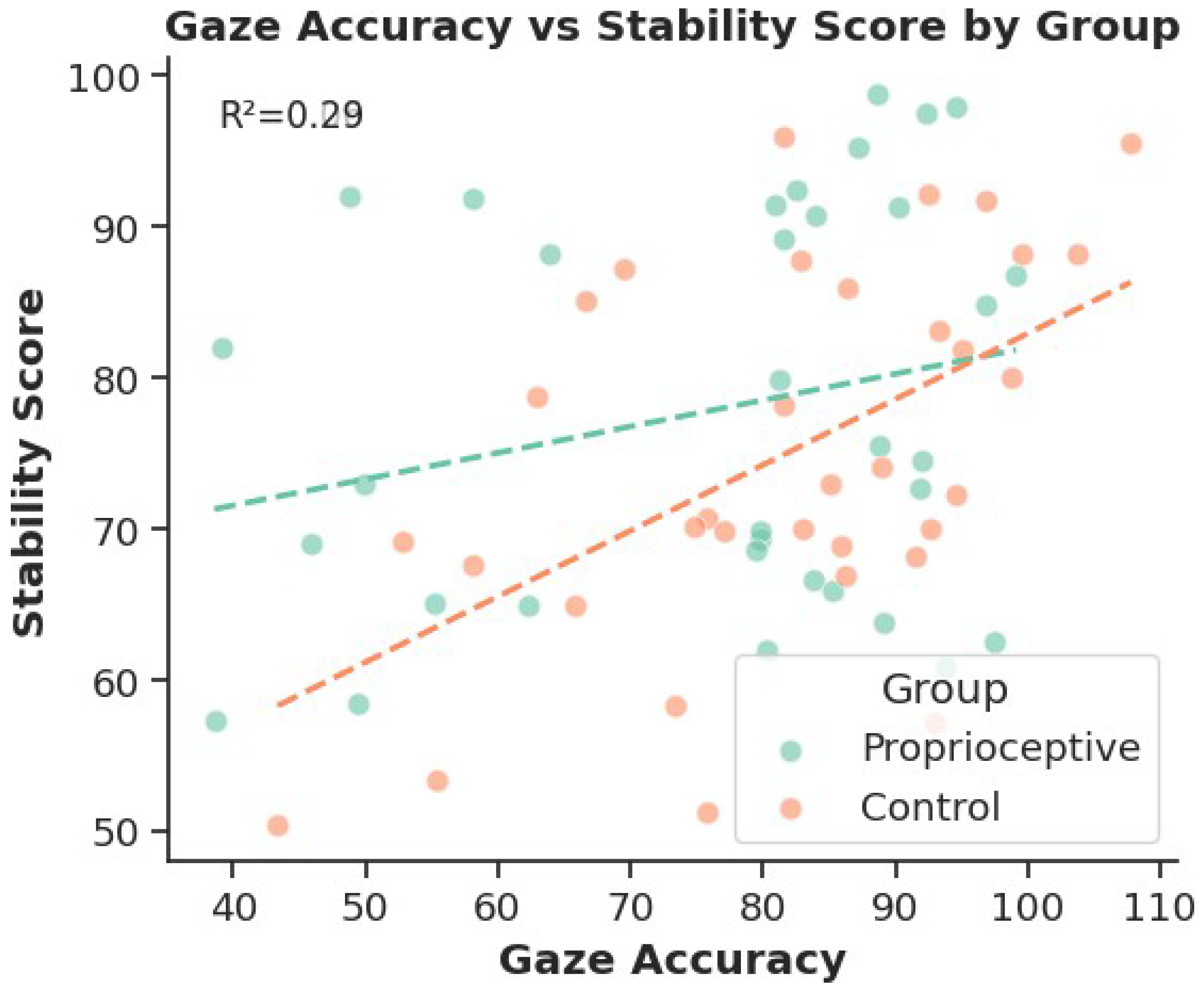
| Gaze accuracy (%) | 84.31 ± 14.73 | 81.80 ± 16.92 | 73.35 ± 17.32 | 79.17 ± 16.90 |
| Model | Accuracy | F1 Score | CV Accuracy (Mean ± SD) |
|---|---|---|---|
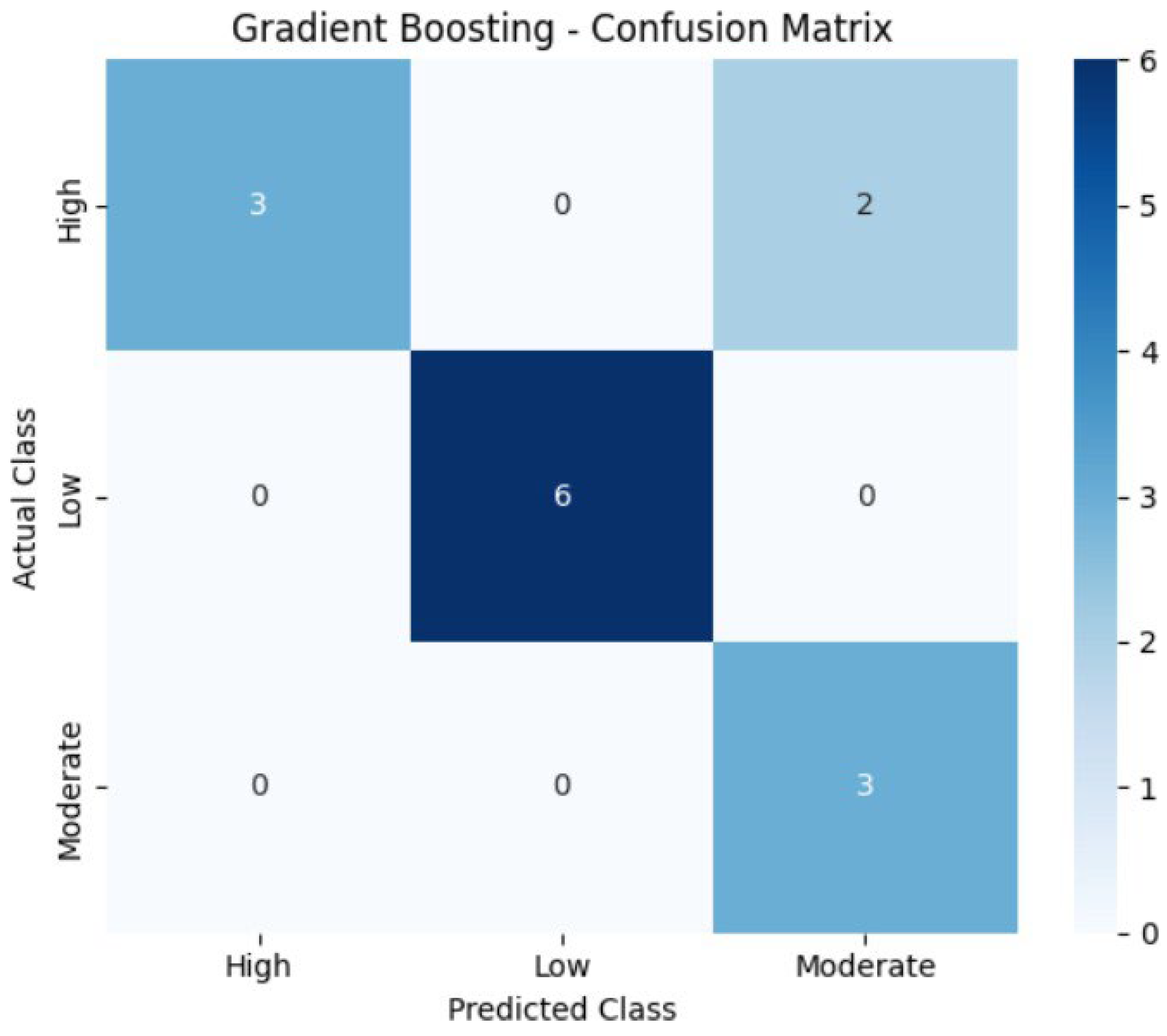
| Gradient Boosting | 0.8571 | 0.8571 | 0.8022 ± 0.0633 |
| Random Forest | 0.7857 | 0.7891 | 0.7264 ± 0.1439 |
| XGBoost | 0.7857 | 0.7891 | 0.6967 ± 0.1462 |
| Logistic Regression | 0.7857 | 0.7670 | 0.6945 ± 0.1774 |
| Support Vector Machine | 0.4286 | 0.4142 | 0.6802 ± 0.1590 |
| Feature | Weight | Weight (%) |
|---|---|---|
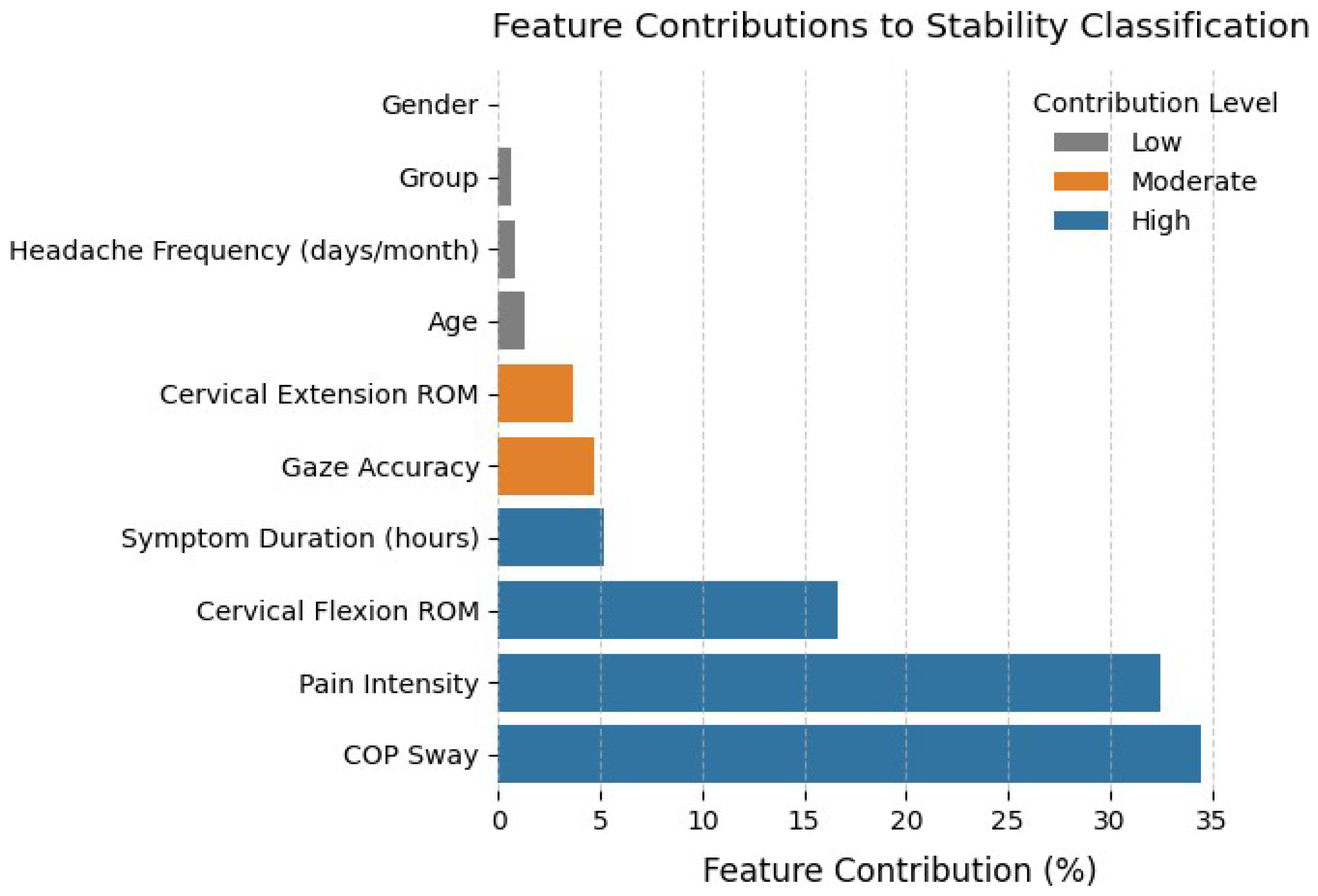
| COP Sway Velocity (mm/s) | 0.3455 | 34.55 |
| Pain Intensity | 0.3246 | 32.46 |
| ROM Flexion | 0.1661 | 16.61 |
| Symptom Duration (hours) | 0.0517 | 5.17 |
| Gaze Accuracy | 0.0472 | 4.72 |
| ROM Extension | 0.0369 | 3.69 |
| Age | 0.0133 | 1.33 |
| Headache Frequency (days/month) | 0.0084 | 0.84 |
| Group | 0.0062 | 0.62 |
| Gender | 0.0001 | 0.01 |
| Stability | COP Velocity (mm/s) | VAS Pain (/10) | Flexion ROM (°) |
|---|---|---|---|
| High | <2.0 | <4 | >45 |
| Moderate | 2.1–5.1 | 4–6 | 35–45 |
| Low | >5.1 | >6 | <35 |
Disclaimer/Publisher’s Note: The statements, opinions and data contained in all publications are solely those of the individual author(s) and contributor(s) and not of MDPI and/or the editor(s). MDPI and/or the editor(s) disclaim responsibility for any injury to people or property resulting from any ideas, methods, instructions or products referred to in the content. |
© 2026 by the authors. Licensee MDPI, Basel, Switzerland. This article is an open access article distributed under the terms and conditions of the Creative Commons Attribution (CC BY) license.
Share and Cite
Emam, M.A.; Ramadan, M.; Horvath, A.A.; Kadry, A.M.; Bolla, G.; Amin, F.S.; Youssef, A.S.A. Using Machine Learning-Based Classification of Postural Stability in Cervicogenic Headache Patients: Predictors and Clinical Implications. Life 2026, 16, 1061. https://doi.org/10.3390/life16071061
Emam MA, Ramadan M, Horvath AA, Kadry AM, Bolla G, Amin FS, Youssef ASA. Using Machine Learning-Based Classification of Postural Stability in Cervicogenic Headache Patients: Predictors and Clinical Implications. Life. 2026; 16(7):1061. https://doi.org/10.3390/life16071061
Chicago/Turabian StyleEmam, Mohamed Abdelaziz, Magda Ramadan, Andras Attila Horvath, Ahmed M. Kadry, Gergo Bolla, Fatma S. Amin, and Ahmed S. A. Youssef. 2026. "Using Machine Learning-Based Classification of Postural Stability in Cervicogenic Headache Patients: Predictors and Clinical Implications" Life 16, no. 7: 1061. https://doi.org/10.3390/life16071061
APA StyleEmam, M. A., Ramadan, M., Horvath, A. A., Kadry, A. M., Bolla, G., Amin, F. S., & Youssef, A. S. A. (2026). Using Machine Learning-Based Classification of Postural Stability in Cervicogenic Headache Patients: Predictors and Clinical Implications. Life, 16(7), 1061. https://doi.org/10.3390/life16071061