Longitudinal Adaptive Functioning Outcomes in Children with Autism Spectrum Disorder During a 180 Day Open-Label Extension of K11-Tmax, a Consortium Probiotic Mix with Multivitamins

 ,
,  ,
, 
Abstract
1. Introduction
2. Materials and Methods
2.1. Study Design and Setting
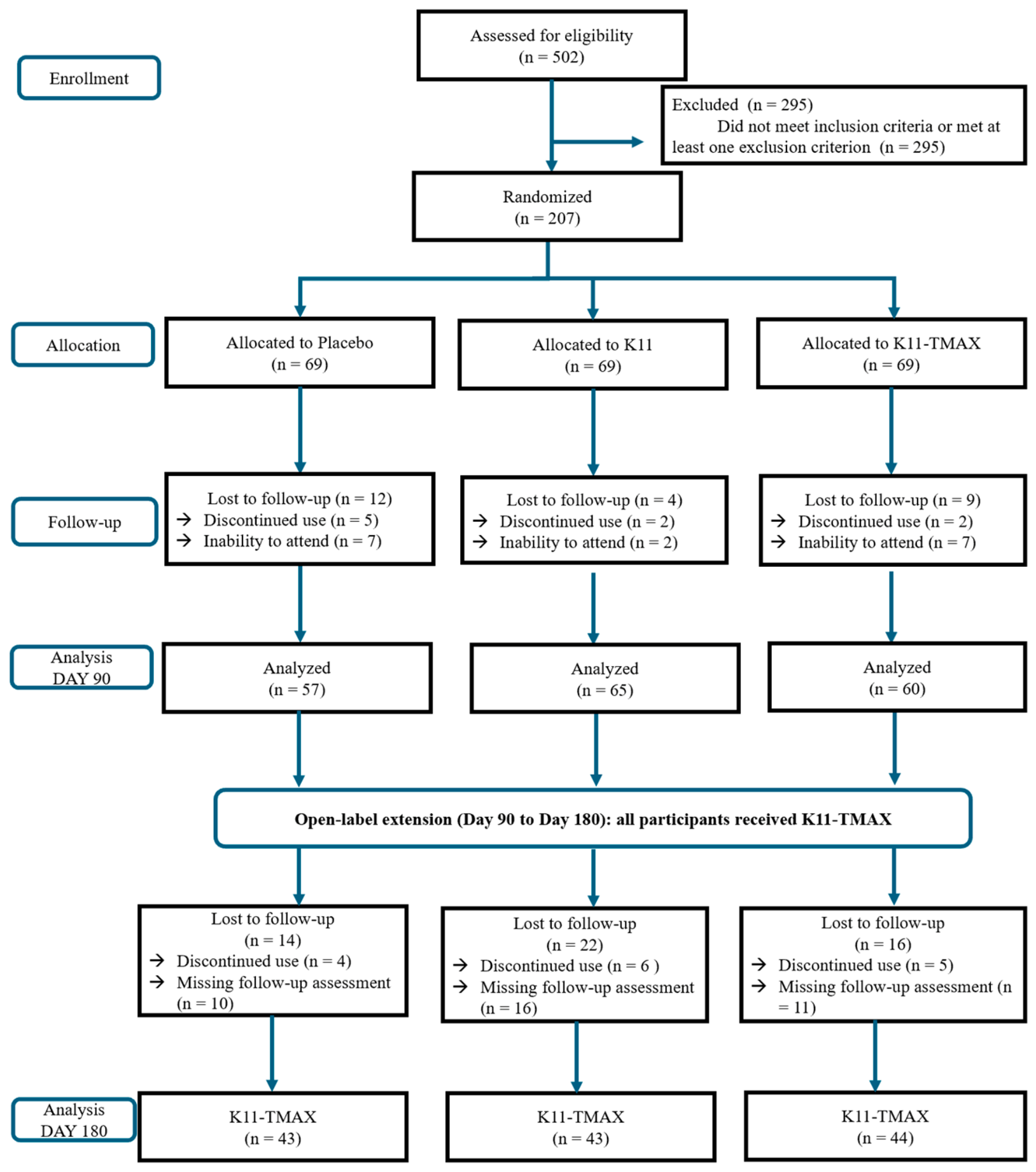
- original placebo → K11-TMAX, corresponding to 90 days of K11-TMAX exposure during the extension phase.
- original K11 → K11-TMAX, corresponding to 90 days of K11-TMAX exposure during the extension phase.
- original K11-TMAX → K11-TMAX, corresponding to 180 days of continuous K11-TMAX exposure.
2.2. Participants
2.3. Intervention and Follow-Up Procedures
2.4. Clinical Outcomes
2.4.1. Administration and Scoring
2.4.2. Primary and Secondary Endpoints
2.5. Statistical Analysis
2.6. Ethical Approval and Consent to Participate
3. Results
3.1. Baseline Demographics
3.2. Clinical Outcomes
3.2.1. Adaptive Behavior Composite
3.2.2. Core Adaptive Domains
3.2.3. Maladaptive Behavior
4. Discussion
5. Conclusions
Author Contributions
Funding
Institutional Review Board Statement
Informed Consent Statement
Data Availability Statement
Acknowledgments
Conflicts of Interest
Abbreviations
| ADHD | Attention-Deficit/Hyperactivity Disorder |
| ANVISA | Brazilian Health Regulatory Agency (National Health Surveillance Agency) |
| ASD | Autism Spectrum Disorder |
| BMI | Body Mass Index |
| CFU | Colony-Forming Units |
| DSM 5-TR | Diagnostic and Statistical Manual of Mental Disorders, Fifth Edition, Text Revision |
| GAD | Generalized Anxiety Disorder |
| HPA | Hypothalamic–pituitary–adrenal |
| LPS | Lipopolysaccharides |
| OLE | Open-Label Extension |
| SCFAs | Short-chain fatty acids |
| SD | Standard Deviation |
| SSRI | Selective Serotonin Reuptake Inhibitor |
| Vineland-3 | Vineland Adaptive Behavior Scales, Third Edition |
References
- American Psychiatric Association. Diagnostic and Statistical Manual of Mental Disorders, 5th ed., Text Revision; American Psychiatric Publishing: Arlington, VA, USA, 2022. [Google Scholar]
- Xu, M.; Xu, X.; Li, J.; Li, F. Association between gut microbiota and autism spectrum disorder: A systematic review and meta-analysis. Front. Psychiatry 2019, 10, 473. [Google Scholar] [CrossRef] [Scilit]
- Rutsch, A.; Kantsjö, J.B.; Ronchi, F. The gut–brain axis: How microbiota and host inflammasome influence brain physiology and pathology. Front. Immunol. 2020, 11, 604179. [Google Scholar] [CrossRef] [Scilit]
- Srikantha, P.; Mohajeri, M.H. The possible role of the microbiota–gut–brain axis in autism spectrum disorder. Int. J. Mol. Sci. 2019, 20, 2115. [Google Scholar] [CrossRef] [Scilit]
- Fiorentino, M.; Sapone, A.; Senger, S.; Camhi, S.S.; Kadzielski, S.M.; Buie, T.M.; Kelly, D.L.; Cascella, N.; Fasano, A. Blood–brain barrier and intestinal epithelial barrier alterations in autism spectrum disorders. Mol. Autism 2016, 7, 49. [Google Scholar] [CrossRef] [Scilit]
- Madore, C.; Leyrolle, Q.; Lacabanne, C.; Benmamar-Badel, A.; Joffre, C.; Nadjar, A.; Layé, S. Neuroinflammation in autism: Plausible role of maternal inflammation, dietary omega 3, and microbiota. Neural Plast. 2016, 2016, 3597209. [Google Scholar] [CrossRef] [Scilit]
- Hsiao, E.Y.; McBride, S.W.; Hsien, S.; Sharon, G.; Hyde, E.R.; McCue, T.; Codelli, J.A.; Chow, J.; Reisman, S.E.; Petrosino, J.F.; et al. Microbiota modulate behavioral and physiological abnormalities associated with neurodevelopmental disorders. Cell 2013, 155, 1451–1463. [Google Scholar] [CrossRef] [Scilit] [PubMed]
- Liu, Y.W.; Liong, M.T.; Chung, Y.E.; Huang, H.Y.; Peng, W.S.; Cheng, Y.F.; Lin, Y.S.; Wu, Y.Y.; Tsai, Y.C. Effects of Lactobacillus plantarum PS128 on children with autism spectrum disorder in Taiwan: A randomized, double blind, placebo controlled trial. Nutrients 2019, 11, 820. [Google Scholar] [CrossRef] [Scilit]
- Lai, Y.; Dhingra, R.; Zhang, Z.; Ball, L.M.; Zylka, M.J.; Lu, K. Toward elucidating the human gut microbiota–brain axis: Molecules, biochemistry, and implications for health and diseases. Biochemistry 2022, 61, 2806–2821. [Google Scholar] [CrossRef] [Scilit]
- Zhuang, M.; Zhang, X.; Cai, J. Microbiota–gut–brain axis: Interplay between microbiota, barrier function and lymphatic system. Gut Microbes 2024, 16, 2387800. [Google Scholar] [CrossRef] [Scilit] [PubMed]
- Chamtouri, M.; Merghni, A.; Miranda-Cadena, K.; Sakly, N.; Gaddour, N.; de los Reyes-Gavilán, C.G.; Mastouri, M.; Eraso, E.; Quindós, G. Characterization of yeast isolated from the gut microbiota of Tunisian children with autism spectrum disorder. J. Fungi 2024, 10, 730. [Google Scholar] [CrossRef] [Scilit] [PubMed]
- Cryan, J.F.; O’Riordan, K.J.; Cowan, C.S.M.; Sandhu, K.V.; Bastiaanssen, T.F.; Boehme, M.; Codagnone, M.G.; Cussotto, S.; Fulling, C.; Golubeva, A.V.; et al. The microbiota–gut–brain axis. Physiol. Rev. 2019, 99, 1877–2013. [Google Scholar] [CrossRef] [Scilit]
- Ng, Q.X.; Peters, C.; Ho, C.Y.X.; Lim, D.Y.; Yeo, W.S. A meta-analysis of the use of probiotics to alleviate depressive symptoms. J. Affect. Disord. 2018, 228, 13–19. [Google Scholar] [CrossRef] [Scilit] [PubMed]
- Fenster, K.; Freeburg, B.; Hollard, C.; Wong, C.; Laursen, R.R.; Ouwehand, A.C. The production and delivery of probiotics: A review of a practical approach. Microorganisms 2019, 7, 83. [Google Scholar] [CrossRef] [Scilit]
- Heidebach, T.; Forst, P.; Kulozik, U. Microencapsulation of probiotic cells for food applications. Crit. Rev. Food Sci. Nutr. 2012, 52, 291–311. [Google Scholar] [CrossRef] [Scilit] [PubMed]
- Mohamadzadeh, M.; Fazeli, A.; Shojaosadati, S.A. Polysaccharides and proteins-based bionanocomposites for microencapsulation of probiotics to improve stability and viability in the gastrointestinal tract: A review. Int. J. Biol. Macromol. 2024, 259, 129287. [Google Scholar] [CrossRef] [Scilit] [PubMed]
- de Queiroz, S.A.L.; Guimarães, D.O.; Ferreira, L.A.; Martinelli, L.; Werly, R.M.; Amorim, R.F.; Holzbach, L.B.; Badaró, R.; Santos, A.A.; Vasquez, E.C.; et al. Kefir-derived probiotic mixture for children with autism spectrum disorder: A double blind randomized clinical trial. BMC Pediatr. 2026, 26, 186. [Google Scholar] [CrossRef] [Scilit]
- Takumi, T.; Tamada, K.; Hatanaka, F.; Nakai, N.; Bolton, P.F. Behavioral neuroscience of autism. Neurosci. Biobehav. Rev. 2020, 110, 60–76. [Google Scholar] [CrossRef] [Scilit]
- Kong, X.J.; Liu, J.; Liu, K.; Koh, M.; Sherman, H.; Liu, S.; Tian, R.; Sukijthamapan, P.; Wang, J.; Fong, M.; et al. Probiotic and oxytocin combination therapy in patients with autism spectrum disorder: A randomized, double blinded, placebo controlled pilot trial. Nutrients 2021, 13, 1552. [Google Scholar] [CrossRef] [Scilit] [PubMed]
- Mazzone, L.; Dooling, S.W.; Volpe, E.; Uljarević, M.; Waters, J.L.; Sabatini, A.; Arturi, L.; Abate, R.; Riccioni, A.; Siracusano, M.; et al. Precision microbial intervention improves social behavior but not autism severity: A pilot double blind randomized placebo controlled trial. Cell Host Microbe 2024, 32, 106–116.e6. [Google Scholar] [CrossRef] [Scilit]
- Soleimanpour, S.; Abavisani, M.; Khoshrou, A.; Sahebkar, A. Probiotics for autism spectrum disorder: An updated systematic review and meta-analysis of effects on symptoms. J. Psychiatr. Res. 2024, 179, 92–104. [Google Scholar] [CrossRef] [Scilit]
- He, X.; Liu, W.; Tang, F.; Chen, X.; Song, G. Effects of probiotics on autism spectrum disorder in children: A systematic review and meta-analysis of clinical trials. Nutrients 2023, 15, 1415. [Google Scholar] [CrossRef] [Scilit] [PubMed]
- Hassib, L.; Kanashiro, A.; Pedrazzi, J.F.C.; Vercesi, B.F.; Higa, S.; Arruda, Í.; Soares, Y.; Souza, A.d.J.d.; Barichello, T.; Guimarães, F.S.; et al. Microbiota-based therapies as novel targets for autism spectrum disorder: A systematic review and meta-analysis. Prog. Neuropsychopharmacol. Biol. Psychiatry 2025, 139, 111385. [Google Scholar] [CrossRef] [Scilit]
- Wong, G.C.; Montgomery, J.M.; Taylor, M.W. The gut–microbiota–brain axis in autism spectrum disorder. In Autism Spectrum Disorders; Grabrucker, A.M., Ed.; Exon Publications: Brisbane, Australia, 2021; pp. 95–113. [Google Scholar] [CrossRef] [Scilit]
- Meidani, F.Z.; Rahmati, R.; Mostafavi, M.; Darvishi, M.; Khodadadi, S.; Mohammadi, M.; Shamlou, F.; Bakhtiyari, S.; Alipourfard, I. Gut microbiota and autism spectrum disorder: A neuroinflammatory mediated mechanism of pathogenesis? Inflammation 2024, 48, 501–519. [Google Scholar] [CrossRef] [Scilit] [PubMed]
- Iglesias-Vázquez, L.; Van Ginkel Riba, G.; Arija, V.; Canals, J. Composition of gut microbiota in children with autism spectrum disorder: A systematic review and meta-analysis. Nutrients 2020, 12, 792. [Google Scholar] [CrossRef] [Scilit]
- Sharon, G.; Cruz, N.J.; Kang, D.W.; Gandal, M.J.; Wang, B.; Kim, Y.M.; Zink, E.M.; Casey, C.P.; Taylor, B.C.; Lane, C.J.; et al. Human gut microbiota from autism spectrum disorder promote behavioral symptoms in mice. Cell 2019, 177, 1600–1618.e17. [Google Scholar] [CrossRef] [Scilit]
- Loomes, R.; Hull, L.; Mandy, W.P.L. What Is the Male-to-Female Ratio in Autism Spectrum Disorder? A Systematic Review and Meta-Analysis. J. Am. Acad. Child Adolesc. Psychiatry 2017, 56, 466–474. [Google Scholar] [CrossRef] [Scilit]
- Restoy, D.; Oriol-Escudé, M.; Alonzo-Castillo, T.; Magán-Maganto, M.; Canal-Bedia, R.; Díez-Villoria, E.; Gisbert-Gustemps, L.; Setién-Ramos, I.; Martínez-Ramírez, M.; Ramos-Quiroga, J.A.; et al. Emotion regulation and emotion dysregulation in children and adolescents with autism spectrum disorder: A meta-analysis of evaluation and intervention studies. Clin. Psychol. Rev. 2024, 109, 102410. [Google Scholar] [CrossRef] [Scilit] [PubMed]
- van Niekerk, K.; Stancheva, V.; Smith, C. Caregiver burden among caregivers of children with autism spectrum disorder. S. Afr. J. Psychiatr. 2023, 29, 2079. [Google Scholar] [CrossRef] [Scilit]
- Chen, X.; Tao, J.; Zhang, Y.; Xu, Q.; Dong, C. Relationship between caregiver burden and family resilience among Chinese parents of children with autism spectrum disorder: The mediating role of social support and positive cognition. J. Pediatr. Nurs. 2025, 82, 57–64. [Google Scholar] [CrossRef] [Scilit]


| Parameters | Placebo → K11-TMAX, Day 90 (n = 43) | K11 → K11-TMAX, Day 90 (n = 43) | K11-TMAX → K11-TMAX, Day 180 (n = 44) |
|---|---|---|---|
| Age (years) | 6.42 ± 2.39 | 6.16 ± 2.18 | 7.12 ± 2.39 |
| Gender | |||
| Male | 88% | 79% | 80% |
| Female | 12% | 21% | 20% |
| BMI (kg/m2) | 17.78 ± 4.48 | 18.06 ± 5.44 | 18.98 ± 5.03 |
| Time of diagnosis (years) | 3.01 ± 1.84 | 2.95 ± 1.97 | 3.04 ± 1.49 |
| Support Level | 2.07 ± 0.91 | 1.87 ± 0.86 | 2.19 ± 0.82 |
| Level 1 | 37% | 44% | 26% |
| Level 2 | 19% | 25% | 29% |
| Level 3 | 44% | 31% | 45% |
| Comorbidities | ADHD 25.6% | ADHD 20% GAD 2% | ADHD 25.5% GAD 2% |
| Use of psychopharmaceuticals | Risperidone 16.3% | Risperidone 35.42% | Risperidone 39.21% |
| Aripiprazole 18.6% | Aripiprazole 10.42% | Aripiprazole 9.8% | |
| Cannabidiol 6.97% | Cannabidiol 10.42% | Cannabidiol 5.88% | |
| Methylphenidate 11.63% | Methylphenidate 4.16% | Methylphenidate 9.8% | |
| SSRIs 6.25% | SSRIs 1.96% |
| Vineland-3 | Baseline | Follow-Up | p-Value | Effect Size (Cohen’s d) 95% CI |
|---|---|---|---|---|
| Initial Group, Placebo | Day 90 with K11-TMAX (n = 43) | |||
| Communication | 68.42 ± 16.09 | 75.14 ± 19.77 | <0.00001 * | 0.37 |
| Daily Living Skills | 73.51 ± 12.18 | 76.93 ± 14.66 | 0.0224 * | 0.25 |
| Socialization | 71.91 ± 12.25 | 74.79 ± 14.72 | 0.0200 * | 0.21 |
| Adaptive Behavior Composite | 70.44 ± 10.71 | 74.74 ± 14.55 | <0.0001 * | 0.34 [−0.09, 0.76] |
| Motor Skills | 77.40 ± 10.88 | 80.71 ± 11.52 | 0.0255 * | 0.30 |
| Internalizing Behavior | 19.50 ± 2.42 | 18.88 ± 2.59 | 0.0059 * | −0.25 |
| Externalizing Behavior | 18.91 ± 2.35 | 18.30 ± 2.77 | 0.0429 * | −0.24 |
| Initial Group—K11 | Day 90 with K11-TMAX (n = 43) | |||
| Communication | 73.74 ± 18.47 | 77.72 ± 20.13 | 0.0024 * | 0.21 |
| Daily Living Skills | 75.84 ± 12.01 | 78.49 ± 12.22 | 0.0120 * | 0.22 |
| Socialization | 75.37 ± 13.33 | 77.72 ± 12.56 | 0.0260 * | 0.18 |
| Adaptive Behavior Composite | 73.67 ± 12.40 | 76.72 ± 13.58 | 0.0011 * | 0.23 [−0.19, 0.66] |
| Motor Skills | 79.08 ± 15.49 | 81.93 ± 19.41 | 0.0462 * | 0.16 |
| Internalizing Behavior | 19.77 ± 1.56 | 19.33 ± 2.14 | 0.0484 * | −0.24 |
| Externalizing Behavior | 18.31 ± 2.10 | 17.81 ± 2.42 | 0.0455 * | −0.22 |
| Initial Group—K11-TMAX | Day 180 with K11-TMAX (n = 44) | |||
| Communication | 65.04 ± 18.05 | 70.14 ± 21.91 | <0.0001 * | 0.25 |
| Daily Living Skills | 72.35 ± 15.05 | 77.50 ± 18.08 | 0.00008 * | 0.31 |
| Socialization | 70.98 ± 13.47 | 72.93 ± 15.81 | 0.027 * | 0.13 |
| Adaptive Behavior Composite | 69.06 ± 12.27 | 73.11 ± 16.28 | 0.00003 * | 0.28 [−0.14, 0.70] |
| Motor Skills | 75.26 ± 14.10 | 77.71 ± 18.61 | 0.0449 * | 0.15 |
| Internalizing Behavior | 19.98 ± 1.95 | 19.18 ± 2.70 | 0.0007 * | −0.34 |
| Externalizing Behavior | 18.51 ± 2.25 | 17.41 ± 2.88 | 0.0125 * | −0.43 |
Disclaimer/Publisher’s Note: The statements, opinions and data contained in all publications are solely those of the individual author(s) and contributor(s) and not of MDPI and/or the editor(s). MDPI and/or the editor(s) disclaim responsibility for any injury to people or property resulting from any ideas, methods, instructions or products referred to in the content. |
© 2026 by the authors. Licensee MDPI, Basel, Switzerland. This article is an open access article distributed under the terms and conditions of the Creative Commons Attribution (CC BY) license.
Share and Cite
Guimaraes, D.O.; Silva, R.S.; Ferreira, L.A.; Martinelli, L.; Werly, R.M.M.; Amorim, R.F.; Holzbach, L.B.S.S.; Badaró, R.; Santos, A.A.B.; Vasquez, E.C.; et al. Longitudinal Adaptive Functioning Outcomes in Children with Autism Spectrum Disorder During a 180 Day Open-Label Extension of K11-Tmax, a Consortium Probiotic Mix with Multivitamins. Life 2026, 16, 940. https://doi.org/10.3390/life16060940
Guimaraes DO, Silva RS, Ferreira LA, Martinelli L, Werly RMM, Amorim RF, Holzbach LBSS, Badaró R, Santos AAB, Vasquez EC, et al. Longitudinal Adaptive Functioning Outcomes in Children with Autism Spectrum Disorder During a 180 Day Open-Label Extension of K11-Tmax, a Consortium Probiotic Mix with Multivitamins. Life. 2026; 16(6):940. https://doi.org/10.3390/life16060940
Chicago/Turabian StyleGuimaraes, Deivis O., Racire S. Silva, Lara A. Ferreira, Larissa Martinelli, Rebeca M. M. Werly, Raphaela F. Amorim, Lívia B. S. S. Holzbach, Roberto Badaró, Alex A. B. Santos, Elisardo C. Vasquez, and et al. 2026. "Longitudinal Adaptive Functioning Outcomes in Children with Autism Spectrum Disorder During a 180 Day Open-Label Extension of K11-Tmax, a Consortium Probiotic Mix with Multivitamins" Life 16, no. 6: 940. https://doi.org/10.3390/life16060940
APA StyleGuimaraes, D. O., Silva, R. S., Ferreira, L. A., Martinelli, L., Werly, R. M. M., Amorim, R. F., Holzbach, L. B. S. S., Badaró, R., Santos, A. A. B., Vasquez, E. C., & de Queiroz, S. A. L. (2026). Longitudinal Adaptive Functioning Outcomes in Children with Autism Spectrum Disorder During a 180 Day Open-Label Extension of K11-Tmax, a Consortium Probiotic Mix with Multivitamins. Life, 16(6), 940. https://doi.org/10.3390/life16060940