Micro- and Nanoplastics as Potential Drivers of Dilated Cardiomyopathy


Abstract
1. Introduction
2. Methods
3. Background
3.1. Introduction to MNPs
3.2. Routes of Exposure
3.3. Cardiovascular Distribution and Clinical Associations
3.4. Detection Methods
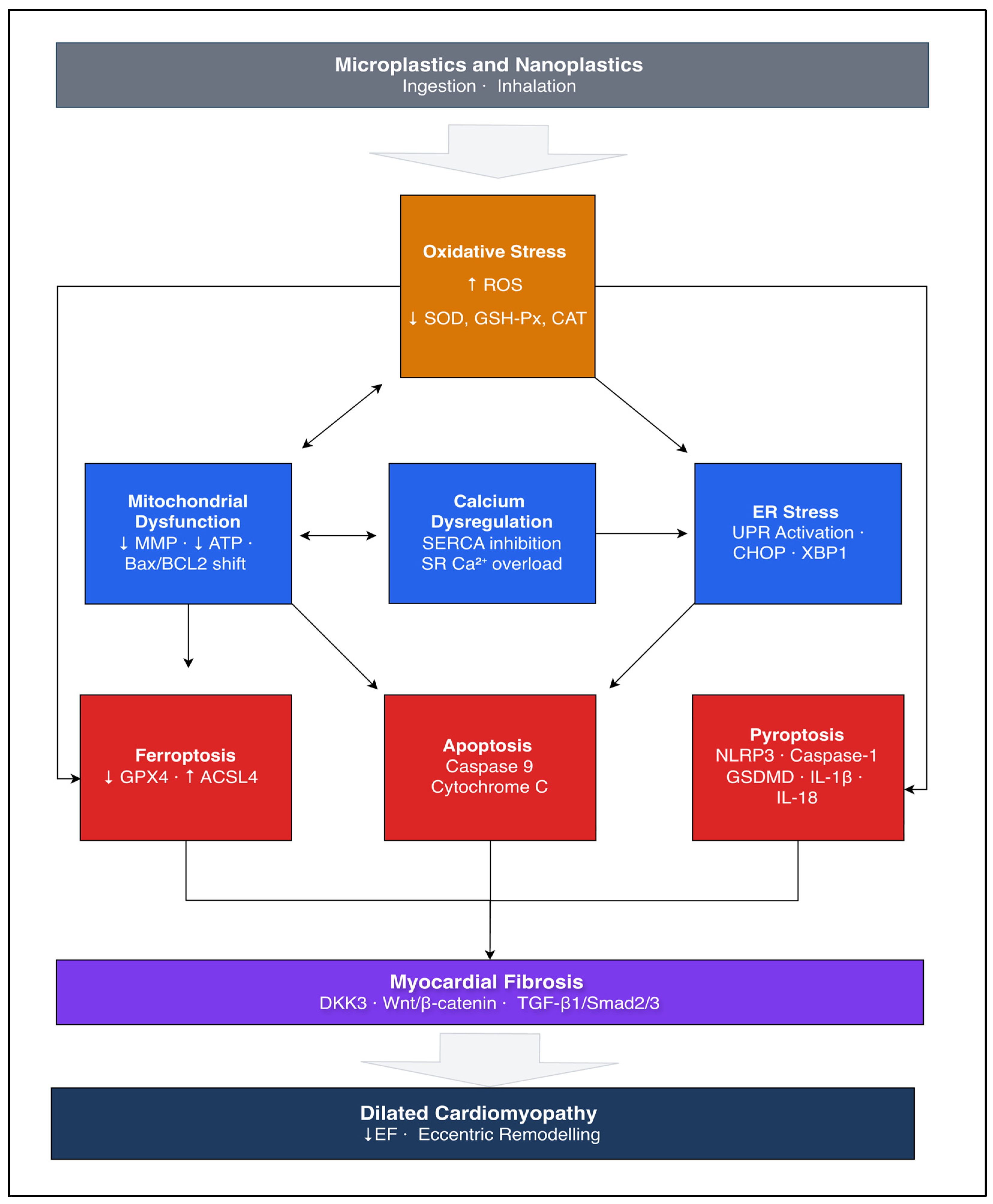
4. Mechanisms and Functional Consequences of MNP-Induced Myocardial Injury
4.1. Cellular Mechanisms
4.1.1. Oxidative Stress
4.1.2. Mitochondrial Dysfunction
4.1.3. Endoplasmic Reticulum Stress and Calcium Dysregulation
4.2. Cardiomyocyte Death
4.2.1. Apoptosis
4.2.2. Pyroptosis
4.2.3. Ferroptosis
4.3. Myocardial Fibrosis
4.4. Cardiac Injury and Functional Consequences
4.4.1. Initial Stress Response
4.4.2. Transition to Dilated Cardiomyopathy Phenotype
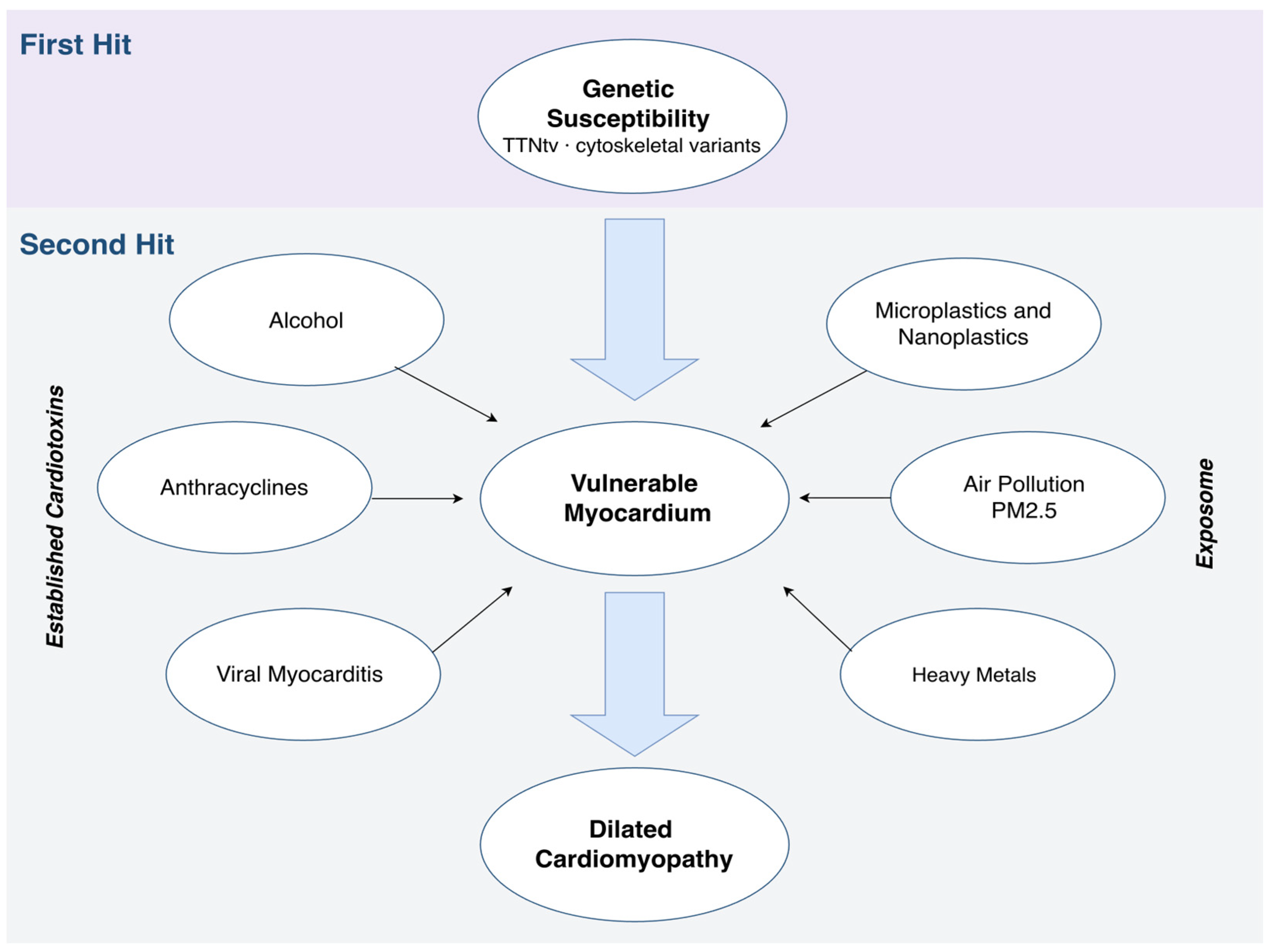
4.4.3. Two-Hit Framework and Clinical Relevance
5. Discussion
5.1. Summary of Key Findings
5.2. Contextualizing Within the Exposome-Driven Cardiotoxicity
5.2.1. Air Pollution
5.2.2. Heavy Metal Exposure
5.3. Mechanistic Similarities with Established Cardiovascular Toxins
5.3.1. Alcohol Induced Cardiomyopathy
5.3.2. Anthracycline Cardiomyopathy
5.3.3. Viral Myocarditis and Inflammatory Cardiomyopathy
5.4. Limitations and Translational Challenges
5.5. Future Directions
6. Conclusions
Supplementary Materials
Author Contributions
Funding
Institutional Review Board Statement
Informed Consent Statement
Data Availability Statement
Acknowledgments
Conflicts of Interest
Abbreviations
| AC | Alcohol-induced cardiomyopathy |
| ACSL4 | Acyl-CoA synthetase long-chain family member 4 |
| AMPK ANP | AMP-activated protein kinase Atrial natriuretic peptide |
| ATP | Adenosine triphosphate |
| Bax | BCL2-associated X protein |
| BCL2 | B-cell lymphoma 2 |
| BNP | Brain natriuretic peptide |
| CaMKII | Ca2+/calmodulin-dependent protein kinase II |
| CAT | Catalase |
| cGAS-STING | Cyclic GMP-AMP synthase stimulator of interferon genes |
| CHOP | C/EBP homologous protein |
| CK-MB | Creatine kinase-MB |
| cTnI | Cardiac troponin I |
| cTnT | Cardiac troponin T |
| CX43 | Connexin 43 |
| DAMP | Damage-associated molecular pattern |
| DCM | Dilated cardiomyopathy |
| DKK3 | Dickkopf-related protein 3 |
| ECG | Electrocardiogram |
| ECM | Extracellular matrix |
| EF | Ejection fraction |
| EPA | Environmental Protection Agency |
| ER | Endoplasmic reticulum |
| ERK | Extracellular signal-regulated kinase |
| ETC | Electron transport chain |
| FS | Fractional shortening |
| FTIR | Fourier transform infrared spectroscopy |
| GPX4 | Glutathione peroxidase 4 |
| GSDMD | Gasdermin D |
| GSH-Px | Glutathione peroxidase activity |
| HF | Heart failure |
| HIF-1 | Hypoxia-inducible factor 1 |
| HIPK2 | Homeodomain-interacting protein kinase 2 |
| hiPSC-CM | Human-induced pluripotent stem-cell-derived cardiomyocyte |
| IL-1β | Interleukin-1 beta |
| IL-18 | Interleukin-18 |
| JNK | c-Jun N-terminal kinase |
| LGE | Late gadolinium enhancement |
| LV | Left ventricle/left ventricular |
| LVIDd | Left ventricular internal diameter at diastole |
| LVIDs | Left ventricular internal diameter at systole |
| LVEF | Left ventricular ejection fraction |
| MAPK | Mitogen-activated protein kinase |
| MDA | Malondialdehyde |
| MESA | Multi-Ethnic Study of Atherosclerosis |
| MMP | Mitochondrial membrane potential |
| MNPs | Microplastics and nanoplastics |
| MPs | Microplastics |
| mPTP | Mitochondrial permeability transition pore |
| MRI | Magnetic resonance imaging |
| mtDNA | Mitochondrial DNA |
| MYH7B | Myosin heavy chain 7B |
| MYL2 | Myosin light chain 2 |
| MYL4 | Myosin light chain 4 |
| NADPH | Nicotinamide adenine dinucleotide phosphate |
| NF-κB | Nuclear factor kappa B |
| NHANES | National Health and Nutrition Examination Survey |
| NLRP3 | NOD-like receptor protein 3 |
| NOX | NADPH oxidase |
| NOX2 | NADPH oxidase 2 |
| Nrf2 | Nuclear factor erythroid 2-related factor 2 |
| NPs | Nanoplastics |
| p53 | Tumor protein p53 |
| PE | Polyethylene |
| PET | Polyethylene terephthalate |
| PGC-1α | Peroxisome proliferator-activated receptor gamma coactivator 1-alpha |
| PLB | Phospholamban |
| PM2.5 | Particulate matter smaller than 2.5 micrometers |
| PMMA | Polymethylmethacrylate |
| PP | Polypropylene |
| PS | Polystyrene |
| PS-MPs | Polystyrene microplastics |
| PS-NPs | Polystyrene nanoplastics |
| PUFA PVC | Polyunsaturated fatty acid Polyvinylchloride |
| Py-GC/MS | Pyrolysis gas chromatography–mass spectrometry |
| ROS | Reactive oxygen species |
| SERCA | Sarco-endoplasmic reticulum calcium ATPase |
| SERCA2a | Sarco-endoplasmic reticulum calcium ATPase 2a |
| SOD | Superoxide dismutase |
| SR | Sarcoplasmic reticulum |
| SV | Stroke volume |
| TGF-β1 | Transforming growth factor beta 1 |
| TLR4 | Toll-like receptor 4 |
| TNF-α | Tumor necrosis factor alpha |
| Top2β | Topoisomerase IIβ |
| TTN | Titin |
| TTNtv | Titin truncating variants |
| UPR | Unfolded protein response |
| Wnt | Wingless-related integration site |
| XBP-1 | X-box binding protein 1 |
References
- Ran, J.; Zhou, P.; Wang, J.; Zhao, X.; Huang, Y.; Zhou, Q.; Zhai, M.; Zhang, Y. Global, Regional, and National Burden of Heart Failure and Its Underlying Causes, 1990–2021: Results from the Global Burden of Disease Study 2021. Biomark. Res. 2025, 13, 16. [Google Scholar] [CrossRef] [Scilit] [PubMed]
- Historical Terminology, Classifications, and Present Definition of DCM|Springer Nature Link. Available online: https://link-springer-com.iclibezp1.cc.ic.ac.uk/chapter/10.1007/978-3-030-13864-6_1 (accessed on 7 April 2026).
- Hazebroek, M.; Dennert, R.; Heymans, S. Idiopathic Dilated Cardiomyopathy: Possible Triggers and Treatment Strategies. Neth. Heart J. 2012, 20, 332–335. [Google Scholar] [CrossRef] [Scilit]
- Marstrand, P.; Picard, K.; Lakdawala, N.K. Second Hits in Dilated Cardiomyopathy. Curr. Cardiol. Rep. 2020, 22, 8. [Google Scholar] [CrossRef] [Scilit]
- Peters, S.A.; Wright, L.; Yao, J.; McCall, L.; Thompson, T.; Thompson, B.; Johnson, R.; Huynh, Q.; Santiago, C.F.; Trainer, A.; et al. Environmental Risk Factors Are Associated with the Natural History of Familial Dilated Cardiomyopathy. J. Am. Heart Assoc. 2025, 14, e037311. [Google Scholar] [CrossRef] [Scilit]
- Al-Kindi, S.G.; Brook, R.D.; Biswal, S.; Rajagopalan, S. Environmental Determinants of Cardiovascular Disease: Lessons Learned from Air Pollution. Nat. Rev. Cardiol. 2020, 17, 656–672. [Google Scholar] [CrossRef] [Scilit]
- Hahad, O.; Wass, S.; Rajagopalan, S.; Abohashem, S.; Hao, H.; Navas-Acien, A.; Bellumkonda, L.; Chen, K.; Brook, R.D.; Nasir, K.; et al. The Environmental Exposome in Heart Failure Risk and Progression. Nat. Rev. Cardiol. 2026, 23, 1–16. [Google Scholar] [CrossRef] [Scilit]
- Rajagopalan, S.; Landrigan, P.J. Pollution and the Heart. N. Engl. J. Med. 2021, 385, 1881–1892. [Google Scholar] [CrossRef] [Scilit]
- Wild, C.P. Complementing the Genome with an “Exposome”: The Outstanding Challenge of Environmental Exposure Measurement in Molecular Epidemiology. Cancer Epidemiol. Biomark. Prev. 2005, 14, 1847–1850. [Google Scholar] [CrossRef] [Scilit]
- Martinez-Morata, I.; Domingo-Relloso, A.; Mayer, M.; Schilling, K.; Glabonjat, R.A.; McGraw, K.; Sanchez, T.R.; Kaufman, J.D.; Vaidya, D.; Post, W.; et al. Associations Between Urinary Metal Levels and Incident Heart Failure: A Multi-Cohort Analysis. JACC Heart Fail. 2025, 13, 102510. [Google Scholar] [CrossRef] [Scilit] [PubMed]
- Rajagopalan, S.; Al-Kindi, S.G.; Brook, R.D. Air Pollution and Cardiovascular Disease: JACC State-of-the-Art Review. J. Am. Coll. Cardiol. 2018, 72, 2054–2070. [Google Scholar] [CrossRef] [Scilit] [PubMed]
- Lamas, G.A.; Bhatnagar, A.; Jones, M.R.; Mann, K.K.; Nasir, K.; Tellez-Plaza, M.; Ujueta, F.; Navas-Acien, A.; The American Heart Association Council on Epidemiology and Prevention; Council on Cardiovascular and Stroke Nursing; et al. Contaminant Metals as Cardiovascular Risk Factors: A Scientific Statement from the American Heart Association. J. Am. Heart Assoc. 2023, 12, e029852. [Google Scholar] [CrossRef] [Scilit]
- Dokl, M.; Copot, A.; Krajnc, D.; Fan, Y.V.; Vujanović, A.; Aviso, K.B.; Tan, R.R.; Kravanja, Z.; Čuček, L. Global Projections of Plastic Use, End-of-Life Fate and Potential Changes in Consumption, Reduction, Recycling and Replacement with Bioplastics to 2050. Sustain. Prod. Consum. 2024, 51, 498–518. [Google Scholar] [CrossRef] [Scilit]
- Vethaak, A.D.; Legler, J. Microplastics and Human Health. Science 2021, 371, 672–674. [Google Scholar] [CrossRef] [Scilit] [PubMed]
- Li, P.; Li, Q.; Lai, Y.; Yang, S.; Yu, S.; Liu, R.; Jiang, G.; Liu, J. Direct Entry of Micro(Nano)Plastics into Human Blood Circulatory System by Intravenous Infusion. iScience 2023, 26, 108454. [Google Scholar] [CrossRef] [Scilit] [PubMed]
- Prattichizzo, F.; Ceriello, A.; Pellegrini, V.; La Grotta, R.; Graciotti, L.; Olivieri, F.; Paolisso, P.; D’Agostino, B.; Iovino, P.; Balestrieri, M.L.; et al. Micro-Nanoplastics and Cardiovascular Diseases: Evidence and Perspectives. Eur. Heart J. 2024, 45, 4099–4110. [Google Scholar] [CrossRef] [Scilit]
- Zhu, X.; Wang, C.; Duan, X.; Liang, B.; Genbo Xu, E.; Huang, Z. Micro-and Nanoplastics: A New Cardiovascular Risk Factor? Environ. Int. 2023, 171, 107662. [Google Scholar] [CrossRef] [Scilit] [PubMed]
- Landrigan, P.J.; Dunlop, S.; Treskova, M.; Raps, H.; Symeonides, C.; Muncke, J.; Spring, M.; Stegeman, J.; Almroth, B.C.; Chiles, T.C.; et al. The Lancet Countdown on Health and Plastics. Lancet 2025, 406, 1044–1062. [Google Scholar] [CrossRef] [Scilit]
- Ramaccini, D.; Montoya-Uribe, V.; Aan, F.J.; Modesti, L.; Potes, Y.; Wieckowski, M.R.; Krga, I.; Glibetić, M.; Pinton, P.; Giorgi, C.; et al. Mitochondrial Function and Dysfunction in Dilated Cardiomyopathy. Front. Cell Dev. Biol. 2021, 8, 624216. [Google Scholar] [CrossRef] [Scilit]
- Ruenraroengsak, P.; Novak, P.; Berhanu, D.; Thorley, A.J.; Valsami-Jones, E.; Gorelik, J.; Korchev, Y.E.; Tetley, T.D. Respiratory Epithelial Cytotoxicity and Membrane Damage (Holes) Caused by Amine-Modified Nanoparticles. Nanotoxicology 2012, 6, 94–108. [Google Scholar] [CrossRef] [Scilit]
- Fox, S.; Stefánsson, H.; Peternell, M.; Zlotskiy, E.; Ásbjörnsson, E.J.; Sturkell, E.; Wanner, P.; Konrad-Schmolke, M. Physical Characteristics of Microplastic Particles and Potential for Global Atmospheric Transport: A Meta-Analysis. Environ. Pollut. 2024, 342, 122938. [Google Scholar] [CrossRef] [Scilit]
- Stock, V.; Laurisch, C.; Franke, J.; Dönmez, M.H.; Voss, L.; Böhmert, L.; Braeuning, A.; Sieg, H. Uptake and Cellular Effects of PE, PP, PET and PVC Microplastic Particles. Toxicol. In Vitro 2021, 70, 105021. [Google Scholar] [CrossRef] [Scilit]
- Kaur, K.; Reddy, S.; Barathe, P.; Oak, U.; Shriram, V.; Kharat, S.S.; Govarthanan, M.; Kumar, V. Microplastic-Associated Pathogens and Antimicrobial Resistance in Environment. Chemosphere 2022, 291, 133005. [Google Scholar] [CrossRef] [Scilit]
- Eales, J.; Bethel, A.; Galloway, T.; Hopkinson, P.; Morrissey, K.; Short, R.E.; Garside, R. Human Health Impacts of Exposure to Phthalate Plasticizers: An Overview of Reviews. Environ. Int. 2022, 158, 106903. [Google Scholar] [CrossRef] [Scilit]
- Hodson, M.E.; Duffus-Hodson, C.A.; Clark, A.; Prendergast-Miller, M.T.; Thorpe, K.L. Plastic Bag Derived-Microplastics as a Vector for Metal Exposure in Terrestrial Invertebrates. Environ. Sci. Technol. 2017, 51, 4714–4721. [Google Scholar] [CrossRef] [Scilit]
- Yuan, Z.; Nag, R.; Cummins, E. Human Health Concerns Regarding Microplastics in the Aquatic Environment—From Marine to Food Systems. Sci. Total Environ. 2022, 823, 153730. [Google Scholar] [CrossRef] [Scilit]
- Nawab, A.; Ahmad, M.; Khan, M.T.; Nafees, M.; Khan, I.; Ihsanullah, I. Human Exposure to Microplastics: A Review on Exposure Routes and Public Health Impacts. J. Hazard. Mater. Adv. 2024, 16, 100487. [Google Scholar] [CrossRef] [Scilit]
- Prata, J.C.; da Costa, J.P.; Lopes, I.; Duarte, A.C.; Rocha-Santos, T. Environmental Exposure to Microplastics: An Overview on Possible Human Health Effects. Sci. Total Environ. 2020, 702, 134455. [Google Scholar] [CrossRef] [Scilit] [PubMed]
- Saha, S.C.; Saha, G. Effect of Microplastics Deposition on Human Lung Airways: A Review with Computational Benefits and Challenges. Heliyon 2024, 10, e24355. [Google Scholar] [CrossRef] [Scilit] [PubMed]
- Leslie, H.A.; van Velzen, M.J.M.; Brandsma, S.H.; Vethaak, A.D.; Garcia-Vallejo, J.J.; Lamoree, M.H. Discovery and Quantification of Plastic Particle Pollution in Human Blood. Environ. Int. 2022, 163, 107199. [Google Scholar] [CrossRef] [Scilit]
- Chang, X.; Xue, Y.; Li, J.; Zou, L.; Tang, M. Potential Health Impact of Environmental Micro- and Nanoplastics Pollution. J. Appl. Toxicol. 2020, 40, 4–15. [Google Scholar] [CrossRef] [Scilit] [PubMed]
- Liu, S.; Wang, C.; Yang, Y.; Du, Z.; Li, L.; Zhang, M.; Ni, S.; Yue, Z.; Yang, K.; Wang, Y.; et al. Microplastics in Three Types of Human Arteries Detected by Pyrolysis-Gas Chromatography/Mass Spectrometry (Py-GC/MS). J. Hazard. Mater. 2024, 469, 133855. [Google Scholar] [CrossRef] [Scilit]
- Rotchell, J.M.; Jenner, L.C.; Chapman, E.; Bennett, R.T.; Bolanle, I.O.; Loubani, M.; Sadofsky, L.; Hobkirk, J.; Palmer, T.M. Detection of Microplastics in Human Saphenous Vein Tissue Using μFTIR: A Pilot Study. PLoS ONE 2023, 18, e0280594. [Google Scholar] [CrossRef] [Scilit]
- Marfella, R.; Prattichizzo, F.; Sardu, C.; Fulgenzi, G.; Graciotti, L.; Spadoni, T.; D’Onofrio, N.; Scisciola, L.; Grotta, R.L.; Frigé, C.; et al. Microplastics and Nanoplastics in Atheromas and Cardiovascular Events. N. Engl. J. Med. 2024, 390, 900–910. [Google Scholar] [CrossRef] [Scilit] [PubMed]
- Zhang, Y.; Gao, Q.; Gao, Q.; Xu, M.; Fang, N.; Mu, L.; Han, X.; Yu, H.; Zhang, S.; Li, Y.; et al. Microplastics and Nanoplastics Increase Major Adverse Cardiac Events in Patients with Myocardial Infarction. J. Hazard. Mater. 2025, 489, 137624. [Google Scholar] [CrossRef] [Scilit]
- Yang, Y.; Xie, E.; Du, Z.; Peng, Z.; Han, Z.; Li, L.; Zhao, R.; Qin, Y.; Xue, M.; Li, F.; et al. Detection of Various Microplastics in Patients Undergoing Cardiac Surgery. Environ. Sci. Technol. 2023, 57, 10911–10918. [Google Scholar] [CrossRef] [Scilit] [PubMed]
- Ma, J.; Ladd, D.M.; Kaval, N.; Wang, H.-S. Toxicity of Long Term Exposure to Low Dose Polystyrene Microplastics and Nanoplastics in Human iPSC-Derived Cardiomyocytes. Food Chem. Toxicol. 2025, 202, 115489. [Google Scholar] [CrossRef] [Scilit]
- Mariano, S.; Tacconi, S.; Fidaleo, M.; Rossi, M.; Dini, L. Micro and Nanoplastics Identification: Classic Methods and Innovative Detection Techniques. Front. Toxicol. 2021, 3, 636640. [Google Scholar] [CrossRef] [Scilit]
- Xu, J.-L.; Thomas, K.V.; Luo, Z.; Gowen, A.A. FTIR and Raman Imaging for Microplastics Analysis: State of the Art, Challenges and Prospects. TrAC Trends Anal. Chem. 2019, 119, 115629. [Google Scholar] [CrossRef] [Scilit]
- Dumont, G.; Rodrigues, A.; Velimirovic, M.; Lievens, S.; Jordens, J.; Focant, J.-F.; Stefanuto, P.-H. Microplastic and Nanoplastic Analysis: From Pyrolysis Gas Chromatography-Mass Spectrometry to Pyrolysis Two-Dimensional Gas Chromatography-Mass Spectrometry—A Critical Review. J. Sep. Sci. 2025, 48, e70287. [Google Scholar] [CrossRef] [Scilit]
- Jomova, K.; Raptova, R.; Alomar, S.Y.; Alwasel, S.H.; Nepovimova, E.; Kuca, K.; Valko, M. Reactive Oxygen Species, Toxicity, Oxidative Stress, and Antioxidants: Chronic Diseases and Aging. Arch. Toxicol. 2023, 97, 2499–2574. [Google Scholar] [CrossRef] [Scilit] [PubMed]
- Tsutsui, H.; Kinugawa, S.; Matsushima, S. Oxidative Stress and Heart Failure. Am. J. Physiol.-Heart Circ. Physiol. 2011, 301, H2181–H2190. [Google Scholar] [CrossRef] [Scilit] [PubMed]
- D’Amato, A.; Cestiè, C.; Ferranti, F.; Segato, C.; Prosperi, S.; Germanò, R.; Myftari, V.; Bartimoccia, S.; Castellani, V.; Badagliacca, R.; et al. Implications of Oxidative Stress in the Pathophysiological Pathways of Heart Failure. Int. J. Mol. Sci. 2025, 26, 5165. [Google Scholar] [CrossRef] [Scilit]
- Qiao, R.; Sheng, C.; Lu, Y.; Zhang, Y.; Ren, H.; Lemos, B. Microplastics Induce Intestinal Inflammation, Oxidative Stress, and Disorders of Metabolome and Microbiome in Zebrafish. Sci. Total Environ. 2019, 662, 246–253. [Google Scholar] [CrossRef] [Scilit]
- Xie, X.; Deng, T.; Duan, J.; Xie, J.; Yuan, J.; Chen, M. Exposure to Polystyrene Microplastics Causes Reproductive Toxicity through Oxidative Stress and Activation of the P38 MAPK Signaling Pathway. Ecotoxicol. Environ. Saf. 2020, 190, 110133. [Google Scholar] [CrossRef] [Scilit]
- Xiong, Z.; Kong, Q.; Hua, J.; Chen, Q.; Wang, D. Cardiotoxicity of Polystyrene Nanoplastics and Associated Mechanism of Myocardial Cell Injury in Mice. Ecotoxicol. Environ. Saf. 2025, 290, 117712. [Google Scholar] [CrossRef] [Scilit]
- Wei, J.; Wang, X.; Liu, Q.; Zhou, N.; Zhu, S.; Li, Z.; Li, X.; Yao, J.; Zhang, L. The Impact of Polystyrene Microplastics on Cardiomyocytes Pyroptosis through NLRP3/Caspase-1 Signaling Pathway and Oxidative Stress in Wistar Rats. Environ. Toxicol. 2021, 36, 935–944. [Google Scholar] [CrossRef] [Scilit]
- Zangene, S.; Goorani, S.; Morovvati, H.; Anbara, H. Effects of Polystyrene Microplastics on Mice Cardiac Tissue Structure: Protective Role of Resveratrol. Chemosphere 2025, 379, 144406. [Google Scholar] [CrossRef] [Scilit]
- Wu, H.; Guo, J.; Yao, Y.; Xu, S. Polystyrene Nanoplastics Induced Cardiomyocyte Apoptosis and Myocardial Inflammation in Carp by Promoting ROS Production. Fish Shellfish Immunol. 2022, 125, 1–8. [Google Scholar] [CrossRef] [Scilit] [PubMed]
- Hu, Q.; Wang, H.; He, C.; Jin, Y.; Fu, Z. Polystyrene Nanoparticles Trigger the Activation of P38 MAPK and Apoptosis via Inducing Oxidative Stress in Zebrafish and Macrophage Cells. Environ. Pollut. 2021, 269, 116075. [Google Scholar] [CrossRef] [Scilit] [PubMed]
- Dimitriadi, A.; Papaefthimiou, C.; Genizegkini, E.; Sampsonidis, I.; Kalogiannis, S.; Feidantsis, K.; Bobori, D.C.; Kastrinaki, G.; Koumoundouros, G.; Lambropoulou, D.A.; et al. Adverse Effects Polystyrene Microplastics Exert on Zebrafish Heart—Molecular to Individual Level. J. Hazard. Mater. 2021, 416, 125969. [Google Scholar] [CrossRef] [Scilit]
- Zhang, T.; Yang, S.; Ge, Y.; Wan, X.; Zhu, Y.; Yang, F.; Li, J.; Gong, S.; Cheng, Y.; Hu, C.; et al. Multi-Dimensional Evaluation of Cardiotoxicity in Mice Following Respiratory Exposure to Polystyrene Nanoplastics. Part. Fibre Toxicol. 2023, 20, 46. [Google Scholar] [CrossRef] [Scilit]
- Zhang, Y.; Yin, K.; Wang, D.; Wang, Y.; Lu, H.; Zhao, H.; Xing, M. Polystyrene Microplastics-Induced Cardiotoxicity in Chickens via the ROS-Driven NF-κB-NLRP3-GSDMD and AMPK-PGC-1α Axes. Sci. Total Environ. 2022, 840, 156727. [Google Scholar] [CrossRef] [Scilit]
- Lin, P.; Tong, X.; Xue, F.; Qianru, C.; Xinyu, T.; Zhe, L.; Zhikun, B.; Shu, L. Polystyrene Nanoplastics Exacerbate Lipopolysaccharide-Induced Myocardial Fibrosis and Autophagy in Mice via ROS/TGF-Β1/Smad. Toxicology 2022, 480, 153338. [Google Scholar] [CrossRef] [Scilit] [PubMed]
- Wang, K.; Du, Y.; Li, P.; Guan, C.; Zhou, M.; Wu, L.; Liu, Z.; Huang, Z. Nanoplastics Causes Heart Aging/Myocardial Cell Senescence through the Ca2+/mtDNA/cGAS-STING Signaling Cascade. J. Nanobiotechnol. 2024, 22, 96. [Google Scholar] [CrossRef] [Scilit] [PubMed]
- Zhou, Y.; Wu, Q.; Li, Y.; Feng, Y.; Wang, Y.; Cheng, W. Low-Dose of Polystyrene Microplastics Induce Cardiotoxicity in Mice and Human-Originated Cardiac Organoids. Environ. Int. 2023, 179, 108171. [Google Scholar] [CrossRef] [Scilit]
- Lu, T.; Yuan, X.; Sui, C.; Yang, C.; Li, D.; Liu, H.; Zhang, G.; Li, G.; Li, S.; Zhang, J.; et al. Exposure to Polypropylene Microplastics Causes Cardiomyocyte Apoptosis Through Oxidative Stress and Activation of the MAPK-Nrf2 Signaling Pathway. Environ. Toxicol. 2024, 39, 5371–5381. [Google Scholar] [CrossRef] [Scilit]
- Lu, T.; Li, D.; Yuan, X.; Wang, Z.; Shao, Z.; Feng, X.; Yang, C.; Liu, H.; Zhang, G.; Wang, Y.; et al. Potential Effects of Orally Ingesting Polyethylene Terephthalate Microplastics on the Mouse Heart. Cardiovasc. Toxicol. 2024, 24, 291–301. [Google Scholar] [CrossRef] [Scilit]
- Gloire, G.; Legrand-Poels, S.; Piette, J. NF-κB Activation by Reactive Oxygen Species: Fifteen Years Later. Biochem. Pharmacol. 2006, 72, 1493–1505. [Google Scholar] [CrossRef] [Scilit]
- Haq, S.; Choukroun, G.; Lim, H.; Tymitz, K.M.; del Monte, F.; Gwathmey, J.; Grazette, L.; Michael, A.; Hajjar, R.; Force, T.; et al. Differential Activation of Signal Transduction Pathways in Human Hearts with Hypertrophy Versus Advanced Heart Failure. Circulation 2001, 103, 670–677. [Google Scholar] [CrossRef] [Scilit] [PubMed]
- Aimo, A.; Castiglione, V.; Borrelli, C.; Saccaro, L.F.; Franzini, M.; Masi, S.; Emdin, M.; Giannoni, A. Oxidative Stress and Inflammation in the Evolution of Heart Failure: From Pathophysiology to Therapeutic Strategies. Eur. J. Prev. Cardiol. 2020, 27, 494–510. [Google Scholar] [CrossRef] [Scilit]
- Lee, S.E.; Yi, Y.; Moon, S.; Yoon, H.; Park, Y.S. Impact of Micro-and Nanoplastics on Mitochondria. Metabolites 2022, 12, 897. [Google Scholar] [CrossRef] [Scilit]
- Li, J.; Weng, H.; Liu, S.; Li, F.; Xu, K.; Wen, S.; Chen, X.; Li, C.; Nie, Y.; Liao, B.; et al. Embryonic Exposure of Polystyrene Nanoplastics Affects Cardiac Development. Sci. Total Environ. 2024, 906, 167406. [Google Scholar] [CrossRef] [Scilit]
- Liu, G.; Bao, Q.; Zhang, C.; Zhong, Y.; Deng, M.; Huang, Y.; Ye, Z.; Jing, J. PVC Nanoplastics Impair Cardiac Function via Lysosomal and Mitochondrial Dysfunction. Biochem. Biophys. Res. Commun. 2025, 762, 151736. [Google Scholar] [CrossRef] [Scilit]
- Zhai, C.; Xu, Y.; Tie, Y.; Zhang, Y.; Chen, W.; Ji, X.; Mao, Y.; Qiao, L.; Cheng, J.; Xu, Q.; et al. DKK3 Overexpression Attenuates Cardiac Hypertrophy and Fibrosis in an Angiotensin-Perfused Animal Model by Regulating the ADAM17/ACE2 and GSK-3β/β-Catenin Pathways. J. Mol. Cell. Cardiol. 2018, 114, 243–252. [Google Scholar] [CrossRef] [Scilit]
- Shen, R.; Yang, K.; Cheng, X.; Guo, C.; Xing, X.; Sun, H.; Liu, D.; Liu, X.; Wang, D. Accumulation of Polystyrene Microplastics Induces Liver Fibrosis by Activating cGAS/STING Pathway. Environ. Pollut. 2022, 300, 118986. [Google Scholar] [CrossRef] [Scilit]
- Yun, H.R.; Singh, M.K.; Han, S.; Ranbhise, J.S.; Ha, J.; Kim, S.S.; Kang, I. Integrating Senescence and Oxidative Stress in Cardiac Disease. Int. J. Mol. Sci. 2025, 26, 11917. [Google Scholar] [CrossRef] [Scilit]
- Chen, X.; Shi, C.; He, M.; Xiong, S.; Xia, X. Endoplasmic Reticulum Stress: Molecular Mechanism and Therapeutic Targets. Signal Transduct. Target. Ther. 2023, 8, 352. [Google Scholar] [CrossRef] [Scilit]
- Eisner, D.; Caldwell, J.; Trafford, A. Sarcoplasmic Reticulum Ca-ATPase and Heart Failure 20 Years Later. Circ. Res. 2013, 113, 958–961. [Google Scholar] [CrossRef] [Scilit]
- Ren, J.; Bi, Y.; Sowers, J.R.; Hetz, C.; Zhang, Y. Endoplasmic Reticulum Stress and Unfolded Protein Response in Cardiovascular Diseases. Nat. Rev. Cardiol. 2021, 18, 499–521. [Google Scholar] [CrossRef] [Scilit]
- Wu, Q.; Liu, C.; Liu, D.; Wang, Y.; Qi, H.; Liu, X.; Zhang, Y.; Chen, H.; Zeng, Y.; Li, J. Polystyrene Nanoplastics-Induced Lung Apoptosis and Ferroptosis via ROS-Dependent Endoplasmic Reticulum Stress. Sci. Total Environ. 2024, 912, 169260. [Google Scholar] [CrossRef] [Scilit]
- Zhang, T.; Yang, S.; Ge, Y.; Yin, L.; Pu, Y.; Gu, Z.; Chen, Z.; Liang, G. Unveiling the Heart’s Hidden Enemy: Dynamic Insights into Polystyrene Nanoplastic-Induced Cardiotoxicity Based on Cardiac Organoid-on-a-Chip. ACS Nano 2024, 18, 31569–31585. [Google Scholar] [CrossRef] [Scilit]
- Roshanzadeh, A.; Oyunbaatar, N.-E.; Ganjbakhsh, S.E.; Park, S.; Kim, D.-S.; Kanade, P.P.; Lee, S.; Lee, D.-W.; Kim, E.-S. Exposure to Nanoplastics Impairs Collective Contractility of Neonatal Cardiomyocytes under Electrical Synchronization. Biomaterials 2021, 278, 121175. [Google Scholar] [CrossRef] [Scilit]
- Chia, S.P.S.; Pang, J.K.S.; Winanto, W.; Soh, B.-S. Nanoplastics Induces Arrhythmia in Human Stem-Cells Derived Cardiomyocytes. Ecotoxicol. Environ. Saf. 2025, 289, 117657. [Google Scholar] [CrossRef] [Scilit]
- Xue, D.; Huang, J.; Sun, X.; Zhang, W.; Ma, H.; Yin, D.; Wang, Y.; Wang, J.; Yang, C.; Geng, Q. Dissection of the Potential Mechanism of Polystyrene Microplastic Exposure on Cardiomyocytes. Sci. Total Environ. 2025, 973, 179048. [Google Scholar] [CrossRef] [Scilit] [PubMed]
- Crow, M.T.; Mani, K.; Nam, Y.-J.; Kitsis, R.N. The Mitochondrial Death Pathway and Cardiac Myocyte Apoptosis. Circ. Res. 2004, 95, 957–970. [Google Scholar] [CrossRef] [Scilit] [PubMed]
- Kumar, R.; Herbert, P.E.; Warrens, A.N. An Introduction to Death Receptors in Apoptosis. Int. J. Surg. 2005, 3, 268–277. [Google Scholar] [CrossRef] [Scilit]
- Li, Z.; Zhu, S.; Liu, Q.; Wei, J.; Jin, Y.; Wang, X.; Zhang, L. Polystyrene Microplastics Cause Cardiac Fibrosis by Activating Wnt/β-Catenin Signaling Pathway and Promoting Cardiomyocyte Apoptosis in Rats. Environ. Pollut. 2020, 265, 115025. [Google Scholar] [CrossRef] [Scilit]
- Zhang, Q.; Wang, F.; Xu, S.; Cui, J.; Li, K.; Shiwen, X.; Guo, M. Polystyrene Microplastics Induce Myocardial Inflammation and Cell Death via the TLR4/NF-κB Pathway in Carp. Fish Shellfish Immunol. 2023, 135, 108690. [Google Scholar] [CrossRef] [Scilit] [PubMed]
- Ye, J.; Qiu, W.; Pang, X.; Su, Y.; Zhang, X.; Huang, J.; Xie, H.; Liao, J.; Tang, Z.; Chen, Z.; et al. Polystyrene Nanoplastics and Cadmium Co-Exposure Aggravated Cardiomyocyte Damage in Mice by Regulating PANoptosis Pathway. Environ. Pollut. 2024, 347, 123713. [Google Scholar] [CrossRef] [Scilit]
- Wu, B.; Li, J.; Ni, H.; Zhuang, X.; Qi, Z.; Chen, Q.; Wen, Z.; Shi, H.; Luo, X.; Jin, B. TLR4 Activation Promotes the Progression of Experimental Autoimmune Myocarditis to Dilated Cardiomyopathy by Inducing Mitochondrial Dynamic Imbalance. Oxid. Med. Cell. Longev. 2018, 2018, 3181278. [Google Scholar] [CrossRef] [Scilit]
- Zhao, Z.; Cai, T.-Z.; Lu, Y.; Liu, W.-J.; Cheng, M.-L.; Ji, Y.-Q. Coxsackievirus B3 Induces Viral Myocarditis by Upregulating Toll-like Receptor 4 Expression. Biochem. Mosc. 2015, 80, 455–462. [Google Scholar] [CrossRef] [Scilit]
- Toldo, S.; Abbate, A. The Role of the NLRP3 Inflammasome and Pyroptosis in Cardiovascular Diseases. Nat. Rev. Cardiol. 2024, 21, 219–237. [Google Scholar] [CrossRef] [Scilit]
- Schirone, L.; Forte, M.; Palmerio, S.; Yee, D.; Nocella, C.; Angelini, F.; Pagano, F.; Schiavon, S.; Bordin, A.; Carrizzo, A.; et al. A Review of the Molecular Mechanisms Underlying the Development and Progression of Cardiac Remodeling. Oxid. Med. Cell. Longev. 2017, 2017, 3920195. [Google Scholar] [CrossRef] [Scilit]
- Xiong, L.; Xiong, Z.; Hua, J.; Chen, Q.; Wang, D. Mechanism of Nano-Microplastics Exposure-Induced Myocardial Fibrosis: DKK3-Mediated Mitophagy Dysfunction and Pyroptosis. J. Biochem. Mol. Toxicol. 2025, 39, e70245. [Google Scholar] [CrossRef] [Scilit] [PubMed]
- Li, D.; Ma, Q. Ubiquitin-Specific Protease: An Emerging Key Player in Cardiomyopathy. Cell Commun. Signal. CCS 2025, 23, 143. [Google Scholar] [CrossRef] [Scilit] [PubMed]
- Huang, D.; Kang, H.; Liu, Z.; Zhang, W.; Wang, J.; Wang, Z.; Jiang, G.; Gao, A. Ferroptosis Involved in Inhaled Polystyrene Microplastics Leaded Myocardial Fibrosis through HIF-ROS-SLC7A11/GPX4 Pathway. J. Environ. Sci. 2026, 159, 391–402. [Google Scholar] [CrossRef] [Scilit] [PubMed]
- Wang, T.; Li, Z.; Lei, J.; Zhang, Y.; Tong, Y.; Guan, X.; Wang, S. RGD Peptide-Functionalized Micelles Loaded with Crocetin Ameliorate Doxorubicin-Induced Cardiotoxicity. Int. J. Pharm. X 2025, 9, 100326. [Google Scholar] [CrossRef] [Scilit]
- Niu, H.; Li, W. Exposure of Polystyrene Nanoplastics Led to Ferroptosis on Cardiomyocytes. Environ. Pollut. 2025, 382, 126685. [Google Scholar] [CrossRef] [Scilit]
- Gyöngyösi, M.; Winkler, J.; Ramos, I.; Do, Q.-T.; Firat, H.; McDonald, K.; González, A.; Thum, T.; Díez, J.; Jaisser, F.; et al. Myocardial Fibrosis: Biomedical Research from Bench to Bedside. Eur. J. Heart Fail. 2017, 19, 177–191. [Google Scholar] [CrossRef] [Scilit]
- Frangogiannis, N.G. Cardiac Fibrosis: Cell Biological Mechanisms, Molecular Pathways and Therapeutic Opportunities. Mol. Asp. Med. 2019, 65, 70–99. [Google Scholar] [CrossRef] [Scilit]
- Li, L.; Zhao, Q.; Kong, W. Extracellular Matrix Remodeling and Cardiac Fibrosis. Matrix Biol. 2018, 68–69, 490–506. [Google Scholar] [CrossRef] [Scilit]
- Halliday, B.P.; Baksi, A.J.; Gulati, A.; Ali, A.; Newsome, S.; Izgi, C.; Arzanauskaite, M.; Lota, A.; Tayal, U.; Vassiliou, V.S.; et al. Outcome in Dilated Cardiomyopathy Related to the Extent, Location, and Pattern of Late Gadolinium Enhancement. JACC Cardiovasc. Imaging 2019, 12, 1645–1655. [Google Scholar] [CrossRef] [Scilit] [PubMed]
- Theerasuwipakorn, N.; Chokesuwattanaskul, R.; Phannajit, J.; Marsukjai, A.; Thapanasuta, M.; Klem, I.; Chattranukulchai, P. Impact of Late Gadolinium-Enhanced Cardiac MRI on Arrhythmic and Mortality Outcomes in Nonischemic Dilated Cardiomyopathy: Updated Systematic Review and Meta-Analysis. Sci. Rep. 2023, 13, 13775. [Google Scholar] [CrossRef] [Scilit]
- Iannuzzi, G.L.; D’Alto, M.; Bosso, G.; Montella, A.P.; D’Oria, V.; Pellegrino, L.; Boccaforno, G.; Masi, A.; Orlando, A.; Franco, R.; et al. Microplastics, Nanoplastics and Heart Contamination: The Hidden Threat. J. Clin. Med. 2025, 14, 7618. [Google Scholar] [CrossRef] [Scilit]
- Działo, E.; Tkacz, K.; Błyszczuk, P. Crosstalk between the TGF-β and WNT Signalling Pathways during Cardiac Fibrogenesis. Acta Biochim. Pol. 2018, 65, 341–349. [Google Scholar] [CrossRef] [Scilit]
- Tao, H.; Yang, J.-J.; Shi, K.-H.; Li, J. Wnt Signaling Pathway in Cardiac Fibrosis: New Insights and Directions. Metabolism 2016, 65, 30–40. [Google Scholar] [CrossRef] [Scilit]
- Chen, R.-R.; Fan, X.-H.; Chen, G.; Zeng, G.-W.; Xue, Y.-G.; Liu, X.-T.; Wang, C.-Y. Irisin Attenuates Angiotensin II-Induced Cardiac Fibrosis via Nrf2 Mediated Inhibition of ROS/TGFβ1/Smad2/3 Signaling Axis. Chem. Biol. Interact. 2019, 302, 11–21. [Google Scholar] [CrossRef] [Scilit] [PubMed]
- Chang, J.; Zhu, Y.; Yang, Z.; Wang, Z.; Wang, M.; Chen, L. Airborne Polystyrene Nanoplastics Exposure Leads to Heart Failure via ECM-Receptor Interaction and PI3K/AKT/BCL-2 Pathways. Sci. Total Environ. 2024, 954, 176469. [Google Scholar] [CrossRef] [Scilit] [PubMed]
- Yang, J.-Z.; Zhang, K.-K.; Hsu, C.; Miao, L.; Chen, L.-J.; Liu, J.-L.; Li, J.-H.; Li, X.-W.; Zeng, J.-H.; Chen, L.; et al. Polystyrene Nanoplastics Induce Cardiotoxicity by Upregulating HIPK2 and Activating the P53 and TGF-Β1/Smad3 Pathways. J. Hazard. Mater. 2024, 474, 134823. [Google Scholar] [CrossRef] [Scilit]
- Wold, L.E.; Ying, Z.; Hutchinson, K.R.; Velten, M.; Gorr, M.W.; Velten, C.; Youtz, D.J.; Wang, A.; Lucchesi, P.A.; Sun, Q.; et al. Cardiovascular Remodeling in Response to Long-Term Exposure to Fine Particulate Matter Air Pollution. Circ. Heart Fail. 2012, 5, 452–461. [Google Scholar] [CrossRef] [Scilit]
- Fecht, D.; Chadeau-hyam, M.; Owen, R.; Gregson, J.; Halliday, B.P.; Lota, A.S.; Gulliver, J.; Ware, J.S.; Pennell, D.J.; Kelly, F.J.; et al. Exposure to Elevated Nitrogen Dioxide Concentrations and Cardiac Remodeling in Patients with Dilated Cardiomyopathy. J. Card. Fail. 2022, 28, 924–934. [Google Scholar] [CrossRef] [Scilit] [PubMed]
- Du Plessis, J.; DesRoche, C.; Delaney, S.; Nethery, R.C.; Hong, R.; Thavendiranathan, P.; Ross, H.; Castillo, F.; Hanneman, K. Association between Long-Term Exposure to Ambient Air Pollution and Myocardial Fibrosis Assessed with Cardiac MRI. Radiology 2025, 316, e250331. [Google Scholar] [CrossRef] [Scilit]
- Bai, L.; Shin, S.; Burnett, R.T.; Kwong, J.C.; Hystad, P.; van Donkelaar, A.; Goldberg, M.S.; Lavigne, E.; Copes, R.; Martin, R.V.; et al. Exposure to Ambient Air Pollution and the Incidence of Congestive Heart Failure and Acute Myocardial Infarction: A Population-Based Study of 5.1 Million Canadian Adults Living in Ontario. Environ. Int. 2019, 132, 105004. [Google Scholar] [CrossRef] [Scilit] [PubMed]
- Wang, M.; Zhou, T.; Song, Y.; Li, X.; Ma, H.; Hu, Y.; Heianza, Y.; Qi, L. Joint Exposure to Various Ambient Air Pollutants and Incident Heart Failure: A Prospective Analysis in UK Biobank. Eur. Heart J. 2021, 42, 1582–1591. [Google Scholar] [CrossRef] [Scilit] [PubMed]
- Shah, A.S.; Langrish, J.P.; Nair, H.; McAllister, D.A.; Hunter, A.L.; Donaldson, K.; Newby, D.E.; Mills, N.L. Global Association of Air Pollution and Heart Failure: A Systematic Review and Meta-Analysis. Lancet 2013, 382, 1039–1048. [Google Scholar] [CrossRef] [Scilit]
- Borné, Y.; Barregard, L.; Persson, M.; Hedblad, B.; Fagerberg, B.; Engström, G. Cadmium Exposure and Incidence of Heart Failure and Atrial Fibrillation: A Population-Based Prospective Cohort Study. BMJ Open 2015, 5, e007366. [Google Scholar] [CrossRef] [Scilit] [PubMed]
- Peters, J.L.; Perlstein, T.S.; Perry, M.J.; McNeely, E.; Weuve, J. Cadmium Exposure in Association with History of Stroke and Heart Failure. Environ. Res. 2010, 110, 199–206. [Google Scholar] [CrossRef] [Scilit]
- Fitch, M.L.; Kabir, R.; Ebenebe, O.V.; Taube, N.; Garbus, H.; Sinha, P.; Wang, N.; Mishra, S.; Lin, B.L.; Muller, G.K.; et al. Cadmium Exposure Induces a Sex-Dependent Decline in Left Ventricular Cardiac Function. Life Sci. 2023, 324, 121712. [Google Scholar] [CrossRef] [Scilit]
- Ferreira de Mattos, G.; Costa, C.; Savio, F.; Alonso, M.; Nicolson, G.L. Lead Poisoning: Acute Exposure of the Heart to Lead Ions Promotes Changes in Cardiac Function and Cav1.2 Ion Channels. Biophys. Rev. 2017, 9, 807–825. [Google Scholar] [CrossRef] [Scilit]
- Liu, Q.; Xu, C.; Jin, J.; Li, W.; Liang, J.; Zhou, S.; Weng, Z.; Zhou, Y.; Liao, X.; Gu, A. Early-Life Exposure to Lead Changes Cardiac Development and Compromises Long-Term Cardiac Function. Sci. Total Environ. 2023, 904, 166667. [Google Scholar] [CrossRef] [Scilit]
- Malamba-Lez, D.; Tshala-Katumbay, D.; Bito, V.; Rigo, J.-M.; Kyandabike, R.K.; Yolola, E.N.; Katchunga, P.; Koba-Bora, B.; Ngoy-Nkulu, D. Concurrent Heavy Metal Exposures and Idiopathic Dilated Cardiomyopathy: A Case-Control Study from the Katanga Mining Area of the Democratic Republic of Congo. Int. J. Environ. Res. Public Health 2021, 18, 4956. [Google Scholar] [CrossRef] [Scilit]
- Domínguez, F.; Adler, E.; García-Pavía, P. Alcoholic Cardiomyopathy: An Update. Eur. Heart J. 2024, 45, 2294–2305. [Google Scholar] [CrossRef] [Scilit]
- Mirijello, A.; Tarli, C.; Vassallo, G.A.; Sestito, L.; Antonelli, M.; d’Angelo, C.; Ferrulli, A.; De Cosmo, S.; Gasbarrini, A.; Addolorato, G. Alcoholic Cardiomyopathy: What Is Known and What Is Not Known. Eur. J. Intern. Med. 2017, 43, 1–5. [Google Scholar] [CrossRef] [Scilit]
- Luczak, E.D.; Wu, Y.; Granger, J.M.; Joiner, M.A.; Wilson, N.R.; Gupta, A.; Umapathi, P.; Murphy, K.R.; Reyes Gaido, O.E.; Sabet, A.; et al. Mitochondrial CaMKII Causes Adverse Metabolic Reprogramming and Dilated Cardiomyopathy. Nat. Commun. 2020, 11, 4416. [Google Scholar] [CrossRef] [Scilit]
- Zhang, X.; Li, S.-Y.; Brown, R.A.; Ren, J. Ethanol and Acetaldehyde in Alcoholic Cardiomyopathy: From Bad to Ugly En Route to Oxidative Stress. Alcohol 2004, 32, 175–186. [Google Scholar] [CrossRef] [Scilit] [PubMed]
- Fernández-Solà, J. The Effects of Ethanol on the Heart: Alcoholic Cardiomyopathy. Nutrients 2020, 12, 572. [Google Scholar] [CrossRef] [Scilit] [PubMed]
- Ware, J.S.; Amor-Salamanca, A.; Tayal, U.; Govind, R.; Serrano, I.; Salazar-Mendiguchía, J.; García-Pinilla, J.M.; Pascual-Figal, D.A.; Nuñez, J.; Guzzo-Merello, G.; et al. Genetic Etiology for Alcohol-Induced Cardiac Toxicity. J. Am. Coll. Cardiol. 2018, 71, 2293–2302. [Google Scholar] [CrossRef] [Scilit] [PubMed]
- Fabiani, I.; Chianca, M.; Cipolla, C.M.; Cardinale, D.M. Anthracycline-Induced Cardiomyopathy: Risk Prediction, Prevention and Treatment. Nat. Rev. Cardiol. 2025, 22, 551–563. [Google Scholar] [CrossRef] [Scilit]
- Chung, W.-B.; Youn, H.-J. Pathophysiology and Preventive Strategies of Anthracycline-Induced Cardiotoxicity. Korean J. Intern. Med. 2016, 31, 625–633. [Google Scholar] [CrossRef] [Scilit]
- Li, H.; Wang, M.; Huang, Y. Anthracycline-Induced Cardiotoxicity: An Overview from Cellular Structural Perspective. Biomed. Pharmacother. 2024, 179, 117312. [Google Scholar] [CrossRef] [Scilit]
- Garcia-Pavia, P.; Kim, Y.; Restrepo-Cordoba, M.A.; Lunde, I.G.; Wakimoto, H.; Smith, A.M.; Toepfer, C.N.; Getz, K.; Gorham, J.; Patel, P.; et al. Genetic Variants Associated with Cancer Therapy–Induced Cardiomyopathy. Circulation 2019, 140, 31–41. [Google Scholar] [CrossRef] [Scilit]
- Kearney, M.T.; Cotton, J.M.; Richardson, P.J.; Shah, A.M. Viral Myocarditis and Dilated Cardiomyopathy: Mechanisms, Manifestations, and Management. Postgrad. Med. J. 2001, 77, 4–10. [Google Scholar] [CrossRef] [Scilit]
- Ammirati, E.; Frigerio, M.; Adler, E.D.; Basso, C.; Birnie, D.H.; Brambatti, M.; Friedrich, M.G.; Klingel, K.; Lehtonen, J.; Moslehi, J.J.; et al. Management of Acute Myocarditis and Chronic Inflammatory Cardiomyopathy. Circ. Heart Fail. 2020, 13, e007405. [Google Scholar] [CrossRef] [Scilit] [PubMed]
- Badorff, C.; Lee, G.-H.; Lamphear, B.J.; Martone, M.E.; Campbell, K.P.; Rhoads, R.E.; Knowlton, K.U. Enteroviral Protease 2A Cleaves Dystrophin: Evidence of Cytoskeletal Disruption in an Acquired Cardiomyopathy. Nat. Med. 1999, 5, 320–326. [Google Scholar] [CrossRef] [Scilit] [PubMed]
- Wessely, R.; Klingel, K.; Santana, L.F.; Dalton, N.; Hongo, M.; Lederer, W.J.; Kandolf, R.; Knowlton, K.U. Transgenic Expression of Replication-Restricted Enteroviral Genomes in Heart Muscle Induces Defective Excitation-Contraction Coupling and Dilated Cardiomyopathy. J. Clin. Investig. 1998, 102, 1444–1453. [Google Scholar] [CrossRef] [Scilit]
- Fairweather, D.; Yusung, S.; Frisancho, S.; Barrett, M.; Gatewood, S.; Steele, R.; Rose, N.R. IL-12 Receptor Β1 and Toll-Like Receptor 4 Increase IL-1β- and IL-18-Associated Myocarditis and Coxsackievirus Replication1. J. Immunol. 2003, 170, 4731–4737. [Google Scholar] [CrossRef] [Scilit]
- Satoh, M.; Nakamura, M.; Akatsu, T.; Shimoda, Y.; Segawa, I.; Hiramori, K. Toll-like Receptor 4 Is Expressed with Enteroviral Replication in Myocardium from Patients with Dilated Cardiomyopathy. Lab. Investig. 2004, 84, 173–181. [Google Scholar] [CrossRef]
- Belkaya, S.; Kontorovich, A.R.; Byun, M.; Mulero-Navarro, S.; Bajolle, F.; Cobat, A.; Josowitz, R.; Itan, Y.; Quint, R.; Lorenzo, L.; et al. Autosomal Recessive Cardiomyopathy Presenting as Acute Myocarditis. J. Am. Coll. Cardiol. 2017, 69, 1653–1665. [Google Scholar] [CrossRef] [Scilit] [PubMed]


| Study | Model | Exposure Route | Polymer Type | Dose | Duration | Key Functional Findings |
|---|---|---|---|---|---|---|
| [99] | ICR mouse, 5 wk, male | Inhalation | PS-NPs, 100 nm | 28.4 mg/m3 (~1 mg/day) | 1–2 weeks | ↑ EF (+13%), ↑ SV (+43%), ↑ LV myocardial mass, ↑ LVIDd/LVIDs; QRS broadening on ECG → hyperdynamic/hypertrophic phenotype (acute stress response) |
| [56] | BALB/c mouse, 8 wk, male; hPSC cardiac organoids | Inhalation | PS-MPs, 1 µm | 25, 50 µg × 2/week (mice); 0.025–2.5 µg/mL (organoids) | 4 weeks (mice); 72 h (organoids) | ↓ Ventricular cavity area, ↑ IVST → concentric hypertrophy pattern; ↑ MYH7B, ANP, BNP, COL1A1 in organoids |
| [52] | C57BL/6 mouse, 6 wk, male | Inhalation | PS-NPs, 40 nm | 16, 40, 100 µg/day (low, medium, high) | 1, 4, 12 weeks | EF/FS preserved at 1 week; dose-dependent ↓ EF/FS by 4 weeks; partial recovery at low/ medium dose by 12 weeks; ↑ LVIDd/LVIDs with dose and duration; transcriptomic enrichment for DCM and HF gene sets at 12 weeks |
| [100] | C57BL/6 mouse, 6 wk, male | Oral | PS-NPs, ~84 nm | 0.1, 0.5, 2.5 mg/day (low, medium, high) | 6 weeks | High-dose: ↓ EF/FS; no hypertrophy; isoproterenol co-exposure produced greater ↓ systolic function than either alone |
| [87] | C57BL/6J mouse, 6 wk, male; AC16 human cardiomyocytes | Inhalation | PS-MPs, 5 µm | 100 µg/dose every 5 days (×12 doses) | ~60 days | ↓ EF/FS, ↓ LVAW, ↓ LVPW; systolic and diastolic impairment; pharmacological HIF-1 inhibition reversed ferroptosis and fibrosis |
| [46] | C57BL/6J mouse, 6–8 wk, male; H9C2 cells | Oral | PS-NPs, ~90 nm | 30, 60, 100 mg/L | 42 days | ↑ LVIDd/LVIDs, ↓ wall thickness, dose-dependent ↓ EF/FS, ↓ HR, ↓ BP → explicit DCM phenotype; dilated ventricular chambers with thinned posterior walls |
| [85] | C57BL/6 mouse, 7–8 wk, male; HL-1 cardiomyocytes | Oral | PE-NPs (DS100), 100 nm | 30, 60, 100 mg/kg | 4 weeks | Dose-dependent ↓ LVEF (70.5% → 58.1%) and ↓ LVFS (37.5% → 24.4%) at high dose |
| Mechanism | MNPs | PM2.5 | Heavy Metals | Alcohol | Anthracyclines | Viral Myocarditis |
|---|---|---|---|---|---|---|
| Oxidative Stress | TLR4/NOX2 → ↑ ROS ↓ SOD · GSH-Px · CAT NF-κB · p38/MAPK activation | Systemic ROS · endothelial injury Shared NF-κB-mediated inflammation | Cd: direct ROS · ↓ antioxidants Pb: ROS mitochondrial impairment | Ethanol: NOX2/CaMKII Acetaldehyde: mitochondrial ROS p38/MAPK · ERK · JNK activation | Cardiolipin binding → ETC disruption ↓ Antioxidant capacity Shared NOX2 axis with MNPs | TLR4 → NF-κB · TNF-α Immune-mediated ROS |
| Mitochondrial Dysfunction | ↓ MMP · ↓ ATP synthesis Cytochrome C release ↓ DKK3 → impaired mitophagy cGAS-STING | Implied via shared ROS pathways Not directly described | Cd: mitochondrial dysfunction ↓ Intracellular Ca2+/zinc balance Pb: impaired mitochondrial function | Acetaldehyde → ETC disruption ↓ ATP · Bax/caspase apoptosis | Cardiolipin binding → ↓ MMP mPTP opening · ↓ ATP Mitochondrial Ca2+ overload | Less directly implicated Cytoskeletal cleavage → energetic failure |
| Calcium Dysregulation | SERCA inhibition → ↑ cytosolic Ca2+ SR Ca2+ → mitochondrial overload Possible membrane adsorption | SERCA2a ↓ → ↓ SR Ca2+ reuptake | Cd: SERCA2a ↓ · phospholamban ↓ Pb: voltage-gated Ca2+ channel ↓ SERCA-mediated pathway | CaMKII → SR Ca2+ leak Acetaldehyde → ↓ EC coupling Arrhythmogenic · negative inotropy | SERCA2A thiol oxidation → ↓ reuptake Mitochondrial Ca2+ overload → mPTP | Not directly described Cytoskeletal impairment → ↓ contractile force |
| ER Stress | UPR activation CHOP · XBP-1 Pro-apoptotic gene expression Impaired autophagic flux | — | — | Partial via acetaldehyde toxicity Not described as a distinct pathway | SERCA2A disruption Downstream Ca2+ effects on ER | — |
| Cardiomyocyte Death | Apoptosis: Bax/BCL2 ↑ · caspase-9 Pyroptosis: NLRP3 · caspase-1 · GSDMD Ferroptosis: ↓ GPX4 · ↑ ACSL4 | Apoptosis via shared oxidative and inflammatory pathways | Cd: apoptosis via oxidative stress Pb: apoptosis | Apoptosis: Bax · caspase-9 via the CaMKII/NOX2 axis | Apoptosis: p53-mediated intrinsic pathway Ferroptosis: ACSL4/GPX4 axis | Apoptosis: direct cytotoxic + immune-mediated Proteases cleave dystrophin |
| Myocardial Fibrosis | Wnt/β-catenin DKK3 suppression TGF-β1/Smad2/3 signaling HIF-1/ROS/GPX4 ferroptosis axis | Diffuse fibrosis on cardiac MRI in DCM patients [103] | Cd: fibrosis via oxidative stress and mitochondrial injury | Acetaldehyde → myofibroblast activation Eccentric remodeling collagen ↑ | p53-apoptosis → myofibroblast activation Ferroptosis → fibrosis-related gene ↑ | Chronic inflammatory DCM subset: cardiomyocyte loss → fibrotic remodeling |
| DCM Phenotype and Human Evidence | ↓ EF · ↑ LVIDd eccentric remodeling Fibrosis by week 12 in the murine model [52] Transcriptomics enriched for DCM gene sets No prospective human data | ↑ LV mass · ↓ EF in DCM patients Diffuse fibrosis on cardiac MRI [103] +2.12% HF events per 10 μg/m3 PM2.5 [106] | Cd: urinary level → ↑ HF across MESA · Strong Heart · Hortega · [129] NHANES 50% ↑ blood Cd → 48% ↑ HF risk [108] DCM association: DRC observational study [112] | ~1/3 of non-ischemic DCM cases [114] TTNtv: 8.7% greater absolute ↓ LVEF vs. non-carriers at equivalent exposure [118] | ↓ EF · chamber dilation · wall thinning TTNtv in 7.5% vs. <1% controls (three independent cohorts) [122] ↑ HF hospitalization · AF · ↓ LVEF recovery in TTNtv carriers [122] | Progression to inflammatory DCM in a subset of acute myocarditis Cytoskeletal variants (dystrophin, desmoplakin) ↑ susceptibility [129] |
Disclaimer/Publisher’s Note: The statements, opinions and data contained in all publications are solely those of the individual author(s) and contributor(s) and not of MDPI and/or the editor(s). MDPI and/or the editor(s) disclaim responsibility for any injury to people or property resulting from any ideas, methods, instructions or products referred to in the content. |
© 2026 by the authors. Licensee MDPI, Basel, Switzerland. This article is an open access article distributed under the terms and conditions of the Creative Commons Attribution (CC BY) license.
Share and Cite
Xu, J.; Sivalokanthan, S. Micro- and Nanoplastics as Potential Drivers of Dilated Cardiomyopathy. Life 2026, 16, 916. https://doi.org/10.3390/life16060916
Xu J, Sivalokanthan S. Micro- and Nanoplastics as Potential Drivers of Dilated Cardiomyopathy. Life. 2026; 16(6):916. https://doi.org/10.3390/life16060916
Chicago/Turabian StyleXu, Joshua, and Sanjay Sivalokanthan. 2026. "Micro- and Nanoplastics as Potential Drivers of Dilated Cardiomyopathy" Life 16, no. 6: 916. https://doi.org/10.3390/life16060916
APA StyleXu, J., & Sivalokanthan, S. (2026). Micro- and Nanoplastics as Potential Drivers of Dilated Cardiomyopathy. Life, 16(6), 916. https://doi.org/10.3390/life16060916