Effect of Plyometric Jump Training on Vertical Jump Indicators and Performance-Related General Physical Fitness in Rugby Players: A Systematic Review
 , , , and
Abstract
1. Introduction
2. Materials and Methods
2.1. Selection Criteria
2.2. Electronic Search Strategy
2.3. Study Selection Eligibility
2.4. Data Collection Process
2.5. Risk of Bias Assessment
3. Results
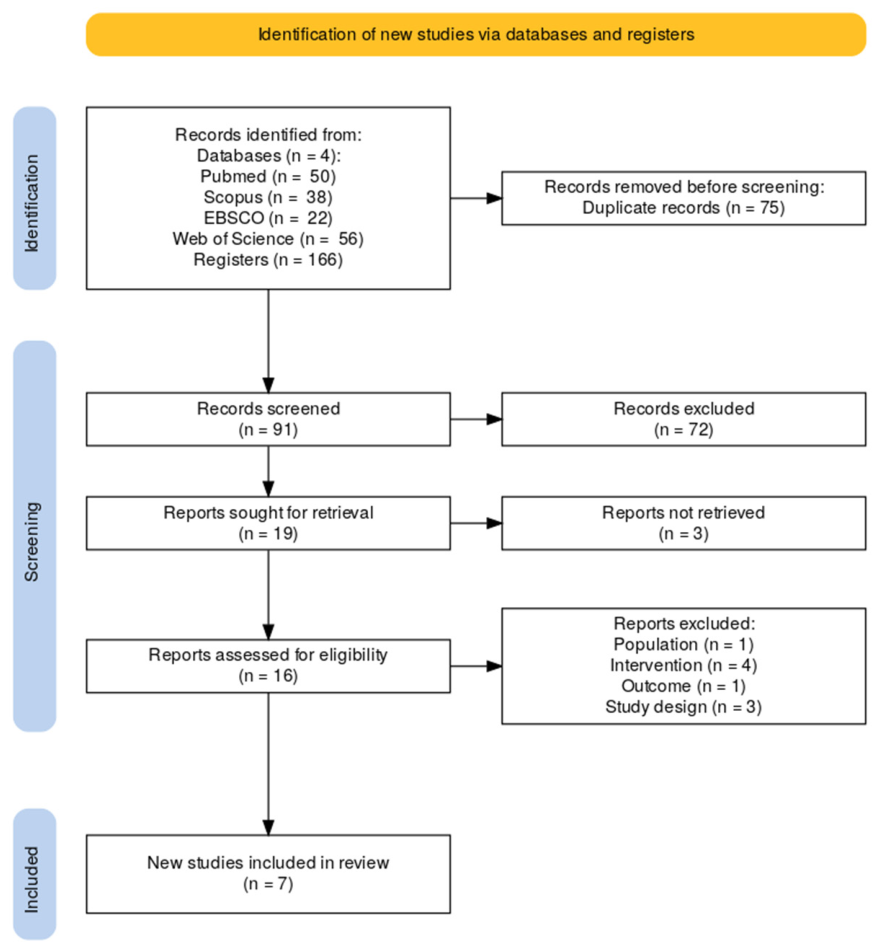
3.1. Search Results
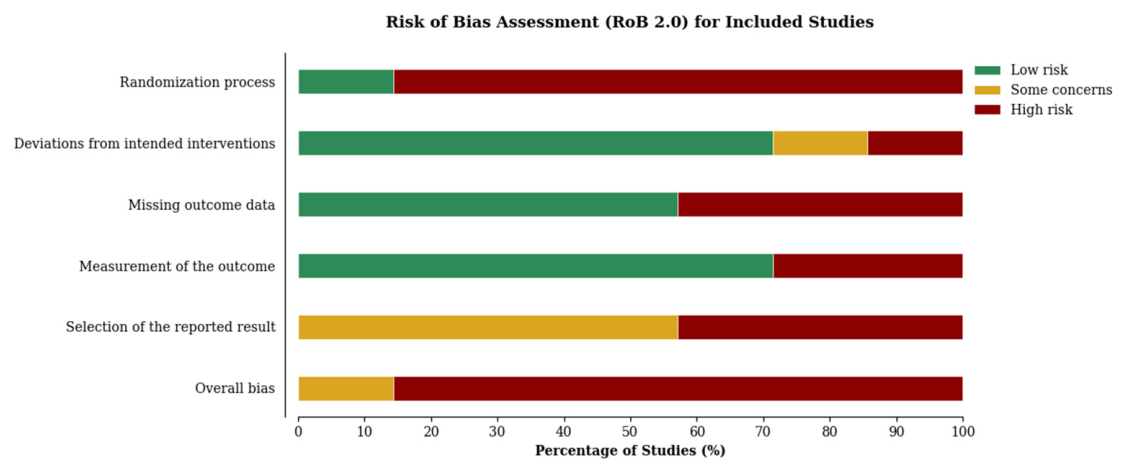
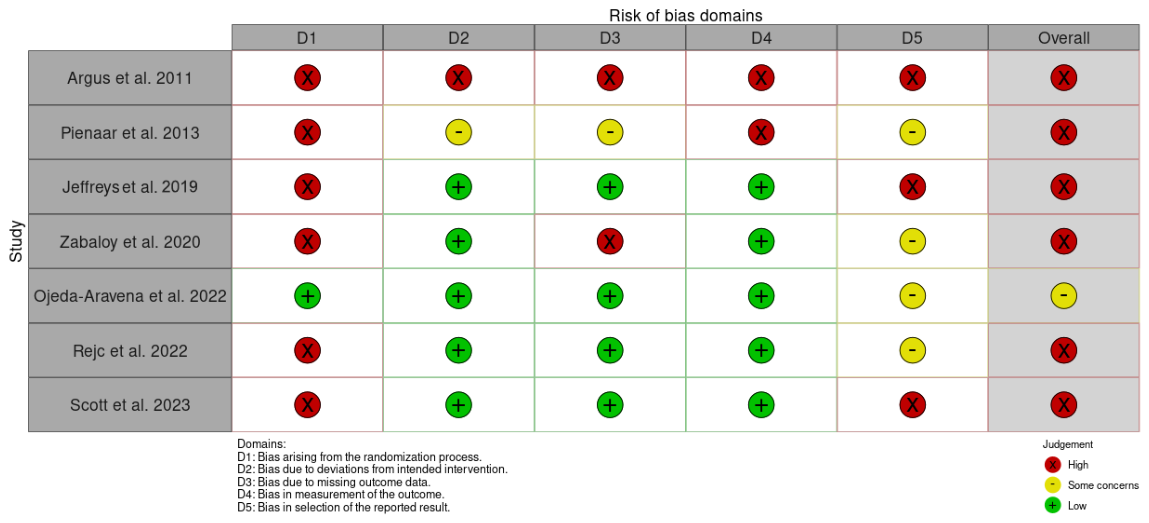
3.2. Study Characteristics and Risk of Bias
4. Discussion
5. Conclusions
5.1. Limitations
5.2. Future Projections
Author Contributions
Funding
Institutional Review Board Statement
Informed Consent Statement
Data Availability Statement
Conflicts of Interest
References
- Rugby, W. Crece la Participación Global en el Rugby de cara a Rugby World Cup 2023. Available online: https://www.world.rugby/news/836825/global-rugby-participation-increasing-ahead-of-rugby-world-cup-2023 (accessed on 25 February 2025).
- Cunningham, D.J.; Shearer, D.A.; Drawer, S.; Pollard, B.; Cook, C.J.; Bennett, M.; Russell, M.; Kilduff, L.P. Relationships between physical qualities and key performance indicators during match-play in senior international rugby union players. PLoS ONE 2018, 13, e0202811. [Google Scholar] [CrossRef]
- Barrio, E.D.; Thapa, R.K.; Villanueva-Flores, F.; Garcia-Atutxa, I.; Santibañez-Gutierrez, A.; Fernández-Landa, J.; Ramirez-Campillo, R. Plyometric Jump Training Exercise Optimization for Maximizing Human Performance: A Systematic Scoping Review and Identification of Gaps in the Existing Literature. Sports 2023, 11, 150. [Google Scholar] [CrossRef]
- Carter, J.; Greenwood, M. Complex Training Reexamined: Review and Recommendations to Improve Strength and Power. Strength Cond. J. 2014, 36, 11–19. [Google Scholar] [CrossRef]
- Thapa, R.; Uysal, H.; Clemente, F.; Afonso, J.; Ramirez-Campillo, R. Effects of complex training compared to resistance training alone on physical fitness of healthy individuals: A systematic review with meta-analysis. J. Sports Sci. 2024, 42, 1367–1389. [Google Scholar] [CrossRef] [PubMed]
- Ramirez-Campillo, R.; García-Hermoso, A.; Moran, J.; Chaabene, H.; Negra, Y.; Scanlan, A.T. The effects of plyometric jump training on physical fitness attributes in basketball players: A meta-analysis. J. Sport Health Sci. 2022, 11, 656–670. [Google Scholar] [CrossRef]
- Zhou, J.Y.; Wang, X.; Hao, L.; Ran, X.W.; Wei, W. Meta-analysis of the effect of plyometric training on the athletic performance of youth basketball players. Front. Physiol. 2024, 15, 1427291. [Google Scholar] [CrossRef] [PubMed]
- Oliver, J.L.; Ramachandran, A.K.; Singh, U.; Ramirez-Campillo, R.; Lloyd, R.S. The Effects of Strength, Plyometric and Combined Training on Strength, Power and Speed Characteristics in High-Level, Highly Trained Male Youth Soccer Players: A Systematic Review and Meta-Analysis. Sports Med. 2024, 54, 623–643. [Google Scholar] [CrossRef]
- Pardos-Mainer, E.; Lozano, D.; Torrontegui-Duarte, M.; Cartón-Llorente, A.; Roso-Moliner, A. Effects of Strength vs. Plyometric Training Programs on Vertical Jumping, Linear Sprint and Change of Direction Speed Performance in Female Soccer Players: A Systematic Review and Meta-Analysis. Int. J. Environ. Res. Public Health 2021, 18, 401. [Google Scholar] [CrossRef]
- Ramirez-Campillo, R.; Castillo, D.; Raya-González, J.; Moran, J.; de Villarreal, E.S.; Lloyd, R.S. Effects of Plyometric Jump Training on Jump and Sprint Performance in Young Male Soccer Players: A Systematic Review and Meta-analysis. Sports Med. 2020, 50, 2125–2143. [Google Scholar] [CrossRef]
- Page, M.J.; McKenzie, J.E.; Bossuyt, P.M.; Boutron, I.; Hoffmann, T.C.; Mulrow, C.D.; Shamseer, L.; Tetzlaff, J.M.; Akl, E.A.; Brennan, S.E.; et al. The PRISMA 2020 statement: An updated guideline for reporting systematic reviews. BMJ 2021, 372, n71. [Google Scholar] [CrossRef] [PubMed]
- Ouzzani, M.; Hammady, H.; Fedorowicz, Z.; Elmagarmid, A. Rayyan-a web and mobile app for systematic reviews. Syst. Rev. 2016, 5, 210. [Google Scholar] [CrossRef]
- Sterne, J.A.C.; Savović, J.; Page, M.J.; Elbers, R.G.; Blencowe, N.S.; Boutron, I.; Cates, C.J.; Cheng, H.Y.; Corbett, M.S.; Eldridge, S.M.; et al. RoB 2: A revised tool for assessing risk of bias in randomised trials. BMJ 2019, 366, l4898. [Google Scholar] [CrossRef]
- Higgins, J.; Thomas, J.; Chandler, J.; Cumpston, M.; Li, T.; Page, M.; Welch, V. (Eds.) Cochrane Handbook for Systematic Reviews of Interventions; John Wiley & Sons Ltd.: Hoboken, NJ, USA, 2019. [Google Scholar] [CrossRef]
- Haddaway, N.R.; Page, M.J.; Pritchard, C.C.; McGuinness, L.A. PRISMA2020: An R package and Shiny app for producing PRISMA 2020-compliant flow diagrams, with interactivity for optimised digital transparency and Open Synthesis. Campbell Syst. Rev. 2022, 18, e1230. [Google Scholar] [CrossRef]
- Ojeda-Aravena, A.; Azócar-Gallardo, J.; Campos-Uribe, V.; Báez-San Martín, E.; Aedo-Muñoz, E.A.; Herrera-Valenzuela, T. Effects of plyometric training on softer vs. Harder surfaces on jump-related performance in rugby sevens players. Front. Physiol. 2022, 13, 941675. [Google Scholar] [CrossRef]
- Argus, C.K.; Gill, N.D.; Keogh, J.W.; Blazevich, A.J.; Hopkins, W.G. Kinetic and training comparisons between assisted, resisted, and free countermovement jumps. J. Strength Cond. Res. 2011, 25, 2219–2227. [Google Scholar] [CrossRef]
- Rejc, E.; Floreani, M.; Vaccari, F.; Giovanelli, N.; Botter, A.; Ganzini, A.; Lazzer, S. Effects of underweight-plyometric training on the neuromuscular characteristics in professional rugby players. Gazz. Medica Ital. Arch. Per Le Sci. Mediche 2022, 180, 722–729. [Google Scholar] [CrossRef]
- Zabaloy, S.; Pareja Blanco, F.; Giráldez, J.; Rasmussen, J.; González, J. Effects of individualised training programmes based on the force-velocity imbalance on physical performance in rugby players. Isokinet. Exerc. Sci. 2020, 28, 181–190. [Google Scholar] [CrossRef]
- Jeffreys, M.A.; De Ste Croix, M.B.A.; Lloyd, R.S.; Oliver, J.L.; Hughes, J.D. The Effect of Varying Plyometric Volume on Stretch-Shortening Cycle Capability in Collegiate Male Rugby Players. J. Strength Cond. Res. 2019, 33, 139–145. [Google Scholar] [CrossRef] [PubMed]
- Pienaar, C.; Coetzee, B. Changes in selected physical, motor performance and anthropometric components of university-level rugby players after one microcycle of a combined rugby conditioning and plyometric training program. J. Strength Cond. Res. 2013, 27, 398–415. [Google Scholar] [CrossRef]
- Scott, D.J.; Ditroilo, M.; Orange, S.T.; Marshall, P. The Effect of Complex Training on Physical Performance in Rugby League Players. Int. J. Sports Physiol. Perform. 2023, 18, 240–247. [Google Scholar] [CrossRef]
- Argus, C.K.; Gill, N.D.; Keogh, J.W. Characterization of the differences in strength and power between different levels of competition in rugby union athletes. J. Strength Cond. Res. 2012, 26, 2698–2704. [Google Scholar] [CrossRef] [PubMed]
- Ziv, G.; Lidor, R. On-field Performances of Rugby Union Players—A Review. J. Strength Cond. Res. 2016, 30, 881–892. [Google Scholar] [CrossRef]
- Posthumus, L.; Macgregor, C.; Winwood, P.; Darry, K.; Driller, M.; Gill, N. Physical and Fitness Characteristics of Elite Professional Rugby Union Players. Sports 2020, 8, 85. [Google Scholar] [CrossRef]
- Davies, G.; Riemann, B.L.; Manske, R. Current Concepts of Plyometric Exercise. Int. J. Sports Phys. Ther. 2015, 10, 760–786. [Google Scholar]
- Markovic, G.; Mikulic, P. Neuro-musculoskeletal and performance adaptations to lower-extremity plyometric training. Sports Med. 2010, 40, 859–895. [Google Scholar] [CrossRef]
- Ojeda-Aravena, A.; Herrera-Valenzuela, T.; Valdés-Badilla, P.; Báez-San Martín, E.; Thapa, R.K.; Ramirez-Campillo, R. A Systematic Review with Meta-Analysis on the Effects of Plyometric-Jump Training on the Physical Fitness of Combat Sport Athletes. Sports 2023, 11, 33. [Google Scholar] [CrossRef] [PubMed]
- Stojanović, E.; Ristic, V.; McMaster, D.; Milanović, Z. Effect of Plyometric Training on Vertical Jump Performance in Female Athletes: A Systematic Review and Meta-Analysis. Sports Med. 2017, 47, 975–986. [Google Scholar] [CrossRef]
- Markovic, G. Does plyometric training improve vertical jump height? A meta-analytical review. Br. J. Sports Med. 2007, 41, 349–355; discussion 355. [Google Scholar] [CrossRef]
- Ramirez-Campillo, R.; Thapa, R.K.; Afonso, J.; Perez-Castilla, A.; Bishop, C.; Byrne, P.J.; Granacher, U. Effects of Plyometric Jump Training on the Reactive Strength Index in Healthy Individuals Across the Lifespan: A Systematic Review with Meta-analysis. Sports Med. 2023, 53, 1029–1053. [Google Scholar] [CrossRef]
- Cao, S.; Wang, Z.; Guo, J.; Geok, S.K.; Sun, H.; Liu, J. The effects of plyometric training on physical fitness and skill-related performance in female basketball players: A systematic review and meta-analysis. Front. Physiol. 2024, 15, 1386788. [Google Scholar] [CrossRef]
- Nicholls, M.; Coetzee, D.; Schall, R.; Kraak, W. Analysing match-related performance indicators in Super Rugby competitions: A study of the 2017–2019 seasons. Int. J. Sports Sci. Coach. 2024, 19, 1066–1081. [Google Scholar] [CrossRef]
- Oxfeldt, M.; Overgaard, K.; Hvid, L.G.; Dalgas, U. Effects of plyometric training on jumping, sprint performance, and lower body muscle strength in healthy adults: A systematic review and meta-analyses. Scand. J. Med. Sci. Sports 2019, 29, 1453–1465. [Google Scholar] [CrossRef] [PubMed]
- Cunniffe, B.; Proctor, W.; Baker, J.S.; Davies, B. An evaluation of the physiological demands of elite rugby union using Global Positioning System tracking software. J. Strength Cond. Res. 2009, 23, 1195–1203. [Google Scholar] [CrossRef] [PubMed]



| Research Question (PICOT) | |
|---|---|
| Population | Rugby players (union or league) of any competitive level (elite, sub-elite, amateur, youth) and gender. |
| Intervention | Plyometric training programs including jump exercises (e.g., depth jumps, countermovement jumps, hurdle jumps). |
| Comparison | Control groups that performed: (a) Usual/traditional training (e.g., strength, endurance training). (b) No additional training intervention. |
| Outcome | Primary: Variables derived from vertical jump tests: jump height, power output, force output, reactive strength index, and muscle stiffness. Secondary: Other physical performance measures not derived from jumping. |
| Study Design | Randomized controlled trials (RCTs), non-randomized controlled trials, and quasi-experimental studies. |
| Time: | Minimum intervention duration of 4 weeks for plyometric jump training programmers. |
| Eligibility Criteria | |
| Inclusion Criteria |
|
| Exclusion Criteria |
|
| By Database | Search Strategies |
|---|---|
| Pubmed | (“Rugby”[Mesh] OR “rugby”) AND (“plyometric exercise”[MeSH Terms] OR (“plyometric” AND “exercise”) OR “plyometric exercise” OR (“plyometric” AND “training”) OR “plyometric training”) AND (“performance” OR “fitness”) |
| Scopus | Rugby (Title-Abs-Key) AND plyometric (Title-Abs-Key) AND training (Title-Abs-Key) AND performance (Title-Abs-Key) |
| EBSCO (SPORTDiscus) | Rugby AND plyometric training AND performance |
| Web of Science | Rugby (Topic) AND Plyometric (Topic) AND training (Topic) AND performance (Topic) |
| Domain | Low Risk | High Risk | Some Concerns |
|---|---|---|---|
| Randomization process | Adequately generated sequence and clearly described allocation concealment. | Non-random sequence, lack of concealment, or major imbalances in baseline characteristics. | Lack of information on methods used to generate the sequence or ensure concealment. |
| Deviations from intended interventions | Interventions implemented according to protocol, without influences from participants or non-blinded personnel. | Significant changes in interventions that could have affected results and are related to the assigned group. | Inconsistent supervision or lack of information on measures to mitigate influences from personnel or participants. |
| Missing outcome data | Low attrition rates distributed equally between groups, with appropriate handling of missing data. | High attrition rates, and missing data likely related to the outcomes or the intervention. | Moderate proportion of missing data or unclear data management. |
| Measurement of the outcome | Outcome assessors blinded to the assigned group, and results measured objectively with validated instruments. | Non-blinded assessors and/or subjective measurement of outcomes. | Lack of information on blinding or potential subjectivity in outcome measurement. |
| Selection of the reported result | All predefined outcomes were reported and a previously registered protocol was followed. | Only selected results are reported without justification, or reports do not match a registered protocol. | Lack of prior protocol registration or insufficient justification for the selection of reported results. |
| Reference | Participants | Population Characteristics | Intervention Duration | Weekly Frequency | Training Modality |
|---|---|---|---|---|---|
| Argus et al. (2011) [17] | 28 | Male rugby players with 2 years of experience in strength and plyometric training | 4 weeks | 2 sessions | Complex training |
| Pienaar & Coetzee (2013) [21] | 35 | Male university players with 10–12 years of rugby experience | 4 weeks | 3 sessions | Combined training |
| Jeffreys et al. (2019) [20] | 29 | Male university players with 1–2 years of experience in plyometry | 6 weeks | 2 sessions | Combined training |
| Zabaloy et al. (2020) [19] | 34 | Male senior players with 10 years of rugby experience | 7 weeks | 2 sessions | Combined training |
| Ojeda-Aravena et al. (2022) [16] | 14 | Male players with 3 years of rugby experience | 4 weeks | 3 sessions | Combined training |
| Rejc et al. (2022) [18] | 14 | Elite male forwards (Italian national championship) | 8 weeks | 2 sessions | Combined training |
| Scott et al. (2023) [22] | 24 | Male university players with 6 months of strength training experience | 6 weeks | 2 sessions | Complex training |
| Reference | Groups | Jump Test Performance Indicators | General Physical Performance Indicators |
|---|---|---|---|
| Argus et al. (2011) [17] | EG-F, EG-A, EG-R | CMJ: Height (%) ↔ EG-F (+1.3%); Height (%) ↔ EG-A (+6.7%); Height (%) ↔ EG-R (+4.0%) | Not reported |
| Pienaar & Coetzee (2013) [21] | EG | Sargent jump test: Height (cm) ↔ EG (+2.0%); Peak power (W) ↔ EG (+1.0%) | 20 m Sprint (s) ↓ EG (−2.7%); T-test (s) ↓ EG (−2.8%). Wingate test (W): ↑ EG (+2.8%) * |
| Jeffreys et al. (2019) [20] | EG-LV, EG-HV | 30 cm DJ: RSI ↑ EG-LV (+11.1%), RSI ↑ EG-HV (+5.7%). 45 cm DJ: RSI ↑ EG-LV (+9.0%), RSI ↑ EG-HV (+7.9%). 60 cm DJ: RSI ↑ EG-LV (+17.5%), RSI ↑ EG-HV (+9.6%). Multi-jumps (10 reps): Stiffness (kN·m−1) ↑ EG-LV (+2.4%), Stiffness (kN·m−1) ↑ EG-HV (+9.5%) | Not reported |
| Zabaloy et al. (2020) [19] | EG-NI, EG-VI, EG-SI, EG-B | SJ: Height (cm) ↔ EG-VI (+5.2%). CMJ: Height (cm) ↔ All groups | 30 m Sprint (s) ↓ EG-SI (−1.2%), 30 m Sprint (s) ↓ EG-B (−1.4%). 1 RM Squat (kg) ↔ All groups |
| Ojeda-Aravena et al. (2022) [16] | EG-HS, EG-SS | SJ: Height (cm) ↔ EG-HS (+4.3%), Height (cm) ↔ EG-SS (+4.6%). CMJ: Height (cm) ↔ EG-HS (+5.2%), Height (cm) ↔ EG-SS (+1.6%). CMJ with arms: Height (cm) ↔ EG-HS (+5.3%), Height (cm) ↑ EG-SS (+8.2%) | Not reported |
| Rejc et al. (2022) [18] | EG | SJ: Peak power (W) ↔ EG (+0.8%). CMJ: Peak power (W) ↔ EG (−7.6%). DJ: Peak power (W) ↔ EG (−0.9%) | Max isometric knee extension strength (N) ↔ EG (+3.9%). Max isometric knee flexion strength (N) ↔ EG (+7.7%). Max isometric plantar flexion strength (N) ↑ EG (+35.9%) * |
| Scott et al. (2023) [22] | EG-VLC, EG-TLC | CMJ: Peak power (W) ↑ EG-VLC (+4.4%), Peak power (W) ↑ EG-TLC (+5.0%) *. 40 cm DJ: RSI ↑ EG-VLC (+20.4%), RSI ↔ EG-TLC (+20.7%). Multi-jumps (10 s): Stiffness (kN·m−1) ↑ EG-VLC (+6.3%), Stiffness (kN·m−1) ↔ EG-TLC (+3.3%) | 1 RM Squat (kg) ↑ EG-VLC (+13.4%), 1 RM Squat (kg) ↑ EG-TLC (+16.0%). 5 m Sprint (s) ↓ EG-VLC (−5.6%), 5 m Sprint (s) ↓ EG-TLC (−8.1%). 20 m Sprint (s) ↔ EG-VLC (−1.6%), 20 m Sprint (s) ↓ EG-TLC (−3.3%) * |
Disclaimer/Publisher’s Note: The statements, opinions and data contained in all publications are solely those of the individual author(s) and contributor(s) and not of MDPI and/or the editor(s). MDPI and/or the editor(s) disclaim responsibility for any injury to people or property resulting from any ideas, methods, instructions or products referred to in the content. |
© 2026 by the authors. Licensee MDPI, Basel, Switzerland. This article is an open access article distributed under the terms and conditions of the Creative Commons Attribution (CC BY) license.
Share and Cite
Russell-Guzmán, J.; Moraga-Moraga, S.; Espinoza-Salinas, A.; Inostroza-Ríos, F.; Carvajal-Parodi, C.; Guede-Rojas, F.; Ulloa-Díaz, D.; Pérez-Contreras, J. Effect of Plyometric Jump Training on Vertical Jump Indicators and Performance-Related General Physical Fitness in Rugby Players: A Systematic Review. Life 2026, 16, 859. https://doi.org/10.3390/life16050859
Russell-Guzmán J, Moraga-Moraga S, Espinoza-Salinas A, Inostroza-Ríos F, Carvajal-Parodi C, Guede-Rojas F, Ulloa-Díaz D, Pérez-Contreras J. Effect of Plyometric Jump Training on Vertical Jump Indicators and Performance-Related General Physical Fitness in Rugby Players: A Systematic Review. Life. 2026; 16(5):859. https://doi.org/10.3390/life16050859
Chicago/Turabian StyleRussell-Guzmán, Javier, Sebastián Moraga-Moraga, Alexis Espinoza-Salinas, Felipe Inostroza-Ríos, Claudio Carvajal-Parodi, Francisco Guede-Rojas, David Ulloa-Díaz, and Jorge Pérez-Contreras. 2026. "Effect of Plyometric Jump Training on Vertical Jump Indicators and Performance-Related General Physical Fitness in Rugby Players: A Systematic Review" Life 16, no. 5: 859. https://doi.org/10.3390/life16050859
APA StyleRussell-Guzmán, J., Moraga-Moraga, S., Espinoza-Salinas, A., Inostroza-Ríos, F., Carvajal-Parodi, C., Guede-Rojas, F., Ulloa-Díaz, D., & Pérez-Contreras, J. (2026). Effect of Plyometric Jump Training on Vertical Jump Indicators and Performance-Related General Physical Fitness in Rugby Players: A Systematic Review. Life, 16(5), 859. https://doi.org/10.3390/life16050859