Machine Learning-Based Identification of Candidate Serum miRNA Features for Pan-Cancer and Cancer Type Classification


 and
and 
Abstract
1. Introduction
2. Materials and Methods
2.1. Dataset
2.2. Feature-Ranking Algorithms
2.3. Incremental Feature Selection
2.4. Synthetic Minority Oversampling Technique
2.5. Classification Algorithms
2.6. Cross-Validation Strategy
2.7. Performance Evaluation
3. Results
3.1. Results of Feature-Ranking Algorithms
3.2. Results of IFS
3.3. Uncovering Biologically Significant Candidate miRNAs
3.4. Quantitative Characterization of miRNA Expression Patterns in Different Populations
4. Discussion
4.1. Feature Analysis for Cancer Versus Non-Cancer Identification
4.2. Feature Analysis for Cancer Type Classification
4.3. Cancer Versus Non-Cancer Classification Rule Analysis
4.4. Cancer Type Classification Rule Analysis
4.5. Limitations
5. Conclusions
Supplementary Materials
Author Contributions
Funding
Institutional Review Board Statement
Informed Consent Statement
Data Availability Statement
Conflicts of Interest
Abbreviations
| miRNA | MicroRNA |
| CATboost | Categorical boosting |
| LASSO | Least absolute shrinkage and selection operator |
| LightGBM | Light gradient boosting machine |
| MCFS | Monte Carlo feature selection |
| mRMR | Minimum redundancy maximum relevance |
| XGBoost | Extreme gradient boosting |
| SMOTE | Synthetic minority oversampling technique |
| IFS | Incremental feature selection |
| RF | Random forest |
| KNN | k-nearest neighbor |
| DT | Decision tree |
| SVM | Support vector machine |
| LIFR | Leukemia inhibitory factor receptor |
| SFTPC | Surfactant protein C |
| LATS2 | Large tumor suppressor 2 |
| hBMSC | Human bone marrow mesenchymal stem cell |
References
- Roy, P.S.; Saikia, B.J. Cancer and cure: A critical analysis. Indian J. Cancer 2016, 53, 441–442. [Google Scholar] [CrossRef]
- Robinson, D.R.; Wu, Y.-M.; Lonigro, R.J.; Vats, P.; Cobain, E.; Everett, J.; Cao, X.; Rabban, E.; Kumar-Sinha, C.; Raymond, V.; et al. Integrative clinical genomics of metastatic cancer. Nature 2017, 548, 297–303. [Google Scholar] [CrossRef] [PubMed]
- Srinivas, P.R.; Kramer, B.S.; Srivastava, S. Trends in biomarker research for cancer detection. Lancet Oncol. 2001, 2, 698–704. [Google Scholar] [CrossRef] [PubMed]
- Calin, G.A.; Dumitru, C.D.; Shimizu, M.; Bichi, R.; Zupo, S.; Noch, E.; Aldler, H.; Rattan, S.; Keating, M.; Rai, K.; et al. Frequent deletions and down-regulation of micro- RNA genes miR15 and miR16 at 13q14 in chronic lymphocytic leukemia. Proc. Natl. Acad. Sci. USA 2002, 99, 15524–15529. [Google Scholar] [CrossRef] [PubMed]
- Lujambio, A.; Lowe, S.W. The microcosmos of cancer. Nature 2012, 482, 347–355. [Google Scholar] [CrossRef]
- Lu, J.; Getz, G.; Miska, E.A.; Alvarez-Saavedra, E.; Lamb, J.; Peck, D.; Sweet-Cordero, A.; Ebert, B.L.; Mak, R.H.; Ferrando, A.A.; et al. Microrna expression profiles classify human cancers. Nature 2005, 435, 834–838. [Google Scholar] [CrossRef] [PubMed]
- Hill, M.; Tran, N. Mirna interplay: Mechanisms and consequences in cancer. Dis. Model. Mech. 2021, 14, dmm047662. [Google Scholar] [CrossRef]
- Bartel, D.P. Micrornas: Genomics, biogenesis, mechanism, and function. Cell 2004, 116, 281–297. [Google Scholar] [PubMed]
- Saliminejad, K.; Khorram Khorshid, H.R.; Soleymani Fard, S.; Ghaffari, S.H. An overview of micrornas: Biology, functions, therapeutics, and analysis methods. J. Cell Physiol. 2019, 234, 5451–5465. [Google Scholar] [PubMed]
- He, B.; Zhao, Z.; Cai, Q.; Zhang, Y.; Zhang, P.; Shi, S.; Xie, H.; Peng, X.; Yin, W.; Tao, Y.; et al. Mirna-based biomarkers, therapies, and resistance in cancer. Int. J. Biol. Sci. 2020, 16, 2628–2647. [Google Scholar]
- Hussen, B.M.; Hidayat, H.J.; Salihi, A.; Sabir, D.K.; Taheri, M.; Ghafouri-Fard, S. Microrna: A signature for cancer progression. Biomed. Pharmacother. 2021, 138, 111528. [Google Scholar] [CrossRef] [PubMed]
- Lin, S.C.; Liu, C.J.; Lin, J.A.; Chiang, W.F.; Hung, P.S.; Chang, K.W. Mir-24 up-regulation in oral carcinoma: Positive association from clinical and in vitro analysis. Oral Oncol. 2010, 46, 204–208. [Google Scholar] [CrossRef]
- Gao, Y.; Liu, Y.; Du, L.; Li, J.; Qu, A.; Zhang, X.; Wang, L.; Wang, C. Down-regulation of mir-24-3p in colorectal cancer is associated with malignant behavior. Med. Oncol. 2015, 32, 362. [Google Scholar] [CrossRef]
- Liu, F.; Dong, H.; Mei, Z.; Huang, T. Investigation of mirna and mrna co-expression network in ependymoma. Front. Bioeng. Biotechnol. 2020, 8, 177. [Google Scholar] [CrossRef]
- Zhou, Y.; Zheng, X.; Xu, B.; Hu, W.; Huang, T.; Jiang, J. The identification and analysis of mrna-lncrna-mirna cliques from the integrative network of ovarian cancer. Front. Genet. 2019, 10, 751. [Google Scholar] [CrossRef]
- Liu, C.; Zhang, Y.H.; Deng, Q.; Li, Y.; Huang, T.; Zhou, S.; Cai, Y.D. Cancer-related triplets of mrna-lncrna-mirna revealed by integrative network in uterine corpus endometrial carcinoma. Biomed. Res. Int. 2017, 2017, 3859582. [Google Scholar] [CrossRef]
- Crowley, E.; Di Nicolantonio, F.; Loupakis, F.; Bardelli, A. Liquid biopsy: Monitoring cancer-genetics in the blood. Nat. Rev. Clin. Oncol. 2013, 10, 472–484. [Google Scholar] [CrossRef]
- Siravegna, G.; Marsoni, S.; Siena, S.; Bardelli, A. Integrating liquid biopsies into the management of cancer. Nat. Rev. Clin. Oncol. 2017, 14, 531–548. [Google Scholar] [CrossRef]
- Nikanjam, M.; Kato, S.; Kurzrock, R. Liquid biopsy: Current technology and clinical applications. J. Hematol. Oncol. 2022, 15, 131. [Google Scholar] [CrossRef] [PubMed]
- Grewal, J.K.; Tessier-Cloutier, B.; Jones, M.; Gakkhar, S.; Ma, Y.; Moore, R.; Mungall, A.J.; Zhao, Y.; Taylor, M.D.; Gelmon, K.; et al. Application of a neural network whole transcriptome–based pan-cancer method for diagnosis of primary and metastatic cancers. JAMA Netw. Open 2019, 2, e192597. [Google Scholar] [CrossRef] [PubMed]
- Singh, A.; Shannon, C.P.; Gautier, B.; Rohart, F.; Vacher, M.; Tebbutt, S.J.; Lê Cao, K.-A. Diablo: An integrative approach for identifying key molecular drivers from multi-omics assays. Bioinformatics 2019, 35, 3055–3062. [Google Scholar] [CrossRef]
- Mar-Aguilar, F.; Mendoza-Ramírez, J.A.; Malagón-Santiago, I.; Espino-Silva, P.K.; Santuario-Facio, S.K.; Ruiz-Flores, P.; Rodríguez-Padilla, C.; Reséndez-Pérez, D. Serum circulating microrna profiling for identification of potential breast cancer biomarkers. Dis. Markers 2013, 34, 163–169. [Google Scholar] [CrossRef]
- Li, Y.; Kang, K.; Krahn, J.M.; Croutwater, N.; Lee, K.; Umbach, D.M.; Li, L. A comprehensive genomic pan-cancer classification using the cancer genome atlas gene expression data. BMC Genom. 2017, 18, 508. [Google Scholar] [CrossRef] [PubMed]
- Zhao, N.; Guo, M.; Wang, K.; Zhang, C.; Liu, X. Identification of pan-cancer prognostic biomarkers through integration of multi-omics data. Front. Bioeng. Biotechnol. 2020, 8, 268. [Google Scholar] [CrossRef] [PubMed]
- Ranstam, J.; Cook, J.A. Lasso regression. Br. J. Surg. 2018, 105, 1348. [Google Scholar] [CrossRef]
- Ke, G.; Meng, Q.; Finley, T.; Wang, T.; Chen, W.; Ma, W.; Ye, Q.; Liu, T.-Y. Lightgbm: A highly efficient gradient boosting decision tree. In Proceedings of the 31st International Conference on Neural Information Processing Systems; Curran Associates Inc.: Long Beach, CA, USA, 2017; pp. 3149–3157. [Google Scholar]
- Dramiński, M.; Koronacki, J. Rmcfs: An r package for monte carlo feature selection and interdependency discovery. J. Stat. Softw. 2018, 85, 1–28. [Google Scholar] [CrossRef]
- Peng, H.; Long, F.; Ding, C. Feature selection based on mutual information: Criteria of max-dependency, max-relevance, and min-redundancy. IEEE Trans. Pattern Anal. Mach. Intell. 2005, 27, 1226–1238. [Google Scholar] [CrossRef] [PubMed]
- Breiman, L. Random forests. Mach. Learn. 2001, 45, 5–32. [Google Scholar] [CrossRef]
- Dorogush, A.V.; Ershov, V.; Gulin, A. Catboost: Gradient boosting with categorical features support. arXiv 2018, arXiv:1810.11363. [Google Scholar] [CrossRef]
- Chen, T.; Guestrin, C. Xgboost: A Scalable Tree Boosting System. In Proceedings of the The 22nd ACM SIGKDD International Conference on Knowledge Discovery and Data Mining, San Francisco, CA, USA, 13–17 August 2016; Association for Computing Machinery: San Francisco, CA, USA, 2016; pp. 785–794. [Google Scholar]
- Liu, H.; Setiono, R. Incremental feature selection. Appl. Intell. 1998, 9, 217–230. [Google Scholar] [CrossRef]
- Safavian, S.R.; Landgrebe, D. A survey of decision tree classifier methodology. IEEE Trans. Syst. Man. Cybern. 1991, 21, 660–674. [Google Scholar] [CrossRef]
- Guo, G.; Wang, H.; Bell, D.; Bi, Y.; Greer, K. Knn Model-Based Approach in Classification. In On The Move to Meaningful Internet Systems 2003: CoopIS, DOA, and ODBASE, Proceedings of the OTM Confederated International Conferences, CoopIS, DOA, and ODBASE 2003, Catania, Sicily, Italy, 3–7 November 2003; Springer: Berlin/Heidelberg, Germany, 2003; pp. 986–996. [Google Scholar]
- Cristianini, N.; Shawe-Taylor, J. An Introduction to Support Vector Machines and Other Kernel-Based Learning Methods; Cambridge University Press: Cambridge, UK, 2000. [Google Scholar]
- Chawla, N.V.; Bowyer, K.W.; Hall, L.O.; Kegelmeyer, W.P. Smote: Synthetic minority over-sampling technique. J. Artif. Intell. Res. 2002, 16, 321–357. [Google Scholar] [CrossRef]
- Matsuzaki, J.; Kato, K.; Oono, K.; Tsuchiya, N.; Sudo, K.; Shimomura, A.; Tamura, K.; Shiino, S.; Kinoshita, T.; Daiko, H.; et al. Prediction of tissue-of-origin of early stage cancers using serum mirnomes. JNCI Cancer Spectr. 2023, 7, pkac080. [Google Scholar] [CrossRef]
- Li, H.; Huang, F.; Liao, H.; Li, Z.; Feng, K.; Huang, T.; Cai, Y.D. Identification of COVID-19-specific immune markers using a machine learning method. Front. Mol. Biosci. 2022, 9, 952626. [Google Scholar] [CrossRef]
- Li, Z.; Guo, W.; Ding, S.; Chen, L.; Feng, K.; Huang, T.; Cai, Y.D. Identifying key microrna signatures for neurodegenerative diseases with machine learning methods. Front. Genet. 2022, 13, 880997. [Google Scholar] [CrossRef]
- Lu, J.; Meng, M.; Zhou, X.; Ding, S.; Feng, K.; Zeng, Z.; Huang, T.; Cai, Y.D. Identification of COVID-19 severity biomarkers based on feature selection on single-cell rna-seq data of cd8(+) t cells. Front. Genet. 2022, 13, 1053772. [Google Scholar] [CrossRef]
- Ren, J.; Zhou, X.; Huang, K.; Chen, L.; Guo, W.; Feng, K.; Huang, T.; Cai, Y.D. Identification of key genes associated with persistent immune changes and secondary immune activation responses induced by influenza vaccination after COVID-19 recovery by machine learning methods. Comput. Biol. Med. 2023, 169, 107883. [Google Scholar] [CrossRef] [PubMed]
- Ma, Q.L.; Huang, F.M.; Guo, W.; Feng, K.Y.; Huang, T.; Cai, Y.D. Machine learning classification of time since bnt162b2 COVID-19 vaccination based on array-measured antibody activity. Life 2023, 13, 1304. [Google Scholar] [CrossRef]
- Kohavi, R. A study of cross-validation and bootstrap for accuracy estimation and model selection. In Proceedings of the International Joint Conference on Artificial Intelligence, Montreal, QC, Canada, 20–25 August 1995; Lawrence Erlbaum Associates Ltd.: Montreal, QC, Canada, 1995; pp. 1137–1145. [Google Scholar]
- Cover, T.; Hart, P. Nearest neighbor pattern classification. IEEE Trans. Inf. Theory 1967, 13, 21–27. [Google Scholar] [CrossRef]
- Cortes, C.; Vapnik, V. Support-vector networks. Mach. Learn. 1995, 20, 273–297. [Google Scholar] [CrossRef]
- Pedregosa, F.; Varoquaux, G.; Gramfort, A.; Michel, V.; Thirion, B.; Grisel, O.; Blondel, M.; Prettenhofer, P.; Weiss, R.; Dubourg, V. Scikit-learn: Machine learning in python. J. Mach. Learn. Res. 2011, 12, 2825–2830. [Google Scholar]
- Liao, H.; Ma, Q.; Chen, L.; Guo, W.; Feng, K.; Bao, Y.; Zhang, Y.; Shen, W.; Huang, T.; Cai, Y.-D. Machine learning analysis of cd4+ t cell gene expression in diverse diseases: Insights from cancer, metabolic, respiratory, and digestive disorders. Cancer Genet. 2025, 290–291, 56–60. [Google Scholar] [CrossRef]
- Chen, L.; Lu, Y.; Xu, J.; Zhou, B. Prediction of drug’s anatomical therapeutic chemical (atc) code by constructing biological profiles of atc codes. BMC Bioinform. 2025, 26, 86. [Google Scholar] [CrossRef]
- Yuan, F.; Huang, F.; Cao, X.; Zhang, Y.-H.; Feng, K.; Bao, Y.; Huang, T.; Cai, Y.-D. Integrative multi-omics machine learning reveals novel driver genes associations in lung adenocarcinoma. Biochim. Biophys. Acta (BBA) Proteins Proteom. 2026, 1874, 141113. [Google Scholar] [CrossRef]
- Ren, J.; Liao, H.; Chen, L.; Bao, Y.; Guo, W.; Feng, K.; Huang, T.; Cai, Y.-D. Identification of gene signatures associated with multisystem inflammatory syndrome in children after SARS-CoV-2 infection. Curr. Bioinform. 2025. [Google Scholar] [CrossRef]
- Chen, L.; Yang, J.; Zhou, B.; Cai, Y.-D. Plysptm-hgnn: Predicting lysine ptm sites of proteins using hybrid graph neural networks. BMC Bioinform. 2026, 27, 32. [Google Scholar] [CrossRef] [PubMed]
- Powers, D. Evaluation: From precision, recall and f-measure to roc., informedness, markedness & correlation. J. Mach. Learn. Technol. 2011, 2, 37–63. [Google Scholar]
- Chen, L.; Chen, Y.; Zhou, B. Hclamcmi: Prediction of circrna-mirna interactions based on hypergraph contrastive learning and an attention mechanism. J. Chem. Inf. Model. 2025, 65, 12099–12115. [Google Scholar] [CrossRef]
- Ren, J.; Gao, Q.; Zhou, X.; Feng, K.; Guo, W.; Huang, T.; Cai, Y.-D. Identification of gene signatures differentiating cancer from normal tissues across histological classifications of gastric adenocarcinoma via machine learning methods. Biochem. Genet. 2026. [Google Scholar] [CrossRef] [PubMed]
- Ma, Q.; Ren, J.; Chen, L.; Guo, W.; Feng, K.; Zhang, Y.; Shen, W.; Huang, T.; Cai, Y.-D. Identifying transcriptional signatures of leukocytes in tissue and blood for multicancer diagnosis by using machine learning methods. Cancer Genet. 2026, 302–303, 13–26. [Google Scholar] [CrossRef]
- Chen, L.; Gu, J.; Zhou, B. Pmislocmf: Predicting mirna subcellular localizations by incorporating multi-source features of mirnas. Brief. Bioinform. 2024, 25, bbae386. [Google Scholar] [CrossRef]
- Chen, L.; Xu, L.; Zhou, B.; Chen, Y. Anticannet: A graph convolution and chemical llm framework for predicting anti-cancer small molecules. Curr. Bioinform. 2026. [Google Scholar]
- Chen, L.; Hu, J.; Zhou, B. Predicting circrna subcellular localization by fusing circrna sequence and network information. Sci. Rep. 2026, 16, 12775. [Google Scholar] [CrossRef] [PubMed]
- Chen, L.; Xun, X.; Zhou, B. Root-associated protein prediction using a protein large language model and hypergraph convolutional networks. Sci. Rep. 2026, 16, 4876. [Google Scholar] [CrossRef] [PubMed]
- Bao, Y.; Zhou, X.; Feng, K.; Guo, W.; Huang, T.; Cai, Y.-D. Convergent autoencoder and machine learning methodologies for SARS-CoV-2 essential host factor identification based on interferon pathway loss-of-function perturb-seq data mining. Curr. Bioinform. 2026. [Google Scholar]
- Matthews, B.W. Comparison of the predicted and observed secondary structure of t4 phage lysozyme. Biochim. Biophys. Acta 1975, 405, 442–451. [Google Scholar] [CrossRef]
- Licursi, V.; Conte, F.; Fiscon, G.; Paci, P. Mienturnet: An interactive web tool for microrna-target enrichment and network-based analysis. BMC Bioinform. 2019, 20, 545. [Google Scholar] [CrossRef] [PubMed]
- Boissan, M.; De Wever, O.; Lizarraga, F.; Wendum, D.; Poincloux, R.; Chignard, N.; Desbois-Mouthon, C.; Dufour, S.; Nawrocki-Raby, B.; Birembaut, P.; et al. Implication of metastasis suppressor nm23-h1 in maintaining adherens junctions and limiting the invasive potential of human cancer cells. Cancer Res. 2010, 70, 7710–7722. [Google Scholar] [CrossRef]
- Eke, I.; Cordes, N. Focal adhesion signaling and therapy resistance in cancer. Semin. Cancer Biol. 2015, 31, 65–75. [Google Scholar] [CrossRef]
- Tilghman, R.W.; Parsons, J.T. Focal adhesion kinase as a regulator of cell tension in the progression of cancer. Semin. Cancer Biol. 2008, 18, 45–52. [Google Scholar] [CrossRef]
- Ding, S.; Li, H.; Zhang, Y.H.; Zhou, X.; Feng, K.; Li, Z.; Chen, L.; Huang, T.; Cai, Y.D. Identification of pan-cancer biomarkers based on the gene expression profiles of cancer cell lines. Front. Cell Dev. Biol. 2021, 9, 781285. [Google Scholar] [CrossRef]
- Li, J.; Xu, Q.; Wu, M.; Huang, T.; Wang, Y. Pan-cancer classification based on self-normalizing neural networks and feature selection. Front. Bioeng. Biotechnol. 2020, 8, 766. [Google Scholar] [CrossRef]
- Chang, L.; Zhou, G.; Soufan, O.; Xia, J. Mirnet 2.0: Network-based visual analytics for mirna functional analysis and systems biology. Nucleic Acids Res. 2020, 48, W244–W251. [Google Scholar] [CrossRef]
- Hamidi, F.; Gilani, N.; Belaghi, R.A.; Sarbakhsh, P.; Edgünlü, T.; Santaguida, P. Exploration of potential mirna biomarkers and prediction for ovarian cancer using artificial intelligence. Front. Genet. 2021, 12, 724785. [Google Scholar] [CrossRef]
- Gierl, M.S.; Karoulias, N.; Wende, H.; Strehle, M.; Birchmeier, C. The zinc-finger factor insm1 (ia-1) is essential for the development of pancreatic beta cells and intestinal endocrine cells. Genes Dev. 2006, 20, 2465–2478. [Google Scholar] [CrossRef]
- Juhlin, C.C.; Zedenius, J.; Höög, A. Clinical routine application of the second-generation neuroendocrine markers isl1, insm1, and secretagogin in neuroendocrine neoplasia: Staining outcomes and potential clues for determining tumor origin. Endocr. Pathol. 2020, 31, 401–410. [Google Scholar] [CrossRef]
- Zhang, C.; Chen, B.; Jiao, A.; Li, F.; Sun, N.; Zhang, G.; Zhang, J. Mir-663a inhibits tumor growth and invasion by regulating tgf-β1 in hepatocellular carcinoma. BMC Cancer 2018, 18, 1179. [Google Scholar] [CrossRef]
- Wang, Z.; Zhang, H.; Zhang, P.; Dong, W.; He, L. Microrna-663 suppresses cell invasion and migration by targeting transforming growth factor beta 1 in papillary thyroid carcinoma. Tumor Biol. 2016, 37, 7633–7644. [Google Scholar] [CrossRef]
- Lu, J.; Li, J.; Ren, J.; Ding, S.; Zeng, Z.; Huang, T.; Cai, Y.D. Functional and embedding feature analysis for pan-cancer classification. Front. Oncol. 2022, 12, 979336. [Google Scholar] [CrossRef]
- Shi, Y.; Chen, C.; Zhang, X.; Liu, Q.; Xu, J.-L.; Zhang, H.-R.; Yao, X.-H.; Jiang, T.; He, Z.-C.; Ren, Y.; et al. Primate-specific mir-663 functions as a tumor suppressor by targeting pik3cd and predicts the prognosis of human glioblastoma. Clin. Cancer Res. 2014, 20, 1803–1813. [Google Scholar] [CrossRef]
- Pan, J.; Hu, H.; Zhou, Z.; Sun, L.; Peng, L.; Yu, L.; Sun, L.; Liu, J.; Yang, Z.; Ran, Y. Tumor-suppressive mir-663 gene induces mitotic catastrophe growth arrest in human gastric cancer cells. Oncol. Rep. 2010, 24, 105–112. [Google Scholar] [CrossRef]
- Liu, Z.Y.; Zhang, G.L.; Wang, M.M.; Xiong, Y.N.; Cui, H.Q. Microrna-663 targets tgfb1 and regulates lung cancer proliferation. Asian Pac. J. Cancer Prev. 2011, 12, 2819–2823. [Google Scholar]
- Yaghoobi, H.; Babaei, E.; Hussen, B.M.; Emami, A. Ebst: An evolutionary multi-objective optimization based tool for discovering potential biomarkers in ovarian cancer. IEEE/ACM Trans. Comput. Biol. Bioinform. 2021, 18, 2384–2393. [Google Scholar] [CrossRef]
- Li, Z.; Chen, Z.; Hu, G.; Zhang, Y.; Feng, Y.; Jiang, Y.; Wang, J. Profiling and integrated analysis of differentially expressed circrnas as novel biomarkers for breast cancer. J. Cell Physiol. 2020, 235, 7945–7959. [Google Scholar] [CrossRef]
- Liu, H.-P.; Lai, H.-M.; Guo, Z. Prostate cancer early diagnosis: Circulating microrna pairs potentially beyond single micrornas upon 1231 serum samples. Brief. Bioinform. 2021, 22, bbaa111. [Google Scholar] [CrossRef]
- Chen, J.W.; Dhahbi, J. Identification of four serum mirnas as potential markers to screen for thirteen cancer types. PLoS ONE 2022, 17, e0269554. [Google Scholar] [CrossRef]
- Chen, S.; Wang, L.; Yao, B.; Liu, Q.; Guo, C. Mir-1307-3p promotes tumor growth and metastasis of hepatocellular carcinoma by repressing dab2 interacting protein. Biomed. Pharmacother. 2019, 117, 109055. [Google Scholar] [CrossRef]
- Han, S.; Zou, H.; Lee, J.W.; Han, J.; Kim, H.C.; Cheol, J.J.; Kim, L.S.; Kim, H. Mir-1307-3p stimulates breast cancer development and progression by targeting smyd4. J. Cancer 2019, 10, 441–448. [Google Scholar] [CrossRef]
- Guo, Z.; Zhang, Y.; Xu, W.; Zhang, X.; Jiang, J. Engineered exosome-mediated delivery of circdido1 inhibits gastric cancer progression via regulation of mir-1307-3p/socs2 axis. J. Transl. Med. 2022, 20, 326. [Google Scholar] [CrossRef]
- Chen, Q.; Mao, Y.; Meng, F.; Wang, L.; Zhang, H.; Wang, W.; Hua, D. Rs7911488 modified the efficacy of capecitabine-based therapy in colon cancer through altering mir-1307-3p and tyms expression. Oncotarget 2017, 8, 74312–74319. [Google Scholar] [CrossRef]
- Duan, N.; Hu, X.; Yang, X.; Cheng, H.; Zhang, W. Microrna-370 directly targets foxm1 to inhibit cell growth and metastasis in osteosarcoma cells. Int. J. Clin. Exp. Pathol. 2015, 8, 10250–10260. [Google Scholar]
- Zhang, L.; Zheng, Y.; Sun, Y.; Zhang, Y.; Yan, J.; Chen, Z.; Jiang, H. Mir-134-mbd3 axis regulates the induction of pluripotency. J. Cell Mol. Med. 2016, 20, 1150–1158. [Google Scholar] [CrossRef]
- White, N.M.; Chow, T.F.; Mejia-Guerrero, S.; Diamandis, M.; Rofael, Y.; Faragalla, H.; Mankaruous, M.; Gabril, M.; Girgis, A.; Yousef, G.M. Three dysregulated mirnas control kallikrein 10 expression and cell proliferation in ovarian cancer. Br. J. Cancer 2010, 102, 1244–1253. [Google Scholar] [CrossRef]
- Guha, M.; Xia, F.; Raskett, C.M.; Altieri, D.C. Caspase 2-mediated tumor suppression involves survivin gene silencing. Oncogene 2010, 29, 1280–1292. [Google Scholar] [CrossRef] [PubMed]
- Si, Z.; Zhou, S.; Shen, Z.; Luan, F.; Yan, J. Knockdown of lncrna fezf1-as1 inhibits metastasis of osteosarcoma cells by mir-4456/galnt10. Res. Sq. 2020. [Google Scholar] [CrossRef]
- Xu, C.; Zhang, L.; Li, H.; Liu, Z.; Duan, L.; Lu, C. Mirna-1469 promotes lung cancer cells apoptosis through targeting stat5a. Am. J. Cancer Res. 2015, 5, 1180–1189. [Google Scholar]
- Zhang, N.; Wang, M.; Zhang, P.; Huang, T. Classification of cancers based on copy number variation landscapes. Biochim. Biophys. Acta 2016, 1860, 2750–2755. [Google Scholar] [CrossRef]
- Luo, J.; Manning, B.D.; Cantley, L.C. Targeting the pi3k-akt pathway in human cancer: Rationale and promise. Cancer Cell 2003, 4, 257–262. [Google Scholar] [CrossRef]
- Qiu, H.; Shao, Z.; Wen, X.; Liu, Z.; Chen, Z.; Qu, D.; Ding, X.; Zhang, L. Efferocytosis: An accomplice of cancer immune escape. Biomed. Pharmacother. 2023, 167, 115540. [Google Scholar] [CrossRef]
- Turner, K.M.; Sun, Y.; Ji, P.; Granberg, K.J.; Bernard, B.; Hu, L.; Cogdell, D.E.; Zhou, X.; Yli-Harja, O.; Nykter, M. Genomically amplified akt3 activates DNA repair pathway and promotes glioma progression. Proc. Natl. Acad. Sci. USA 2015, 112, 3421–3426. [Google Scholar] [CrossRef] [PubMed]
- Álvarez-Fernández, M.; Malumbres, M. Mechanisms of sensitivity and resistance to cdk4/6 inhibition. Cancer Cell 2020, 37, 514–529. [Google Scholar] [CrossRef]
- Oerlemans, R.; Franke, N.E.; Assaraf, Y.G.; Cloos, J.; van Zantwijk, I.; Berkers, C.R.; Scheffer, G.L.; Debipersad, K.; Vojtekova, K.; Lemos, C. Molecular basis of bortezomib resistance: Proteasome subunit β5 (psmb5) gene mutation and overexpression of psmb5 protein. Blood J. Am. Soc. Hematol. 2008, 112, 2489–2499. [Google Scholar] [CrossRef]
- Taniguchi, K.; Iwatsuki, A.; Sugito, N.; Shinohara, H.; Kuranaga, Y.; Oshikawa, Y.; Tajirika, T.; Futamura, M.; Yoshida, K.; Uchiyama, K. Oncogene rna helicase ddx6 promotes the process of c-myc expression in gastric cancer cells. Mol. Carcinog. 2018, 57, 579–589. [Google Scholar] [CrossRef]
- Chugh, S.; Meza, J.; Sheinin, Y.M.; Ponnusamy, M.P.; Batra, S.K. Loss of n-acetylgalactosaminyltransferase 3 in poorly differentiated pancreatic cancer: Augmented aggressiveness and aberrant erbb family glycosylation. Br. J. Cancer 2016, 114, 1376–1386. [Google Scholar] [CrossRef]
- Li, Y.; Sun, S.; Zhang, H.; Jing, Y.; Ji, X.; Wan, Q.; Liu, Y. Calu promotes lung adenocarcinoma progression by enhancing cell proliferation, migration and invasion. Respir. Res. 2024, 25, 267. [Google Scholar] [CrossRef] [PubMed]
- Wang, J.; Song, C.; Tang, H.; Zhang, C.; Tang, J.; Li, X.; Chen, B.; Xie, X. Mir-629-3p may serve as a novel biomarker and potential therapeutic target for lung metastases of triple-negative breast cancer. Breast Cancer Res. 2017, 19, 72. [Google Scholar] [CrossRef] [PubMed]
- Li, B.; Meng, Y.-Q.; Li, Z.; Yin, C.; Lin, J.-P.; Zhu, D.-J.; Zhang, S.-B. Mir-629-3p-induced downregulation of sftpc promotes cell proliferation and predicts poor survival in lung adenocarcinoma. Artif. Cells Nanomed. Biotechnol. 2019, 47, 3286–3296. [Google Scholar] [CrossRef] [PubMed]
- Li, Y.; Zeng, S.; Cao, L. Mir-629 repressed lats2 expression and promoted the proliferation of prostate cancer cells. Horm. Metab. Res. 2023, 55, 573–579. [Google Scholar] [CrossRef]
- Yan, H.; Li, Q.; Wu, J.; Hu, W.; Jiang, J.; Shi, L.; Yang, X.; Zhu, D.; Ji, M.; Wu, C. Mir-629 promotes human pancreatic cancer progression by targeting foxo3. Cell Death Dis. 2017, 8, e3154. [Google Scholar] [CrossRef]
- Yang, X.; Zhou, Y.; Lai, Q.; Huang, S.; Liu, X.; Hu, B.; Dai, M.; Zhang, B. Mirna-6087 delivered by exosomes derived from human bone marrow mesenchymal stem cells, inhibition of mir-6087 in exosomes can significantly inhibit the proliferation, invasion and migration of tumor cells. Res. Sq. 2020. [Google Scholar] [CrossRef]
- Usuba, W.; Urabe, F.; Yamamoto, Y.; Matsuzaki, J.; Sasaki, H.; Ichikawa, M.; Takizawa, S.; Aoki, Y.; Niida, S.; Kato, K.; et al. Circulating mirna panels for specific and early detection in bladder cancer. Cancer Sci. 2019, 110, 408–419. [Google Scholar] [CrossRef]
- Wei, W.-T.; Nian, X.-X.; Wang, S.-Y.; Jiao, H.-L.; Wang, Y.-X.; Xiao, Z.-Y.; Yang, R.-W.; Ding, Y.-Q.; Ye, Y.-P.; Liao, W.-T. Mir-422a inhibits cell proliferation in colorectal cancer by targeting akt1 and mapk1. Cancer Cell Int. 2017, 17, 91. [Google Scholar] [CrossRef] [PubMed]
- Zou, Y.; Chen, Y.; Yao, S.; Deng, G.; Liu, D.; Yuan, X.; Liu, S.; Rao, J.; Xiong, H.; Yuan, X.; et al. Mir-422a weakened breast cancer stem cells properties by targeting plp2. Cancer Biol. Ther. 2018, 19, 436–444. [Google Scholar] [CrossRef]
- Liu, M.; Xiusheng, H.; Xiao, X.; Wang, Y. Overexpression of mir-422a inhibits cell proliferation and invasion, and enhances chemosensitivity in osteosarcoma cells. Oncol. Rep. 2016, 36, 3371–3378. [Google Scholar] [CrossRef]
- Zhang, H.; He, Q.-Y.; Wang, G.-C.; Tong, D.-K.; Wang, R.-K.; Ding, W.-B.; Li, C.; Wei, Q.; Ding, C.; Liu, P.-Z.; et al. Mir-422a inhibits osteosarcoma proliferation by targeting bcl2l2 and kras. Biosci. Rep. 2018, 38, BSR20170339. [Google Scholar] [CrossRef]
- Zhou, Z.; Lin, Z.; He, Y.; Pang, X.; Wang, Y.; Ponnusamy, M.; Ao, X.; Shan, P.; Tariq, M.A.; Li, P.; et al. The long noncoding rna d63785 regulates chemotherapy sensitivity in human gastric cancer by targeting mir-422a. Mol. Ther. Nucleic Acids 2018, 12, 405–419. [Google Scholar] [CrossRef]
- Li, F.; Xu, J.W.; Wang, L.; Liu, H.; Yan, Y.; Hu, S.Y. Microrna-221-3p is up-regulated and serves as a potential biomarker in pancreatic cancer. Artif. Cells Nanomed. Biotechnol. 2018, 46, 482–487. [Google Scholar] [CrossRef]
- Wu, Q.; Ren, X.; Zhang, Y.; Fu, X.; Li, Y.; Peng, Y.; Xiao, Q.; Li, T.; Ouyang, C.; Hu, Y.; et al. Mir-221-3p targets arf4 and inhibits the proliferation and migration of epithelial ovarian cancer cells. Biochem. Biophys. Res. Commun. 2018, 497, 1162–1170. [Google Scholar] [CrossRef]
- Tao, K.; Yang, J.; Guo, Z.; Hu, Y.; Sheng, H.; Gao, H.; Yu, H. Prognostic value of mir-221-3p, mir-342-3p and mir-491-5p expression in colon cancer. Am. J. Transl. Res. 2014, 6, 391–401. [Google Scholar] [PubMed]
- Zhang, Y.; Huang, H.; Zhang, Y.; Liao, N. Combined detection of serum mir-221-3p and mir-122-5p expression in diagnosis and prognosis of gastric cancer. J. Gastric Cancer 2019, 19, 315–328. [Google Scholar] [CrossRef]
- Li, H.; Zhang, B.; Ding, M.; Lu, S.; Zhou, H.; Sun, D.; Wu, G.; Gan, X. C1qtnf1-as1 regulates the occurrence and development of hepatocellular carcinoma by regulating mir-221-3p/socs3. Hepatol. Int. 2019, 13, 277–292. [Google Scholar] [CrossRef] [PubMed]
- Luo, M.; Li, Z.; Wang, W.; Zeng, Y.; Liu, Z.; Qiu, J. Long non-coding rna h19 increases bladder cancer metastasis by associating with ezh2 and inhibiting e-cadherin expression. Cancer Lett. 2013, 333, 213–221. [Google Scholar] [CrossRef] [PubMed]
- Ding, D.; Li, C.; Zhao, T.; Li, D.; Yang, L.; Zhang, B. Lncrna h19/mir-29b-3p/pgrn axis promoted epithelial-mesenchymal transition of colorectal cancer cells by acting on wnt signaling. Mol. Cells 2018, 41, 423–435. [Google Scholar]
- Gu, L.; Li, Q.; Liu, H.; Lu, X.; Zhu, M. Long noncoding rna tug1 promotes autophagy-associated paclitaxel resistance by sponging mir-29b-3p in ovarian cancer cells. OncoTargets Ther. 2020, 13, 2007–2019. [Google Scholar] [CrossRef] [PubMed]
- Worst, T.S.; Previti, C.; Nitschke, K.; Diessl, N.; Gross, J.C.; Hoffmann, L.; Frey, L.; Thomas, V.; Kahlert, C.; Bieback, K.; et al. Mir-10a-5p and mir-29b-3p as extracellular vesicle-associated prostate cancer detection markers. Cancers 2020, 12, 43. [Google Scholar] [CrossRef]
- Tang, Q.; Li, X.; Chen, Y.; Long, S.; Yu, Y.; Sheng, H.; Wang, S.; Han, L.; Wu, W. Solamargine inhibits the growth of hepatocellular carcinoma and enhances the anticancer effect of sorafenib by regulating hottip-tug1/mir-4726-5p/muc1 pathway. Mol. Carcinog. 2022, 61, 417–432. [Google Scholar] [CrossRef]
- Shen, D.; Zhao, H.; Zeng, P.; Ge, M.; Shrestha, S.; Zhao, W. Circular rna circ_0001459 accelerates hepatocellular carcinoma progression via the mir-6165/igf1r axis. Ann. N. Y. Acad. Sci. 2022, 1512, 46–60. [Google Scholar] [CrossRef] [PubMed]
- Ebrahimi, S.O.; Reiisi, S. Mir-6165 dysregulation in breast cancer and its effect on cell proliferation and migration. ISMJ 2021, 24, 439–453. [Google Scholar] [CrossRef]
- Kano, M.; Seki, N.; Kikkawa, N.; Fujimura, L.; Hoshino, I.; Akutsu, Y.; Chiyomaru, T.; Enokida, H.; Nakagawa, M.; Matsubara, H. Mir-145, mir-133a and mir-133b: Tumor-suppressive mirnas target fscn1 in esophageal squamous cell carcinoma. Int. J. Cancer 2010, 127, 2804–2814. [Google Scholar] [CrossRef]
- Huang, H.; Jiang, Y.; Wang, Y.; Chen, T.; Yang, L.; He, H.; Lin, Z.; Liu, T.; Yang, T.; Kamp, D.W.; et al. Mir-5100 promotes tumor growth in lung cancer by targeting rab6. Cancer Lett. 2015, 362, 15–24. [Google Scholar] [CrossRef] [PubMed]
- Chijiiwa, Y.; Moriyama, T.; Ohuchida, K.; Nabae, T.; Ohtsuka, T.; Miyasaka, Y.; Fujita, H.; Maeyama, R.; Manabe, T.; Abe, A.; et al. Overexpression of microrna-5100 decreases the aggressive phenotype of pancreatic cancer cells by targeting podxl. Int. J. Oncol. 2016, 48, 1688–1700. [Google Scholar] [CrossRef]
- Zhang, H.; Wang, J.; Wang, Y.; Li, J.; Zhao, L.; Zhang, T.; Liao, X. Long non-coding lef1-as1 sponge mir-5100 regulates apoptosis and autophagy in gastric cancer cells via the mir-5100/dek/ampk-mtor axis. Int. J. Mol. Sci. 2022, 23, 4787. [Google Scholar] [CrossRef]
- Mello-Grand, M.; Bruno, A.; Sacchetto, L.; Cristoni, S.; Gregnanin, I.; Dematteis, A.; Zitella, A.; Gontero, P.; Peraldo-Neia, C.; Ricotta, R.; et al. Two novel ceramide-like molecules and mir-5100 levels as biomarkers improve prediction of prostate cancer in gray-zone psa. Front. Oncol. 2021, 11, 769158. [Google Scholar] [CrossRef]
- Yang, W.; Ju, H.Y.; Tian, X.F. Hsa-mir-4730 as a new and potential diagnostic and prognostic indicators for pancreatic cancer. Eur. Rev. Med. Pharmacol. Sci. 2020, 24, 8801–8811. [Google Scholar]
- Kalhori, M.R.; Soleimani, M.; Arefian, E.; Alizadeh, A.M.; Mansouri, K.; Echeverria, J. The potential role of mir-1290 in cancer progression, diagnosis, prognosis, and treatment: An oncomir or onco-suppressor microrna? J. Cell Biochem. 2022, 123, 506–531. [Google Scholar] [CrossRef]
- Wang, L.; Bo, X.; Yi, X.; Xiao, X.; Zheng, Q.; Ma, L.; Li, B. Exosome-transferred linc01559 promotes the progression of gastric cancer via pi3k/akt signaling pathway. Cell Death Dis. 2020, 11, 723. [Google Scholar] [CrossRef]
- Bhat, I.P.; Rather, T.B.; Bhat, G.A.; Maqbool, I.; Akhtar, K.; Rashid, G.; Parray, F.Q.; Besina, S.; Mudassar, S. Tead4 nuclear localization and regulation by mir-4269 and mir-1343-3p in colorectal carcinoma. Pathol.-Res. Pract. 2022, 231, 153791. [Google Scholar] [CrossRef]
- Chen, X.; Wang, J.; Xie, F.; Mou, T.; Zhong, P.; Hua, H.; Liu, P.; Yang, Q. Long noncoding rna linc01559 promotes pancreatic cancer progression by acting as a competing endogenous rna of mir-1343-3p to upregulate raf1 expression. Aging 2020, 12, 14452–14466. [Google Scholar] [CrossRef]
- Li, Y.; Zhao, Z.; Sun, D.; Li, Y. Novel long noncoding rna linc02323 promotes cell growth and migration of ovarian cancer via tgf-β receptor 1 by mir-1343-3p. J. Clin. Lab. Anal. 2021, 35, e23651. [Google Scholar] [CrossRef]
- Wang, X.S.; Zhang, Z.; Wang, H.C.; Cai, J.L.; Xu, Q.W.; Li, M.Q.; Chen, Y.C.; Qian, X.P.; Lu, T.J.; Yu, L.Z.; et al. Rapid identification of uca1 as a very sensitive and specific unique marker for human bladder carcinoma. Clin. Cancer Res. Off. J. Am. Assoc. Cancer Res. 2006, 12, 4851–4858. [Google Scholar] [CrossRef]
- Zhou, Y.; Meng, X.; Chen, S.; Li, W.; Li, D.; Singer, R.; Gu, W. Imp1 regulates uca1-mediated cell invasion through facilitating uca1 decay and decreasing the sponge effect of uca1 for mir-122-5p. Breast Cancer Res. 2018, 20, 32. [Google Scholar] [CrossRef]
- Xiao, Y.; Zhao, Q.; Du, B.; Chen, H.-y.; Zhou, D.-Z. Microrna-187 inhibits growth and metastasis of osteosarcoma by downregulating s100a4. Cancer Investig. 2018, 36, 1–9. [Google Scholar] [CrossRef]
- Chao, A.; Lin, C.Y.; Lee, Y.S.; Tsai, C.L.; Wei, P.C.; Hsueh, S.; Wu, T.I.; Tsai, C.N.; Wang, C.J.; Chao, A.S.; et al. Regulation of ovarian cancer progression by microrna-187 through targeting disabled homolog-2. Oncogene 2012, 31, 764–775. [Google Scholar] [CrossRef]
- Shujuan, K.; Zhongxin, L.; Jingfang, M.; Zhili, C.; Wei, W.; Liu, Q.; Li, Y. Circular rna circ_0000518 promotes breast cancer progression through the microrna-1225-3p/sry-box transcription factor 4 pathway. Bioengineered 2022, 13, 2611–2622. [Google Scholar] [CrossRef]
- Tubita, V.; Segui-Barber, J.; Lozano, J.J.; Banon-Maneus, E.; Rovira, J.; Cucchiari, D.; Moya-Rull, D.; Oppenheimer, F.; Del Portillo, H.; Campistol, J.M.; et al. Effect of immunosuppression in mirnas from extracellular vesicles of colorectal cancer and their influence on the pre-metastatic niche. Sci. Rep. 2019, 9, 11177. [Google Scholar] [CrossRef]
- Rashid, F.; Awan, H.M.; Shah, A.; Chen, L.; Shan, G. Induction of mir-3648 upon er stress and its regulatory role in cell proliferation. Int. J. Mol. Sci. 2017, 18, 1375. [Google Scholar] [CrossRef]
- Zhang, D.; Yin, H.; Bauer, T.L.; Rogers, M.P.; Velotta, J.B.; Morgan, C.T.; Du, W.; Xu, P.; Qian, X. Development of a novel mir-3648-related gene signature as a prognostic biomarker in esophageal adenocarcinoma. Ann. Transl. Med. 2021, 9, 1702. [Google Scholar] [CrossRef]
- Dong, Y.; Zhang, N.; Zhao, S.; Chen, X.; Li, F.; Tao, X. Mir-221-3p and mir-15b-5p promote cell proliferation and invasion by targeting axin2 in liver cancer. Oncol. Lett. 2019, 18, 6491–6500. [Google Scholar] [CrossRef] [PubMed]
- Liu, Z.; Yu, Y.; Huang, Z.; Kong, Y.; Hu, X.; Xiao, W.; Quan, J.; Fan, X. Circrna-5692 inhibits the progression of hepatocellular carcinoma by sponging mir-328-5p to enhance dab2ip expression. Cell Death Dis. 2019, 10, 900. [Google Scholar] [CrossRef]
- Ohno, M.; Matsuzaki, J.; Kawauchi, J.; Aoki, Y.; Miura, J.; Takizawa, S.; Kato, K.; Sakamoto, H.; Matsushita, Y.; Takahashi, M.; et al. Assessment of the diagnostic utility of serum microrna classification in patients with diffuse glioma. JAMA Netw. Open 2019, 2, e1916953. [Google Scholar] [CrossRef]
- Gao, K.-F.; Zhao, Y.-F.; Liao, W.-J.; Xu, G.-L.; Zhang, J.-D. Cers6-as1 promotes cell proliferation and represses cell apoptosis in pancreatic cancer via mir-195-5p/wipi2 axis. Kaohsiung J. Med. Sci. 2022, 38, 542–553. [Google Scholar] [CrossRef]
- Zhou, W.-Y.; Zhang, M.-M.; Liu, C.; Kang, Y.; Wang, J.-O.; Yang, X.-H. Long noncoding rna linc00473 drives the progression of pancreatic cancer via upregulating programmed death-ligand 1 by sponging microrna-195-5p. J. Cell Physiol. 2019, 234, 23176–23189. [Google Scholar] [CrossRef] [PubMed]
- Wang, S.; Du, P.; Cao, Y.; Ma, J.; Yang, X.; Yu, Z.; Yang, Y. Cancer associated fibroblasts secreted exosomal mir-1290 contributes to prostate cancer cell growth and metastasis via targeting gsk3β. Cell Death Discov. 2022, 8, 371. [Google Scholar] [CrossRef] [PubMed]





| Group | Number of Patients | |
|---|---|---|
| Non-cancer | 6245 | |
| Pan-cancer | biliary tract cancer | 402 |
| bladder cancer | 399 | |
| bone and soft tissue sarcomas | 299 | |
| breast cancer | 675 | |
| colorectal cancer | 1596 | |
| esophageal squamous cell cancer | 566 | |
| gastric cancer | 1418 | |
| hepatocellular cancer | 348 | |
| intraparenchymal brain tumors | 241 | |
| lung cancer | 1699 | |
| ovarian cancer | 400 | |
| pancreatic cancer | 851 | |
| prostate cancer | 1027 | |
| Total | 9921 | |
| Feature Ranking Algorithms | Classification Algorithm | Number of Features | SN | SP | Precision | F1 Measure | MCC | ACC |
|---|---|---|---|---|---|---|---|---|
| LASSO | KNN | 25 | 0.979 | 0.965 | 0.946 | 0.962 | 0.938 | 0.970 |
| LightGBM | KNN | 25 | 0.985 | 0.983 | 0.973 | 0.979 | 0.965 | 0.983 |
| MCFS | RF | 15 * | 0.919 | 0.992 | 0.986 | 0.952 | 0.924 | 0.964 |
| RF | 645 ** | 0.940 | 0.991 | 0.985 | 0.962 | 0.940 | 0.971 | |
| mRMR | DT | 50 * | 0.961 | 0.962 | 0.941 | 0.951 | 0.919 | 0.962 |
| DT | 175 ** | 0.966 | 0.966 | 0.946 | 0.956 | 0.928 | 0.966 | |
| RF_ZL | RF | 25 * | 0.928 | 0.985 | 0.976 | 0.951 | 0.923 | 0.963 |
| RF | 995 ** | 0.945 | 0.993 | 0.989 | 0.966 | 0.947 | 0.975 | |
| CATboost | KNN | 50 | 0.984 | 0.982 | 0.971 | 0.977 | 0.963 | 0.982 |
| XGBoost | RF | 35 | 0.962 | 0.987 | 0.979 | 0.970 | 0.952 | 0.977 |
| Feature Ranking Algorithms | Classification Algorithm | Number of Features | Weighted F1 | MCC | ACC |
|---|---|---|---|---|---|
| LASSO | SVM | 60 * | 0.783 | 0.766 | 0.789 |
| SVM | 195 ** | 0.795 | 0.778 | 0.800 | |
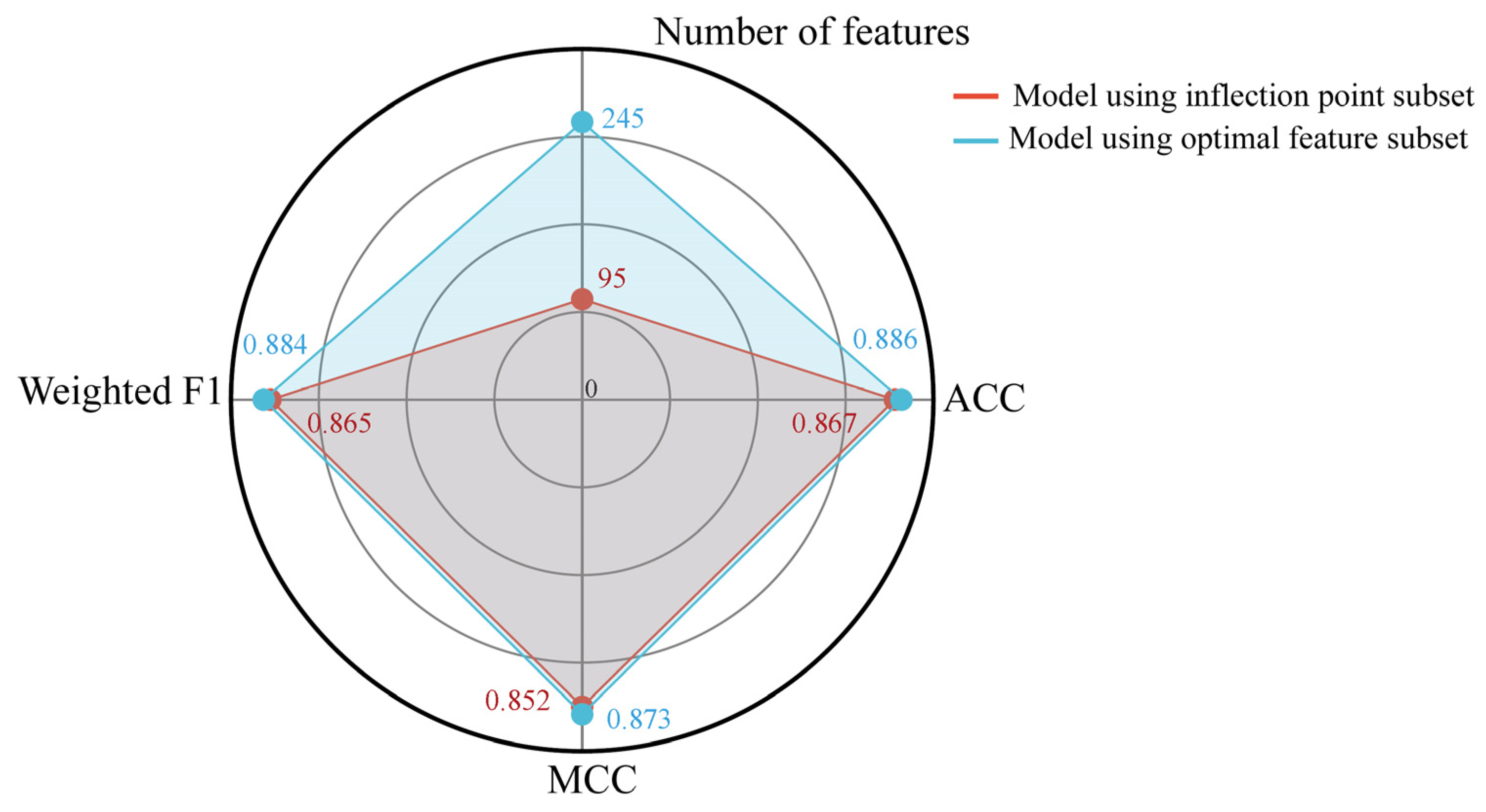
| LightGBM | SVM | 95 * | 0.865 | 0.852 | 0.867 |
| SVM | 245 ** | 0.884 | 0.873 | 0.886 | |
| MCFS | SVM | 95 * | 0.821 | 0.805 | 0.825 |
| SVM | 480 ** | 0.869 | 0.857 | 0.871 | |
| mRMR | SVM | 115 * | 0.821 | 0.806 | 0.825 |
| SVM | 615 ** | 0.850 | 0.837 | 0.853 | |
| RF_ZL | SVM | 115 * | 0.859 | 0.846 | 0.862 |
| SVM | 295 ** | 0.876 | 0.865 | 0.878 | |
| CATboost | SVM | 65 * | 0.850 | 0.836 | 0.853 |
| SVM | 155 ** | 0.878 | 0.866 | 0.880 | |
| XGBoost | SVM | 140 * | 0.821 | 0.805 | 0.825 |
| SVM | 240 ** | 0.832 | 0.817 | 0.835 |
| Cancer Type | F1 Measure | Cancer Type | F1 Measure |
|---|---|---|---|
| biliary tract cancer | 0.865 | bladder cancer | 0.951 |
| bone and soft tissue sarcomas | 0.949 | breast cancer | 0.926 |
| colorectal cancer | 0.767 | esophageal squamous cell cancer | 0.896 |
| gastric cancer | 0.884 | hepatocellular cancer | 0.915 |
| intraparenchymal brain tumors | 0.996 | lung cancer | 0.835 |
| ovarian cancer | 0.948 | pancreatic cancer | 0.933 |
| prostate cancer | 0.971 | - | - |
Disclaimer/Publisher’s Note: The statements, opinions and data contained in all publications are solely those of the individual author(s) and contributor(s) and not of MDPI and/or the editor(s). MDPI and/or the editor(s) disclaim responsibility for any injury to people or property resulting from any ideas, methods, instructions or products referred to in the content. |
© 2026 by the authors. Licensee MDPI, Basel, Switzerland. This article is an open access article distributed under the terms and conditions of the Creative Commons Attribution (CC BY) license.
Share and Cite
Feng, K.; Bao, Y.; Ren, J.; Guo, W.; Wang, D.; Huang, T.; Cai, Y.-D. Machine Learning-Based Identification of Candidate Serum miRNA Features for Pan-Cancer and Cancer Type Classification. Life 2026, 16, 850. https://doi.org/10.3390/life16050850
Feng K, Bao Y, Ren J, Guo W, Wang D, Huang T, Cai Y-D. Machine Learning-Based Identification of Candidate Serum miRNA Features for Pan-Cancer and Cancer Type Classification. Life. 2026; 16(5):850. https://doi.org/10.3390/life16050850
Chicago/Turabian StyleFeng, Kaiyan, Yusheng Bao, Jingxin Ren, Wei Guo, Deling Wang, Tao Huang, and Yu-Dong Cai. 2026. "Machine Learning-Based Identification of Candidate Serum miRNA Features for Pan-Cancer and Cancer Type Classification" Life 16, no. 5: 850. https://doi.org/10.3390/life16050850
APA StyleFeng, K., Bao, Y., Ren, J., Guo, W., Wang, D., Huang, T., & Cai, Y.-D. (2026). Machine Learning-Based Identification of Candidate Serum miRNA Features for Pan-Cancer and Cancer Type Classification. Life, 16(5), 850. https://doi.org/10.3390/life16050850