Systems Biology and Multi-Omics Determinants of Response to Bladder-Preserving Trimodality Therapy in Muscle-Invasive Bladder Cancer

 , , , ,
Abstract
1. Introduction
2. Materials and Methods
3. Endpoints and Patient Selection
3.1. Endpoint Specification and Harmonization for Computational Modeling
3.2. Patient Selection Variables as Model Prerequisites
4. DDR Genomics as Response Prediction Biology: ERCC2 and Related Pathways
4.1. Biological Rationale
4.2. ERCC2 and Nucleotide Excision Repair
4.3. DDR Markers Beyond ERCC2: MRE11 and Radiotherapy Outcomes
4.4. DDR and Immunotherapy Responsiveness: Future Implications for Multi-Modal Strategies
5. Transcriptomic and Immune Stratification of MIBC for TMT: Classification Frameworks, Quantification Methods, and Translational Constraints
5.1. Classification Frameworks: Basal–Luminal Lineage and Consensus Molecular Classes
5.2. Immune Contexture: Prognostic Relevance and Computational Deconvolution
5.3. Reproducible Transcriptomic Feature Engineering: Pathway Scoring and Discovery Platforms
5.4. Translational Constraints: Endpoint Heterogeneity, Assay Variability, and Clinical Interpretability
6. Radiogenomics and Digital Pathology as Noninvasive Surrogates
6.1. Radiomics and Radiogenomics for Bladder Cancer Outcomes
6.2. Deep Learning and Response Assessment on CT
6.3. Digital Pathology and AI in Bladder Cancer
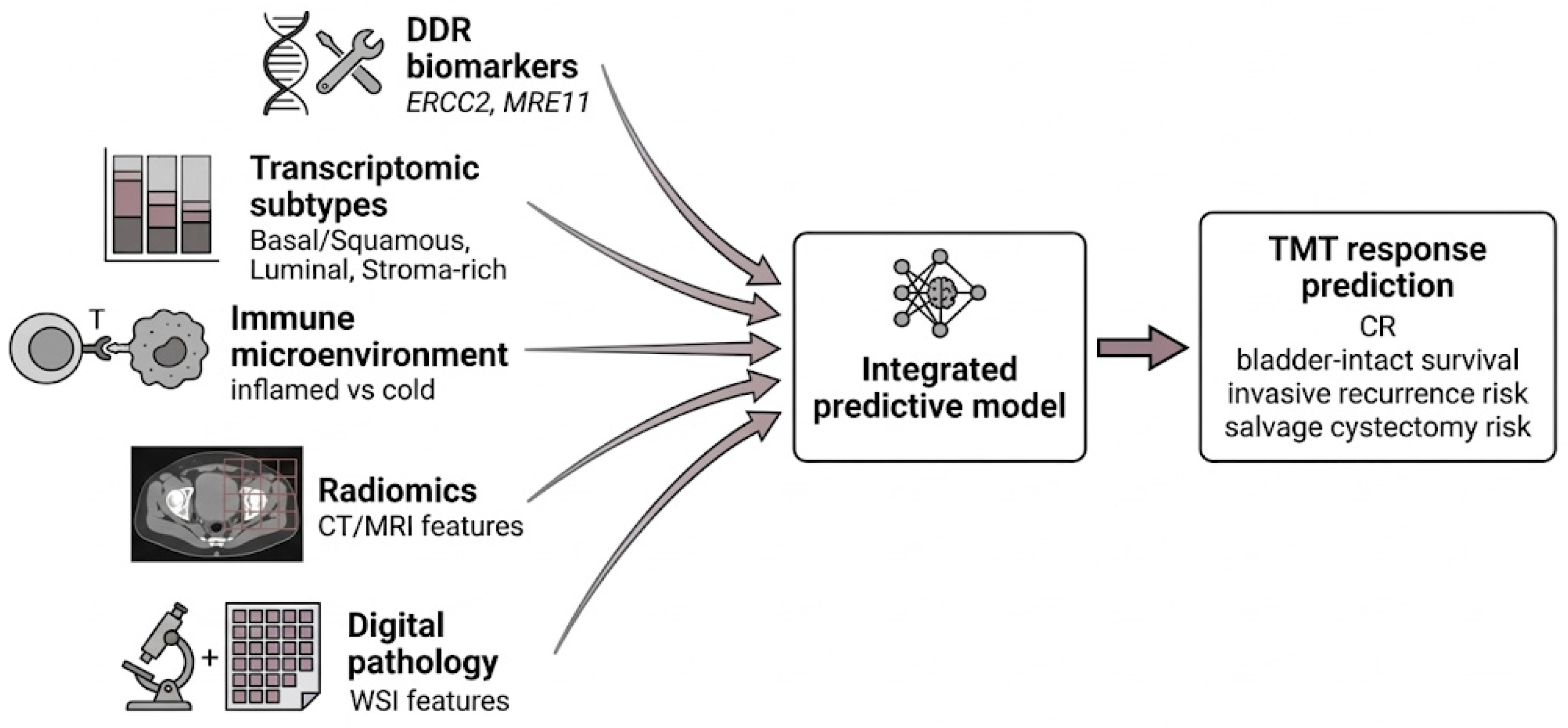
6.4. Integration with Multi-Omics Models: Translational Considerations
7. When to Recommend Cystectomy: Upfront Versus Salvage (Evidence and Guideline Framing)
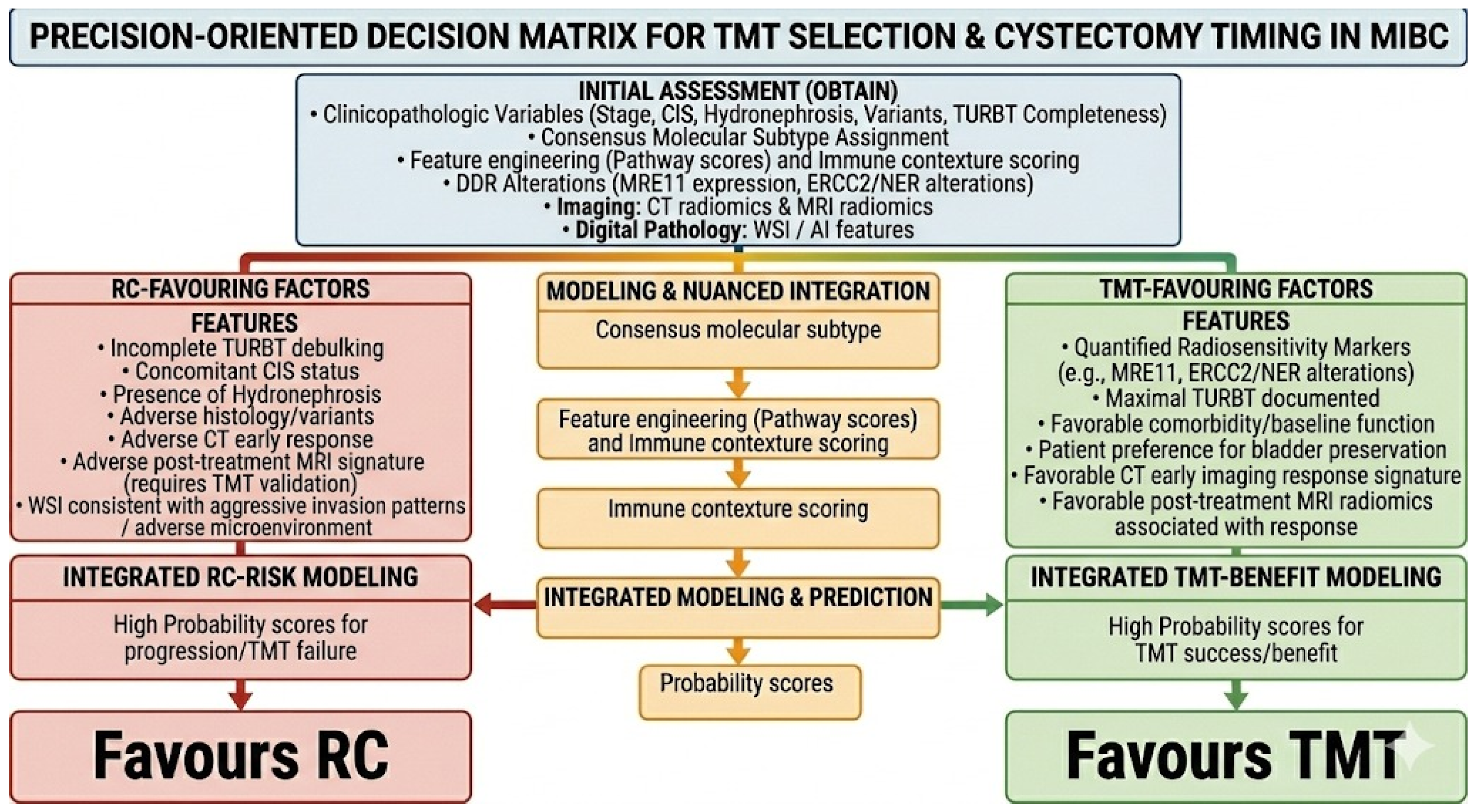
8. Precision Framework for TMT Selection and Cystectomy Timing in MIBC
8.1. Domains of Interest and Integration for Treatment Selection

| Factor (Domain + Variable) | Pre-TMT Operationalization | Decision Relevance |
|---|---|---|
| Clinicopathologic: CIS status | TURBT pathology; document concomitant CIS [13,14]. | May favor TMT: CIS absent. May favor upfront RC/lower salvage threshold: CIS present given higher intravesical failure risk and reduced suitability for bladder preservation [3,13]. |
| Clinicopathologic: hydronephrosis | Baseline imaging; record hydronephrosis [13,14]. | May favor TMT: no hydronephrosis. May favor upfront RC/lower salvage threshold: hydronephrosis as a marker of adverse local disease [13]. |
| Clinicopathologic: TURBT completeness/debulking feasibility | Operative report + pathology; document maximal TURBT [13,14]. | May favor TMT: maximal debulking feasible/achieved. May favor upfront RC/lower salvage threshold: incomplete debulking or inability to achieve maximal TURBT (reduced probability of durable bladder control) [4,5]. |
| Clinicopathologic: histology/variants | Standard histopathology; record variant features [13]. | May favor TMT: histology compatible with bladder preservation in guideline-based selection. May favor upfront RC: adverse histologic contexts where bladder preservation suitability is reduced [13]. |
| Pathology risk: lymphovascular invasion (if available) | TURBT pathology when reported (limited sensitivity) [15]. | May favor TMT: LVI absent (lower-risk biology). May favor upfront RC/lower salvage threshold: LVI present as aggressive-biology marker associated with worse recurrence/survival in cystectomy cohorts [15]. |
| Transcriptome: consensus molecular subtype | RNA from TURBT; assign consensus class with validated classifier [26]. | May favor TMT: subtypes associated with more favorable biology for local control (to be validated against TMT endpoints). May favor upfront RC/lower salvage threshold: subtypes associated with aggressive programs (requires endpoint-specific validation) [26,35]. |
| Immune: immune contexture | Bulk RNA; immune deconvolution and immune program scoring [28,30]. | May favor TMT: immune-inflamed contexture consistent with improved outcomes in bladder cancer. May favor upfront RC/lower salvage threshold: immune-cold/excluded phenotypes (requires validation in TMT cohorts) [28,30]. |
| Immune: immune-risk signatures | Candidate immune genes/signatures prioritized from TCGA-type analyses for testing [29]. | Favors TMT vs. RC: directionality must be defined by TMT-specific validation; intended for risk stratification rather than deterministic selection [29,35]. |
| DDR: MRE11 | TURBT immunohistochemistry; quantify expression [19,20]. | May favor TMT: DDR marker profile associated with radiotherapy outcomes. May favor upfront RC/lower salvage threshold: DDR profile associated with poorer radiotherapy-related outcomes [19,20]. |
| DDR: ERCC2/NER alterations | Targeted DNA sequencing from TURBT where feasible [17,18]. | May favor TMT:ERCC2/NER alterations associated with cisplatin sensitivity and NER deficiency, potentially increasing benefit from platinum-based radiosensitization. May favor upfront RC/lower salvage threshold: absence of sensitizing DDR signals does not preclude TMT but reduces biologic rationale for enhanced chemo-radiation sensitivity [14,17,18]. |
| Feature engineering: pathway program scores | GSVA-based continuous program scoring from bulk expression [31]. | May favor TMT vs. RC: program directionality must be defined by TMT-specific model calibration; pathway scores provide continuous features enabling risk-tier assignment rather than binary eligibility [31]. |
| Imaging: CT radiomics for response assessment | Standardized CT acquisition/segmentation; extract radiomic/deep-learning features [39]. | May favor TMT: favorable early imaging response signature may support continuation. May favor early salvage/lower salvage threshold: adverse imaging might suggest residual disease risk [39]. |
| Imaging: MRI radiomics (treatment-modified state) | mpMRI radiomics; compare baseline vs. on-treatment/post-treatment features [38]. | May favor continued organ-preservation strategy: favorable post-treatment MRI radiomics associated with response (pCR AUC = 0.83 post vs. = 0.66 pre; major response AUC = 0.92). May favor early salvage strategy: adverse post-treatment imaging [38]. |
| Digital pathology: whole-slide imaging (WSI)/AI features | WSI from TURBT; derives morphologic and microenvironmental features [40]. | May favor TMT: WSI features consistent with favorable differentiation/immune contexture. May favor upfront RC/lower salvage threshold: WSI features consistent with aggressive invasion patterns or adverse microenvironmental signals [40]. |
| Modeling: interpretable multimodal integration | Late fusion + attribution frameworks integrating clinical + molecular ± imaging features [43]. | May favor TMT vs. RC: enables calibrated individualized risk tiers (e.g., predicted CR, invasive recurrence, salvage RC risk) rather than deterministic single-marker selection [43]. |
8.2. Toward a Quantitative Scoring Framework for TMT Selection
9. From Code to Clinic
9.1. Data Requirements and Public Resources
9.2. Framework Validation and Implementation
9.3. Methodological and Implementation Limitations
10. Conclusions
11. Future Directions
Author Contributions
Funding
Institutional Review Board Statement
Informed Consent Statement
Data Availability Statement
Acknowledgments
Conflicts of Interest
Abbreviations
| AI | Artificial Intelligence |
| AQUA | Automated Quantitative Immunofluorescence |
| AUC | Area Under the Curve |
| cCR | Clinical Complete Response |
| CIBERSORT | Cell-Type Identification by Estimating Relative Subsets of RNA Transcripts |
| CIS | Carcinoma In Situ |
| CR | Complete Response |
| CT | Computed Tomography |
| ctDNA | Circulating Tumor DNA |
| DDR | DNA Damage Response |
| EAU | European Association of Urology |
| ECOG-ACRIN | Eastern Cooperative Oncology Group—American College of Radiology Imaging Network |
| EMT | Epithelial–Mesenchymal Transition |
| GSVA | Gene Set Variation Analysis |
| HR | Hazard Ratio |
| LVI | Lymphovascular Invasion |
| MFS | Metastasis-Free Survival |
| MIBC | Muscle-Invasive Bladder Cancer |
| mpMRI | Multiparametric Magnetic Resonance Imaging |
| MRI | Magnetic Resonance Imaging |
| MVAC | Methotrexate, Vinblastine, Doxorubicin, and Cisplatin |
| NER | Nucleotide Excision Repair |
| NMIBC | Non-Muscle-Invasive Bladder Cancer |
| NPV | Negative Predictive Value |
| NRG | NRG Oncology |
| OS | Overall Survival |
| pCR | Pathological Complete Response |
| PD-L1 | Programmed Death-Ligand 1 |
| PPV | Positive Predictive Value |
| RC | Radical Cystectomy |
| RNA | Ribonucleic Acid |
| RTOG | Radiation Therapy Oncology Group |
| SWOG | Southwest Oncology Group |
| TCGA | The Cancer Genome Atlas |
| TMB | Tumor Mutational Burden |
| TMT | Trimodality Therapy |
| TURBT | Transurethral Resection of Bladder Tumor |
| utDNA | Urinary Tumor DNA |
| VI-RADS | Vesical Imaging-Reporting and Data System |
| WSI | Whole-Slide Imaging |
References
- Sung, H.; Ferlay, J.; Siegel, R.L.; Laversanne, M.; Soerjomataram, I.; Jemal, A.; Bray, F. Global cancer statistics 2020: GLOBOCAN estimates of incidence and mortality worldwide for 36 cancers in 185 countries. CA Cancer J. Clin. 2021, 71, 209–249. [Google Scholar] [CrossRef]
- Dobruch, J.; Daneshmand, S.; Fisch, M.; Lotan, Y.; Noon, A.P.; Resnick, M.J.; Shariat, S.F.; Zlotta, A.R.; Boorjian, S.A. Gender and bladder cancer: A collaborative review of etiology, biology, and outcomes. Eur. Urol. 2016, 69, 300–310. [Google Scholar] [CrossRef]
- Ploussard, G.; Daneshmand, S.; Efstathiou, J.A.; Herr, H.W.; James, N.D.; Rödel, C.M.; Shariat, S.F.; Shipley, W.U.; Sternberg, C.N.; Thalmann, G.N.; et al. Critical analysis of bladder sparing with trimodal therapy in muscle-invasive bladder cancer: A systematic review. Eur. Urol. 2014, 66, 120–137. [Google Scholar] [CrossRef]
- Giacalone, N.J.; Shipley, W.U.; Clayman, R.H.; Niemierko, A.; Drumm, M.; Heney, N.M.; Michaelson, M.D.; Lee, R.J.; Saylor, P.J.; Wszolek, M.F.; et al. Long-term outcomes after bladder-preserving tri-modality therapy for patients with muscle-invasive bladder cancer: An updated analysis of the Massachusetts General Hospital experience. Eur. Urol. 2017, 71, 952–960. [Google Scholar] [CrossRef] [PubMed]
- Mak, R.H.; Hunt, D.; Shipley, W.U.; Efstathiou, J.A.; Tester, W.J.; Hagan, M.P.; Kaufman, D.S.; Heney, N.M.; Zietman, A.L. Long-term outcomes in patients with muscle-invasive bladder cancer after selective bladder-preserving combined-modality therapy: A pooled analysis of RTOG protocols 8802, 8903, 9506, 9706, 9906, and 0233. J. Clin. Oncol. 2014, 32, 3801–3809. [Google Scholar] [CrossRef] [PubMed]
- Fahmy, O.; Khairul-Asri, M.G.; Schubert, T.; Renninger, M.; Malek, R.; Kübler, H.; Stenzl, A.; Gakis, G. A systematic review and meta-analysis on the oncological long-term outcomes after trimodality therapy and radical cystectomy with or without neoadjuvant chemotherapy for muscle-invasive bladder cancer. Urol. Oncol. 2018, 36, 43–53. [Google Scholar] [CrossRef]
- Magee, D.E.; Cheung, D.C.; Hird, A.E.; Sridhar, S.S.; Nam, R.K.; Catton, C.N.; Goldberg, H.; Kulkarni, G.S.; Chung, P.W.M. Trimodal therapy vs. radical cystectomy for muscle-invasive bladder cancer: A Markov microsimulation model. Can. Urol. Assoc. J. 2022, 16, E197–E204. [Google Scholar] [CrossRef] [PubMed]
- Schuettfort, V.M.; Hennus, P.M.; Boormans, J.L.; Aben, K.K.H.; van der Heijden, A.G.; Witjes, J.A. Incidence and outcome of salvage cystectomy after bladder sparing therapy for muscle invasive bladder cancer: A systematic review and meta-analysis. World J. Urol. 2021, 39, 1757–1768. [Google Scholar] [CrossRef]
- Gray, P.J.; Lin, C.C.; Jemal, A.; Shipley, W.U.; Fedewa, S.A.; Kibel, A.S.; Rosenberg, J.E.; Kamat, A.M.; Virgo, K.S.; Blute, M.L.; et al. Clinical-pathologic stage discrepancy in bladder cancer patients treated with radical cystectomy: Results from the national cancer data base. Int. J. Radiat. Oncol. Biol. Phys. 2014, 88, 1048–1056. [Google Scholar] [CrossRef]
- De Jong, J.J.; van der Heijden, A.G.; Boormans, J.L.; Aben, K.K.H.; Meijer, R.P.; Richters, A. Discrepancy between clinical and pathological stage in patients with muscle-invasive bladder cancer: A population-based study. In Proceedings of the 40th Annual EAU Congress (EAU25), Madrid, Spain, 21–24 March 2025; Available online: https://urosource.uroweb.org/resource-centres/EAU25/262783/abstract (accessed on 21 April 2026).
- Efstathiou, J.A.; Spiegel, D.Y.; Shipley, W.U.; Heney, N.M.; Kaufman, D.S.; Niemierko, A.; Coen, J.J.; Skowronski, R.Y.; Paly, J.J.; McGovern, F.J.; et al. Long-term outcomes of selective bladder preservation by combined-modality therapy for invasive bladder cancer: The MGH experience. Eur. Urol. 2012, 61, 705–711. [Google Scholar] [CrossRef]
- Miyajima, K.; Matsukawa, A.; Yanagisawa, T.; Miszczyk, M.; Roessler, N.; Inoue, S.; Nishimura, S.; Alqahtani, A.S.; Alfarhan, A.R.; Urabe, F.; et al. Prognostic factors of trimodal therapy for muscle-invasive bladder cancer: A systematic review and meta-analysis. Eur. Urol. Focus 2025. preprint. [Google Scholar] [CrossRef]
- van der Heijden, A.G.; Bruins, H.M.; Carrion, A.; Cathomas, R.; Compérat, E.; Dimitropoulos, K.; Efstathiou, J.A.; Fietkau, R.; Kailavasan, M.; Lorch, A.; et al. European Association of Urology guidelines on muscle-invasive and metastatic bladder cancer: Summary of the 2025 guidelines. Eur. Urol. 2025, 87, 582–600. [Google Scholar] [CrossRef]
- Mirza, A.; Choudhury, A. Bladder preservation for muscle invasive bladder cancer. Bladder Cancer 2016, 2, 151–163. [Google Scholar] [CrossRef]
- Lotan, Y.; Gupta, A.; Shariat, S.F.; Palapattu, G.S.; Vazina, A.; Karakiewicz, P.I.; Bastian, P.J.; Rogers, C.G.; Amiel, G.; Perotte, P.; et al. Lymphovascular invasion is independently associated with overall survival, cause-specific survival, and local and distant recurrence in patients with negative lymph nodes at radical cystectomy. J. Clin. Oncol. 2005, 23, 6533–6539. [Google Scholar] [CrossRef]
- Grivas, P. DNA damage response gene alterations in urothelial cancer: Ready for practice? Clin. Cancer Res. 2019, 25, 907–909. [Google Scholar] [CrossRef] [PubMed]
- Van Allen, E.M.; Mouw, K.W.; Kim, P.; Iyer, G.; Wagle, N.; Al-Ahmadie, H.; Zhu, C.; Ostrovnaya, I.; Kryukov, G.V.; O’Connor, K.W.; et al. Somatic ERCC2 mutations correlate with cisplatin sensitivity in muscle-invasive urothelial carcinoma. Cancer Discov. 2014, 4, 1140–1153. [Google Scholar] [CrossRef]
- Li, Q.; Damish, A.W.; Frazier, Z.; Liu, D.; Reznichenko, E.; Kamburov, A.; Bell, A.; Zhao, H.; Jordan, E.J.; Gao, S.P.; et al. ERCC2 helicase domain mutations confer nucleotide excision repair deficiency and drive cisplatin sensitivity in muscle-invasive bladder cancer. Clin. Cancer Res. 2019, 25, 977–988. [Google Scholar] [CrossRef] [PubMed]
- Choudhury, A.; Nelson, L.D.; Teo, M.T.; Chilka, S.; Bhattarai, S.; Johnston, C.F.; Elliott, F.; Lowery, J.; Taylor, C.F.; Churchman, M.; et al. MRE11 expression is predictive of cause-specific survival following radical radiotherapy for muscle-invasive bladder cancer. Cancer Res. 2010, 70, 7017–7026. [Google Scholar] [CrossRef]
- Magliocco, A.M.; Moughan, J.; Miyamoto, D.T.; Simko, J.; Shipley, W.U.; Gray, P.J.; Hagan, M.P.; Parliament, M.; Tester, W.J.; Zietman, A.L.; et al. Analysis of MRE11 and mortality among adults with muscle-invasive bladder cancer managed with trimodality therapy. JAMA Netw. Open 2022, 5, e2242378. [Google Scholar] [CrossRef] [PubMed]
- Teo, M.Y.; Seier, K.; Ostrovnaya, I.; Regazzi, A.M.; Kania, B.E.; Moran, M.M.; Cipolla, C.K.; Bluth, M.J.; Chaim, J.; Al-Ahmadie, H.; et al. Alterations in DNA damage response and repair genes as potential marker of clinical benefit from PD-1/PD-L1 blockade in advanced urothelial cancers. J. Clin. Oncol. 2018, 36, 1685–1694. [Google Scholar] [CrossRef]
- Powles, T.; Kockx, M.; Rodriguez-Vida, A.; Duran, I.; Crabb, S.J.; Van Der Heijden, M.S.; Szabados, B.; Pous, A.F.; Gravis, G.; Herranz, U.A.; et al. Clinical efficacy and biomarker analysis of neoadjuvant atezolizumab in operable urothelial carcinoma in the ABACUS trial. Nat. Med. 2019, 25, 1706–1714. [Google Scholar] [CrossRef]
- Choi, W.; Czerniak, B.; Ochoa, A.; Su, X.; Siefker-Radtke, A.; Dinney, C.; McConkey, D.J. Intrinsic basal and luminal subtypes of muscle-invasive bladder cancer. Nat. Rev. Urol. 2014, 11, 400–410. [Google Scholar] [CrossRef] [PubMed]
- Efstathiou, J.A.; Gibb, E.; Miyamoto, D.T.; Wu, C.-L.; Drumm, M.; Lehrer, J.; Ashab, H.A.-D.; Erho, N.; du Plessis, M.; Ong, K.; et al. Subtyping muscle-invasive bladder cancer to assess clinical response to trimodality therapy. J. Clin. Oncol. 2017, 35, 287. [Google Scholar] [CrossRef]
- Robertson, A.G.; Kim, J.; Al-Ahmadie, H.; Bellmunt, J.; Guo, G.; Cherniack, A.D.; Hinoue, T.; Laird, P.W.; Hoadley, K.A.; Akbani, R.; et al. Comprehensive molecular characterization of muscle-invasive bladder cancer. Cell 2017, 171, 540–556.e25. [Google Scholar] [CrossRef] [PubMed]
- Kamoun, A.; de Reyniès, A.; Allory, Y.; Sjödahl, G.; Robertson, A.G.; Seiler, R.; Hoadley, K.A.; Groeneveld, C.S.; Al-Ahmadie, H.; Choi, W.; et al. A consensus molecular classification of muscle-invasive bladder cancer. Eur. Urol. 2020, 77, 420–433. [Google Scholar] [CrossRef]
- Hoadley, K.A.; Yau, C.; Hinoue, T.; Wolf, D.M.; Lazar, A.J.; Drill, E.; Shen, R.; Taylor, A.M.; Cherniack, A.D.; Thorsson, V.; et al. Cell-of-origin patterns dominate the molecular classification of 10,000 tumors from 33 types of cancer. Cell 2018, 173, 291–304.e6. [Google Scholar] [CrossRef] [PubMed]
- Taber, A.; Prip, F.; Lamy, P.; Agerbæk, M.; Jensen, J.B.; Steiniche, T.; Dyrskjøt, L. Immune contexture and differentiation features predict outcome in bladder cancer. Eur. Urol. Oncol. 2022, 5, 203–213. [Google Scholar] [CrossRef]
- Guo, L.; Wu, Q.; Ma, Z.; Yuan, M.; Zhao, S. Identification of immune-related genes that predict prognosis and risk of bladder cancer: Bioinformatics analysis of TCGA database. Aging 2021, 13, 19352–19374. [Google Scholar] [CrossRef]
- Newman, A.M.; Liu, C.L.; Green, M.R.; Gentles, A.J.; Feng, W.; Xu, Y.; Hoang, C.D.; Diehn, M.; Alizadeh, A.A. Robust enumeration of cell subsets from tissue expression profiles. Nat. Methods 2015, 12, 453–457. [Google Scholar] [CrossRef]
- Hänzelmann, S.; Castelo, R.; Guinney, J. GSVA: Gene set variation analysis for microarray and RNA-Seq data. BMC Bioinform. 2013, 14, 7. [Google Scholar] [CrossRef]
- Ritchie, M.E.; Phipson, B.; Wu, D.; Hu, Y.; Law, C.W.; Shi, W.; Smyth, G.K. Limma powers differential expression analyses for RNA-sequencing and microarray studies. Nucleic Acids Res. 2015, 43, e47. [Google Scholar] [CrossRef]
- Papalexi, E.; Satija, R. Single-cell RNA sequencing to explore immune cell heterogeneity. Nat. Rev. Immunol. 2017, 18, 35–45. [Google Scholar] [CrossRef]
- Sjödahl, G.; Eriksson, P.; Liedberg, F.; Höglund, M. Molecular subtypes as a basis for stratified use of neoadjuvant chemotherapy for muscle-invasive bladder cancer—A narrative review. Cancers 2022, 14, 1692. [Google Scholar] [CrossRef]
- Kool, R.; Mansure, J.J.; Kassouf, W. Molecular subtyping, tumor infiltration, and trimodal therapy for muscle-invasive bladder cancer: More questions than answers. Transl. Androl. Urol. 2019, 8, S325–S328. [Google Scholar] [CrossRef]
- O’Sullivan, N.J.; Temperley, H.C.; Corr, A.; Meaney, J.F.; Lonergan, P.E.; Kelly, M.E. Current role of radiomics and radiogenomics in predicting oncological outcomes in bladder cancer. Curr. Urol. 2024, 19, 43–48. [Google Scholar] [CrossRef] [PubMed]
- Huang, X.; Wang, X.; Lan, X.; Deng, J.; Lei, Y.; Lin, F. The role of radiomics with machine learning in the prediction of muscle-invasive bladder cancer: A mini review. Front. Oncol. 2022, 12, 990176. [Google Scholar] [CrossRef]
- Necchi, A.; Brembilla, G.; Arita, Y.; Akin, O.; Apte, A.; Cosenza, M.; Maiorano, B.; Tateo, V.; Cigliola, A.; Mercinelli, C.; et al. Magnetic resonance imaging (MRI) radiomics as predictor of clinical outcomes to neoadjuvant immunotherapy in patients with muscle invasive bladder cancer undergoing radical cystectomy. J. Clin. Oncol. 2025, 43, 1567. [Google Scholar] [CrossRef]
- Cha, K.H.; Hadjiiski, L.; Chan, H.-P.; Weizer, A.Z.; Alva, A.; Cohan, R.H.; Caoili, E.M.; Paramagul, C.; Samala, R.K. Bladder cancer treatment response assessment in CT using radiomics with deep-learning. Sci. Rep. 2017, 7, 8738. [Google Scholar] [CrossRef] [PubMed]
- Laurie, M.A.; Zhou, S.R.; Islam, T.; Shkolyar, E.; Xing, L.; Liao, J.C. Bladder cancer and artificial intelligence. Urol. Clin. N. Am. 2024, 51, 63–75. [Google Scholar] [CrossRef]
- Pieretti, A.; Krasnow, R.; Drumm, M.; Gusev, A.; Dahl, D.M.; McGovern, F.; Blute, M.L.; Shipley, W.U.; Efstathiou, J.A.; Feldman, A.S.; et al. Complications and outcomes of salvage cystectomy after trimodality therapy. J. Urol. 2021, 206, 29–36. [Google Scholar] [CrossRef] [PubMed]
- James, N.D.; Hussain, S.A.; Hall, E.; Jenkins, P.; Tremlett, J.; Rawlings, C.; Crundwell, M.; Sizer, B.; Symonds, P.; Chakrabarti, A.; et al. Radiotherapy with or without chemotherapy in muscle-invasive bladder cancer. N. Engl. J. Med. 2012, 366, 1477–1488. [Google Scholar] [CrossRef]
- Bai, Z.; Osman, M.; Brendel, M.; Tangen, C.M.; Flaig, T.W.; Thompson, I.M.; Plets, M.; Lucia, M.S.; Theodorescu, D.; Gustafson, D.; et al. Predicting response to neoadjuvant chemotherapy in muscle-invasive bladder cancer via interpretable multimodal deep learning. npj Digit. Med. 2025, 8, 60. [Google Scholar] [CrossRef]
- Powles, T.; Assaf, Z.J.; Davarpanah, N.; Banchereau, R.; Szabados, B.E.; Yuen, K.C.; Grivas, P.; Hussain, M.; Oudard, S.; Gschwend, J.E.; et al. ctDNA guiding adjuvant immunotherapy in urothelial carcinoma. Nature 2021, 595, 432–437. [Google Scholar] [CrossRef] [PubMed]
- Guerrero-Ramos, F.; Subiela, J.D.; Rodríguez-Faba, Ó.; Aumatell, J.; Manfredi, C.; Bozzini, G.; Romero-Otero, J.; Couñago, F. Predicting recurrence and progression in patients with non-muscle-invasive bladder cancer: Systematic review on the performance of risk stratification models. Bladder Cancer 2022, 8, 339–357. [Google Scholar] [CrossRef]
- Ghatalia, P.; Ross, E.A.; Zibelman, M.R.; Anari, F.; Abbosh, P.; Herberts, C.; Mille, P.J.; Rose, T.L.; Cole, S.; Mark, J.R.; et al. Circulating tumor DNA (ctDNA) to guide response-adapted bladder preservation in muscle-invasive bladder cancer (MIBC): Integrated analysis of the RETAIN trials. J. Clin. Oncol. 2026, 44, LBA632. [Google Scholar] [CrossRef]
- Ross, E.A.; Zibelman, M.R.; Anari, F.; Abbosh, P.; Tester, W.J.; Rose, T.L.; Cole, S.; Mark, J.R.; Viterbo, R.; Jerome, E.; et al. A phase 2 trial of risk enabled therapy after neoadjuvant chemo-immunotherapy for muscle-invasive bladder cancer (RETAIN-2). J. Clin. Oncol. 2025, 43, 815. [Google Scholar] [CrossRef]
- Necchi, A.; Galsky, M.D.; Dizman, N.; Aggen, D.H.; Agarwal, N.; Al-Ahmadie, H.; Apolo, A.B.; Ballas, L.; Bangs, R.; Black, P.C.; et al. End points for the next-generation bladder-sparing perioperative trials for patients with muscle-invasive bladder cancer. J. Clin. Oncol. 2025, 43, 32. [Google Scholar] [CrossRef] [PubMed]
- Lee, J.; Chen, F.; Lopez-Beltran, A.; Necchi, A.; Cimadamore, A.; Spiess, P.E.; Li, R.; Roy-Chowdhuri, S.; Montironi, R.; Golijanin, D.; et al. Urinary tumor DNA-based liquid biopsy in bladder cancer management: A systematic review. Eur. Urol. Focus 2025, 11, 978–990. [Google Scholar] [CrossRef]
- Ragonese, M.; Di Gianfrancesco, L.; Palermo, G.; Pierconti, F.; Martini, M.; Foti, M.; Bassi, P.; Racioppi, M. The role of Bladder EpiCheck test in follow-up of patients with non-muscle invasive bladder cancer. Clin. Genitourin. Cancer 2022, 20, e271–e275. [Google Scholar] [CrossRef]
- Rose, K.M.; Huelster, H.L.; Meeks, J.J.; Faltas, B.M.; Sonpavde, G.P.; Lerner, S.P.; Ross, J.S.; Spiess, P.E.; Grass, G.D.; Jain, R.K.; et al. Circulating and urinary tumour DNA in urothelial carcinoma—upper tract, lower tract and metastatic disease. Nat. Rev. Urol. 2023, 20, 406–419. [Google Scholar] [CrossRef]
- Zhao, D.; Khatri, V.M.; Nakashima, J.Y.; Chadha, J.; Chatwal, M.; Zhang, J.; Ionescu, F.; Linscott, J.A.; Li, R.; Poch, M.; et al. Early detection of metastatic progression by circulating tumor DNA in patients undergoing bladder-preserving trimodality therapy. J. Urol. 2026, 215, 305–315. [Google Scholar] [CrossRef] [PubMed]
- Blondel, A.; Fontugne, J.; Allory, Y.; Walter, T.; Harter, V.; Krucker, C.; Groeneveld, C.; Culine, S.; Pfister, C. Artificial intelligence predicts molecular subtypes and outcomes in muscle-invasive bladder cancer from whole slide images. Ann. Oncol. 2025, 36, S1603. [Google Scholar] [CrossRef]
- SWOG/NRG S1806. Phase III Randomized Trial of Concurrent Chemoradiotherapy with or Without Atezolizumab in Localized Muscle Invasive Bladder Cancer. SWOG Clinical Trials. Available online: https://www.swog.org/clinical-trials/s1806 (accessed on 21 April 2026).
- ECOG-ACRIN/NRG EA8185 (INSPIRE). Bladder Cancer Treatment Trial EA8185/INSPIRE. ECOG-ACRIN Cancer Research Group. Available online: https://ecog-acrin.org/clinical-trials/ea8185 (accessed on 21 April 2026).

| Factor | Favoring Direction | Proposed Score |
|---|---|---|
| Macroscopically complete TURBT (R0 debulking) | TMT | +2 |
| Absence of hydronephrosis | TMT | +1 |
| Absence of concomitant CIS | TMT | +1 |
| Favorable DDR alteration (ERCC2, ATM, FANCC, or RB1) | TMT | +2 |
| High MRE11 expression (AQUA quantification) | TMT | +1 |
| Luminal or infiltrated luminal molecular subtype | TMT | +1 |
| Favorable Post-Treatment MRI | TMT | +1 |
| Concomitant CIS | RC | −1 |
| Hydronephrosis | RC | −2 |
| Incomplete or technically unfeasible TURBT | RC | −2 |
| Basal/squamous or neuroendocrine-like molecular subtype | RC | −2 |
| Adverse variant histology | RC | −2 |
| Adverse WSI/AI patterns | RC | −1 |
Disclaimer/Publisher’s Note: The statements, opinions and data contained in all publications are solely those of the individual author(s) and contributor(s) and not of MDPI and/or the editor(s). MDPI and/or the editor(s) disclaim responsibility for any injury to people or property resulting from any ideas, methods, instructions or products referred to in the content. |
© 2026 by the authors. Licensee MDPI, Basel, Switzerland. This article is an open access article distributed under the terms and conditions of the Creative Commons Attribution (CC BY) license.
Share and Cite
Schițcu, V.-H.; Munteanu, V.C.; Borz, M.B.; Cojocaru, I.; Morari, O.; Gîrbovan, M.; Tișe, A.-I. Systems Biology and Multi-Omics Determinants of Response to Bladder-Preserving Trimodality Therapy in Muscle-Invasive Bladder Cancer. Life 2026, 16, 826. https://doi.org/10.3390/life16050826
Schițcu V-H, Munteanu VC, Borz MB, Cojocaru I, Morari O, Gîrbovan M, Tișe A-I. Systems Biology and Multi-Omics Determinants of Response to Bladder-Preserving Trimodality Therapy in Muscle-Invasive Bladder Cancer. Life. 2026; 16(5):826. https://doi.org/10.3390/life16050826
Chicago/Turabian StyleSchițcu, Vlad-Horia, Vlad Cristian Munteanu, Mihnea Bogdan Borz, Ion Cojocaru, Octavia Morari, Mircea Gîrbovan, and Andrei-Ionuț Tișe. 2026. "Systems Biology and Multi-Omics Determinants of Response to Bladder-Preserving Trimodality Therapy in Muscle-Invasive Bladder Cancer" Life 16, no. 5: 826. https://doi.org/10.3390/life16050826
APA StyleSchițcu, V.-H., Munteanu, V. C., Borz, M. B., Cojocaru, I., Morari, O., Gîrbovan, M., & Tișe, A.-I. (2026). Systems Biology and Multi-Omics Determinants of Response to Bladder-Preserving Trimodality Therapy in Muscle-Invasive Bladder Cancer. Life, 16(5), 826. https://doi.org/10.3390/life16050826