Establishing Ingrischana gen. nov. as a First Step in Reviewing Asian Tetriginae (Orthoptera: Tetrigidae) †



Abstract
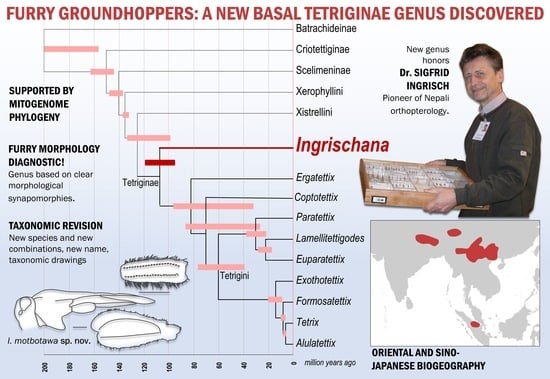
1. Introduction
2. Materials and Methods
3. Results
3.1. Taxonomy
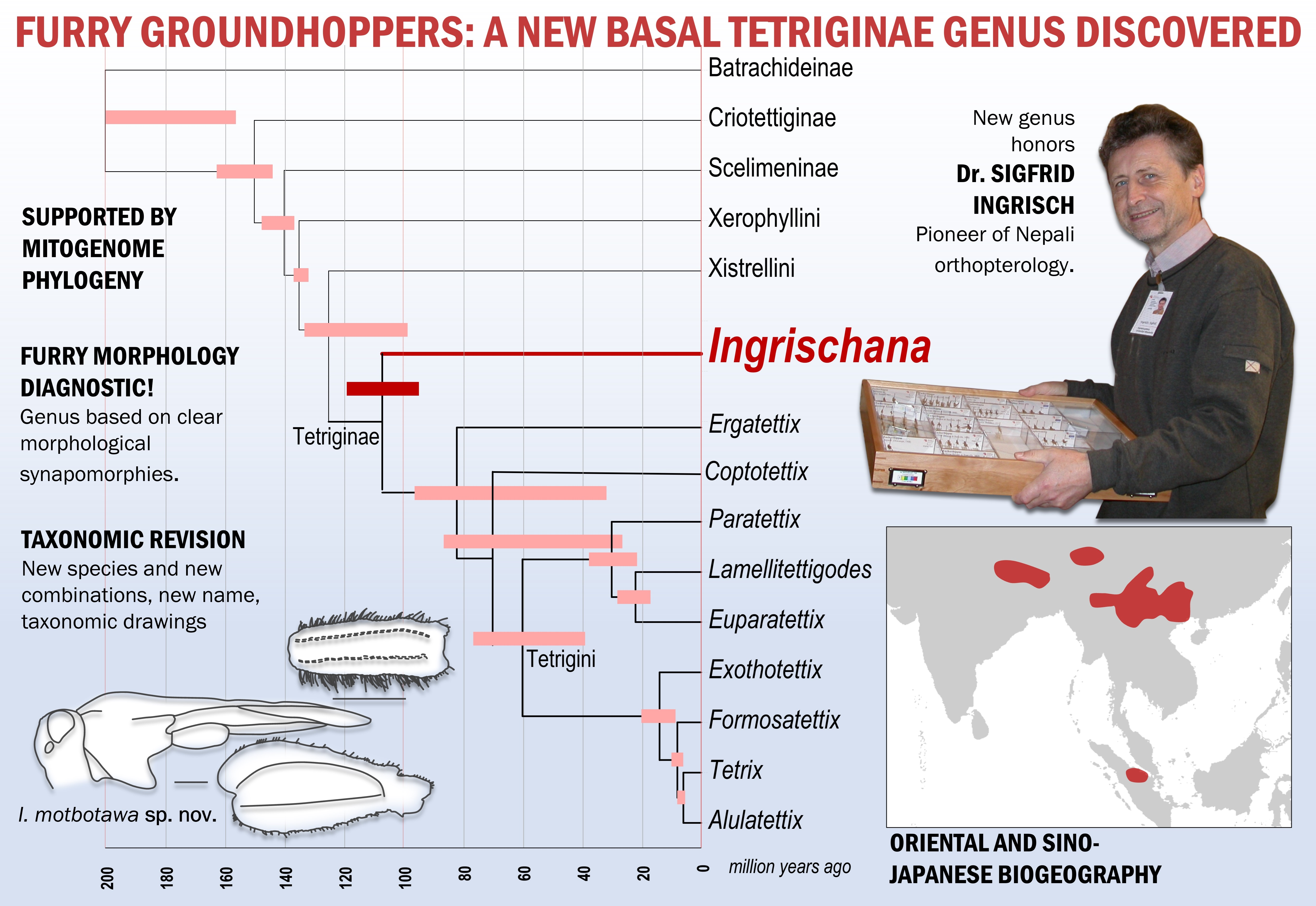
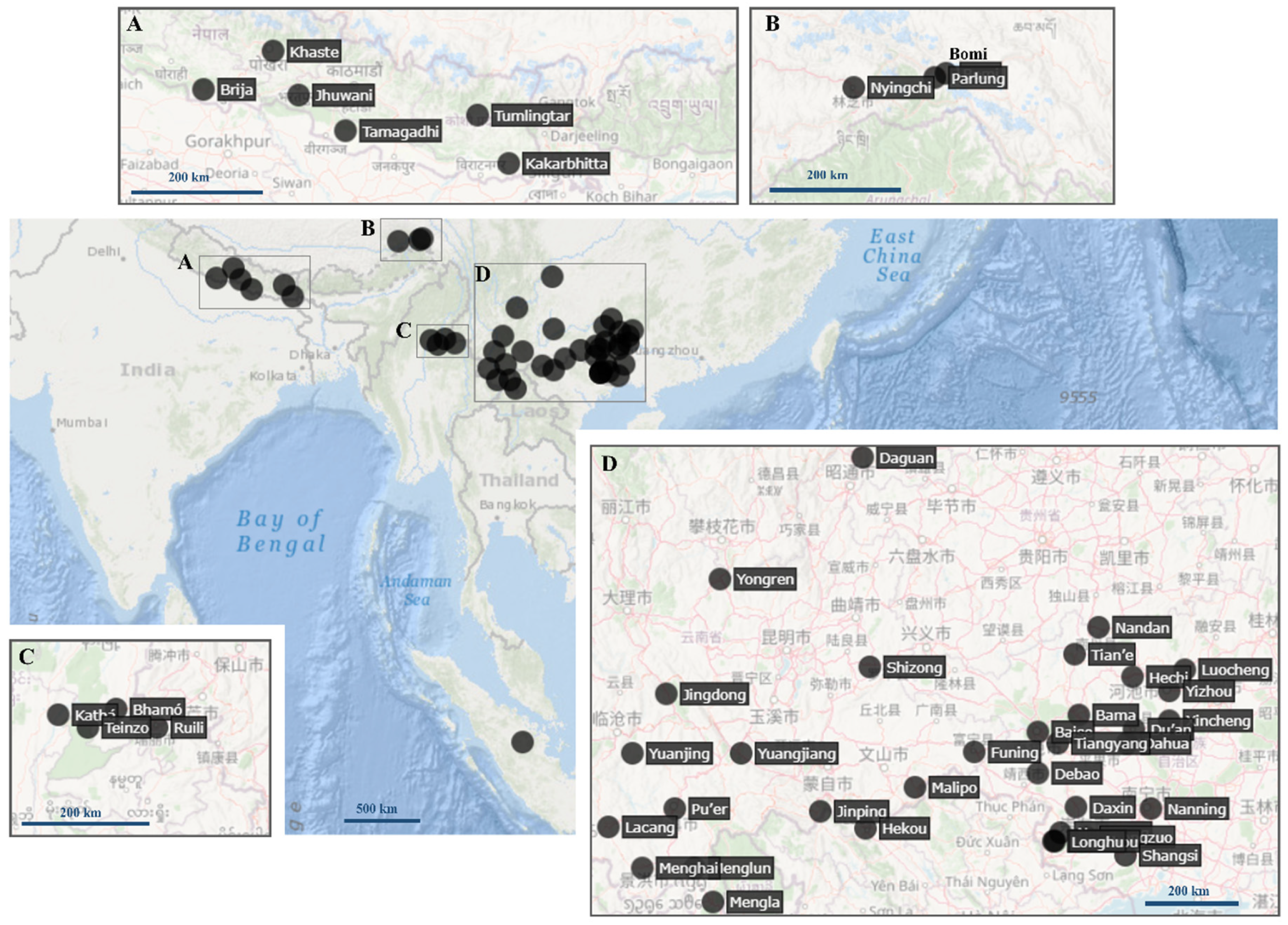
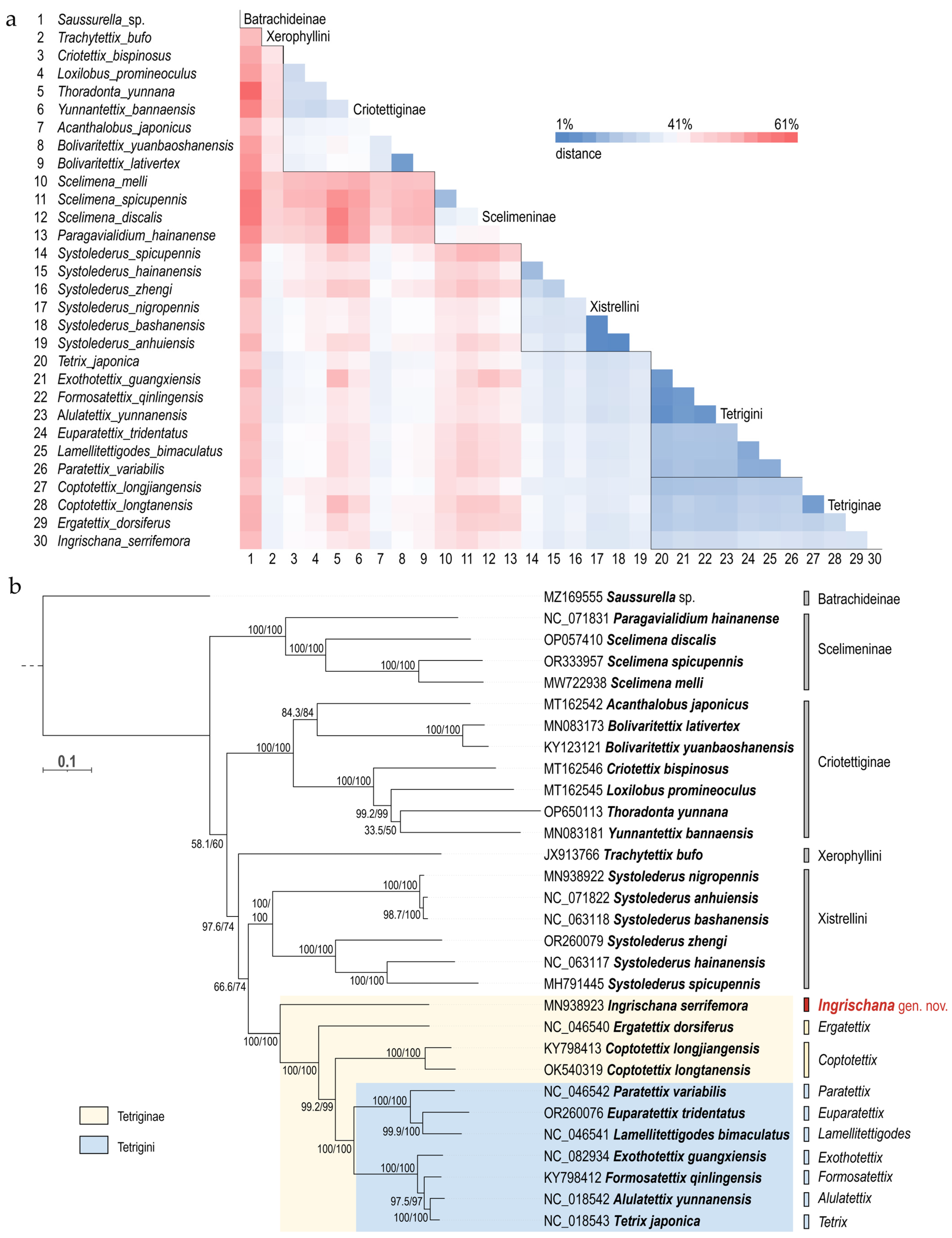
- Family Tetrigidae Rambur, 1838 [53]Subfamily Tetriginae Rambur, 1838 [53]Justification of the placement. Members of Ingrischana gen. nov. exhibit typical Tetriginae characteristics: (i) L-shaped carina of the vertex; (ii) lateral lobes directed downwards and contiguous with the body; (iii) dorsal margin of anterior and mid femora carinate (not sulcate); (iv) median ocellus below the lower margin of the eyes; and (v) presence of a filiform antenna.Genus Ingrischana gen. nov.LSID. urn:lsid:zoobank.org:act:5337DA82-2DE8-4215-A540-E44FE8A5596EDerivatio nominis. Patronymic. The genus is named in honor of Dr. Sigfrid Ingrisch, a renowned German orthopterist, a pioneer of Nepali Orthopterology, and our mentor. Ingrisch has described more than 750 Orthoptera taxa worldwide and his papers (e.g., [14,25,54,55] inspired many young scientists to study grasshoppers and crickets. The name is formed as a feminine noun in apposition.Vernacular name: Asian Furry Groundhoppers, based on the occurrence (Asia), and based on the hairy appearance of the mid and hind femora.Type species: Paratettix obesus Bolívar, 1887 [3] (=Ingrischana obesa comb. nov.) by present designation. Holotype female, most likely from Myanmar, deposited at the NMW.Composition and distribution: Currently includes 15 species (Table 2, Figure 1.) inhabiting Nepal, China (Guangxi, Yunnan, Tibet), Myanmar, and Thailand ([7], this study).Figure 1. Distribution of the genus Ingrischana gen. nov. (A) Himalayan region; (B) Southeastern Tibetan Plateau; (C) Northern Myanmar and bordering Yunnan; (D) South China. All localities mentioned in this study are shown; a doubtful record from Tanzania is not included in the map. Locality in Sumatra is not specified, while a record from Tanzania has been omitted. The map was generated using GPS Visualizer [56].Figure 1. Distribution of the genus Ingrischana gen. nov. (A) Himalayan region; (B) Southeastern Tibetan Plateau; (C) Northern Myanmar and bordering Yunnan; (D) South China. All localities mentioned in this study are shown; a doubtful record from Tanzania is not included in the map. Locality in Sumatra is not specified, while a record from Tanzania has been omitted. The map was generated using GPS Visualizer [56].
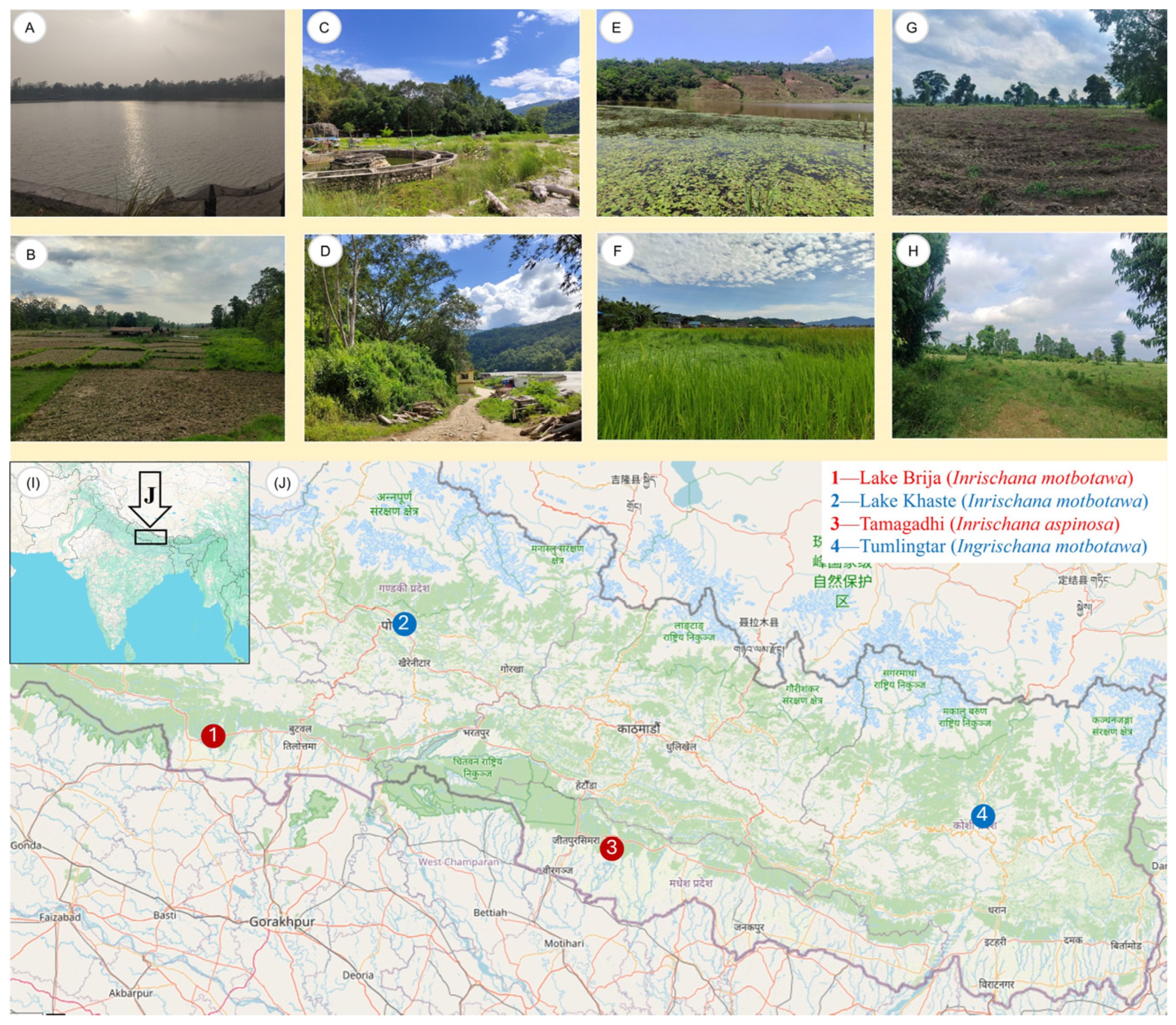
 Diagnosis. Head, pronotum and legs morphology typical for Tetriginae genera, but specific in: (i) vertex subequal to a compound eye or wider, apex truncated in dorsal view; (ii) tip of the fastigium not projected before the compound eyes; (iii) mid femora widened; (iv) fore and mid femora covered in numerous hairs; (v) serrated dorsal and/or margins of the hind femora; (vi) most commonly in a brachypronotal state (except for I. serrifemoroides comb. nov. and I. serrifemoralis comb. nov. which are pauropronotal; and I. obesa comb. nov. may be brachypronotal and macropronotal); and (vii) toothed pulvilli of the hind tarsi.Comparison with Paratettix. The new genus differs from Paratettix Bolívar, 1887 [3] (based on the type species, Paratettix meridionalis (Rambur, 1838) [51]), to which the type species of Ingrischana gen. nov. was previously assigned [3,57] by the following characters: (i) continuous median carina (median carina broken/missing in prozona in Paratettix); (ii) strongly setose mid femora (hairless or weakly setose in Paratettix), and (iii) ventral and/or dorsal margins of the hind femora with toothed serrations (margins of hind femora smooth in Paratettix).Description.Head: In dorsal view vertex subequal to an eye width or wider and finely granulated; anterior margin of the vertex truncated, i.e., in level with or not reaching the anterior margin of the eyes; transverse and lateral carinae of the vertex forming rounded right angle, i.e., L-shape with rounded angle; medial carina distinctly elevated. In frontal view frontal costa short, bifurcating in the upper third of the eye height; facial carinae typically widened downwards; face covered with fine hairs. In lateral view head not exserted above the pronotal surface, but at the level of it or slightly below; vertex visible above the eyes; occipital area narrow; angle between frons and vertex obtuse rounded; facial carinae slightly convex, protruding in front of the anterior level of eyes.Antenna: Filiform, composed of 14–15 antennomeresPronotum: In dorsal view, surface rugose, covered in small nodules, wrinkles, or tubercles; prozonal carina subparallel to converging posteriorly; lateral lobes lack spines and are directed downwards; shoulders broad, humeroapical carina forming with lateral carina wide rounded angle. In the frontal view characteristically tectiform (roof-like) with an elevated median carina. In lateral view, predominantly brachypronotal (not exceeding hind knees), rarely pauropronotal, and macropronotal; infrascapular area wide, trapezoidal, usually reaching half of the hind femur length.Wings: Tegmina and alae generally present; most species brachypronotal; some macropronotal or pauropronotal; some species have several states.Legs: Robust. Densely covered in hairs. Mid femura swollen, covered in dense hairs. Hind femora dorsal margin always serrated (saw-like); ventral margin usually less serrated than dorsal with undulating margins; first segment of hind tarsi longer than the third; pulvilli of the hind tarsus triangular and acute with apical teeth.Catalog of the species belonging to Ingrischana gen. nov.Ingrischana aptera (Zheng et Ou, 2009) comb. nov.=Euparatettix apterus Zheng et Ou, 2009 [19]Notes. Transferred from the genus Euparatettix Hancock, 1904 [2].Ingrischana aspinosa Subedi et Skejo gen. et sp. nov.LSID. urn:lsid:zoobank.org:act:DB77DBFE-992A-4001-A88B-D0436733C9AAVernacular name: Toothless Furry Groundhopper, based on the blunt ovipositor teeth in females, and based on the generic vernacular name (Asian Furry Groundhoppers).Etymology: The specific epithet aspinosa, meaning ‘lacking spines’, is derived from Latin, a- meaning ‘without’, and ‘spinosus’ meaning ‘with spines’. The name refers to the blunt or reduced ovipositor teeth, distinguishing this species from its congeners with more pronounced teeth (spines).Type material: Holotype 1♀, NEPAL: Madhesh Province: Bara district: Kolhabi Municipality: Tamagadhi: Herbs Production & Processing Co. Ltd.: Agricultural fields; 27.09552° N, 85.15825° E; ca. 120 m a.s.l.; 16.vii.2025; M. Subedi leg.; collected by an aerial net; ICAG (ICAG-ORT-TETR214).Habitat description. The habitat is agricultural land primarily used for the commercial production of aromatic and medicinal herbs (Figure 2D,H). The video of the type locality can be viewed at https://www.youtube.com/shorts/ol8wFP6YPKA?feature=share (accessed on 30 July 2025).Diagnosis. The main difference between I. aspinosa gen. et sp. nov. and other species of Ingrischana gen. nov. is in the morphology of the ovipositor. This species has blunt ovipositor teeth, while others have sharp ovipositor teeth. Comparison with other Ingrischana species is shown in Table 3 and Table 4.Figure 2. Habitat (A–G) and distribution (I,J) of I. motbotawa gen. et sp. nov. (A–F) and I. aspinosa gen. et sp. nov. (G,H) from Nepal. (A) Lake Brija, the type locality of the former species, and (B) adjacent agricultural fields; (C) plains on the bank of the Arun River and (D) the periphery of Satighat, Tumlingtar, Khandbari, Sankhuwasabha; (E) lake Khaste, Pokhara, Kaski, and (F) adjacent agricultural fields. (G) Agricultural fields in Tamagadhi, Bara, type locality of the latter species, prepared for the plantation of medicinal and aromatic herbs and (H) the fields with ongoing plantation. The map shows the position of type localities in red, and paratype localities in blue. Broader (I) and narrower (J) contexts are shown. The map was generated using GPS Visualizer [56].Figure 2. Habitat (A–G) and distribution (I,J) of I. motbotawa gen. et sp. nov. (A–F) and I. aspinosa gen. et sp. nov. (G,H) from Nepal. (A) Lake Brija, the type locality of the former species, and (B) adjacent agricultural fields; (C) plains on the bank of the Arun River and (D) the periphery of Satighat, Tumlingtar, Khandbari, Sankhuwasabha; (E) lake Khaste, Pokhara, Kaski, and (F) adjacent agricultural fields. (G) Agricultural fields in Tamagadhi, Bara, type locality of the latter species, prepared for the plantation of medicinal and aromatic herbs and (H) the fields with ongoing plantation. The map shows the position of type localities in red, and paratype localities in blue. Broader (I) and narrower (J) contexts are shown. The map was generated using GPS Visualizer [56].
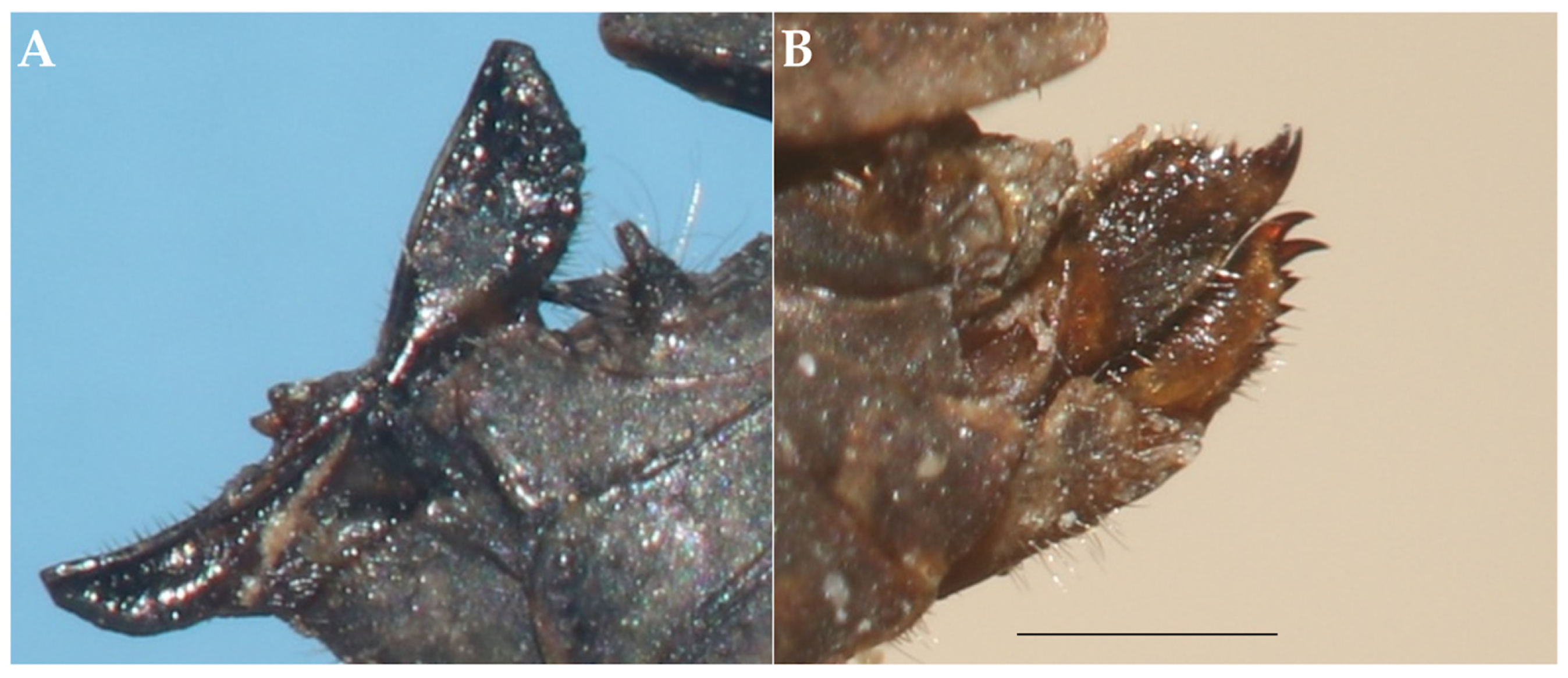
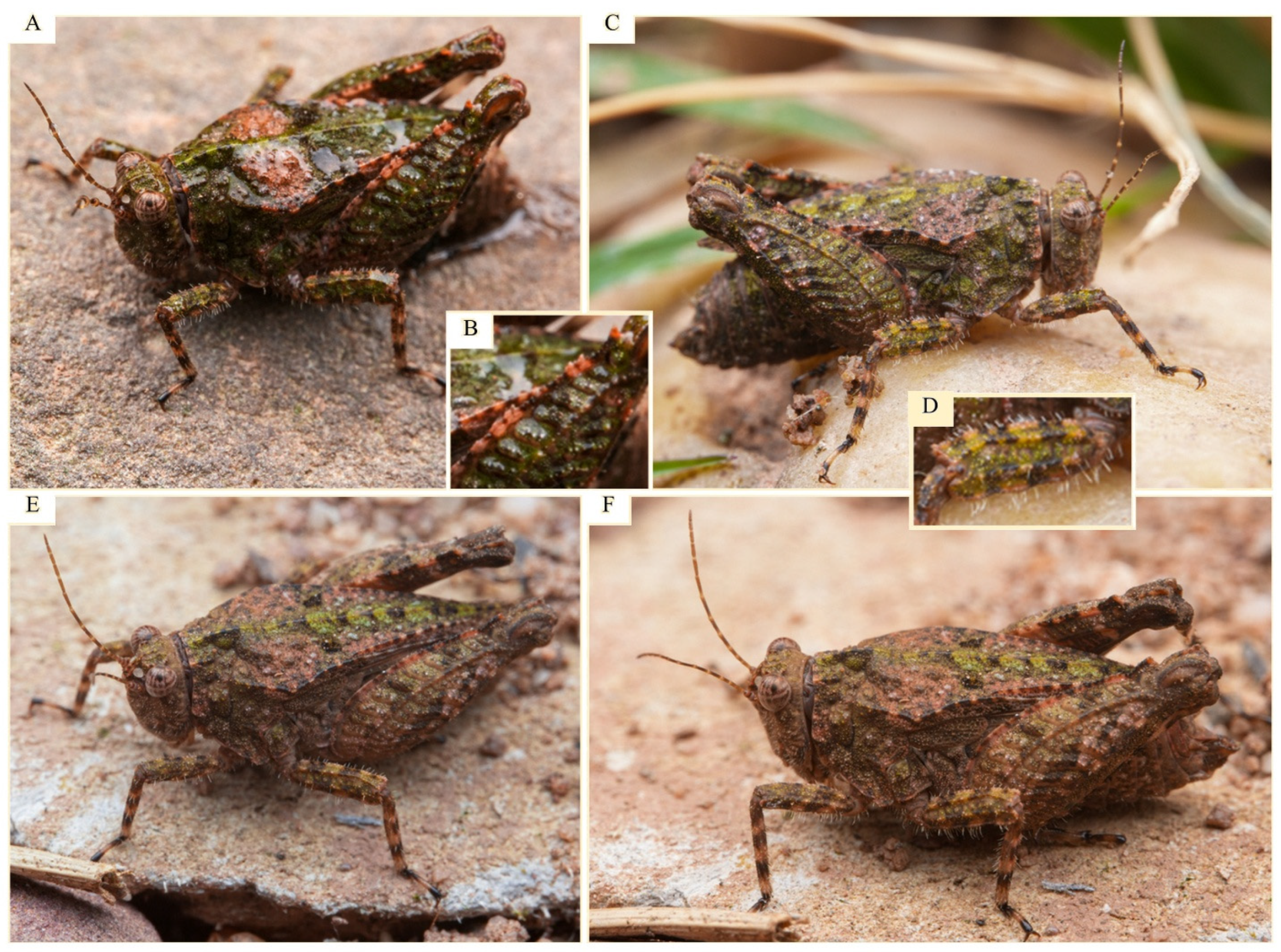
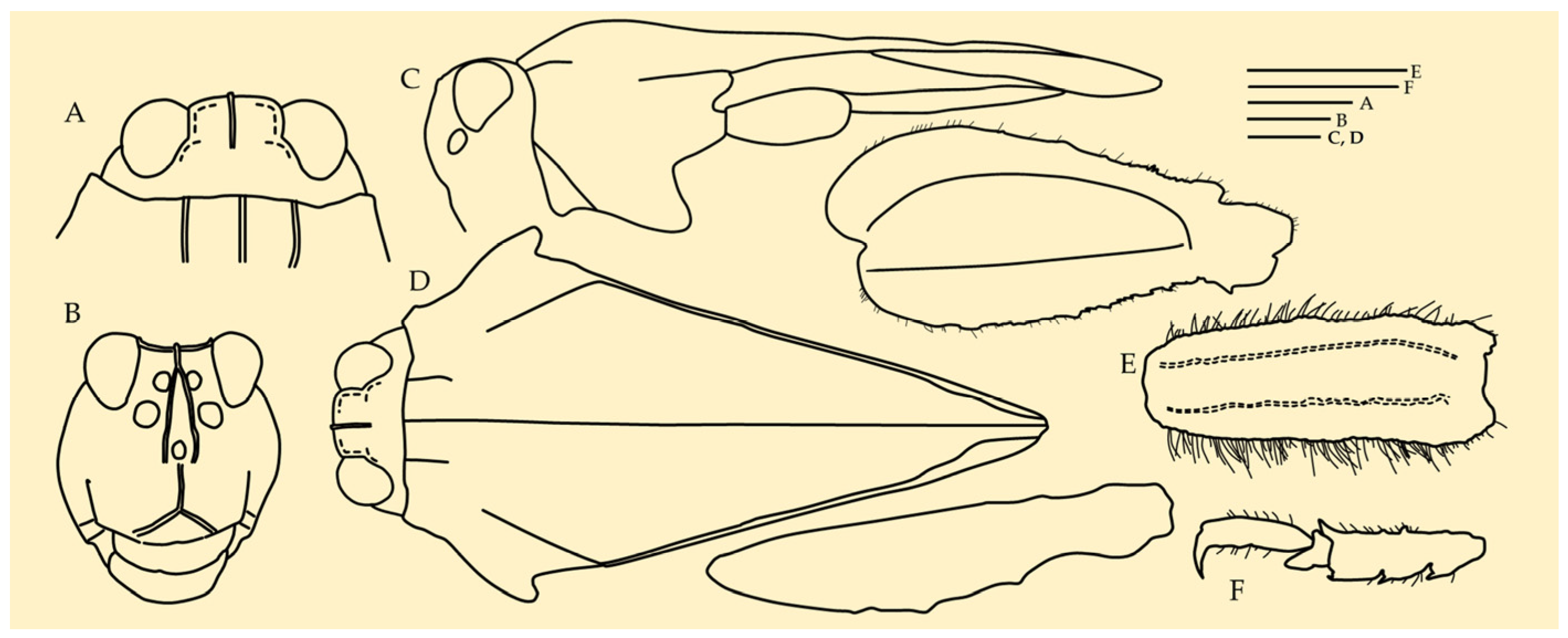
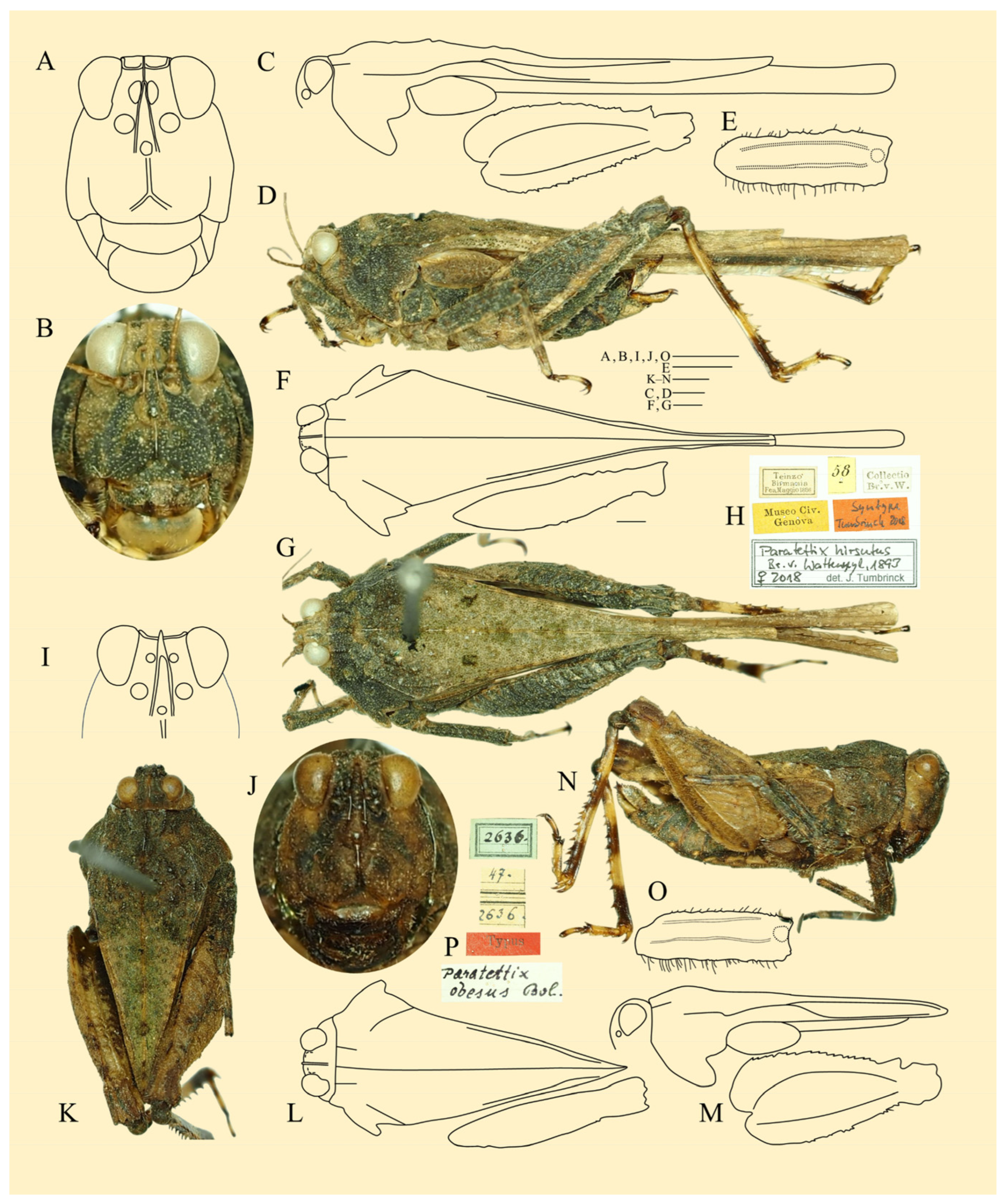
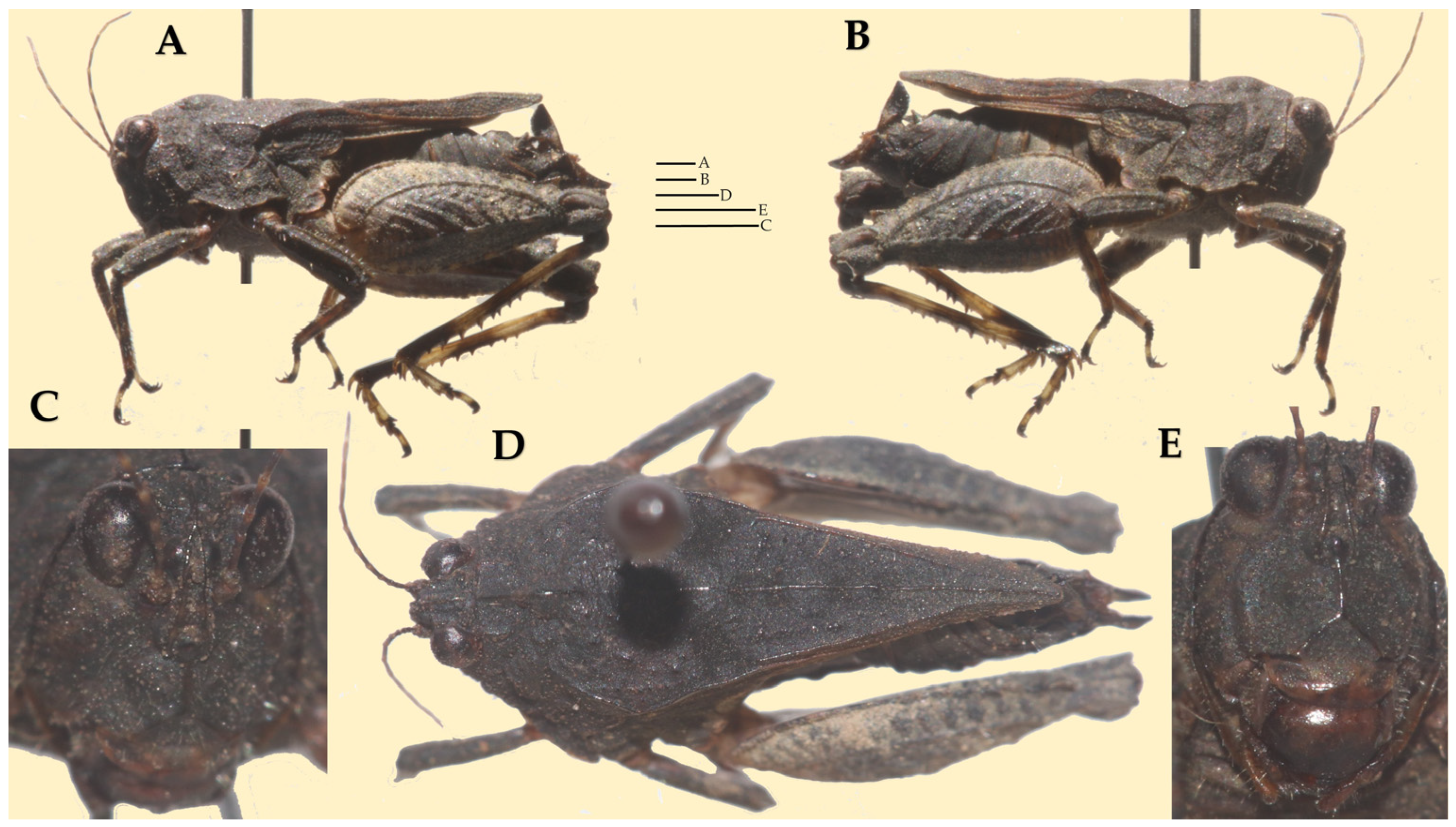
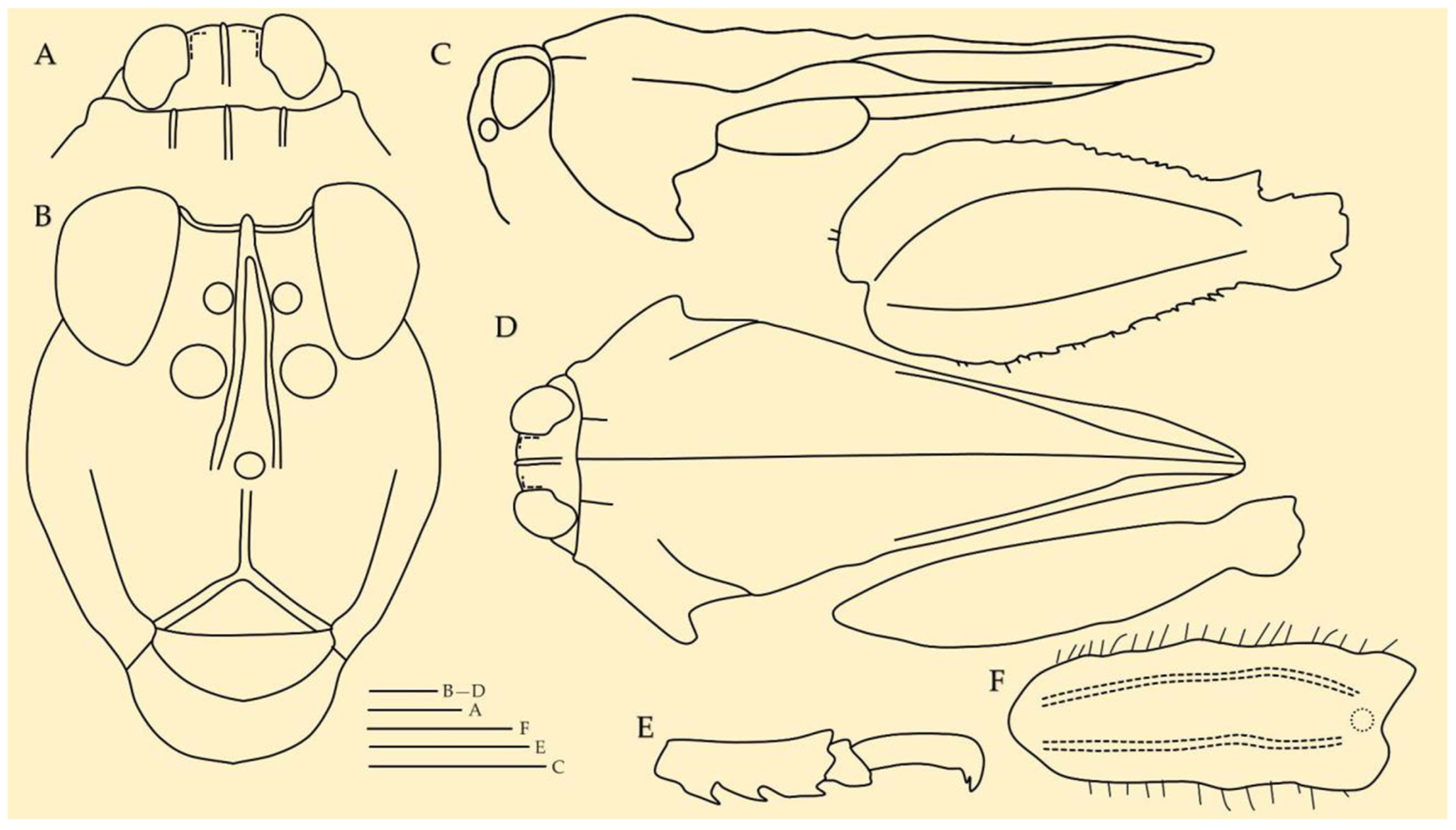
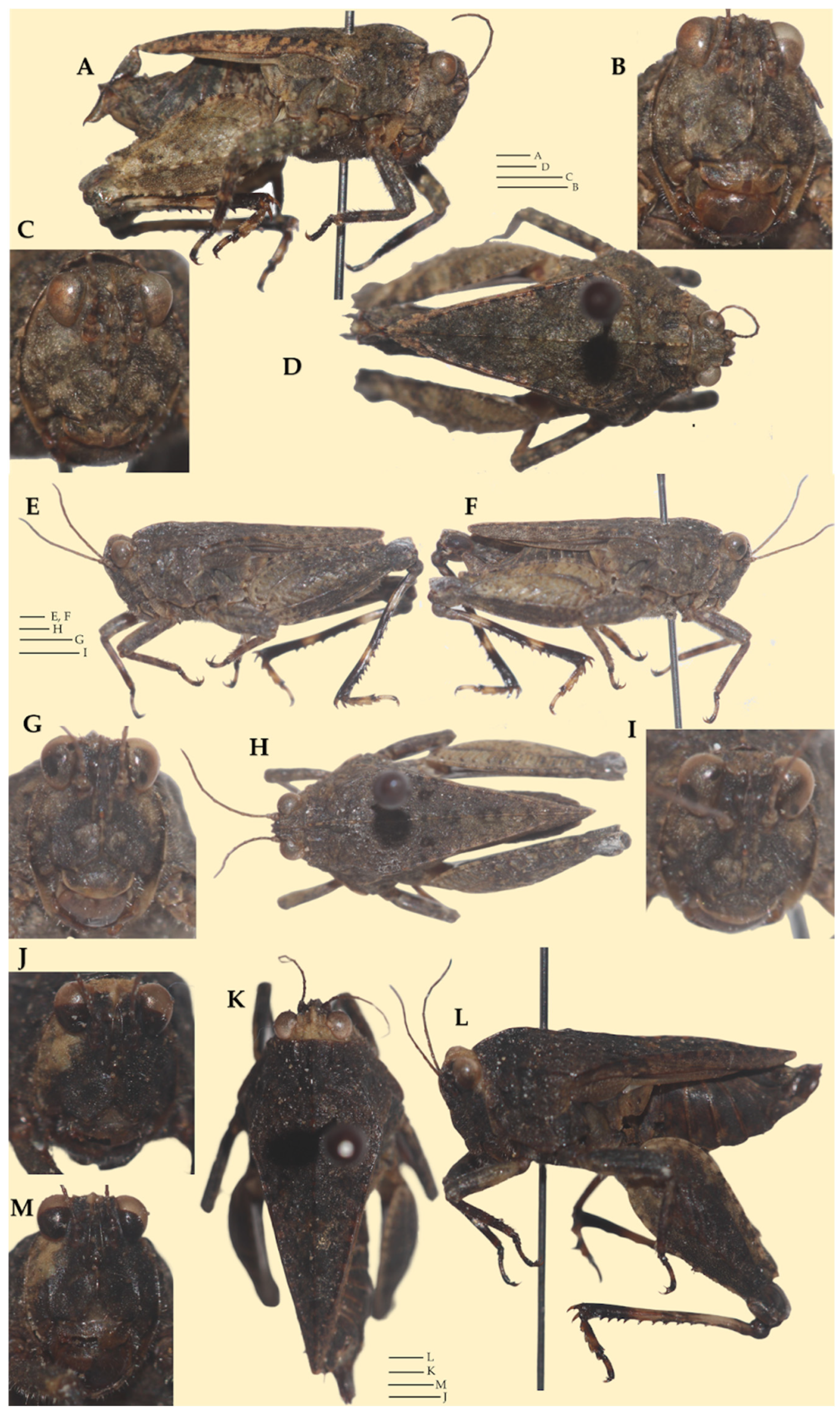
 Head. In the dorsal view. Surface of the vertex finely granulated. Vertex between the eyes 1.25× wider than a compound eye. Vertex at the base of the eyes 1.77× wider than an eye; narrowing anteriorly and subequal to the width of an eye at its apex. Anterior margin of the fastigium truncated, not reaching the anterior margin of the compound eyes. Medial carina not protruding in front of the compound eyes, distinctly elevated and extending nearly to the base of head. Transverse and lateral carinae of the vertex forming rounded right angle (L-shape with rounded angle). Fossula shallow, elongate, reaching the posterior margin of the medial carina. Eyes reniform. In the frontal view. Face covered with sparse fine hairs. Top margin of eyes slightly above the vertex. Frontal costa short, bifurcating in the upper third of a compound eye height. Facial carinae progressively widen downwards, then slightly narrowing below superior ocelli, and then progressively widen again toward the median ocellus. Scutellum between the antennal grooves slightly narrower than an antennal groove. Paired ocelli located at mid-height of the eyes, slightly below the point of the frontal costa bifurcation. Top margin of antennal groove above the lower margin of eyes; bottom margin slightly below the lower margin of eyes. In the lateral view. Head placed below the level of pronotal surface (below the highest point of median carina). Angle between frons and vertex obtuse rounded. Facial carinae slightly convex, protruding in front of the anterior level of eyes.Antenna. Filiform. Composed of 15 antennomeres (scape, pedicel and 13 flagellar antennomeres). Mid antennomeres around 7.5× as long as wide. One antenna as long as the distance between the anterior margin of the vertex and the mid-length of tegmina.Pronotum. Slender and brachypronotal species with finely granulated/wrinkled pronotum, tip of the pronotum not exceeding hind knees. In the dorsal view. Anterior margin of pronotum produced between prozonal carinae. Median carina continuous, reaching the apex of the pronotum. Surface rough; covered with small nodules and wrinkles. Prozonal carinae elevated, subparallel. Humero-apical carinae distinctly visible, forming with external lateral carina weakly projected rounded humeral angles (shoulders). Interhumeral carina indistinct. Pronotum widest at humeral angles, progressively converging caudad. Lateral lobes bluntly rounded, directed downwards, and contiguous to the body. Spines on the lateral lobes absent. Lateral area wide. Apex of pronotum blunt. In the lateral view. Median carina distinctly elevated in the region of prozona, slightly undulated in the region of metazona, elevated in the posterior third of metazona and then progressively lowering towards the apex. Prozona nodulated. Prozonal carina visible, short. Extralateral carina indistinct. Lateral area wide, narrowing caudally. Apex of lateral lobe subrounded. Infrascapular area subrectangular, widest at the middle. Ventral and tegminal sinus evident, right angled. In the frontal view. Pronotum tectiform (roof-like), with visibly elevated median carina. Lateral lobes of paranota directed downwards and slightly sideways.Wings. Wings present. Tegmina (forewings) elongated, oval, entirely visible. Alae (hindwings) not reaching the apex of the pronotum.Legs. All legs covered with sparse hairs and with distinct black rings. Fore legs: Femora robust. Dorsal margin of femur convex; posterior fourth of ventral margin slightly concave, rest straight. Tibia with few acute spines on the ventral distal surface. Mid legs: Femora robust, widest at the middle. Dorsal margin of femur slightly convex, except concave towards the distal end. Tibiae with acute spines on the ventral margin. Hind legs: Femora robust. Dorsal and median external areas with a series of parallel transversal ridges. Dorsal margin undulating with a few minute, acute protrusions in the distal half; ventral margin undulating with several minute acute and few blunt teeth. Antegenicular teeth large, triangular and protruded with blunt tip. Genicular teeth large, subtriangular. Tibiae smooth with several blunt spines. First tarsal segment longer than third. Pulvilli triangular and acute; distal pulvillus longest.Ovipositor. Covered with sparse hairs. Ovipositor valves widened, apices blunt. Dorsal valves with blunt serrations; ventral valves lack serrations (Figure 5A).Sexual dimorphism. Unknown. Only female of I. aspinosa sp. nov. is currently known; therefore, sexual dimorphism cannot be assessed and remains to be documented when additional material becomes available.Measurements: See Table 5.Ingrischana barbifemura (Zheng, 1998) comb. nov.=Tetrix barbifemura Zheng, 1998 [12]Distribution: China: reported from multiple localities in Yunnan (Mengla (Figure 6), Menghai, Menglun, Pu’er, Yuanjing, Jinping, Lacang, Jingdong) and Guangxi (Baise) [55].Notes. Transferred from the genus Tetrix Latreillle, 1802 [1].Ingrischana curvimargina (Zheng et Deng, 2004) comb. nov.=Tetrix curvimarginus Zheng et Deng, 2004 [17]Notes. Known only from the holotype female. Transferred from the genus Tetrix Latreille, 1802 [1].Ingrischana dentifemura (Zheng, Shi et Luo, 2003) comb. nov.=Tetrix dentifemura Zheng, Shi et Luo, 2003 [16]=Tetrix grossus Zheng, Shi et Luo, 2003 (HT ♀ China: Guangxi: Xincheng (SNNU)), synonymized with T. dentifemura by [60]=Tetrix grossus Zheng et Shi, 2003, wrong authorship cited by [61]Distribution: China: reported from many localities in Yunnan (Malipo, Hekou, Funing, Shizong, Daguan), and Guangxi (Dahua, Du’an, Bama, Daxin, Debao, Baise, Xincheng, Tian’e, Yizhou, Hechi, Nandan) [61]. Previously reported only from Guangxi (Xincheng) as pauropronotal I. dentifemura, and from all other localities as its synonym, brachypronotal Tetrix grossus (e.g., [61]).Notes. Transferred from the genus Tetrix Latreille, 1802 [1].Ingrischana grossifemura (Zheng et Jiang, 1997) comb. nov.=Tetrix grossifemura Zheng et Jiang, 1997 [11]Notes. Transferred from the genus Tetrix Latreille, 1802 [1].Ingrischana jhapana (Ingrisch, 2001a) stat. rev.Distribution: Known from a single locality in Nepal, Jhapa: Kakarbhitta [14].Notes: Ingrisch [14] described Paratettix jhapanus Ingrisch, 2001a from Kakarbhitta (misspelled as Karkabita in the original text), Jhapa, Nepal. Tumbrinck [62] synonymized this species with Paratettix obesus as a brachypronotal variant. We examined the holotype of P. jhapanus (SMF-SA 103), deposited in SMF, and found that P. jhapanus differs remarkably from I. obesa comb. nov. by the following characters: (i) robust body shape; (ii) prozonal carinae parallel or faintly diverging caudad (prozonal carinae converging caudad in I. obesa comb. nov.); (iii) anterior margin of vertex in level with anterior margin of eyes (anterior margin of vertex does not reach the anterior margin of eyes in I obesa comb. nov.); (iv) In lateral view, the pronotum of P. jhapanus has distinctly steeper anterior slope in the prozona descending more abruptly towards the head, while posteriorly, the pronotal apex is upturned (in I. obesa comb. nov., the pronotum has gradually sloping prozona and a gently tapering, non-elevated apex, which follows the general outline of the pronotal disk). Based on these distinct characters, Paratettix jhapanus is herein revived as a valid species and transferred to the genus Ingrischana gen. nov., as its morphological features comply with the new genus.Ingrischana longzhouensis (Zheng et Jiang, 2000) comb. nov.=Tetrix longzhouensis Zheng et Jiang, 2000 [13]=Formosatettixoides guangxiensis Zheng et Jiang, 2000 syn. nov. (HT ♀ from China: Guangxi: Longzhou, Longhy; deposited in SNNU) [13]Distribution: Known only from the type locality in China and its vicinity. Guangxi (Longzhou: Nonggang, Longhu) [61].Notes. Transferred from the genus Tetrix Latreille, 1802 [1]. Formosatettixoides guangxiensis Zheng & Jiang, 2000 [13] is hereby synonymized with I. longzhouensis (Zheng & Jiang, 2000) comb. nov. Namely, F. guangxiensis syn. nov. clearly represents a nymph as it lacks an antegenicular notch; and is clearly a nymph of Ingrischana gen. nov. based on the hairy fore and mid femoa and serrated margins of the hind femora. Furthermore, this species was caught in the same day on the same locality (Guangxi: Longzhou: Longhu) as Ingrischana longzhouensis comb. nov. and published in the same publication (Zheng and Jiang, 2000). Following the Principle of the first revisor ([27]: ICZN Article 24.2), priority is assigned to the name longzhouensis. because (1) the type series of I. longzhouensis comb. nov. consists of adult specimens, and (2) the description of T. longzhouensis (page 144) precedes that of F. guangxiensis (page 145).Ingrischana motbotawa Subedi et Skejo gen. et sp. nov.LSID. urn:lsid:zoobank.org:act:FAF764F6-BB0E-4FD8-8759-9ED8ED80D8B7Derivatio nominis. The species epithet motbotawa is derived from the local Tharu language, where mot means ‘fat’, and botawa means ‘grasshopper.’ The name thus translates to ‘fat grasshopper,’ referring to the species’ relatively robust body form. It is treated here as a feminine noun in apposition.Vernacular name: Brija Furry Groundhopper, based on the species’ type locality (Lake Brija) and based on the generic vernacular name (Asian Furry Groundhoppers).Type material. Holotype. (Figure 7 and Figure 8A–D) 1♀, NEPAL: Lumbini Province: Kapilvastu district: Buddhabhumi Municipality: Brija Lake: Agricultural fields near a lake; 27.67129° N, 82.96422° E; ca. 130 m a.s.l.; 24.iii.2024; M. Subedi leg.; collected by hand; ICAG (ICAG-ORT-TETR211). Paratype. (Figure 8E–I) 1♂, NEPAL: Koshi Province: Sankhuwasabha district: Khandbari Municipality: Tumlingtar, Satighat: Banks of Arun river; 27.31171° N, 87.19885° E; ca. 400 m a.s.l.; 22viii.2025; M. Subedi leg.; collected by hand; ICAG (ICAG-ORT-TETR215)|(Figure 8J–L) 1♀, NEPAL: Gandaki Province: Kaski district: Pokhara Metropolitan City: Khaste Lake: Agricultural fields near a lake; 28.19459° N, 84.05241° E; ca. 755 m a.s.l.; 01.ix.2025; M. Subedi leg.; collected by an aerial net; ANHM.Distribution. Known only from Nepal: Brija Lake (the type locality) in the southern part of the country, the banks of the Arun River in the eastern part, and Khaste Lake in the central part. Khaste Lake lies 120 km northeast of Brija Lake, and Satighat is located 420 km northeast of Brija Lake.Habitat description. The type locality is the agricultural land adjacent to a lake (Figure 2A,B). The video of the type locality can be viewed at https://www.youtube.com/watch?v=XJgBxG7bnCc (accessed on 24 July 2025). The male paratype’s habitat locality is the riverbank of the Arun River (Figure 2C,D). A video of the locality can be viewed at https://www.youtube.com/shorts/iwucv92x4_A (accessed on 3 September 2025). The female paratype’s habitat locality is an agricultural land adjacent to a lake (Figure 2E,F). The video of the locality can be viewed at https://www.youtube.com/shorts/Cd5pHUEt4BI (accessed on 8 October 2025).Diagnosis. Ingrischana motbotawa gen. et sp. nov. is a winged brachypronotal species with a wide vertex, most similar to I. obesa comb. nov. Comparison with all Ingrischana species is given in Table 3 and Table 4.Description.Head. In the dorsal view. Vertex surface finely granulated and covered in hairs. Vertex between the eyes 1.4× wider than a compound eye. Anterior margin of the fastigium truncated, not projected before the compound eyes (anterior margin of vertex in level with anterior margin of eye). Medial carina protruded in front of the compound eyes. Medial carina evident along the apical half of the vertex. Transverse and lateral carinae of vertex forming L-shape with rounded angle. Fossula evident, short and deep, placed in the anterior third of vertex between the eyes. Eyes reniform (oval but more rounded than in most other Tetrix species). Occipital area narrow, not wider than a third of a compound eye. In the frontal view. Face covered with fine hairs. Top margin of eyes slightly above vertex. Frontal costa short, bifurcating in the upper third of a compound eye height. Facial carinae progressively widen downwards. Scutellum between the antennal grooves as wide as an antennal groove. Paired ocelli placed halfway of the eye height, slightly below the bifurcation. Top margin of an antennal groove above the bottom margin of eyes, while bottom margin of an antennal groove slightly below the bottom margin of eyes. In the lateral view. Head positioned slightly below the highest point of the pronotal median carina. Angle between frons and vertex obtuse-rounded. Facial carinae slightly convex, protruding anterior to the eyes.Antenna. Filiform. Composed of 15 antennomeres (scape, pedicel and 13 flagellar antennomeres). Mid antennomeres approximately 5× as long as wide. Each antenna approximately as long as the distance from the anterior margin of vertex to the coxa of mid femur.Pronotum. Robust and brachypronotal species with finely granulated/wrinkled pronotum, tip of the pronotum not exceeding hind knees. In the dorsal view. Anterior margin of pronotum slightly produced between prozonal carinae. Median carina continuous, reaching the apex of the pronotum. Surface rough; covered with small nodules and wrinkles. Prozonal carinae parallel to slightly converging caudad, distinctly elevated. Humero-apical carinae distinctly visible, forming with external lateral carina weakly projected rounded humeral angles (shoulders). Interhumeral carina indistinct. Pronotum widest at humeral angles, progressively converging caudad. Lateral lobes bluntly rounded, directed downwards, and contiguous to the body. Spines on the lateral lobes absent. Lateral area wide. Apex of pronotum blunt. In the lateral view. Median carina distinctly elevated in the region of prozona, flat in the anterior region of metazona progressively lowering in the posterior third. Prozona wrinkled, moderately nodulated. Prozonal carina clearly visible, short. Extralateral carina indistinct. Lateral area wide, widening caudally. Apex of the lateral lobe subrounded. Infrascapular area subrectangular, widest at the middle. Ventral and tegminal sinus evident, right angled. In the frontal view. Pronotum tectiform (roof-like), with visibly elevated median carina. Lateral lobes of paranota directed downwards and slightly sidewards.Wings. Wings present. Tegmina (forewings) elongated, oval, entirely visible. Alae (hindwings) do not reach the apex of the pronotum.Legs. All legs covered with dense hairs and with distinct black rings. Fore legs: Femora robust. Dorsal margin of femur slightly convex, with even undulation throughout, except at about one-fourth from the distal end where it forms a distinct raised prominence; posterior fourth of ventral margin slightly concave, rest straight. Tibiae with numerous acute spines on the ventral distal surface. Mid legs: Femora robust, widest at the middle. Tibiae with acute spines on the ventral margin. Hind legs: Femora robust. Dorsal and median external areas with a series of parallel transversal ridges. Dorsal margin undulating, with numerous minute acute protrusions distally; ventral margin undulating with several distinct teeth. Antegenicular teeth large, triangular with blunt tip. Genicular teeth large, subtriangular. Tibiae smooth with several acute spines. First tarsal segment longer than third. Pulvilli triangular, sharp, with apical teeth; distal one larger than the proximal two in size; the proximal pulvillus shorter than the two distal pulvilli, which are similar in length.Ovipositor. Covered with dense hairs. Ovipositor valves widened with fine serrations; apices hooked and acute (Figure 5B).Sexual dimorphism. The female is more robust and slightly larger than the male; however, several body parts are comparatively longer in the male (see Table 3 and Table 4 for detailed morphometric comparisons). The ventral margins of the hind femora bear distinct teeth in the female, whereas these are reduced to fine blunt serrations in the male. The mid femora are more robust in the male, while the infrascapular and lateral areas are relatively wider in the female.Morphological variation. In the holotype and male paratype, tegmina are elongate and oval in shape, whereas in the female paratype, tegmina are elongate and subtriangular in outline (Figure 9).Measurements: See Table 5.Ingrischana obesa (Bolívar, 1887) comb. nov. (Figure 10)=Paratettix obesus Bolívar, 1887=Paratettix hirsutus Brunner von Wattenwyl, 1893 [57] (Many syntypes from Myanmar (Sagaing: Kathá; Kachin: Bhamó.; Teinzo) in MHNG, NMW, MHNG), synonymized by Günther [63].Distribution: Myanmar, Sumatra, and maybe Nepal (Jhuwani, see below). The type locality of P. hirsutus—a synonym of I. obesa comb. nov.—is Myanmar, whereas for I. obesa comb. nov. no locality was specified in the original description [3]. We question the presence of I. obesa comb. nov. in Tanzania, which is far away from the rest of the species’ distribution area.Notes. Transferred from the genus Paratettix Bolívar, 1887 [3]. Günther [63] examined the type specimens of both I. obesus comb. nov. and Paratettix hirsutus and synonymized the two taxa. Ingrisch [55] noted that specimens identified as P. hirsutus from Jhuwani (misspelled as “Jhawani” in [55], Nepal, were smaller than the measurements given in [57,64]. We doubt that these specimens truly belong to I. obesa comb. nov., as they differ from the holotype of I. obesa comb. nov. in having anterior margin of the vertex level with the anterior margin of eyes (in I. obesa comb. nov. it does not reach that level), and by the shape of eyes (globular in I. obesa comb. nov., oval in the Jhuwani specimens). We therefore doubt the presence of I. obesa comb. nov. in Nepal at present. Several specimens from Nepal are currently listed as I. obesa comb. nov. in OSF [7], but their true identity requires further investigation. It is likely that this taxon may comprise multiple distinct species.Ingrischana parlungana Subedi et Skejo nom. nov.LSID. urn:lsid:zoobank.org:act:0BD0CADF-CBE8-4B21-B903-F5CFB745FFA5=Ingrischana serrifemoralis (Zheng et Shi, 2009a) [20] comb. nov. (HT ♂ from China: Tibet: Bomi, deposited in SNNU); homonym of Ingrischana serrifemoralis (Zheng, 1998) comb. nov.=Bannatettix serrifemoralis Zheng et Shi, 2009a [20]=Ergatettix serrifemoroides Zheng et Shi, 2009b [21] syn. nov. (HT ♀ from China: Tibet: Nyingchi, deposited in SNNU); if not synonym of I. parlungana nom. nov., it is homonym with I. serrifemoroides (Zheng et Jiang, 2002) comb. nov. [15]Distribution: Known from a single locality in the basin of the Parlung River in Tibet (China) [20,21].Notes: Ingrischana parlungana nom. nov. is a new name proposed for Bannatettix serrifemoralis Zheng et Shi, 2009a from Tibet (China) because of secondary homonymy with Ingrischana serrifemoralis (Zheng, 1998) comb. nov. after the new combination is introduced. The adjective parlunganus, parlungana, parlunganum is based on the Latinized name of Parlung River, in whose basin the species occurs.Ingrischana serrifemora (Deng, Zheng et Wei, 2008) comb. nov.=Ergatettix serrifemora Deng, Zheng et Wei, 2008 [18]Notes: Transferred from the genus Ergatettix Kirby, 1914 [5].Ingrischana serrifemoralis (Zheng, 1998) comb. nov.=Tetrix serrifemoralis Zheng, 1998 [12]=Tetrix serrifemora [sic] Zheng, 1998, misspelling of T. serrifemoralisDistribution: China: reported from many localities in Yunnan (Hekou, Shizong, Yongren), and Guangxi (Bama, Dahua, Chongzuo, Shangsi) [58,65]Notes. Transferred from the genus Tetrix Latreille, 1802 [1].Ingrischana serrifemoroides (Zheng et Jiang, 2002) comb. nov.=Tetrix serrifemoroides Zheng et Jiang, 2002 [15]Notes. Transferred from the genus Tetrix Latreille, 1802 [1].Ingrischana torulosinota (Zheng, 1998) comb. nov.=Tetrix torulosinota Zheng, 1998 [12]Distribution: China: reported from several localities in Yunnan (Mengla, Menglun, Yuangjiang) [65].Notes. Transferred from the genus Tetrix Latreille, 1802 [1].


3.2. Phylogeny
4. Discussion
5. Conclusions
Author Contributions
Funding
Institutional Review Board Statement
Informed Consent Statement
Data Availability Statement
Acknowledgments
Conflicts of Interest
Abbreviations
| Museum Abbreviations | |
| ANHM | Annapurna Natural History Museum, Pokhara, Kaski, Nepal |
| ICAG | Insect Collection of Agriculture Science Center, Ghyalchok, Gorkha, Nepal |
| NMW | Naturhistorisches Museum, Wien, Austria |
| SMF | Senckenberg Forschungsinstitut und Naturmuseum, Frankfurt, Germany |
| SNNU | Museum of Flora and Fauna of Shaanxi Normal University, Shaanxi, China |
| Other Abbreviations | |
| ca. | Circa |
| comb. nov. | New combination |
| gen. nov. | New genus |
| m a.s.l. | Meters above sea level |
| mm | Millimeters |
| nom. nov. | New name |
| sp. nov. | New species |
| stat. rev. | Reviewed status |
References
- Latreille, P.A. Histoire Naturelle, Genérale et Particuliere, des Crustacés et des Insectes; F. Dufart: Paris, France, 1802; Volume 3. [Google Scholar]
- Hancock, J.L. The Tettigidae of Ceylon. Spolia Zeylan. 1904, 2, 97–157. [Google Scholar]
- Bolívar, I. Essai sur les Acridiens de la tribu des Tettigidae. Ann. Soc. Entomol. Belg. 1887, 31, 175–313. [Google Scholar]
- Tinkham, E.R. Notes on the identity of Formosan Acrydiinae with descriptions of a new genus and two new species (Orth.: Acrid.). Trans. Nat. Hist. Soc. Formosa 1937, 27, 229–243. [Google Scholar]
- Kirby, W.F. Fauna of British India, Including Ceylon and Burma. Orthoptera (Acrididae); Taylor and Francis: London, UK, 1914. [Google Scholar] [CrossRef]
- Liang, G.-Q. A new genus and species of Tetrigidae from Yunnan (Orthoptera). Acta Zootaxonomica Sin. 1993, 18, 73–75. [Google Scholar]
- Cigliano, M.M.; Braun, H.; Eades, D.C.; Otte, D. Orthoptera Species File. Available online: http://Orthoptera.SpeciesFile.org (accessed on 3 March 2026).
- Subedi, M. A new genus and a new groundhopper species from Nepal (Orthoptera: Tetriginae: Skejotettix netrajyoti gen. et sp. nov.). Zootaxa 2022, 5250, 35–54. [Google Scholar] [CrossRef]
- Zheng, Z.-M. One new genus and three new species of Tetrigidae from Yunnan province (Orthoptera: Tetrigidae). J. Shaanxi Norm. Univ. Nat. Sci. Ed. 1993, 21, 46–50. [Google Scholar]
- Zheng, Z.-M. A new genus and new species of Tetrigidae from Zhejiang, China (Orthoptera). Acta Zootaxonomica Sin. 1994, 19, 97–99. [Google Scholar]
- Zheng, Z.-M.; Jiang, G. Three new species of Tetrigidae from Guangxi (Orthoptera: Tetrigoidea). Zool. Res. 1997, 18, 377–381. [Google Scholar]
- Zheng, Z.-M. A study of Tetrigoidea from Xishuangbanna (Orthoptera). Acta Zootaxonomica Sin. 1998, 23, 161–184. [Google Scholar]
- Zheng, Z.-M.; Jiang, G. Four new species of Tetrigidae from Guangxi (Orthoptera: Tetrigoidea). Zool. Res. 2000, 21, 144–148. [Google Scholar]
- Ingrisch, S. Orthoptera of the Nepal expeditions of Prof. J. Martens (Mainz). Senckenberg. Biol. 2001, 81, 147–186. [Google Scholar]
- Zheng, Z.-M.; Jiang, G. Three new species of Tetrigoidea from Guangxi (Orthoptera). Acta Entomol. Sin. 2002, 45, 9–12. [Google Scholar]
- Zheng, Z.-M.; Shi, F.-M.; Luo, G. New species of Tetrigoidea from the region Hongshui river of Guangxi (Orthoptera). J. Huazhong Agric. Univ. 2003, 22, 136–441. [Google Scholar]
- Zheng, Z.-M.; Deng, W.A. Six new species of Tetrigidae from Jincheng river area of Guangxi (Orthoptera: Tetrigoidea). J. Shaanxi Norm. Univ. Nat. Sci. Ed. 2004, 32, 77–83. [Google Scholar]
- Deng, W.-A.; Zheng, Z.-M.; Wei, S.-Z. One new species of the genus Ergatettix Kirby (Orthoptera, Tetrigoidea, Tetrigidae) from China. Acta Zootaxonomica Sin. 2008, 33, 484–486. [Google Scholar]
- Zheng, Z.-M.; Ou, X.-H. Four new species of Tetrigoidea (Orthoptera) from Yunnan. Entomotaxonomia 2009, 31, 247–254. [Google Scholar]
- Zheng, Z.-M.; Shi, F.-M. A survey of grasshoppers from South Eastern of Xizang (Orthoptera). J. Shaanxi Norm. Univ. Nat. Sci. Ed. 2009, 37, 67–73. [Google Scholar]
- Zheng, Z.-M.; Shi, F.-M. A taxonomic study on the genus Ergatettix Kirby (Orthoptera: Tetricidae) with description of one new species from China. Acta Zootaxonomica Sin. 2009, 34, 871–874. [Google Scholar]
- Shrestha, A.B.; Aryal, R. Climate change in Nepal and its impact on Himalayan glaciers. Reg. Environ. Change 2011, 11, 65–77. [Google Scholar] [CrossRef]
- Hancock, J.L.V. Indian Tetriginae (Acrydiinae). Rec. Indian Mus. 1915, 11, 55–137. [Google Scholar] [CrossRef]
- de Haan, W. Bijdragen tot de kennis der Orthoptera. In Verhandelingen over de Natuurlijke Geschiedenis der Nederlansche Overzeesche Bezittingen; Temminck, C.J., Ed.; S. en J. Luchtmans: Leiden, The Netherlands; C.C. van der Hoek: Leiden, The Netherlands, 1843; Volume 19/20, pp. 165–228. [Google Scholar]
- Ingrisch, S. Orthoptera (Insecta) fauna of the Nepal Himalayas: Current knowledge. In Biodiversität & Naturausstattung im Himalaya; Hartmann, M., Weipert, J., Eds.; Verein der Freunde und Förderer des Naturkundemuseums Erfurt: Erfurt, Germany, 2006; Volume II, pp. 73–118. [Google Scholar]
- Kuřavová, K.; Sipos, J.; Wahab, R.A.; Kahar, R.S.; Kocarek, P. Feeding patterns in tropical groundhoppers (Tetrigidae): A case of phylogenetic dietary conservatism in a basal group of Caelifera. Zool. J. Linn. Soc. 2017, 179, 291–302. [Google Scholar] [CrossRef]
- ICZN [International Commission on Zoological Nomenclature]. International Code of Zoological Nomenclature, 4th ed.; The International Trust for Zoological Nomenclature: London, UK, 1999. [Google Scholar]
- Adobe Systems Incorporated. Adobe Photoshop CS6, Version 13.0.1 x32; Adobe Systems Incorporated: San Jose, CA, USA, 2012. Available online: https://www.adobe.com/products/photoshop.html (accessed on 3 March 2026).
- Devriese, H. Contribution à l’étude des Tetrigidae de Madagascar (Orthoptera). Bull. Ann. Soc. R. Belge Entomol. 1991, 127, 119–131. [Google Scholar]
- Tumbrinck, J. Taxonomic revision of the Cladonotinae (Orthoptera: Tetrigidae) from the islands of South-East Asia and from Australia. In Biodiversity, Biogeography and Nature Conservation in Wallacea and New Guinea; Telnov, D., Ed.; The Entomological Society of Latvia: Riga, Latvia, 2014; Volume II, pp. 345–396. [Google Scholar]
- Subedi, M.; Kasalo, N. Aryalidonta itishreea, a new genus and species of Thoradontini (Orthoptera, Tetrigidae) from Nepal honors the Emperor of Laughter. J. Orthoptera Res. 2023, 32, 63–80. [Google Scholar] [CrossRef]
- Tan, M.K.; Artchawakom, T. A new species from the genus Gorochovitettix (Tetrigidae: Metrodorinae) from Thailand. Zootaxa 2015, 3990, 444–450. [Google Scholar] [CrossRef]
- Rueden, C.T.; Schindelin, J.; Hiner, M.C.; DeZonia, B.E.; Walter, A.E.; Arena, E.T.; Eliceiri, K.W. ImageJ2: ImageJ for the next generation of scientific image data. BMC Bioinform. 2017, 18, 529. [Google Scholar] [CrossRef] [PubMed]
- Xiao, B.; Chen, W.; Hu, C.-C.; Jiang, G.-F. Complete mitochondrial genome of the groundhopper Alulatettix yunnanensis (Insecta: Orthoptera: Tetrigoidea). Mitochondrial DNA 2012, 23, 286–287. [Google Scholar] [CrossRef]
- Xiao, B.; Feng, X.; Miao, W.J.; Jiang, G.F. The complete mitochondrial genome of grouse locust Tetrix japonica (Insecta: Orthoptera: Tetrigoidea). Mitochondrial DNA 2012, 23, 288–289. [Google Scholar] [CrossRef] [PubMed]
- Lin, L.-L.; Li, X.-J.; Zhang, H.L.; Zheng, Z.-M. Mitochondrial genomes of three Tetrigoidea species and phylogeny of Tetrigoidea. PeerJ 2017, 5, e4002. [Google Scholar] [CrossRef]
- Yang, J. Mitochondrial Genome Sequencing of Three Tetrigoidea and Comparative Analysis of Mitochondrial Genome of Acrididae; Shaanxi Normal University: Xi’an, China, 2017. [Google Scholar]
- Yang, J.; Lu, C.; Zhang, Z.-B.; Huang, Y.; Lin, L.-L. Mitochondrial genomes of two pygmy grasshoppers (Orthoptera: Tetrigoidea) and a comparative analysis of Caelifera mitogenomes. Zool. Sci. 2017, 34, 287–294. [Google Scholar] [CrossRef]
- Chang, H.-H.; Nie, Y.-M.; Zhang, N.; Zhang, X.; Sun, H.M.; Mao, Y.; Qiu, Z.-Y.; Huang, Y. MtOrt: An empirical mitochondrial amino acid substitution model for evolutionary studies of Orthoptera insects. BMC Evol. Biol. 2020, 20, 57. [Google Scholar] [CrossRef]
- Deng, W.-A.; Zhang, R.J.; Li, X.D.; Xin, L. The complete chloroplast genome of Saussurella borneensis (Orthoptera: Tetrigoidea) from China and its phylogenetic analysis. Mitochondrial DNA B 2021, 6, 2739–2740. [Google Scholar] [CrossRef]
- Li, X.-D.; Wang, Y.-Q.; Deng, W.-A.; Rong, W.T.; Li, R. First record of mitochondrial genome of Teredorus nigropennis (Orthoptera: Tetrigidae) and phylogenetic analysis. Mitochondrial DNA B Resour. 2020, 5, 1145–1146. [Google Scholar] [CrossRef] [PubMed]
- Li, X.D.; Ying, X.L.; Deng, W.A.; Zhang, R.J.; Li, R. Characterization of the complete mitochondrial genome of Ergatettix serrifemora (Orthoptera: Tetrigidae) from China and its phylogenetic analysis. Mitochondrial DNA B 2020, 5, 2335–2336. [Google Scholar] [CrossRef]
- Guan, D.L.; Huang, C.M.; Deng, W.A. Reassessment of the phylogenetics of two pygmy grasshopper generic groups Tetrix and Systolederus through mitochondrial phylogenomics using four new mitochondrial genome assemblies. Insects 2024, 15, 174. [Google Scholar] [CrossRef] [PubMed]
- Li, R.; Ying, X.-L.; Deng, W.-A.; Rong, W.-T.; Li, X.-D. Mitochondrial genomes of eight Scelimeninae species (Orthoptera) and their phylogenetic implications within Tetrigoidea. PeerJ 2021, 9, e10523. [Google Scholar] [CrossRef]
- Li, X.-J.; Liu, Y.X.; Lin, L.L. Comparative mitogenomes and phylogenetic analysis reveal taxonomic relationship of genera Teredorus and Systolederus (Orthoptera, Tetrigoidea). Zootaxa 2021, 5027, 127–135. [Google Scholar] [CrossRef]
- Katoh, K.; Standley, D.M. MAFFT multiple sequence alignment software version 7: Improvements in performance and usability. Mol. Biol. Evol. 2013, 30, 772–780. [Google Scholar] [CrossRef]
- Kumar, S.; Stecher, G.; Suleski, M.; Sanderford, M.; Sharma, S.; Tamura, K. Molecular Evolutionary Genetics Analysis Version 12 for adaptive and green computing. Mol. Biol. Evol. 2024, 41, msae263. [Google Scholar] [CrossRef]
- Nguyen, L.T.; Schmidt, H.A.; Von Haeseler, A.; Minh, B.Q. IQ-TREE: A fast and effective stochastic algorithm for estimating maximum-likelihood phylogenies. Mol. Biol. Evol. 2015, 32, 268–274. [Google Scholar] [CrossRef] [PubMed]
- Wong, T.K.; Ly-Trong, N.; Ren, H.; Baños, H.; Roger, A.J.; Susko, E.; Bielow, C.; De Maio, N.; Goldman, N.; Hahn, M.W.; et al. IQ-TREE 3: Phylogenomic inference software using complex evolutionary models. EcoEvoRxiv 2025. [Google Scholar] [CrossRef]
- Tavaré, S. Some Probabilistic and Statistical Problems in the Analysis of DNA Sequences. Lect. Math. Life Sci. 1986, 17, 57–86. [Google Scholar]
- Letunic, I.; Bork, P. Interactive Tree of Life (iTOL): An online tool for phylogenetic tree display and annotation. Bioinformatics 2007, 23, 127–128. [Google Scholar] [CrossRef]
- Letunic, I.; Bork, P. Interactive Tree of Life (iTOL) v6: Recent updates to the phylogenetic tree display and annotation tool. Nucleic Acids Res. 2024, 52, W78–W82. [Google Scholar] [CrossRef]
- Rambur, P. Orthoptères. In Faune Entomologique de l’Andalousie; Bertrand: Paris, France, 1838; Volume 2, pp. 12–94. [Google Scholar]
- Ingrisch, S. Neue Grillen von Borneo und aus Thailand (Insecta: Saltatoria: Grylloidea). Senckenberg. Biol. 1987, 68, 163–185. [Google Scholar]
- Ingrisch, S. Tetrigidae from Nepal in the Zoologische Staatssammlung München. Spixiana 2001, 24, 147–155. [Google Scholar]
- Schneider, A. GPS Visualizer. Available online: https://www.gpsvisualizer.com/ (accessed on 3 March 2026).
- Brunner von Wattenwyl, C. Révision du système des Orthoptères et déscription des espèces rapportées par M. Leonardo Fea de Birmanie. In Annali del Museo Civico di Storia Naturale di Genova; Tipografia del Regio Istituto Sordo-Muti: Genova, Italy, 1893; Volume 13, pp. 1–230. [Google Scholar]
- Deng, W.-A. Taxonomic study of Tetrigoidea from China. Ph.D. Thesis, Huazhong Agricultural University, Wuhan, China, 2016. [Google Scholar]
- Zheng, Z.-M.; Xie, L.-D. New species of Tetrigoidea from Xishuangbanna (Orthoptera). J. Shaanxi Norm. Univ. Nat. Sci. Ed. 2000, 28, 90–95. [Google Scholar]
- Yao, Y.; Meng, Z.-M.; Wang, N.-X.; Jiang, G. Revision of the four species of Tetrigidae (Orthoptera: Tetrigoidea) from China based on morphological characteristics and partial sequences of three genes. Acta Entomol. Sin. 2008, 51, 855–860. [Google Scholar]
- Zheng, Z.-M. A taxonomic study of Tetrix Latreille from China (Tetrigoidea: Tetrigidae). J. Shaanxi Norm. Univ. Nat. Sci. Ed. 2005, 33, 99–108. [Google Scholar]
- Tumbrinck, J. Weitere Dornschrecken (Insecta: Orthoptera: Tetrigidae) aus Nepal in der Sammlung des Naturkundemuseums Erfurt. In Biodiversität und Naturausstattung im Himalaya; Hartmann, M., Weipert, J., Eds.; Naturkundemuseum: Erfurt, Germany, 2015; Volume V, pp. 275–286. [Google Scholar]
- Günther, K. Revision der Acrydiinenausbeute H. Sauters von Formosa (Orth.). Stett. Entomol. Ztg. 1941, 102, 145–165. [Google Scholar]
- Shishodia, M.S. Taxonomy and Zoogeography of the Tetrigidae (Orthoptera: Tetrigoidea) of North Eastern India; Records of the Zoological Survey of India, Miscellaneous Publication, Occasional Paper; Zoological Survey of India: Kolkata, India, 1991; Volume 140, pp. 1–204.
- Deng, W.-A.; Zheng, Z.-M.; Wei, S.-Z. Fauna of Tetrigoidea from Yunnan and Guangxi; Guangxi Science & Technology Press: Nanning, China, 2007. [Google Scholar]
- Devriese, H.; Nguyen, E.; Husemann, M. An identification key to the genera and species of Afrotropical Tetrigini (genera Paratettix, Leptacrydium, Hedotettix, Rectitettix nov. gen., and Alienitettix nov. gen.) with general remarks on the taxonomy of Tetrigini (Orthoptera, Tetrigidae). Zootaxa 2023, 5285, 511–556. [Google Scholar] [CrossRef]
- Devriese, H. Bijdrage tot de systematiek, morfologie en biologie van de West-Palearktische Tetrigidae. Nieuwsbr. Saltabel. 1996, 15, 2–38. [Google Scholar]
- Long, Y.; Teng, C.L.; Huang, C.M.; Zhang, R.J.; Deng, W.A.; Lin, L.L. Twenty-three new synonyms of the Eastern common groundhopper, Tetrix japonica (Bolívar, 1887) (Orthoptera: Tetrigidae). ZooKeys 2023, 1187, 135–167. [Google Scholar] [CrossRef]
- Kovačević, M.; Kasalo, N. Deconstructing the Australian Tetrix (Orthoptera: Tetrigidae): Three new genera and a new species, Cyphotettix ellurae. Acta Entomol. Mus. Natl. Pragae 2025, 65, 349–364. [Google Scholar] [CrossRef]
- Huang, C.M.; Deng, W.-A.; Zhang, R.J.; He, C. The molecular phylogenetic analysis of some species of Tetriginae based on COI, 16S rRNA & 18S rRNA genes. Genom. Appl. Biol. 2022, 41, 970–980. [Google Scholar]
- Walker, F. Catalogue of the Specimens of Dermaptera Saltatoria in the Collection of the British Museum; British Museum: London, UK, 1871; Volume 5. [Google Scholar]
- Luo, J.; Zhang, R.; Deng, W. First mitogenomic characterization of Macromotettixoides (Orthoptera, Tetrigidae), with the descriptions of two new species. ZooKeys 2024, 1195, 95–120. [Google Scholar] [CrossRef] [PubMed]
- Li, Y.M.; Leng, S.X.; He, J.S.; Deng, W.A.; Guan, D.L. Mitochondrial phylogenomics of pygmy grasshoppers (Orthoptera: Tetrigidae: Metrodorinae): Descriptions of a new genus, two new species, and new synonyms from China. ZooKeys 2025, 1236, 249–281. [Google Scholar] [CrossRef]
- Li, X.; Dong, X.; Lin, L. New insights into the phylogeny of Tetrigoidea (Insecta, Orthoptera), with the announcement of the first mitogenome of the genus Phaesticus. ZooKeys 2025, 1251, 115. [Google Scholar] [CrossRef] [PubMed]
- Li, X.; Dou, W.; Lin, L. Mitogenomic phylogeny of Tetrigoidea (Insecta, Orthoptera), with a focus on the genus Zhengitettix. PeerJ 2025, 13, e19521. [Google Scholar] [CrossRef]
- Zheng, Z.-M. Orthoptera: Tetrigoidea. In Insects from Mt. Shiwandashan Area of Guangxi; China Forestry Publishing House: Beijing, China, 2004. [Google Scholar]
- Deng, W.-A.; Zheng, Z.-M.; Wei, S.-Z. One New Species of Tetrix Latreille (Orthoptera: Tetrigoidea) from Jiuwan Mountian of Guangxi, China. Sichuan J. Zool. 2009, 28, 1–3. [Google Scholar]
- Zheng, Z.-M.; Mao, B.-Y.; Xu, J.-S. New species of Tetrigidae from southwest Yunnan (Orthoptera). Acta Zootaxon. Sin. 2010, 35, 883–891. [Google Scholar]
- Li, Y.-M.; Zheng, B.-W.; Zhang, R.-J.; Guan, D.-L.; Deng, W.-A. Comparative phylotranscriptomics of four sympatric tetrigids provides implications for convergent evolution and morphological discordance. BMC Genom. 2026, 27, 438. [Google Scholar] [CrossRef] [PubMed]
- Holt, B.G.; Lessard, J.P.; Borregaard, M.K.; Fritz, S.A.; Araújo, M.B.; Dimitrov, D.; Rahbek, C. An update of Wallace’s zoogeographic regions of the world. Science 2013, 339, 74–78. [Google Scholar] [CrossRef] [PubMed]
- Deng, W.-A.; Zheng, Z.-M.; Wei, S.-Z. A systematic study of the genus Bannatettix Zheng (Orthoptera: Tetrigidae). J. Nat. Hist. 2012, 46, 2377–2386. [Google Scholar] [CrossRef]
- Hancock, J.L. Tettigidae of North America; The Lakeside Press, R.R. Donnelley & Sons Company: Chicago, IL, USA, 1902. [Google Scholar]





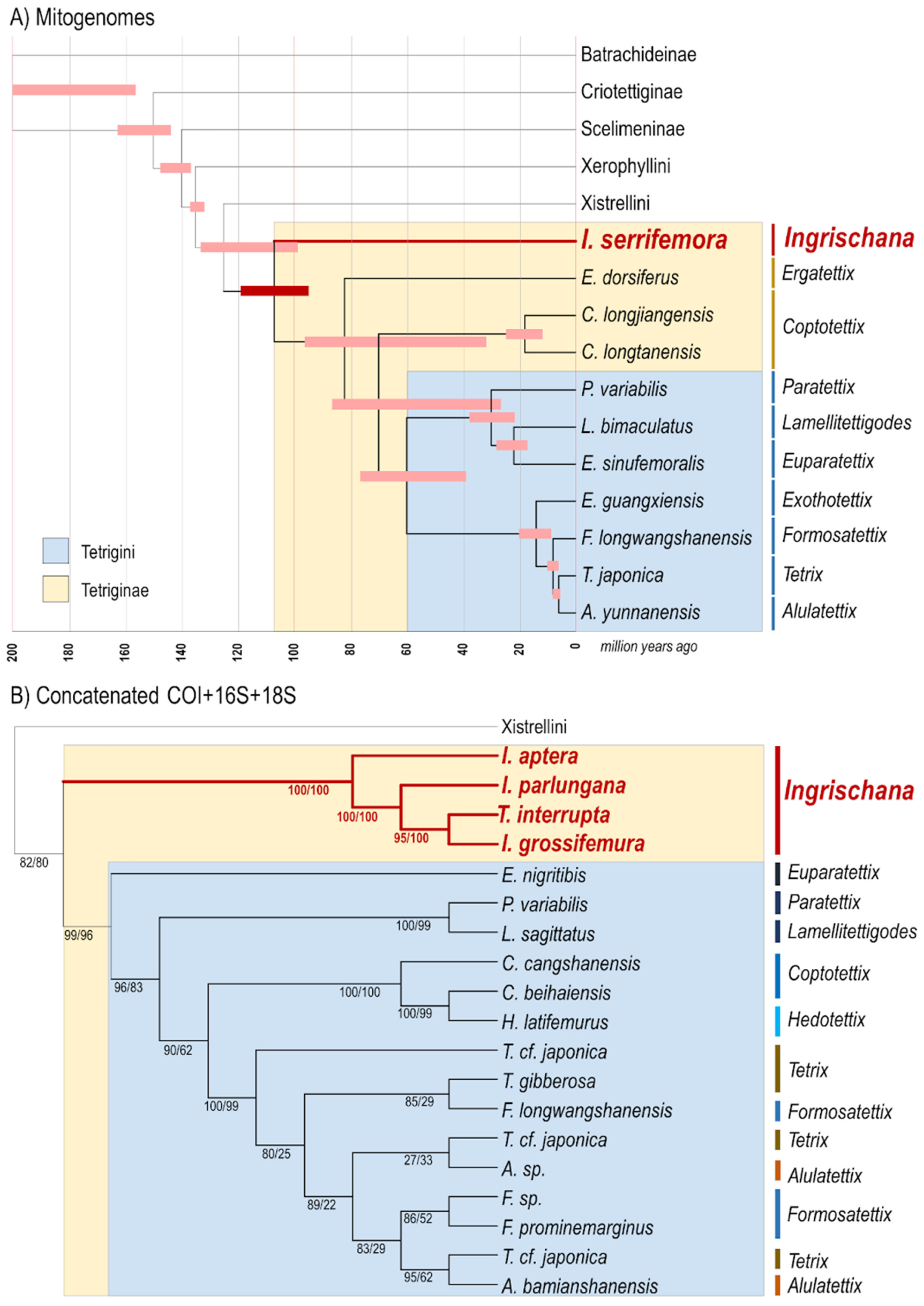
| Species | Classification | NCBI Accession | Length |
|---|---|---|---|
| Saussurella sp. | Batrachideinae | MZ169555 | 16,006 bp |
| Criotettix bispinosus | Criotettiginae | MT162546 | 14,838 bp |
| Acanthalobus japonicus | MT162542 | 14,247 bp | |
| Loxilobus promineoculus | MT162545 | 15,025 bp | |
| Thoradonta yunnana | OP650113 | 17,859 bp | |
| Bolivaritettix yuanbaoshanensis | KY123121 | 14,905 bp | |
| Bolivaritettix lativertex | MN083173 | 15,054 bp | |
| Yunnantettix bannaensis | MN083181 | 15,167 bp | |
| Scelimena melli | Scelimeninae | MW722938 | 14,598 bp |
| Scelimena discalis | OP057410 | 17,552 bp | |
| Scelimena spicupennis | OR333957 | 16,069 bp | |
| Paragavialidium hainanense | NC_071831 | 17,849 bp | |
| Trachytettix bufo | Xerophyllini | JX913766 | 14,578 bp |
| Systolederus spicupennis | No subfamily assignment: Xistrellini | MH791445 | 15,262 bp |
| Systolederus nigropennis | MN938922 | 14,652 bp | |
| Systolederus hainanensis | NC_063117 | 14,946 bp | |
| Systolederus bashanensis | NC_063118 | 14,775 bp | |
| Systolederus anhuiensis | NC_071822 | 15,458 bp | |
| Systolederus zhengi | OR260079 | 15,398 bp | |
| Ingrischana serrifemora comb. nov. | Tetriginae: no tribal assignment | MN938923 | 14,947 bp |
| Ergatettix dorsiferus | NC_046540 | 15,326 bp | |
| Coptotettix longtanensis | OK540319 | 16,861 bp | |
| Coptotettix longjiangensis | KY798413 | 14,495 bp | |
| Paratettix variabilis | Tetriginae: Tetrigini | NC_046542 | 15,194 bp |
| Lamellitettigodes bimaculatus | NC_046541 | 15,221 bp | |
| Euparatettix tridentatus | OR260076 | 15,086 bp | |
| Exothotettix guangxiensis | NC_082934 | 17,643 bp | |
| Formosatettix qinlingensis | KY798412 | 15,180 bp | |
| Tetrix japonica | NC_018543 | 15,128 bp | |
| Alulatettix yunnanensis | NC_018542 | 15,104 bp |
| Species | Type Locality | Name Bearing Type |
|---|---|---|
| I. aptera (Zheng et Ou, 2009) [19] comb. nov. | China: Yunnan: Ruili | HT ♂ (SNNU) |
| I. aspinosa gen. et sp. nov. | NEPAL: Bara: Tamagadhi | HT ♀ (ICAG) |
| I. barbifemura (Zheng, 1998) [12] comb. nov. | China: Yunnan: Menglun | HT ♂ (SNNU) |
| I. curvimargina (Zheng et Deng, 2004) [17] comb. nov. | China: Guangxi: Yizhou | HT ♀ (SNNU) |
| I. dentifemura (Zheng, Shi et Luo, 2003) [16] comb. nov. | China: Guangxi: Xincheng | HT ♂ (SNNU) |
| I. grossifemura (Zheng et Jiang, 1997) [11] comb. nov. | China: Guangxi: Nanning | HT ♂ (SNNU) |
| I. jhapana (Ingrisch, 2001a) [14] stat. rev. | NEPAL: Jhapa: Kakarbhitta | HT ♀ (SMF) |
| I. longzhouensis (Zheng et Jiang, 2000) [13] comb. nov. | China: Guangxi: Longzhou | HT ♀ (SNNU) |
| I. motbotawa gen. et sp. nov. | NEPAL: Kapilvastu: Lake Brija | HT ♀ (ICAG) |
| I. obesa (Bolívar, 1887) [3] comb. nov. | MYANMAR (ambiguous, see in text) | HT ♀ (NMW) |
| I. parlungana nom. nov. | China: Tibet: Bomi | HT ♀ (SNNU) |
| I. serrifemora (Deng, Zheng et Wei, 2008) [18] comb. nov. | China: Guangxi: Luocheng | HT ♀ (SNNU) |
| I. serrifemoralis (Zheng, 1998) [12] comb. nov. | China: Yunnan: Yongren | HT ♀ (SNNU)) |
| I. serrifemoroides (Zheng et Jiang, 2002) [15] comb. nov. | China: Guangxi: Longzhou, Nonggang | HT ♀ (SNNU) |
| I. torulosinota (Zheng, 1998) [12] comb. nov. | China: Yunnan: Jinping, Mengla | HT ♀ (SNNU) |
| Species | Vertex/Eye Ratio (Sex) | Anterior Margin of Vertex in Comparison to Eyes | Anterior Margin of Pronotum | Prozonal Carinae (Anterior to Posterior) | Median Carina of Pronotum (Lateral View) | Pronotum Surface | Pronotum Length |
|---|---|---|---|---|---|---|---|
| I. aptera comb. nov. | 1.1 (♂) | in level | straight | subparallel | arched, then flat | finely granulated | brachy |
| I. aspinosa sp. nov. | 1.25 (♀) | not reaching | slightly produced | subparallel | arched, then slightly undulated | finely granulated | brachy |
| I. barbifemura comb. nov. | 1.3 (♂) | in level | straight | subparallel | arched, then undulated | tuberculated | brachy |
| I. curvimargina comb. nov. | 1.5 (♀) | in level | straight | weakly converging | arched, then undulated | smooth | brachy |
| I. dentifemura comb. nov. | 0.8 (♂) | in level | straight | subparallel | arched, then flat | smooth | pauro |
| I. grossifemura comb. nov. | 1.25 (♂) | not reaching | straight | subparallel | arched, then strongly undulated | finely nodulated | brachy |
| I. jhapana stat. rev. | 1.2 (♀) | not reaching | straight | subparallel | arched, then flat | densely granular | brachy |
| I. longzhouensis comb. nov. | ≈1 (♀) | not reaching | straight | subparallel | arched, then flat | finely nodulated | brachy |
| I. motbotawa sp. nov. | 1.4 (♀), 1.3 (♂) | in level | slightly produced | parallel to slightly converging | arched, then flat | finely granulated/wrinkled | brachy |
| I. obesa comb. nov. | 1.4 (♀) | not reaching | straight | weakly converging | slightly arched, then flat | tuberculated | brachy to pauro |
| I. parlungana nom. nov. | 0.9 (♀) | not reaching | straight | subparallel | slightly arched/undulated, then flat | finely tuberculated | brachy |
| I. serrifemora comb. nov. | 0.9 (♀) | not reaching | straight | weakly converging | slightly arched then undulated | finely tuberculated | brachy |
| I. serrifemoralis comb. nov. | ≈1 (♀) | not reaching | straight | subparallel | undulated, then flat | finely tuberculated | pauro |
| I. serrifemoroides comb. nov. | ≈1 (♀) | in level | straight | weakly converging | weakly undulated, then flat | finely tuberculated | pauro |
| I. torulosinota comb. nov. | 1.3 (♀) | in level | straight | subparallel | arched then flat | densely tuberculated | pauro |
| Species | Hind Wing Length | Mid Femora Length/Width Ratio (Sex) | Hind Femora Length/Width Ratio (Sex) | Serrations on Hind Femora (Dorsal/Ventral) | Ovipositor Spines | Size (mm) |
|---|---|---|---|---|---|---|
| I. aptera comb. nov. | absent | 2.8 (♂) | 2.3–2.5 (♂) | large/absent | fine | 8.0–8.3 (♀), 7.0–7.5 (♂) |
| I. aspinosa sp. nov. | slightly abbreviated | 3.0 (♀) | 2.4 (♀) | fine/fine | absent | 13.45 (♀) |
| I. barbifemura comb. nov. | slightly abbreviated | 2.2 (♂) | 2.2 (♀,♂) | fine/fine | fine | 8.5–11 (♀), 8.0–8.5 (♂) |
| I. curvimargina comb. nov. | slightly abbreviated | 3.9 (♀) | 3.2 (♀) | large/large | fine | 10.5 (♀) |
| I. dentifemura comb. nov. | developed | 3.0 (♂) | 2.9 (♂) | large/fine | N/A (male) | 9 (♂) |
| I. grossifemura comb. nov. | slightly abbreviated | 2.9 (♂) | 2.2(♂) | large/absent | N/A (male) | 9 (♂) |
| I. jhapana stat. rev. | slightly abbreviated | 3.3 (♀) | 2.3 (♀) | fine spines alternating with large | n/v | 8.52 (♀) |
| I. longzhouensis comb. nov. | slightly abbreviated | 3.5 (♀) | 3.7 (♀) | fine/fine | fine | 11–12 (♀), 10 (♂) |
| I. motbotawa sp. nov. | slightly abbreviated | 3 (♀), 2.3 (♂) | 2.7 (♀), 2.4 (♂) | fine/large | fine | 11.9–12.16 (♀), 10.55 (♂) |
| I. obesa comb. nov. | slightly abbreviated | 3.7 (♀) | 2.4 (♀) | large/fine | fine | 9.34 (♀) |
| I. parlungana nom. nov. | developed | 2.7 (♀) | 2.6 (♀) | large/large | fine | 8.0–11.0 (♀), 7.5–8.5 (♂) |
| I. serrifemora comb. nov. | developed | 3.0 (♀) | 2.5 (♀) | large/fine | fine | 8.0–8.5 (♀), 6.5–6.7 (♂) |
| I. serrifemoralis comb. nov. | developed | 3.3 (♀) | 2.6 (♀) | large/large | fine | 12.5 (♀), 11 (♂) |
| I. serrifemoroides comb. nov. | developed | 2.7 (♀) | 3.0 (♀) | fine/fine | fine | 11.5 (♀), 10 (♂) |
| I. torulosinota comb. nov. | developed | 2.5 (♀) | 2.6 (♀) | fine/fine | fine | 10 (♀) |
| Body Parts | I. motbotawa gen. et sp. nov. | I. aspinosa gen. et sp. nov. | I. obesa comb. nov. | |||
|---|---|---|---|---|---|---|
| HT (♀) | PT (♂) | PT (♀) | HT (♀) | HT (♀) | Jhuwani (♀) | |
| Body length | 12.16 | 10.55 | 11.90 | 13.45 | 9.34 | 7.76 |
| Vertex width | 0.89 | 0.88 | 0.96 | 0.77 | 0.78 | 0.59 |
| Eye width | 0.61 | 0.69 | 0.69 | 0.63 | 0.56 | 0.51 |
| Scutellum width | 0.32 | 0.32 | 0.26 | 0.23 | 0.28 | 0.23 |
| Pronotum length | 8.97 | 9.44 | 10.16 | 10.15 | 8.14 | 8.21 |
| Pronotum lobe width | 5.16 | 4.63 | 5.10 | 4.87 | 4.27 | 3.40 |
| Pronotum height | 3.27 | 3.46 | 3.89 | 3.02 | 2.74 | 2.34 |
| Tegmen length | 1.84 | 1.85 | 2.02 | 2.35 | n/v | 1.69 |
| Tegmen width | 0.79 | 0.72 | 0.60 | 0.76 | 0.81 | 0.75 |
| Alae length | 4.89 | 6.01 | 5.33 | 6.25 | 5.06 | 9.95 |
| Fore femur length | 2.39 | 2.53 | 2.43 | 2.56 | 1.73 | 1.52 |
| Fore femur width | 0.67 | 0.69 | 0.68 | 0.78 | 0.57 | 0.44 |
| Mid femur length | 2.71 | 2.36 | 2.87 | 2.98 | 2.45 | 1.90 |
| Mid femur width | 0.95 | 1.03 | 0.91 | 0.98 | 0.66 | 0.56 |
| Hind femur length | 5.98 | 6.91 | 7.35 | 7.27 | 5.70 | 4.73 |
| Hind femur width | 2.34 | 2.83 | 2.63 | 3.02 | 2.41 | 1.99 |
| Hind tibia length | 5.13 | 6.42 | 6.23 | 6.30 | 5.06 | 4.12 |
| Hind basal tarsal segment length | 1.20 | 1.08 | 1.21 | 1.23 | 1.10 | 0.80 |
| Hind apical tarsal segment length | 0.77 | 0.90 | 0.83 | 0.77 | 0.74 | 0.61 |
| Subgenital plate length | n/v | 0.85 | n/v | n/v | n/v | n/v |
| Subgenital plate width | n/v | 0.51 | n/v | n/v | n/v | n/v |
| Ovipositor dorsal valve length | 1.31 | N/A (male) | 1.57 | 1.43 | 1.16 | 0.90 |
| Ovipositor dorsal valve width | 0.56 | N/A (male) | 0.56 | 0.61 | 0.48 | 0.37 |
| Ovipositor ventral valve length | 1.39 | N/A (male) | 1.49 | 1.67 | 1.02 | 0.66 |
| Ovipositor ventral valve width | 0.38 | N/A (male) | 0.39 | 0.35 | 0.30 | 0.27 |
Disclaimer/Publisher’s Note: The statements, opinions and data contained in all publications are solely those of the individual author(s) and contributor(s) and not of MDPI and/or the editor(s). MDPI and/or the editor(s) disclaim responsibility for any injury to people or property resulting from any ideas, methods, instructions or products referred to in the content. |
© 2026 by the authors. Licensee MDPI, Basel, Switzerland. This article is an open access article distributed under the terms and conditions of the Creative Commons Attribution (CC BY) license.
Share and Cite
Subedi, M.; Skejo, J. Establishing Ingrischana gen. nov. as a First Step in Reviewing Asian Tetriginae (Orthoptera: Tetrigidae). Life 2026, 16, 797. https://doi.org/10.3390/life16050797
Subedi M, Skejo J. Establishing Ingrischana gen. nov. as a First Step in Reviewing Asian Tetriginae (Orthoptera: Tetrigidae). Life. 2026; 16(5):797. https://doi.org/10.3390/life16050797
Chicago/Turabian StyleSubedi, Madan, and Josip Skejo. 2026. "Establishing Ingrischana gen. nov. as a First Step in Reviewing Asian Tetriginae (Orthoptera: Tetrigidae)" Life 16, no. 5: 797. https://doi.org/10.3390/life16050797
APA StyleSubedi, M., & Skejo, J. (2026). Establishing Ingrischana gen. nov. as a First Step in Reviewing Asian Tetriginae (Orthoptera: Tetrigidae). Life, 16(5), 797. https://doi.org/10.3390/life16050797