Postoperative Patient-Reported Visual Symptoms After Robot-Assisted Laparoscopic Radical Prostatectomy in Steep Trendelenburg: A Prospective Single-Center Observational Cohort Study

Abstract
1. Introduction
2. Background
2.1. Perioperative Visual Loss: Definition and Epidemiology
2.2. Mechanisms and Etiologies of POVL
2.3. Pathophysiology and Risk Factors
2.4. Practice Advisory for POVL Prevention
2.5. Physiological Effects of Steep Trendelenburg Positioning During RALP
2.5.1. Cardiovascular and Respiratory Effects
2.5.2. Effects on Intracranial and Intraocular Pressure
2.5.3. Optic Nerve Sheath Diameter as a Surrogate of Intracranial Pressure
3. Materials and Methods
3.1. Study Design and Population
- -
- Written informed consent;
- -
- Age > 18 years;
- -
- Negative history for glaucoma and/or other ocular surgical disease;
- -
- Negative history for intracranial hypertension.
- -
- Refusal or inability to provide informed consent;
- -
- Age < 18 years;
- -
- History of glaucoma or other significant ocular disease;
- -
- History of intracranial hypertension.
3.2. Perioperative Anesthetic Management
3.3. Surgical Positioning
3.4. Transorbital Ultrasound Protocol
- -
- t1: Immediately after induction, before Trendelenburg positioning (baseline);
- -
- t2: 30 min after initiation of steep Trendelenburg positioning;
- -
- t3: At the end of steep Trendelenburg positioning, before returning to supine position.
3.5. Data Collection
3.6. Postoperative Assessment
3.7. Statistical Analysis
3.8. Ethical Approval
4. Results
4.1. Patient Characteristics
4.2. Intraoperative Variables
4.3. Optic Nerve Sheath Diameter Measurements
4.4. Incidence of Postoperative Visual Symptoms
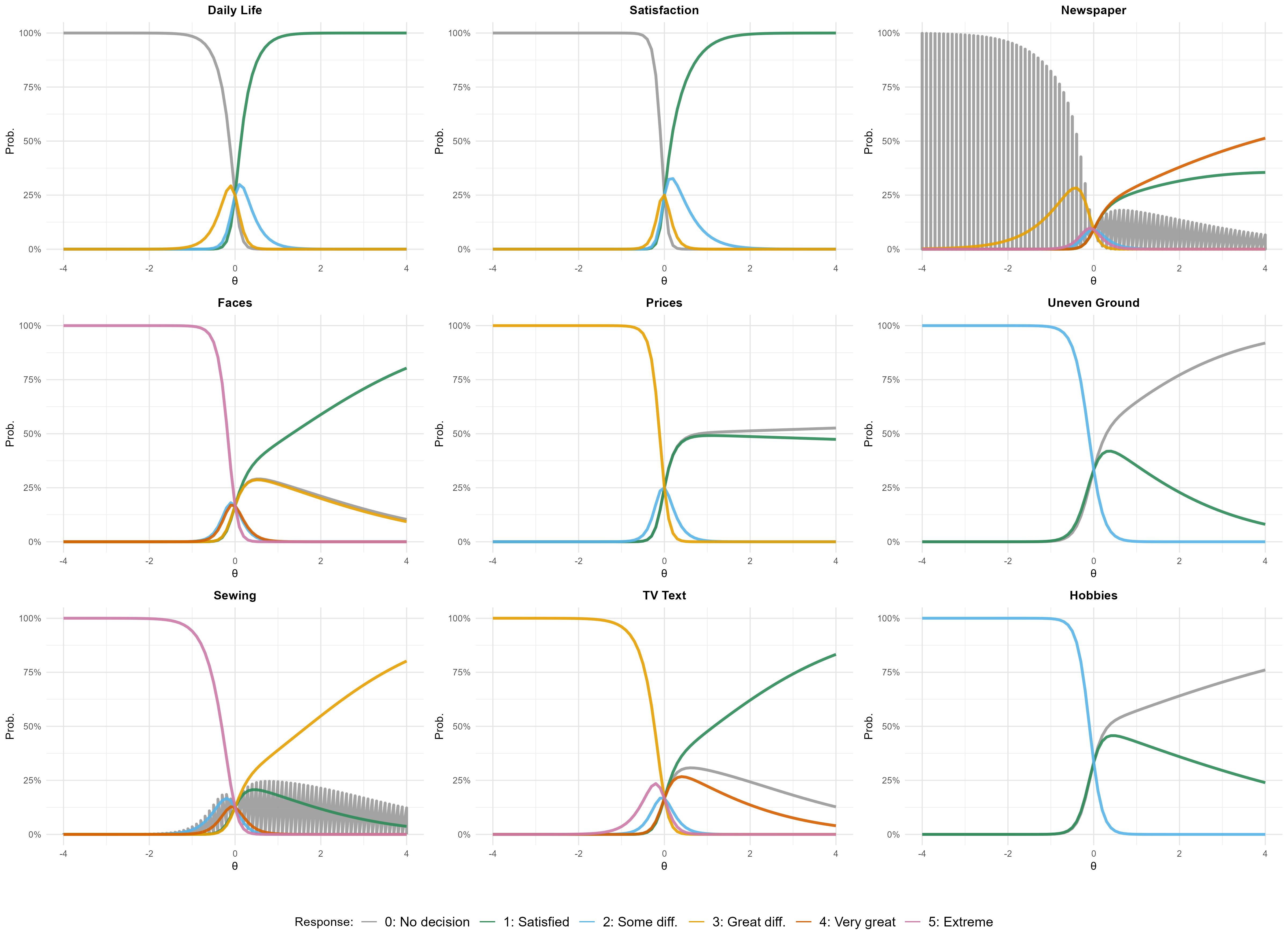
4.5. Rasch Analysis of Catquest-9SF Responses
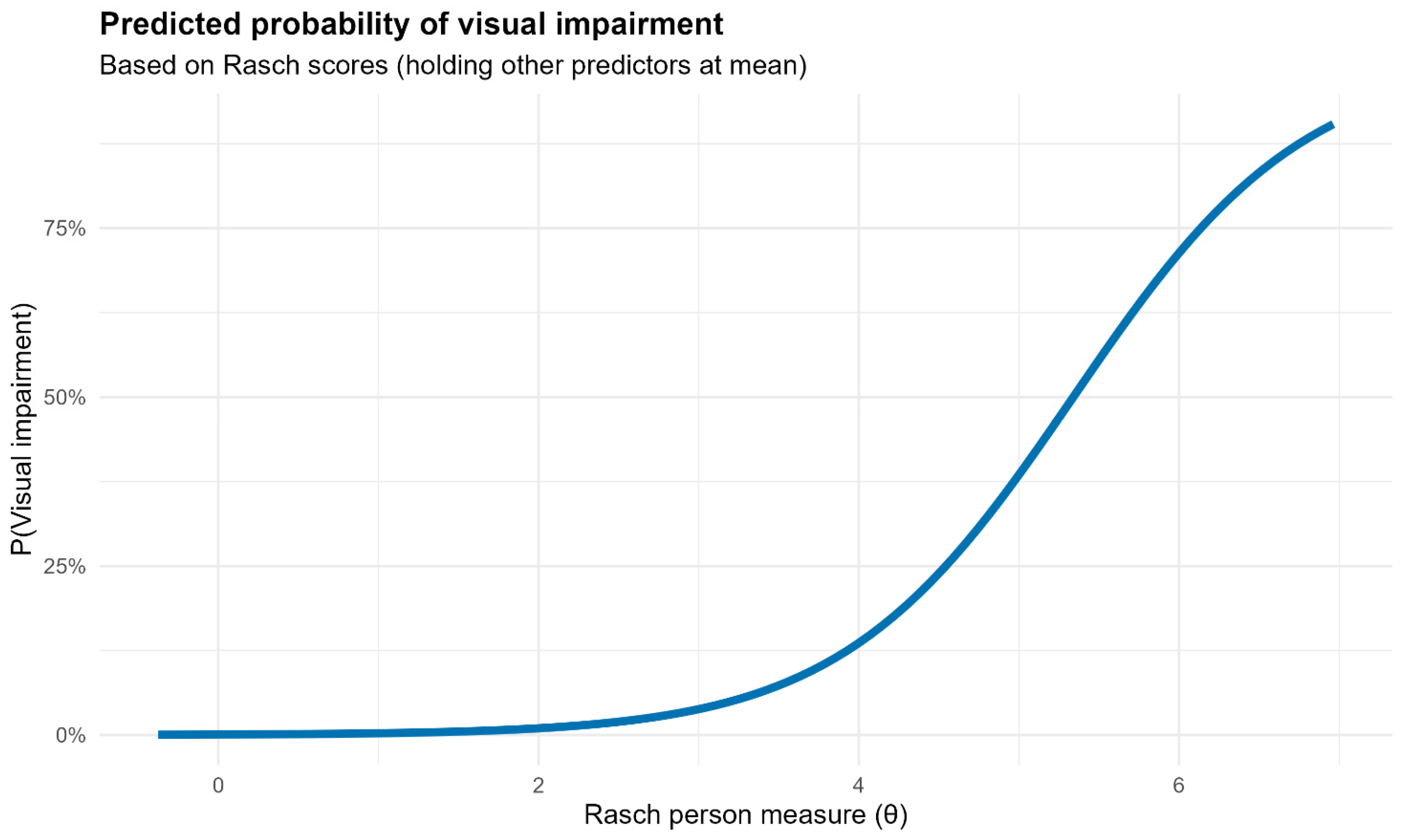
4.6. Logistic Regression Analysis
5. Discussion
5.1. Principal Findings
5.2. Comparison with Existing Literature
| Study | Year | N | Visual Assessment | Incidence of Visual Changes | Long-Term Outcome |
|---|---|---|---|---|---|
| Hoshikawa et al. [6] | 2014 | 31 eyes | VA, RNFL | No significant change | No complications at 1 month |
| Taketani et al. [7] | 2015 | 50 eyes | Humphrey VF 30-2 | 28% transient VF defects | Recovery within 3 months |
| Mizumoto et al. [39] | 2017 | 44 eyes | Humphrey VF, OCT | No significant change | No change at 3–6 months |
| Awad et al. [5] | 2020 | 52 pts | VA, RNFL, GCC | No significant change | No change at 3 months |
| Kakutani et al. [38] | 2020 | 98 pts | Humphrey VF | 17.3% transient VF defects | Recovery within 3 months |
| Present study | 2023 | 55 pts | Catquest-9SF (PRO) | 10.9% patient-reported | — |
5.3. Pathophysiological Considerations
5.4. Role of Intraoperative Hypotension
5.5. ONSD as a Predictor of Visual Outcomes
5.6. Strengths and Limitations
5.7. Clinical Implications
5.8. Future Directions
6. Conclusions
Author Contributions
Funding
Institutional Review Board Statement
Informed Consent Statement
Data Availability Statement
Acknowledgments
Conflicts of Interest
References
- Newman, N.J. Perioperative visual loss after nonocular surgeries. Am. J. Ophthalmol. 2008, 145, 604–610. [Google Scholar] [CrossRef]
- Kla, K.M.; Lee, L.A. Perioperative visual loss. Best Pract. Res. Clin. Anaesthesiol. 2016, 30, 69–77. [Google Scholar] [CrossRef]
- Weber, E.D.; Colyer, M.H.; Lesser, R.L.; Subramanian, P.S. Posterior ischemic optic neuropathy after minimally invasive prostatectomy. J. Neuroophthalmol. 2007, 27, 285–287. [Google Scholar] [CrossRef]
- Raz, O.; Boesel, T.W.; Arianayagam, M.; Lau, H.; Vass, J.; Huynh, C.C.; Graham, S.L.; Varol, C. The effect of the modified Z Trendelenburg position on intraocular pressure during robotic assisted laparoscopic radical prostatectomy: A randomized, controlled study. J. Urol. 2015, 193, 1213–1219. [Google Scholar] [CrossRef]
- Awad, H.; Bai, M.; Ramadan, M.E.; Shabsigh, A.; Backes, F.; Craven, M.A.; Abdel-Rasoul, M.; Bergese, S.D.; Slabaugh, M. The effect of increased intraocular pressure during steep Trendelenburg positioning in robotic prostatectomy and hysterectomy on structural and functional ocular parameters. Anesth. Analg. 2020, 130, 975–982. [Google Scholar] [CrossRef] [PubMed]
- Hoshikawa, Y.; Tsutsumi, N.; Ohkoshi, K.; Serizawa, S.; Hamada, M.; Inagaki, K.; Tsuzuki, K.; Koshimizu, J.; Echizen, N.; Fujitani, S.; et al. The effect of steep Trendelenburg positioning on intraocular pressure and visual function during robotic-assisted radical prostatectomy. Br. J. Ophthalmol. 2014, 98, 305–308. [Google Scholar] [CrossRef] [PubMed]
- Taketani, Y.; Mayama, C.; Suzuki, N.; Wada, A.; Oka, T.; Inamochi, K.; Nomoto, Y. Transient but significant visual field defects after robot-assisted laparoscopic radical prostatectomy in deep Trendelenburg position. PLoS ONE 2015, 10, e0123361. [Google Scholar] [CrossRef]
- American Society of Anesthesiologists Task Force on Perioperative Visual Loss. Practice advisory for perioperative visual loss associated with spine surgery 2019: An updated report. Anesthesiology 2019, 130, 12–30. [Google Scholar] [CrossRef] [PubMed]
- Roth, S.; Moss, H.E. Update on perioperative ischemic optic neuropathy associated with non-ophthalmic surgery. Front. Neurol. 2018, 9, 557. [Google Scholar] [CrossRef]
- Shen, Y.; Drum, M.; Roth, S. The prevalence of perioperative visual loss in the United States: A 10-year study from 1996 to 2005 of spinal, orthopedic, cardiac, and general surgery. Anesth. Analg. 2009, 109, 1534–1545. [Google Scholar] [CrossRef]
- Rubin, D.S.; Matsumoto, M.M.; Moss, H.E.; Joslin, C.; Tung, A.; Roth, S. Ischemic optic neuropathy in cardiac surgery: Incidence and risk factors in the United States from the National Inpatient Sample 1998 to 2013. Anesthesiology 2017, 126, 810–821. [Google Scholar] [CrossRef] [PubMed]
- Biousse, V.; Newman, N.J. Ischemic optic neuropathies. N. Engl. J. Med. 2015, 372, 2428–2436. [Google Scholar] [CrossRef]
- Goyal, A.; Elminawy, M.; Alvi, M.A.; Long, T.R.; Chen, J.J.; Bradley, E.; Freedman, B.A.; Bydon, M. Ischemic optic neuropathy following spine surgery: Case control analysis and systematic review of the literature. Spine 2019, 44, 1087–1096. [Google Scholar] [CrossRef]
- Su, A.W.; Lin, S.C.; Larson, A.N. Perioperative vision loss in spine surgery and other orthopaedic procedures. J. Am. Acad. Orthop. Surg. 2016, 24, 702–710. [Google Scholar]
- Biousse, V.; Newman, N.J. Diagnosis and clinical features of common optic neuropathies. Lancet Neurol. 2016, 15, 1355–1367. [Google Scholar] [CrossRef]
- Hernandez-Meza, G.; Gainsburg, D.M. Anesthetic concerns for robotic-assisted laparoscopic radical prostatectomy: An update. Minerva Anestesiol. 2023, 89, 812–823. [Google Scholar] [CrossRef]
- Kalmar, A.F.; Foubert, L.; Hendrickx, J.F.; Mottrie, A.; Absalom, A.; Mortier, E.P.; Struys, M.M.R.F. Influence of steep Trendelenburg position and CO2 pneumoperitoneum on cardiovascular, cerebrovascular, and respiratory homeostasis during robotic prostatectomy. Br. J. Anaesth. 2010, 104, 433–439. [Google Scholar] [CrossRef] [PubMed]
- Atkinson, T.M.; Giraud, G.D.; Togioka, B.M.; Jones, D.B.; Cigarroa, J.E. Cardiovascular and ventilatory consequences of laparoscopic surgery. Circulation 2017, 135, 700–710. [Google Scholar] [CrossRef]
- Tharp, W.G.; Murphy, S.; Breidenstein, M.W.; Love, C.; Booms, A.; Rafferty, M.N.; Friend, A.F.; Perrapato, S.; Ahern, T.P.; Dixon, A.E.; et al. Body habitus and dynamic surgical conditions independently impair pulmonary mechanics during robotic-assisted laparoscopic surgery. Anesthesiology 2020, 133, 750–763. [Google Scholar] [CrossRef] [PubMed]
- Brandão, J.C.; Lessa, M.A.; Motta-Ribeiro, G.; Hashimoto, S.; Paula, L.F.; Torsani, V.; Le, L.; Bao, X.; Eikermann, M.; Dahl, D.M.; et al. Global and regional respiratory mechanics during robotic-assisted laparoscopic surgery: A randomized study. Anesth. Analg. 2019, 129, 1564–1573. [Google Scholar] [CrossRef]
- Kim, K.; Jang, D.M.; Park, J.Y.; Yoo, H.; Kim, H.S.; Choi, W.J. Changes of diaphragmatic excursion and lung compliance during major laparoscopic pelvic surgery: A prospective observational study. PLoS ONE 2018, 13, e0207841. [Google Scholar] [CrossRef]
- Chiumello, D.; Coppola, S.; Fratti, I.; Leone, M.; Pastene, B. Ventilation strategy during urological and gynaecological robotic-assisted surgery: A narrative review. Br. J. Anaesth. 2023, 131, 764–774. [Google Scholar] [CrossRef]
- Kan, K.M.; Brown, S.E.; Gainsburg, D.M. Ocular complications in robotic-assisted prostatectomy: A review of pathophysiology and prevention. Minerva Anestesiol. 2015, 81, 557–566. [Google Scholar] [PubMed]
- Ripa, M.; Schipa, C.; Kopsacheilis, N.; Nomikarios, M.; Perrotta, G.; De Rosa, C.; Aceto, P.; Sollazzi, L.; De Rosa, P.; Motta, L. The impact of steep Trendelenburg position on intraocular pressure. J. Clin. Med. 2022, 11, 2844. [Google Scholar] [CrossRef] [PubMed]
- Koziarz, A.; Sne, N.; Kegel, F.; Nath, S.; Badhiwala, J.H.; Nassiri, F.; Mansouri, A.; Yang, K.; Zhou, Q.; Rice, T.; et al. Bedside optic nerve ultrasonography for diagnosing increased intracranial pressure: A systematic review and meta-analysis. Ann. Intern. Med. 2019, 171, 896–905. [Google Scholar] [CrossRef]
- Berhanu, D.; Ferreira, J.C.; Abegão Pinto, L.; de Sousa, D.A.; Neto, L.L.; Ferreira, J.T. The role of optic nerve sheath ultrasonography in increased intracranial pressure: A systematic review and meta-analysis. J. Neurol. Sci. 2023, 454, 120853. [Google Scholar] [CrossRef] [PubMed]
- Agrawal, D.; Raghavendran, K.; Zhao, L.; Rajajee, V. A prospective study of optic nerve ultrasound for the detection of elevated intracranial pressure in severe traumatic brain injury. Crit. Care Med. 2020, 48, e1278–e1285. [Google Scholar] [CrossRef]
- Jeon, J.P.; Lee, S.U.; Kim, S.E.; Kang, S.H.; Yang, J.S.; Choi, H.J.; Cho, Y.J.; Ban, S.P.; Byoun, H.S.; Kim, Y.S. Correlation of optic nerve sheath diameter with directly measured intracranial pressure in Korean adults using bedside ultrasonography. PLoS ONE 2017, 12, e0183170. [Google Scholar] [CrossRef]
- Malky, I.E.; Aita, W.E.; Elkordy, A.; Nasreldeen, M.; Abdelhafiz, M.; Tael, A.M.; Abdelkhalek, H.M. Optic nerve sonographic parameters in idiopathic intracranial hypertension, case-control study. Sci. Rep. 2025, 15, 1788. [Google Scholar] [CrossRef]
- Kim, Y.; Choi, S.; Kang, S.; Park, B. Propofol affects optic nerve sheath diameter less than sevoflurane during robotic surgery in the steep Trendelenburg position. BioMed Res. Int. 2019, 2019, 5617815. [Google Scholar] [CrossRef]
- De Bernardo, M.; Vitiello, L.; De Luca, M.; La Marca, A.; Rosa, N. Optic nerve changes detected with ocular ultrasonography during different surgical procedures: A narrative review. J. Clin. Med. 2022, 11, 5467. [Google Scholar] [CrossRef]
- Kabanovski, A.; Shah, B.; D’Silva, C.; Ma, J.; Minotti, S.C.; Qian, J.; Hatch, W.; Reid, R.; Chaudhary, V.; El-Defrawy, S.; et al. Multi-center validation of Catquest-9SF visual function questionnaire in Ontario, Canada. PLoS ONE 2023, 18, e0278863. [Google Scholar] [CrossRef]
- Schlenker, M.B.; Minotti, S.C.; Kabanovski, A.; Lim, M.; D’sIlva, C.; Ma, J.; Reid, R.; Ahmed, I.I.K. Catquest-9SF questionnaire and eCAPS: Validation in a Canadian population. PLoS ONE 2020, 15, e0237788. [Google Scholar] [CrossRef]
- Kabanovski, A.; Hatch, W.; Chaudhary, V.; El-Defrawy, S.; Reid, R.; Ahmed, I.I.K.; Schlenker, M.B. Validation and application of Catquest-9SF in various populations: A systematic review. Surv. Ophthalmol. 2020, 65, 348–360. [Google Scholar] [CrossRef]
- Petrillo, J.; Cano, S.J.; McLeod, L.D.; Coon, C.D. Using classical test theory, item response theory, and Rasch measurement theory to evaluate patient-reported outcome measures: A comparison of worked examples. Value Health 2015, 18, 25–34. [Google Scholar] [CrossRef]
- Browne, J.P.; Cano, S.J. A Rasch measurement theory approach to improve the interpretation of patient-reported outcomes. Med. Care 2019, 57, S18–S23. [Google Scholar] [CrossRef]
- Pesudovs, K. Item banking: A generational change in patient-reported outcome measurement. Optom. Vis. Sci. 2010, 87, 285–293. [Google Scholar] [CrossRef] [PubMed]
- Kakutani, S.; Asamoto, M.; Araki, F.; Chen, Y.; Shinokawa, M.; Okagami, Y.; Ohata, T.; Taguchi, S.; Yamada, Y.; Takeshima, Y.; et al. Prospective evaluation of visual function in patients with ocular diseases after robot-assisted laparoscopic prostatectomy. Int. J. Urol. 2020, 27, 307–312. [Google Scholar] [CrossRef]
- Mizumoto, K.; Gosho, M.; Iwaki, M.; Zako, M. Ocular parameters before and after steep Trendelenburg positioning for robotic-assisted laparoscopic radical prostatectomy. Clin. Ophthalmol. 2017, 11, 1643–1650. [Google Scholar] [CrossRef] [PubMed]
- Dunker, S.; Hsu, H.Y.; Sebag, J.; Sadun, A.A. Perioperative risk factors for posterior ischemic optic neuropathy. J. Am. Coll. Surg. 2002, 194, 705–710. [Google Scholar] [CrossRef] [PubMed]


| Variable | Value |
|---|---|
| Age (years), mean ± SD | 65.96 ± 8.52 |
| BMI (kg/m2), mean ± SD | 26.36 ± 3.02 |
| ASA Class II, n (%) | 50 (90.9%) |
| ASA Class III, n (%) | 5 (9.1%) |
| Variable | Value |
|---|---|
| Surgical duration, min, mean ± SD | 174.64 ± 46.88 |
| Mean BIS/PSI value, mean ± SD | 50.11 ± 5.34 |
| Lowest intraoperative MAP, mmHg, mean ± SD | 58.27 ± 4.09 |
| Lowest intraoperative hemoglobin, g/dL, mean ± SD | 12.96 ± 1.35 |
| Estimated blood loss, mL, mean ± SD | 267.27 ± 317.14 |
| Time Point | Right Eye ONSD, mm, Mean ± SD | Left Eye ONSD, mm, Mean ± SD |
|---|---|---|
| t1—Before Trendelenburg (baseline) | 4.00 ± 0.67 | 3.93 ± 0.61 |
| t2—30 min after Trendelenburg | 4.29 ± 0.66 | 4.21 ± 0.65 |
| t3—End of Trendelenburg | 4.39 ± 0.61 | 4.34 ± 0.63 |
| Maximum ONSD during surgery, mean ± SD | 4.53 ± 0.65 | — |
| Variable | Coefficient (β) | Odds Ratio (OR) | 95% CI | p-Value |
|---|---|---|---|---|
| Rasch score | 1.38 | 3.97 | (1.00–15.75) | 0.050 |
| Lowest MAP | 0.25 | 1.29 | (0.97–1.73) | 0.081 |
| Maximum ONSD | 0.18 | 1.20 | (0.27–5.32) | 0.811 |
Disclaimer/Publisher’s Note: The statements, opinions and data contained in all publications are solely those of the individual author(s) and contributor(s) and not of MDPI and/or the editor(s). MDPI and/or the editor(s) disclaim responsibility for any injury to people or property resulting from any ideas, methods, instructions or products referred to in the content. |
© 2026 by the authors. Licensee MDPI, Basel, Switzerland. This article is an open access article distributed under the terms and conditions of the Creative Commons Attribution (CC BY) license.
Share and Cite
Cappellini, I.; Tabani, F.; Campiglia, L.; Schirru, E.; Pavoni, V. Postoperative Patient-Reported Visual Symptoms After Robot-Assisted Laparoscopic Radical Prostatectomy in Steep Trendelenburg: A Prospective Single-Center Observational Cohort Study. Life 2026, 16, 704. https://doi.org/10.3390/life16050704
Cappellini I, Tabani F, Campiglia L, Schirru E, Pavoni V. Postoperative Patient-Reported Visual Symptoms After Robot-Assisted Laparoscopic Radical Prostatectomy in Steep Trendelenburg: A Prospective Single-Center Observational Cohort Study. Life. 2026; 16(5):704. https://doi.org/10.3390/life16050704
Chicago/Turabian StyleCappellini, Iacopo, Francesca Tabani, Laura Campiglia, Elena Schirru, and Vittorio Pavoni. 2026. "Postoperative Patient-Reported Visual Symptoms After Robot-Assisted Laparoscopic Radical Prostatectomy in Steep Trendelenburg: A Prospective Single-Center Observational Cohort Study" Life 16, no. 5: 704. https://doi.org/10.3390/life16050704
APA StyleCappellini, I., Tabani, F., Campiglia, L., Schirru, E., & Pavoni, V. (2026). Postoperative Patient-Reported Visual Symptoms After Robot-Assisted Laparoscopic Radical Prostatectomy in Steep Trendelenburg: A Prospective Single-Center Observational Cohort Study. Life, 16(5), 704. https://doi.org/10.3390/life16050704