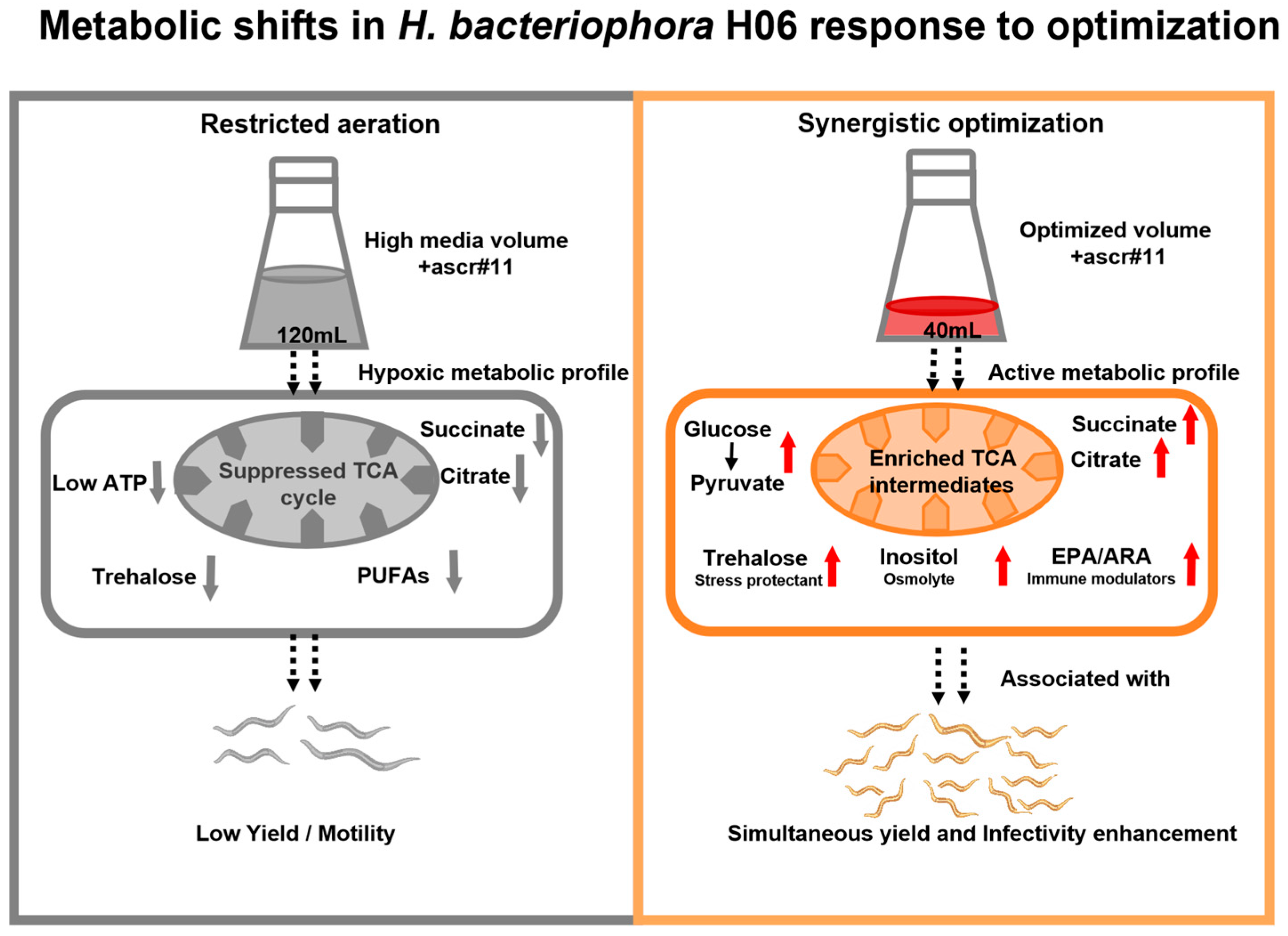
Synergy of Ascr#11 and Improved Aeration Drives Enhanced Yield and Fitness of Entomopathogenic Nematodes

Abstract
1. Introduction
2. Materials and Methods
2.1. Nematode and Bacteria
2.2. Reagents and Medium Components
2.3. Preparation of Nematode Inoculum
2.4. Liquid Culture Protocol
2.5. Experimental Design
2.6. Quantification of Yield and Biological Quality
2.7. Targeted Metabolomics
2.8. Statistical Analysis
3. Results
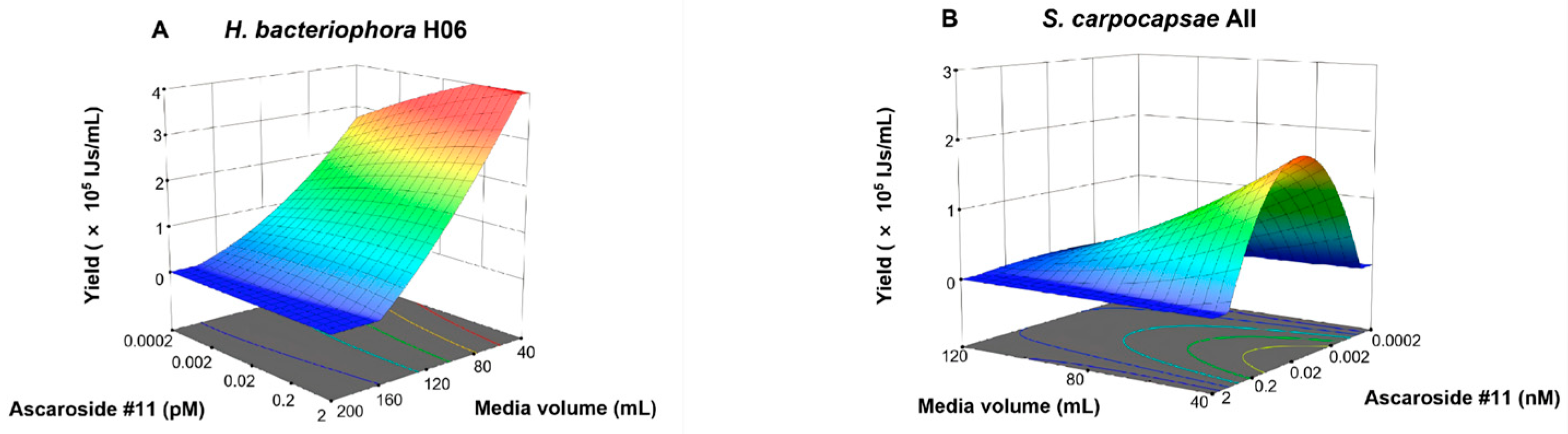
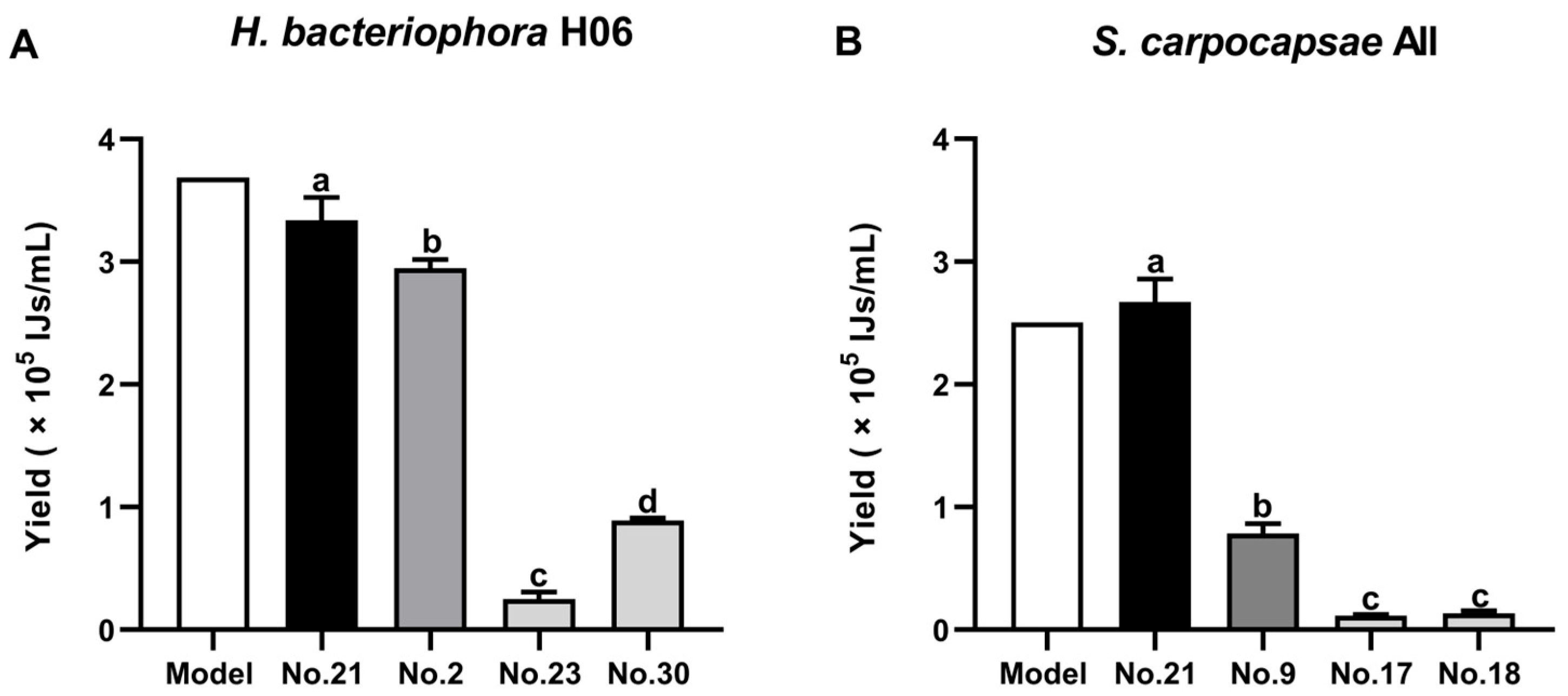
3.1. Optimization of Fermentation Parameters via Response Surface Methodology
3.2. Biological Quality Assessment
3.3. Metabolic Characterization Associated with the High-Quality Phenotype
4. Discussion
5. Conclusions
Supplementary Materials
Author Contributions
Funding
Institutional Review Board Statement
Informed Consent Statement
Data Availability Statement
Acknowledgments
Conflicts of Interest
Abbreviations
| ANOVA | Analysis of variance |
| ARA | Arachidonic acid |
| ascr#11 | Ascaroside #11 |
| CCRD | Central composite rotatable design |
| DGLA | Dihomo-gamma-linolenic acid |
| DMSO | Dimethyl sulfoxide |
| DO | Dissolved oxygen |
| EPA | Eicosapentaenoic acid |
| EPNs | Entomopathogenic nematodes |
| FC | Fold change |
| FFAs | Free fatty acids |
| GC-MS | Gas chromatography–mass spectrometry |
| IJs | Infective juveniles |
| NBTA | Nutrient agar supplemented with triphenyl tetrazolium chloride and bromothymol blue |
| OPLS-DA | Orthogonal partial least squares discriminant analysis |
| OTR | Oxygen transfer rate |
| PCA | Principal component analysis |
| PUFAs | Polyunsaturated fatty acids |
| SEM | Standard error of the mean |
| TCA | Tricarboxylic acid |
| UCP4 | Uncoupling protein 4 |
| UHPLC-MS/MS | Ultra-high-performance liquid chromatography–tandem mass spectrometry |
| VIP | Variable importance in projection |
References
- Lacey, L.A.; Grzywacz, D.; Shapiro-Ilan, D.I.; Frutos, R.; Brownbridge, M.; Goettel, M.S. Insect pathogens as biological control agents: Back to the future. J. Invertebr. Pathol. 2015, 132, 1–41. [Google Scholar] [CrossRef]
- Tarasco, E.; Fanelli, E.; Salvemini, C.; El-Khoury, Y.; Troccoli, A.; Vovlas, A.; De Luca, F. Entomopathogenic nematodes and their symbiotic bacteria: From genes to field uses. Front. Insect Sci. 2023, 3, 1195254. [Google Scholar] [CrossRef]
- Gaugler, R.; Georgis, R. Culture method and efficacy of entomopathogenic nematodes (Rhabditida: Steinernematidae and Heterorhabditidae). Biol. Control 1991, 1, 269–274. [Google Scholar] [CrossRef]
- Lacey, L.A.; Georgis, R. Entomopathogenic nematodes for control of insect pests above and below ground with comments on commercial production. J. Nematol. 2012, 44, 218–225. [Google Scholar]
- Gaugler, R.; Brown, I.; Shapiro-Ilan, D.; Atwa, A. Automated technology for in vivo mass production of entomopathogenic nematodes. Biol. Control 2002, 24, 199–206. [Google Scholar] [CrossRef]
- Friedman, M.J. Commercial production and development. In Entomopathogenic Nematodes in Biological Control; Gaugler, R., Kaya, H.K., Eds.; CRC Press: Boca Raton, FL, USA, 1990; pp. 153–172. [Google Scholar]
- Ehlers, R.U. Mass production of entomopathogenic nematodes for plant protection. Appl. Microbiol. Biotechnol. 2001, 56, 623–633. [Google Scholar] [CrossRef] [PubMed]
- Shapiro-Ilan, D.I.; Leite, L.G.; Han, R. Production of entomopathogenic nematodes. In Mass Production of Beneficial Organisms, 2nd ed.; Morales-Ramos, J.A., Rojas, M.G., Shapiro-Ilan, D.I., Eds.; Academic Press: Cambridge, MA, USA, 2023; pp. 293–315. [Google Scholar] [CrossRef]
- Kaya, H.K.; Gaugler, R. Entomopathogenic nematodes. Annu. Rev. Entomol. 1993, 38, 181–206. [Google Scholar] [CrossRef]
- Dunn, M.D.; Belur, P.D.; Malan, A.P. A review of the in vitro liquid mass culture of entomopathogenic nematodes. Biocontrol Sci. Technol. 2021, 31, 1–21. [Google Scholar] [CrossRef]
- Hatab, M.A.A.; Gaugler, R. Lipids of in vivo and in vitro cultured Heterorhabditis bacteriophora. Biol. Control 1999, 15, 113–118. [Google Scholar] [CrossRef]
- Griffin, C.T.; Boemare, N.E.; Lewis, E.E. Biology and behaviour. In Nematodes as Biocontrol Agents; Grewal, P.S., Ehlers, R.U., Shapiro-Ilan, D.I., Eds.; CABI Publishing: Wallingford, UK, 2005; pp. 47–64. [Google Scholar] [CrossRef]
- Bedding, R.A. Low cost in vitro mass production of Neoaplectana and Heterorhabditis species (Nematoda) for field control of insect pests. Nematologica 1981, 27, 109–114. [Google Scholar] [CrossRef]
- Han, R.C. The effects of inoculum size on yield of Steinernema carpocapsae and Heterorhabditis bacteriophora in liquid culture. Nematologica 1996, 42, 546–553. [Google Scholar] [CrossRef]
- Qiu, L.; Bedding, R.A. Energy metabolism and survival of the infective juveniles of Steinernema carpocapsae under oxygen-deficient conditions. J. Nematol. 2000, 32, 271–280. [Google Scholar] [PubMed]
- Michaelson, L.V.; Napier, J.A.; Lewis, M.; Griffiths, G.; Lazarus, C.M.; Stobart, A.K. Functional identification of a fatty acid Δ5 desaturase gene from Caenorhabditis elegans. FEBS Lett. 1998, 439, 215–218. [Google Scholar] [CrossRef]
- Pfeiffer, M.; Kayzer, E.B.; Yang, X.; Abramson, E.; Kenaston, M.A.; Lago, C.U.; Lo, H.H.; Sedensky, M.M.; Lunec, J.; Nakano, K. Caenorhabditis elegans UCP4 protein controls complex II-mediated oxidative phosphorylation through succinate transport. J. Biol. Chem. 2011, 286, 37712–37720. [Google Scholar] [CrossRef]
- Butcher, R.A.; Fujita, M.; Schroeder, F.C.; Clardy, J. Small-molecule pheromones that control dauer development in Caenorhabditis elegans. Nat. Chem. Biol. 2007, 3, 420–422. [Google Scholar] [CrossRef]
- Butcher, R.A.; Ragains, J.R.; Kim, E.; Clardy, J. A potent dauer pheromone component in Caenorhabditis elegans that acts synergistically with other components. Proc. Natl. Acad. Sci. USA 2008, 105, 14288–14292. [Google Scholar] [CrossRef]
- Choe, A.; von Reuss, S.H.; Kogan, D.; Gasser, R.B.; Platzer, E.G.; Schroeder, F.C.; Sternberg, P.W. Ascaroside signaling is widely conserved among nematodes. Curr. Biol. 2012, 22, 772–780. [Google Scholar] [CrossRef] [PubMed]
- Jeong, P.Y.; Jung, M.; Yim, Y.H.; Kim, H.; Park, M.; Hong, E.; Lee, W.; Kim, Y.H.; Kim, K.; Paik, Y.K. Chemical structure and biological activity of the Caenorhabditis elegans dauer-inducing pheromone. Nature 2005, 433, 541–545. [Google Scholar] [CrossRef] [PubMed]
- Kaplan, F.; Alborn, H.T.; von Reuss, S.H.; Ajredini, R.; Ali, J.G.; Akyazi, F.; Stelinski, L.L.; Edison, A.S.; Schroeder, F.C.; Teal, P.E. Interspecific nematode signals regulate dispersal behavior. PLoS ONE 2012, 7, e38735. [Google Scholar] [CrossRef]
- Noguez, J.H.; Conner, E.S.; Zhou, Y.; Ciche, T.A.; Ragains, J.R.; Butcher, R.A. A novel ascaroside controls the parasitic life cycle of the entomopathogenic nematode Heterorhabditis bacteriophora. ACS Chem. Biol. 2012, 7, 961–966. [Google Scholar] [CrossRef] [PubMed]
- Roder, A.C.; Wang, Y.; Stock, S.P.; Butcher, R.A. Influence of symbiotic and non-symbiotic bacteria on pheromone production in Steinernema nematodes (Nematoda, Steinernematidae). J. Exp. Biol. 2019, 222, jeb212068. [Google Scholar] [CrossRef] [PubMed]
- Hartley, C.J.; Lillis, P.E.; Owens, R.A.; Griffin, C.T. Infective juveniles of entomopathogenic nematodes (Steinernema and Heterorhabditis) secrete ascarosides and respond to interspecific dispersal signals. J. Invertebr. Pathol. 2019, 168, 107257. [Google Scholar] [CrossRef]
- Kong, X.; Huang, Z.; Gu, X.; Cui, Y.; Li, J.; Han, R.; Liu, X.; Cao, L. Dimethyl sulfoxide and ascarosides improve the growth and yields of entomopathogenic nematodes in liquid cultures. J. Invertebr. Pathol. 2022, 193, 107800. [Google Scholar] [CrossRef]
- Wang, J.; Cao, L.; Huang, Z.; Gu, X.; Cui, Y.; Li, J.; Han, R. Influence of the ascarosides on the recovery, yield and dispersal of entomopathogenic nematodes. J. Invertebr. Pathol. 2022, 188, 107717. [Google Scholar] [CrossRef]
- Golden, J.W.; Riddle, D.L. The Caenorhabditis elegans dauer larva: Developmental effects of pheromone, food, and temperature. Dev. Biol. 1984, 102, 368–378. [Google Scholar] [CrossRef] [PubMed]
- Srinivasan, J.; Kaplan, F.; Ajredini, R.; Xiao, C.; Alborn, H.T.; Teal, P.E.A.; Sternberg, P.W.; Schroeder, F.C. A blend of small molecules regulates both mating and development in Caenorhabditis elegans. Nature 2008, 454, 1115–1118. [Google Scholar] [CrossRef] [PubMed]
- Liu, X.; Rao, Z.; Han, R.; Jin, L.; Cao, L. Genes involved in DMSO-mediated yield increase of entomopathogenic nematodes. Sci. Rep. 2024, 14, 31670. [Google Scholar] [CrossRef]
- Costes, L.H.; Lippi, Y.; Naylies, C.; Jamin, E.L.; Genthon, C.; Bailly, S.; Oswald, I.P.; Bailly, J.D.; Puel, O. The solvent dimethyl sulfoxide affects physiology, transcriptome and secondary metabolism of Aspergillus flavus. J. Fungi 2021, 7, 1055. [Google Scholar] [CrossRef]
- Huang, S.H.; Wu, C.H.; Chen, S.J.; Sytwu, H.K.; Lin, G.J. Immunomodulatory effects and potential clinical applications of dimethyl sulfoxide. Immunobiology 2020, 225, 151906. [Google Scholar] [CrossRef]
- Crowe, J.H.; Crowe, L.M.; Chapman, D. Preservation of membranes in anhydrobiotic organisms: The role of trehalose. Science 1984, 223, 701–703. [Google Scholar] [CrossRef] [PubMed]
- Grewal, P.S.; Peters, A. Formulation and quality. In Nematodes as Biocontrol Agents; Grewal, P.S., Ehlers, R.-U., Shapiro-Ilan, D.I., Eds.; CABI Publishing: Wallingford, UK, 2005; pp. 79–90. [Google Scholar] [CrossRef]
- Qiu, L.; Bedding, R.A. Energy metabolism and its relation to survival and infectivity of infective juveniles of Steinernema carpocapsae under unstressed aerobic conditions. Nematology 2000, 2, 551–559. [Google Scholar] [CrossRef]
- Park, Y.; Kim, Y. Eicosanoids rescue Spodoptera exigua infected with Xenorhabdus nematophilus, the symbiotic bacteria to the entomopathogenic nematode Steinernema carpocapsae. J. Insect Physiol. 2000, 46, 1469–1476. [Google Scholar] [CrossRef] [PubMed]
- Selvan, S.; Gaugler, R.; Grewal, P.S. Water content and fatty acid composition of infective juvenile entomopathogenic nematodes during storage. J. Parasitol. 1993, 79, 510–516. [Google Scholar] [CrossRef]
- Akhurst, R.J. Morphological and functional dimorphism in Xenorhabdus spp., bacteria symbiotically associated with the insect pathogenic nematodes Neoaplectana and Heterorhabditis. J. Gen. Microbiol. 1980, 121, 303–309. [Google Scholar] [CrossRef]
- Han, R.C.; Wouts, W.M.; Li, L. Development of Heterorhabditis spp. strains as characteristics of possible Xenorhabdus luminescens subspecies. Rev. Nematol. 1990, 13, 411–415. [Google Scholar]
- Woodring, J.L.; Kaya, H.K. Steinernematid and Heterorhabditid Nematodes: A Handbook of Biology and Techniques; Southern Cooperative Series Bulletin 331; Arkansas Agricultural Experiment Station: Fayetteville, AR, USA, 1988. [Google Scholar]
- Lunau, S.; Stoessel, S.; Schmidt-Peisker, A.J.; Ehlers, R.U. Establishment of monoxenic inocula for scaling up in vitro cultures of the entomopathogenic nematodes Steinernema spp. and Heterorhabditis spp. Nematologica 1993, 39, 385–399. [Google Scholar] [CrossRef]
- Kaya, H.K.; Stock, S.P. Techniques in insect nematology. In Manual of Techniques in Insect Pathology; Lacey, L.A., Ed.; Academic Press: San Diego, CA, USA, 1997; pp. 281–324. [Google Scholar] [CrossRef]
- Filgueiras, C.C.; Willett, D.S. Non-lethal effects of entomopathogenic nematode infection. Sci. Rep. 2021, 11, 17090. [Google Scholar] [CrossRef]
- Han, R.C.; Ehlers, R.U. Cultivation of axenic Heterorhabditis spp. dauer juveniles and their response to non-specific Photorhabdus luminescens food signals. Nematologica 1998, 44, 425–435. [Google Scholar] [CrossRef]
- Strauch, O.; Ehlers, R.U. Food signal production of Photorhabdus luminescens inducing the recovery of entomopathogenic nematodes Heterorhabditis spp. in liquid culture. Appl. Microbiol. Biotechnol. 1998, 50, 369–374. [Google Scholar] [CrossRef]
- Strauch, O.; Stoessel, S.; Ehlers, R.U. Culture conditions define automictic or amphimictic reproduction in entomopathogenic rhabditid nematodes of the genus Heterorhabditis. Fundam. Appl. Nematol. 1994, 17, 575–582. [Google Scholar]
- Cai, Y.; Zhu, Z.J. A high-throughput targeted metabolomics workflow for the detection of 200 polar metabolites in central carbon metabolism. In Microbial Metabolomics; Methods in Molecular Biology; Humana Press: New York, NY, USA, 2019; Volume 1859, pp. 263–274. [Google Scholar] [CrossRef]
- Chiu, H.H.; Kuo, C.H. Gas chromatography-mass spectrometry-based analytical strategies for fatty acid analysis in biological samples. J. Food Drug Anal. 2020, 28, 60–73. [Google Scholar] [CrossRef]
- Sokal, R.R.; Rohlf, F.J. Biometry: The Principles and Practice of Statistics in Biological Research, 3rd ed.; W.H. Freeman: New York, NY, USA, 1995; pp. 451–554. [Google Scholar]
- Eriksson, L.; Byrne, T.; Johansson, E.; Trygg, J.; Vikström, C. Multi- and Megavariate Data Analysis: Basic Principles and Applications; Umetrics Academy: Malmö, Sweden, 2013; Volume 1. [Google Scholar]
- Chong, J.; Xia, J. MetaboAnalystR: An R package for flexible and reproducible analysis of metabolomics data. Bioinformatics 2018, 34, 4313–4314. [Google Scholar] [CrossRef]
- Cortés-Martínez, C.I.; Chavarría-Hernández, N. Production of entomopathogenic nematodes in submerged monoxenic culture: A review. Biotechnol. Bioeng. 2020, 117, 3968–3985. [Google Scholar] [CrossRef] [PubMed]
- Claasen, N.J.; Dunn, M.D.; Malan, A.P. Mass-culture technique of a South African Heterorhabditis bacteriophora isolate, using in vitro liquid culture. Afr. Entomol. 2025, 33, e20609. [Google Scholar] [CrossRef]
- Inman, F.L., III; Singh, S.; Holmes, L.D. Mass production of the beneficial nematode Heterorhabditis bacteriophora and its bacterial symbiont Photorhabdus luminescens. Indian J. Microbiol. 2012, 52, 316–324. [Google Scholar] [CrossRef] [PubMed]
- Gil, G.; Choo, H.; Gaugler, R. Enhancement of entomopathogenic nematode production in in-vitro liquid culture of Heterorhabditis bacteriophora by fed-batch culture with glucose supplementation. Appl. Microbiol. Biotechnol. 2002, 58, 751–755. [Google Scholar] [CrossRef]
- Maushe, D.; Ogi, V.; Divakaran, K.; Mogena, A.M.V.; Himmighofen, P.A.; Machado, R.A.; Turlings, T.C.J. Stress tolerance in entomopathogenic nematodes: Engineering superior nematodes for precision agriculture. J. Invertebr. Pathol. 2023, 199, 107953. [Google Scholar] [CrossRef] [PubMed]
- Klöckner, W.; Büchs, J. Advances in shaking technologies. Trends Biotechnol. 2012, 30, 307–314. [Google Scholar] [CrossRef]
- Meier, K.; Klöckner, W.; Bonhage, B.; Antonov, E.; Regestein, L.; Büchs, J. Correlation for the maximum oxygen transfer capacity in shake flasks for a wide range of operating conditions and for different culture media. Biochem. Eng. J. 2016, 109, 228–235. [Google Scholar] [CrossRef]
- Bai, X.; Adams, B.J.; Ciche, T.A.; Clifton, S.; Gaugler, R.; Kim, K.S.; Spieth, J.; Sternberg, P.W.; Wilson, R.K.; Grewal, P.S. A lover and a fighter: The genome sequence of an entomopathogenic nematode Heterorhabditis bacteriophora. PLoS ONE 2013, 8, e69618. [Google Scholar] [CrossRef]
- Erkut, C.; Penkov, S.; Khesbak, H.; Vorkel, D.; Verbavatz, J.M.; Fahmy, K.; Kurzchalia, T.V. Trehalose renders the dauer larva of Caenorhabditis elegans resistant to extreme desiccation. Curr. Biol. 2011, 21, 1331–1336. [Google Scholar] [CrossRef] [PubMed]
- Yin, X.; Gower, N.J.; Baylis, H.A.; Strange, K. Inositol 1, 4, 5-trisphosphate signaling regulates rhythmic contractile activity of myoepithelial sheath cells in Caenorhabditis elegans. Mol. Biol. Cell 2004, 15, 3938–3949. [Google Scholar] [CrossRef]
- Conrad, M.; Sato, H. The oxidative stress-inducible cystine/glutamate antiporter, system xc−: Cystine supplier and beyond. Amino Acids 2012, 42, 231–246. [Google Scholar] [CrossRef]
- Zhou, Y.; Falck, J.R.; Rothe, M.; Schunck, W.H.; Menzel, R. Role of CYP eicosanoids in the regulation of pharyngeal pumping and food uptake in Caenorhabditis elegans. J. Lipid Res. 2015, 56, 2110–2123. [Google Scholar] [CrossRef] [PubMed]


| Factors | Symbol | Coded Levels | ||||
|---|---|---|---|---|---|---|
| Factor A | −2 | −1 | 0 | 1 | 2 | |
| Ascr#11 for H. bacteriophora H06 (pM) | 0.0002 | 0.002 | 0.02 | 0.2 | 2 | |
| Ascr#11 for S. carpocapsae All (nM) | 0.0002 | 0.002 | 0.02 | 0.2 | 2 | |
| DMSO (% v/v) | Factor B | 0.0025 | 0.005 | 0.01 | 0.02 | 0.04 |
| Media volume (mL/flask) | Factor C | 40 | 80 | 120 | 160 | 200 |
| Inoculum size (IJs/mL) | Factor D | 1500 | 3000 | 6000 | 12,000 | 24,000 |
| Source | df | F-Value | p-Value |
|---|---|---|---|
| Model | 11 | 48.78 | <0.0001 |
| A-ascr | 1 | 6.38 | 0.0185 |
| B-DMSO | 1 | 0.2022 | 0.6570 |
| C-Media volume | 1 | 491.32 | <0.0001 |
| D-Inoculum size | 1 | 9.02 | 0.0062 |
| AC | 1 | 6.83 | 0.0152 |
| C2 | 1 | 10.40 | 0.0036 |
| D2 | 1 | 8.22 | 0.0085 |
| Residual | 24 | ||
| Lack of Fit | 13 | 1.90 | 0.1461 |
| Source | df | F-Value | p-Value |
|---|---|---|---|
| Model | 6 | 65.56 | <0.0001 |
| A-ascr | 1 | 0.0209 | 0.8870 |
| C-Media volume | 1 | 207.23 | <0.0001 |
| AC | 1 | 0.0005 | 0.9826 |
| A2 | 1 | 2.38 | 0.1339 |
| C2 | 1 | 133.13 | <0.0001 |
| A2C | 1 | 58.48 | <0.0001 |
| Residual | 29 | ||
| Lack of Fit | 18 | 23.52 | <0.0001 |
| Pure Error | 11 | ||
| Cor Total | 35 |
Disclaimer/Publisher’s Note: The statements, opinions and data contained in all publications are solely those of the individual author(s) and contributor(s) and not of MDPI and/or the editor(s). MDPI and/or the editor(s) disclaim responsibility for any injury to people or property resulting from any ideas, methods, instructions or products referred to in the content. |
© 2026 by the authors. Licensee MDPI, Basel, Switzerland. This article is an open access article distributed under the terms and conditions of the Creative Commons Attribution (CC BY) license.
Share and Cite
Wang, Q.; Liao, H.; Voitka, D.; Yankouskaya, A.; Han, R.; Jin, Y.; Cao, L. Synergy of Ascr#11 and Improved Aeration Drives Enhanced Yield and Fitness of Entomopathogenic Nematodes. Life 2026, 16, 703. https://doi.org/10.3390/life16050703
Wang Q, Liao H, Voitka D, Yankouskaya A, Han R, Jin Y, Cao L. Synergy of Ascr#11 and Improved Aeration Drives Enhanced Yield and Fitness of Entomopathogenic Nematodes. Life. 2026; 16(5):703. https://doi.org/10.3390/life16050703
Chicago/Turabian StyleWang, Qiji, Huilin Liao, Dzmitry Voitka, Alena Yankouskaya, Richou Han, Yongling Jin, and Li Cao. 2026. "Synergy of Ascr#11 and Improved Aeration Drives Enhanced Yield and Fitness of Entomopathogenic Nematodes" Life 16, no. 5: 703. https://doi.org/10.3390/life16050703
APA StyleWang, Q., Liao, H., Voitka, D., Yankouskaya, A., Han, R., Jin, Y., & Cao, L. (2026). Synergy of Ascr#11 and Improved Aeration Drives Enhanced Yield and Fitness of Entomopathogenic Nematodes. Life, 16(5), 703. https://doi.org/10.3390/life16050703