Accessory Nerve Schwannomas Presenting with Hypoglossal Nerve Palsy: A Narrative Review with an Illustrative Case
 , , ,
, , ,  , and
, and
Abstract
1. Introduction
2. Methods
Literature Search Strategy
3. Results
3.1. Overview of Reported Cases
3.2. Tumor Location and Classification
3.3. Clinical Manifestations and Cranial Nerve Dysfunction
3.3.1. Frequency of Initial Symptoms (Table 2)
3.3.2. Combined Analysis of Initial and Preoperative Symptoms (Table 3)
3.3.3. Temporal Evolution of Cranial Nerve Symptoms According to Tumor Location
3.4. Imaging Findings
3.5. Accessory Nerve Schwannomas Presenting with Hypoglossal Nerve Palsy (Table 5)

| Authors & Year | Sex | Age | Symptoms | location | Tumor Volume * | Surgical Approach | Extent of Resection | Preoperative CN Deficit | New Postoperative CN Deficit | Postoperative CN Recovery | |||
|---|---|---|---|---|---|---|---|---|---|---|---|---|---|
| Initial | Preoperative | Julow et al. [11] Classification | JFS Classification | Details | |||||||||
| Pluchino et al., 1975 [23] | female | 42 | headache | absent corneal reflexes, hearing loss, hoarseness, tongue atrophy, gait ataxia | Intrajugular type | Type D | Involving the medial aspect of the petrous bone and the occipital condyle | - | Lateral suboccipital approach | GTR | V, VIII, X, XII | None | V, VIII, X, XII |
| Pou-Serradell et al., 1978 [24] | male | 56 | hoarseness | hearing loss, dysphagia, shoulder weakness, shoulder pain, sternocleidomastoid and trapezius muscles atrophy, tongue atrophy | Intrajugular type | - | - | - | Lateral suboccipital approach | GTR | VIII, IX, X, XI, XII | None | VIII, IX, X, XII |
| Saydam et al., 1997 [41] | female | 52 | hoarseness, shoulder weakness | dysphagia, trapezius atrophy, tongue deviation | Intrajugular type | Type C | Jugular foramen with extracranial extension | - | Transcervical-transmandibular approach | GTR | IX, X, XI, XII | None | IX, X, XI, XII |
| Wilson et al., 2005 [45] | - | - | tongue deviation | None | Intrajugular type | Type B | Jugular foramen with extracranial extension | >13.5 ** | Transcondylar approach | - | XII | XI | XII |
| Wilson et al., 2005 [45] | - | - | - | dysphagia, hoarseness, tongue deviation | Intrajugular type | Type D | Jugular foramen tumor extending into the posterior fossa and extracranial space | >13.5 ** | Infratemporal approach with partial VII mobilization | - | IX, X, XII | None | None |
| Richard et al., 2017 [13] | female | 52 | dizziness, hoarseness, tongue deviation | None | Intracisternal type | Type A | Foramen of Luschka extending to foramen magnum | 21.9 | Lateral suboccipital approach with C1 laminectomy | GTR | X, XII | None | XII |
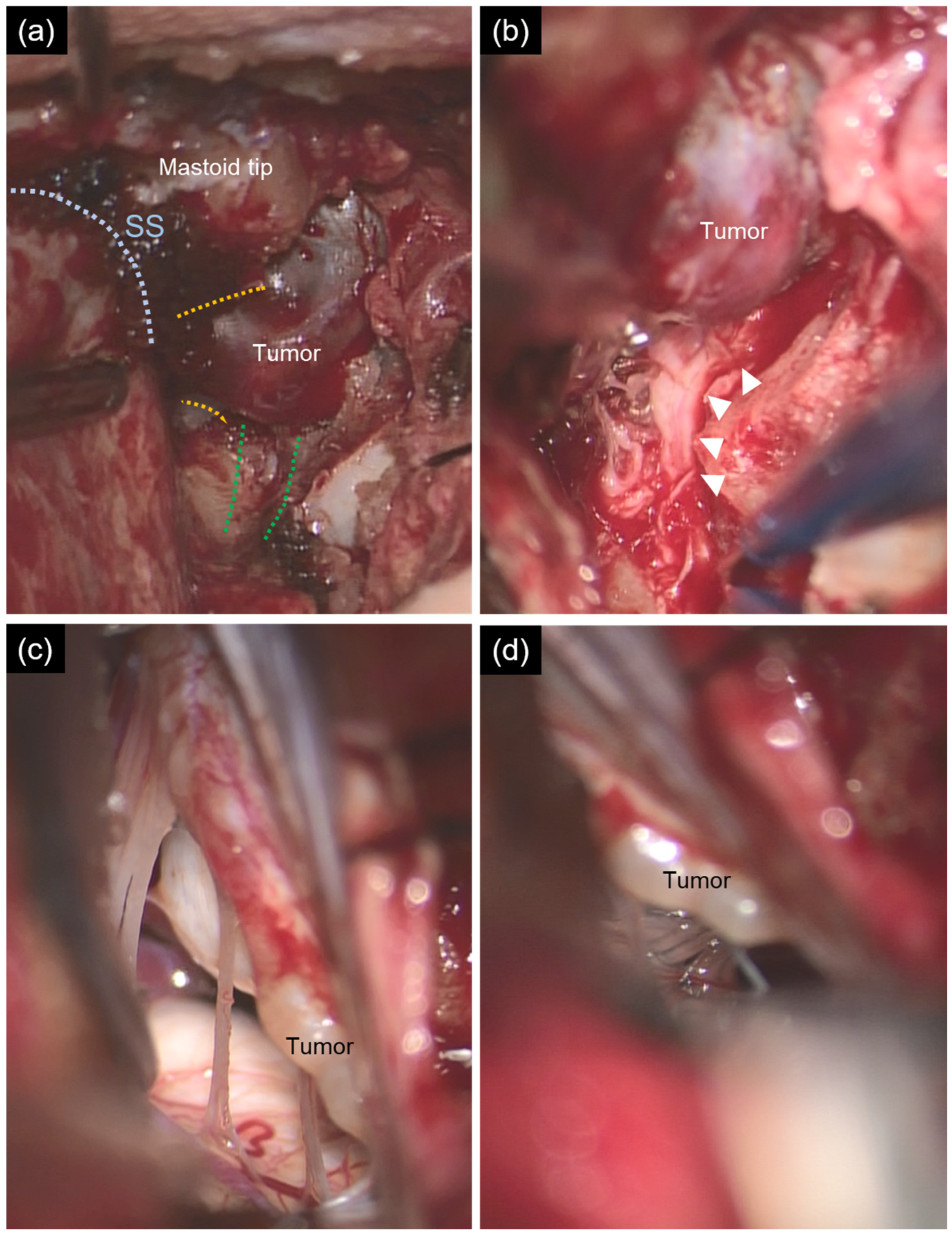
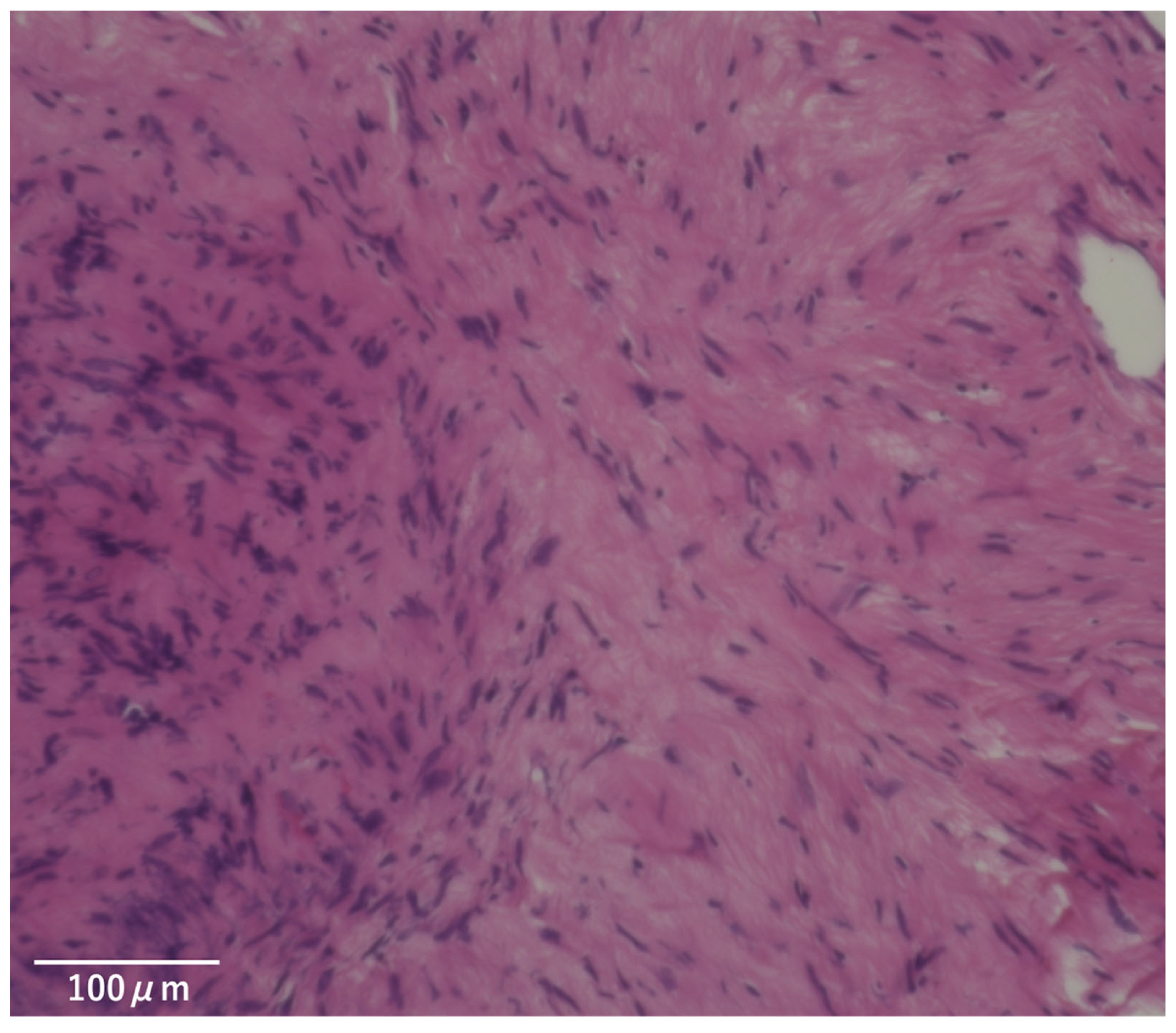
| Present case | female | 62 | tongue deviation and atrophy, dysarthria | dysphagia, hoarseness, trapezius muscle atrophy | Intrajugular type | Type B | Jugular foramen with extracranial extension (partly into the hypoglossal canal) | 10.3 | Transcondylar approach | RCIR | IX, X, XI, XII | None | IX, X, XII |
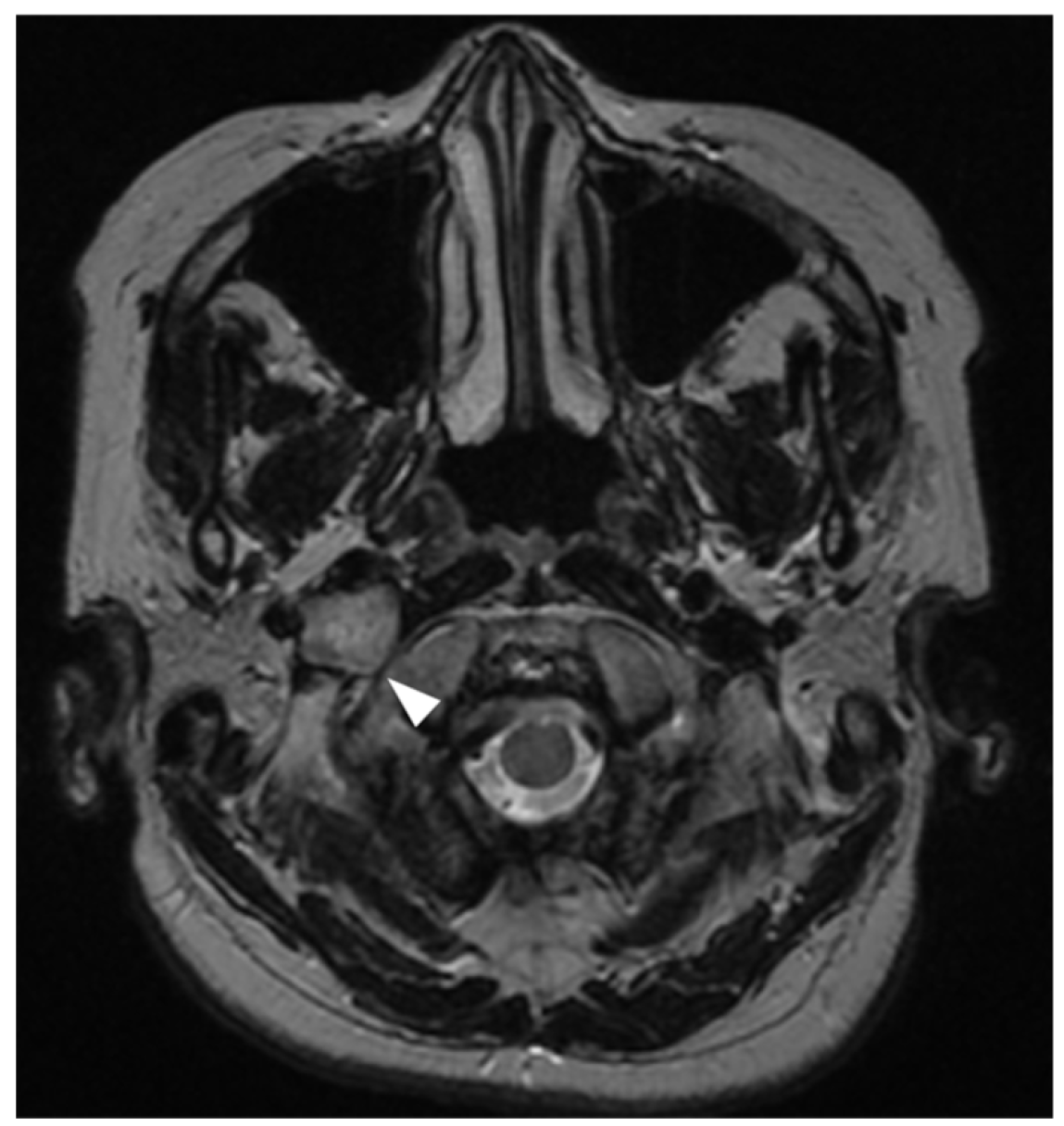
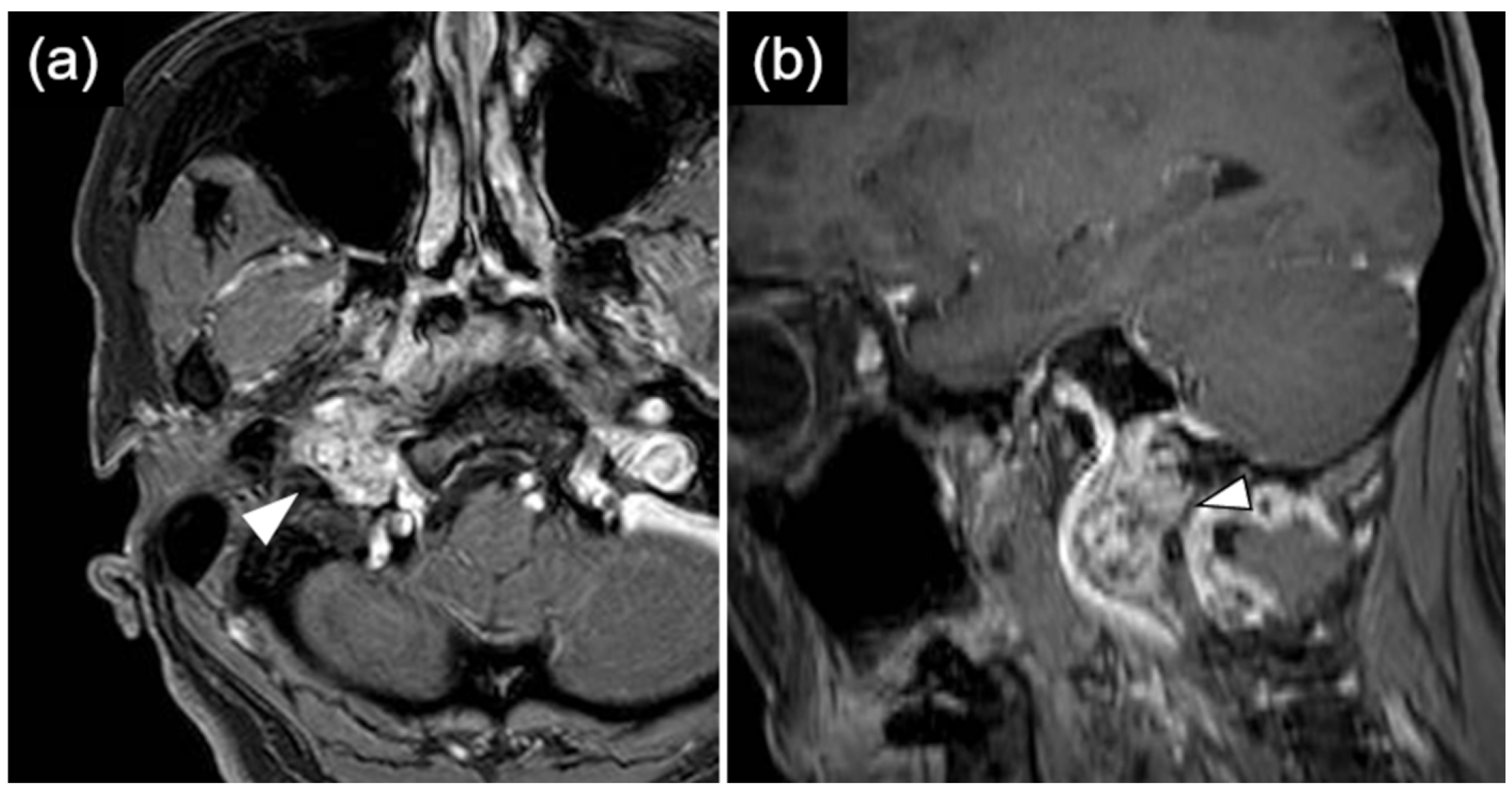
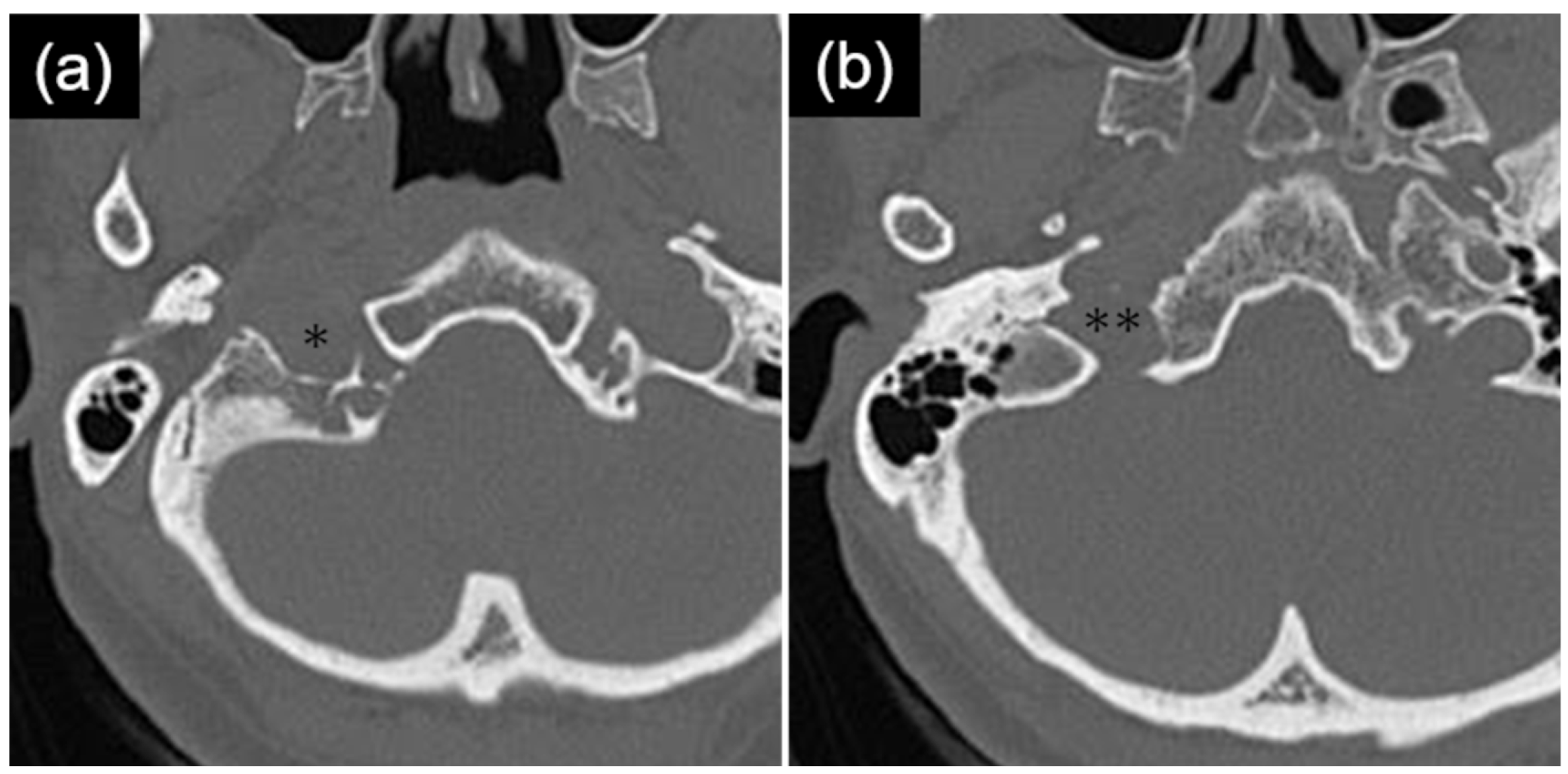
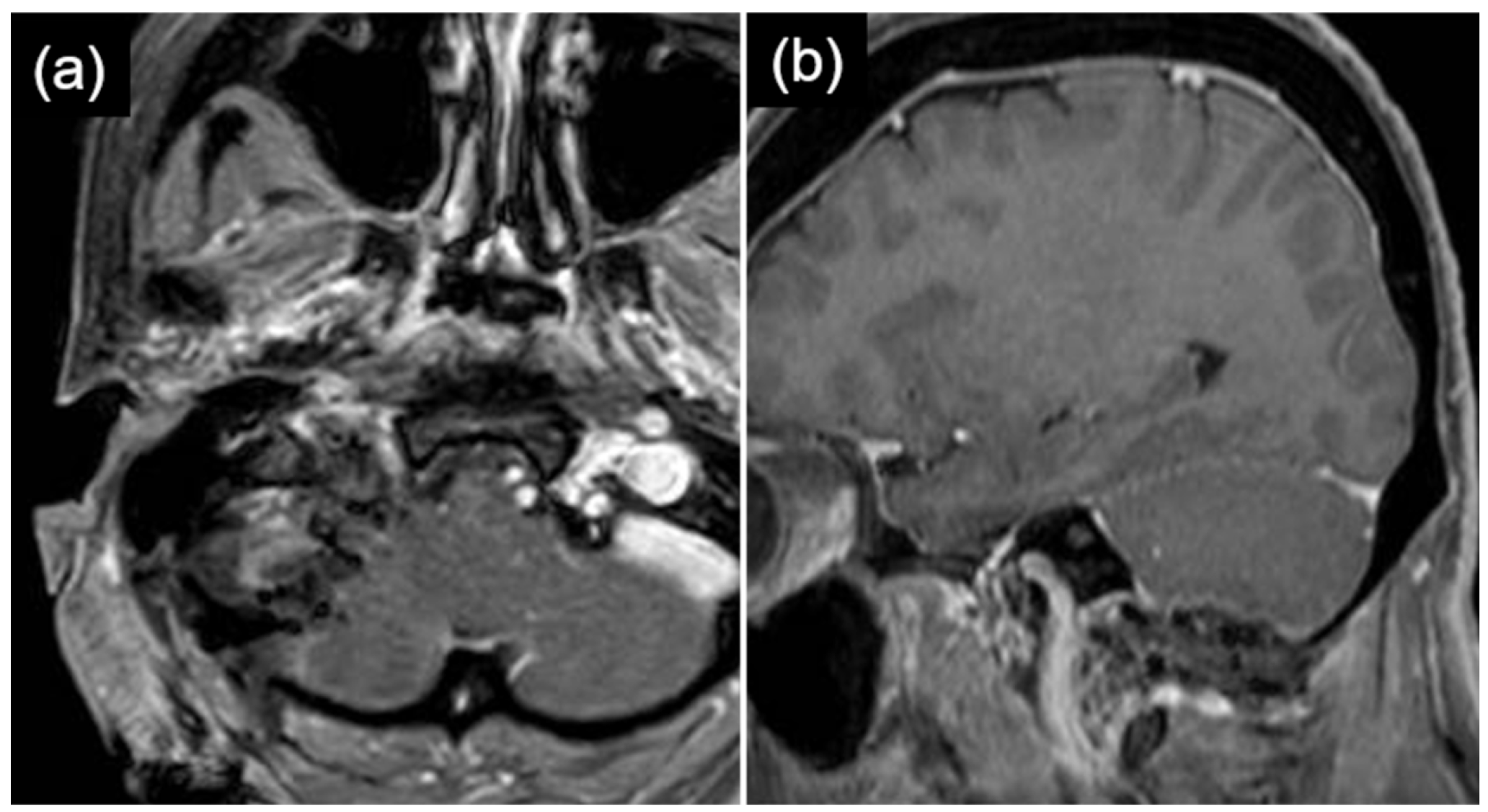
3.6. Illustrative Case
4. Discussion
4.1. Clinical Characteristics of Intracranial Accessory Nerve Schwannomas
4.2. Mechanisms of Hypoglossal Nerve Palsy in Accessory Nerve Schwannomas
4.3. Diagnostic Pitfalls and the Importance of Temporal Symptom Assessment
4.4. Surgical Outcomes and Clinical Implications
4.5. Limitations
5. Conclusions
Author Contributions
Funding
Institutional Review Board Statement
Informed Consent Statement
Data Availability Statement
Conflicts of Interest
Abbreviations
| CN | cranial nerve |
| CT | computed tomography |
| JFS classification | jugular foramen schwannoma classification |
| MRI | magnetic resonance imaging |
References
- Samii, M.; Babu, R.P.; Tatagiba, M.; Sepehrnia, A. Surgical treatment of jugular foramen schwannomas. J. Neurosurg. 1995, 82, 924–932. [Google Scholar] [CrossRef]
- Yamakami, I.; Nakamura, T.; Ono, J.; Yamaura, A. Recovery of hearing after removal of a large jugular foramen schwannoma: Report of two cases. Surg. Neurol. 1999, 51, 60–65. [Google Scholar] [CrossRef]
- Lee, S.K.; Park, K.; Kong, D.S.; Cho, Y.S.; Baek, C.H.; Nam, D.H.; Lee, J.I.; Hong, S.C.; Shin, H.J.; Eoh, W.; et al. Surgical tactics and outcome of treatment in jugular foramen schwannomas. J. Clin. Neurosci. 2001, 8, 32–39. [Google Scholar] [CrossRef] [PubMed]
- Samii, M.; Alimohamadi, M.; Gerganov, V. Surgical Treatment of Jugular Foramen Schwannoma: Surgical Treatment Based on a New Classification. Neurosurgery 2015, 77, 424–432; discussion 432. [Google Scholar] [CrossRef] [PubMed]
- Hakuba, A.; Hashi, K.; Fujitani, K.; Ikuno, H.; Nakamura, T.; Inoue, Y. Jugular foramen neurinomas. Surg. Neurol. 1979, 11, 83–94. [Google Scholar]
- Sarma, S.; Sekhar, L.N.; Schessel, D.A. Nonvestibular schwannomas of the brain: A 7-year experience. Neurosurgery 2002, 50, 437–448; discussion 438–439. [Google Scholar] [CrossRef]
- Jin, S.W.; Park, K.J.; Park, D.H.; Kang, S.H. Intracisternal cranial root accessory nerve schwannoma associated with recurrent laryngeal neuropathy. J. Korean Neurosurg. Soc. 2014, 56, 152–156. [Google Scholar] [CrossRef]
- Furuse, M.; Futamura, G.; Yagi, R.; Fukumura, M.; Hiramatsu, R.; Kameda, M.; Nonoguchi, N.; Kawabata, S.; Takami, T.; Wanibuchi, M. Jugular Foramen Schwannoma. No Shinkei Geka 2025, 53, 746–753. [Google Scholar] [CrossRef]
- Tsukamoto, H.; Hikita, T.; Takaki, T. Cerebellopontine angle meningioma associated with cranial accessory nerve neurinoma—Case report. Neurol. Med. Chir. 1994, 34, 225–229. [Google Scholar] [CrossRef]
- Iwasaki, K.; Kondo, A. Accessory nerve neurinoma manifesting with typical jugular foramen syndrome. Neurosurgery 1991, 29, 455–459. [Google Scholar] [CrossRef]
- Julow, J. Neurinoma of Spinal Accessory Nerve Report of Two Cases. Acta Neurochir. 1983, 69, 219–224. [Google Scholar] [CrossRef] [PubMed]
- Kurokawa, R.; Tabuse, M.; Yoshida, K.; Kawase, T. Spinal accessory schwannoma mimicking a tumor of the fourth ventricle: Case report. Neurosurgery 2004, 54, 510–514; discussion 514. [Google Scholar] [CrossRef]
- Richard, S.A.; Lan, Z.G.; Zhang, Y.; You, C. Accessory Nerve Schwannoma Extending to the Foramen Magnum and Mimicking Glossopharyngeal Nerve Tumor—A Case and Review of Surgical Techniques. World J. Neurosci. 2017, 7, 233–243. [Google Scholar] [CrossRef]
- Yan, P.; Wang, P. Accessory nerve schwannoma: A new case report and systematic review. Interdiscip. Neurosurg. 2020, 19, 100571. [Google Scholar] [CrossRef]
- Bindal, S.; El Ahmadieh, T.Y.; Plitt, A.; Aoun, S.G.; Neeley, O.J.; El Tecle, N.E.; Barnett, S.; Gluf, W. Hypoglossal schwannomas: A systematic review of the literature. J. Clin. Neurosci. 2019, 62, 162–173. [Google Scholar] [CrossRef]
- Miyamori, T.; Yamano, K.; Hasegawa, T.; Minamide, H.; Kurosaki, M.; Takayallagi, N. A Dunlbhell−shaped Neurinoma of the Hypoglossal Nerve: A Case Report. Jpn. J. Neurosurg. 1992, 1, 265–269. [Google Scholar] [CrossRef]
- Kaneko, Y.; Hokao, K.; Tamaoki, Y.; Masuda, T. Intracranial Hypoglossal Schwannoma without Hypoglossal Nerve Paresis. Jpn. J. Neurosurg. 2012, 21, 144–149. [Google Scholar] [CrossRef]
- Nonaka, Y. Surgical Management for Hypoglossal Schwannoma. No Shinkei Geka 2025, 53, 754–762. [Google Scholar] [CrossRef] [PubMed]
- Ortiz, O.; Reed, L. Spinal accessory nerve schwannoma involving the jugular foramen. AJNR Am. J. Neuroradiol. 1995, 16, 986–989. [Google Scholar]
- Nowak, A.; Dziedzic, T.; Czernicki, T.; Kunert, P.; Marchel, A. Surgical treatment of jugular foramen schwannomas. Neurol. Neurochir. Pol. 2014, 48, 188–195. [Google Scholar] [CrossRef] [PubMed]
- Yoo, H.; Jung, H.W.; Yang, H.J. Jugular foramen schwannomas: Surgical approaches and outcome of treatment. Skull Base Surg. 1999, 9, 243–252. [Google Scholar] [CrossRef]
- Ruberti, R.; Carteri, A. Neurinomas of the foramen lacerum posterius. G. Psichiatr. Neuropatol. 1961, 89, 1099–1128. [Google Scholar]
- Pluchino, F.; Crivelli, G.; Vaghi, M.A. Intracranial neurinomas of the nerves of the jugular foramen. Report of 12 personal cases. Acta Neurochir. 1975, 31, 201–221. [Google Scholar] [CrossRef] [PubMed]
- Pou-Serradell, A.; Llovet-Tapies, J.; Galito, E.; Pascual, J. Intracranial neurinoma of the spinal nerve (author’s transl). Rev. Neurol. 1978, 134, 803–805. [Google Scholar]
- Christoferson, L.A.; Leech, R.W.; Grossman, M. Intracranial neurilemoma of the spinal accessory nerve. Surg. Neurol. 1982, 18, 18–20. [Google Scholar] [CrossRef] [PubMed]
- Tohyama, I.; Nishiura, I.; Fukuyama, H.; Akiguchi, I.; Koyama, T.; Kameyama, M. Neurinoma of the spinal accessory nerve. A case report. Shinkeinaika 1982, 17, 400–403. [Google Scholar]
- Tsuchiya, K.; Machida, T.; Maehara, T.; Iio, M. Case of accessory nerve neurinoma. Rinsho Hoshasen 1982, 27, 1375–1378. [Google Scholar] [PubMed]
- Lesoin, F.; Destee, A.; Vaneecloo, J.F.; Lozes, G.; Rousseaux, M.; Delandsheer, J.M.; Clarisse, J.; Jomin, M. Radicular and truncal neurinoma of the spinal accessory nerve. 3 cases. Rev. Otoneuroophtalmol. 1984, 56, 455–461. [Google Scholar]
- Nishiura, I.; Koyama, T. Neurinoma of the spinal accessory nerve. A case report. Neurochirurgia 1984, 27, 154–157. [Google Scholar] [CrossRef]
- Matsushima, T.; Fukui, M.; Matsunaga, M.; Kitamura, K.; Hasuo, K. Accessory nerve neurinoma mimicking a brain stem tumor on angiography: Report of a case. Neurosurgery 1985, 16, 839–842. [Google Scholar] [CrossRef]
- Nakashima, T.; Tomita, K.; Uemura, T.; Matsushima, T.; Fukui, M. Accessory nerve schwannoma extending extracranially to the second cervical level of vertebra. J. Laryngol. Otol. 1988, 102, 959–961. [Google Scholar] [CrossRef]
- Shiroyama, Y.; Inoue, S.; Tsuha, M.; Abiko, S.; Aoki, H. Intracranial neurinomas of the jugular foramen and hypoglossal canal. No Shinkei Geka 1988, 16, 313–319. [Google Scholar]
- Chang, K.C.; Huang, J.S.; Liu, K.N.; Tsai, C.S.; Chen, T.Y. Neurinoma of the spinal accessory nerve: Report of a case. J. Formos. Med. Assoc. 1990, 89, 593–597. [Google Scholar] [PubMed]
- Fransen, P.; Dooms, G.; Mathurin, P.; Thauvoy, C.; Stroobandt, G. Juxtabulbar neurinoma of the spinal accessory nerve. Neurochirurgie 1992, 38, 173–178. [Google Scholar]
- Sawada, H.; Udaka, F.; Kameyama, M.; Iwasaki, K.; Kondou, A. Accessory nerve neuroma presenting as recurrent jugular foramen syndrome. Neuroradiology 1992, 34, 417–419. [Google Scholar] [CrossRef]
- Aksik, I. Microneural decompression operations in the treatment of some forms of cranial rhizopathy. Acta Neurochir. 1993, 125, 64–74. [Google Scholar] [CrossRef]
- Lanotte, M.; Massaro, F.; Scienza, R.; Faccani, G. Intracisternal schwannoma of the spinal accessory nerve presenting as a normal pressure hydrocephalus syndrome. Case report and review of the literature. Neurosurg. Rev. 1994, 17, 225–227. [Google Scholar] [CrossRef]
- Soo, S.J.; Irie, K.; Fujiwara, T.; Kuyama, H.; Nagao, S. A case of accessory nerve neurinoma presenting an intracisternal tumor. No Shinkei Geka 1995, 23, 723–726. [Google Scholar]
- Ohkawa, M.; Fujiwara, N.; Takashima, H.; Satoh, K.; Tanabe, M.; Honjo, Y.; Nagao, S.; Kojima, K. Radiologic manifestation of spinal accessory neurinoma: A case report. Radiat. Med. 1996, 14, 269–273. [Google Scholar] [PubMed]
- Caputi, F.; de Sanctis, S.; Gazzeri, G.; Gazzeri, R. Neuroma of the spinal accessory nerve disclosed by a subarachnoid hemorrhage: Case report. Neurosurgery 1997, 41, 946–950. [Google Scholar] [CrossRef] [PubMed]
- Saydam, L.; Donovan, D.T. Extirpation of a jugular foramen schwannoma via the transcervical-transmandibular approach. Eur. Arch. Otorhinolaryngol. 1997, 254, 110–112. [Google Scholar] [CrossRef]
- Kubota, M.; Ushikubo, O.; Miyata, A.; Yamaura, A. Schwannoma of the spinal accessory nerve. J. Clin. Neurosci. 1998, 5, 436–437. [Google Scholar] [CrossRef]
- Tatebayashi, K.; Tanaka, Y.; Numata, H.; Kawakami, S.; Kamitani, H.; Watanabe, T. Schwannoma of the spinal accessory nerve in the cisterna magna. Surg. Neurol. 2003, 59, 217–222; discussion 222. [Google Scholar] [CrossRef]
- Takumi, I.; Isayama, K.; Osamura, R.Y.; Kobayashi, S.; Teramoto, A. Intracisternal neurinoma of the C1 posterior root. Acta Neurochir. 2005, 147, 1189–1192; discussion 1192. [Google Scholar] [CrossRef]
- Wilson, M.A.; Hillman, T.A.; Wiggins, R.H.; Shelton, C. Jugular foramen schwannomas: Diagnosis, management, and outcomes. Laryngoscope 2005, 115, 1486–1492. [Google Scholar] [CrossRef]
- Jung, T.Y.; Jung, S.; Kim, I.Y.; Kang, S.S. Intracisternal schwannoma of the spinal accessory nerve: A case report. Skull Base 2006, 16, 175–179. [Google Scholar] [CrossRef]
- Chibbaro, S.; Mirone, G.; Makiese, O.; Bresson, D.; George, B. Dumbbell-shaped jugular foramen schwannomas: Surgical management, outcome and complications on a series of 16 patients. Neurosurg. Rev. 2009, 32, 151–159; discussion 159. [Google Scholar] [CrossRef]
- Fukuda, M.; Oishi, M.; Saito, A.; Fujii, Y. Long-term outcomes after surgical treatment of jugular foramen schwannoma. Skull Base 2009, 19, 401–408. [Google Scholar] [CrossRef] [PubMed]
- Sadatomo, T.; Yuki, K.; Migita, K.; Hidaka, T.; Kurisu, K. Accessory nerve schwannoma of the intracisternal type: A case report. No Shinkei Geka 2010, 38, 831–837. [Google Scholar] [PubMed]
- Cavalcanti, D.D.; Martirosyan, N.L.; Verma, K.; Safavi-Abbasi, S.; Porter, R.W.; Theodore, N.; Sonntag, V.K.; Dickman, C.A.; Spetzler, R.F. Surgical management and outcome of schwannomas in the craniocervical region. J. Neurosurg. 2011, 114, 1257–1267. [Google Scholar] [CrossRef] [PubMed]
- Chowdhury, F.H.; Haque, M.R.; Kawsar, K.A.; Sarker, M.H.; Hasan, M.; Goel, A.H. Intracranial nonvestibular neurinomas: Young neurosurgeons’ experience. J. Neurosci. Rural. Pract. 2014, 5, 231–243. [Google Scholar] [CrossRef]
- Krishnan, S.S.; Bojja, S.; Vasudevan, M.C. Spinal accessory nerve schwannomas masquerading as a fourth ventricular lesion. J. Neurosci. Rural. Pract. 2015, 6, 112–115. [Google Scholar] [CrossRef]
- Antoniades, E.; Athanasiou, A.; Sarlis, P.; Magras, I.; Patsalas, I. Gross total resection of intracisternal accessory nerve schwannomas using a familiar midline suboccipital subtonsilar approach. J. Surg. Case Rep. 2019, 2019, rjz220. [Google Scholar] [CrossRef] [PubMed]
- Watanabe, Y.; Higuchi, Y.; Sunaoka, H.; Yakufujiang, M.; Ikegami, S.; Iwadate, Y. Postoperative Cerebellar Cyst with Pseudomeningocele After Tumor Removal at the Craniovertebral Junction. World Neurosurg. 2019, 130, 71–76. [Google Scholar] [CrossRef]
- Otero-Fernandez, P.; Ruiz-Escribano-Menchen, L.; Herrera-Montoro, V.; Morcillo-Carratala, R.; Calvo-Garcia, M.; Llumiguano-Zaruma, C. Accessory nerve ancient schwannoma: A case report. Surg. Neurol. Int. 2022, 13, 338. [Google Scholar] [CrossRef]
- Lasica, N.; Djilvesi, D.; Parikh, K.A. Accessory Nerve Schwannoma with Medulla Oblongata Compression: Microsurgical Resection by Far Lateral Suboccipital Transcondylar Approach: 2-Dimensional Operative Video. World Neurosurg. 2024, 190, 289–290. [Google Scholar] [CrossRef] [PubMed]
- Naser, P.V.; Haux-Nettesheim, D.; Rahmanzade, R.; Lenga, P.; Reuss, D.; Unterberg, A.W.; Beynon, C. Accessory nerve schwannoma extending into the fourth ventricle: Case report and review of literature. Br. J. Neurosurg. 2025, 39, 251–254. [Google Scholar] [CrossRef] [PubMed]
- Kaye, A.H.; Hahn, J.F.; Kinney, S.E.; Hardy, R.W., Jr.; Bay, J.W. Jugular foramen schwannomas. J. Neurosurg. 1984, 60, 1045–1053. [Google Scholar] [CrossRef]
- Pellet, W.; Cannoni, M.; Pech, A. The widened transcochlear approach to jugular foramen tumors. J. Neurosurg. 1988, 69, 887–894. [Google Scholar] [CrossRef]
- Byeon, Y.; Lee, C.; Kim, G.J.; Jeon, J.; Chong, S.; Song, S.W.; Cho, Y.H.; Hong, S.H.; Hong, C.K.; Kim, J.H.; et al. Radiographic and neurological outcomes of Gamma Knife radiosurgery for lower cranial nerve schwannomas: A single-institution experience. J. Neurosurg. 2025, 142, 488–497. [Google Scholar] [CrossRef]
- Hasegawa, T.; Kato, T.; Kida, Y.; Sasaki, A.; Iwai, Y.; Kondoh, T.; Tsugawa, T.; Sato, M.; Sato, M.; Nagano, O.; et al. Gamma Knife surgery for patients with jugular foramen schwannomas: A multiinstitutional retrospective study in Japan. J. Neurosurg. 2016, 125, 822–831. [Google Scholar] [CrossRef]



| No | Authors & Year | Sex | Age | Symptoms | Duration from Symptom Onset to Surgery | Location | Tumor Volume * | Surgical Approach | Preoperative CN Deficit | New Postoperative CN Deficit | Postoperative CN Recovery | |||
|---|---|---|---|---|---|---|---|---|---|---|---|---|---|---|
| Initial | Preoperative | Julow et al. [11] Classification | JFS Classification | Details | ||||||||||
| 1 | Ruberti et al., 1961 [22] | male | 31 | hearing loss | dysphagia, hoarseness, shoulder weakness, sternocleidomastoid and trapezius muscles atrophy, gait ataxia | 8 m | Intrajugular type | Type A | Cerebellopontine angle with extension to the jugular foramen | - | Midline suboccipital approach | VIII, IX, X, XI | None | IX, X |
| 2 | Pluchino et al., 1975 [23] | female | 42 | headache | absent corneal reflexes, hearing loss, hoarseness, tongue atrophy, gait ataxia | 2 y | Intrajugular type | Type D | Involving the medial aspect of the petrous bone and the occipital condyle | - | Lateral suboccipital approach | V, VIII, X, XII | None | V, VIII, X, XII |
| 3 | Pou-Serradell et al., 1978 [24] | male | 56 | hoarseness | hearing loss, dysphagia, shoulder weakness, shoulder pain, sternocleidomastoid and trapezius muscles atrophy, tongue atrophy | 2 y | Intrajugular type | - | - | - | Lateral suboccipital approach | VIII, IX, X, XI, XII | None | VIII, IX, X, XII |
| 4 | Christoferson et al., 1982 [25] | female | 24 | trapezius muscle pain, arm and hand numbness, leg weakness | Clonus of the right ankle | 1 y | Intracisternal type | Type A | Foramen magnum | 13.1 | Midline suboccipital approach | XI | None | None |
| 5 | Tohyama et al., 1982 [26] | male | 52 | burning sensation in his right forearm | sternocleidomastoid and trapezius muscles atrophy and weakness, bladder and rectal dysfunction | 5 y | Intracisternal type | Type A | Foramen magnum | - | Midline suboccipital approach | - | - | - |
| 6 | Tsuchiya et al., 1982 [27] | male | 18 | nausea, vomiting, gait ataxia | left absence of corneal reflex, left abduction deficit | 9 m | Intracisternal type | Type A | Cerebellopontine angle | - | Midline suboccipital approach | VI, VII | - | - |
| 7 | Julow et al., 1983 [11] | female | 50 | headache, neck pain | papilledema, sternocleidomastoid and trapezius weakness | 3 y | Intracisternal type | Type A | Foramen magnum | 48.0 | Midline suboccipital approach | XI | None | XI |
| 8 | Julow et al., 1983 [11] | male | 29 | slight tetraparesis, dysmetria | sternocleidomastoid and trapezius muscles atrophy and weakness | 4 y | Intracisternal type | Type A | Foramen magnum | - | Midline suboccipital approach with C1 laminectomy | XI | None | XI |
| 9 | Lesoin et al., 1984 [28] | male | 23 | hearing loss, gait ataxia, papilledema | None | - | Intracisternal type | Type A | Foramen magnum | - | Lateral suboccipital approach | VIII | - | - |
| 10 | Nishiura et al., 1984 [29] | male | 52 | burning sensation in his right forearm, numbness in both his hands | sternomastoid and trapezius atrophy, quadriparesis, bladder and rectal dysfunction | 5 y | Intracisternal type | Type A | Foramen magnum | - | Midline suboccipital approach with C1–3 laminectomy | XI | None | None |
| 11 | Matsushima et al., 1985 [30] | male | 51 | nausea, vertigo, gait ataxia, taste disturbance | hearing loss, hyperesthesia of left body | 15 m | Intracisternal type | Type A | Cerebellopontine angle | - | Lateral suboccipital approach | V, VII, VIII | IX, X, XI | - |
| 12 | Nakashima et al., 1988 [31] | male | 62 | hoarseness | hearing loss, dysphagia, trapezius weakness, sternocleidomastoid muscle atrophy | 5 y | Intrajugular type | Type D | Jugular foramen tumor extending into the posterior fossa and extracranial space | - | Lateral suboccipital approach with intralabyrinthine approach | VII, IX, X, XI | - | - |
| 13 | Shiroyama et al., 1988 [32] | female | 47 | nausea, vomiting, gait ataxia | papilledema, dysphagia | 2 m | Intracisternal type | Type A | Cerebellopontine angle | - | Lateral suboccipital approach | IX | - | - |
| 14 | Shiroyama et al., 1988 [32] | male | 49 | tinnitus | papilledema, fundus hemorrhage | 10 m | Intracisternal type | Type A | Cerebellopontine angle | - | Midline suboccipital approach | None | - | - |
| 15 | Chang et al., 1990 [33] | male | 32 | headaches, nausea, vomiting | gait ataxia, papilledema | 3 m | Intracisternal type | Type D | Foramen magnum | 20.0 | Lateral suboccipital approach with a C1-C2 laminectomy | None | None | XI |
| 16 | Iwasaki, et al., 1991 [10] | male | 60 | neck pain, dysphagia, hoarseness | shoulder weakness, sternomastoid and trapezius atrophy | several years | Intrajugular type | Type B | Jugular foramen | 0.5 | Lateral suboccipital approach | IX, X, XI | IX | X, XI |
| 17 | Fransen et al., 1992 [34] | female | 27 | headache, right upper extremity numbness | trapezius weakness, gait ataxia, papilledema | 7 m | Intracisternal type | Type A | Cerebellomedullary | - | Midline suboccipital approach with C1 laminectomy | XI | None | XI |
| 18 | Sawada et al., 1992 [35] | male | 40 | dysphagia, hoarseness, shoulder weakness | sternomastoid and trapezius atrophy | 8 y | Intrajugular type | Type B | Jugular foramen | - | Lateral suboccipital approach | IX, X, XI | None | XI |
| 19 | Aksik, 1993 [36] | - | - | spasmodic torticollis | None | - | Intracisternal type | Type A | - | 0.03 | Midline suboccipital approach with C1 laminectomy | XI | None | None |
| 20 | Aksik, 1993 [36] | - | - | spasmodic torticollis | None | - | Intracisternal type | Type A | - | 0.03 | Midline suboccipital approach with C1 laminectomy | XI | None | None |
| 21 | Lanotte et al., 1994 [37] | male | 62 | headache, nausea, vertigo, gait ataxia | None | 3 m | Intracisternal type | Type A | Foramen magnum | 11.2 | Midline suboccipital approach with C1 laminectomy | None | XI | None |
| 22 | Tsukamoto et al., 1994 [9] | female | 46 | headache, diplopia, dysphagia, dysarthria, gait ataxia | hypesthesia of the left face, facial palsy | 2 y | Intracisternal type | Type A | Cerebellopontine angle | 0.06 | Lateral suboccipital approach | V, VI, VII, IX, X | VIII | V, VI, VII, IX, X |
| 23 | Ortiz et al., 1995 [19] | male | 76 | headaches, nausea, vomiting, gait ataxia | sternomastoid and trapezius atrophy | 1.5 m | Intrajugular type | Type D | Jugular foramen with extracranial extension | - | Lateral suboccipital approach | XI | - | - |
| 24 | Samii et al., 1995 [1] | male | 43 | facial prickling | None | - | Intrajugular type | Type A | - | - | Lateral suboccipital approach | V | None | V |
| 25 | Soo et al., 1995 [38] | male | 54 | headache, nausea | papilledema, gait ataxia | 7 m | Intracisternal type | Type A | Foramen magnum extending to cerebellar vermis | - | Midline suboccipital approach with C1 laminectomy | None | None | None |
| 26 | Ohkawa et al., 1996 [39] | female | 54 | headache, nausea | papilledema, diplopia, vertigo, gait ataxia | 7 m | Intracisternal type | Type A | Foramen magnum | - | Midline suboccipital approach with C1 laminectomy | - | None | - |
| 27 | Caputi et al., 1997 [40] | male | 42 | headache, nausea, vomiting | None | 1 m | Intracisternal type | Type A | Foramen magnum | 1.43 | Midline suboccipital approach with C1 laminectomy | None | None | None |
| 28 | Saydam et al., 1997 [41] | female | 52 | hoarseness, shoulder weakness | dysphagia, trapezius atrophy, tongue deviation | 1 y | Intrajugular type | Type C | Jugular foramen with extracranial extension | - | Transcervical-transmandibular approach | IX, X, XI, XII | None | IX, X, XI, XII |
| 29 | Kubota et al., 1998 [42] | female | 40 | - | headache, nausea, blurred vision, papilledema | - | Intracisternal type | Type A | Cerebellomedullary | - | Midline suboccipital approach with C1 laminectomy | None | None | None |
| 30 | Yoo et al., 1999 [21] | female | 31 | obscuration of vision | papilledema, afferent pupillary defect, abducens nerve palsy | 10 m | Intrajugular type | Type A | - | - | Lateral suboccipital approach | VI | None | - |
| 31 | Yoo et al., 1999 [21] | female | 40 | tinnitus | shoulder weakness, LCN dysfunction (details unspecified), nystagmus, gait ataxia | 1 y | Intrajugular type | Type D | - | - | Lateral suboccipital approach | IX, X, XI | None | - |
| 32 | Lee et al., 2001 [3] | female | 48 | hemifacial spasm | hearing loss, hoarseness, dysphagia, truncal ataxia | 7 y | Intrajugular type | Type D | - | - | Petrooccipital transsigmoid approach | VII, VIII, IX, X | - | - |
| 33 | Sarma et al., 2002 [6] | - | - | - | a typical jugular foramen syndrome (details unspecified) | - | Intrajugular type | Type B | - | - | Retrosigmoid-extreme lateral approach | IX, X, XI | None | IX, X, XI |
| 34 | Tatebayashi et al., 2003 [43] | female | 46 | headache, neck pain, shoulder pain | nausea, vomiting, right upper extremity numbness | 1 y | Intracisternal type | Type A | Foramen magnum and medulla oblongata. | 31.5 | Midline suboccipital approach with C1 laminectomy | None | None | None |
| 35 | Kurokawa et al., 2004 [12] | male | 50 | neck pain | None | 2 m | Intracisternal type | Type A | Extending from the foramen magnum to the fourth ventricle | 21.4 | Midline suboccipital approach with C1 laminectomy | None | None | None |
| 36 | Takumi et al., 2005 [44] | male | 35 | headache, neck pain | motor weakness in the bilateral distal upper limbs numbness in the right upper limb | 6 m | Intracisternal type | Type A | Foramen magnum | - | The postero-lateral approach | None | None | None |
| 37 | Wilson et al., 2005 [45] | - | - | tongue deviation | None | - | Intrajugular type | Type B | Jugular foramen with extracranial extension | >13.5 ** | Transcondylar approach | XII | XI | XII |
| 38 | Wilson et al., 2005 [45] | - | - | - | dysphagia, hoarseness, tongue deviation | - | Intrajugular type | Type D | Jugular foramen tumor extending into the posterior fossa and extracranial space | >13.5 ** | Infratemporal approach with partial VII mobilization | IX, X, XII | None | None |
| 39 | Jung et al., 2006 [46] | female | 70 | headache, neck pain | None | 5 y | Intracisternal type | Type A | Cerebellomedullary | 3.2 × 2.0 | Midline suboccipital approach | None | None | None |
| 40 | Chibbaro et al., 2009 [47] | female | 42 | - | headache, vertigo, hoarseness | - | Intrajugular type | Type D | - | - | Juxtacondylar approach | X | - | X |
| 41 | Fukuda et al., 2009 [48] | male | 47 | - | - | - | Intrajugular type | Type D | - | - | Lateral suboccipital approach with transjugular approach | IX, X, XI, XII | - | - |
| 42 | Sadatomo et al., 2010 [49] | female | 48 | headache | None | - | Intracisternal type | Type A | Cerebellomedullary | 3.75 | Lateral suboccipital approach | None | None | None |
| 43 | Cavalcanti et al., 2011 [50] | female | 47 | hoarseness | None | - | Intrajugular type | Type B | Cerebellopontine angle and jugular foramen | - | Lateral suboccipital approach with transjugular approach | X | None | X |
| 44 | Chowdhury et al., 2014 [51] | male | 38 | - | neck pain, quadriparesis, sternomastoid and trapezius weakness | - | Intracisternal type | Type A | Foramen magnum and posterior fossa | 3.0 × 4.0 | Lateral suboccipital approach with C1 laminectomy | XI | None | XI |
| 45 | Chowdhury et al., 2014 [51] | female | 52 | - | headache, neck pain, quadriparesis, sternomastoid and trapezius atrophy | - | Intracisternal type | Type A | Posterior fossa and foramen magnum with extracranial extension | 3.0 × 3.0 | Midline suboccipital approach with C1 laminectomy | XI | None | None |
| 46 | Jin et al., 2014 [7] | female | 58 | dizziness, hoarseness | left side of body numbness | 2 m | Intracisternal type | Type A | Cerebellomedullary | 14.7 | Lateral suboccipital approach with C1 laminectomy | X | None | X |
| 47 | Nowak et al., 2014 [20] | female | 25 | shoulder weakness | dysphagia, hoarseness | - | Intrajugular type | Type D | Jugular foramen with extracranial extension | - | Lateral suboccipital approach with C1 laminectomy | IX, X, XI | VII, IX, X | None |
| 48 | Krishnan et al. 2015 [52] | male | 22 | headache, obscuration of vision | gait ataxia, papilledema | 6 m | Intracisternal type | Type A | Extending from the foramen magnum to the fourth ventricle | - | Midline suboccipital approach with C1 laminectomy | None | None | None |
| 49 | Richard et al., 2017 [13] | female | 52 | dizziness, hoarseness, tongue deviation | None | 6 m | Intracisternal type | Type A | Foramen of Luschka extending to foramen magnum | 21.9 | Lateral suboccipital approach with C1 laminectomy | X, XII | None | XII |
| 50 | Antoniades et al., 2019 [53] | male | 43 | - | headache, neck pain, dizziness, tinnitus | - | Intracisternal type | Type A | Foramen magnum | 1.6 × 2. | Midline suboccipital approach with C1 laminectomy | None | None | None |
| 51 | Antoniades et al., 2019 [53] | female | 36 | None | None | - | Intracisternal type | Type A | Foramen magnum | 1.1 × 1.0 | Midline suboccipital approach with C1 laminectomy | None | None | None |
| 52 | Antoniades et al., 2019 [53] | male | 45 | - | headache, neck pain, | - | Intracisternal type | Type A | Foramen magnum | 1.2 × 1.0 | Midline suboccipital approach with C1 laminectomy | None | None | None |
| 53 | Watanabe et al., 2019 [54] | male | 68 | - | dizziness numbness in the right upper limb | - | Intracisternal type | Type A | Foramen magnum | - | Midline suboccipital approach with C1 laminectomy | None | None | None |
| 54 | Yan et al., 2020 [14] | female | 62 | headache | None | 1 m | Intracisternal type | Type A | Cerebellomedullary | - | Midline suboccipital approach with C1 laminectomy | None | XI | None |
| 55 | Paula et al., 2022 [55] | male | 61 | dysmetria, gait ataxia | vomiting | 3 m | Intracisternal type | Type A | Cerebellomedullary | 29.9 | Extended far lateral retrosigmoid approach with C1 hemilaminectomy | None | X | None |
| 56 | Lasica et al., 2024 [56] | female | 60 | right-sided weakness | None | 3 m | Intracisternal type | Type A | Foramen of Luschka extending to the foramen magnum | - | Far lateral suboccipital approach with C1 hemilaminectomy | None | None | None |
| 57 | Naser et al., 2025 [57] | female | 61 | headache | None | - | Intracisternal type | Type A | Foramen magnum extending rostrally to the fourth ventricle | - | Midline suboccipital approach with C1 laminectomy | None | None | None |
| 58 | Present case | female | 62 | tongue deviation and atrophy, dysarthria | dysphagia, hoarseness, trapezius muscle atrophy | 3 y | Intrajugular type | Type B | Jugular foramen with extracranial extension (partly into the hypoglossal canal) | 10.3 | Transcondylar approach | IX, X, XI, XII | None | IX, X, XII |
| Initial Symptom | Intrajugular Type, n (%) | Intracisternal Type, n (%) | Total, n (%) |
|---|---|---|---|
| Headache | 3 (15.0) | 13 (35.1) | 16 (28.1) |
| Nausea/Vomiting | 1 (5.0) | 8 (21.6) | 9 (15.8) |
| Hoarseness (CN X) | 6 (30.0) | 2 (5.4) | 8 (14.0) |
| Gait ataxia | 1 (5.0) | 6 (16.2) | 7 (12.3) |
| Neck pain | 1 (5.0) | 5 (13.5) | 6 (10.7) |
| Shoulder weakness (CN XI) | 4 (20.0) | 0 (0.0) | 4 (7.0) |
| Dizziness/Vertigo | 0 (0.0) | 3 (8.1) | 3 (5.3) |
| Tongue deviation/atrophy (CN XII) | 2 (10.0) | 1 (2.7) | 3 (5.3) |
| Visual disturbance | 1 (5.0) | 1 (2.7) | 2 (3.5) |
| Hearing loss (CN VIII) | 1 (5.0) | 1 (2.7) | 2 (3.5) |
| Dysphagia (CN IX) | 2 (10.0) | 0 (0.0) | 2 (3.5) |
| Shoulder pain (CN IX) | 0 (0.0) | 2 (5.4) | 2 (3.5) |
| Spasmodic torticollis | 0 (0.0) | 2 (5.4) | 2 (3.5) |
| Dysarthria (CN XII) | 1 (5.0) | 0 (0.0) | 1 (1.8) |
| Symptom | Intrajugular Type, n (%) | Intracisternal Type, n (%) | Total, n (%) |
|---|---|---|---|
| Headache | 3 (15.0) | 18 (48.6) | 21 (36.8) |
| Hoarseness (CN X) | 13 (65.0) | 2 (5.4) | 15 (26.3) |
| Gait ataxia | 4 (20.0) | 11 (29.7) | 15 (26.3) |
| Nausea/Vomiting | 1 (5.0) | 11 (29.7) | 12 (21.1) |
| SCM and/or trapezius muscle atrophy (CN XI) | 8 (40.0) | 4 (10.8) | 12 (21.1) |
| Shoulder weakness (CN XI) | 7 (35.0) | 5 (13.5) | 12 (21.1) |
| Dysphagia (CN IX) | 9 (45.0) | 1 (2.7) | 10 (17.5) |
| Neck pain | 1 (5.0) | 9 (24.3) | 10 (17.5) |
| Hearing loss (CNVIII) | 5 (25.0) | 2 (5.4) | 7 (12.3) |
| Tongue deviation/atrophy (CN XII) | 6 (30.0) | 1 (2.7) | 7 (12.3) |
| Dizziness/Vertigo | 1 (5.0) | 6 (16.2) | 7 (12.3) |
| Visual disturbance | 1 (5.0) | 3 (8.1) | 4 (7.0) |
| Shoulder pain (CN XI) | 1 (5.0) | 2 (5.4) | 3 (5.3) |
| Spasmodic torticollis | 0 (0.0) | 2 (5.4) | 2 (3.5) |
| Abduction deficit (CN VI) | 0 (0.0) | 1 (2.7) | 1 (1.8) |
| Absence of corneal reflex (CN VII) | 0 (0.0) | 1 (2.7) | 1 (1.8) |
| Dysarthria (CN XII) | 1 (5.0) | 0 (0.0) | 1 (1.8) |
| Symptom | Intrajugular Type, n (%) | Intracisternal Type, n (%) | Total, n (%) | ||
|---|---|---|---|---|---|
| Initial | Preoperative | Initial | Preoperative | ||
| Abduction deficit (CN VI) | 0 (0.0) | 0 (0.0) | 0 (0.0) | 1 (2.7) | 1 (1.8) |
| Absence of corneal reflex (CN VII) | 0 (0.0) | 0 (0.0) | 0 (0.0) | 1 (2.7) | 1 (1.8) |
| Hearing loss (CNVIII) | 1 (5.0) | 4 (20.0) | 1 (2.7) | 1 (2.7) | 7 (12.3) |
| Dysphagia (CN IX) | 2 (10.0) | 7 (35.0) | 0 (0.0) | 1 (2.7) | 10 (17.5) |
| Hoarseness (CN X) | 6 (30.0) | 7 (35.0) | 2 (5.4) | 0 (0.0) | 15 (26.3) |
| Shoulder weakness (CN XI) | 4 (20.0) | 4 (20.0) | 0 (0.0) | 4 (10.8) | 12 (21.1) |
| SCM/Trapezius muscle atrophy (CN XI) | 0 (0.0) | 8 (40.0) | 0 (0.0) | 4 (10.8) | 12 (21.1) |
| Shoulder pain (CN XI) | 0 (0.0) | 1 (5.0) | 2 (5.4) | 0 (0.0) | 3 (5.3) |
| Tongue deviation/atrophy (CN XII) | 3 (15.0) | 3 (15.0) | 1 (2.7) | 0 (0.0) | 7 (12.3) |
| Dysarthria (CN XII) | 1 (5.0) | 0 (0.0) | 0 (0.0) | 0 (0.0) | 1 (1.8) |
Disclaimer/Publisher’s Note: The statements, opinions and data contained in all publications are solely those of the individual author(s) and contributor(s) and not of MDPI and/or the editor(s). MDPI and/or the editor(s) disclaim responsibility for any injury to people or property resulting from any ideas, methods, instructions or products referred to in the content. |
© 2026 by the authors. Licensee MDPI, Basel, Switzerland. This article is an open access article distributed under the terms and conditions of the Creative Commons Attribution (CC BY) license.
Share and Cite
Futamura, G.; Yagi, R.; Fukumura, M.; Tani, M.; Kashiwagi, H.; Tsuji, Y.; Hiramatu, R.; Kameda, M.; Nonoguchi, N.; Furuse, M.; et al. Accessory Nerve Schwannomas Presenting with Hypoglossal Nerve Palsy: A Narrative Review with an Illustrative Case. Life 2026, 16, 655. https://doi.org/10.3390/life16040655
Futamura G, Yagi R, Fukumura M, Tani M, Kashiwagi H, Tsuji Y, Hiramatu R, Kameda M, Nonoguchi N, Furuse M, et al. Accessory Nerve Schwannomas Presenting with Hypoglossal Nerve Palsy: A Narrative Review with an Illustrative Case. Life. 2026; 16(4):655. https://doi.org/10.3390/life16040655
Chicago/Turabian StyleFutamura, Gen, Ryokichi Yagi, Masao Fukumura, Moeko Tani, Hideki Kashiwagi, Yuichiro Tsuji, Ryo Hiramatu, Masahiro Kameda, Naosuke Nonoguchi, Motomasa Furuse, and et al. 2026. "Accessory Nerve Schwannomas Presenting with Hypoglossal Nerve Palsy: A Narrative Review with an Illustrative Case" Life 16, no. 4: 655. https://doi.org/10.3390/life16040655
APA StyleFutamura, G., Yagi, R., Fukumura, M., Tani, M., Kashiwagi, H., Tsuji, Y., Hiramatu, R., Kameda, M., Nonoguchi, N., Furuse, M., Kawabata, S., Takami, T., & Wanibuchi, M. (2026). Accessory Nerve Schwannomas Presenting with Hypoglossal Nerve Palsy: A Narrative Review with an Illustrative Case. Life, 16(4), 655. https://doi.org/10.3390/life16040655