Hypothesis

Gravity as a Boundary Condition for the Evolution of Three-Dimensional Multicellularity

by
Oliver Ullrich
1,2,3,4,5,6,* and
Cora S. Thiel
1,2,3,4,5,*
1
Institute of Aerospace Medicine, University of Zurich, Wangenstrasse 68, 8600 Dübendorf, Switzerland
2
Center for Space and Aviation Switzerland and Liechtenstein, Innovation Park Zurich, Hangar 4, Wangenstrasse 68, 8600 Dübendorf, Switzerland
3
Space Life Sciences Laboratory (SLSL), Kennedy Space Center, 505 Odyssey Way, Exploration Park, Merritt Island, FL 32953, USA
4
Institute of Machine Design, Otto-von-Guericke-University Magdeburg, Universitätsplatz 2, 39106 Magdeburg, Germany
5
Department of Industrial Engineering, Ernst-Abbe-Hochschule (EAH) Jena, Carl-Zeiss-Promenade 2, 07745 Jena, Germany
6
Faculty of Medical Sciences, Institute of Laboratory Medicine, Private University of the Principality of Liechtenstein (UFL), Dorfstrasse 24, 9495 Triesen, Liechtenstein
*
Authors to whom correspondence should be addressed.
Life 2026, 16(4), 638; https://doi.org/10.3390/life16040638
Submission received: 16 February 2026 / Revised: 30 March 2026 / Accepted: 8 April 2026 / Published: 10 April 2026
(This article belongs to the Section Cell Biology and Tissue Engineering)

Abstract

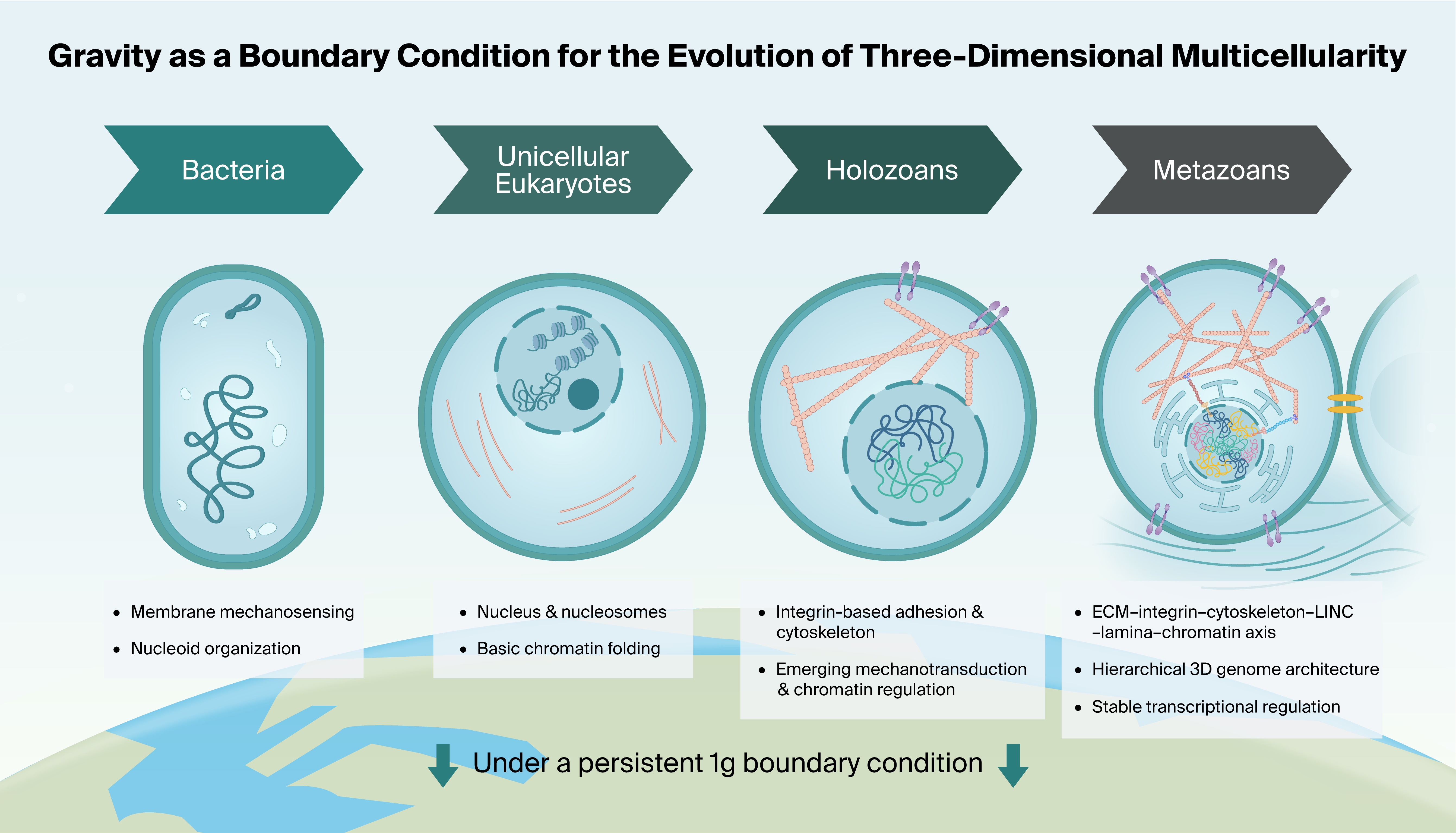
Life evolved under a persistent 1 g field that is continuous, ubiquitous, and directionally structured. Here, we synthesize evidence across evolutionary biology, mechanobiology, and genome architecture to propose gravity as a mechanical boundary condition that helped canalize the emergence of complex multicellularity. Order-of-magnitude considerations indicate that gravity-derived hydrostatic loads can fall within force/pressure regimes relevant to nuclear and chromatin mechanosensitivity when transmitted through adhesion–cytoskeleton–LINC–lamina coupling. Comparative genomic and imaging frameworks suggest that complex animals increasingly rely on volumetric genome organization (packing domains and higher-order 3D architectures) that supports durable transcriptional memory and stable differentiated cell identities. Integrating these concepts with altered-gravity experiments, we argue that microgravity and hypergravity perturb chromatin topology and region-level transcription in rapid, largely reversible patterns consistent with a mechanically defined 1 g reference state. We advance a boundary-condition thesis: gravity is not a sole driver but a stable reference that likely contributed to the evolvability and long-term robustness of mechanogenomic architectures required for high-dimensional differentiation and tissue homeostasis.
Keywords: gravity; mechanotransduction; 3D genome organization; chromatin; packing domains; nuclear mechanics; microgravity; hypergravity; multicellularity gravity; mechanotransduction; 3D genome organization; chromatin; packing domains; nuclear mechanics; microgravity; hypergravity; multicellularity
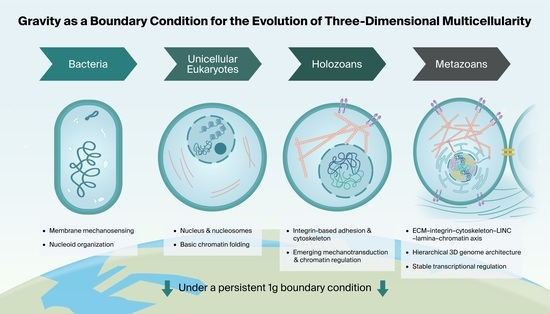
Graphical Abstract