


Reliability and Validity of Plantar Pressures and the Modified ICPBL Test vs. Telemetry for Diagnosing Anatomical Discrepancies: A Pilot Study

 , , , , , and
Abstract
1. Introduction
1.1. Palpation of the Iliac Crests and Pelvimeter with Blocks (ICPBL)
1.2. Plantar Pressure Analysis
1.3. Rationale, Objectives, and Hypotheses
2. Materials and Methods
2.1. Study Design and Sample Size
2.2. Procedure and Technical Considerations
2.2.1. Instrumentation and Calibration Protocols
2.2.2. Modified ICPBL Test
2.2.3. Plantar Pressure Assessments
2.3. Statistical Analysis
3. Results
4. Discussion
4.1. Modified ICPBL Test
4.2. Plantar Pressures
4.3. Limitations
5. Conclusions
Author Contributions
Funding
Institutional Review Board Statement
Informed Consent Statement
Data Availability Statement
Acknowledgments
Conflicts of Interest
References
- Clarke, G.R. Unequal leg length: An accurate method of detection and some clinical results. Ann. Rheum. Dis. 1972, 31, 385–390. [Google Scholar] [CrossRef] [PubMed]
- Woerman, A.L.; Binder-Macleod, S.A. Leg length discrepancy assessment: Accuracy and precision in five clinical methods of evaluation. J. Orthop. Sports Phys. Ther. 1984, 5, 230–239. [Google Scholar] [CrossRef] [PubMed]
- Petrone, M.R.; Guinn, J.; Reddin, A.; Sutlive, T.G.; Flynn, T.W.; Garber, M.P. The accuracy of the Palpation Meter (PALM) for measuring pelvic crest height difference and leg length discrepancy. J. Orthop. Sports Phys. Ther. 2003, 33, 319–325. [Google Scholar] [CrossRef] [PubMed]
- Gomez-Aguilar, E.; Reina-Bueno, M.; Lafuente-Sotillos, G.; Montes-Salas, R.; Munuera-Martinez, P.V.; Castillo-Lopez, J.M. Validity of clinical methods in the detection of leg-length discrepancies. Hip Int. 2021, 31, 186–190. [Google Scholar] [CrossRef]
- Kogutt, M.S. Computed radiographic imaging: Use in low-dose leg length radiography. AJR Am. J. Roentgenol. 1987, 148, 1205–1206. [Google Scholar] [CrossRef]
- Blake, R.L.; Ferguson, H. Limb length discrepancies. J. Am. Podiatr. Med. Assoc. 1992, 82, 33–38. [Google Scholar] [CrossRef]
- Kaur, M.; Chandran, S.; McPhail, S.; Kuys, S.; James, L.; Read, G. Effect of slight leg length discrepancy on lateral pelvic tilt and lumbar spine during gait. J. Biomech. 2020, 102, 109653. [Google Scholar] [CrossRef]
- Rännistö, S.; Okuloff, A.; Uitti, J.; Paananen, M.; Rännistö, P.H.; Malmivaara, A.; Karppinen, J. Leg-length discrepancy is associated with low back pain among those who must stand while working. BMC Musculoskelet. Disord. 2015, 16, 110. [Google Scholar] [CrossRef]
- GILESL. Leg length inequality. In 100 Challenging Spinal Pain Syndrome Cases; Elsevier: Amsterdam, The Netherlands, 2009; pp. 119–122. [Google Scholar]
- Cooperstein, R.; Lucente, M. Comparison of Supine and Prone Methods of Leg Length Inequality Assessment. J. Chiropr. Med. 2017, 16, 103–110. [Google Scholar] [CrossRef]
- Guggenberger, R.; Pfirrmann, C.W.A.; Koch, P.P.; Buck, F.M. Assessment of lower limb length and alignment by biplanar linear radiography: Comparison with supine CT and upright full-length radiography. AJR Am. J. Roentgenol. 2014, 202, W161–W167. [Google Scholar] [CrossRef]
- Kawakami, H.; Sugano, N.; Yonenobu, K.; Yoshikawa, H.; Ochi, T.; Hattori, A.; Suzuki, N. Effects of rotation on measurement of lower limb alignment for knee osteotomy. J. Orthop. Res. 2004, 22, 1248–1253. [Google Scholar] [CrossRef] [PubMed]
- Lonner, J.H.; Laird, M.T.; Stuchin, S.A. Effect of Rotation and Knee Flexion on Radiographic Alignment in Total Knee Arthroplasties. Clin. Orthop. Relat. Res. 1996, 331, 102–106. [Google Scholar] [CrossRef]
- Sabharwal, S.; Kumar, A. Methods for assessing leg length discrepancy. Clin. Orthop. Relat. Res. 2008, 466, 2910–2922. [Google Scholar] [CrossRef] [PubMed]
- Baumfeld, D.; Baumfeld, T.; Da Rocha, R.L.; Macedo, B.; Raduan, F.; Zambelli, R.; Alves Silva, T.A.; Nery, C. Reliability of Baropodometry on the Evaluation of Plantar Load Distribution: A Transversal Study. BioMed Res. Int. 2017, 2017, 5925137. [Google Scholar] [CrossRef]
- Hanada, E.; Kirby, R.L.; Mitchell, M.; Swuste, J.M. Measuring leg-length discrepancy by the “iliac crest palpation and book correction” method: Reliability and validity. Arch. Phys. Med. Rehabil. 2001, 82, 938–942. [Google Scholar] [CrossRef]
- Jonson, S.R.; Gross, M.T. Intraexaminer reliability, interexaminer reliability, and mean values for nine lower extremity skeletal measures in healthy naval midshipmen. J. Orthop. Sports Phys. Ther. 1997, 25, 253–263. [Google Scholar] [CrossRef]
- Alfuth, M.; Fichter, P.; Knicker, A. Leg length discrepancy: A systematic review on the validity and reliability of clinical assessments and imaging diagnostics used in clinical practice. PLoS ONE 2021, 16, e0261457. [Google Scholar] [CrossRef]
- Friberg, O.; Nurminen, M.; Korhonen, K.; Soininen, E.; Mänttäri, T. Accuracy and precision of clinical estimation of leg length inequality and lumbar scoliosis: Comparison of clinical and radiological measurements. Int. Disabil. Stud. 1988, 10, 49–53. [Google Scholar] [CrossRef]
- Grassi Dde, O.; de Souza, M.Z.; Ferrareto, S.B.; Montebelo MIde, L.; Guirro ECde, O. Immediate and lasting improvements in weight distribution seen in baropodometry following a high-velocity, low-amplitude thrust manipulation of the sacroiliac joint. Man. Ther. 2011, 16, 495–500. [Google Scholar] [CrossRef] [PubMed]
- Pereiro-Buceta, H.; Calvo-Lobo, C.; Becerro-de-Bengoa-Vallejo, R.; Losa-Iglesias, M.E.; Romero-Morales, C.; López-López, D.; Martínez-Jiménez, E.M. Intra and intersession repeatability and reliability of dynamic parameters in pressure platform assessments on subjects with simulated leg length discrepancy. A cross-sectional research. Obs. Study Sao Paulo Med. J. 2021, 139, 424–434. [Google Scholar] [CrossRef] [PubMed]
- Azizan, N.A.; Basaruddin, K.S.; Salleh, A.F.; Sulaiman, A.R.; Aziz Safar, M.J.; Radzi Rusli, W.M. Leg Length Discrepancy: Dynamic Balance Response during Gait. J. Healthc. Eng. 2018, 2018, 7815451. [Google Scholar] [CrossRef]
- Pardoe, H.R. Sample size estimates for well-powered cross-sectional cortical thickness studies. NeuroImage 2013, 64, 3000–3009. [Google Scholar] [CrossRef]
- Escott, B.G.; Ravi, B.; Weathermon, A.C.; Acharya, J.; Gordon, C.L.; Babyn, P.S.; Kelley, S.P.; Narayanan, U.G. EOS low-dose radiography: A reliable and accurate method for leg length measurement. J. Bone Jt. Surg. 2013, 22, 611–618. [Google Scholar]
- Obuchowski, N.A.; Bullen, J.A. Receiver operating characteristic (ROC) curves: Review of methods with applications in diagnostic medicine. Phys. Med. Biol. 2018, 63, 07TR01. [Google Scholar] [CrossRef] [PubMed]
- Knutson, G.A. Anatomic and functional leg-length inequality: A review and recommendation for clinical decision-making. Chiropr Osteopat. 2005, 13, 11. [Google Scholar] [CrossRef] [PubMed]
- Roaas, A.; Andersson, G.B.J. Leg length discrepancy and osteoarthrosis of the hip. Clin. Orthop. Relat. Res. 1982, 164, 186–190. [Google Scholar]
- Piva, S.R.; Erhard, R.E.; Childs, J.D.; Hicks, G.; Al-Abdulmohsin, H. Reliability of measuring iliac crest level in the standing and sitting position using a new measurement device. J. Manip. Physiol Ther. 2003, 26, 437–441. [Google Scholar] [CrossRef]
- Domínguez, G.; Munuera, P.V.; Lomas, M. Metatarsal protrusion angle: Values of normality. J. Am. Podiatr. Med. Assoc. 2009, 99, 49–53. [Google Scholar] [CrossRef]
- Alfaro-Santafé, J.V.; Gómez-Bernal, A. Reliability and Repeatability of the Footwork Plantar Pressure Plate System. J. Am. Podiatr. Med. Assoc. 2021, 111, 1–7. [Google Scholar] [CrossRef]
- Beattie, P.; Isaacson, K.; Riddle, D.L.; Rothstein, J.M. Validity of derived measurements of leg-length differences obtained by use of a tape measure. Phys. Ther. 1990, 70, 150–157. [Google Scholar] [CrossRef]
- Xu, C.; Wen, X.X.; Huang, L.Y.; Shang, L.; Yang, Z.; Yan, Y.B.; Lei, W. Reliability of the Footscan® Platform System in Healthy Subjects: A Comparison of without Top-Layer and with Top-Layer Protocols. BioMed Res. Int. 2017, 2017, 2708712. [Google Scholar] [CrossRef]
- Merriman, L.M.; Tollafield, D.R. Assessment of the Lower Limb; Churchill Livingstone: Edinburgh, UK, 1995; 437p. [Google Scholar]
- Becerro-de-Bengoa-Vallejo, R.; Losa-Iglesias, M.E.; Rodriguez-Sanz, D. Static and dynamic plantar pressures in children with and without sever disease: A case-control study. Phys. Ther. 2014, 94, 818–826. [Google Scholar] [CrossRef] [PubMed]
- Becerro de Bengoa Vallejo, R.; Losa Iglesias, M.E.; Zeni, J.; Thomas, S. Reliability and repeatability of the portable EPS-platform digital pressure-plate system. J. Am. Podiatr. Med. Assoc. 2013, 103, 197–203. [Google Scholar] [CrossRef]
- Koo, T.K.; Li, M.Y. A Guideline of Selecting and Reporting Intraclass Correlation Coefficients for Reliability Research. J. Chiropr. Med. 2016, 15, 155–163. [Google Scholar] [CrossRef]
- Tsuji, I.; Nakamoto, K.; Hasegawa, T.; Hisashige, A.; Inawashiro, H.; Fukao, A.; Hisamichi, S. Receiver Operating Characteristic Analysis on Fasting Plasma Glucose, HbA1c, and Fructosamine on Diabetes Screening. Diabetes Care 1991, 14, 1075–1077. [Google Scholar] [CrossRef]
- Cerda, J.; Cifuentes, L. Uso de curvas ROC en investigación clínica: Aspectos teórico-prácticos. Rev. Chil. Infectol. 2012, 29, 138–141. [Google Scholar] [CrossRef]
- Bossuyt, P.M.; Reitsma, J.B.; Bruns, D.E.; Gatsonis, C.A.; Glasziou, P.P.; Irwig, L.; Lijmer, J.G.; Moher, D.; Rennie, D.; De Vet, H.C.; et al. STARD 2015: An updated list of essential items for reporting diagnostic accuracy studies. BMJ 2015, 351, 826–832. [Google Scholar] [CrossRef]
- Stief, F.; Schmidt, A.; Adolf, S.; Kremer, L.; Brkic, M.; Meurer, A. Development of gait performance and dynamic hip and knee joint loading after containment improving surgery in patients with Legg-Calvé-Perthes disease. Gait Posture 2016, 47, 51–56. [Google Scholar] [CrossRef] [PubMed]
- El-Nahas, M.R.; Gawish, H.M.; Tarshoby, M.M.; State, O.I.; Aboelyazid, A. Effect of simulated leg length discrepancy on plantar pressure distribution in diabetic patients with neuropathic foot ulceration. J. Wound Care 2011, 20, 473–477. [Google Scholar] [CrossRef]
- Gross, M.T.; Burns, C.B.; Chapman, S.W.; Hudson, C.J.; Curtis, H.S.; Lehmann, J.R.; Renner, J.B. Reliability and validity of rigid lift and pelvic leveling device method in assessing functional leg length inequality. J. Orthop. Sports Phys. Ther. 1998, 27, 285–294. [Google Scholar] [CrossRef] [PubMed]
- Pereiro-Buceta, H.; Becerro-de-Bengoa-Vallejo, R.; Losa-Iglesias, M.E.; López-López, D.; Navarro-Flores, E.; Martínez-Jiménez, E.M.; Martiniano, J.; Calvo-Lobo, C. The Effect of Simulated Leg-Length Discrepancy on the Dynamic Parameters of the Feet during Gait-Cross-Sectional Research. Healthcare 2021, 9, 932. [Google Scholar] [CrossRef] [PubMed]
- Park, K.H.; Kim, K.W.; Kim, C.H. Effect of Leg Length Discrepancy on Gait and Cobb’s Angle. Korean J. Appl. Biomech. 2016, 26, 101–113. [Google Scholar] [CrossRef]
- Resende, R.; Kirkwood, R.; Deluzio, K.; Cabral, S.; Fonseca, S. Biomechanical strategies implemented to compensate for mild leg length discrepancy during gait. Gait Posture 2016, 46, 147–153. [Google Scholar] [CrossRef]
- Heath, M.R.; Aitchison, A.H.; Schlichte, L.M.; Goodbody, C.; Cordasco, F.A.; Fabricant, P.D.; Green, D.W. Use caution when assessing preoperative leg-length discrepancies in patients undergoing ACL reconstruction. Orthop. J. Sports Med. 2020, 8, 2325967120951062. [Google Scholar]



| Variable | Total Sample (N = 30) | DA Group (n = 13) | Non-DA Group (n = 17) | p-Value |
|---|---|---|---|---|
| Age (years) | 51.60 ± 15.41 | 52.77 ± 14.45 | 50.71 ± 16.50 | 718 |
| Height (cm) | 168.43 ± 9.42 | 168.77 ± 9.16 | 168.18 ± 9.89 | 867 |
| Weight (kg) | 71.34 ± 11.07 | 73.10 ± 8.73 | 70.00 ± 12.68 | 435 |
| TE Gold Standard (mm) | 3.73 ± 4.45 | 8.09 ± 3.24 | 0.41 ± 0.96 | <0.001 * |
| Modified ICPBL (mm) | 2.19 ± 2.40 | 4.38 ± 2.10 | 0.51 ± 0.53 | <0.001 * |
| Plantar Pressures (kg/cm2) | 3.53 ± 2.87 | 5.17 ± 3.28 | 2.28 ± 1.77 | 0.024 * |
| Technique Variable | ICC (3,1) (95% CI) | ICC (3,1) Intra (95% CI) | Optimal Cut-Off Value | Area Under the ROC Curve (95% CI) (Lb–Ub) | p-Value | Sensitivity % (95% CI) (Lb–Ub) | Specificity % (95% CI) (Lb–Ub) |
|---|---|---|---|---|---|---|---|
| (Lb–Ub) | (Lb–Ub) | ||||||
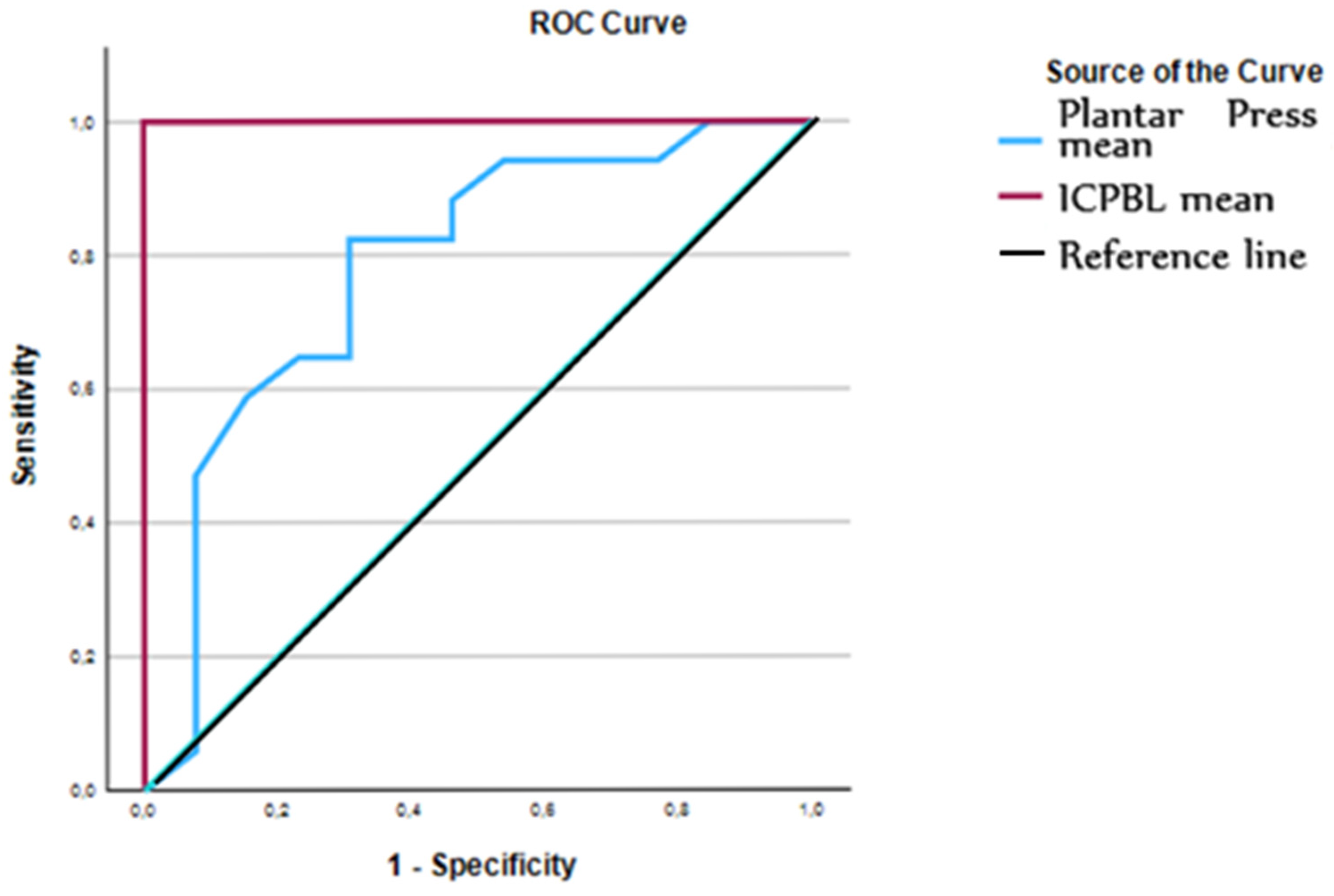
| PLANTAR PRESSURES (kg/cm2) | 0.741 (0.456–0.877) | 0.911 (0.844–0.953) | 2.83 | 0.783 (0.603–0.962) | <0.05 * | 69.2 (38.6–90.9) | 82.4 (56.6–96.2) |
| MODIFIED ICPBL (mm) | 0.877 (0.742–0.942) | 0.977 (0.959–0.988) | 1.88 | 1.000 (0.912–1.000) | <0.001 ** | 100 (75.3–100) | 100 (80.5–100) |
| Test | Actual Condition (TE) | Predicted: NO | Predicted: YES | Accuracy/Metric |
|---|---|---|---|---|
| Plantar Pressures | Negative (Non-DA) | 14 | 3 | Specificity: 82.4% |
| (Cut-off: 2.83 kg/cm2) | Positive (DA) | 4 | 9 | Sensitivity: 69.2% |
| AUC: 0.783 | Total Accuracy | 76.7% | ||
| --- | --- | --- | --- | --- |
| Modified ICPBL | Negative (Non-DA) | 17 | 0 | Specificity: 100% |
| (Cut-off: 1.88 mm) | Positive (DA) | 0 | 13 | Sensitivity: 100% |
| AUC: 1.000 | Total Accuracy | 100% |
| Test | Prevalence | PPV (%) | NPV (%) |
|---|---|---|---|
| Plantar pressures | 35.5% | 67.9 | 82.9 |
| Plantar pressures | 50% | 79.7 | 72.8 |
| Plantar pressures | 80% | 94.0 | 40.1 |
| Modified ICPBL | 35.5% | 100 | 100 |
| Modified ICPBL | 50% | 100 | 100 |
| Modified ICPBL | 80% | 100 | 100 |
Disclaimer/Publisher’s Note: The statements, opinions and data contained in all publications are solely those of the individual author(s) and contributor(s) and not of MDPI and/or the editor(s). MDPI and/or the editor(s) disclaim responsibility for any injury to people or property resulting from any ideas, methods, instructions or products referred to in the content. |
© 2026 by the authors. Licensee MDPI, Basel, Switzerland. This article is an open access article distributed under the terms and conditions of the Creative Commons Attribution (CC BY) license.
Share and Cite
Marcelino Argemi, A.; Alexe, D.I.; Ortuño Soriano, I.; Zaragoza García, I.; Saura Sempere, A.; Bueno Fermoso, R.; Gómez Carrión, Á.; Sánchez-Gómez, R. Reliability and Validity of Plantar Pressures and the Modified ICPBL Test vs. Telemetry for Diagnosing Anatomical Discrepancies: A Pilot Study. Life 2026, 16, 612. https://doi.org/10.3390/life16040612
Marcelino Argemi A, Alexe DI, Ortuño Soriano I, Zaragoza García I, Saura Sempere A, Bueno Fermoso R, Gómez Carrión Á, Sánchez-Gómez R. Reliability and Validity of Plantar Pressures and the Modified ICPBL Test vs. Telemetry for Diagnosing Anatomical Discrepancies: A Pilot Study. Life. 2026; 16(4):612. https://doi.org/10.3390/life16040612
Chicago/Turabian StyleMarcelino Argemi, Arian, Dan Iulian Alexe, Ismael Ortuño Soriano, Ignacio Zaragoza García, Alvaro Saura Sempere, Rebeca Bueno Fermoso, Álvaro Gómez Carrión, and Rubén Sánchez-Gómez. 2026. "Reliability and Validity of Plantar Pressures and the Modified ICPBL Test vs. Telemetry for Diagnosing Anatomical Discrepancies: A Pilot Study" Life 16, no. 4: 612. https://doi.org/10.3390/life16040612
APA StyleMarcelino Argemi, A., Alexe, D. I., Ortuño Soriano, I., Zaragoza García, I., Saura Sempere, A., Bueno Fermoso, R., Gómez Carrión, Á., & Sánchez-Gómez, R. (2026). Reliability and Validity of Plantar Pressures and the Modified ICPBL Test vs. Telemetry for Diagnosing Anatomical Discrepancies: A Pilot Study. Life, 16(4), 612. https://doi.org/10.3390/life16040612