Article

Interleukin-6 in Daily Use in the Intensive Care Unit: Does It Change the Patients’ Outcome and Antimicrobial Prescription? An Explorative Study

1
Department for Interdisciplinary Intensive Medicine and Intermediate Care, Helios Dr. Horst Schmidt Hospital Wiesbaden, 65199 Wiesbaden, Germany
2
Department of Anesthesiology and Critical Care, University of Freiburg Medical Center, 79106 Freiburg, Germany
3
Department for Anesthesiology and Surgical Intensive Care Medicine, Paracelsus Medical University, Nuremberg General Hospital, 90419 Nuremberg, Germany
4
Department of Anesthesiology, Intensive Care Medicine and Pain Medicine, Medical Faculty Mannheim of Heidelberg University, 68167 Mannheim, Germany
*
Author to whom correspondence should be addressed.
Life 2026, 16(4), 590; https://doi.org/10.3390/life16040590
Submission received: 25 February 2026 / Revised: 21 March 2026 / Accepted: 30 March 2026 / Published: 1 April 2026
(This article belongs to the Special Issue Critical Issues in Intensive Care Medicine)

Abstract

Background: Interleukin-6 (IL-6) rises rapidly during systemic inflammation and is used in some ICUs as a daily infection marker. Whether routine IL-6 monitoring affects patient outcomes or antimicrobial use, compared with standard biomarkers CRP/PCT, remains unclear. Methods: This retrospective two-step study was conducted at a tertiary interdisciplinary ICU in Wiesbaden, Germany. Step 1 (pilot cohort) compared two 2-month periods with routine IL-6 versus CRP/PCT testing to identify differences and generate assumptions. Step 2 (extended cohort) compared two consecutive 12-month periods before and after discontinuation of IL-6 testing. After matching for disease severity and specialty, endpoints included ICU length of stay, ventilation hours, mortality, and antimicrobial use measured as defined daily doses (DDD), and recommended daily doses (RDD) per 100 patient-days. Results: Results: In the pilot cohort (n = 221), there were no significant differences between the IL-6 and CRP/PCT groups in terms of anti-infective therapy or ventilation hours. In the extended cohort (n = 5146), case-matched analyses showed no significant group differences in ICU length of stay, ventilation hours, or mortality between groups. Antimicrobial consumption was higher when IL-6 was used: DDD (16.8% increase, rate ratio RR = 1.17, 95% CI (1.14, 1.19), p < 0.001) and RDD (11.6% increase, RR = 1.12, 95% CI (1.09, 1.14), p < 0.001). Conclusions: In this exploratory study, routine IL-6 testing was not associated with improved outcomes but might be linked to increased antimicrobial consumption.

1. Introduction

Critically ill patients in intensive care units (ICUs) are at high risk of developing infections or are admitted due to infections, such as ventilator-associated pneumonia (VAP) or surgical-site infections, that contribute to increased morbidity and mortality [1,2]. VAP is among the leading infections in the ICU and is sometimes challenging to diagnose [3] due to concomitant organ dysfunction, overlapping symptoms, and underlying diseases. Inflammatory biomarkers such as C-reactive protein (CRP) and procalcitonin (PCT) have become established surrogate markers for infections [4,5,6,7].
IL 6 has gained attention as an additional marker due to its rapid kinetics and short half-life. It is among the fastest-responding inflammatory biomarkers, rising 24 to 48 h before clinical signs of inflammation [8] and peaking approximately 6 h post-exposure [9]. In comparison, C-reactive protein (CRP) rises 10–12 h after stimulation, peaks after approximately 36–50 h, and declines with a half-life of approximately 19 h once the inflammatory focus is controlled [4]. For CRP, a strong predictive value was reported for ventilator-associated pneumonia (VAP) in both surgical and medical ICU patients with an area under the receiver operating characteristic curve (AUROC) of 0.912 (95% CI 0.847–0.950) when measured 72 h after intubation [10]. Procalcitonin (PCT) rises, similar to IL-6, within 4–6 h after stimulation, reaching peak concentrations between 12 and 24 h post-exposure; it helps distinguish bacterial from viral infections with a sensitivity of approximately 92% and a specificity of 73%, although its diagnostic performance varies depending on the causative pathogen. Even after severe trauma, particularly involving abdominal organs, an increase in PCT levels has been documented [8,11]. Among several evaluated biomarkers, IL-6 was the only one capable of differentiating between microbiologically confirmed and merely suspected cases of VAP [12]. However, the clinical relevance of IL-6 in diagnosing infections in the ICU remains controversial, as its elevation can result from a wide range of inflammatory processes. Despite putative advantages, other studies have demonstrated only a moderate diagnostic value of IL-6 in differentiating confirmed infections from suspected infections [13,14,15,16].
In former studies, it was assumed that PCT-guided therapy may reduce mortality at 28 days and after one year [17,18] and decrease antibiotic consumption but is not necessary with a shortened ICU length of stay [19]. Our working assumption was that regular IL-6 use may be associated with a shorter ICU length of stay (LOS) and antibiotic consumption by facilitating faster discontinuation. Therefore, the aim of this study was to explore whether the routine use of IL-6, compared with CRP/PCT, is associated with shorter ICU LOS (primary outcome) and ventilation hours, ICU mortality, and antibiotic use (secondary outcomes).

2. Materials and Methods

The Clinical Setting: This retrospective observational study was conducted at the interdisciplinary ICU and intermediate care unit, collectively referred to as the ICU in the following, of the Helios Dr. Horst-Schmidt-Kliniken in Wiesbaden, Germany. IL-6 was routinely used every day as a marker for infection from 2019 until 31 March 2022. Due to institutional and economic considerations, IL-6 testing was discontinued and replaced by the combination of CRP and PCT, jointly referred to here as CRP/PCT, from 1 April 2022 onward.
Patients with an end of ICU stay between 1 April 2021, and 31 March 2023, were included. Exclusion criteria were age < 18, ≤24 h hours of ventilation, and pregnancy. Because COVID-19 elicits a strong inflammatory response and there was no prior experience with this condition at that time, patients were excluded from specific analyses as indicated. In a pilot cohort, patients with an end of stay between 1 April and 31 May 2021, were assigned to the IL-6 group, and between 1 April and 31 May 2022, to the CRP/PCT comparison group. For confirmatory analyses in a larger cohort, the IL-6 group was extended by patients with an end of stay by 31 March 2022, and the CRP/PCT group by 31 March 2023. The two comparison periods in each cohort were chosen in consecutive years to minimize the effect of seasonal variation, particularly in respiratory infections.
Data on demographics, underlying medical conditions, laboratory values, vital signs, treatment parameters, initiation and duration of antimicrobial therapies, and ICU mortality were retrieved from the clinical information management system ICM (Dräger®), the anesthesia and ICU documentation system MetaVision (IMD Soft®), and the hospital information system (SAP®). Days of antimicrobial therapy (DOT) were defined as the sum of calendar days on which a patient received at least one dose of a given antimicrobial agent. During combination therapy, one DOT was counted per agent and calendar day. The WHO-defined defined daily dose (DDD) and recommended daily dose (RDD) were used to quantify antibiotic consumption. DDD represents the assumed average adult maintenance dose for the main indication, and RDD reflects guideline-based daily doses for clinical indications. As measures of disease severity, we utilized the SAPS II score and the German intensive care complex treatment (ICCT) code, which is based on the modified SAPS II score of the first 24 h after admission, the need for mechanical ventilation and its duration, acute renal replacement therapy (intermittent hemodialysis or continuous renal replacement therapy), and extracorporeal membrane oxygenation (ECMO) [20,21].
The primary outcome was the ICU LOS. Secondary outcomes included mechanical ventilation duration, ICU mortality, and antimicrobial consumption.
Statistical Analysis: Depending on distribution, variables were compared using t tests or Mann–Whitney U tests. Metric variables are indicated as the mean (SD). Cohen’s d (d) or Cramer’s V (V) were used to determine the corresponding effect size [22]. Effect sizes were interpreted using conventional thresholds: small (Cohen’s d ≈ 0.2, rank-biserial r ≈ 0.1, Cramer’s V ≈ 0.1), medium (d ≈ 0.5, r/V ≈ 0.3), and large (d ≥ 0.8, r/V ≥ 0.5). Categorical variables were analyzed using chi-square tests. A p value of less than 0.05 was considered statistically significant. Multivariable regression was performed for the ICU LOS for c variables age, sex, and ICCT categories. Antibiotic consumption (DDD and RDD) was modeled using Poisson regression to estimate rate ratios between the IL-6 and CRP/PCT groups. The statistical analysis was performed with JASP 0.18.2, and matching and graph visualization were performed with Julius.ai 1.1 Max (Caesar Labs, Inc., San Francisco, CA, USA).

3. Results

Pilot Cohort

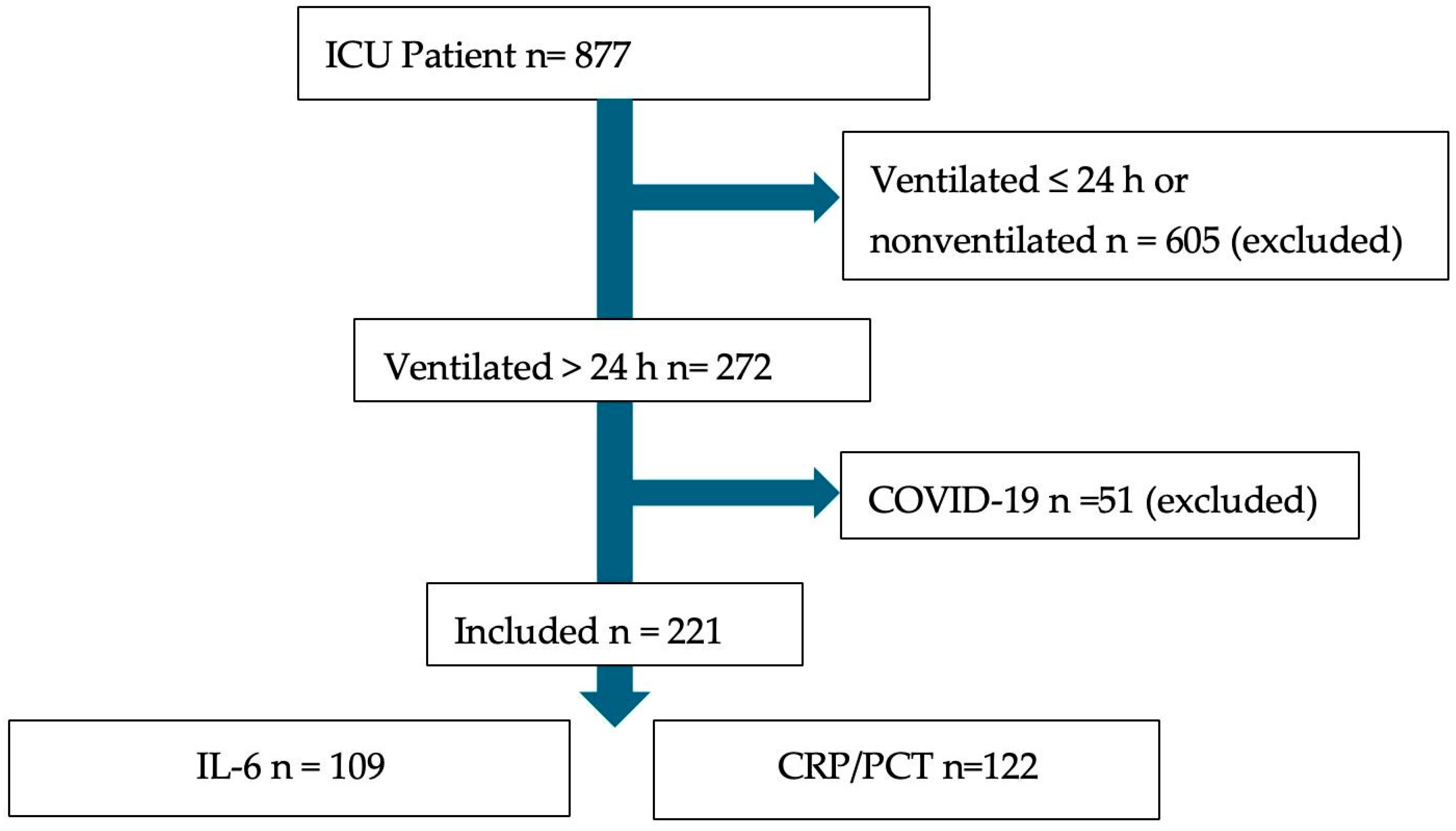
Baseline: For the pilot cohort, a total of 221 ICU patients met the inclusion criteria, with 109 patients in the IL-6 group and 112 in the CRP/PCT group (Appendix A Figure A1). There was no statistically significant difference in disease severity between the groups, as indicated by median SAPS II scores of 36 vs. 34 (p = 0.351, r = 0.073). Likewise, no significant differences were found in most baseline clinical parameters, except for a lower Horowitz index and bicarbonate levels in the CRP/PCT group. Regarding comorbidities, the CRP/PCT group had a higher prevalence of peripheral arterial disease (16.96% vs. 7.34%, p = 0.039, V = 0.029). Details are given in Table 1 and Appendix A, Table A1 (baseline and SAPS II) and Table A2 (anamnestic characteristics).
Primary outcome: There were no significant differences between the two groups with respect to the mean ICU LOS (4.18 [4.12] vs. 4.29 [4.94] days, p = 0.419, r = 0.068) or ICU mortality (21.10% vs. 16.07%, p = 0.3884, V = 0.025). In the overall cohort, the proportion of ventilated patients was significantly higher in the IL-6 group than in the PCT/CRP group (76.14% vs. 53.57%, p < 0.001, V = 0.236). However, among patients receiving antimicrobial therapy, this difference was no longer statistically significant (87.1% vs. 78.2%, p = 0.201, V= 0.118). Also, the length of ventilation among those patients who were ventilated did not differ significantly between the groups (60.87 [79.70] h vs. 77.95 [89.92] h, p = 0.203, r = 0.125). Details are given in Table 2.
Secondary outcome: The proportion of patients receiving any antimicrobial therapy did not differ significantly between groups (56.88% in the IL-6 group vs. 49.10% in the CRP/PCT group, p = 0.247, V = 0.078). A similar pattern was observed across different types of antimicrobial therapy—antibiotics (55.96% vs. 48.21%, p = 0.248, V = 0.078), antifungals (2.75% vs. 5.36%, p = 0.327, V = 0.066), and antivirals (3.67% vs. 1.79%, p = 0.389, V = 0.058). The mean days of antimicrobial therapy (DOT) were higher in the IL-6 group (4.07 [6.57]) than in the control group (2.95 [4.51]), but the difference was not statistically significant (p = 0.136, r = 0.110). Details are given in Table 2.
  • Extended Cohort:
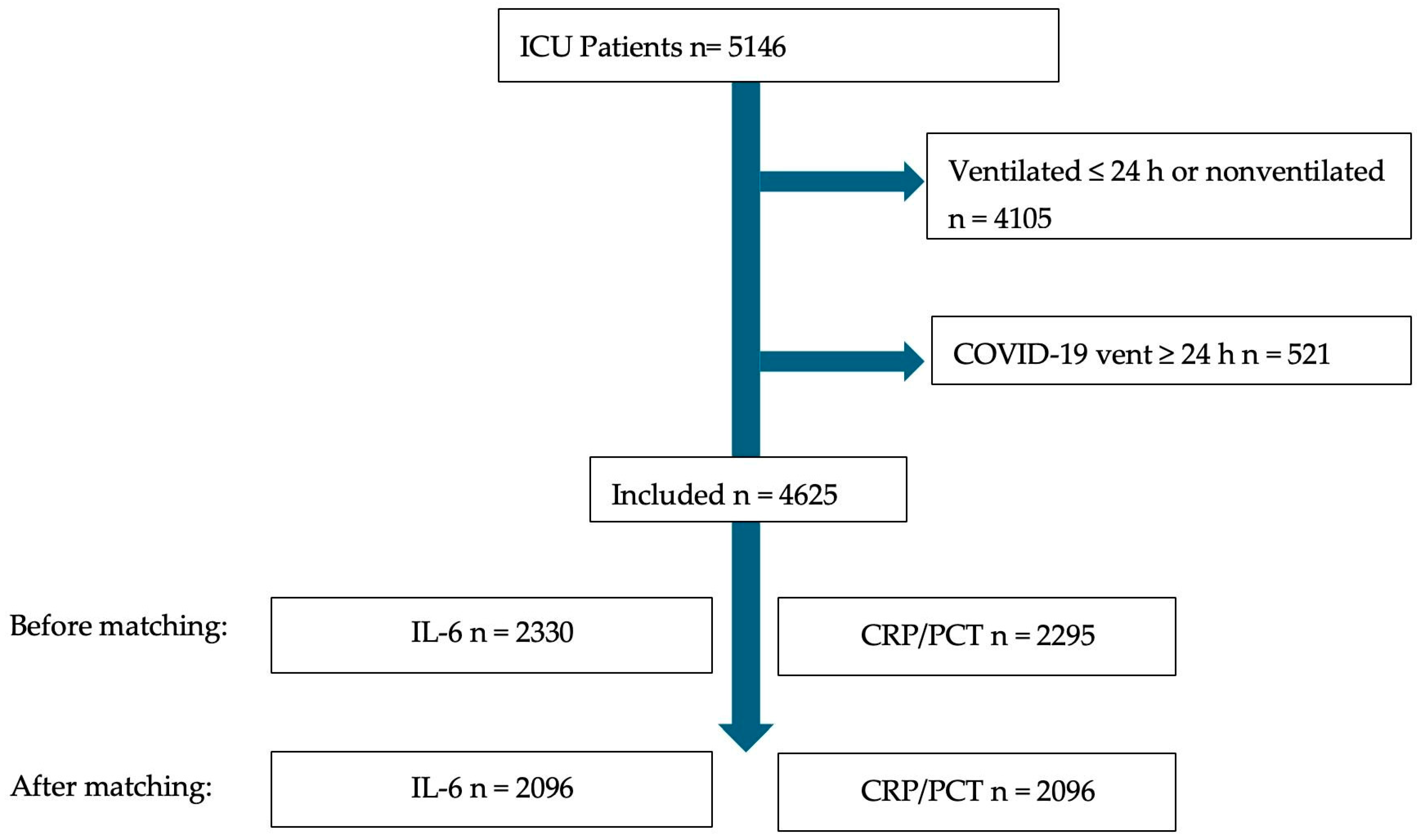
Baseline: For the extended cohort, 5146 ICU patients were included, with 2576 in the IL-6 group and 2570 in the PCT/CRP group (Appendix A Figure A2). The disease severity was calculated and compared between the groups using the ICCT. Details are given in Table 3.
We did not find a difference in the distribution of internal and surgical patients (χ2(1) = 3.70, p = 0.054). Details are given in Appendix A, Table A3.
Likewise, there were no significant differences in age (67.10 [16.02] vs. 67.10 [16.53] p = 0.996, d < 0.000). The sex distribution indicated a significant difference between the two cohorts (χ2(1, N = 5146) = 5.69, p = 0.017, V = 0.033), with more men in the first IL-6 group and more women in the PCT/CRP group. However, the difference is statistically significant but with an effect size of 0.033, which is not of practical relevance.
  • Primary outcome:
To avoid confounding by COVID-19, 521 COVID-19 patients were excluded. Thereafter, one-to-one matching was performed within each ICCT level, using the leading specialty as the matching variable (e.g., IL-6 neurosurgical patients in ICCT level 3 were matched to PCT/CRP neurosurgical patients in ICCT level 3). This led to a sample size of 2096 patients in each group.
Here, mortality did not differ significantly between groups, χ2(1, N = 4192) = 1.28, p = 0.258, V = 0.017 (327 (15.6%) in the IL-6 group, compared to 354 patients (16.9%) in the PCT/CRP group. Additionally, the hours of ventilation and the ICU length of stay did not differ significantly between the cohorts. Details are given in Table 4.
Additionally, after adjustment for age, sex, and ICCT categories, ICU LOS was not significantly longer in the PCT/CRP in the negative binomial model (IRR 1.05, 95% CI 0.97–1.13). There was no meaningful multicollinearity among these predictors (VIF 1.00–1.02).
  • Secondary outcome:
For the secondary outcome, also COVID-19 patients were included. Although the IL-6 group had more COVID-19-positive patients than the PCT/CRP group (234 vs. 164), total ICU days were very similar between the groups (1529 vs. 1550 days).
We found higher antibiotic consumption in the IL-6 group than in the PCT/CRP group, both for DDD (16.8% increase, rate ratio RR = 1.17, 95% CI (1.14, 1.19), p < 0.001) and RDD (11.6% increase, RR = 1.12, 95% CI (1.09, 1.14), p < 0.001). (Table 5).

4. Discussion

Our study aimed to determine whether the daily routine use of IL-6 as an infection marker influences the ICU LOS, duration of mechanical ventilation, ICU mortality or antibiotic consumption in ICU patients compared to PCT/CRP.
Primary outcome: The results of our investigation suggest that IL-6, compared to PCT/CRP, did not significantly impact patient outcomes in our ICU setting. Despite the theoretical advantages of IL-6—namely, its rapid rise and fall in serum levels—its routine use did not result in a different outcome concerning ICU LOS, ventilation hours and ICU mortality. Although IL-6 has been associated with disease severity and prognosis in sepsis [14,16], our data indicate that this biomarker provided no additional clinical benefit when applied routinely. Baseline IL-6 and 96-h IL-6 clearance were able to demonstrate some discriminatory ability in mortality risk [23]. In terms of outcomes, mortality was comparable between groups, within the predicted range for the SAPS II score.
Secondary outcome: In our first cohort, we found a trend toward reduced antimicrobial use after IL-6 testing was discontinued. Next, we tested this hypothesis on a much larger cohort, confirming a significant decrease in antimicrobial use. Since we were not able to exclude COVID-19 patients for this latter calculation, the higher antibiotic consumption in the IL-6 group could be explained by the more severe COVID-19 cases in the first time period, accounting for higher ventilation hours within this group. The relationship between COVID-19 severity and interleukin 6 levels is well established [24]. These higher levels might have prompted the treating physicians to initiate or prolong antibiotic therapy. Therefore, we must assume that a significant proportion of the higher antibiotic consumption in the IL-6 group is related to this. Nevertheless, we also observed this trend within the pilot cohort that excluded COVID-19 patients.
One further possible explanation for this trend might be that IL-6 may have led to a more aggressive therapeutic approach when elevated. IL-6 has shown a high sensitivity in discriminating sepsis and septic shock from controls with systemic inflammatory response syndrome (SIRS) [16] but a lag of specificity [13,25]. This lag could promote overtreatment, particularly in heterogeneous ICU populations where sterile inflammation is frequent (e.g., after surgery, trauma, or ischemia–reperfusion injury). Consequently, we may have interpreted IL-6 elevations as infection triggers, resulting in unnecessary or prolonged antimicrobial therapy. In contrast, PCT-guided algorithms have been shown to shorten antibiotic courses when they are implemented in a standardized protocol [11,26]. In our setting, IL-6 values were available daily without a predefined protocol in antibiotic disruption, which might have led to subjective treatment decisions rather than improving stewardship.
Besides biomarker monitoring, microbiological analysis of suitable specimens remains highly valuable, with microbiological cultures still serving as the gold standard for detecting phenotypic antibiotic resistance. However, rapid molecular techniques such as multiplex real-time PCR and next-generation sequencing allow for earlier pathogen identification and may decrease antibiotic exposure, although diagnostic accuracy can differ among pathogens. Emerging technologies, including nanopore sequencing, also offer near real-time bedside diagnostics, potentially supporting more targeted antimicrobial therapy [27,28].
In addition, studies like the STOP-IT Trial (Study to Optimize Peritoneal Infection Therapy) demonstrated that a predefined duration of antimicrobial therapy, independent of biomarker levels, was not inferior in terms of clinical outcomes [29].
Routine laboratory testing is usually performed every day at the same hour, with the same routine markers for every patient. In this setting, the physician in charge makes the decision to prescribe antibiotics. Different factors influence this decision, such as the experience level of the physician or the interpretation standards for biomarkers within the department. Additional factors such as time pressure, requests from patients/carers, diagnostic uncertainty and reliance on evidence-based guidelines and diagnostic tests greatly influence when and how we decide [30,31,32]. One of these factors we have illuminated in this study is the influence of biomarkers. In a previous study, we showed that IL-6 is a favorable marker, outperforming PCT and CRP in differentiating patients with ventilator-associated pneumonia [33]. However, unreflective daily use might lower the threshold for prescribing an antibiotic [32]. Therefore, it might be reasonable to embed the advantages of IL-6 compared to PCT or CRP into protocols. These protocols should specify the timing of the test, which might be supported by artificial intelligence, which has already been shown to reduce unnecessary tests [34,35].
Strengths and Limitations: This study’s strength lies in its two-step design, which combines detailed single-cohort data with a large, system-wide dataset across consecutive years, reducing seasonal and case-mix bias. However, there are several limitations.
First, the study was designed as a retrospective single-center study, which may imply that hospital-specific factors, as well as unrecorded clinical variables, could have influenced treatment decisions. In addition, we did not differentiate between infection types or confirm microbiological findings in the extended cohort. Furthermore, dose–response relationships or thresholds for the initiation of antibiotic therapy were not recorded.
Within the pilot cohort, we found a higher proportion of ventilated patients in the IL-6 group. This was likely reflecting temporal and case-mix differences between the comparison periods. Nevertheless, this represents a potential confounder. However, this imbalance was not reproduced in the extended cohort and was not evident among patients receiving antimicrobial therapy.
ICU LOS represents a multifactorial outcome influenced by factors beyond infection and antimicrobial therapy, including ICU capacity, discharge logistics, and organizational constraints. While the large sample size was intended to mitigate the impact of such variability, residual confounding cannot be excluded. Second, antimicrobial utilization could only be assessed at a general level, as detailed patient-level data on indication, appropriateness, microbiological confirmation, cofounding factors, such as organ replacement therapies, and treatment modifications were not available.
For antibiotic consumption metrics (DDD and RDD), exclusion of COVID-19 patients was not feasible without introducing substantial selection bias. Given the known impact of COVID-19 on inflammatory markers and antimicrobial use, this represents a relevant confounding factor. However, when comparing the total ICU length of stay of COVID-19 patients between the IL-6 and PCT/CRP groups, only a minimal difference of 11 days was observed. Nevertheless, these analyses were considered exploratory and should be interpreted with caution. Statistically, this study employed an exploratory, descriptive design. To support a large sample size, we also did not perform individual-level propensity score matching, which might have reduced the risk of selection bias. However, we could demonstrate group-level homogeneity. Additionally, no formal adjustment for multiple testing was applied to secondary outcomes, as these analyses were exploratory and the endpoints were conceptually related. The results should be interpreted accordingly. Future studies should evaluate IL-6 within protocolized antimicrobial stewardship algorithms and its advantages over CRP and/or PCT with respect to clinically relevant outcomes.

5. Conclusions

In this exploratory ICU study, routine IL-6 monitoring was not associated with improved clinical outcomes but may be associated with increased antimicrobial use, emphasizing the need for structured, stewardship-guided implementation of biomarker-based decision-making.
Therefore, future prospective studies should focus more on antibiotic utilization, including detailed patient-level data on antimicrobial therapy, microbiological confirmation, and relevant clinical confounders, while evaluating standardized biomarker-guided algorithms within antimicrobial stewardship frameworks.
Future considerations might include integrating reliable biomarkers and AI-driven decision pathways, determining when to obtain a laboratory sample, and determining whether to initiate antibiotic therapy to support bedside physicians in their decision-making. Nevertheless, this should always be embedded within a structured stewardship programme.

Author Contributions

Conceptualization, T.B. and H.A.L.; methodology, T.B., R.K. and V.S.-L.; software, T.B.; validation, T.B., R.K., V.S.-L. and H.A.L.; formal analysis, T.B. and V.S.-L.; investigation, T.B. and R.K.; resources, T.B. and R.K.; data curation, T.B. and A.K.; writing—original draft preparation, T.B.; writing—review and editing, T.B., R.K., S.B., A.K., V.S.-L. and H.A.L.; visualization, T.B.; supervision, H.A.L.; project administration, T.B.; funding acquisition, not applicable. All authors have read and agreed to the published version of the manuscript.

Funding

This research received no external funding.

Institutional Review Board Statement

The study was conducted in accordance with the Declaration of Helsinki and was reviewed and approved by the Ethics Committee II of Heidelberg University, Medical Faculty Mannheim (Ethik-Kommission II der Universität Heidelberg, Medizinische Fakultät Mannheim) (protocol code 2022-820, date of approval 4 April 2022).

Informed Consent Statement

Patient consent was waived due to the retrospective, non-interventional design and the use of routinely collected clinical data. Data were extracted from hospital information and ICU documentation systems and analyzed in an anonymized/pseudonymized form for this study, without any additional procedures, patient contact, or impact on clinical management.

Data Availability Statement

The data presented in this study are not publicly available due to legal and ethical restrictions related to the use of sensitive patient data and data protection regulations. Anonymized or aggregated datasets may be made available from the corresponding author upon reasonable request and with appropriate justification and compliance with applicable data protection laws.

Acknowledgments

The authors gratefully acknowledge financial support for the article processing charges by Helios Kliniken. During the preparation of this manuscript/study, the author used Julius.ai (Caesar Labs, Inc., San Francisco, CA, USA) for the cohort matching. The authors have reviewed and edited the output and take full responsibility for the content of this publication.

Conflicts of Interest

The authors declare no conflicts of interest.

Abbreviations

The following abbreviations are used in this manuscript:
AIDSacquired immunodeficiency syndrome
AUROCarea under the receiver operating characteristic curve
CIconfidence interval
COPDchronic obstructive pulmonary disease
DDDdefined daily dose
DOTdays of therapy
ECMOextracorporeal membrane oxygenation
ICUintensive care unit
ICCTintensive care complex treatment
IL-6interleukin-6
IRRincidence rate ratio
LOSlength of stay
PCTprocalcitonin
PDpatient days
RDDrecommended daily dose
RRrate ratio
SAPS IISimplified Acute Physiology Score II
SDstandard deviation
SIRSsystemic inflammatory response syndrome
VAPventilator-associated pneumonia
VIFvariance inflation factor
WHOWorld Health Organization

Appendix A

Table A1. Baseline SAPS II characteristics of the pilot cohort.
CharacteristicIL-6
(n = 109)
PCT/CRP
(n = 112)
p Value
SAPS II (points) *36 (17.00)34 (20.23)0.3510
Age (years) *74 (20.00)68 (23.23)0.0640
Sex   
– Male63 (57.79%)76 (67.85%) 
– Female46 (42.21%)36 (32.15%)0.1282
Heart rate (beats/min)   
– 70–11933 (30.28%)32 (28.57%) 
– 40–6943 (39.45%)35 (31.25%) 
– 120–15926 (23.85%)32 (28.57%) 
– >1603 (2.75%)8 (7.14%) 
– <404 (3.67%)5 (4.46%)0.4337
Systolic blood pressure (mmHg)   
– 100–19940 (36.70%)36 (32.14%) 
– >2003 (2.75%)4 (3.57%) 
– 70–9961 (55.96%)61 (54.46%) 
– <705 (4.59%)11 (9.82%)0.4640
Temperature (°C)   
– <39100 (91.74%)104 (92.86%) 
– ≥399 (8.26%)8 (7.14%)0.8049
Horowitz index   
– No ventilation29 (26.61%)56 (50.00%) 
– ≥20054 (49.54%)34 (30.36%) 
– 100–19921 (19.27%)16 (14.29%) 
– <1005 (4.59%)6 (5.36%)0.0031 *
Urea (mg/dL)   
– <6074 (67.89%)78 (69.64%) 
– 61–17931 (28.44%)28 (25.00%) 
– >1804 (3.67%)6 (5.36%)0.7345
Urine output (mL/24 h)   
– >100074 (67.89%)78 (69.64%) 
– 500–100025 (22.94%)26 (23.21%) 
– <50010 (9.17%)8 (7.14%)0.8579
Sodium (mmol/L)   
– 125–14490 (82.57%)94 (83.93%) 
– >14518 (16.51%)14 (12.50%) 
– <1251 (0.92%)4 (3.57%)0.3093
Potassium (mmol/L)   
– 3.0–4.9100 (91.74%)98 (87.50%) 
– ≤3.02 (1.83%)3 (2.68%) 
– ≥5.07 (6.42%)11 (9.82%)0.6200
Bicarbonate (mmol/L)   
– ≥2081 (74.31%)98 (87.50%) 
– 15–1921 (19.27%)10 (8.93%) 
– <157 (6.42%)4 (3.57%)0.0429 *
Bilirubin (mg/dL)   
– <4.0105 (96.33%)108 (96.43%) 
– 4.0–5.90 (0.0%)2 (1.79%) 
– ≥6.04 (3.67%)2 (1.79%)0.2633
Leukocytes (cells ×109/L)   
– 1.0–19.991 (83.49%)100 (89.29%) 
– ≥20.017 (15.60%)11 (9.82%) 
– <1.01 (0.92%)1 (0.89%)0.4340
Chronic disease *   
– None102 (93.58%)105 (93.75%) 
– 16 (5.50%)4 (3.57%) 
– 21 (0.92%)3 (2.68%) 
– 30 (0.0%)0 (0.0%)0.4958
Reason for admission **   
– 19 (8.26%)9 (8.03%) 
– 271 (65.14%)70 (62.50%) 
– 329 (26.61%)33 (29.46%)0.4373
Values are presented as median (interquartile range) or as absolute and relative frequencies. SAPS II = Simplified Acute Physiology Score II. * Chronic disease: 1 = metastatic cancer, 2 = hematologic malignancy, 3 = acquired immunodeficiency syndrome (AIDS). ** Reason for admission: 1 = elective surgery, 2 = medical, 3 = emergency surgery. Statistically significant p values are italicized.
Table A2. Anamnestic characteristics of patients with and without IL-6 measurements.
CharacteristicIL-6 (n = 109)PCT/CRP (n = 112)p Value
Chronic renal failure15 (13.76%)16 (14.29%)0.911
COPD14 (12.84%)8 (7.14%)0.157
Asthma6 (5.50%)6 (5.36%)0.961
Arterial hypertension64 (58.72%)59 (52.68%)0.366
Coronary artery disease23 (21.10%)32 (28.57%)0.199
Acute myocardial infarction12 (11.01%)21 (18.75%)0.106
Peripheral arterial disease8 (7.34%)19 (16.96%)0.029
Heart failure20 (18.35%)32 (28.57%)0.073
Neoplasia23 (21.10%)24 (21.43%)0.953
Cerebral ischemia16 (14.68%)12 (10.71%)0.376
Intracerebral hemorrhage4 (3.67%)5 (4.46%)0.765
Epilepsy5 (4.59%)5 (4.46%)0.965
High-dose steroids0 (0.0%)0 (0.0%)
Diabetes mellitus27 (24.77%)25 (22.32%)0.668
Dyslipoproteinemia16 (14.68%)17 (15.18%)0.917
Nicotine abuse12 (11.01%)23 (20.54%)0.052
Values are presented as absolute and relative frequencies. COPD = chronic obstructive pulmonary disease.
Table A3. Comparison of Internal vs. Surgical Cases Across ZK Groups.
ICCT Groupn (Total)Internal Medicine
IL-6
Surgical Medicine
IL-6
Internal
Medicine
PCT/CRP
Surgical
Medicine PCT/CRP
χ2pdfCramér’s V
03586759103886892114.02<0.00110.063
1–210123261733201930.830.36210.029
3–53971149490991.770.18310.067
6149403228494.780.02910.179
C1 = Cohort 1; C2 = Cohort 2. Values are absolute numbers. Chi-square tests were used to compare internal vs. surgical cases.
Figure A1. Flowchart of the pilot cohort.
Life 16 00590 g0a1
Figure A2. Flowchart of the extended cohort.
Life 16 00590 g0a2

References

  1. Melsen, W.G.; Rovers, M.M.; Groenwold, R.; Bergmans, D.C.; Camus, C.; Bauer, T.T.; Hanisch, E.; Klarin, B.; Koeman, M.; Krueger, W.A.; et al. Attributable mortality of ventilator-associated pneumonia: A meta-analysis of individual patient data from randomised prevention studies. Lancet Infect. Dis. 2013, 13, 665–671. [Google Scholar] [CrossRef]
  2. Zimlichman, E.; Henderson, D.; Tamir, O.; Franz, C.; Song, P.; Yamin, C.K.; Keohane, C.; Denham, C.R.; Bates, D.W. Health Care–Associated Infections: A meta-analysis of costs and financial impact on the US health care system. JAMA Intern. Med. 2013, 173, 2039–2046. [Google Scholar] [CrossRef] [PubMed]
  3. Howroyd, F.; Chacko, C.; MacDuff, A.; Gautam, N.; Pouchet, B.; Tunnicliffe, B.; Weblin, J.; Gao-Smith, F.; Ahmed, Z.; Duggal, N.A.; et al. Ventilator-associated pneumonia: Pathobiological heterogeneity and diagnostic challenges. Nat. Commun. 2024, 15, 6447. [Google Scholar] [CrossRef] [PubMed]
  4. Schmit, X.; Vincent, J.L. The time course of blood C-reactive protein concentrations in relation to the response to initial antimicrobial therapy in patients with sepsis. Infection 2008, 36, 213–219. [Google Scholar] [CrossRef] [PubMed]
  5. Póvoa, P.; Coelho, L.; Almeida, E.; Fernandes, A.; Mealha, R.; Moreira, P.; Sabino, H. C-reactive protein as a marker of infection in critically ill patients. Clin. Microbiol. Infect. 2005, 11, 101–108. [Google Scholar] [CrossRef]
  6. Coelho, L.; Rabello, L.; Salluh, J.; Martin-Loeches, I.; Rodriguez, A.; Nseir, S.; Gomes, J.A.; Povoa, P. C-reactive protein and procalcitonin profile in ventilator-associated lower respiratory infections. J. Crit. Care 2018, 48, 385–389. [Google Scholar] [CrossRef]
  7. Póvoa, P.; Coelho, L.; Dal-Pizzol, F.; Ferrer, R.; Huttner, A.; Morris, A.C.; Nobre, V.; Ramirez, P.; Rouze, A.; Salluh, J.; et al. How to use biomarkers of infection or sepsis at the bedside: Guide to clinicians. Intensive Care Med. 2023, 49, 142–153. [Google Scholar] [CrossRef]
  8. Boenisch, S.; Fae, P.; Drexel, H.; Walli, A.K.; Fraunberger, P. Are circulating levels of CRP compared to IL-6 and PCT still relevant in intensive care unit patients? Laboratoriumsmedizin 2013, 37. [Google Scholar] [CrossRef]
  9. Rettig, T.C.D.; Verwijmeren, L.; Dijkstra, I.M.; Boerma, D.; Van De Garde, E.M.W.; Noordzij, P.G. Postoperative Interleukin-6 Level and Early Detection of Complications After Elective Major Abdominal Surgery. Ann. Surg. 2016, 263, 1207–1212. [Google Scholar] [CrossRef]
  10. Ding, H.G.; Zhou, H.F.; Diao, M.Y.; Xu, Y.; Pan, O.M.; Shen, X.H. A novel biomarker of serum Histidine-Rich Glycoprotein (HRG) for diagnosing and predicting prognosis of ventilator-associated pneumonia (VAP): A pilot study. Eur. Rev. Med. Pharmacol. Sci. 2018, 22, 7920–7927. [Google Scholar] [CrossRef]
  11. Maier, M.; Wutzler, S.; Lehnert, M.; Szermutzky, M.; Wyen, H.; Bingold, T.; Henrich, D.; Walcher, F.; Marzi, I. Serum procalcitonin levels in patients with multiple injuries including visceral trauma. J. Trauma 2009, 66, 243–249. [Google Scholar] [CrossRef] [PubMed]
  12. Ramírez, P.; Ferrer, M.; Gimeno, R.; Tormo, S.; Valencia, M.; Piñer, R.; Menendez, R.; Torres, A. Systemic inflammatory response and increased risk for ventilator-associated pneumonia: A preliminary study. Crit. Care Med. 2009, 37, 1691–1695. [Google Scholar] [CrossRef]
  13. Iwase, S.; Nakada, T.-A.; Hattori, N.; Takahashi, W.; Takahashi, N.; Aizimu, T.; Yoshida, M.; Morizane, T.; Oda, S. Interleukin-6 as a diagnostic marker for infection in critically ill patients: A systematic review and meta-analysis. Am. J. Emerg. Med. 2019, 37, 260–265. [Google Scholar] [CrossRef]
  14. Takahashi, W.; Nakada, T.-A.; Yazaki, M.; Oda, S. Interleukin-6 Levels Act as a Diagnostic Marker for Infection and a Prognostic Marker in Patients with Organ Dysfunction in Intensive Care Units. Shock 2016, 46, 254–260. [Google Scholar] [CrossRef] [PubMed]
  15. Reddy, P.R.; Cherukuri, M.; Eshwara, V.K.; Kudru, C.U.; Prabhu, R.K. Diagnostic Potential of Serum Interleukin-6 in Predicting Bacteremia in Adult Patients with Sepsis: A Prospective Observational Study. Indian J. Crit. Care Med. 2024, 28, 637–644. [Google Scholar] [CrossRef] [PubMed]
  16. Song, J.; Park, D.W.; Moon, S.; Cho, H.-J.; Park, J.H.; Seok, H.; Choi, W.S. Diagnostic and prognostic value of interleukin-6, pentraxin 3, and procalcitonin levels among sepsis and septic shock patients: A prospective controlled study according to the Sepsis-3 definitions. BMC Infect. Dis. 2019, 19, 968. [Google Scholar] [CrossRef] [PubMed]
  17. de Jong, E.; van Oers, J.A.; Beishuizen, A.; Vos, P.; Vermeijden, W.J.; Haas, L.E.; Loef, B.G.; Dormans, T.; van Melsen, G.C.; Kluiters, Y.C.; et al. Efficacy and safety of procalcitonin guidance in reducing the duration of antibiotic treatment in critically ill patients: A randomised, controlled, open-label trial. Lancet Infect. Dis. 2016, 16, 819–827. [Google Scholar] [CrossRef]
  18. Papp, M.; Kiss, N.; Baka, M.; Trásy, D.; Zubek, L.; Fehérvári, P.; Harnos, A.; Turan, C.; Hegyi, P.; Molnár, Z. Procalcitonin-guided antibiotic therapy may shorten length of treatment and may improve survival—A systematic review and meta-analysis. Crit. Care 2023, 27, 394. [Google Scholar] [CrossRef]
  19. Schuetz, P.; Wirz, Y.; Sager, R.; Christ-Crain, M.; Stolz, D.; Tamm, M.; Bouadma, L.; Luyt, C.E.; Wolff, M.; Chastre, J.; et al. Effect of procalcitonin-guided antibiotic treatment on mortality in acute respiratory infections: A patient level meta-analysis. Lancet Infect. Dis. 2018, 18, 95–107. [Google Scholar] [CrossRef]
  20. Mang, H.; Bauer, M. German Refined—Diagnosis Related Groups, Version 2007. Anaesthesist 2007, 56, 158–168. [Google Scholar] [CrossRef]
  21. Bogdanov, C.; Hohenstein, S.; Brederlau, J.; Groesdonk, H.V.; Bollmann, A.; Kuhlen, R. A Comparison of Different Intensive Care Unit Definitions Derived from the German Administrative Data Set: A Methodological, Real-World Data Analysis from 86 Helios Hospitals. J. Clin. Med. 2024, 13, 3393. [Google Scholar] [CrossRef]
  22. Lee, D.K. Introduction Alternatives to P value: Confidence interval and effect size KJA. Korean J. Anesthesiol. 2016, 69, 555–562. [Google Scholar] [CrossRef]
  23. Varga, N.-I.; Bagiu, I.C.; Vulcanescu, D.D.; Lazureanu, V.; Turaiche, M.; Rosca, O.; Bota, A.V.; Horhat, F.G. IL-6 Baseline Values and Dynamic Changes in Predicting Sepsis Mortality: A Systematic Review and Meta-Analysis. Biomolecules 2025, 15, 407. [Google Scholar] [CrossRef] [PubMed]
  24. Zhang, J.; Hao, Y.; Ou, W.; Ming, F.; Liang, G.; Qian, Y.; Cai, Q.; Dong, S.; Hu, S.; Wang, W.; et al. Serum interleukin-6 is an indicator for severity in 901 patients with SARS-CoV-2 infection: A cohort study. J. Transl. Med. 2020, 18, 406. [Google Scholar] [CrossRef] [PubMed]
  25. Han, Z.; Li, J.; Yi, X.; Zhang, T.; Liao, D.; You, J.; Ai, J. Diagnostic accuracy of interleukin-6 in multiple diseases: An umbrella review of meta-analyses. Heliyon 2024, 10, e27769. [Google Scholar] [CrossRef] [PubMed]
  26. Wirz, Y.; Meier, M.A.; Bouadma, L.; Luyt, C.E.; Wolff, M.; Chastre, J.; Tubach, F.; Schroeder, S.; Nobre, V.; Annane, D.; et al. Effect of procalcitonin-guided antibiotic treatment on clinical outcomes in intensive care unit patients with infection and sepsis patients: A patient-level meta-analysis of randomized trials. Crit. Care 2018, 22, 191. [Google Scholar] [CrossRef]
  27. Darie, A.M.; Khanna, N.; Jahn, K.; Osthoff, M.; Bassetti, S.; Osthoff, M.; Schumann, D.M.; Albrich, W.C.; Hirsch, H.; Brutsche, M.; et al. Fast multiplex bacterial PCR of bronchoalveolar lavage for antibiotic stewardship in hospitalized patients with pneumonia at risk of Gram-negative bacterial infection (Flagship II): A multicentre, randomised controlled trial. Lancet Respir. Med. 2022, 10, 877–887. [Google Scholar] [CrossRef] [PubMed]
  28. Chen, S.; Kang, Y.; Li, D.; Li, Z. Diagnostic performance of metagenomic next-generation sequencing for the detection of pathogens in bronchoalveolar lavage fluid in patients with pulmonary infections: Systematic review and meta-analysis. Int. J. Infect. Dis. 2022, 122, 867–873. [Google Scholar] [CrossRef] [PubMed]
  29. Zanghi, N.P.; Stouffer, N.; Slotman, G.J. Stop-It Randomized Clinical Trial (RCT) for Intra-Abdominal Infection (IAI) Revisited: Multivariate Analyses to Identify Treatment Effects 4 Days Antibiotic Agents Versus Resolution Signs/Symptoms + 2 Days and Drivers of Outcomes. Surg. Infect. 2025, 26, 239–243. [Google Scholar] [CrossRef] [PubMed]
  30. Cronberg, O.; Tyrstrup, M.; Ekblom, K.; Hedin, K. Factors influencing antibiotic prescribing for respiratory tract infections in primary care—A comparison of physicians with different antibiotic prescribing rates. Scand. J. Prim. Health Care 2024, 42, 424–434. [Google Scholar] [CrossRef]
  31. Baillie, E.J.; Merlo, G.; Van Driel, M.L.; Magin, P.J.; Hall, L. Early-career general practitioners’ antibiotic prescribing for acute infections: A systematic review. J. Antimicrob. Chemother. 2024, 79, 512–525. [Google Scholar] [CrossRef]
  32. Reali, S.; Kwang, Y.C.; Cho, J.; Alffenaar, J.; Aslani, P. Factors influencing physicians’ antimicrobial prescribing decisions: A systematic review of qualitative studies. Br. J. Clin. Pharmacol. 2025, 91, 1330–1351. [Google Scholar] [CrossRef]
  33. Bexten, T.; Wiebe, S.; Brink, M.; Hinzmann, D.; Haarmeyer, G.-S. Early Detection of Ventilator-Associated Pneumonia in a Neurosurgical Patient: Do Biomarkers Help Us? Cureus 2025, 17, e78567. [Google Scholar] [CrossRef]
  34. Cismondi, F.; Celi, L.; Fialho, A.; Vieira, S.; Reti, S.; Sousa, J.; Finkelstein, S. Reducing unnecessary lab testing in the ICU with artificial intelligence. Int. J. Med. Inform. 2013, 82, 345–358. [Google Scholar] [CrossRef]
  35. Bai, Y.; Gu, B.; Tang, C. Enhancing Real-Time Patient Monitoring in Intensive Care Units with Deep Learning and the Internet of Things. Big Data 2025. Online ahead of print. [Google Scholar] [CrossRef]
Table 1. Baseline characteristics of pilot cohort.
CharacteristicIL-6
n = 109
CRP/PCT
n = 112
p Value
(95% CI)
Age (years) as the mean (SD)69.72 (16.82)66.08 (17.09)0.112 (−0.862–8.131)
Sex   
 Male63 (57.7%)76 (67.85%) 
 Female46 (42.21%)36 (32.15%)0.128
SAPS II (points) as the mean (SD)38.61 (18.53)36.54 (15.12)0.3510 (−2.418–6.539)
Chronic disease   
 None102 (93.58%)105 (93.75%) 
 Metastatic cancer6 (5.50%)4 (3.57%) 
 Hematologic malignancy1 (0.92%)3 (2.68%) 
 AIDS0 (0.0%)0 (0.0%)0.496
Reason for admission   
 Elective surgery9 (8.26%)9 (8.03%) 
 Medical71 (65.14%)70 (62.50%) 
 Emergency surgery29 (26.61%)33 (29.46)0.437
Values are presented as the mean (SD) or as absolute and relative frequencies. 95% CIs refer to the mean difference. SAPS II = Simplified Acute Physiology Score II. AIDS = acquired immunodeficiency syndrome. Statistically significant p values are italicized.
Table 2. Primary and secondary outcomes of patients with and without IL-6 measurements.
Primary OutcomeIL-6
(n = 109)
CRP/PCT
(n = 112)
p Value
(95% CI)
Length of stay (days)4.18 (4.12)4.30 (4.94)0.856 (−1.319–1.096)
Proportion of ventilated patients83/109 (76.14%)60/112 (53.57%)<0.001
Duration of ventilation (h)46.35 (74.18)41.76 (76.30)0.651 (−15.37–24.55)
Mortality23 (21.10%)18 (16.07%)0.336
Secondary outcome
Patients with antimicrobial therapy62 (56.88%)55 (49.10%)0.247
– Antibiotic therapy61 (55.96%)54 (48.21%)0.249
– Antimycotic therapy3 (2.75%)6 (5.36%)0.327
– Antiviral therapy4 (3.67%)2 (1.79%)0.389
Mean Days of antimicrobial therapy (DOT)4.07 (6.57)2.95 (4.50)0.137 (−0.363–2.617)
Days of antimicrobial therapy (DOT) for treated patients7.16 (7.34)6.00 (4.80)0.320 (−1.142–3.465)
Values are presented as the mean (SD) or as absolute and relative frequencies. 95% CIs refer to the mean difference. Statistically significant p values are italicized.
Table 3. Distribution of patients across ICCT categories by cohort.
Group01–23–5≥6
IL-61797 (69.8%)499 (19.4%)208 (8.1%)72 (2.8%)
PCT/CRP1789 (69.7%)513 (20.0%)189 (7.4%)77 (3.0%)
χ2(3) = 1.28, p = 0.735, V = 0.016. Values are given as absolute numbers (percentages).
Table 4. Descriptive statistics and independent samples t tests for IL-6 versus PCT/CRP group for the extended cohort.
VariableIL-6 (n = 2096)
Mean (SD)
PCT/CRP (n = 2096)
Mean (SD)
p Value
Hours of ventilation28.75 (98.60)26.49 (97.96)0.456
ICU LOS (days)3.82 (6.35)4.11 (7.63)0.181
Values are given as the means with standard deviations in parentheses. Student’s t test was used.
Table 5. Antibiotic consumption within the IL-6 group compared to the PCT/CRP group.
IL-6PCT/CRP
Total patient days11,79913,256
DDD per 100 PD153131
RDD per 100 PD125112
Total DDD18,052.4717,365.36
Total RDD14,748.7514,846.72
DDD = defined daily dose; RDD = recommended daily dose; PD = patient days.
Disclaimer/Publisher’s Note: The statements, opinions and data contained in all publications are solely those of the individual author(s) and contributor(s) and not of MDPI and/or the editor(s). MDPI and/or the editor(s) disclaim responsibility for any injury to people or property resulting from any ideas, methods, instructions or products referred to in the content.