3. Results
Table 1 summarizes the structure of the available performance data for each Olympic discipline and breed. The highest average number of participations per event was recorded in Show Jumping (160.14; SD = 158.70), followed by Dressage (68.91; SD = 62.47) and Eventing (27.40; SD = 21.17). Participations correspond to individual starts; therefore, the same horse may contribute multiple starts within the same event or across different events.
In Dressage competitions held in Spain, PRE showed the highest number of participations (43,921) and individual competitors (4563), followed by Foreign Warmblood Horses—FWH—(39,503 participations and 2723 individuals), with males being the most represented sex category. In Show Jumping, FWH horses accounted for the majority of participations (202,915) and competitors (6772), most of them males, followed by CDE horses, with 89,091 participations from 3422 individuals, the majority being females. In Eventing, CDE was the most represented breed (5296 participations and 568 individuals), followed by AA (5109 participations and 443 individuals). Although the number of CDE male competitors was higher (259 vs. 243 females), most participations corresponded to CDE females (2393 vs. 1943 for males).
Overall, considering individual animals, most competing horses were males across the three Olympic disciplines analyzed (6348 in Dressage, 5389 in Show Jumping, and 839 in Eventing). Notably, in Dressage, geldings outnumbered females in six of the nine populations considered (Spanish Pura Raza Árabe -PRA-, Pura Sangre Inglés -PSI-, Spanish Hispano-Árabe -HA-, FWH, Pony breeds -Pon- and Others -Oth-); whereas the number of females was considerably higher than geldings in the PRE population (326 female vs. 126 gelding). In Show Jumping, the number of CDE females (1606) exceeded that of males (1413) and geldings (403). Finally, in Eventing, the number of females surpassed that of males in five of the nine breed groups: HA, AA, FWH, Pon and Oth.
Table 2 presents a description of the model used for the genetic evaluation of each Olympic discipline in Spain. Notably, the number of animals included in the pedigree file for Dressage (35,589) is higher than in the other disciplines (33,935 in Show Jumping and 12,102 in Eventing), despite the lower number of registered participations (101,093) and participating horses (9073) compared to Show Jumping (319,000 and 12,109, respectively) (
Table 1). This pattern may reflect the greater pedigree depth available for the national breeds (mainly PRE), which dominate Dressage competitions, whereas Show Jumping and Eventing include a higher proportion of foreign-origin horses with fewer known/registered generations in the official studbooks.
Heritability estimates for all analyzed traits are also shown in this table, ranging from 0.10 (TP) to 0.18 (T, C and P) in Dressage, 0.04 (PSJ) to 0.10 (WFR) in Show Jumping, and 0.09 (ECr) to 0.19 (EDr) in Eventing.
Table 3 summarizes the main characteristics of the most numerous horse breeds bred in Spain and the focus of their official Breeding Programs. These programs cover different disciplines, and although performance data are available for most breeds and genetic evaluations are conducted, the majority of PRE horses genetically evaluated in 2024 obtained EBVs for Dressage (43,914 individuals). Nevertheless, a considerable number of PRE horses were also evaluated for Eventing ability (2310). CDE horses were primarily evaluated for Dressage (5942), as were HA individuals (188). However, a substantial number of CDE horses were also evaluated for Show Jumping (4747). The number of PRA and AA horses genetically evaluated for Eventing was also noteworthy (1490 and 1485, respectively). Finally, PSI horses, which are mainly used in speed competitions in Spanish racetracks, were primarily evaluated for Show Jumping (2154) when considering only the Olympic disciplines.
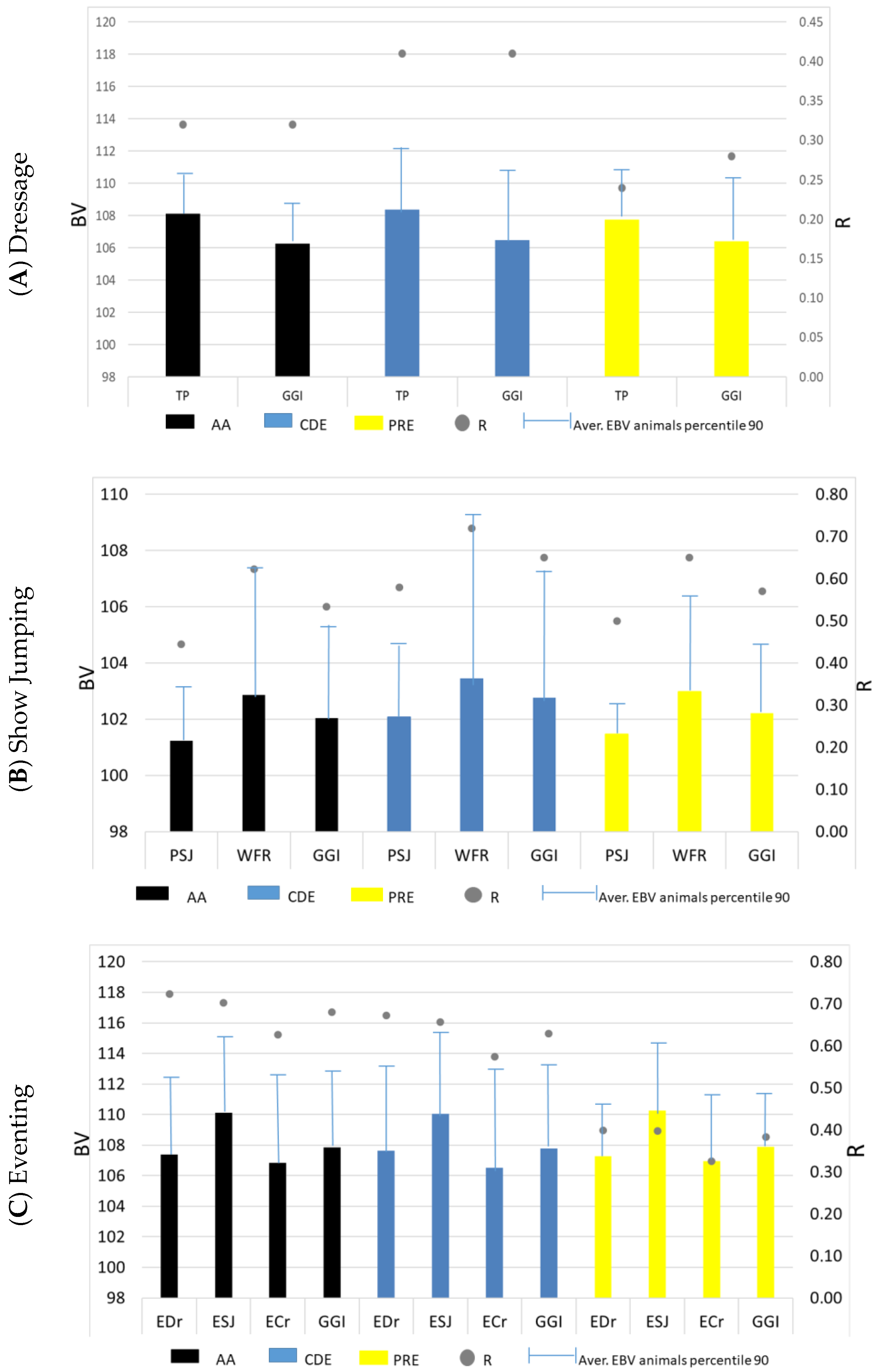
The comparison of genetic merit among the three populations genetically evaluated for each Olympic discipline in Spain (AA, CDE and PRE) is shown in
Figure 1. This figure displays the average EBVs and accuracies (R) by discipline and breed, as well as the average EBV of animals within the top 10% percentile.
For Classic Dressage, only the total points/reprise (TP) and the Genetic Global Index (GGI) are represented (
Figure 1A), which summarize overall performance ability. The average values for TP and GGI were consistently above 100, which corresponds to the mean of the evaluated population. When the GGI is considered, very similar results were observed for the different analyzed populations, with values ranging between 106.28 for AA horses and 106.50 for CDE. TP showed the highest EBV in all the analyzed populations, ranging between 107.75 for PRE and 108.38 for CDE. The highest R values were obtained for the CDE population, and the lowest for the PRE.
In Show Jumping, all the estimated traits are represented: positive score of jumping (PSJ), weighted final ranking (WFR) and GGI (
Figure 1B). All populations showed EBVs equal to or higher than 100, the average of the population, for the three represented traits. Higher EBV and R values were observed in the CDE animals, followed by the PRE, with only minor differences compared to AA horses.
Finally, in
Figure 1C for the Eventing, all the analyzed traits are included: positive score of dressage (EDr), positive score of jumping (ESJ), positive score of cross-country (ECr) and GGI. All populations showed EBVs equal to or higher than the population mean of 100 in all traits. The average GGI value is similar for all the represented populations (107.86 for AA horses, 107.80 for CDE and 107.89 for PRE horses). Overall, all populations showed their highest EBVs in the jumping-related traits, while the lowest EBVs were consistently observed for the cross-country trait. The highest R values were obtained for the AA animals, followed by the CDE, whereas PRE horses showed the lowest accuracies.
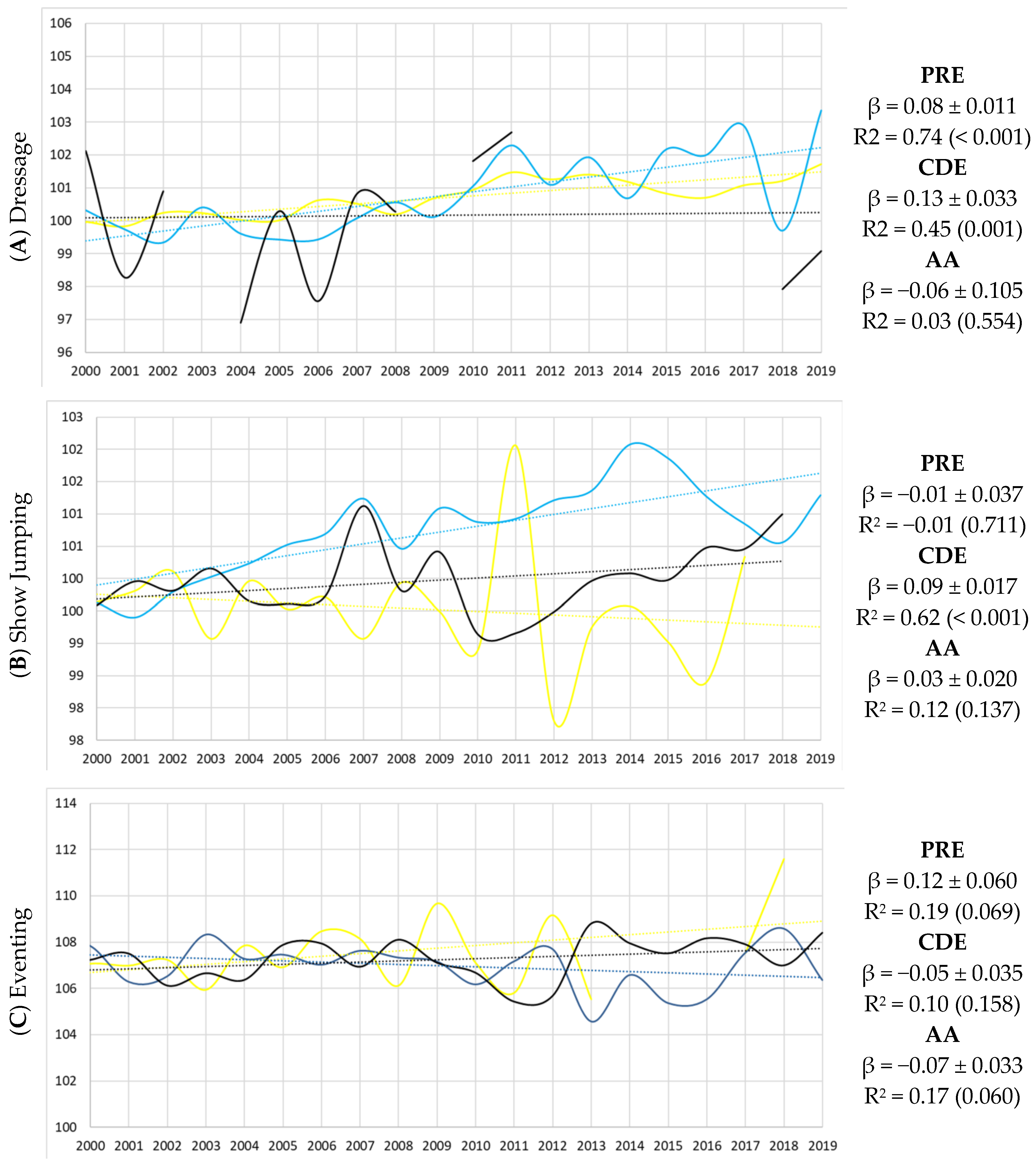
The genetic progress of the three main breeds that incorporate the Olympic disciplines into their official Breeding Programs was assessed by examining the temporal trend of the GGI values by year of birth of the animals included in the analysis. The graphical representation and the results of the linear regression analyses are shown in
Figure 2.
For Dressage, the temporal evolution of the GGI indicates a slight, but significant, upward trend in PRE (β = 0.08 ± 0.011) and CDE (β = 0.13 ± 0.033). A modest decreasing tendency was observed in AA. However, the interpretation for AA should be made cautiously due to the limited number of animals contributing to the Dressage evaluation for this breed, as evidenced by their discontinuous curve and the lack of statistical significance.
The temporal evolution of the GGI for Show Jumping indicates a pronounced and significant upward trend in CDE (β = 0.09 ± 0.017), whereas no significant trends were observed in PRE and AA. This pattern is consistent with the breeding orientation of the CDE population, primarily selected for Show Jumping performance. In contrast, the evolution of GGI for Eventing is less marked, with a slight increase observed in PRE (β = 0.11 ± 0.060) and overall stability in AA (β = −0.07 ± 0.033), both with marginal significance.
Table 4 summarizes the mean EBV, the EBV of the top 10% of animals and the accuracy values for the main traits evaluated in Dressage, Show Jumping and Eventing for PRE, CDE and AA populations. In Dressage, the three populations showed similar EBV levels for both TP and GGI, whereas CDE and PRE maintained competitive figures within the top-ranked group, as evidenced by the average EBV for top 10% animals in comparison with AA horses. In Show Jumping, CDE obtained the highest EBVs across PSJ, WFR and GGI, reflecting a stronger specialization for this discipline compared to PRE and AA, both in the complete and the top 10% populations. In Eventing, CDE and AA again showed superior EBV levels for EDr and GGI, while similar values were shown for ESJ and ECr. PRE displayed lower averages but clear improvement within the top 10% of animals in the four analyzed traits.
Overall, the results indicate marked differences in genetic merit among breeds, with CDE showing the highest EBVs in Show Jumping and Eventing, AA showing consistent competitiveness across disciplines, and PRE presenting more moderate but still positive values, particularly among its top 10% ranking individuals.
In
Table 5, as an indicator of the selection intensity, the average number of offspring per stallion or mare according to their GGI value and the age class of the breeding stock was considered to evaluate potential variations in the number of registered offspring in relation to the GGI value of the parents.
In general, younger animals considered young horses in the official competitions (≤7 years) show a lower number of registered offspring compared to older stallions and broodmares, with this trend being more pronounced in mares. Although there are some PRE stallions with registered offspring in this age group for Dressage, with an average between 1.15 and 1.62 registered descendants, the highest number of registered offspring is observed in animals (stallions and mares) included in the top 10% by GGI value and older than twelve years. However, the selection criteria for breeding stock appear unclear, as the animals with the highest number of registered offspring do not always coincide with those included within the top 10% of GGI across all Olympic disciplines and sexes.
4. Discussion
Many horse breeding organizations aim at improving the genetic ability of riding horses for performance in sport competitions, mainly in Dressage, Show Jumping and Eventing, the Olympic equestrian disciplines [
1]. Within this context, national genetic evaluation systems play a key role in translating performance records into effective selection decisions.
The inclusion of molecular data (SNPs) could improve the accuracy of the genetic evaluations. However, genomic information is not available for all animals included in performance recording over the last 20 years, as it has not yet been implemented across all equine populations bred in Spain, and the pedigree-based BLUP methodology is the official system used for routine genetic evaluation. Therefore, it remains the only methodology currently available for conducting a longitudinal analysis of genetic merit and genetic progress in Spanish horse populations. Although future research within the Spanish national breeding framework could incorporate genomic evaluation (e.g., ssGBLUP), as well as functional longevity and structural conformation traits (including axial and appendicular musculoskeletal soundness), these components are not yet implemented uniformly at the national level and were therefore outside the scope of this study.
As shown in
Table 1, Olympic equestrian disciplines in Spain involve a substantial number of participating horses and events held throughout the year. Among these disciplines, Show Jumping is the most represented, with the highest number of events, participations, participating horses, and average number of participations per event. In contrast, Eventing competitions exhibit the lowest overall figures. These differences reflect the relative structural weight of each discipline within the national performance recording system.
This may be attributed to the complexity and heterogeneity of this sport, which requires different physical and mental aptitudes [
14,
15], the important organizational requirements of the events, and the advanced performance levels demanded from horses and riders in the three distinct phases of the discipline, which carry the greatest risks of injury and fatality for both horses and riders [
16]. This competitive structure has direct implications for genetic evaluation, as disciplines with higher participation density generate more robust EBV estimates, while disciplines such as Eventing remain constrained by limited data availability and greater environmental heterogeneity.
National genetic evaluation systems vary significantly across countries due to diverse breeding objectives and testing schemes [
1]. Current genetic evaluations in European countries rely on performance data from Olympic disciplines. Belgium and France use competition results; Denmark and Sweden rely on performance test results; while Germany and the Netherlands combine both competition and test results [
17]. According to Ricard et al. [
7], genetic progress in sport horse breeding can be accelerated when selection is based on multi-trait genetic evaluations of stallions and mares, conducted through sequential steps that integrate information from both stallion and mare tests, as well as competition data. The Spanish evaluation framework analyzed in this study follows this integrated approach, combining information from both competition and young horse performance tests.
The main breeding objective for sport horses is the talent and motivation required to achieve high performance levels and to compete successfully at that level. Therefore, competition scores for mares and stallions, as well as results from young horse competitions, must be included in routine genetic evaluations as indicator traits and early selection criteria [
18]. In this context, the official equine Breeding Programs in Spain also incorporate Olympic equestrian disciplines as breeding objectives, with sufficient heritability levels (
Table 2) to allow selection, taking into account both competition results and young horse competitions outcomes. In addition, other breeding objectives, such as functional conformation, behavior and/or endurance, are also included in the official Breeding Programs (
Table 3) of the different riding breeds. However, the relative weight given to sport performance traits differs substantially among populations, which may influence both the intensity and effectiveness of genetic selection for Olympic disciplines.
It is remarkable that, in Spain, a unique genetic evaluation by discipline is conducted annually, encompassing all animals under performance control from different populations with an official studbook registered in the country. This procedure, which includes breed as a fixed effect and improves the genetic connectedness between the different populations, allows for the direct comparison of the various horse populations competing in Olympic disciplines based on their EBVs (additive component) under a genetic common base. This unified evaluation framework represents a distinctive feature of the Spanish breeding system, as it enables direct and objective genetic comparisons across breeds under a common methodological structure. It should be emphasized that EBV reflects the additive genetic component of performance. Although crossbred populations, such as CDE, may benefit phenotypically from heterosis effects, these correspond to non-additive genetic components (e.g., dominance or epistasis) that are not transmitted as breeding values and are therefore not captured as additive genetic merit in the BLUP animal model. Consequently, the genetic trends discussed in this study represent changes in additive genetic merit rather than heterotic effects. Notably, a high percentage of CDE horses have available EBVs for Dressage (25.27% of the official census) and Show Jumping (20.19%). Additionally, a significant proportion of PSI horses have been evaluated for Show Jumping ability (21.59%) and Eventing (20.04%), similar to the situation reported in other European populations [
19]. Furthermore, 20.77% of the PRE horses included in the official census have also been genetically evaluated in 2024 for Dressage ability. These rates of genetic evaluation coverage are noteworthy and reflect the considerable sportive use of the different populations bred in Spain, the increasing interest of the sector in sport abilities, and the availability of objective and official genetic information for use in future mating design within the official Breeding Program.
To analyze genetic progress and selection intensity, only the three populations with official Breeding Programs that include Olympic disciplines were considered, as genetic efforts in these breeds are specifically focused on enhancing performance in these areas, unlike the remaining riding breeds in Spain.
The impact of breed on genetic evaluation has been widely discussed in the literature. Several authors have highlighted the influence of breed on performance data [
12,
20,
21,
22]. Ricard and Touvais [
23] suggested that differences among breeds may reflect underlying genetic factors associated with variations in metabolic conditions [
24,
25,
26], muscle morphology [
27,
28,
29] and locomotion characteristics [
30,
31]. In this sense, Stewart et al. [
12] recommended including the breed effect in the genetic evaluations to obtain more accurate estimates by accounting for the variance associated with breed differences. However, Doyle et al. [
6] confirmed the limited number of studbooks which consider the effect of breed in their genetic models. In contrast, other studies did not detect a significant breed effect on Eventing [
32] or Show Jumping performance [
19]. These authors concluded that there were no significant differences between the major warmblood sport breeds produced in Europe for jumping ability. In Spain, however, the breed effect was detected as significant. Therefore, breed is included in the genetic evaluation of Olympic Disciplines (
Table 2), allowing the separation of true genetic differences from population structure effects within the national evaluation system.
This study provides a unique opportunity to compare multiple equine populations under a unified national evaluation framework, because Spain implements a single genetic evaluation per discipline that integrates performance test and competition data across breeds. This shared structure may increase connectedness, enabling direct comparison of EBVs between populations, and offering valuable insight into how breed composition and Breeding Program decisions shape genetic trends under a common selection scheme.
The differences in breed participation levels across the various disciplines in Spain are evident. In Dressage, the PRE is the breed with the highest number of participations and participating horses, followed by the FWH. In Eventing, another breed with an official Spanish studbook, the AA, exhibits the highest number of participations and participating horses, followed by the FWH. In contrast, in Show Jumping competitions, the majority of registered participations and participating horses belong to the FWH, followed by CDE, both composite populations with diverse genetic backgrounds. The relatively high participation of FWH in Eventing may contribute to differences in population structure within this discipline and should therefore be considered when interpreting the genetic trends observed.
Differences in average phenotypic values are also observed across breeds (
Supplementary Table S1). PRA shows the lowest scores in both Dressage and Show Jumping, similar to PSI. In these two disciplines, CDE and FWH stand out for their higher average scores. In Eventing, no breed performs consistently well across all three exercises. This pattern may be associated with the higher proportion of FWH participating in this Olympic discipline, which may enhance genetic connectedness across events but could also influence the stability of the estimated genetic trends. The highest average scores in Dressage phase are observed in FWH (although this breed shows the lowest scores in Cross-country phase), while CDE performs best in Show Jumping phase and AA in Cross-country phase. These phenotypic differences are consistent with the genetic patterns observed in EBVs and help to contextualize breed-specific genetic merit within each discipline.
From a genetic point of view,
Figure 1 shows the graphical representation of the average EBV and accuracy (R) by discipline and breed, including only the three populations that feature these disciplines in their official Breeding Programs. In Dressage, the three populations analyzed exhibited broadly similar results for both the average EBV and R (
Figure 1A), with CDE showing the highest R values. This may be associated with the completeness of their pedigrees (including extensive international pedigree information from imported stallions and mares) and the levels of connectedness in their participations, due to the high number of participations per animal. As affirmed by Thorén-Hellsten et al. [
33], the accuracy of EBVs increases with greater connectedness among populations. In this discipline, CDE stands out due to both its composite genetic background and its high level of participations. PRE horses exhibited the highest levels of participation, although they did not achieve the highest EBV. This could be due to the positive effect of international breed promotion for sporting activities, developed by the Breeders’ Association, which increases the number of participating horses in official competitions, as well as a previously discussed breed-related differences in evaluation context [
12], which may influence performance controls and official competitions results.
For Show Jumping (
Figure 1B), CDE horses showed the highest levels of EBV and R compared to the other analyzed populations. This may be due to the composite nature of this population, as its official studbook allows the inclusion of breeding stock from other national and international breeds to improve sport performance ability [
34] and to achieve the desired characteristics in the offspring [
15]. Important selection has been made to improve Show Jumping performance in this breed with an international impact.
For Eventing (
Figure 1C), the three analyzed populations exhibited similarly moderate results for the average EBVs, with AA being the population with the highest R values. This could be attributed to the higher number of registered participations, participants and participation rate per animal, which enhances the connectedness between the performance controls for this population and discipline. Overall, these results may indicate that the unified evaluation system discriminates genetic merit more effectively through accuracy and extreme-ranking animals than through differences in mean EBVs between breeds, which is consistent with expectations in well-connected multi-breed populations.
Regarding sex distribution, most of the competing horses were males across the three Olympic disciplines analyzed. However, in Dressage, geldings outnumbered females in six of the nine breed groups considered in the study (PRA, PSI, HA, FWH, Pon and Oth,
Table 1), mainly because of their easier management characteristics in this strict discipline, where temperament may condition performance. In Show Jumping, the number of female CDE horses exceeded that of males and geldings, which may be explained by the high availability of mares on the market for this emerging breed in Spain as evidenced by the official census. Finally, in Eventing, females outnumbered males in five of the nine breed groups (HA, AA, FWH, Pon, and Oth), likely due to management and availability reasons in this complex discipline.
As affirmed by Viklund et al. [
35], a well-functioning Breeding Program is essential to achieve defined breeding objectives, and an efficient program can only be established if past and present population conditions and trends are well characterized. In the graphical representation of the genetic progress for the three main populations selected by Olympic disciplines in Spain (
Figure 2), a clear positive and significant genetic trend was observed for CDE in Dressage and Show Jumping. These results suggest an increasing specialization of the CDE populations through the selection of specific ancestors from other populations according to their EBVs and performance data, mainly in these disciplines, as evidenced by Bartolomé et al. [
36]. These authors reported that, in general, EBVs of CDE offspring were higher than the EBVs of their parents, consistent with the positive trend observed in the present study.
The PRE population shows a clear positive and significant genetic tendency in Dressage. Due to its natural collection, balance and responsiveness, which suit the discipline’s precision and controlled movements, PRE horses are mainly used for Dressage competitions (
Table 1). However, its conformation, characterized by a compact body [
37] and limited stride length [
38,
39], tends to reduce scope and power, making the breed less competitive in other disciplines. The more limited response observed in Eventing is consistent with lower participation rates and greater environmental heterogeneity, which may constrain both EBV accuracy and the expected response to selection in this discipline. In this sense, both PRE and AA horses populations have shown a slight increasing trend in Eventing, with marginal significance.
Differences in genetic trends among populations therefore may reflect variation in selection intensity, generational interval and the timing of reproductive use of elite animals, rather than genetic potential alone.
Some caution is warranted when interpreting genetic trends, particularly in Eventing, where the number of observations and the unequal representation of breeds may limit the precision of the estimates. Differences in connectedness between disciplines and across years may also influence the accuracy of EBVs. Nevertheless, the consistency of results across multiple indicators (EBVs, R values and phenotypic patterns) may reinforce the robustness of the conclusions.
Reproductive technologies such as artificial insemination and embryo transfer have facilitated the dissemination of elite sport-horse genetics across countries and breeds, overcoming geographical barriers [
6]. However, closed populations such as PRE and PSI remain restricted to their own genetic resources within their respective official studbooks. This limited genetic base may slow performance improvement, but enhances the genetic and economic value of purebred populations, as a genetic reservoir, providing an important potential source of genetic improvement in performance [
40] and adaptability to environmental changes, and management systems.
The average EBVs and their accuracies (R) by discipline were compared among the three selected populations in order to assess genetic differences. This comparison is feasible due to the joint genetic evaluation applied across all Spanish sport horse populations. As shown in
Table 4, for Dressage, the three populations exhibited similar results for TP and GGI, with CDE performing slightly better in both the complete and top 10% populations. These findings are consistent with the observed phenotypic trends. CDE also showed the highest average R values, likely attributable to a higher mean number of participations per horse, which may improve connectedness among performance records (
Table 1). Together with the positive EBV trends observed for both CDE and PRE (
Figure 2A), these results may support the effectiveness of the breeding programs implemented in these populations for improving Dressage ability. In contrast, AA did not stand out in terms of either EBVs or R, presenting the lowest EBVs in the top 10% population and no significant positive EBV trend (
Figure 2A) which may suggest a limited response to selection for this discipline.
Part of the variability observed between breeds can also be attributed to differences in population structure and historical selection pressures. Closed populations, such as PRE, tend to display higher within-breed connectedness and more homogeneous pedigrees, which may enhance the stability of EBV estimation but may limit the introduction of novel alleles affecting performance. In contrast, composite or recently formed populations, such as CDE, benefit from broader genetic variability and introgression from performance-oriented lines, which may accelerate genetic progress but may also generate greater heterogeneity in response to selection. These structural differences may influence both the statistical properties of EBVs and the expected genetic gain across disciplines.
In Show Jumping (
Table 4), CDE showed the highest EBV and R values, as expected given their strong phenotypic performance (
Supplementary Table S1) and the highest number of participating horses and participations recorded for this discipline (
Table 1). The pronounced positive and significant EBV trend for CDE in Show Jumping (
Figure 2B) may further indicate substantial recent genetic progress, reflecting effective breeding decisions and selection policies within this studbook.
Finally, for Eventing (
Table 4), CDE and AA exhibited similar results for both EBVs and R, whereas PRE showed the lowest values. The EBV trends were slightly positive for PRE and AA (
Figure 2C) with marginal significance, while CDE displayed a non-significant result. These patterns highlight the need to strengthen selection strategies for Eventing in Spain, particularly in the CDE population, where recent genetic progress appears to be stagnating.
It is also important to consider that genetic trends may be influenced not only by selection decisions but also by demographic dynamics, including the number of active sires and mares, replacement rates and the degree of generational overlap within each studbook. Breeds with a broader and continuously refreshed sire base, such as CDE, may tend to show faster short-term genetic progress, whereas breeds with more conservative replacement patterns, such as PRE and AA, often may show slower but more stable trajectories. In addition, fluctuations in the availability of high-performing animals for breeding, driven by market preferences or the competitive career length of elite horses, can temporarily accelerate or decelerate genetic gain. These demographic and management factors must therefore be considered when interpreting the observed genetic trends and when designing strategies to optimize long-term selection response. These structural and demographic factors are expected to directly influence breeders’ mating decisions and the realized selection intensity, as explored through the analysis of reproductive patterns in
Table 5.
To evaluate the effectiveness of the official Breeding Programs, we examined breeders’ mating decisions by analyzing the average number of offspring per stallion or mare according to their genetic merit class and the age class (
Table 5). As expected, younger animals (group ≤7, considered young horses in sport competitions) show a lower number of registered offspring in comparison to older stallions and mares, with this trend being more pronounced in mares. This can be explained by the general sportive use of most of the younger animals, for performance testing, before their reproductive use in all breeds and disciplines. Only some PRE stallions registered offspring in the younger age group for Dressage. Whereas results for mares are 0 or close to 0 for all the analyzed disciplines, because their reproductive use produces their unavailability for competitions by pregnancy.
Nonetheless, reproductive patterns may also be shaped by management priorities, market demand and the economic value assigned to particular bloodlines within populations. These factors frequently lead breeders to favor animals with proven sport performance or desirable pedigrees, even when their genetic merit is not among the highest within their cohort. Consequently, the expected genetic gain may be attenuated if the most genetically superior animals are underused early in life or if selection decisions rely more heavily on reputation, phenotype or rider preference than on EBVs in the official Breeding Programs.
The highest number of registered offspring corresponds to stallions included in the top 10% by GGI value and older than twelve years. The genetic selection criteria are clearest in stallions for all the disciplines, except CDE for Dressage and AA for Show Jumping and Eventing. For the mares, also, animals with GGI > 100 and older than twelve years showed the highest number of registered offspring, except for CDE in Dressage and Eventing and AA for Eventing.
However, the relationship between genetic merit and reproductive contribution was not fully linear across breeds or disciplines. In several cases, individuals belonging to intermediate GGI classes contributed disproportionately more offspring than top 10% ranked animals, suggesting that selection decisions may not always reflect the genetic hierarchy expected under an optimal breeding strategy. This pattern indicates that breeder choice may still be influenced by subjective preferences, historical lineages or short-term sport performance, rather than by systematic use of EBVs as primary selection criteria within the official Breeding Programs.
These values demonstrate the optimal application of selection criteria both in stallions and broodmares of PRE, with a preferential use of breeding stock with GGI >100 or higher for all the Olympic Disciplines. Whereas the selection criteria applied in CDE are suboptimal in Dressage for both sexes and broodmares in Eventing. The criteria for mating design applied to the AA population in Spain may also be less aligned with genetic merit for stallions used in Show Jumping, and both stallions and broodmares in Eventing. This information is of vital importance for the Breeders Associations which have to reconsider their selective strategy within the official Breeding Program of these breeds. More training courses for breeders and greater dissemination of Breeding Stock Catalogs with genetic information are needed to ensure the efficiency of the official Breeding Programs.
These findings emphasize that the effectiveness of a Breeding Program does not rely solely on the accuracy of genetic evaluations, but also on the degree to which breeders implement selection decisions based on genetic merit. Even when EBVs provide clear differentiation between animals, inconsistent mating choices may markedly reduce the realized genetic gain in the populations. Strengthening breeder engagement with genetic information and improving the practical use of EBVs are therefore essential steps to ensure that the genetic potential estimated by the evaluation system is effectively translated into population-level progress. Overall, this study demonstrates that a unified multi-breed genetic evaluation framework may support measurable genetic progress, but its long-term effectiveness ultimately depends on the alignment between estimated genetic merit and actual breeding decisions.




 ,
,