Article

Acute and Long-Term Physiological and Hematological Responses in Well-Trained Young Swimmers Throughout a Training Season
by
Dimitra Nafpaktitou
1,
Anastassios Philippou
2,*,
Nikos Vagiakakos
3,
George Vagiakakos
4,
Alexandros Nikolopoulos
1,5,
Markos Mantaloufas
1,
George Chrousos
6,7,
Michael Koutsilieris
2 and
Theodoros Platanou
1
1
School of Physical Education and Sport Science, National and Kapodistrian University of Athens, 17237 Athens, Greece
2
Department of Physiology, Medical School, National and Kapodistrian University of Athens, 11527 Athens, Greece
3
Department of Physics, National and Kapodistrian University of Athens, 15784 Athens, Greece
4
School of Civil Engineering, National Technical University of Athens, 10682 Athens, Greece
5
Hellenic Swimming Federation, 17672 Athens, Greece
6
University Research Institute of Maternal and Child Health & Precision Medicine, Medical School, National and Kapodistrian University of Athens, 11527 Athens, Greece
7
Clinical, Translational and Experimental Surgery Research Centre, Biomedical Research Foundation Academy of Athens, 11527 Athens, Greece
*
Author to whom correspondence should be addressed.
Life 2026, 16(3), 413; https://doi.org/10.3390/life16030413
Submission received: 31 December 2025 / Revised: 24 February 2026 / Accepted: 26 February 2026 / Published: 3 March 2026

Abstract

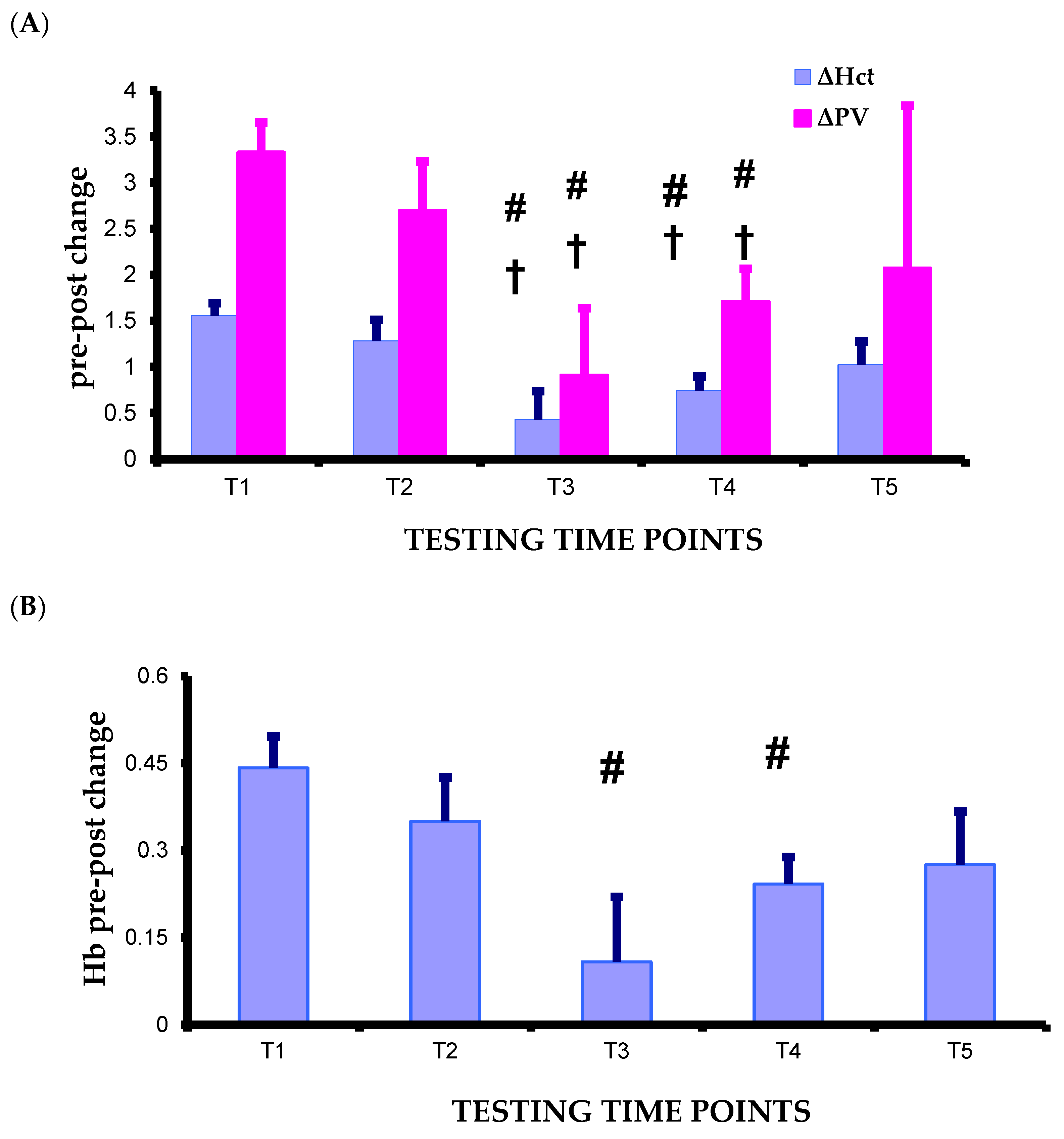
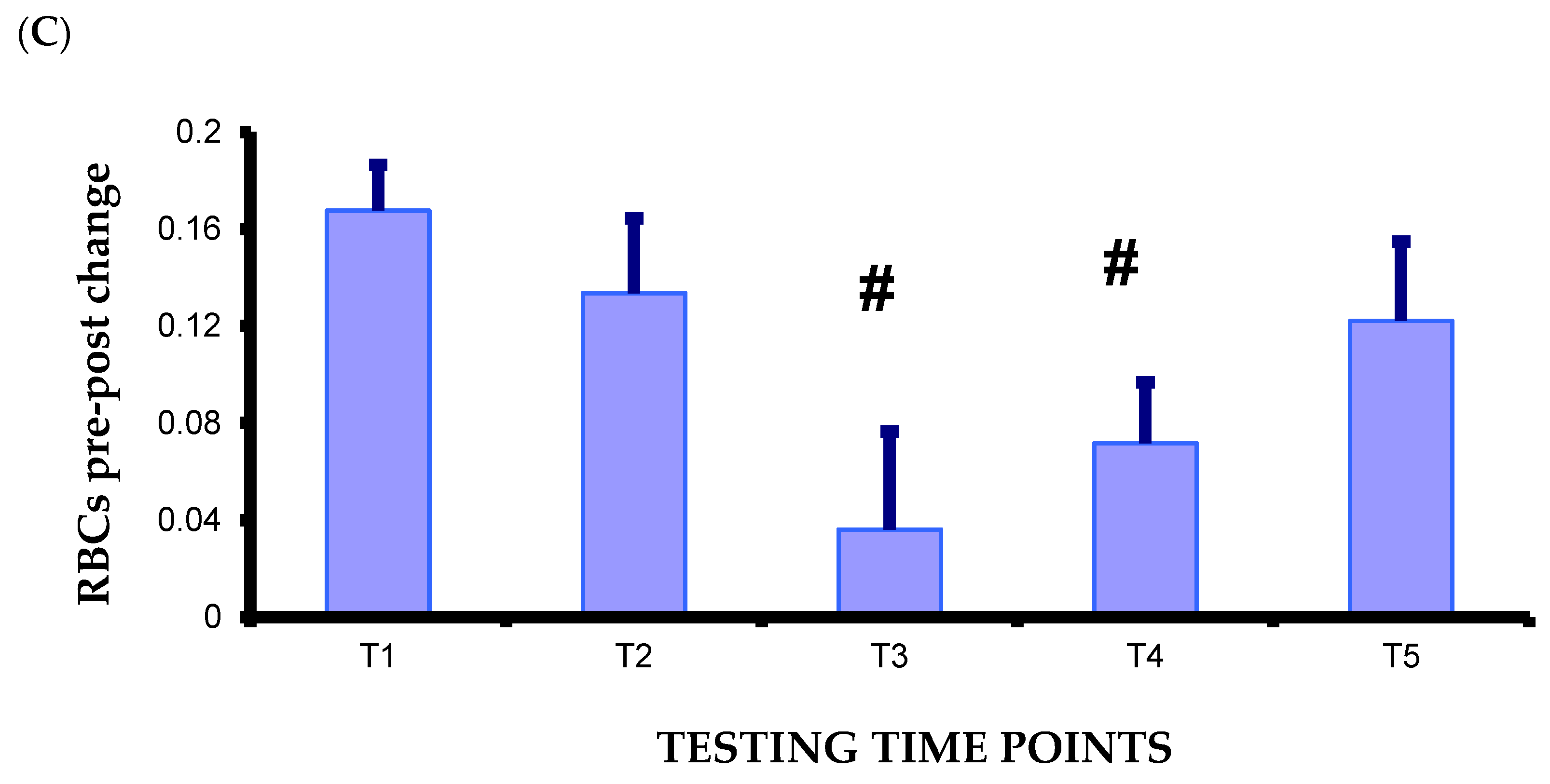
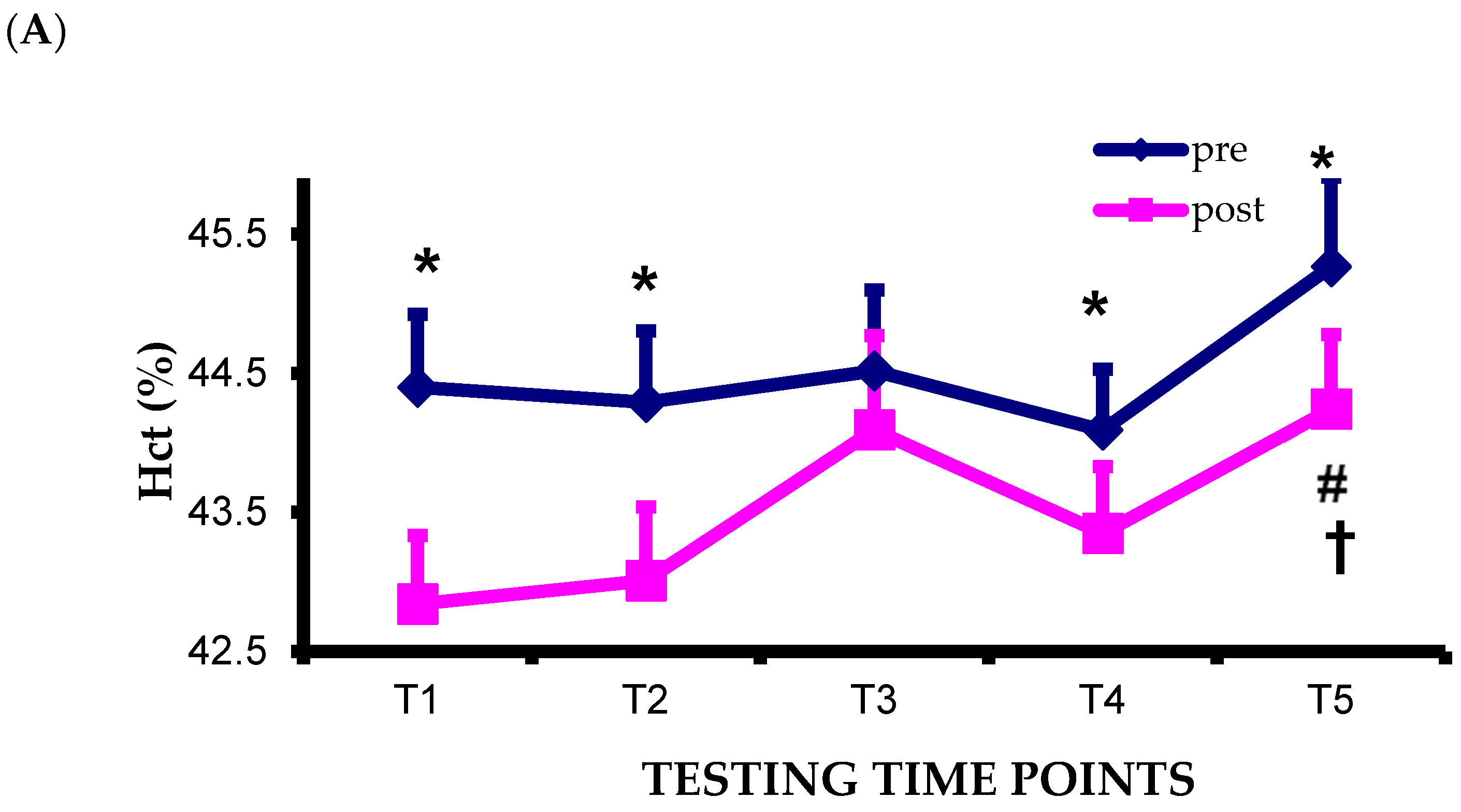
The physiological and hematological responses to exercise and the corresponding adaptations in high-level sports have become an important issue, from both the health and the physical performance points of view. This study investigated the fluctuations in physiological and hematological variables of young swimmers throughout a training season. Twelve well-trained male swimmers (age: 14 ± 0.3 y) participated in the study. Measurements were carried out at the beginning of the training season (T1) and pre and post the taper of each of the two competitive periods (i.e., T2, T3 for the first training macrocycle, and T4, T5 for the second macrocycle, respectively). At each of the above time points, maximum oxygen uptake (VO2max) was estimated, and blood samples were collected before and 1 h post a maximal 400 m swimming testing to measure hemoglobin (Hb), hematocrit (Hct), mean corpuscular volume (MCV), mean cell hemoglobin (MCH), mean cell hemoglobin corpuscular (MCHC), platelets (PLT), red blood cells (RBCs), and albumin (Alb). Adjustment for exercise-induced plasma volume changes was performed before all data analyses. Analysis of variance (ANOVA) with repeated measures followed by Bonferroni post hoc analyses was used for statistics. Multiple correlations with Bonferroni correction were also performed. Significant improvement of performance from T1 to the end of the study was recorded. Moreover, significant changes in lactate concentration ([La]) with significant decrease at T3 and increase at T4 were also observed. Significant interaction (pre–post-test × test condition) for Hct, Hb, MCV, MCH, and RBCs; the main effect of test condition for Hct, MCV, MCHC, PLT, and Alb; and pre–post-test for Hct, Hb, MCV, MCHC, and RBCs were observed. No significant changes for VO2max and HR were recorded (p > 0.05). Significant correlations between MCV and MCH at T1, T2, T4, and Hct and Hb at T1, T4, T5 were found. These results indicate that swimming training throughout a season induces both acute and long-term effects on the physiological and hematological profile of young swimmers. These findings provide fundamental information about the effects of the training volume and intensity on physical performance and might be utilized as a useful source for future studies to further characterize the systemic and performance signature of training-induced adaptations during a competitive season in swimmers.
Keywords: acute and chronic effects; exercise-induced adaptations; hematological parameters; physiological parameters; swimming training; young athletes acute and chronic effects; exercise-induced adaptations; hematological parameters; physiological parameters; swimming training; young athletes