Concurrent HIIT and Resistance Training for Musculoskeletal Function: A Systematic Review of Neuromuscular, Morphological, and Performance Adaptations

Abstract
1. Introduction
1.1. Musculoskeletal Function and Integrative Assessment
1.2. HIIT, Resistance Training, and Neuromuscular Adaptations
1.3. Rationale for a Systematic Review on Concurrent HIIT and Resistance Training
1.4. Objectives
2. Methods
2.1. Protocol and Reporting
2.2. Data Sources and Search Strategy
2.3. Eligibility Criteria (PICO Framework)
2.4. Study Selection
2.5. Data Extraction
2.6. Data Synthesis
2.7. Risk of Bias Assessment
3. Results
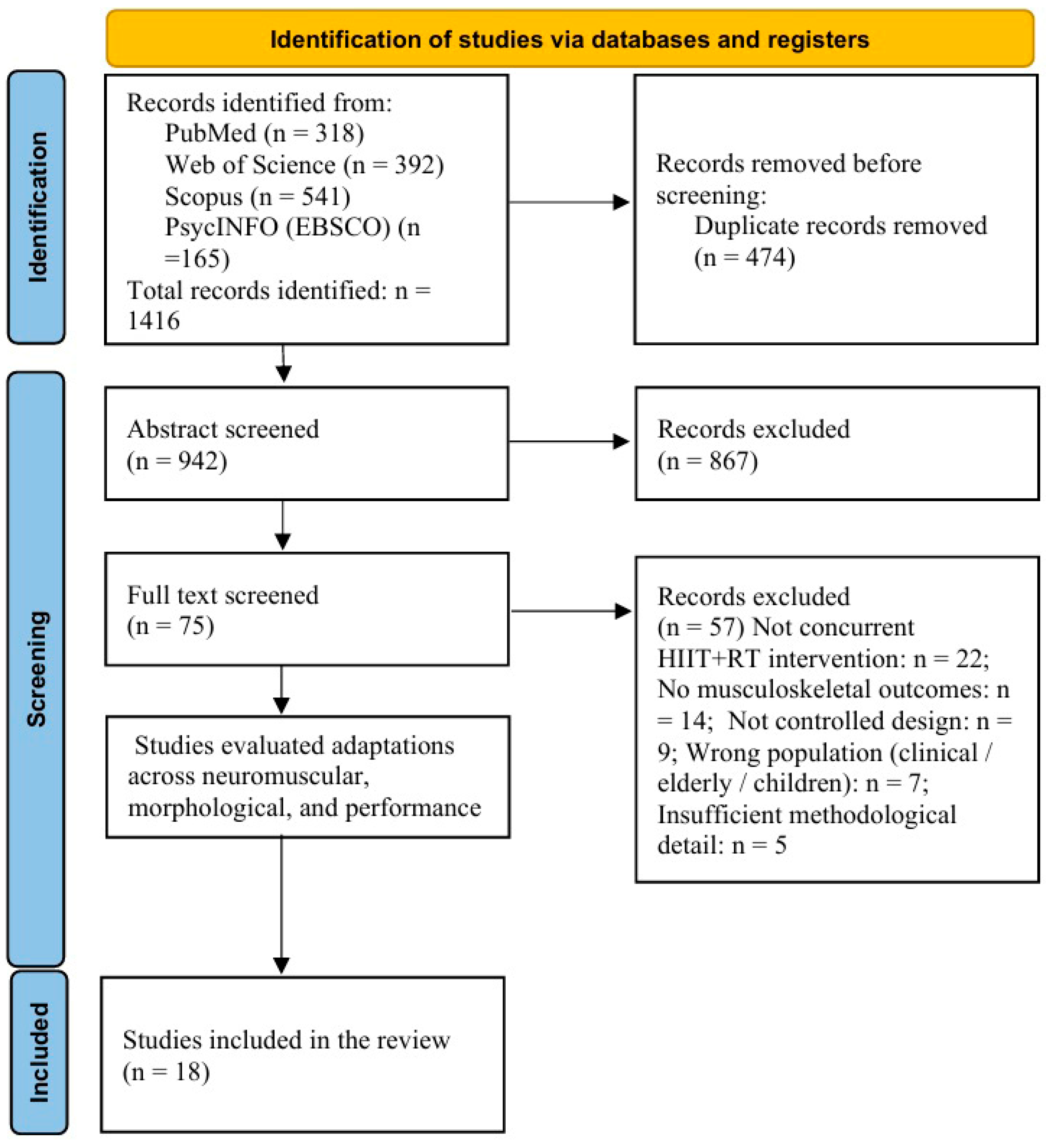
3.1. Included Studies
3.2. Overview of Included Studies
3.3. Effects on Maximal Strength
3.4. Effects on Power and Explosive Performance
3.5. Effects on Neuromuscular Activity (EMG)
3.6. Effects on Muscle Morphology and Architecture
3.7. Effects on Tendon Properties
3.8. Adherence and Adverse Events
3.9. Summary of Main Findings from the Included Evidence
4. Discussion
4.1. Strength Adaptations
4.2. Power and Explosive Performance Adaptations
4.3. Neuromuscular Activity (EMG) Adaptations
4.4. Muscle Morphology and Architecture Adaptations
4.5. Tendon Adaptations
4.6. Interference Considerations
4.7. Integrated Interpretation of Musculoskeletal Adaptations
4.8. Limitations
5. Practical Implications
6. Conclusions
Supplementary Materials
Author Contributions
Funding
Institutional Review Board Statement
Informed Consent Statement
Data Availability Statement
Acknowledgments
Conflicts of Interest
Abbreviations
| 1RM | One repetition maximum |
| CMJ | Countermovement jump |
| CON | Control group (strength-only or comparison condition) |
| CSA | Cross-sectional area |
| DXA | Dual-energy X-ray absorptiometry |
| EMG | Electromyography |
| FL | Fascicle length |
| HIIT | High-intensity interval training |
| HRmax | Maximal heart rate |
| INT | Short-interval training (interval training condition) |
| MVC | Maximal voluntary contraction |
| PA | Pennation angle |
| PICO | Population, Intervention, Comparison, Outcome |
| PRISMA | Preferred Reporting Items for Systematic Reviews and Meta-Analyses |
| RFD | Rate of force development |
| RSA | Repeated-sprint ability |
| RT | Resistance training |
| SIT | Sprint-interval training |
| V̇O2max | Maximal oxygen uptake |
| V̇O2peak | Peak oxygen uptake |
References
- Weinberger, M.; Dostrovsky, J.O. Motor Unit Synchronization. In Encyclopedia of Movement Disorders; Academic Press: New York, NY, USA, 2010; pp. 206–209. [Google Scholar] [CrossRef]
- Harano, K. Neuromechanics of the Rate of Force Development. Exerc. Sport Sci. Rev. 2022, 51, 34–42. [Google Scholar] [CrossRef]
- Wakeling, J.M.; Lee, S.S.M.; Arnold, A.S.; de Brito Miara, M.; Biewener, A.A. A Muscle’s Force Depends on the Recruitment Patterns of Its Fibers. Ann. Biomed. Eng. 2012, 40, 1708–1720. [Google Scholar] [CrossRef] [PubMed]
- Khare, S.P.; Reddy, T.O.; Kumar, A.; Sisodia, A. Muscle Architecture and Sports Performance. J. Sports Sci. Nutr. 2023, 4, 254–257. [Google Scholar] [CrossRef]
- Earp, J.E.; Kraemer, W.J.; Cormie, P.; Volek, J.S.; Maresh, C.M.; Joseph, M.; Newton, R.U. Influence of Muscle Tendon Unit Structure on Rate of Force Development during the Squat, Countermovement and Drop Jumps. J. Strength Cond. Res. 2011, 25, 340–347. [Google Scholar] [CrossRef] [PubMed]
- Morelli, K.M.; Garcia, J.D.; Brown, L.; Farthing, A.K.; Miller, J.L.; Warren, G.L. Clinical Measures Predicting Knee Extensor Muscle Activation during a Maximal Voluntary Isometric Contraction. J. Orthop. Sports Phys. Ther. Res. 2015, 2, 1–10. [Google Scholar] [CrossRef][Green Version]
- Disselhorst-Klug, C.; Williams, S. Surface Electromyography Meets Biomechanics, Correct Interpretation of sEMG Signals in Neuro Rehabilitation Needs Biomechanical Input. Front. Neurol. 2020, 11, 603550. [Google Scholar] [CrossRef]
- Rivares, C.; Weide, G.; Jaspers, R.T.; Sartori, M. Individual Calf Muscle Structure Function Adaptations to 12 Weeks of Eccentric Training Measured with 3D Ultrasonography and Dynamometry. bioRxiv 2025. [Google Scholar] [CrossRef]
- Mersmann, F.; Laube, G.; Bohm, S.; Arampatzis, A. Muscle and Tendon Morphology in Early Adolescent Athletes and Untrained Peers. Front. Physiol. 2020, 11, 1029. [Google Scholar] [CrossRef]
- Magalhães, R.A.; Hunger, M.S.; Martelli, A. Benefits Arising from the Practice of High Intensity Interval Training. Int. Sport Exerc. J. Health Vital. 2023, 2, 97–105. [Google Scholar] [CrossRef]
- Lee, K.H.; Lee, K.; Choi, Y.C. Very Short Term High Intensity Interval Training in High School Soccer Players. J. Mens Health 2020, 16, 1–8. [Google Scholar] [CrossRef]
- Pfingstgraf, I.O.; Ruta, V.M.; Negrean, V.; Handru, M.I.; Orășan, O.H.; Alexescu, T. High Intensity Interval Training, As Good in Athletes as in Subjects with Metabolic Syndrome? J. Mind Med. Sci. 2019, 6, 41–46. [Google Scholar] [CrossRef]
- Song, Z.; Moore, D.R.; Hodson, N.; Ward, C.; Dent, J.R.; O’Leary, M.F.; Shaw, A.; Hamilton, D.L.; Sarkar, S.; Gangloff, Y.G.; et al. Resistance Exercise Initiates Mechanistic Target of Rapamycin (mTOR) Translocation and Protein Complex Co localisation in Human Skeletal Muscle. Sci. Rep. 2017, 7, 5028. [Google Scholar] [CrossRef] [PubMed]
- Lim, C.; Nunes, E.A.; Currier, B.S.; McLeod, J.C.; Thomas, A.C.Q.; Phillips, S.M. An Evidence-Based Narrative Review of Mechanisms of Resistance Exercise–Induced Human Skeletal Muscle Hypertrophy. Med. Sci. Sports Exerc. 2022, 54, 1546–1559. [Google Scholar] [CrossRef]
- Kumar, N.T.A.; Oliver, J.L.; Lloyd, R.S.; Pedley, J.S.; Radnor, J.M. The Influence of Growth, Maturation and Resistance Training on Muscle Tendon and Neuromuscular Adaptations, A Narrative Review. Sports 2021, 9, 59. [Google Scholar] [CrossRef]
- Mangine, G.T.; Hoffman, J.R.; Fukuda, D.H.; Stout, J.R.; Ratamess, N.A. Improving Muscle Strength and Size, The Importance of Training Volume, Intensity and Status. Kinesiology 2015, 47, 131–138. [Google Scholar]
- Hung, C.H.; Su, C.H.; Wang, D. The Role of High Intensity Interval Training (HIIT) in Neuromuscular Adaptations, Implications for Strength and Power Development, A Review. Life 2025, 15, 657. [Google Scholar] [CrossRef]
- Shirai, T.; Hanakita, H.; Uemichi, K.; Takemasa, T. Effect of the Order of Concurrent Training Combined with Resistance and High Intensity Interval Exercise on mTOR Signaling and Glycolytic Metabolism in Mouse Skeletal Muscle. Physiol. Rep. 2021, 9, e14770. [Google Scholar] [CrossRef]
- Williams, J. Concurrent Strength and Endurance Training. J. Phys. Fitness Med. Treat. Sports 2017, 1, 555563. [Google Scholar] [CrossRef]
- Eddens, L.; van Someren, K.A.; Howatson, G.; Howatson, G. The Role of Intra-Session Exercise Sequence in the Interference Effect: A Systematic Review with Meta-Analysis. Sports Med. 2018, 48, 177–188. [Google Scholar] [CrossRef]
- Page, M.J.; McKenzie, J.E.; Bossuyt, P.M.; Boutron, I.; Hoffmann, T.C.; Mulrow, C.D.; Shamseer, L.; Tetzlaff, J.M.; Akl, E.A.; Brennan, S.E.; et al. The PRISMA 2020 statement: An updated guideline for reporting systematic reviews. BMJ 2021, 372, n71. [Google Scholar] [CrossRef] [PubMed]
- Rethlefsen, M.L.; Kirtley, S.; Waffenschmidt, S.; Ayala, A.P.; Moher, D.; Page, M.J.; Koffel, J.B.; PRISMA S Group. PRISMA S, An Extension to the PRISMA Statement for Reporting Literature Searches in Systematic Reviews. Syst. Rev. 2021, 109, 174–200. [Google Scholar] [CrossRef]
- García Pinillos, F.; Laredo Aguilera, J.A.; Muñoz Jiménez, M.; Latorre Román, P.A. Effects of a 12 Week Concurrent High Intensity Interval Strength and Endurance Training Program on Physical Performance in Healthy Older People. J. Strength Cond. Res. 2019, 33, 1445–1452. [Google Scholar] [CrossRef]
- Wadsworth, D.D.; Rodriguez Hernandez, M.; Huffman, L.S.; McDonald, J.R.; Spring, K.E.; Pascoe, D.D. Adaptations to a Concurrent Exercise Training Program in Inactive Aging Women. J. Strength Cond. Res. 2022, 36, 3217–3223. [Google Scholar] [CrossRef]
- Panissa, V.L.G.; Fukuda, D.H.; de Oliveira, F.P.; Parmezzani, S.S.; Campos, E.Z.; Rossi, F.E.; Franchini, E.; Lira, F.S. Maximum Strength Development and Volume Load during Concurrent High Intensity Intermittent Training Plus Strength or Strength Only Training. J. Sports Sci. Med. 2018, 17, 623–632. [Google Scholar] [PubMed]
- Benítez Flores, S.; Medeiros, A.R.; Voltarelli, F.A.; Iglesias Soler, E.; Doma, K.; Simões, H.G.; Rosa, T.S.; Boullosa, D.A. Combined Effects of Very Short All Out Efforts during Sprint and Resistance Training on Physical and Physiological Adaptations after 2 Weeks of Training. Eur. J. Appl. Physiol. 2019, 119, 1337–1351. [Google Scholar] [CrossRef]
- Pugh, J.K.; Faulkner, S.H.; Jackson, A.P.; King, J.A.; Nimmo, M.A. Acute Molecular Responses to Concurrent Resistance and High Intensity Interval Exercise in Untrained Skeletal Muscle. Physiol. Rep. 2015, 3, e12364. [Google Scholar] [CrossRef]
- Campos Vazquez, M.A.; Romero Boza, S.; Toscano Bendala, F.J.; Leon Prados, J.A.; Suarez Arrones, L.J.; Gonzalez Jurado, J.A. Comparison of the Effect of Repeated Sprint Training Combined with Two Different Methods of Strength Training on Young Soccer Players. J. Strength Cond. Res. 2015, 29, 744–751. [Google Scholar] [CrossRef]
- Botonis, P.G.; Toubekis, A.G.; Platanou, T.I. Concurrent Strength and Interval Endurance Training in Elite Water Polo Players. J. Strength Cond. Res. 2016, 30, 126–133. [Google Scholar] [CrossRef] [PubMed]
- Wong, P.L.; Chaouachi, A.; Chamari, K.; Dellal, A.; Wisloff, U. Effect of Preseason Concurrent Muscular Strength and High Intensity Interval Training in Professional Soccer Players. J. Strength Cond. Res. 2010, 24, 653–660. [Google Scholar] [CrossRef] [PubMed]
- Müller, D.C.; Boeno, F.P.; Izquierdo, M.; Aagaard, P.; Teodoro, J.L.; Grazioli, R.; Cunha, G.; Ferrari, R.; Saez de Asteasu, M.L.; Pinto, R.S.; et al. Effects of High Intensity Interval Training Combined with Traditional Strength or Power Training on Functionality and Physical Fitness in Healthy Older Men, A Randomized Controlled Trial. Exp. Gerontol. 2021, 149, 111321. [Google Scholar] [CrossRef]
- Vlietstra, L.; Waters, D.L.; Jones, L.M.; Wilson, L.; Meredith Jones, K. High Intensity Interval Aerobic and Resistance Training to Counteract Low Relative Lean Soft Tissue Mass in Middle Age, A Randomized Controlled Trial. Exp. Gerontol. 2023, 171, 111991. [Google Scholar] [CrossRef] [PubMed]
- Thomakos, P.; Spyrou, K.; Katsikas, C.; Geladas, N.D.; Bogdanis, G.C. Effects of Concurrent High Intensity and Strength Training on Muscle Power and Aerobic Performance in Young Soccer Players during the Pre Season. Sports 2023, 11, 59. [Google Scholar] [CrossRef] [PubMed]
- Thomakos, P.; Tsekos, P.; Tselios, Z.; Spyrou, K.; Katsikas, C.; Tsoukos, A.; Bogdanis, G.C. Effects of Two In Season Short High Intensity Interval Training Formats on Aerobic and Neuromuscular Performance in Young Soccer Players. J. Sports Sci. Med. 2024, 23, 812–821. [Google Scholar] [CrossRef] [PubMed]
- Robineau, J.; Lacome, M.; Piscione, J.; Bigard, X.; Babault, N. Concurrent Training in Rugby Sevens: Effects of High-Intensity Interval Exercises. Int. J. Sports Physiol. Perform. 2017, 12, 336–344. [Google Scholar] [CrossRef]
- Leuchtmann, A.B.; Mueller, S.M.; Aguayo, D.; Petersen, J.A.; Ligon-Auer, M.; Flück, M.; Jung, H.H.; Toigo, M. Resistance Training Preserves High Intensity Interval Training Induced Improvements in Skeletal Muscle Capillarization of Healthy Old Men, A Randomized Controlled Trial. Sci. Rep. 2020, 10, 6578. [Google Scholar] [CrossRef]
- Kazior, Z.; Willis, S.J.; Moberg, M.; Apró, W.; Calbet, J.A.; Holmberg, H.C.; Blomstrand, E. Endurance Exercise Enhances the Effect of Strength Training on Muscle Fiber Size and Protein Expression of Akt and mTOR. PLoS ONE 2016, 11, e0149082. [Google Scholar] [CrossRef]
- Spiliopoulou, P.; Zaras, N.; Methenitis, S.; Papadimas, G.; Papadopoulos, C.; Bogdanis, G.C.; Terzis, G. Effect of Concurrent Power Training and High Intensity Interval Cycling on Muscle Morphology and Performance. J. Strength Cond. Res. 2021, 35, 2464–2471. [Google Scholar] [CrossRef]
- Sterczala, A.J.; Krajewski, K.T.; Peterson, P.A.; Sekel, N.M.; Lovalekar, M.; Wardle, S.L.; O’Leary, T.J.; Greeves, J.P.; Flanagan, S.D.; Connaboy, C.; et al. Twelve weeks of concurrent resistance and interval training improves military occupational task performance in men and women. Eur. J. Sport Sci. 2023, 23, 2411–2424. [Google Scholar] [CrossRef]
- Sterczala, A.J.; Rodriguez-Ortiz, N.; Feigel, E.D.; Krajewski, K.T.; Martin, B.J.; Sekel, N.M.; Lovalekar, M.; Kargl, C.K.; Koltun, K.J.; Van Eck, C.; et al. Skeletal Muscle Adaptations to High Intensity, Low Volume Concurrent Resistance and Interval Training in Recreationally Active Men and Women. Physiol. Rep. 2024, 12, e15953. [Google Scholar] [CrossRef]
- Enoka, R.M.; Duchateau, J. Rate Coding and the Control of Muscle Force. Cold Spring Harb. Perspect. Med. 2017, 7, a029702. [Google Scholar] [CrossRef]
- Peterson, M.D.; Rhea, M.R.; Sen, A.; Gordon, P.M. Resistance exercise for muscular strength in older adults: A meta-analysis. Ageing Res. Rev. 2010, 9, 226–237. [Google Scholar] [CrossRef]
- Lieber, R.L.; Fridén, J. Functional and Clinical Significance of Skeletal Muscle Architecture. Muscle Nerve 2000, 23, 1647–1666. [Google Scholar] [CrossRef]
- Suchomel, T.J.; Nimphius, S.; Stone, M.H. The Importance of Muscular Strength in Athletic Performance. Sports Med. 2016, 46, 1419–1449. [Google Scholar] [CrossRef]
- Folland, J.P.; Williams, A.G. Morphological and Neurological Contributions. Sports Med. 2007, 37, 145–168. [Google Scholar] [CrossRef]
- Schoenfeld, B.J.; Grgic, J.; Ogborn, D.; Krieger, J.W. Strength and Hypertrophy Adaptations Between Low- vs. High-Load Resistance Training: A Systematic Review and Meta-analysis. J. Strength Cond. Res. 2017, 31, 3508–3523. [Google Scholar] [CrossRef] [PubMed]
- Dankel, S.J.; Mattocks, K.T.; Jessee, M.B.; Buckner, S.L.; Mouser, J.G.; Counts, B.R.; Laurentino, G.C.; Loenneke, J.P. Frequency: The Overlooked Resistance Training Variable for Inducing Muscle Hypertrophy? Sports Med. 2017, 47, 799–805. [Google Scholar] [CrossRef]
- Fyfe, J.J.; Bishop, D.J.; Stepto, N.K. Interference between concurrent resistance and endurance exercise: Molecular bases and the role of individual training variables. Sports Med. 2014, 44, 743–762. [Google Scholar] [CrossRef]
- Coffey, V.G.; Hawley, J.A. Concurrent Exercise Training: Do Opposites Distract? J. Physiol. 2017, 595, 2883–2896. [Google Scholar] [CrossRef] [PubMed]
- Wilson, J.M.; Marin, P.J.; Rhea, M.R.; Wilson, S.M.; Loenneke, J.P.; Anderson, J.C. Concurrent Training: A Meta-Analysis Examining Interference of Aerobic and Resistance Exercise. J. Strength Cond. Res. 2012, 26, 2293–2307. [Google Scholar] [CrossRef] [PubMed]
- Aagaard, P.; Simonsen, E.B.; Andersen, J.L.; Magnusson, S.P.; Dyhre-Poulsen, P. Increased Rate of Force Development and Neural Drive of Human Skeletal Muscle Following Resistance Training. J. Appl. Physiol. 2002, 93, 1318–1326. [Google Scholar] [CrossRef]
- Maffiuletti, N.A.; Aagaard, P.; Blazevich, A.J.; Folland, J.; Tillin, N.; Duchateau, J. Rate of Force Development: Physiological and Methodological Considerations. Eur. J. Appl. Physiol. 2016, 116, 1091–1116. [Google Scholar] [CrossRef]
- Reid, K.F.; Fielding, R.A. Skeletal Muscle Power: A Critical Determinant of Physical Functioning in Older Adults. Exerc. Sport Sci. Rev. 2012, 40, 4–12. [Google Scholar] [CrossRef]
- Piasecki, M.; Ireland, A.; Jones, D.A.; McPhee, J.S. Age-Dependent Motor Unit Remodeling in Human Limb Muscles. Biogerontology 2016, 17, 485–496. [Google Scholar] [CrossRef]
- Cormie, P.; McGuigan, M.R.; Newton, R.U. Developing Maximal Neuromuscular Power. Sports Med. 2011, 41, 17–38. [Google Scholar] [CrossRef]
- Haff, G.G.; Nimphius, S. Training Principles for Power. Strength Cond. J. 2012, 34, 2–12. [Google Scholar] [CrossRef]
- Stefanovic, F.; Ramanarayanan, S.; Karkera, N.; Mujumdar, R.; Mohana, P.; Hostler, D. Rate of Change in Longitudinal EMG Indicates Time Course of an Individual’s Neuromuscular Adaptation in Resistance Based Muscle Training. Front. Rehabil. Sci. 2022, 3, 981990. [Google Scholar] [CrossRef] [PubMed]
- Timmins, R.G.; Shield, A.J.; Williams, M.D.; Lorenzen, C.; Opar, D.A. Architectural Adaptations of Muscle to Training and Injury: A Narrative Review Outlining the Contributions by Fascicle Length, Pennation Angle and Muscle Thickness. Br. J. Sports Med. 2016, 50, 1467–1472. [Google Scholar] [CrossRef] [PubMed]
- Franchi, M.V.; Atherton, P.J.; Reeves, N.D.; Flück, M.; Williams, J.; Mitchell, W.K.; Selby, A.; Beltran Valls, R.M.; Narici, M.V. Architectural, Functional and Molecular Responses to Concentric and Eccentric Loading in Human Skeletal Muscle. Acta Physiol. 2014, 210, 642–654. [Google Scholar] [CrossRef] [PubMed]
- Manini, T.M.; Clark, B.C. Dynapenia and Aging: An Update. J. Gerontol. Ser. A 2012, 67, 28–40. [Google Scholar] [CrossRef]
- Kjaer, M. Role of Extracellular Matrix in Adaptation of Tendon and Skeletal Muscle to Mechanical Loading. Physiol. Rev. 2004, 84, 649–698. [Google Scholar] [CrossRef]
- Magnusson, S.P.; Kjaer, M. The Impact of Loading, Unloading, Ageing and Injury on the Human Tendon. J. Physiol. 2019, 597, 1283–1298. [Google Scholar] [CrossRef]
- Perry, C.G.; Lally, J.; Holloway, G.P.; Heigenhauser, G.J.; Bonen, A.; Spriet, L.L. Repeated Transient mRNA Bursts Precede Increases in Transcriptional and Mitochondrial Proteins during Training in Human Skeletal Muscle. J. Physiol. 2010, 588, 4795–4810. [Google Scholar] [CrossRef]
- Enoka, R.M.; Duchateau, J. Translating Fatigue to Human Performance. Med. Sci. Sports Exerc. 2016, 48, 2228–2238. [Google Scholar] [CrossRef] [PubMed]
- Couppé, C.; Kongsgaard, M.; Aagaard, P.; Hansen, P.; Bojsen-Moller, J.; Kjaer, M.; Magnusson, S.P. Habitual Loading Results in Tendon Hypertrophy and Increased Stiffness of the Human Patellar Tendon. J. Appl. Physiol. 2008, 105, 805–810. [Google Scholar] [CrossRef] [PubMed]
- Hunter, S.K. Performance Fatigability: Mechanisms and Task Specificity. Cold Spring Harb. Perspect. Med. 2018, 8, a029728. [Google Scholar] [CrossRef]


| Study (Ref.) | Design | Overall Risk of Bias | Main Concerns |
|---|---|---|---|
| García Pinillos et al., 2019 [23] | Controlled training trial in healthy older adults | Some concerns | Randomization and allocation procedures not clearly described; no blinding; small sample. |
| Wadsworth et al., 2022 [24] | Single-group pre–post concurrent program | High | No control group; no randomization; self-selection and maturation effects cannot be excluded. |
| Panissa et al., 2018 [25] | Randomized parallel-group training study | Some concerns | Allocation concealment not reported; no blinding; modest sample size. |
| Benítez-Flores et al., 2019 [26] | Randomized short-term parallel trial | Some concerns | Very short duration; limited information on allocation concealment and blinding. |
| Pugh et al., 2015 [27] | Acute randomized crossover trial | Some concerns | Small sample; no blinding; short follow-up limited to acute responses. |
| Campos Vázquez et al., 2015 [28] | Randomized preseason training study | Some concerns | Team-sport setting, potential contamination between groups; allocation procedures not fully detailed. |
| Botonis et al., 2016 [29] | Non-randomized in-season controlled study | High | Group allocation not randomized; small sample; potential confounding from team practice and schedule. |
| Wong et al., 2010 [30] | Randomized preseason team-sport trial | Some concerns | Limited reporting on allocation concealment and blinding; potential performance bias in team environment. |
| Müller et al., 2021 [31] | Randomized controlled trial in older men | Some concerns | Participant and trainer blinding are not feasible; some outcomes based on performance tests are susceptible to expectation effects. |
| Vlietstra et al., 2023 [32] | Randomized controlled trial in middle-aged adults | Some concerns | No blinding of participants; adherence threshold may exclude less-compliant individuals and introduce selection bias. |
| Thomakos et al., 2023 [33] | Randomized preseason soccer trial | Some concerns | Team context and shared training environment may lead to contamination; blinding not reported. |
| Thomakos et al., 2024 [34] | Randomized in-season soccer trial | Some concerns | Player blinding not feasible; differential match exposure may influence outcomes. |
| Robineau et al., 2017 [35] | Randomized parallel-group rugby sevens trial | Some concerns | Attrition across groups; no blinding; training outside the study protocol not fully controlled. |
| Leuchtmann et al., 2020 [36] | Randomized controlled trial in older men | Some concerns | Blinding of participants not possible; some outcomes based on sub-samples (biopsies). |
| Kazior et al., 2016 [37] | Controlled training study in young men | Some concerns | Randomization and allocation procedures incompletely reported; small sample; no blinding. |
| Spiliopoulou et al., 2021 [38] | Randomized concurrent power + HIIT trial | Some concerns | No blinding; modest sample size; some imaging outcomes based on small subgroups. |
| Sterczala et al., 2023 [39] | Randomized concurrent training trial in military-aged adults | Some concerns | No blinding; complex multi-component program; occupational tests partly field-based and operator-dependent. |
| Sterczala et al., 2024 [40] | Randomized high-intensity, low-volume concurrent trial | Some concerns | Short-to-moderate duration; limited description of allocation concealment and blinding; mechanistic outcomes based on biopsy sub-samples. |
| Study (Ref.) | Population | Design and Duration | HIIT/Sprint Component | Resistance/Power Component | Comparator Condition(s) | Primary Musculoskeletal Outcomes and Main Findings |
|---|---|---|---|---|---|---|
| Wadsworth et al., 2022 [24] | Inactive aging women, ~40–64 years; apparently healthy but low active | Randomized, 10-week concurrent training program combining sprint intervals and undulating resistance training; ~3 sessions/week | Treadmill sprint-interval training with very short, high-intensity work bouts (≈40 s close to ≥90–95% HRmax) interspersed with brief passive recovery; performed 2 times/week as part of the concurrent program | Non-linear (undulating) resistance training across major muscle groups, progressing over 30 sessions; included both moderate and higher load phases to target strength and muscular endurance | Single concurrent-training group (no pure RT control); outcomes evaluated pre–post within group | 1RM strength, body composition, and functional performance tests. The 10-week program improved lower-body 1RM and functional outcomes, with modest changes in body composition. Strength gains occurred despite the inclusion of frequent high-intensity sprints, suggesting compatibility of sprint-interval work with resistance training in middle-aged women. |
| Panissa et al., 2018 [25] | Young men, recreationally trained; free of major disease or injury | Randomized, 8-week training study; 3 sessions/week of either concurrent training or strength-only | High-intensity intermittent running or cycling intervals performed shortly before or after the strength portion in the concurrent group; brief repeated work bouts at vigorous to near-maximal intensity with controlled recovery | Multi-joint and single-joint resistance exercises for upper and lower body, performed with progressive loading (moderate to high loads across sets; volume recorded to calculate total volume load) | Strength-only group performing the same resistance training without HIIT; concurrent group combining HIIT plus the same strength exercises | Primary outcome was maximal dynamic strength (1RM in key lifts) and total resistance training volume. Both groups improved 1RM strength, but strength-only tended to accumulate higher volume load. The addition of HIIT did not abolish strength gains but slightly constrained volume progression, illustrating a manageable but detectable concurrent effect on training load. |
| Benítez-Flores et al., 2019 [26] | Young men, recreationally active; no major health issues | Randomized, 2-week intervention with 6 sessions; short-term concurrent sprint plus resistance training vs. single-mode training | Very short “all-out” sprints (≈5 s) performed repeatedly on a cycle ergometer or treadmill, with brief recovery between efforts; sprints integrated alongside resistance work in the combined protocol | Lower- and upper-body resistance exercises (multi-joint dominant), performed with moderate to high loads; the concurrent group performed resistance plus sprints within the same sessions | Groups included: sprint-plus-resistance vs. resistance-only vs. sprint-only (and/or control, depending on the exact design) | Neuromuscular performance (jump tests, short sprint performance), aerobic/anaerobic markers, and heart rate variability. Even over 2 weeks, combined sprint and resistance training produced meaningful improvements in aerobic and anaerobic performance without compromising strength-related outcomes. Short all-out efforts appeared to be well tolerated when paired with moderate-volume resistance training. |
| Pugh et al., 2015 [27] | Young, untrained men; healthy | Acute randomized crossover trial; one session of concurrent resistance plus HIIT, with muscle biopsies pre- and post- | High-intensity interval cycling performed either before or after a bout of resistance exercise; repeated work bouts at vigorous intensity with fixed recovery intervals | Single resistance-training bout emphasizing lower body multi-joint work at moderate to heavy loads; designed to stimulate strength/hypertrophy pathways | Conditions compared sequence (RT → HIIT vs. HIIT → RT) and/or HIIT-only or RT-only | Primary endpoints were acute molecular and signaling responses in skeletal muscle (e.g., AMPK, mTOR-related pathways) and markers of substrate metabolism. The study showed that a single concurrent session can activate both endurance- and strength-related signaling, with sequence influencing some molecular responses. Provides mechanistic context for chronic adaptations observed in longer trials. |
| Campos Vázquez et al., 2015 [28] | Young male soccer players; competitive youth athletes | Randomized, 7-week preseason study; 3x/week training combining repeated sprints and strength vs. alternative strength method | Field-based repeated sprint training with short high-intensity runs (e.g., 30 m sprints) interspersed with brief recovery; integrated into soccer-specific conditioning | Two different strength-training approaches (e.g., traditional vs. velocity-oriented) over lower-body multi-joint exercises; progressive loading across the 7 weeks | Two concurrent training groups (same sprint training, different strength method); no pure endurance-only group | Outcomes included 1RM or near-maximal strength, jump performance, repeated-sprint ability, and field-test measures. Both concurrent protocols improved strength and sprint-related performance, with some differences between the strength methods. The addition of high-intensity repeated sprints did not impair strength gains and supported soccer-specific performance. |
| Botonis et al., 2016 [29] | Elite male water polo players; high-level competitive athletes | In-season concurrent training study (~8 weeks), with players allocated to combined strength + interval endurance training vs. usual practice | Pool-based interval endurance training with repeated high-intensity swims at or above race pace, interspersed with structured recovery; frequency integrated with team practice | Dry-land strength training emphasizing multi-joint upper and lower body exercises, performed with moderate to heavy loads to improve maximal strength and power | Strength + interval endurance vs. more traditional team conditioning, with both groups continuing water polo practice | Main outcomes were maximal strength, swimming performance (e.g., repeated sprint swims, aerobic capacity), and water polo-specific test results. Players performing concurrent strength plus high-intensity interval swimming improved or maintained strength while enhancing water polo-specific endurance, indicating that well-planned concurrent work can support musculoskeletal performance in aquatic team sports. |
| Wong et al., 2010 [30] | Professional male soccer players; elite level | Preseason randomized study (~10 weeks) comparing concurrent strength + HIIT vs. control conditions within standard team training | High-intensity running intervals (e.g., repeated runs at close to maximal aerobic velocity or above), integrated 2–3 times per week during preseason | Structured muscular strength sessions targeting lower and upper body, using free weights and machines at moderate to high loads; focused on maximal and explosive strength relevant to soccer | Strength + HIIT group vs. group with more traditional conditioning (e.g., moderate-intensity running) or less systematic strength exposure | Outcomes included 1RM strength, jumping ability, sprint performance, and aerobic fitness tests. Concurrent strength + HIIT improved lower-body strength and power while also enhancing aerobic indices. The study showed that preseason integration of HIIT does not necessarily compromise strength development in professional soccer players when resistance training is adequately maintained. |
| Müller et al., 2021 [31] | Healthy older men (~65–80 years), insufficiently active but without major disability | Randomized controlled trial, 12 weeks; supervised 3x/week | High-intensity interval cycling performed at near-maximal intensities (e.g., short repeated intervals around 85–95% peak capacity) with controlled work–rest structure | Traditional strength-training group performed multi-joint and single-joint exercises with progressive heavy loading; the power group emphasized higher movement velocity at moderate loads; both combined with HIIT depending on allocation | HIIT + traditional strength vs. HIIT + power-oriented strength vs. (potentially) a more basic training condition; all in a structured laboratory setting | Primary outcomes were lower-extremity strength, muscle power, gait and chair-rise performance, and cardiorespiratory fitness. Both combined protocols improved functional capacity and muscular performance, with some added benefits of power-oriented work for rapid-force tasks. HIIT did not prevent strength or power gains in older men and appeared to support functional improvements. |
| Vlietstra et al., 2023 [32] | Middle-aged adults with low relative lean soft tissue mass; men and women | Randomized controlled trial, 12 weeks; 3 supervised sessions/week | High-intensity interval aerobic training (likely cycling or treadmill) performed with repeated high-intensity work intervals and matched recovery periods | Resistance training targeting major muscle groups with progressive loading, designed to increase lean mass and strength | Combined HIIT + RT vs. comparator (e.g., moderate-intensity continuous training, RT-only, or standard care depending on design) | Primary endpoints were lean soft tissue mass (via DXA), muscle strength, and physical function. Combined HIIT and resistance training increased lean mass, improved strength, and enhanced physical performance compared with baseline and, in some outcomes, relative to comparison conditions. The protocol effectively counteracted low lean mass without compromising strength gains. |
| Thomakos et al., 2023 [33] | Young male soccer players; competitive youth | Preseason randomized study (~7–8 weeks) comparing concurrent high-intensity and strength training formats | Field-based high-intensity running or sprint intervals performed 2–3 times/week, often in small-sided or shuttle formats mimicking match demands | Lower-body strength and power exercises (e.g., squats, jumps) implemented with progressive overload to target maximal strength and explosive performance | Combined strength + HIIT vs. alternative conditioning regimen or control approach within team training | Outcomes included countermovement jump, sprint times, aerobic performance, and sport-specific tests. Concurrent high-intensity and strength training enhanced muscle power and aerobic capacity, demonstrating that well-structured preseason concurrent work can simultaneously improve neuromuscular and endurance qualities in young soccer players. |
| Thomakos et al., 2024 [34] | Young male soccer players; same team context as [33] but in-season | In-season randomized study (~6–8 weeks) testing two brief HIIT formats, both combined with ongoing strength and soccer practice | Two short high-intensity interval formats differing in work:recovery structure or mode (e.g., long vs. short intervals), both implemented in addition to regular training | Strength training continued during the in-season period, focusing on maintenance of maximal strength and power through moderate volume, higher-intensity sets | Two concurrent HIIT conditions (e.g., format A vs. format B) with similar strength and technical training; no pure non-HIIT group | Main outcomes were aerobic performance, neuromuscular tests (jumps, sprints), and repeated-sprint ability. Both HIIT formats maintained or improved aerobic capacity without substantial loss of strength or power across the in-season, suggesting that short HIIT additions can be used flexibly without heavy interference with neuromuscular performance. |
| Robineau et al., 2017 [35] | Amateur male rugby sevens players (n ≈ 36) | Randomized, 8-week concurrent program; 3 groups: strength + short-interval HIIT, strength + sprint-interval training, and strength-only | Short-interval training (INT) used repeated high-intensity efforts of moderate duration, whereas sprint-interval training (SIT) consisted of very brief near-maximal sprints; both performed in addition to strength | Strength program common to all groups, using multi-joint lifts at moderate to high loads to develop maximal strength and power | INT (strength + short intervals), SIT (strength + sprints), and strength-only (CON) | Outcomes included maximal strength, power tests, V̇O2peak, maximal aerobic velocity, and rugby-specific repeated-sprint ability. All groups improved strength, while INT and SIT produced superior gains in aerobic measures and repeated-sprint performance. Strength was preserved despite additional high-intensity running, showing that concurrent configurations can be tailored in team sport settings. |
| Leuchtmann et al., 2020 [36] | Healthy older men; previously inactive or recreationally active | Randomized controlled trial, 12 weeks; initial HIIT phase followed by RT or continued HIIT | High-intensity interval cycling used as initial stimulus to improve cardiorespiratory fitness and muscle perfusion; intervals performed at high relative intensity with structured work–rest cycles | After initial HIIT, one group continued RT with heavy loads to preserve and augment HIIT-induced skeletal muscle capillarization; exercises targeted major lower-body muscle groups | Groups included HIIT followed by RT vs. alternative continuation (e.g., HIIT-only or different sequence) | Primary outcomes were skeletal muscle capillarization (histological measures), muscle function, and aerobic capacity. HIIT improved capillarization, and subsequent RT preserved these microvascular gains while also supporting strength improvements. Findings support the compatibility of sequential HIIT and heavy resistance training for microvascular and functional adaptations in older men. |
| Kazior et al., 2016 [37] | Healthy young men; recreationally active | Controlled training study (≈7–8 weeks), comparing strength training alone vs. strength plus endurance exercise | Endurance work consisted of cycling or running at moderate to high intensity, performed either concurrently with or in addition to strength workouts | Strength program focused on lower-body resistance training (e.g., leg press/extension) at moderate to high loads; same RT in both groups | Strength-only vs. concurrent strength + endurance group | Muscle biopsies assessed fiber cross-sectional area and signaling proteins (Akt, mTOR, etc.), along with strength performance. Endurance exercise enhanced some hypertrophic and molecular responses when added to strength training, with larger increases in fiber size and protein expression than strength-only in certain muscles. The study suggests that appropriately dosed endurance work need not blunt, and may even augment, morphological adaptations. |
| Spiliopoulou et al., 2021 [38] | Young men; recreationally trained | Randomized, 8-week concurrent program combining power training and HIIT cycling vs. control | High-intensity interval cycling sessions with repeated short bouts at vigorous to near-maximal intensity; added 2–3 times/week | Power-oriented resistance training for lower limbs (e.g., squats, jumps) performed at moderate loads with high movement velocity, designed to enhance rate of force development | Power + HIIT vs. strength/power training alone or habitual activity (depending on the design) | Outcomes included muscle morphology (e.g., quadriceps cross-sectional area via imaging), architecture indices, maximal strength, jump performance, and cycling power. Concurrent power training and HIIT produced improvements in muscle size and power output without clear evidence of interference, suggesting that explosive RT can coexist with high-intensity cycling in young men. |
| Sterczala et al., 2023 [39] | Recreationally active men and women; military-aged adults | 12-week randomized study; concurrent resistance + interval training vs. comparison, focusing on occupational performance | High-intensity interval sessions (e.g., loaded or unloaded intervals) implemented alongside resistance training, targeting both aerobic capacity and task-specific tolerance | Comprehensive resistance program focused on whole-body strength and power relevant to military tasks; multi-joint lifts, progressive loading | Concurrent training group compared with alternative conditioning (e.g., traditional physical training) | Primary outcomes were maximal strength, power, V̇O2max, and military occupational task performance (e.g., loaded marches, lifts). Concurrent resistance and interval training improved occupational task performance and strength in both sexes, indicating that this configuration is effective for applied military settings without compromising musculoskeletal performance. |
| Sterczala et al., 2024 [40] | Recreationally active men and women | 8–12-week trial (high-intensity, low-volume concurrent program) | Low-volume interval training at high intensity (brief, repeated efforts with relatively small total work time per session) | High-intensity, low-volume resistance training focusing on heavy multi-joint lifts, performed with limited total sets but high effort | Concurrent high-intensity, low-volume conditioning; often contrasted with baseline or standard training | Muscle biopsies and performance tests evaluated skeletal muscle adaptations (fiber size, strength, power, and molecular markers). The high-intensity, low-volume concurrent program elicited significant neuromuscular and structural adaptations in men and women, showing that relatively small amounts of carefully targeted concurrent work can meaningfully enhance musculoskeletal function without large training volumes. |
| Trials (Ref.) | Population Group | Strength (1RM/MVC) | Power/Explosive (CMJ, Sprint, RFD) | Neuromuscular Activity (EMG) | Morphology/Architecture (CSA, FL, PA) | Tendon (Stiffness/Strain) | Functional/Task Performance |
|---|---|---|---|---|---|---|---|
| [23,24,31,32,36] | Older adults (≥60 y) | ↑ small–moderate in major lifts and isometric tests | ↑ or ↔; gains mainly in chair-rise and gait speed; limited data on CMJ | ↓ EMG at submax loads (efficiency ↑); ↑ activation capacity in some tests | ↑ or ↔ muscle CSA; modest changes in fascicle length and pennation when reported | ↔ to slight ↑ in stiffness; HIIT did not blunt RT-related tendon adaptations | ↑ sit-to-stand, walking capacity, composite function scores; better maintenance of daily tasks |
| [25,26,27,37,38,40] | Middle-aged/recreational adults | ↑ moderate–large when RT volume/progression maintained; ↔ when RT dose low or very short-term | ↑ CMJ height, RFD, or sprint performance in most multi-week protocols; ↔ in very short (≤2 wk) interventions | Mixed: ↑ peak activation and rate of activation in high-intent tasks; some ↓ EMG at submax loads (efficiency) | ↑ fiber CSA and lean mass in several trials; architecture changes (FL, PA) direction depends on power vs. strength emphasis | Limited direct tendon measures; no evidence of deterioration with concurrent formats | ↑ composite fitness scores, work-related tasks, and muscular endurance; equivocal changes when programs are very short or under-dosed |
| [28,29,30,33,34,35,39] | Athletes/tactical populations | ↑ or maintained maximal strength despite added HIIT; decrements rare when heavy RT preserved | ↑ CMJ, sprint, repeated-sprint performance in most formats; isolated ↓ CMJ when HIIT volume is very dense or poorly sequenced | ↑ EMG amplitude and rate of activation during explosive tasks in some trials; pattern often task-specific | Small ↑ in CSA and lean mass in preseason or off-season periods; in-season protocols mainly maintain morphology | Tendon outcomes rarely measured; no reports of impaired function; indirect indicators (stiffness-related performance) generally preserved | ↑ sport-specific or occupational performance (Yo-Yo, RSA, rugby sevens tests, military tasks); maintenance of match fitness across congested periods |
| Domain | Favorable Patterns in Concurrent HIIT + RT | Equivocal/Less Favorable Patterns | Representative Trials (Ref.) |
|---|---|---|---|
| Maximal strength | 2–3 RT sessions·wk−1 with progressive loading; HIIT 1–3 sessions·wk−1, mostly cycling or short running intervals; clear priority on multi-joint RT and lower-body strength; HIIT scheduled on separate days or after upper-body work | Very short interventions (≤2 wk); low RT volume or lack of progression; frequent lower-body HIIT immediately before heavy RT; high endurance load with limited recovery | Strength gains and maintenance in older and recreational adults [23,24,25,31,32,40]; team-sport and tactical populations maintaining or improving strength in-season [28,29,30,33,34,35,39] |
| Power/explosive performance | Inclusion of velocity-focused RT (light–moderate loads lifted with maximal intent); plyometric or jump-based elements; sprint- or RSA-type HIIT closely matching sport demands; HIIT performed after RT or on separate days | Programs with little or no power-oriented RT; very dense HIIT blocks with limited recovery; in-season periods where HIIT volume increases but RT intensity or frequency drops | CMJ and sprint improvements in athletes and active adults [25,28,29,30,33,35,38,39]; modest gains in older adults when explosive tasks were included [23,31,32] |
| Neuromuscular activation (EMG) | Emphasis on high-intent contractions (fast concentric phase); moderate session duration to avoid excessive fatigue; intervals structured to allow quality efforts across sets | Very fatiguing sessions with long total HIIT duration and minimal rest; low-load RT performed slowly without intent; very short interventions where neural changes may not fully develop | EMG efficiency gains and improved activation patterns in older and recreational adults [23,24,38,40]; sport-specific activation maintained or enhanced in athletes [28,29,33,39] |
| Muscle morphology/architecture | Multi-joint RT at moderate–high loads (≈70–85% 1RM); 2–3 RT sessions·wk−1; concurrent HIIT kept time-efficient (≤30 min) and not performed to exhaustion every session; interventions ≥8–12 wk | Protocols dominated by HIIT with minimal RT sets; very short (≤2 wk) programs; in-season phases where RT is de-emphasized; insufficient weekly volume for hypertrophy in trained athletes | CSA and lean mass gains in middle-aged and recreational populations [25,37,38,40]; preservation or small increases in older men when RT was maintained [31,36]; mixed architectural changes across age groups [23,37,38] |
| Tendon behavior | Progressive RT with sufficient load and tempo control; HIIT volume moderated so cumulative lower-limb loading is manageable; longer intervention duration (≥12 wk) when tendon change is a target | Short-term protocols where structural remodeling is unlikely; very high impact or downhill running without gradual progression; lack of any heavy slow resistance component | Maintenance of tendon-related function in older men undergoing concurrent HIIT + RT [31,36]; indirect stiffness-sensitive performance preserved in athletes [28,29,30,33,35] |
| Functional and task performance | Programs that integrate both strength and aerobic endpoints into periodization; HIIT tailored to functional tasks (e.g., loaded marches, change-of-direction); RT focused on key occupational or sport tasks (squats, deadlifts, pulls, pushes) | Mismatch between training content and target tasks; insufficient total training duration; focus on laboratory outcomes with limited transfer to real-world demands | Improvements in daily function in older adults [23,24,31,32]; better match performance in team-sport athletes [28,29,30,33,35]; enhanced occupational task performance in military personnel [39,40] |
Disclaimer/Publisher’s Note: The statements, opinions and data contained in all publications are solely those of the individual author(s) and contributor(s) and not of MDPI and/or the editor(s). MDPI and/or the editor(s) disclaim responsibility for any injury to people or property resulting from any ideas, methods, instructions or products referred to in the content. |
© 2026 by the authors. Licensee MDPI, Basel, Switzerland. This article is an open access article distributed under the terms and conditions of the Creative Commons Attribution (CC BY) license.
Share and Cite
Chang, Y.; Tai, H.-L.; Yang, C.-L.; Su, C.-H. Concurrent HIIT and Resistance Training for Musculoskeletal Function: A Systematic Review of Neuromuscular, Morphological, and Performance Adaptations. Life 2026, 16, 381. https://doi.org/10.3390/life16030381
Chang Y, Tai H-L, Yang C-L, Su C-H. Concurrent HIIT and Resistance Training for Musculoskeletal Function: A Systematic Review of Neuromuscular, Morphological, and Performance Adaptations. Life. 2026; 16(3):381. https://doi.org/10.3390/life16030381
Chicago/Turabian StyleChang, YuWei, Hsia-Ling Tai, Cheng-Long Yang, and Chun-Hsien Su. 2026. "Concurrent HIIT and Resistance Training for Musculoskeletal Function: A Systematic Review of Neuromuscular, Morphological, and Performance Adaptations" Life 16, no. 3: 381. https://doi.org/10.3390/life16030381
APA StyleChang, Y., Tai, H.-L., Yang, C.-L., & Su, C.-H. (2026). Concurrent HIIT and Resistance Training for Musculoskeletal Function: A Systematic Review of Neuromuscular, Morphological, and Performance Adaptations. Life, 16(3), 381. https://doi.org/10.3390/life16030381