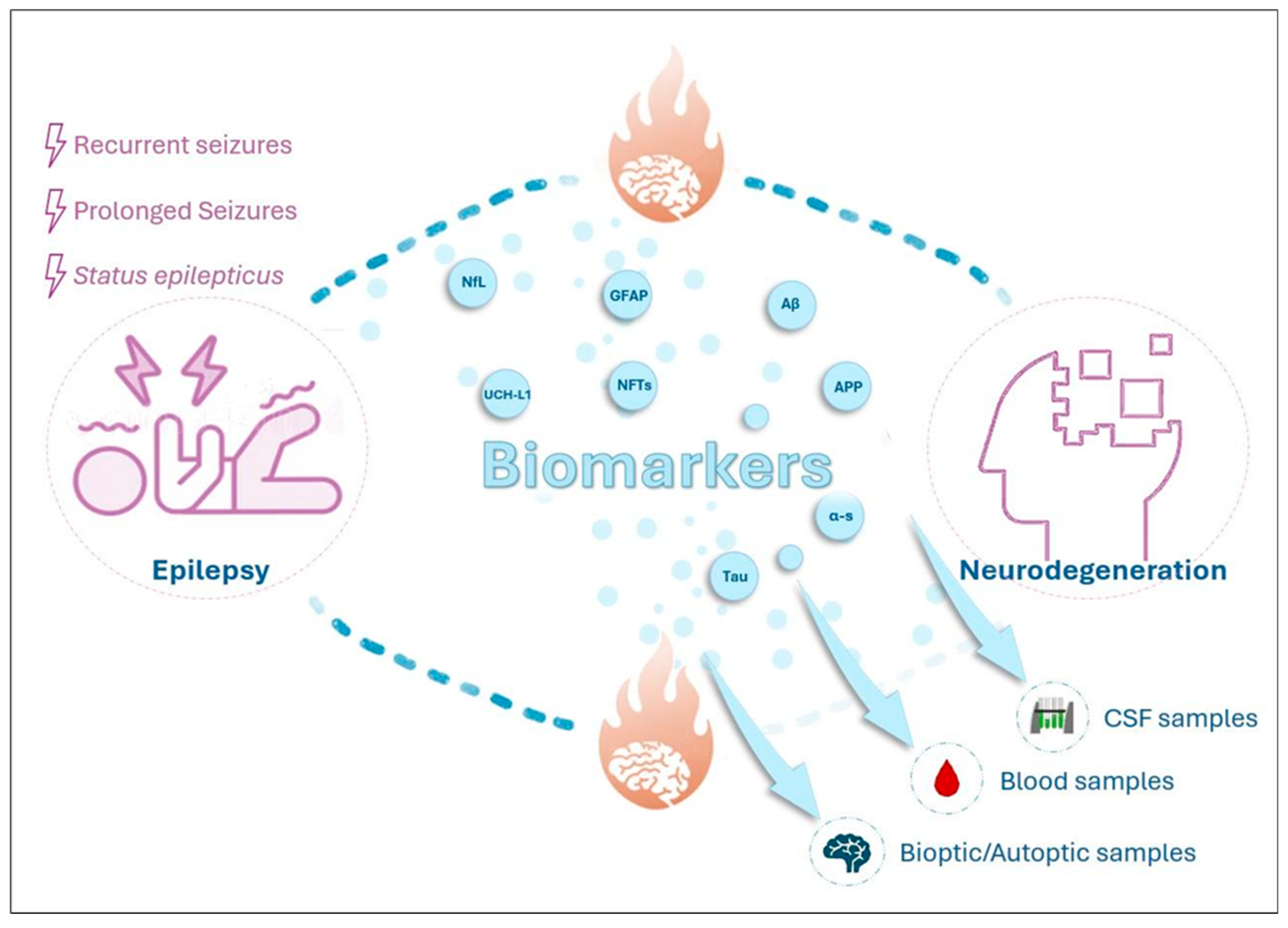
Neurodegeneration Biomarkers in Epilepsy: A Critical Review of Current Findings
 ,
,  , , ,
, , , 

Abstract
1. Introduction
Epilepsy and Neurodegeneration
2. Materials and Methods
3. Results
3.1. Neurofilaments Light Chain (NfL)
NfL and Epilepsy
3.2. GFAP
GFAP and Epilepsy
3.3. α-Synuclein
α-Synuclein and Epilepsy
3.4. Ubiquitin C-Terminal Hydrolase L1
UCH-L1 and Epilepsy
3.5. Tau Protein and Neurofibrillary Tangles
Tau, NFTs and Epilepsy
3.6. Amyloid-β and Amyloid Precursor Protein
Aβ, APP and Epilepsy
4. Discussion
Author Contributions
Funding
Institutional Review Board Statement
Informed Consent Statement
Data Availability Statement
Conflicts of Interest
Abbreviations
| Aβ | Amyloid-β |
| AD | Alzheimer’s disease |
| AI | Autoimmune |
| AIE | Autoimmune Epilepsy |
| APOE | Apolipoprotein E |
| APP | Amyloid Precursor Protein |
| BACE1 | β-Secretase (Beta-Site APP-Cleaving Enzyme 1) |
| BBB | Blood–Brain Barrier |
| CNS | Central Nervous System |
| CSE | Convulsive Status Epilepticus |
| CSF | Cerebrospinal Fluid |
| DEEs | Developmental and Epileptic Encephalopathies |
| DRE | Drug Resistant Epilepsies |
| EEG | Electroencephalography |
| FBTCS | Focal to Bilateral Tonic–Clonic Seizure |
| FCD | Focal Cortical Dysplasia |
| FCD IIb | FCD Type IIb |
| GABA | Gamma-Aminobutyric Acid |
| GGE | Genetic General Epilepsy |
| GFAP | Glial Fibrillary Acidic Protein |
| GTCS | Generalized Tonic–Clonic Seizure |
| Hp-tau | Hyperphosphorylated Tau |
| HS | Hippocampal Sclerosis |
| IL-1 | Interleukin-1β |
| IL-6 | Interleukin-6 |
| IL-10 | Interleukin-10 |
| iPSC | Induced Pluripotent Stem Cells |
| ISF | Cerebral Interstitial Fluid |
| MRI | Magnetic Resonance Imaging |
| nSE | Non-Convulsive Status Epilepticus |
| Nf | Neurofilaments |
| NfH | Neurofilament Heavy Chain |
| NfL | Neurofilament Light Chain |
| NfM | Neurofilament Medium Chain |
| NFT | Neurofibrillary Tangle |
| PET | Positron Emission Tomography |
| PiB | Pittsburgh Compound B |
| PNES | Psychogenic Non-Epileptic Seizures |
| p-tau | Phosphorylated Tau |
| sAPPβ | Soluble Amyloid Precursor Protein Beta |
| SE | Status Epilepticus |
| sNfL | Serum Neurofilament Light Chain |
| TBI | Traumatic Brain Injury |
| TLE | Temporal Lobe Epilepsy |
| TNF-α | Tumor Necrosis Factor α |
| t-tau | Total tau |
| TSC | Tuberous Sclerosis Complex |
| UCH-L1 | Ubiquitin C-Terminal Hydrolase L1 |
| UPS | Ubiquitin–Proteasome System |
Appendix A


| Species | Population | Type of Sample | Results | Epileptic Features | Detection Method | Additional Information | Reference |
|---|---|---|---|---|---|---|---|
| Homo sapiens | 28 Epi adults (21 CSE vs. 7 nSE) vs. 1186 HC | CFS, serum | ↑ NfL in SE (p = 0.001) n.s. differences between CSE and nSE | SE | Simoa | NfL concentrations in CFS and serum showed a high correlation (p < 0.001) | Margraf et al. [43] |
| Homo sapiens | 13 AIE vs. 13 HS vs. 7 GGE vs. 8 PNES | CSF, serum | n.s. in GGE, ↑ NfL in AIE in serum and CSF | F or G seizures | Simoa | - | Nass et al. [40] |
| Homo sapiens | 60 Epi adults (30 SE vs. 30 DRE) vs. 30 HC | Serum (+CFS in subset) | ↑ serum NfL in SE pts vs. DRE (p < 0.001) and HC (p < 0.001). n.s. differences between DRE and HC | SE and DRE | Simoa | CFS NfL levels strongly correlate with serum (τ = 0.68, p < 0.001) | Giovannini et al. [38] |
| Homo sapiens | 46 Epi adults (last seizure < 6 months) vs. 49 Epi adults (seizure free >1 year) | Serum | n.s. differences | F or G seizures or unknown seizures | Simoa | NfL levels were increased in male patients, mainly within age-adjusted reference ranges. | Dargvainiene et al. [45] |
| Homo sapiens | 38 Epi adults vs. 24 HC | Serum | n.s. differences (p = 0.92) | F or G seizures or unknown seizures | ELISA | Correlation between NfL and cognitive levels | Ueda et al. [44] |
| Homo sapiens | 87 SE vs. 30 Epi adults vs. 27 HC | Serum | ↑ NfL in SE (p < 0.001) | SE | Immunoassay | Samples collected during SE (≤72 h); serum NfL predicted 30-day outcome | Giovannini et al. [35] |
| Homo sapiens | 20 Epi adults vs. 20 HC | Serum | ↑ NfL in epi adults pts | F or G seizures | Simoa | - | Nass et al. [36] |
| Homo sapiens | 104 Epi adults vs. 22 PNES vs. 12 NED | Plasma | ↑ NfL in Epi pts compared to PNES (p = 0.04) | NA | Simoa | - | Dobson et al. [39] |
| Homo sapiens | 204 Epi adults | Plasma | ↑ NfL in pts with seizures ≤ 2 mo (p = 0.006). ↑ NfL in younger pts with epileptogenic lesions (p < 0.001) | NA | Simoa | Higher NfL levels in focal vs. generalized epilepsy (<65 years) | Akel et al. [32] |
| Homo sapiens | 117 Epi pts vs. 79 HC children | CSF | ↑ NfL in epilepsy (p < 0.001) and progressive encephalopathy ↑ NfL in SE compared to focal epilepsy (p < 0.01), primary generalized epilepsy (p < 0.001) and unspecified epilepsy group (p < 0.01) | F or G seizures or unknown seizures, SE | Immunoassay | - | Shahim et al. [47] |
| Homo sapiens | 6 Epi children vs. 34 febrile controls vs. 23 ANC vs. 37 FS vs. 18 CNC vs. 3 SSD vs. 101 HC | Serum | n.s. differences in sNfL levels | n.a. | Simoa | - | Geis et al. [37] |
| Species | Population | Type of Sample | Results | Epileptic Features | Detection Method | Additional Information | Reference |
|---|---|---|---|---|---|---|---|
| Homo sapiens | 13 AIE vs. 13 HS vs. 7 GGE vs. 8 PNES adults | CSF, serum | n.s. differences | F or G seizures | Simoa | - | Nass et al. [40] |
| Homo sapiens | 119 Epi adults vs. 80 HC | Serum | ↑ GFAP in Epi pts (p = 0.042) | F or G seizures | ELISA | - | Mochol et al. [65] |
| Homo sapiens | 20 Epi adults vs. 20 HC | Serum | ↑ GFAP in Epi adults pts (p < 0.001 a postictal peak at 125.3 pg/mL) | F or G seizures | Simoa | - | Nass et al. [36] |
| Homo sapiens | 43 SE vs. 20 PNES vs. 19 HC adults | Serum | ↑ GFAP in pts with SE (p < 0.001) n.s. differences between PNES and HC (p = 0.5) | F or G seizures/SE | ELISA | - | Simani et al. [63] |
| Homo sapiens | 104 Epi adults vs. 22 PNES vs. 12 NED | Plasma | ↑ GFAP in Epi pts compared to PNES (p < 0.04) | Various epilepsy subtypes (including DRE) | Simoa | - | Dobson et al. [39] |
| Homo sapiens | 204 Epi adults | Plasma | ↑ GFAP in pts with seizures ≤2 mo (p = 0.032). ↑ GFAP in younger pts with epileptogenic lesions (p < 0.001) | F or G seizures or unknown seizures, SE | Simoa | - | Akel et al. [32] |
| Homo sapiens | 331 adults ND including SE (n. n.a.) | Plasma | n.s. differences | SE | Immunoassay | ↑ GFAP in SE (n.s.) | Mayer et al. [71] |
| Homo sapiens | 12 SE DRV vs. 6 SE DRT adults | Peripheral blood | n.s. differences | n.a. | ELISA | Blood collected ≤72 h post-seizure | Mahama et al. [70] |
| Homo sapiens | 25 Epi adults vs. 6 HC | Temporal cortex resection specimens | ↑ GFAP immunoreactivity in resected tissue from TLE patients (p < 0.01) | TLE | IHC and Western blot | - | Song et al. [64] |
| Homo sapiens | 52 Epi children vs. 33 HC | CSF | ↑ GFAP in Epi pts (p = 0.0075) (correlation with seizure duration) | F or G seizures | ELISA | CSF collected ≤24 h post-seizure | Gurnett et al. [68] |
| Homo sapiens | 117 Epi children vs. 79 HC | CSF | ↑ GFAP in Epi pts (p < 0.1) | F or G seizures or unknown seizures, SE | Immunoassay | Biomarkers distinguish progressive from static disorders | Shahim et al. [47] |
| Homo sapiens | 35 RE vs. 18 NRE vs. 16 HC children | Serum | ↑ GFAP in Epi pts (p = 0.001) | F or G seizures | ELISA | - | Aksoy et al. [67] |
| Homo sapiens | 57 CSE vs. 30 HC children (1,4,10 th day) | Serum | ↑ GFAP in pediatric pts with CSE (4th day) (p < 0.01) | G epilepsy and CFS | ELISA | - | Wang et al. [69] |
| Homo sapiens | 30 Epi children vs. 30 HC | Serum | ↑ GFAP in Epi pts (p < 0.0001) | F or G seizures | ELISA | GFAP correlated with seizure severity in the past 6 months; high levels predicted active seizures (p = 0.035) | Elhady et al. [16] |
| Mus musculus | 75 kindle mice vs. 32 control rats | Plasma | n.s. differences | n.a. | ELISA | - | Chmielewska et al. [81] |
| Rattus norvegicus | 84 pilocarpine-treated vs. 6 control rats | Hippocampal tissue | ↑ GFAP expression in the hippocampus of rats with spontaneous recurrent seizures | TLE | IHC, WB and RT-qPCR | HC: Non-epileptic controls (post-traumatic tissue) | Song et al. [64] |
| Species | Population | Type of Sample | Results | Epileptic Features | Detection Method | Additional Information | Reference |
|---|---|---|---|---|---|---|---|
| Homo sapiens | 40 DRE vs. 14 TE vs. 13 Epi adults newly diagnosed vs. 22 HC | CSF, serum | ↑ α-synuclein in DRE (p < 0.05) | F or G seizures | ELISA | HC: pts with neurosis | Rong et al. [85] |
| Homo sapiens | 110 Epi children vs. 35 HC | Serum | ↑ α-synuclein in Epi pts (p < 0.05) | F or G epilepsy | ELISA | Positive correlation with EEG abnormalities | Zheng & Kong [91] |
| Homo sapiens | 30 DRE vs. 30 WCE vs. 30 HC children | Serum | ↑ α-synuclein in Epi pts (p < 0.001) ↑ α-synuclein in DRE vs. WCE (p < 0.001) | F or G epilepsy | ELISA | α-Syn negatively correlated with time since last seizure and age at onset (p = 0.001, 0.016) | Salem et al. [92] |
| Homo sapiens | 115 Epi children vs. 10 acquired demyelinating disorders vs. 146 HC | Serum (and serum-derived exosomes) | ↑ α-synuclein in Epi pts (serum levels related with disease severity) (p < 0.05) ↑ α-synuclein in pts with demyelinating disorders (p < 0.05) | F or G seizures | ELISA | Blood ≤48 h post-seizure; exosomal α-syn correlated with serum (p < 0.0001). | Choi et al. [89] |
| Homo sapiens | 15 FCD IIb and 24 TSC children with DRE vs. 26 HC | CTX | ↓ α-synuclein mRNA in FCD IIb, (p < 0.01) ↑ α-synuclein mRNA in TSC (p < 0.05) ↓ α-synuclein protein in FCD IIb (p < 0.05) ↓ α-synuclein protein in TSC (p < 0.01) | F epilepsy associated with FCD IIb/TSC | IHC, IF, Western blotting, Co-immunoprecipitation, RT-PCR | - | Zhang et al. [93] |
| Mus musculus | 58 prenatal X-ray–induced FCD rat model | CTX | ↓ α-synuclein mRNA in FCD (p < 0.01) ↓ α-syn immunoreactivity in FCD (p < 0.05) ↑ p-α-syn protein in FCD (p < 0.01–0.001) ↓ p-α-syn immunoreactivity in FCD (p < 0.01) ↓ α-synuclein protein in FCD (p < 0.05) | - | IHC, IF, Western blotting, Co-immunoprecipitation, RT-PCR | Analyses were performed in rats at postnatal days 7, 14, and 28 | Zhang et al. [93] |
| Species | Population | Type of Sample | Results | Epileptic Features | Detection Method | Additional Information | Reference |
|---|---|---|---|---|---|---|---|
| Homo sapiens | 33 Epi adults vs. 23 HC | CSF | ↑ UCH L1 post-seizure | F or G seizures | ELISA | UCH-L1 levels were higher in G than in F seizures, and showed no correlation with age or epilepsy-related clinical variables | Li et al. [103] |
| Homo sapiens | 52 Epi adults | CSF, plasma | ↑ UCH-L1 post-seizure | GTCS (Single or repetitive) or FBTCS | ELISA | Plasma UCH-L1 levels decreased with increasing time to sampling; CSF and plasma levels were strongly correlated and associated with age in epileptic patients, but not in controls | Mondello et al. [102] |
| Homo sapiens | 160 Epi adults vs. 100 HC | Plasma | ↑ UCH-L1 in Epi adults | ES and nSP | ELISA | No difference in UCH-L1 between epileptic seizure and non-seizure periods | Yasak et al. [96] |
| Homo sapiens | 43 Epi adults vs. 20 PNES vs. 19 HC | Serum | ↑ UCH-L1 post-seizure | F or G seizures | ELISA | - | Asadollahi and Simani [104] |
| Homo sapiens | 35 RE vs. 18 NRE vs. 16 HC children | Serum | n.s. in UCH-L1 | SeLFE, F seizures, IGE, DEEs, CP, NMD or TSC | ELISA | - | Aksoy et al. [67] |
| Homo sapiens | 30 Epi children vs. 30 HC children | Serum | ↑ UCH-L1 in Epi children | F or G seizures | ELISA | UCH-L1 levels were higher in G seizures than in F seizures and were significantly elevated in children with active seizures compared to those seizures-free for the previous 6 months | Elhady et al. [16] |
| Mus musculus | 43 kindled mice vs. 32 control mice | Plasma | ↑ UCH-L1 post-seizure | PTZ induced | ELISA | - | Chmielewska et al. [81] |
| Mus musculus | Preconditioned (tolerance) vs. sham-preconditioned (injury) | Hippocampal tissue samples | ↓ UCH-L1 in hippocampus 24 h after KA induced SE | F-onset SE KA induced | WB | - | Reynolds et al. [105] |
| Mus musculus | Kindled PTZ mice vs. control mice | Hippocampal tissue samples | ↑ UCH-L1 Epi mice | PTZ and LDN-57444 induced | WB, IF, IP, and Timm staining | LDN-57444 treatment increased seizure severity in PTZ-kindled mice, with higher Racine score, shorter latency, and more stage 4–5 seizures | Wen et al. [106] |
| Species | Population | Type of Sample | Results | Epileptic Features | Detection Method | Additional Information | Reference |
|---|---|---|---|---|---|---|---|
| Homo sapiens | 30 Epi adults | CSF | n.s. in t-tau and p-tau in different seizures type | TLE | CLEIA | ↑ t-tau and ↑ p-tau in patients with poorer performance in verbal fluency | Fonseca et al. [114] |
| Homo sapiens | 28 adolescents and adults with SE | CSF | ↑ t-tau in 14 pts ↑ p-tau in 6 pts | SE | ELISA | t-tau levels were higher in pts who developed a RSE and positively correlated with SE duration; elevated CSF t-tau was associated with increased risk of developing disability and chronic epilepsy | Monti et al. [108] |
| Homo sapiens | 54 Epi adolescents and adults vs. 31 HC | CSF | ↑ t-tau and ↑ p-tau post-seizure in pts with acute or remote symptomatic seizures | GTCS or FBTCS | ELISA | No statistical differences in t-tau or p-tau levels between different etiologic group or HC | Palmio et al. [112] |
| Homo sapiens | 45 Epi adults vs. 17 HC | CSF | ↓ t-tau and p-tau vs. HC | F or G (single, repetitive, or nSE) | ELISA | - | Shahim et al. [113] |
| Homo sapiens | 204 Epi adults | Plasma | n.s. in t-tau in different epilepsy type | F, G or unknown epilepsy | Simoa | n.s. differences in plasma t-tau between patients with recent seizures and those who were seizure-free | Akel et al. [32] |
| Homo sapiens | 12 Epi adults | TL samples | NTs and NFTs as forms of p-tau structures in half biopsies | DRE | ELISA | Robust presence of p-tau (Ser202/Thr205)-related neuropil threads and neurofibrillary tangles in epilepsy biopsies, with no significant correlation between p-tau Thr205 and Thr181 | Aroor et al. [118] |
| Homo sapiens | 19 Epi adults vs. 9 Alzheimer cases vs. 22 HC | TL and/or hippocampal tissue samples | ↑ tau5 in TLE hippocampus (p < 0.01) but not in temporal cortex | TLE | WB and IHC | tau5 (p < 0.05) and p-tau AT180 (p < 0.05) were negatively correlated with executive function; Aβ42 levels correlated with tau 4R in TLE cortex (p < 0.05) | Gourmaud et al. [115] |
| Homo sapiens | 56 Epi adults | TL and hippocampal tissue samples | NFTs and p-tau in TL of 2/56 pts | Drug-resistant TLE | IHC | - | Silva et al. [117] |
| Homo sapiens | 33 Epi adults | TL samples | NFTs, NTs, and pre-NFTs as forms of p-tau in TLE | TLE | IHC | Tau pathology extent correlated with decline in verbal learning (r = 0.63), recall (r = 0.44), and GNT scores (r = 0.50) over 1 year post-TL resection (p ≤ 0.05). | Tai et al. [14] |
| Homo sapiens | 22 Epi adults vs. 20 post-mortem control | TL and hippocampal tissue samples | p-tau (95%), mature NFTs (66.7%), and pretangles (100%) in sclerotic hippocampi of Epi adults | MTLE | WB and IHC | ↑ p-tau leveled were associated with impaired BNT (p = 0.033) and Digit Span Forward (p = 0.048) scores | Toscano et al. [116] |
| Mus musculus | 112 mice | TL samples | ↑ p-tau | KA induced | ELISA | - | Canet et al. [119] |
| Mus musculus | 18 genetically modified mice (ChR2-expressing excitatory neurons in ventral CA1) | Ventral CA1 hippocampal tissue samples | ↑ p-tau and ↑ t-tau in hippocampus and cortex after repeated seizures | Optogenetically induced seizures | WB and IHC | C4 treatment ↓ p-tau and ↓ tau, ameliorated seizure severity (increased latency, reduced duration), and improved spatial memory | Gao et al. [122] |
| Mus musculus | 19 Kcna1−/−Tau−/− mice vs. 15 Kcna1−/−Tau+/+ mice vs. 15 WT Tau+/+ mice | Hippocampal slices | Tau loss in Kcna1−/− mice ↓ burst frequency and duration to WT levels; Kcna1−/−, Tau+/+ mice showed high burst frequency; no effect in WT slices | Kcna1−/− mice | In vitro electrophysiology (hippocampal slice recordings) | - | Holth et al. [121] |
| Mus musculus | 60 mice | AMY, HIP, and CTX | ↓ PP2A ↑ p-tau in key epileptogenic brain regions | AK, KA SE, and PTE | BCA kit | - | Liu et al. [13] |
| Species | Population | Type of Sample | Results | Epileptic Features | Detection Method | Additional Information | Reference |
|---|---|---|---|---|---|---|---|
| Homo sapiens | 45 Epi adults vs. 17 controls * | CSF | ↑ Aβx-38, Aβx-40 in rPS vs. nSE (p < 0.01), sPS & controls (p < 0.05) ↑ Aβx-42 in rPS vs. nSE (p < 0.05) sAPP: n.s. | F or G (single, repetitive or nSE) | ELISA | - | Shahim et al. [113] |
| Homo sapiens | 30 Epi adults | CSF and PET imaging | ↑ Aβ PET uptake in MTL bil (p < 0.001), ipsi > ant cingulate (p = 0.020) ↓ CSF Aβ1–42 in 7 pts (23%) CSF Aβ1–42 and other brain areas on Aβ PET: n.s. | TLE | PET and CLIA | - | Fonseca et al. [114] |
| Homo sapiens | 41 Epi adults vs. 46 matched HC | Brain PiB-PET imaging | ↑ PiB uptake: higher in Epi cases than controls (p = 0.04) | Unspecified COES | PET | ↑ PiB uptake in cases strongly associated with the APOE genotype | Joutsa et al. [126] |
| Homo sapiens | 12 Epi adults | TL samples | Robust Aβ plaques but n.s. correlation to cognitive performance | Drug-resistant epilepsy | IHC and ELISA | - | Aroor et al. [118] |
| Homo sapiens | 56 Epi adults | TL samples | Aβ plaques have been found just in 4/56 pts n.s. | Drug-resistant TLE | IHC | pts with Aβ plaques showed lower scores on verbal memory assessment scales | Silva et al. [117] |
| Homo sapiens | 33 Epi adults | TL samples | Aβ plaques have been found just in 5/33 pts n.s. | Drug-resistant TLE | IHC | n.s. correlation was found between Aβ plaque deposition and cognitive performance (p = 0.02) | Tai et al. [14] |
| Species | Population | Type of Sample | Results | Epileptic Features | Detection Method | Additional Information | Reference |
|---|---|---|---|---|---|---|---|
| Homo sapiens | 19 Epi adults vs. 9 Alzheimer cases vs. 22 HC | TL and/or hippocampal samples | ↑ β-APP and Aβ42 in the hippocampus (p < 0.01) ↑ pAPP in hippocampus and temporal cortex (p < 0.01) ↑ BACE1 and soluble Aβ56 in both the hippocampus (p < 0.05) and temporal cortex (p < 0.0001) | TLE | WB and IHC | pAPP (p < 0.05), BACE (p = 0.001), tau5 (p < 0.05), and P-tau AT180 (p < 0.05) were negatively correlated with executive function + correlation between Aβ42 and tau 4R in TLE cortex (p < 0.05) + correlation between BACE1 and full-length APP in both TLE hippocampus (p < 0.05) and temporal cortex (p < 0.05) | Gourmaud et al. [115] |
| Homo sapiens | 36 Epi adults vs. 25 controls * | TL and/or hippocampal samples | ↑ β-APP in TL and hippocampal sample of cases (p < 0.05) APP mRNA concentrations: n.s. | Unspecified refractory epilepsy | qPCR, IHC and IF | No differences in APP mRNA concentrations between the epileptic and control groups | Sima et al. [12] |
| Homo sapiens | 8 Epi adults vs. 8 HC | TL samples | ↑ β-APP 770 and 751 (p < 0.05) of cases β-APP 695: n.s. ↑ β-APP-positive neurons in TL (p < 0.001) of cases ↑ IL-1α in microglia in case (p < 0.001) | TLE | WB and IHC | - | Sheng et al. [125] |
References
- Palmer, E.E.; Howell, K.; Scheffer, I.E. Natural History Studies and Clinical Trial Readiness for Genetic Developmental and Epileptic Encephalopathies. Neurotherapeutics 2021, 18, 1432–1444. [Google Scholar] [CrossRef] [PubMed]
- Surdi, P.; Trivisano, M.; De Dominicis, A.; Mercier, M.; Piscitello, L.M.; Pavia, G.C.; Calabrese, C.; Cappelletti, S.; Correale, C.; Mazzone, L.; et al. Unveiling the disease progression in developmental and epileptic encephalopathies: Insights from EEG and neuropsychology. Epilepsia 2024, 65, 3279–3292. [Google Scholar] [CrossRef]
- Di Rosa, G.; Dicanio, D.; Nicotera, A.G.; Mondello, P.; Cannavò, L.; Gitto, E. Efficacy of Intravenous Hydrocortisone Treatment in Refractory Neonatal Seizures: A Report on Three Cases. Brain Sci. 2020, 10, 885. [Google Scholar] [CrossRef]
- McTague, A.; Howell, K.B.; Cross, J.H.; Kurian, M.A.; Scheffer, I.E. The genetic landscape of the epileptic encephalopathies of infancy and childhood. Lancet Neurol. 2016, 15, 304–316. [Google Scholar] [CrossRef]
- Dicanio, D.; Nicotera, A.G.; Cucinotta, F.; Di Rosa, G. Perampanel treatment in Early-onset Epileptic Encephalopathy with infantile movement disorders associated with a de novo GRIN1 gene mutation: A 3-year follow-up. Neurol. Sci. 2021, 42, 1627–1629. [Google Scholar] [CrossRef] [PubMed]
- Paudel, Y.N.; Angelopoulou, E.; Piperi, C.; Othman, I.; Shaikh, M.F. Revisiting the Impact of Neurodegenerative Proteins in Epilepsy: Focus on Alpha-Synuclein, Beta-Amyloid, and Tau. Biology 2020, 9, 122. [Google Scholar] [CrossRef] [PubMed]
- Nicotera, A.G.; Spanò, M.; Decio, A.; Valentini, G.; Saia, M.; Di Rosa, G. Epileptic Phenotype and Cannabidiol Efficacy in a Williams-Beuren Syndrome Patient with Atypical Deletion: A Case Report. Front. Neurol. 2021, 12, 659543. [Google Scholar] [CrossRef]
- Helbig, I.; von Deimling, M.; Marsh, E.D. Epileptic Encephalopathies as Neurodegenerative Disorders. Adv. Neurobiol. 2017, 15, 295–315. [Google Scholar] [CrossRef]
- Guerrini, R.; Conti, V. Epileptic encephalopathies and progressive neurodegeneration. Rev. Neurol. 2024, 180, 363–367. [Google Scholar] [CrossRef]
- Neri, S.; Mastroianni, G.; Gardella, E.; Aguglia, U.; Rubboli, G. Epilepsy in neurodegenerative diseases. Epileptic Disord. 2022, 24, 249–273. [Google Scholar] [CrossRef]
- Costanzo, M.C.; Nicotera, A.G.; Vinci, M.; Vitello, A.; Fiumara, A.; Calì, F.; Musumeci, S.A. Novel compound heterozygous mutation in NPC1 gene cause Niemann-Pick disease type C with juvenile onset. J. Genet. 2020, 99, 30. [Google Scholar] [CrossRef] [PubMed]
- Sima, X.; Xu, J.; Li, J.; Zhong, W.; You, C. Expression of β-amyloid precursor protein in refractory epilepsy. Mol. Med. Rep. 2014, 9, 1242–1248. [Google Scholar] [CrossRef]
- Liu, J.Y.; Reeves, C.; Diehl, B.; Coppola, A.; Al-Hajri, A.; Hoskote, C.; Mughairy, S.A.; Tachrount, M.; Groves, M.; Michalak, Z.; et al. Early lipofuscin accumulation in frontal lobe epilepsy. Ann. Neurol. 2016, 80, 882–895. [Google Scholar] [CrossRef]
- Tai, X.Y.; Koepp, M.; Duncan, J.S.; Fox, N.; Thompson, P.; Baxendale, S.; Liu, J.Y.; Reeves, C.; Michalak, Z.; Thom, M. Hyperphosphorylated tau in patients with refractory epilepsy correlates with cognitive decline: A study of temporal lobe resections. Brain 2016, 139, 2441–2455. [Google Scholar] [CrossRef]
- Musumeci, A.; Calì, F.; Scuderi, C.; Vinci, M.; Vitello, G.A.; Musumeci, S.A.; Chiavetta, V.; Federico, C.; Amore, G.; Saccone, S.; et al. Identification of a Novel Missense Mutation of POLR3A Gene in a Cohort of Sicilian Patients with Leukodystrophy. Biomedicines 2022, 10, 2276. [Google Scholar] [CrossRef]
- Elhady, M.; Youness, E.R.; AbuShady, M.M.; Nassar, M.S.; Elaziz, A.A.; Masoud, M.M.; Fouda, F.K.; Elhamed, W.A.A. Correction to: Circulating glial fibrillary acidic protein and ubiquitin carboxy-terminal hydrolase-L1 as markers of neuronal damage in children with epileptic seizures. Child Nerv. Syst. 2021, 37, 3283. [Google Scholar] [CrossRef]
- Jacobs Sariyar, A.; van Pesch, V.; Nassogne, M.C.; Moniotte, S.; Momeni, M. Usefulness of serum neurofilament light in the assessment of neurologic outcome in the pediatric population: A systematic literature review. Eur. J. Pediatr. 2023, 182, 1941–1948. [Google Scholar] [CrossRef]
- Di Rosa, G.; Lenzo, P.; Parisi, E.; Neri, M.; Guerrera, S.; Nicotera, A.; Alibrandi, A.; Germanò, E.; Caccamo, D.; Spanò, M.; et al. Role of plasma homocysteine levels and MTHFR polymorphisms on IQ scores in children and young adults with epilepsy treated with antiepileptic drugs. Epilepsy Behav. 2013, 29, 548–551. [Google Scholar] [CrossRef]
- Cano, A.; Fonseca, E.; Ettcheto, M.; Sánchez-López, E.; de Rojas, I.; Alonso-Lana, S.; Morató, X.; Souto, E.B.; Toledo, M.; Boada, M.; et al. Epilepsy in Neurodegenerative Diseases: Related Drugs and Molecular Pathways. Pharmaceuticals 2024, 14, 1057. [Google Scholar] [CrossRef] [PubMed]
- Tai, X.Y.; Torzillo, E.; Lyall, D.M.; Manohar, S.; Husain, M.; Sen, A. Association of Dementia Risk with Focal Epilepsy and Modifiable Cardiovascular Risk Factors. JAMA Neurol. 2023, 80, 445–454. [Google Scholar] [CrossRef] [PubMed]
- Butera, A.; Spoto, G.; Ceraolo, G.; Grella, M.; Giunta, I.; Albertini, M.L.; Consoli, C.; Sferro, C.; Spanò, M.; Di Rosa, G.; et al. Efficacy and safety of cannabidiol in a single-center pediatric drug-resistant epilepsy cohort: A retrospective study. Front. Neurol. 2025, 16, 1616480. [Google Scholar] [CrossRef]
- Farhan, R.; Hashmi, S.A.; Kapur, J.; D’Abreu, A.; Punia, V.; Manning, C.; Smith, V.L.; Zawar, I. Exploring biomarkers of neurodegeneration in epilepsy: Critical insights. Epileptic Disord. 2023, 27, 341–357. [Google Scholar] [CrossRef]
- Amore, G.; Butera, A.; Spoto, G.; Valentini, G.; Saia, M.C.; Salpietro, V.; Calì, F.; Di Rosa, G.; Nicotera, A.G. KCNQ2-Related Neonatal Epilepsy Treated with Vitamin B6: A Report of Two Cases and Literature Review. Front. Neurol. 2022, 13, 826225. [Google Scholar] [CrossRef] [PubMed]
- Guerrini, R.; Conti, V.; Mantegazza, M.; Balestrini, S.; Galanopoulou, A.S.; Benfenati, F. Developmental and epileptic encephalopathies: From genetic heterogeneity to phenotypic continuum. Physiol. Rev. 2023, 103, 433–513. [Google Scholar] [CrossRef]
- Spoto, G.; Valentini, G.; Saia, M.C.; Butera, A.; Amore, G.; Salpietro, V.; Nicotera, A.G.; Di Rosa, G. Synaptopathies in Developmental and Epileptic Encephalopathies: A Focus on Pre-synaptic Dysfunction. Front. Neurol. 2022, 13, 826211. [Google Scholar] [CrossRef]
- Costagliola, G.; Depietri, G.; Michev, A.; Riva, A.; Foiadelli, T.; Savasta, S.; Bonuccelli, A.; Peroni, D.; Consolini, R.; Marseglia, G.L.; et al. Targeting Inflammatory Mediators in Epilepsy: A Systematic Review of Its Molecular Basis and Clinical Applications. Front. Neurol. 2022, 13, 741244. [Google Scholar] [CrossRef]
- Goeral, K.; Hauck, A.; Atkinson, A.; Wagner, M.B.; Pimpel, B.; Fuiko, R.; Klebermass-Schrehof, K.; Leppert, D.; Kuhle, J.; Berger, A.; et al. Early life serum neurofilament dynamics predict neurodevelopmental outcome of preterm infants. J. Neurol. 2021, 268, 2570–2577. [Google Scholar] [CrossRef] [PubMed]
- Banote, R.K.; Akel, S.; Zelano, J. Blood biomarkers in epilepsy. Acta Neurol. Scand. 2022, 146, 362–368. [Google Scholar] [CrossRef] [PubMed]
- Eriksson, H.; Löwhagen Hendén, P.; Rentzos, A.; Pujol-Calderón, F.; Karlsson, J.E.; Höglund, K.; Blennow, K.; Zetterberg, H.; Rosengren, L.; Zelano, J. Acute symptomatic seizures and epilepsy after mechanical thrombectomy. Epilepsy Behav. 2020, 104, 106520. [Google Scholar] [CrossRef]
- Yuan, A.; Rao, M.V.; Veeranna; Nixon, R.A. Neurofilaments and Neurofilament Proteins in Health and Disease. Cold Spring Harb. Perspect. Biol. 2017, 9, a018309. [Google Scholar] [CrossRef]
- Rejdak, K.; Kuhle, J.; Rüegg, S.; Lindberg, R.L.; Petzold, A.; Sulejczak, D.; Papuc, E.; Rejdak, R.; Stelmasiak, Z.; Grieb, P. Neurofilament heavy chain and heat shock protein 70 as markers of seizure-related brain injury. Epilepsia 2012, 53, 922–927. [Google Scholar] [CrossRef]
- Akel, S.; Asztely, F.; Banote, R.K.; Axelsson, M.; Zetterberg, H.; Zelano, J. Neurofilament light, glial fibrillary acidic protein, and tau in a regional epilepsy cohort: High plasma levels are rare but related to seizures. Epilepsia 2023, 64, 2690–2700. [Google Scholar] [CrossRef] [PubMed]
- Matsushige, T.; Inoue, H.; Fukunaga, S.; Hasegawa, S.; Okuda, M.; Ichiyama, T. Serum neurofilament concentrations in children with prolonged febrile seizures. J. Neurol. Sci. 2012, 321, 39–42. [Google Scholar] [CrossRef]
- Ouédraogo, O.; Rébillard, R.M.; Jamann, H.; Mamane, V.H.; Clénet, M.L.; Daigneault, A.; Lahav, B.; Uphaus, T.; Steffen, F.; Bittner, S.; et al. Increased frequency of proinflammatory CD4 T cells and pathological levels of serum neurofilament light chain in adult drug-resistant epilepsy. Epilepsia 2021, 62, 176–189. [Google Scholar] [CrossRef] [PubMed]
- Giovannini, G.; Meletti, S. Fluid Biomarkers of Neuro-Glial Injury in Human Status Epilepticus: A Systematic Review. Int. J. Mol. Sci. 2023, 24, 12519. [Google Scholar] [CrossRef] [PubMed]
- Nass, R.D.; Akgün, K.; Elger, C.; Reichmann, H.; Wagner, M.; Surges, R.; Ziemssen, T. Serum biomarkers of cerebral cellular stress after self-limiting tonic clonic seizures: An exploratory study. Seizure 2021, 85, 1–5. [Google Scholar] [CrossRef]
- Geis, T.; Gutzeit, S.; Fouzas, S.; Ambrosch, A.; Benkert, P.; Kuhle, J.; Wellmann, S. Serum Neurofilament light chain (NfL) levels in children with and without neurologic diseases. Eur. J. Paediatr. Neurol. 2023, 45, 9–13. [Google Scholar] [CrossRef]
- Giovannini, G.; Bedin, R.; Ferraro, D.; Vaudano, A.E.; Mandrioli, J.; Meletti, S. Serum neurofilament light as biomarker of seizure-related neuronal injury in status epilepticus. Epilepsia 2022, 63, e23–e29. [Google Scholar] [CrossRef]
- Dobson, H.; Al Maawali, S.; Malpas, C.; Santillo, A.F.; Kang, M.; Todaro, M.; Watson, R.; Yassi, N.; Blennow, K.; Zetterberg, H.; et al. Elevated plasma neurofilament light and glial fibrillary acidic protein in epilepsy versus nonepileptic seizures and nonepileptic disorders. Epilepsia 2024, 65, 2751–2763. [Google Scholar] [CrossRef]
- Nass, R.D.; Akgün, K.; Dague, K.O.; Elger, C.E.; Reichmann, H.; Ziemssen, T.; Surges, R. CSF and Serum Biomarkers of Cerebral Damage in Autoimmune Epilepsy. Front. Neurol. 2021, 12, 647428. [Google Scholar] [CrossRef]
- Eriksson, H.; Banote, R.K.; Larsson, D.; Blennow, K.; Zetterberg, H.; Zelano, J. Brain injury markers in new-onset seizures in adults: A pilot study. Seizure 2021, 92, 62–67. [Google Scholar] [CrossRef]
- Lybeck, A.; Friberg, H.; Nielsen, N.; Rundgren, M.; Ullén, S.; Zetterberg, H.; Blennow, K.; Cronberg, T.; Westhall, E. Postanoxic electrographic status epilepticus and serum biomarkers of brain injury. Resuscitation 2021, 158, 253–257. [Google Scholar] [CrossRef]
- Margraf, N.G.; Dargvainiene, J.; Theel, E.; Leypoldt, F.; Lieb, W.; Franke, A.; Berger, K.; Kuhle, J.; Kuhlenbaeumer, G. Neurofilament light (NfL) as biomarker in serum and CSF in status epilepticus. J. Neurol. 2023, 270, 2128–2138. [Google Scholar] [CrossRef]
- Ueda, M.; Suzuki, M.; Hatanaka, M.; Nakamura, T.; Hirayama, M.; Katsuno, M. Serum neurofilament light chain in patients with epilepsy and cognitive impairment. Epileptic Disord. Int. Epilepsy J. Videotape 2023, 25, 229–236. [Google Scholar] [CrossRef]
- Dargvainiene, J.; Sahaf, S.; Franzenburg, J.; Matthies, I.; Leypoldt, F.; Wandinger, K.P.; Baysal, L.; Markewitz, R.; Kuhlenbäumer, G.; Margraf, N.G. Neurofilament light (NfL) concentrations in patients with epilepsy with recurrent isolated seizures: Insights from a clinical cohort study. Seizure 2024, 121, 91–94. [Google Scholar] [CrossRef] [PubMed]
- Disanto, G.; Prosperetti, C.; Gobbi, C.; Barro, C.; Michalak, Z.; Cassina, T.; Kuhle, J.; Casso, G.; Agazzi, P. Serum neurofilament light chain as a prognostic marker in postanoxic encephalopathy. Epilepsy Behav. 2019, 101, 106432. [Google Scholar] [CrossRef]
- Shahim, P.; Darin, N.; Andreasson, U.; Blennow, K.; Jennions, E.; Lundgren, J.; Månsson, J.E.; Naess, K.; Törnhage, C.J.; Zetterberg, H.; et al. Cerebrospinal fluid brain injury biomarkers in children: A multicenter study. Pediatr. Neurol. 2013, 49, 31–39.e2. [Google Scholar] [CrossRef] [PubMed]
- Yang, Q.; Wang, S.; Karlsson, J.E.; Hamberger, A.; Haglid, K.G. Phosphorylated and non-phosphorylated neurofilament proteins: Distribution in the rat hippocampus and early changes after kainic acid induced seizures. J. Chem. Neuroanat. 1995, 9, 217–228. [Google Scholar] [CrossRef] [PubMed]
- Custers, M.L.; Vande Vyver, M.; Kaltenböck, L.; Barbé, K.; Bjerke, M.; Van Eeckhaut, A.; Smolders, I. Neurofilament light chain: A possible fluid biomarker in the intrahippocampal kainic acid mouse model for chronic epilepsy? Epilepsia 2023, 64, 2200–2211. [Google Scholar] [CrossRef]
- Fowler, K.M.; Shinn, R.L.; Rossmeisl, J.H.; Parker, R.L. Evaluation of neurofilament light chain as a biomarker in dogs with structural and idiopathic epilepsy. J. Vet. Intern. Med. 2024, 38, 1577–1582. [Google Scholar] [CrossRef]
- Heiskanen, M.; Jääskeläinen, O.; Manninen, E.; Das Gupta, S.; Andrade, P.; Ciszek, R.; Gröhn, O.; Herukka, S.K.; Puhakka, N.; Pitkänen, A. Plasma Neurofilament Light Chain (NF-L) Is a Prognostic Biomarker for Cortical Damage Evolution but Not for Cognitive Impairment or Epileptogenesis Following Experimental TBI. Int. J. Mol. Sci. 2022, 23, 15208. [Google Scholar] [CrossRef] [PubMed]
- Xin, Y.; Lin, G.; Hua, T.; Liang, J.; Sun, T.; Wu, X. The altered expression of cytoskeletal and synaptic remodeling proteins during epilepsy. Open Life Sci. 2023, 18, 20220595. [Google Scholar] [CrossRef]
- Vermunt, L.; Otte, M.; Verberk, I.M.W.; Killestein, J.; Lemstra, A.W.; van der Flier, W.M.; Pijnenburg, Y.A.L.; Vijverberg, E.G.B.; Bouwman, F.H.; Gravesteijn, G.; et al. Age- and disease-specific reference values for neurofilament light presented in an online interactive support interface. Ann. Clin. Transl. Neurol. 2022, 9, 1832–1837. [Google Scholar] [CrossRef] [PubMed]
- Gadea, A.; Schinelli, S.; Gallo, V. Endothelin-1 regulates astrocyte proliferation and reactive gliosis via a JNK/c-Jun signaling pathway. J. Neurosci. 2008, 28, 2394–2408. [Google Scholar] [CrossRef]
- Sofroniew, M.V. Molecular dissection of reactive astrogliosis and glial scar formation. Trends Neurosci. 2009, 32, 638–647. [Google Scholar] [CrossRef]
- Yoon, H.; Walters, G.; Paulsen, A.R.; Scarisbrick, I.A. Astrocyte heterogeneity across the brain and spinal cord occurs developmentally, in adulthood and in response to demyelination. PLoS ONE 2017, 12, e0180697. [Google Scholar] [CrossRef]
- Shandra, O.; Winemiller, A.R.; Heithoff, B.P.; Munoz-Ballester, C.; George, K.K.; Benko, M.J.; Zuidhoek, I.A.; Besser, M.N.; Curley, D.E.; Edwards, G.F., 3rd; et al. Repetitive Diffuse Mild Traumatic Brain Injury Causes an Atypical Astrocyte Response and Spontaneous Recurrent Seizures. J. Neurosci. 2019, 39, 1944–1963. [Google Scholar] [CrossRef]
- Xu, S.; Sun, Q.; Fan, J.; Jiang, Y.; Yang, W.; Cui, Y.; Yu, Z.; Jiang, H.; Li, B. Role of Astrocytes in Post-traumatic Epilepsy. Front. Neurol. 2019, 10, 1149. [Google Scholar] [CrossRef]
- Jung, C.S.; Foerch, C.; Schänzer, A.; Heck, A.; Plate, K.H.; Seifert, V.; Steinmetz, H.; Raabe, A.; Sitzer, M. Serum GFAP is a diagnostic marker for glioblastoma multiforme. Brain 2007, 130, 3336–3341. [Google Scholar] [CrossRef]
- Foerch, C.; Niessner, M.; Back, T.; Bauerle, M.; De Marchis, G.M.; Ferbert, A.; Grehl, H.; Hamann, G.F.; Jacobs, A.; Kastrup, A.; et al. Diagnostic accuracy of plasma glial fibrillary acidic protein for differentiating intracerebral hemorrhage and cerebral ischemia in patients with symptoms of acute stroke. Clin. Chem. 2012, 58, 237–245. [Google Scholar] [CrossRef] [PubMed]
- Kalsariya, R.A.; Kavila, D.; Shorter, S.; Negi, D.; Goodall, I.C.A.; Boussios, S.; Ovsepian, S.V. Molecular biomarkers of glial activation and injury in epilepsy. Drug Discov. Today 2025, 30, 104289. [Google Scholar] [CrossRef]
- Sitovskaya, D.; Zabrodskaya, Y.; Parshakov, P.; Sokolova, T.; Kudlay, D.; Starshinova, A.; Samochernykh, K. Expression of Cytoskeletal Proteins (GFAP, Vimentin), Proapoptotic Protein (Caspase-3) and Protective Protein (S100) in the Epileptic Focus in Adults and Children with Drug-Resistant Temporal Lobe Epilepsy Associated with Focal Cortical Dysplasia. Int. J. Mol. Sci. 2023, 24, 14490. [Google Scholar] [CrossRef]
- Simani, L.; Elmi, M.; Asadollahi, M. Serum GFAP level: A novel adjunctive diagnostic test in differentiate epileptic seizures from psychogenic attacks. Seizure 2018, 61, 41–44. [Google Scholar] [CrossRef]
- Song, P.; Hu, J.; Liu, X.; Deng, X. Increased expression of the P2X7 receptor in temporal lobe epilepsy: Animal models and clinical evidence. Mol. Med. Rep. 2019, 19, 5433–5439. [Google Scholar] [CrossRef]
- Mochol, M.; Taubøll, E.; Aukrust, P.; Ueland, T.; Andreassen, O.A.; Svalheim, S. Serum Markers of Neuronal Damage and Astrocyte Activity in Patients with Chronic Epilepsy: Elevated Levels of Glial Fibrillary Acidic Protein. Acta Neurol. Scand. 2023, 2023, 7246373. [Google Scholar] [CrossRef]
- Schulz, P.; Lütt, A.; Stöcker, W.; Teegen, B.; Holtkamp, M.; Prüss, H. High frequency of cerebrospinal fluid autoantibodies in patients with seizures or epilepsies of unknown etiology. Front. Neurol. 2023, 14, 1211812. [Google Scholar] [CrossRef] [PubMed]
- Aksoy, H.U.; Yılmaz, C.; Orak, S.A.; Ayça, S.; Polat, M. Evaluation of GFAP, S100B, and UCHL-1 Levels in Children with Refractory Epilepsy. J. Child Neurol. 2024, 39, 317–323. [Google Scholar] [CrossRef]
- Gurnett, C.A.; Landt, M.; Wong, M. Analysis of cerebrospinal fluid glial fibrillary acidic protein after seizures in children. Epilepsia 2003, 44, 1455–1458. [Google Scholar] [CrossRef]
- Wang, M.; Yu, J.; Xiao, X.; Zhang, B.; Tang, J. Changes of biochemical biomarkers in the serum of children with convulsion status epilepticus: A prospective study. BMC Neurol. 2022, 22, 196. [Google Scholar] [CrossRef]
- Mahama, C.N.; Louisa, M.; Octaviana, F.; Suryandari, D.A.; Budikayanti, A.; Wibowo, H. Investigation of Correlation between Resistance to Diazepam and Expression of Inflammatory Markers in the Peripheral Blood of Patients with Status Epilepticus. Acta Medica Acad. 2023, 52, 169–181. [Google Scholar] [CrossRef] [PubMed]
- Mayer, C.A.; Brunkhorst, R.; Niessner, M.; Pfeilschifter, W.; Steinmetz, H.; Foerch, C. Blood levels of glial fibrillary acidic protein (GFAP) in patients with neurological diseases. PLoS ONE 2013, 8, e62101. [Google Scholar] [CrossRef] [PubMed]
- Zhang, L.; Guo, Y.; Hu, H.; Wang, J.; Liu, Z.; Gao, F. FDG-PET and NeuN-GFAP immunohistochemistry of hippocampus at different phases of the pilocarpine model of temporal lobe epilepsy. Int. J. Med. Sci. 2015, 12, 288–294. [Google Scholar] [CrossRef]
- Alese, O.O.; Mabandla, M.V. Upregulation of hippocampal synaptophysin, GFAP and mGluR3 in a pilocarpine rat model of epilepsy with history of prolonged febrile seizure. J. Chem. Neuroanat. 2019, 100, 101659. [Google Scholar] [CrossRef]
- Hubbard, J.A.; Szu, J.I.; Yonan, J.M.; Binder, D.K. Regulation of astrocyte glutamate transporter-1 (GLT1) and aquaporin-4 (AQP4) expression in a model of epilepsy. Exp. Neurol. 2016, 283, 85–96. [Google Scholar] [CrossRef]
- Goisis, R.C.; Chiavegato, A.; Gomez-Gonzalo, M.; Marcon, I.; Requie, L.M.; Scholze, P.; Carmignoto, G.; Losi, G. GABA tonic currents and glial cells are altered during epileptogenesis in a mouse model of Dravet syndrome. Front. Cell. Neurosci. 2022, 16, 919493. [Google Scholar] [CrossRef]
- Sprissler, R.S.; Wagnon, J.L.; Bunton-Stasyshyn, R.K.; Meisler, M.H.; Hammer, M.F. Altered gene expression profile in a mouse model of SCN8A encephalopathy. Exp. Neurol. 2017, 288, 134–141. [Google Scholar] [CrossRef]
- Thompson, J.A.; Miralles, R.M.; Wengert, E.R.; Wagley, P.K.; Yu, W.; Wenker, I.C.; Patel, M.K. Astrocyte reactivity in a mouse model of SCN8A epileptic encephalopathy. Epilepsia Open 2022, 7, 280–292. [Google Scholar] [CrossRef] [PubMed]
- Huang, Y.; Wang, L.; Ren, S.; Wu, G.; Wu, J. The Expression of ZnT3 and GFAP Is Potentiated in the Hippocampus of Drug-Resistant Epileptic Rats Induced by Amygdala Kindling. Neuroimmunomodulation 2020, 27, 104–112. [Google Scholar] [CrossRef]
- Xu, Z.; Xue, T.; Zhang, Z.; Wang, X.; Xu, P.; Zhang, J.; Lei, X.; Li, Y.; Xie, Y.; Wang, L.; et al. Role of signal transducer and activator of transcription-3 in up-regulation of GFAP after epilepsy. Neurochem. Res. 2011, 36, 2208–2215. [Google Scholar] [CrossRef] [PubMed]
- Zubareva, O.E.; Kharisova, A.R.; Roginskaya, A.I.; Kovalenko, A.A.; Zakharova, M.V.; Schwarz, A.P.; Sinyak, D.S.; Zaitsev, A.V. PPARβ/δ Agonist GW0742 Modulates Microglial and Astroglial Gene Expression in a Rat Model of Temporal Lobe Epilepsy. Int. J. Mol. Sci. 2024, 25, 10015. [Google Scholar] [CrossRef]
- Chmielewska, N.; Maciejak, P.; Turzyńska, D.; Sobolewska, A.; Wisłowska-Stanek, A.; Kołosowska, K.; Płaźnik, A.; Szyndler, J. The role of UCH-L1, MMP-9, and GFAP as peripheral markers of different susceptibility to seizure development in a preclinical model of epilepsy. J. Neuroimmunol. 2019, 332, 57–63. [Google Scholar] [CrossRef]
- Buckmaster, P.S.; Abrams, E.; Wen, X. Seizure frequency correlates with loss of dentate gyrus GABAergic neurons in a mouse model of temporal lobe epilepsy. J. Comp. Neurol. 2017, 525, 2592–2610. [Google Scholar] [CrossRef]
- Di Rosa, G.; Puzzo, D.; Sant’Angelo, A.; Trinchese, F.; Arancio, O. Alpha-synuclein: Between synaptic function and dysfunction. Histol. Histopathol. 2003, 18, 1257–1266. [Google Scholar] [CrossRef]
- Nordengen, K.; Morland, C. From Synaptic Physiology to Synaptic Pathology: The Enigma of α-Synuclein. Int. J. Mol. Sci. 2024, 25, 986. [Google Scholar] [CrossRef]
- Rong, H.; Jin, L.; Wei, W.; Wang, X.; Xi, Z. Alpha-synuclein is a potential biomarker in the serum and CSF of patients with intractable epilepsy. Seizure 2015, 27, 6–9. [Google Scholar] [CrossRef]
- Rcom-H’cheo-Gauthier, A.N.; Osborne, S.L.; Meedeniya, A.C.; Pountney, D.L. Calcium: Alpha-Synuclein Interactions in Alpha-Synucleinopathies. Front. Neurosci. 2016, 10, 570. [Google Scholar] [CrossRef] [PubMed]
- Park, J.H.; Burgess, J.D.; Faroqi, A.H.; DeMeo, N.N.; Fiesel, F.C.; Springer, W.; Delenclos, M.; McLean, P.J. Alpha-synuclein-induced mitochondrial dysfunction is mediated via a sirtuin 3-dependent pathway. Mol. Neurodegener. 2020, 15, 5. [Google Scholar] [CrossRef] [PubMed]
- Burtscher, J.; Syed, M.M.K.; Keller, M.A.; Lashuel, H.A.; Millet, G.P. Fatal attraction—The role of hypoxia when alpha-synuclein gets intimate with mitochondria. Neurobiol. Aging 2021, 107, 128–141. [Google Scholar] [CrossRef]
- Choi, J.; Kim, S.Y.; Kim, H.; Lim, B.C.; Hwang, H.; Chae, J.H.; Kim, K.J.; Oh, S.; Kim, E.Y.; Shin, J.S. Serum α-synuclein and IL-1β are increased and correlated with measures of disease severity in children with epilepsy: Potential prognostic biomarkers? BMC Neurol. 2020, 20, 85. [Google Scholar] [CrossRef] [PubMed]
- Puschmann, A.; Wszolek, Z.K.; Farrer, M.; Gustafson, L.; Widner, H.; Nilsson, C. Alpha-synuclein multiplications with parkinsonism, dementia or progressive myoclonus? Park. Relat. Disord. 2009, 15, 390–392. [Google Scholar] [CrossRef]
- Zheng, G.; Kong, H. Exploring the correlation between serum α-synuclein and abnormal electroencephalography patterns in children with epilepsy, as well as electroencephalographic discharge index. Int. J. Neurosci. 2025, 135, 779–786. [Google Scholar] [CrossRef]
- Salem, A.M.S.; Morgan, D.S.; Elgendy, M.O.; Abdelrahim, M.E.A.; Mohamed Mostafa, N.M.; Saleh, A.; Abdel-Aziz, M.M.; Ramadan, A.K. Serum α-Synuclein in Pediatric Refractory Epilepsy: Correlation with Diagnosis and Clinical Severity. Medicina 2025, 61, 818. [Google Scholar] [CrossRef]
- Zhang, L.; Huang, J.; Dai, L.; Zhu, G.; Yang, X.L.; He, Z.; Li, Y.H.; Yang, H.; Zhang, C.Q.; Shen, K.F.; et al. Expression profiles of α-synuclein in cortical lesions of patients with FCD IIb and TSC, and FCD rats. Front. Neurol. 2023, 14, 1255097. [Google Scholar] [CrossRef]
- Yang, J.W.; Czech, T.; Felizardo, M.; Baumgartner, C.; Lubec, G. Aberrant expression of cytoskeleton proteins in hippocampus from patients with mesial temporal lobe epilepsy. Amino Acids 2006, 30, 477–493. [Google Scholar] [CrossRef]
- Li, A.; Choi, Y.S.; Dziema, H.; Cao, R.; Cho, H.Y.; Jung, Y.J.; Obrietan, K. Proteomic profiling of the epileptic dentate gyrus. Brain Pathol. 2010, 20, 1077–1089. [Google Scholar] [CrossRef] [PubMed]
- Yasak, I.H.; Yilmaz, M.; GÖnen, M.; Atescelik, M.; Gurger, M.; Ilhan, N.; Goktekin, M.C. Evaluation of ubiquitin C-terminal hydrolase-L1 enzyme levels in patients with epilepsy. Arq. Neuro-Psiquiatr. 2020, 78, 424–429. [Google Scholar] [CrossRef]
- Bishop, P.; Rocca, D.; Henley, J.M. Ubiquitin C-terminal hydrolase L1 (UCH-L1): Structure, distribution and roles in brain function and dysfunction. Biochem. J. 2016, 473, 2453–2462. [Google Scholar] [CrossRef] [PubMed]
- Dong, L.; Chang, Q.; Ma, J.; Liu, C.; Guo, D.; Li, X.; Yang, D.; Fan, Y.; Liang, K.; Li, D.; et al. Associations of blood UCH-L1 and NfL levels with cognitive dysfunction in Parkinson’s disease patients. Neurosci. Lett. 2023, 804, 137219. [Google Scholar] [CrossRef]
- Chatziefstathiou, A.; Canaslan, S.; Kanata, E.; Vekrellis, K.; Constantinides, V.C.; Paraskevas, G.P.; Kapaki, E.; Schmitz, M.; Zerr, I.; Xanthopoulos, K.; et al. SIMOA Diagnostics on Alzheimer’s Disease and Frontotemporal Dementia. Biomedicines 2024, 12, 1253. [Google Scholar] [CrossRef]
- Gong, B.; Cao, Z.; Zheng, P.; Vitolo, O.V.; Liu, S.; Staniszewski, A.; Moolman, D.; Zhang, H.; Shelanski, M.; Arancio, O. Ubiquitin hydrolase Uch-L1 rescues beta-amyloid-induced decreases in synaptic function and contextual memory. Cell 2006, 126, 775–788. [Google Scholar] [CrossRef] [PubMed]
- Liu, H.; Povysheva, N.; Rose, M.E.; Mi, Z.; Banton, J.S.; Li, W.; Chen, F.; Reay, D.P.; Barrionuevo, G.; Zhang, F.; et al. Role of UCHL1 in axonal injury and functional recovery after cerebral ischemia. Proc. Natl. Acad. Sci. USA 2019, 116, 4643–4650. [Google Scholar] [CrossRef]
- Mondello, S.; Palmio, J.; Streeter, J.; Hayes, R.L.; Peltola, J.; Jeromin, A. Ubiquitin carboxy-terminal hydrolase L1 (UCH-L1) is increased in cerebrospinal fluid and plasma of patients after epileptic seizure. BMC Neurol. 2012, 12, 85. [Google Scholar] [CrossRef]
- Li, Y.; Wang, Z.; Zhang, B.; Zhe, X.; Wang, M.; Bai, J.; Lin, T.; Zhang, S. Cerebrospinal fluid ubiquitin C-terminal hydrolase as a novel marker of neuronal damage after epileptic seizure. Epilepsy Res. 2013, 103, 205–210. [Google Scholar] [CrossRef]
- Asadollahi, M.; Simani, L. The diagnostic value of serum UCHL-1 and S100-B levels in differentiate epileptic seizures from psychogenic attacks. Brain Res. 2019, 1704, 11–15. [Google Scholar] [CrossRef]
- Reynolds, J.P.; Jimenez-Mateos, E.M.; Cao, L.; Bian, F.; Alves, M.; Miller-Delaney, S.F.; Zhou, A.; Henshall, D.C. Proteomic Analysis After Status Epilepticus Identifies UCHL1 as Protective Against Hippocampal Injury. Neurochem. Res. 2017, 42, 2033–2054. [Google Scholar] [CrossRef]
- Wen, Y.; Wu, Q.; Shi, Q.; Xie, Y.; Dan, W.; Chen, Y.; Ma, L. UCH-L1 inhibition aggravates mossy fiber sprouting in the pentylenetetrazole kindling model. Biochem. Biophys. Res. Commun. 2018, 503, 2312–2318. [Google Scholar] [CrossRef]
- Hwang, K.; Vaknalli, R.N.; Addo-Osafo, K.; Vicente, M.; Vossel, K. Tauopathy and Epilepsy Comorbidities and Underlying Mechanisms. Front. Aging Neurosci. 2022, 14, 903973. [Google Scholar] [CrossRef] [PubMed]
- Monti, G.; Tondelli, M.; Giovannini, G.; Bedin, R.; Nichelli, P.F.; Trenti, T.; Meletti, S.; Chiari, A. Cerebrospinal fluid tau proteins in status epilepticus. Epilepsy Behav. 2015, 49, 150–154. [Google Scholar] [CrossRef] [PubMed]
- Martin, S.P.; Leeman-Markowski, B.A. Proposed mechanisms of tau: Relationships to traumatic brain injury, Alzheimer’s disease, and epilepsy. Front. Neurol. 2024, 14, 1287545. [Google Scholar] [CrossRef] [PubMed]
- Sontag, J.M.; Sontag, E. Protein phosphatase 2A dysfunction in Alzheimer’s disease. Front. Mol. Neurosci. 2014, 7, 16. [Google Scholar] [CrossRef]
- Zhang, X.; Wang, J.; Zhang, Z.; Ye, K. Tau in neurodegenerative diseases: Molecular mechanisms, biomarkers, and therapeutic strategies. Transl. Neurodegener. 2024, 13, 40. [Google Scholar] [CrossRef]
- Palmio, J.; Suhonen, J.; Keränen, T.; Hulkkonen, J.; Peltola, J.; Pirttilä, T. Cerebrospinal fluid tau as a marker of neuronal damage after epileptic seizure. Seizure 2009, 18, 474–477. [Google Scholar] [CrossRef]
- Shahim, P.; Rejdak, R.; Ksiazek, P.; Blennow, K.; Zetterberg, H.; Mattsson, N.; Rejdak, K. Cerebrospinal fluid biomarkers of β-amyloid metabolism and neuronal damage in epileptic seizures. Eur. J. Neurol. 2014, 21, 486–491. [Google Scholar] [CrossRef] [PubMed]
- Fonseca, E.; Lallana, S.; Ortega, G.; Cano, A.; Sarria-Estrada, S.; Pareto, D.; Quintana, M.; Lorenzo-Bosquet, C.; López-Maza, S.; Gifreu, A.; et al. Amyloid deposition in adults with drug-resistant temporal lobe epilepsy. Epilepsia 2024, 65, 3664–3675. [Google Scholar] [CrossRef]
- Gourmaud, S.; Shou, H.; Irwin, D.J.; Sansalone, K.; Jacobs, L.M.; Lucas, T.H.; Marsh, E.D.; Davis, K.A.; Jensen, F.E.; Talos, D.M. Alzheimer-like amyloid and tau alterations associated with cognitive deficit in temporal lobe epilepsy. Brain 2020, 143, 191–209. [Google Scholar] [CrossRef]
- Toscano, E.C.B.; Vieira, É.L.M.; Grinberg, L.T.; Rocha, N.P.; Brant, J.A.S.; Paradela, R.S.; Giannetti, A.V.; Suemoto, C.K.; Leite, R.E.P.; Nitrini, R.; et al. Hyperphosphorylated Tau in Mesial Temporal Lobe Epilepsy: A Neuropathological and Cognitive Study. Mol. Neurobiol. 2023, 60, 2174–2185. [Google Scholar] [CrossRef] [PubMed]
- Silva, J.C.; Vivash, L.; Malpas, C.B.; Hao, Y.; McLean, C.; Chen, Z.; O’Brien, T.J.; Jones, N.C.; Kwan, P. Low prevalence of amyloid and tau pathology in drug-resistant temporal lobe epilepsy. Epilepsia 2021, 62, 3058–3067. [Google Scholar] [CrossRef] [PubMed]
- Aroor, A.; Nguyen, P.; Li, Y.; Das, R.; Lugo, J.N.; Brewster, A.L. Assessment of tau phosphorylation and β-amyloid pathology in human drug-resistant epilepsy. Epilepsia Open 2023, 8, 609–622. [Google Scholar] [CrossRef]
- Canet, G.; Zub, E.; Zussy, C.; Hernandez, C.; Blaquiere, M.; Garcia, V.; Vitalis, M.; deBock, F.; Moreno-Montano, M.; Audinat, E.; et al. Seizure activity triggers tau hyperphosphorylation and amyloidogenic pathways. Epilepsia 2022, 63, 919–935. [Google Scholar] [CrossRef]
- Alves, M.; Kenny, A.; de Leo, G.; Beamer, E.H.; Engel, T. Tau phosphorylation in a mouse model of temporal lobe epilepsy. Front. Aging Neurosci. 2019, 11, 308. [Google Scholar] [CrossRef]
- Holth, J.K.; Bomben, V.C.; Reed, J.G.; Inoue, T.; Younkin, L.; Younkin, S.G.; Pautler, R.G.; Botas, J.; Noebels, J.L. Tau loss attenuates neuronal network hyperexcitability in mouse and Drosophila genetic models of epilepsy. J. Neurosci. 2013, 33, 1651–1659. [Google Scholar] [CrossRef]
- Gao, Y.; Zheng, J.; Jiang, T.; Pi, G.; Sun, F.; Xiong, R.; Wang, W.; Wu, D.; Li, S.; Lei, H.; et al. Targeted reducing of tauopathy alleviates epileptic seizures and spatial memory impairment in an optogenetically inducible mouse model of epilepsy. Front. Cell Dev. Biol. 2021, 8, 633725. [Google Scholar] [CrossRef]
- Duyckaerts, C.; Delatour, B.; Potier, M.C. Classification and basic pathology of Alzheimer disease. Acta Neuropathol. 2009, 118, 5–36. [Google Scholar] [CrossRef] [PubMed]
- Tang, B.L. Amyloid precursor protein (APP) and GABAergic neurotransmission. Cells 2019, 8, 550. [Google Scholar] [CrossRef]
- Sheng, J.G.; Boop, F.A.; Mrak, R.E.; Griffin, W.S. Increased neuronal beta-amyloid precursor protein expression in human temporal lobe epilepsy: Association with interleukin-1 alpha immunoreactivity. J. Neurochem. 1994, 63, 1872–1879. [Google Scholar] [CrossRef]
- Joutsa, J.; Rinne, J.O.; Hermann, B.; Karrasch, M.; Anttinen, A.; Shinnar, S.; Sillanpää, M. Association between childhood-onset epilepsy and amyloid burden 5 decades later. JAMA Neurol. 2017, 74, 583–590. [Google Scholar] [CrossRef]
- Minkeviciene, R.; Rheims, S.; Dobszay, M.B.; Zilberter, M.; Hartikainen, J.; Fülöp, L.; Penke, B.; Zilberter, Y.; Harkany, T.; Pitkänen, A.; et al. Amyloid beta-induced neuronal hyperexcitability triggers progressive epilepsy. J. Neurosci. 2009, 29, 3453–3462. [Google Scholar] [CrossRef]
- Westmark, C.J.; Westmark, P.R.; Beard, A.M.; Hildebrandt, S.M.; Malter, J.S. Seizure susceptibility and mortality in mice that over-express amyloid precursor protein. Int. J. Clin. Exp. Pathol. 2008, 1, 157–168. [Google Scholar]
- Palop, J.J.; Chin, J.; Roberson, E.D.; Wang, J.; Thwin, M.T.; Bien-Ly, N.; Yoo, J.; Ho, K.O.; Yu, G.Q.; Kreitzer, A.; et al. Aberrant excitatory neuronal activity and compensatory remodeling of inhibitory hippocampal circuits in mouse models of Alzheimer’s disease. Neuron 2007, 55, 697–711. [Google Scholar] [CrossRef] [PubMed]
- Vogt, D.L.; Thomas, D.; Galvan, V.; Bredesen, D.E.; Lamb, B.T.; Pimplikar, S.W. Abnormal neuronal networks and seizure susceptibility in mice overexpressing the APP intracellular domain. Neurobiol. Aging 2011, 32, 1725–1729. [Google Scholar] [CrossRef] [PubMed]
- Alcantara-Gonzalez, D.; Villasana-Salazar, B.; Peña-Ortega, F. Single amyloid-beta injection exacerbates 4-aminopyridine-induced seizures and changes synaptic coupling in the hippocampus. Hippocampus 2019, 29, 1150–1164. [Google Scholar] [CrossRef]
- Vande Vyver, M.; Daeninck, L.; De Smet, G.; Aourz, N.; Sahu, S.; Engelborghs, S.; Pauwels, K.; De Bundel, D.; Smolders, I. The intracerebral injection of Aβ1-42 oligomers does not invariably alter seizure susceptibility in mice. Front. Aging Neurosci. 2023, 15, 1239140. [Google Scholar] [CrossRef]
- Bertoglio, D.; Amhaoul, H.; Van Eetveldt, A.; Houbrechts, R.; Van De Vijver, S.; Ali, I.; Dedeurwaerdere, S. Kainic acid-induced post-status epilepticus models of temporal lobe epilepsy with diverging seizure phenotype and neuropathology. Front. Neurol. 2017, 8, 588. [Google Scholar] [CrossRef]
- Pitkänen, A.; Kharatishvili, I.; Narkilahti, S.; Lukasiuk, K.; Nissinen, J. Administration of diazepam during status epilepticus reduces development and severity of epilepsy in rat. Epilepsy Res. 2005, 63, 27–42. [Google Scholar] [CrossRef]
- Uchida, Y.; Kan, H.; Furukawa, G.; Onda, K.; Sakurai, K.; Takada, K.; Matsukawa, N.; Oishi, K. Relationship between Brain Iron Dynamics and Blood–Brain Barrier Function during Childhood: A Quantitative Magnetic Resonance Imaging Study. Fluids Barriers CNS 2023, 20, 60. [Google Scholar] [CrossRef] [PubMed]
- Thaele, A.; Barba, L.; Abu-Rumeileh, S.; Foschi, M.; Otto, M. Neurofilament light chain and glial fibrillary acidic protein as diagnostic and prognostic biomarkers in epileptic seizures and epilepsy: A systematic review. Epilepsy Behav. 2025, 165, 110321. [Google Scholar] [CrossRef] [PubMed]
- Xing, Y.; Mo, Y.; Chen, Q.; Li, X. Synaptic Pruning Mechanisms and Application of Emerging Imaging Techniques in Neurological Disorders. Neural Regen. Res. 2026, 21, 1698–1714. [Google Scholar] [CrossRef] [PubMed]
- Wu, Q.; Wang, H.; Liu, X.; Zhao, Y.; Su, P. Microglial Activation and Over-Pruning Involved in Developmental Epilepsy. J. Neuropathol. Exp. Neurol. 2023, 82, 150–159. [Google Scholar] [CrossRef]
Disclaimer/Publisher’s Note: The statements, opinions and data contained in all publications are solely those of the individual author(s) and contributor(s) and not of MDPI and/or the editor(s). MDPI and/or the editor(s) disclaim responsibility for any injury to people or property resulting from any ideas, methods, instructions or products referred to in the content. |
© 2026 by the authors. Licensee MDPI, Basel, Switzerland. This article is an open access article distributed under the terms and conditions of the Creative Commons Attribution (CC BY) license.
Share and Cite
Butera, A.; D’Antoni, S.; Nicotera, A.G.; Catania, M.V.; Consoli, C.; Ceraolo, G.; Spoto, G.; Albertini, M.L.; Di Rosa, G.; Elia, M. Neurodegeneration Biomarkers in Epilepsy: A Critical Review of Current Findings. Life 2026, 16, 296. https://doi.org/10.3390/life16020296
Butera A, D’Antoni S, Nicotera AG, Catania MV, Consoli C, Ceraolo G, Spoto G, Albertini ML, Di Rosa G, Elia M. Neurodegeneration Biomarkers in Epilepsy: A Critical Review of Current Findings. Life. 2026; 16(2):296. https://doi.org/10.3390/life16020296
Chicago/Turabian StyleButera, Ambra, Simona D’Antoni, Antonio Gennaro Nicotera, Maria Vincenza Catania, Carla Consoli, Graziana Ceraolo, Giulia Spoto, Maria Ludovica Albertini, Gabriella Di Rosa, and Maurizio Elia. 2026. "Neurodegeneration Biomarkers in Epilepsy: A Critical Review of Current Findings" Life 16, no. 2: 296. https://doi.org/10.3390/life16020296
APA StyleButera, A., D’Antoni, S., Nicotera, A. G., Catania, M. V., Consoli, C., Ceraolo, G., Spoto, G., Albertini, M. L., Di Rosa, G., & Elia, M. (2026). Neurodegeneration Biomarkers in Epilepsy: A Critical Review of Current Findings. Life, 16(2), 296. https://doi.org/10.3390/life16020296