Systematic Review

Lower-Limb Biomechanical Adaptations to Exercise-Induced Fatigue During Running: A Systematic Review of Injury-Relevant Mechanical Changes


by
Prashant Kumar Choudhary
1,
Suchishrava Choudhary
1,
Sohom Saha
2,
Yajuvendra Singh Rajpoot
3,
Vasile-Cătălin Ciocan
4,*,
Voinea Nicolae-Lucian
4,*,
Silviu-Ioan Pavel
4 and
Constantin Șufaru
4
1
Department of Physical Education Pedagogy, Lakshmibai National Institute of Physical Education, Gwalior 474002, Madhya Pradesh, India
2
Department of Sport Psychology, Lakshmibai National Institute of Physical Education, Gwalior 474002, Madhya Pradesh, India
3
Department of Sports Management & Coaching, Lakshmibai National Institute of Physical Education, Gwalior 474002, Madhya Pradesh, India
4
Faculty of Movement, Sports, and Health Sciences, “Vasile Alecsandri” University of Bacău, 600115 Bacău, Romania
*
Authors to whom correspondence should be addressed.
Life 2026, 16(2), 272; https://doi.org/10.3390/life16020272
Submission received: 24 December 2025 / Revised: 12 January 2026 / Accepted: 19 January 2026 / Published: 4 February 2026
(This article belongs to the Section Physiology and Pathology)

Abstract

Background/Objectives: Exercise-induced fatigue is a fundamental component of running performance and training, yet it is also implicated in altered movement mechanics and increased injury risk. While numerous studies have examined fatigue-related biomechanical changes during running, findings remain fragmented across biomechanical domains and fatigue modalities. The purpose of this systematic review was to synthesize contemporary evidence on the effects of fatigue on lower-limb biomechanics during running and to interpret the potential injury relevance of these adaptations. Methods: A systematic literature search was conducted in PubMed, Scopus, and Web of Science for original empirical studies published between January 2010 and December 2025. Eligible studies involved human participants performing running or running-related tasks, applied an explicit fatigue protocol, and reported quantitative lower-limb biomechanical outcomes. Study selection followed PRISMA 2020 guidelines. Data extraction included participant characteristics, fatigue protocols, biomechanical measures, instrumentation, and key findings. Methodological quality was assessed using the Cochrane Risk of Bias 2 (RoB-2) tool. Due to substantial methodological heterogeneity, findings were synthesized narratively. Results: Twenty-four studies met the inclusion criteria. Across studies, fatigue consistently altered spatiotemporal parameters, joint kinematic and kinetic variables, spring-mass behavior, impact loading, coordination variability, neuromuscular output, and inter-limb symmetry. Common adaptations included increased ground contact time, reduced ankle joint power and stiffness, increased joint range of motion, elevated impact loading, and greater movement variability. These changes reflected reduced mechanical efficiency and a redistribution of mechanical load from distal to proximal joints, particularly toward the knee and hip. Similar fatigue-related biomechanical patterns were observed in both laboratory-based and real-world endurance running conditions. Conclusions: Exercise-induced fatigue produces systematic and injury-relevant alterations in lower-limb biomechanics during running. These adaptations may preserve short-term performance but create mechanical conditions associated with increased susceptibility to overuse and non-contact injuries. Integrating fatigue-aware biomechanical assessment, neuromuscular conditioning, and individualized load management strategies may help mitigate adverse fatigue-related adaptations.

1. Introduction

Regular involvement in sport and physical activity promotes adaptations in physical capacity and neuromuscular control, while also contributing positively to mental health and holistic development [1,2]. Despite its simplicity, running imposes substantial repetitive mechanical loads on the lower extremities, requiring efficient neuromuscular coordination, elastic energy storage, and precise joint control to maintain performance and minimize injury risk [3,4]. Fatigue, an inevitable consequence of prolonged or intense running, has been recognized as a critical factor influencing movement mechanics and injury susceptibility. Understanding how fatigue alters lower-limb biomechanics is therefore essential for advancing injury prevention strategies, optimizing training design, and improving performance sustainability.
Fatigue is a multifactorial phenomenon encompassing neuromuscular, metabolic, and central components, all of which can influence movement execution. In the context of running, fatigue has been shown to affect force production, coordination, and motor control, leading to altered movement strategies aimed at maintaining task performance [5]. These compensatory adaptations, while potentially beneficial in the short term, may simultaneously increase mechanical stress on musculoskeletal structures. Consequently, fatigue has been implicated as a contributing factor in both overuse injuries, such as stress fractures and tendinopathies, and acute non-contact injuries [6]. Biomechanical research over the past two decades has increasingly focused on identifying fatigue-induced changes in running mechanics. Experimental studies have reported fatigue-related alterations in spatiotemporal parameters, including prolonged ground contact time and modified stride characteristics, suggesting reduced neuromuscular efficiency and altered force application strategies [7,8]. Joint-level analyses further indicate that fatigue affects kinematics and kinetics across the ankle, knee, and hip, often resulting in reduced ankle power and stiffness and increased reliance on proximal joints to sustain locomotion [9,10]. Such proximal load redistribution has important implications for injury risk, particularly at the knee and hip. Spring-mass behaviour has emerged as a key conceptual framework for understanding fatigue-related mechanical adaptations during running. Several studies have demonstrated reductions in leg and vertical stiffness under fatigued conditions, reflecting diminished elastic energy storage and return [11,12]. Reduced stiffness may compromise shock attenuation capacity, thereby increasing impact transmission to passive tissues such as bone and cartilage. Indeed, fatigue-induced increases in impact loading variables, including vertical loading rate and tibial acceleration, have been reported in both laboratory-based protocols and real-world endurance events [13,14]. In addition to joint mechanics and impact loading, fatigue has been shown to influence coordination variability and inter-limb symmetry. Increased coordination variability at the trunk–pelvis–hip complex and altered motor variability structure have been observed following fatigue, particularly in novice runners [15,16]. While movement variability is a normal feature of adaptive motor control, excessive or poorly organized variability under fatigue may reflect compromised neuromuscular regulation and reduced movement stability. Similarly, fatigue-related increases in inter-limb asymmetry have been reported, indicating uneven load distribution that may predispose runners to unilateral injury development [17].
Despite extensive research on fatigue-related biomechanical adaptations in running, substantial heterogeneity exists in fatigue protocols, participant characteristics, running environments, and biomechanical outcome measures. Fatigue has been induced using diverse modalities, from short-duration sprint tasks to prolonged endurance efforts—eliciting distinct physiological and mechanical responses that limit statistical comparability. Consequently, a narrative synthesis was adopted to integrate findings across biomechanical domains while preserving contextual and mechanistic interpretation where meta-analysis is inappropriate.
Nevertheless, the growing body of research on fatigue-related running biomechanics remains fragmented. Studies vary widely in fatigue protocols, participant characteristics, running environments, biomechanical outcome measures, and verification of fatigue. Moreover, while individual studies provide valuable insights, no consensus has yet emerged regarding the consistency, direction, and injury relevance of fatigue-induced biomechanical changes across different contexts. Importantly, systematic reviews that focus exclusively on synthesizing original experimental evidence while deliberately excluding secondary analyses such as meta-analyses and bibliometric studies remain relatively limited in the running biomechanics literature.
Exercise-induced fatigue is a multifactorial construct encompassing interacting central, peripheral, neuromuscular, and metabolic mechanisms. Central fatigue reflects reductions in neural drive originating from the central nervous system, whereas peripheral fatigue involves impairments in excitation-contraction coupling, muscle contractile capacity, and local energy availability. Metabolic fatigue is characterized by the accumulation of metabolites such as hydrogen ions, inorganic phosphate, and lactate, as well as substrate depletion during prolonged exercise, while neuromuscular fatigue reflects altered motor unit recruitment, synchronization, and force–time characteristics. The included studies targeted these mechanisms to varying degrees depending on fatigue modality: sprint- and task-based protocols predominantly elicited metabolic and neuromuscular fatigue; prolonged endurance protocols emphasized metabolic depletion and muscle damage; and repeated or high-intensity protocols incorporated combined central and peripheral contributions. This framework provides a physiological context for interpreting the heterogeneous biomechanical adaptations observed under fatigue.
Therefore, the purpose of this systematic review was to synthesize original empirical studies published between 2010 and 2025 that examined the effects of fatigue on lower-limb biomechanics during running. Specifically, this review aimed to (i) identify consistent fatigue-induced biomechanical adaptations across spatiotemporal, kinematic, kinetic, stiffness, impact, and coordination domains; (ii) evaluate the consistency of these adaptations across study designs and fatigue modalities; and (iii) interpret their potential relevance to injury-related mechanical loading. By providing an integrated synthesis of contemporary evidence, this review seeks to enhance understanding of fatigue-related biomechanical mechanisms and inform future research, training, and injury prevention strategies. Accordingly, the research question of this systematic review was framed using the PICO framework, where the population comprised, human participants engaged in running or running-related tasks across varying ages and training levels. The exposure of interest was exercise-induced fatigue, examined through running-, sprint-, endurance-, or task-based fatigue protocols, with comparisons made against non-fatigued or pre-fatigue conditions. Outcomes focused on quantitative lower-limb biomechanical measures, including spatiotemporal parameters, joint kinematics and kinetics, stiffness, impact loading, coordination variability, inter-limb asymmetry, and neuromuscular mechanical indicators.

2. Materials and Methods

2.1. Study Selection Procedures

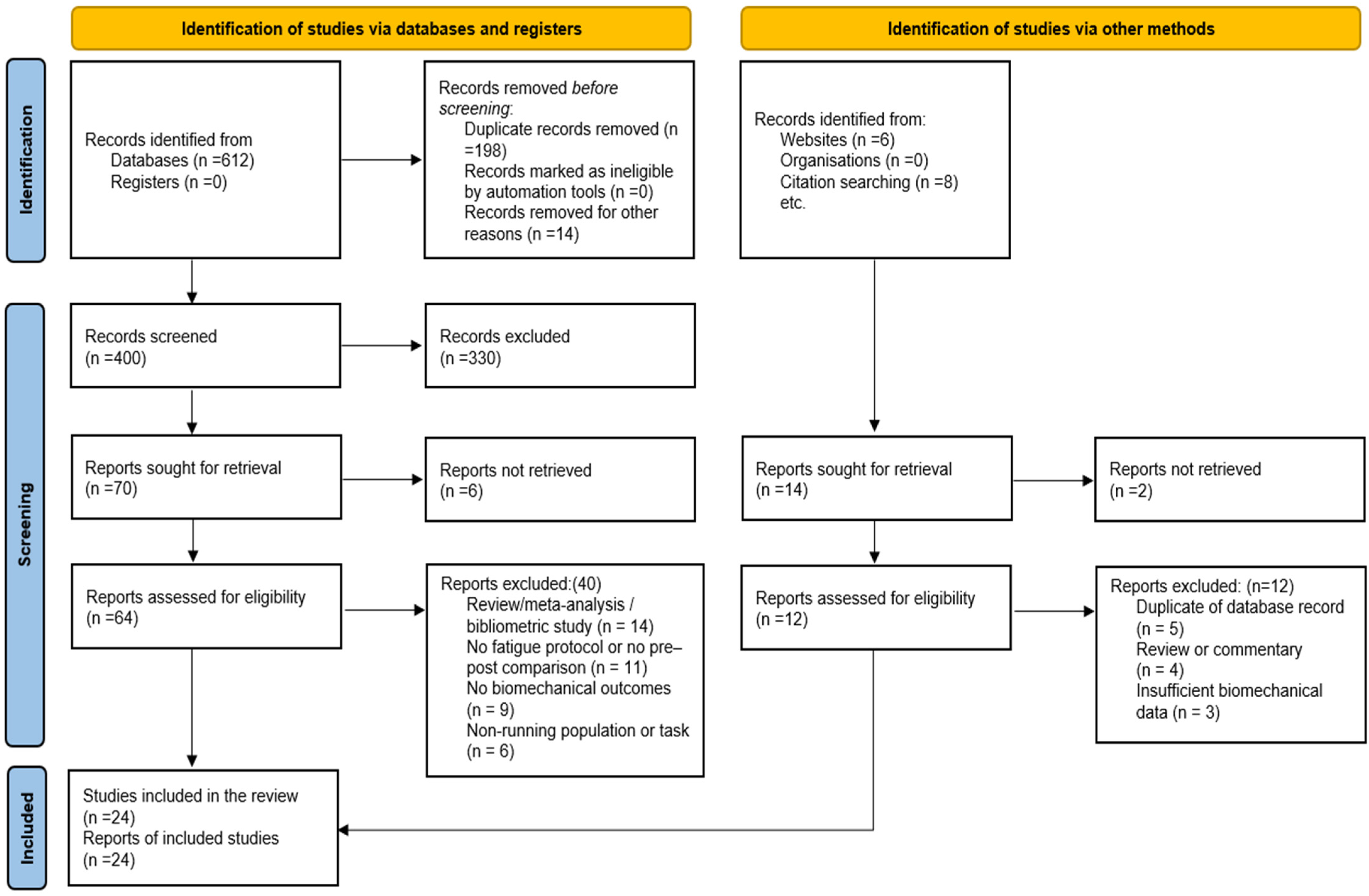
All records retrieved from the database search were imported into a reference management software, and duplicate records were removed before screening. Study selection was conducted in two stages. First, titles and abstracts were independently screened to exclude clearly irrelevant studies, such as those not involving running, not involving fatigue, or not reporting biomechanical outcomes. Second, full-text articles of potentially eligible studies were assessed against predefined inclusion and exclusion criteria. Studies were included if they involved human participants performing running or running-related tasks, employed an explicit fatigue protocol, and reported quantitative biomechanical outcomes of the lower limb. Systematic reviews, meta-analyses, bibliometric studies, non-running studies, and studies without pre-post fatigue biomechanical comparisons were excluded. Discrepancies during study selection were resolved through discussion, consistent with established systematic review methodology [18]. The complete selection process is summarized using a PRISMA 2020 flow diagram (Figure 1).
All included studies involved healthy participants without diagnosed neurological disorders or acute musculoskeletal injuries; no studies explicitly examined clinical populations or runners with active injury, which limits generalizability to rehabilitation or pathological cohorts.

2.2. Literature Search: Administration and Update

A systematic literature search was conducted to identify studies examining the effects of fatigue on lower-limb biomechanics during running. The search strategy was developed and reported in accordance with the PRISMA 2020 guidelines [19] and followed established recommendations for transparent reporting of electronic search strategies in systematic reviews [20]. Searches were implemented across three electronic databases, PubMed, Scopus, and Web of Science, selected for their comprehensive coverage of biomechanics, sports science, and kinesiology research. Search terms were constructed using combinations of keywords and Boolean operators related to running (“running,” “treadmill,” “overground running”), fatigue (“fatigue,” “exercise-induced fatigue,” “running-induced fatigue”), and biomechanics (“biomechanics,” “kinematics,” “kinetics,” “stiffness,” “impact loading,” “ground reaction forces”). The complete Boolean search strategy used in PubMed was as follows: (“running” OR “distance running” OR “treadmill running” OR “overground running” OR “sprint running”) AND (“fatigue” OR “exercise-induced fatigue” OR “running-induced fatigue” OR “neuromuscular fatigue”) AND (“biomechanics” OR “kinematics” OR “kinetics” OR “joint mechanics” OR “stiffness” OR “ground reaction force” OR “impact loading” OR “spring-mass” OR “movement variability”).
The search was limited to studies published in English between January 2010 and December 2025 to capture contemporary biomechanical methodologies. Reference lists of eligible studies and relevant reviews were manually screened to identify additional studies not retrieved through database searching. The final search update was performed before manuscript submission to ensure inclusion of the most recent evidence (Table 1).

2.3. Data Extraction

Data extraction was performed using a standardized extraction form designed specifically for biomechanics research. Extracted information included author and year of publication, study design, participant characteristics (sample size, sex, training status), fatigue protocol characteristics, biomechanical outcome domains, measurement instruments, and key findings related to fatigue-induced biomechanical changes. Particular emphasis was placed on extracting details of fatigue exposure and biomechanical measurement techniques to allow methodological comparison across studies. When required information was unclear or incomplete, the original article was carefully re-examined to minimize extraction errors. This approach follows best practice recommendations for systematic reviews in movement science and biomechanics [18,21,22].

2.4. Methodological Quality of the Included Studies

The methodological quality and risk of bias of the included studies were assessed using the Cochrane Risk of Bias 2 (RoB-2) tool, adapted for experimental biomechanics and kinesiology research [23]. Although the RoB-2 tool was originally developed for randomized controlled trials, it was pragmatically adapted in this review to evaluate within-subject experimental designs, with emphasis on measurement validity, protocol standardization, and selective reporting. The following domains were evaluated: bias arising from the randomization process, deviations from intended interventions (fatigue protocol adherence), missing outcome data, measurement of outcomes, and selective reporting. As most included studies employed non-randomized or within-subject experimental designs, particular attention was given to protocol standardization and outcome measurement validity. Each study was categorized as having low risk of bias, some concerns, or high risk of bias.
The RoB-2 tool was adapted because its domain-based framework aligns well with controlled experimental and within-subject biomechanics designs, where protocol standardization and objective outcome measurement are central. Although ROBINS-I was considered, it is primarily suited for observational clinical studies with complex confounding structures and was therefore less appropriate for tightly controlled laboratory fatigue experiments.
This assessment informed the interpretation of findings but did not serve as an exclusion criterion, in line with PRISMA recommendations.
Although the RoB-2 tool was originally developed for randomized controlled trials, it was applied in the present review with contextual adaptation due to the predominance of experimental, within-subject, and repeated-measures designs in biomechanics research. Several RoB-2 domains, particularly outcome measurement, missing data, and selective reporting, are directly applicable to fatigue biomechanics studies regardless of randomization. The randomization domain was interpreted with caution, acknowledging that many included studies employed controlled laboratory fatigue protocols rather than allocation-based group comparisons. Alternative tools designed for non-randomized intervention studies (e.g., ROBINS-I) were considered; however, they were deemed less appropriate given the acute, mechanistic nature of the fatigue protocols and the absence of exposure-based group comparisons. This pragmatic approach aligns with prior systematic reviews in sports biomechanics that adapt RoB-2 for experimental and within-subject designs to ensure consistent and transparent methodological appraisal.

2.5. Summary Measures

Due to heterogeneity in fatigue protocols, biomechanical outcome measures, and reporting metrics, standardized quantitative summary measures such as pooled effect sizes were not calculated. However, synthesis extended beyond simple vote counting. Where available, the magnitude and direction of biomechanical changes were qualitatively integrated into the narrative synthesis, including reported percentage changes, relative shifts in joint contribution, changes in stiffness magnitude, and alterations in force time characteristics. This approach emphasizes the mechanical significance of fatigue-related adaptations rather than relying solely on the frequency of reported findings and is consistent with the Synthesis Without Meta-analysis (SWiM) reporting recommendations [24].

2.6. Synthesis of Results

A narrative synthesis approach was employed to integrate findings across studies. Results were synthesized according to major biomechanical domains, including spatiotemporal parameters, joint kinematics, joint kinetics, stiffness and spring-mass behaviour, impact loading, coordination and variability, inter-limb asymmetry, and balance-related measures. This domain-based synthesis enabled the identification of common fatigue-related biomechanical patterns while accounting for methodological and outcome heterogeneity across studies. The synthesis process involved grouping studies according to fatigue modality, running environment, and biomechanical outcome domain, followed by structured comparison of directional trends and consistency of fatigue-related changes across studies. Patterns were identified within and across biomechanical domains (e.g., spatiotemporal parameters, joint kinetics, stiffness, and coordination), while discrepancies were interpreted in relation to differences in fatigue intensity, participant characteristics, and measurement techniques. This approach followed established methodological guidance for narrative synthesis in systematic reviews of complex and heterogeneous interventions [24,25].

2.7. Data Synthesis

Data synthesis emphasized qualitative integration rather than statistical pooling. Studies were grouped based on similarities in fatigue modality, running environment, and biomechanical outcome domain. Consistent trends across studies were highlighted, while conflicting findings were interpreted in the context of differences in participant characteristics, fatigue intensity, and measurement techniques. Statistical integration was inappropriate due to substantial heterogeneity in fatigue protocols (sprint vs. endurance), running environments, participant characteristics, and biomechanical outcome definitions across studies. Key variables such as ankle stiffness, joint kinetics, and spatiotemporal parameters were quantified using non-comparable models, speeds, and fatigue thresholds. Accordingly, a narrative synthesis was adopted to preserve contextual specificity and enable mechanistic interpretation, consistent with recommendations for synthesis without meta-analysis in heterogeneous biomechanics research [24,25,26].

2.8. Additional Analyses and Publication Bias

Formal assessment of publication bias using funnel plots or regression-based methods was not conducted, as such approaches are not recommended when meta-analysis is not performed or when substantial methodological and clinical heterogeneity exists among included studies [18]. Given the diversity of fatigue protocols, participant populations, and biomechanical outcome measures, quantitative evaluation of small-study effects was deemed inappropriate. Instead, potential publication bias was addressed qualitatively through comprehensive searches across multiple electronic databases, screening of the reference lists of eligible articles, and consideration of grey literature sources, such as conference proceedings and academic theses, where available. This approach aligns with recommendations for narrative and qualitative evidence synthesis, which emphasize comprehensive evidence capture and contextual interpretation over statistical assessment of bias [27]. In addition, the influence of methodological quality, study design, and sample size on reported biomechanical findings was carefully considered during data interpretation to mitigate the impact of selective reporting.

3. Results

Across the 24 included studies, the consistency of fatigue-related adaptations varied across biomechanical domains. High consistency was observed for increased ground contact time, reduced ankle power and stiffness, elevated impact loading, and increased coordination variability. Moderate consistency was evident for changes in joint range of motion, proximal joint loading, and inter-limb asymmetry. Lower consistency was observed for cadence adjustments and ankle range of motion changes, reflecting protocol and population variability.
This systematic literature search and study selection process identified 24 studies published between 2010 and 2025 that met the predefined inclusion criteria. At the full-text screening stage, an additional 23 studies were excluded because they examined fatigue without reporting biomechanical outcomes or assessed biomechanics without an explicit fatigue protocol, highlighting the fragmented nature of the existing literature. These studies collectively examined the biomechanical effects of exercise-induced fatigue during running across a wide range of participant populations, fatigue modalities, and experimental environments. The results are presented in a structured manner, beginning with an overview of study characteristics and methodological quality, followed by a domain-wise synthesis of fatigue-related biomechanical adaptations, including spatiotemporal parameters, joint kinematics and kinetics, spring-mass behaviour, impact loading, coordination variability, neuromuscular indicators, and inter-limb asymmetry. Findings are summarized descriptively to highlight the direction, consistency, and injury relevance of biomechanical changes observed under fatigued conditions.
Table 2 summarizes 24 experimental and field-based studies (2010–2025) examining fatigue-related biomechanical changes during running and jumping tasks across recreational, trained, and clinical runner populations. Fatigue was induced using diverse protocols, including repeated sprints, graded treadmill running, endurance races, and sport-specific tasks. Outcome domains covered spring–mass mechanics, joint kinematics and kinetics, impact loading, coordination, variability, symmetry, balance, and bone strain.
Methods included force plates, motion capture, IMUs, EMG, and musculoskeletal–finite element modelling. Despite heterogeneity, consistent patterns emerged, including increased contact time, altered or redistributed stiffness, elevated joint loading, and greater movement variability under fatigue. Several studies showed that performance outputs were preserved despite substantial internal biomechanical alterations. Overall, the findings indicate that fatigue induces multi-system biomechanical adaptations that may increase musculoskeletal injury risk.
Table 3 presents the methodological quality of included studies assessed using the RoB-2 tool. Most studies were rated as having “some concerns, mainly due to non-randomized or within-subject designs. Outcome measurement and missing data domains were generally rated as low risk. A limited number of studies demonstrated a high overall risk of bias.
Table 4 summarizes fatigue intervention characteristics across the 24 included studies, with fatigue primarily conceptualized as an acute exposure induced through laboratory protocols or occurring during real-world endurance events. Fatigue modalities ranged from short-duration maximal tasks to prolonged continuous running and competitive races. Termination criteria included volitional exhaustion, fixed task completion, or race distance, while fatigue monitoring relied on performance decline, physiological markers, perceptual scales, or wearable-derived metrics.
Although intervention designs were heterogeneous, consistent biomechanical responses emerged, including increased joint loading, altered stiffness regulation, elevated impact metrics, and greater movement variability. Several studies also demonstrated task-dependent or group-specific vulnerability, highlighting that fatigue effects are context- and population-sensitive. Collectively, the interventions produced mechanical adaptations consistent with elevated musculoskeletal loading and potential injury risk.
Table 5 synthesises common fatigue protocol characteristics and methodological patterns across the included studies. Fatigue was almost exclusively conceptualised as an acute exposure, with biomechanical assessments conducted immediately following fatigue induction, and no studies examining chronic or cumulative fatigue effects. Continuous running was the dominant fatigue modality, while fewer studies employed sprint-based, endurance race, or task-transfer designs. Most protocols were laboratory-based treadmill interventions, with a smaller number of field studies capturing fatigue during real-world races, improving ecological validity but reducing experimental control.
Fatigue duration and intensity varied widely, ranging from brief maximal tasks to prolonged endurance exposures, and termination criteria were inconsistently defined, often relying on task completion or volitional exhaustion without physiological thresholds. Fatigue verification methods were heterogeneous, including subjective ratings, mechanical performance decrements, and wearable-derived metrics, and recovery allowances were rarely incorporated before biomechanical testing. Collectively, the substantial protocol heterogeneity limited quantitative pooling of results and supported the use of narrative synthesis.
Table 6 summarises the direction, consistency, and injury-relevant nature of biomechanical changes observed under fatigue. Across studies, fatigue was most consistently associated with increased ground contact time, reduced distal joint contribution (notably decreased ankle power and functional stiffness), and a compensatory shift toward greater knee and hip loading. Impact-related measures, including tibial acceleration and vertical loading rate, tended to increase during prolonged or high-speed conditions, indicating elevated skeletal loading.
Fatigue also produced marked increases in coordination and motor variability, particularly in trunk–pelvis–hip coupling, suggesting reduced neuromuscular stability. Several studies reported increased inter-limb asymmetry and impaired balance or landing stability, especially following task-transfer protocols. While the magnitude of individual biomechanical responses varied across studies and populations, the overall pattern indicates a shift toward less efficient and more injury-relevant mechanical strategies under fatigue.
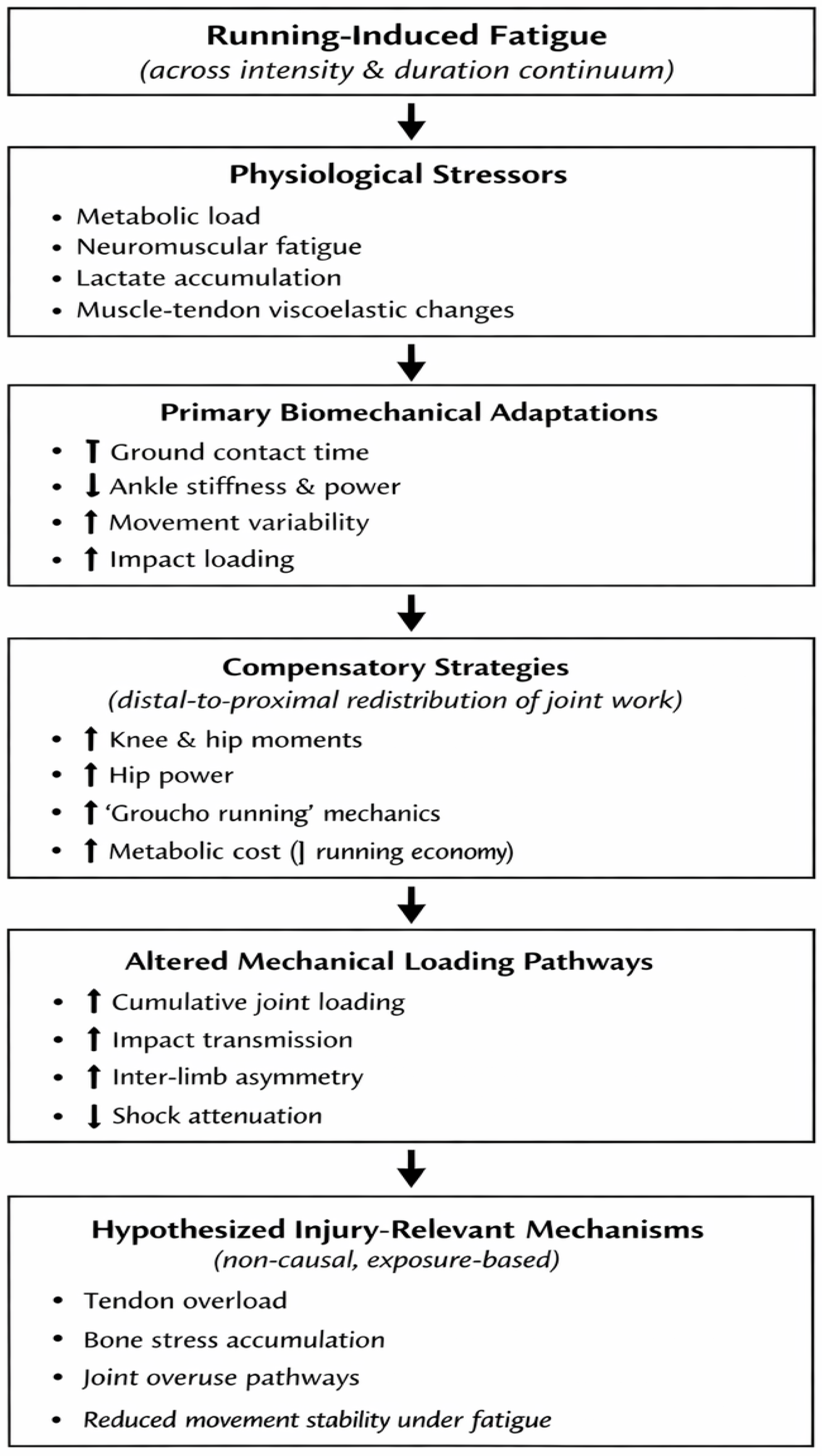
This schematic illustrates (Figure 2) how running-induced fatigue, arising across a continuum of intensity and duration, initiates physiological stressors that drive progressive biomechanical adaptations. These adaptations include alterations in spatiotemporal parameters, joint mechanics, stiffness, impact loading, and coordination. Compensatory strategies, particularly distal-to-proximal redistribution of joint work, may help preserve running performance but increase metabolic cost and modify mechanical loading patterns. The framework highlights hypothesized injury-relevant mechanical pathways rather than direct injury causation, as most included studies did not prospectively assess injury outcomes.

4. Discussion

4.1. Overview of Main Findings

The present systematic review synthesized evidence from 24 original studies published between 2010 and 2025 to examine the effects of fatigue on lower-limb biomechanics during running. Collectively, the findings demonstrate that exercise-induced fatigue consistently alters spatiotemporal parameters, joint kinematics and kinetics, spring-mass behaviour, impact loading, coordination variability, and inter-limb symmetry. Although methodological heterogeneity precluded quantitative pooling, strong qualitative convergence was evident across multiple biomechanical domains, suggesting that fatigue induces systematic and potentially injury-relevant mechanical adaptations during running (see Table 2, Table 4 and Table 6). Rather than reiterating individual findings already summarized in the results and tables, the following discussion focuses on the underlying mechanisms and functional implications of fatigue-induced biomechanical adaptations. Specifically, emphasis is placed on why these adaptations emerge under fatigue and how they influence running performance, mechanical efficiency, and potential injury-relevant loading pathways.

4.2. Effects of Fatigue on Spatiotemporal Parameters

One of the most consistent fatigue-related adaptations across the included literature involved spatiotemporal parameters, particularly changes in stance-phase mechanics (Table 6). The observed increase in ground contact time under fatigue likely reflects reduced neuromuscular efficiency and slower force application, indicating a diminished capacity to rapidly generate and absorb forces during stance [7,8,38]. This interpretation is supported by force–time impairments reported in countermovement jump and running fatigue protocols, which demonstrate fatigue-related reductions in rate of force development and impulse generation [5]. While subtle adjustments in cadence and stride length may serve as compensatory strategies to preserve running speed, prolonged contact times increase cumulative musculoskeletal loading per stride and modify impact attenuation characteristics. Consequently, sustained or repeated exposure to these altered loading patterns has been associated with theoretical mechanisms underlying overuse-related musculoskeletal injury development [6,40,41,42].

4.3. Joint Kinematic Adaptations Under Fatigue

Joint kinematic adaptations to fatigue were consistently observed at the ankle, knee, and hip (Table 6). Increased knee flexion during stance was one of the most frequently reported changes, particularly in novice and recreational runners [10,15,28]. While greater knee flexion may enhance shock absorption under fatigued conditions, it simultaneously increases patellofemoral joint stress, potentially contributing to knee-related overuse injuries. In parallel, several studies identified increased ankle dorsiflexion and altered ankle range of motion following fatigue [14,17]. These changes suggest reduced elastic recoil capacity of the ankle–Achilles complex, which may shift mechanical demands proximally to the knee and hip joints. This proximal redistribution of load is further supported by evidence of increased hip flexion and hip joint work under fatigued conditions [10,36].

4.4. Joint Kinetic Alterations and Proximal Load Redistribution

Fatigue-induced changes in joint kinetics further reinforce a proximal shift in mechanical demand during running. Runner expertise is an important factor when interpreting these adaptations. Novice and recreational runners typically exhibit larger kinematic deviations, increased movement variability, and greater stiffness loss under fatigue. In contrast, trained and elite runners often maintain more stable mechanics and distal joint contribution, reflecting superior neuromuscular coordination and fatigue resistance. Accordingly, findings should be interpreted with caution when performance levels are blended.
Reductions in ankle joint power and stiffness were consistently reported across laboratory- and field-based studies [8,9,11] (See Table 2 and Table 6). Given the ankle’s critical role in elastic energy storage during running, fatigue-related impairment at this joint promotes a distal-to-proximal redistribution of mechanical work. This redistribution is characterized by reduced ankle contribution and compensatory increases in knee joint moments and hip power output [10,31,43,44]. While this strategy may help preserve running speed under fatigued conditions, it increases reliance on active muscular work at proximal joints and reduces elastic energy return. This compensation pattern resembles a “groucho running” strategy and is therefore likely accompanied by an increased metabolic cost of transport and reduced running economy.
When such compensatory loading is sustained or repeatedly exposed under fatigue, it may contribute to injury-relevant mechanical loading pathways at the knee, hip, and lumbar regions. These pathways should be interpreted as theoretical rather than direct injury causation [43,45].
Fatigue-related biomechanical adaptations should not be interpreted as abrupt transitions between non-fatigued and fatigued states. Instead, available evidence indicates that mechanical adjustments emerge progressively over time. Early fatigue is often characterized by subtle kinematic changes, such as increased joint range of motion and prolonged ground contact time, reflecting initial neuromuscular compensation. As fatigue accumulates, reductions in ankle joint power and stiffness become more pronounced, compromising elastic energy storage and push-off capacity. In later stages, runners increasingly adopt proximal compensatory strategies, marked by elevated knee and hip joint moments and power output. This phased adaptation highlights fatigue as a dynamic process in which biomechanical strategies evolve to maintain task performance despite declining neuromuscular capacity. Sex, training status, and age were inconsistently reported across studies, limiting subgroup interpretation; most samples were male or mixed-sex, with few sex-specific analyses and minimal representation of youth or older runners. Available evidence indicates that novice runners exhibit greater kinematic deviations and stiffness loss under fatigue than trained or elite runners, highlighting the need for future stratified investigations.

4.5. Spring-Mass Behaviour and Mechanical Efficiency

Spring-mass behaviour emerged as a central theme across the included literature. Multiple studies demonstrated reductions in vertical and leg stiffness following fatigue (Table 2 and Table 6), irrespective of running experience or fatigue modality [7,9,11,12]. Reduced stiffness compromises the efficiency of elastic energy storage and return, which may partly explain the observed increases in ground contact time and joint range of motion. From an injury-mechanics perspective, diminished stiffness reduces the system’s ability to attenuate impact forces, thereby increasing the transmission of loads to passive structures such as bone and cartilage. This interpretation is consistent with findings from ultra-endurance and speed-perturbation studies reporting increased tibial acceleration and strain under fatigued conditions [13,35]. Importantly, reductions in global leg and vertical stiffness under fatigue should not be interpreted solely as centrally mediated or coordinative strategies. Acute fatigue also induces tissue-level alterations in the viscoelastic properties of the muscle tendon unit, including changes in tendon compliance, muscle stiffness, and damping characteristics. Exhaustive or prolonged running has been shown to produce heterogeneous reductions in tendon stiffness and alterations in muscle force–length behavior, which directly impair elastic energy storage and return. These acute viscoelastic changes provide a mechanistic explanation for the observed increases in ground contact time, joint excursion, and impact transmission under fatigued conditions. Accordingly, fatigue-related reductions in spring–mass stiffness likely reflect the combined influence of neuromuscular control strategies and transient alterations in muscle tendon mechanical properties.

4.6. Impact Loading and Injury-Relevant Mechanical Indicators

Impact loading variables provide further insight into fatigue-related injury mechanisms (Table 6). Several studies reported increased vertical loading rates and tibial acceleration following fatigue [13,14,38,46]. Elevated loading rates are widely regarded as biomechanical indicators that may contribute to stress-related injury mechanisms, particularly when combined with prolonged exposure and insufficient recovery; however, most studies included in this review did not prospectively assess injury incidence. Importantly, these impact-related changes were observed not only in laboratory treadmill studies but also under real-world conditions, such as ultramarathon and half-marathon running [13,38]. This convergence across experimental and field environments strengthens the ecological validity of fatigue-induced biomechanical adaptations. Recent systematic evidence highlights the complexity of linking biomechanical deviations to injury outcomes. No single lower-limb biomechanical variable has been identified as an independent causal factor for groin pain [46], supporting the present findings that fatigue induces distributed, multi-joint mechanical adaptations rather than isolated injury-specific patterns [47].

4.7. Mechanical Correlates Versus Direct Injury Outcomes

It is important to distinguish between biomechanical variables that are mechanically associated with injury risk and direct clinical injury outcomes. The majority of studies included in this review quantified mechanical indicators such as loading rates, joint moments, stiffness, and movement variability, but did not prospectively track injury incidence. Accordingly, these variables should be interpreted as biomechanical correlates or theoretical pathways that may contribute to injury development rather than causal predictors of injury. While established injury biomechanics literature supports the relevance of these mechanical markers, definitive injury risk inference requires longitudinal designs integrating fatigue exposure, biomechanical monitoring, and injury surveillance. This distinction is essential to avoid over-interpretation of fatigue-related biomechanical adaptations as direct evidence of injury causation.

4.8. Coordination Variability and Motor Control Under Fatigue

Coordination variability and motor control adaptations represent another important dimension of fatigue-related biomechanical change (Table 2 and Table 6). Increased coordination variability at the trunk–pelvis–hip complex was consistently reported following fatigue, particularly at higher running speeds [16]. Similarly, fatigue-induced alterations in the structure of motor variability have been demonstrated in novice runners [15], indicating reduced movement stability [15]. While some degree of variability is essential for adaptive movement, excessive or poorly structured variability under fatigue may reflect compromised neuromuscular control and reduced capacity to respond to perturbations, thereby increasing non-contact injury risk during dynamic running conditions.

4.9. Inter-Limb Asymmetry and Bilateral Load Distribution

Inter-limb asymmetry emerged as a notable fatigue-related adaptation across several studies (Table 6). Increased asymmetry in joint moments following prolonged running-induced fatigue has been reported, suggesting uneven load distribution between limbs [17]. Such asymmetry may arise from unilateral strength deficits, neuromuscular fatigue, or compensatory strategies and has been implicated in the development of unilateral overuse injuries. These findings underscore the importance of assessing bilateral mechanics when evaluating fatigue effects, particularly in runners with pre-existing asymmetries or injury history. Injury-prediction evidence further supports the injury relevance of fatigue-related biomechanical asymmetries. From an injury epidemiology perspective, fatigue-induced inter-limb asymmetry represents a meaningful mechanical exposure that alters tissue loading patterns and interacts with individual susceptibility, contributing to injury risk when asymmetrical loading is repeated over time [48]. Although derived from a jumping-dominant task, these findings closely align with fatigue-induced increases in asymmetry, coordination variability, and proximal loading reported in running, reinforcing their injury relevance across high-impact activities. Interpretation of fatigue-related inter-limb asymmetry should extend beyond unilateral strength deficits to include the physiological dynamics of high-intensity exercise. During repeated maximal efforts, elevated blood lactate has been shown to modulate muscle activation patterns and intermuscular coordination, which can alter asymmetry expression under fatigue. Recent evidence from elite sprinters demonstrates that progressive lactate accumulation during repeated sprinting is associated with systematic changes in lower-limb muscle activity and, in some cases, reduced inter-limb asymmetry, indicating a fatigue-induced reorganization of neuromuscular control rather than purely mechanical imbalance [49].

4.10. Neuromuscular Performance Degradation

Neuromuscular indicators derived from force–time analysis further support the presence of fatigue-induced mechanical degradation (Table 2 and Table 6). Wu et al. (2019) [5], along with Gathercole et al. (2015) and McMahon et al. (2018), demonstrated that countermovement jump force time signatures can distinguish between neuromuscular and metabolic fatigue, with fatigue states characterized by reductions in impulse and rate of force development [5,45,50]. These impairments likely contribute to the observed reductions in lower-limb stiffness and joint power during running, as diminished force-generating capacity compromises effective energy transfer across the muscle tendon units. Importantly, such neuromuscular deficits may persist beyond the immediate fatigue task, resulting in altered movement strategies and impaired load attenuation during subsequent training or competition sessions, thereby increasing susceptibility to overuse and non-contact injuries [50,51,52].

4.11. Transfer Effects to Functional Tasks

Task-transfer studies provided additional insight into how running-induced fatigue influences biomechanical performance in related tasks (Table 6). Several investigations reported impaired landing stability and balance performance following fatigue, as evidenced by altered joint loading during tuck-jump assessments and Y-Balance tests [34,37,53]. These findings indicate that fatigue effects extend beyond steady-state running to dynamic tasks requiring rapid force production and postural control, which is particularly relevant for sports involving combined running, jumping, and cutting actions.

4.12. Methodological Heterogeneity and Research Gaps

Despite the overall consistency of directional trends, considerable heterogeneity was observed across studies in fatigue protocols, participant characteristics, and measurement techniques. Fatigue duration ranged from short, task-induced protocols to extreme ultra-endurance events, and verification methods varied from subjective measures such as RPE to objective performance or force-based criteria. This variability limits direct comparison across studies and highlights the need for standardized fatigue definitions and verification procedures in future biomechanical research. Nonetheless, the convergence of findings across diverse methodologies suggests that the fundamental biomechanical consequences of fatigue are robust.

4.13. Practical Implications

From a practical perspective, the findings of this review have important implications for training, injury prevention, and rehabilitation. Coaches and practitioners should recognize that fatigue alters not only performance outcomes but also underlying mechanical loading patterns. Training interventions emphasizing fatigue-resistant strategies such as improving ankle stiffness, proximal joint control, and neuromuscular coordination may help mitigate adverse biomechanical adaptations. Additionally, wearable sensor technologies demonstrated in several included studies [38,39] offer promising tools for real-time fatigue monitoring and individualized load management. From a practical perspective, the findings of this review support the use of targeted monitoring and training strategies to manage fatigue-related biomechanical alterations. For example, wearable inertial measurement units (IMUs) or instrumented treadmills can be used to monitor changes in ground contact time, stride characteristics, and impact loading as indicators of emerging fatigue during training or competition. Reductions in ankle stiffness or push-off power may signal the need for load modification, recovery emphasis, or technique-focused interventions. Strength and conditioning programs may prioritize ankle–foot complex stiffness, calf muscle endurance, and elastic energy utilization to delay distal fatigue and reduce compensatory proximal loading. Additionally, coaches may employ neuromuscular fatigue monitoring tools such as countermovement jump force–time analysis or asymmetry metrics to inform individualized training adjustments and recovery strategies, particularly during high-intensity or prolonged running blocks. For example, during a rehabilitation or gait retraining session using virtual reality (VR), a therapist could integrate wearable inertial sensors placed on the shank or foot to continuously monitor ground contact time, step symmetry, and impact loading in real time. If the system detects progressive increases in contact time asymmetry or excessive impact peaks as fatigue develops, the VR environment can provide immediate visual or auditory feedback prompting gait correction, pacing adjustment, or rest intervals. Such sensor-guided feedback allows clinicians to individualize load progression, minimize compensatory movement patterns, and enhance neuromuscular control during immersive training or rehabilitation sessions.

4.14. Limitations and Future Directions

Several limitations of the current evidence base warrant consideration. Most included studies employed small sample sizes and laboratory-based designs, which may limit generalizability. Moreover, few studies directly linked biomechanical changes to injury outcomes, necessitating cautious interpretation of injury relevance. Nevertheless, the mechanical indicators identified in this review are well supported by established injury biomechanics literature [6] and provide a strong foundation for hypothesis generation in future longitudinal investigations.
An important limitation of the present review is the aggregation of biomechanical outcomes across fatigue protocols that arise from fundamentally different physiological mechanisms. Short-duration, high-intensity running (e.g., sprint or middle-distance efforts) is predominantly characterized by metabolic acidosis, inorganic phosphate accumulation, and rapid neuromuscular fatigue, whereas prolonged endurance running involves distinct processes such as glycogen depletion, muscle damage, and central fatigue. Although similar biomechanical adaptations, such as reduced ankle stiffness or increased joint flexion, were observed across fatigue modalities, these adaptations may emerge from different underlying physiological states. Accordingly, the term ‘fatigued state’ in this review should be interpreted as a functional biomechanical condition rather than a uniform physiological entity, and caution is warranted when extrapolating findings across sprint- and endurance-based fatigue contexts. Another important limitation is that the injury relevance of fatigue-induced biomechanical adaptations was interpreted indirectly. The majority of included studies quantified biomechanical variables without prospectively tracking injury outcomes. Consequently, references to injury risk throughout this review should be interpreted as hypothesized or theoretical mechanical pathways informed by established injury biomechanics literature, rather than as direct evidence of injury causation. Future longitudinal studies integrating fatigue exposure, biomechanical assessment, and injury surveillance are required to confirm these relationships. Furthermore, substantial heterogeneity in fatigue protocols, including differences in fatigue modality, duration, intensity, termination criteria, and verification methods, limits the direct comparability of biomechanical outcomes across studies. Variations in experimental design may influence both the magnitude and temporal expression of fatigue-related adaptations, contributing to between-study variability. This heterogeneity constrained the ability to quantitatively synthesize findings and necessitated a narrative, domain-based approach. Consequently, observed consistencies should be interpreted as indicative of general biomechanical trends rather than precise estimates of fatigue effects across all running contexts.

5. Conclusions

This systematic review demonstrates that exercise-induced fatigue consistently alters lower-limb biomechanics during running, affecting spatiotemporal characteristics, joint kinematics and kinetics, spring-mass behavior, impact loading, neuromuscular output, coordination variability, and inter-limb symmetry. Across studies published between 2010 and 2025, fatigue-related biomechanical adaptations followed clear directional trends despite heterogeneity in fatigue protocols, participant populations, and measurement techniques, indicating robust and systematic mechanical responses to fatigue. Fatigue was commonly associated with prolonged ground contact time, reduced ankle joint power and stiffness, increased joint range of motion, elevated impact loading, and greater movement variability. These changes reflect a decline in mechanical efficiency and a redistribution of load from distal to proximal joints, particularly toward the knee and hip. Such adaptations may help maintain running performance in the short term but simultaneously create mechanical conditions associated with increased susceptibility to overuse and non-contact injuries, especially during prolonged or repeated exposure to fatigue. Importantly, similar biomechanical patterns were observed across controlled laboratory studies and real-world endurance running conditions, supporting the ecological validity and practical relevance of the findings. Transfer effects to functional tasks such as jumping and balance assessments further indicate that fatigue-related biomechanical deficits extend beyond steady-state running and may influence movement stability in sport-specific contexts. Collectively, these findings highlight fatigue as a critical determinant of running biomechanics and injury-relevant mechanical loading. Integrating fatigue-aware biomechanical assessment, neuromuscular conditioning, and individualized load management into training and rehabilitation programs may help mitigate adverse fatigue-related adaptations. Future research should prioritize standardized fatigue protocols, longitudinal designs linking biomechanics to injury outcomes, and wider application of wearable technologies to advance understanding of fatigue–biomechanics–injury relationships. From an applied perspective, the most actionable fatigue-related biomechanical adaptations include prolonged ground contact time, reductions in ankle stiffness and push-off power, elevated impact loading, and increased coordination variability. These variables are consistently observable across protocols and can be monitored using wearable sensors, force platforms, or field-based performance testing. Targeting these adaptations through load management, ankle–foot complex conditioning, neuromuscular control training, and recovery optimization may offer practical benefits for injury risk mitigation and performance sustainability.

Author Contributions

Conceptualization, P.K.C. and S.C.; methodology, P.K.C.; software, P.K.C. and S.S.; validation, P.K.C., Y.S.R., V.-C.C. and V.N.-L.; formal analysis, P.K.C., S.C. and Y.S.R.; data curation, P.K.C. and S.C.; writing—original draft preparation, P.K.C. and S.S.; writing—review and editing, S.S., V.N.-L., C.Ș. and S.-I.P.; visualization, P.K.C. and S.S.; supervision, V.-C.C., V.N.-L. and C.Ș.; project administration, P.K.C., S.C. and S.S.; funding acquisition, V.-C.C., V.N.-L. and C.Ș. All authors have read and agreed to the published version of the manuscript.

Funding

This research received no external funding.

Institutional Review Board Statement

Not applicable.

Informed Consent Statement

Not applicable.

Data Availability Statement

All evidence included in this systematic review is derived exclusively from previously published studies. No new data were generated or independently analyzed for the purposes of this research. Detailed information on the included studies, such as data extraction tables and methodological documentation, is available from the corresponding author upon reasonable request.

Acknowledgments

The authors sincerely acknowledge the researchers whose published work formed the foundation of this systematic review. We also extend our appreciation to the academic and technical support teams for their guidance during the literature search, screening, and synthesis processes. Special thanks are due to our colleagues and mentors for their valuable and constructive feedback, which contributed to improving the quality of the manuscript. Finally, we gratefully acknowledge the institutional support that enabled access to essential databases and scholarly resources necessary for the completion of this study.

Conflicts of Interest

The authors declare that there are no potential conflicts of interest associated with this study.

References

  1. Hammami, A.; Mahmoudi, A.; Selmi, W.; Negra, Y.; Rebai, H.; Granacher, U.; Hammami, R. Effects of neuromuscular versus plyometric training on physical fitness and mental well-being in male pubertal soccer players. Sci. Rep. 2025, 15, 43393. [Google Scholar] [CrossRef]
  2. Baghel, B.S.; Patel, D.C.B. Impact of Sports Training On Physical and Psychological Development in Male Athlete. Int. J. Sci. Res. Sci. Eng. Technol. 2025, 12, 198–205. [Google Scholar] [CrossRef]
  3. Van Hooren, B.; Jukic, I.; Cox, M.; Frenken, K.G.; Bautista, I.; Moore, I.S. The Relationship Between Running Biomechanics and Running Economy: A Systematic Review and Meta-Analysis of Observational Studies. Sports Med. 2024, 54, 1269–1316. [Google Scholar] [CrossRef]
  4. Figueiredo, I.; Reis ESilva, M.; Sousa, J.E. The Influence of Running Cadence on Biomechanics and Injury Prevention: A Systematic Review. Cureus 2025, 17, e90322. [Google Scholar] [CrossRef]
  5. Wu, P.P.Y.; Sterkenburg, N.; Everett, K.; Chapman, D.W.; White, N.; Mengersen, K. Predicting fatigue using countermovement jump force-time signatures: PCA can distinguish neuromuscular versus metabolic fatigue. PLoS ONE 2019, 14, e0219295. [Google Scholar] [CrossRef]
  6. Bahr, R.; Holme, I. Risk factors for sports injuries—A methodological approach. Br. J. Sports Med. 2003, 37, 384–392. [Google Scholar] [CrossRef] [PubMed]
  7. Girard, O.; Millet, G.P.; Slawinski, J.; Racinais, S.; Micallef, J.P. Changes in running mechanics and spring-mass behaviour during a 5-km time trial. Int. J. Sports Med. 2013, 34, 832–840. [Google Scholar] [CrossRef] [PubMed]
  8. Möhler, F.; Fadillioglu, C.; Stein, T. Fatigue-Related Changes in Spatiotemporal Parameters, Joint Kinematics and Leg Stiffness in Expert Runners During a Middle-Distance Run. Front. Sports Act. Living 2021, 3, 634258. [Google Scholar] [CrossRef]
  9. Girard, O.; Micallef, J.P.; Millet, G.P. Changes in spring-mass model characteristics during repeated running sprints. Eur. J. Appl. Physiol. 2011, 111, 125–134. [Google Scholar] [CrossRef]
  10. Yu, P.; Liang, M.; Fekete, G.; Baker, J.S.; Gu, Y. Effect of running-induced fatigue on lower limb mechanics in novice runners. Technol. Health Care 2021, 29, 231–242. [Google Scholar] [CrossRef]
  11. Fischer, G.; Storniolo, J.L.L.; Eyré-Tartaruga, L.A.P. Effects of Fatigue on Running Mechanics: Spring-Mass Behavior in Recreational Runners After 60 Seconds of Countermovement Jumps. J. Appl. Biomech. 2015, 31, 445–451. [Google Scholar] [CrossRef]
  12. Munoz, G.J. Effects of a Fatigue Protocol on Vertical, Leg, and Joint Stiffness During Overground Running. Master’s Thesis, University of Hawaii at Manoa, Honolulu, Hawaii, 2022. Available online: https://hdl.handle.net/10125/104656 (accessed on 20 December 2025).
  13. Giandolini, M.; Gimenez, P.; Temesi, J.; Arnal, P.J.; Martin, V.; Rupp, T.; Morin, J.B.; Samozino, P.; Millet, G.Y. Effect of the Fatigue Induced by a 110-km Ultramarathon on Tibial Impact Acceleration and Lower Leg Kinematics. PLoS ONE 2016, 11, e0151687. [Google Scholar] [CrossRef] [PubMed]
  14. Encarnación-Martínez, A.; García-Gallart, A.; Sanchis-Sanchis, R.; Pérez-Soriano, P. Effects of Central and Peripheral Fatigue on Impact Characteristics during Running. Sensors 2022, 22, 3786. [Google Scholar] [CrossRef] [PubMed]
  15. Möhler, F.; Fadillioglu, C.; Scheffler, L.; Müller, H.; Stein, T. Running-Induced Fatigue Changes the Structure of Motor Variability in Novice Runners. Biology 2022, 11, 942. [Google Scholar] [CrossRef] [PubMed]
  16. Khaleghi Tazji, M.; Valizadeh Ghale-Beig, A.; Sadeghi, H.; Koumantakis, G.A.; Chrysagis, N.; Abbasi, A. Effects of Running-induced Fatigue on the Trunk-pelvis-hip Coordination Variability During Treadmill Running at Different Speeds. J. Musculoskelet. Neuronal Interact. 2023, 23, 189–195. [Google Scholar]
  17. Gao, Z.; Fekete, G.; Baker, J.S.; Liang, M.; Xuan, R.; Gu, Y. Effects of running fatigue on lower extremity symmetry among amateur runners: From a biomechanical perspective. Front. Physiol. 2022, 13, 899818. [Google Scholar] [CrossRef]
  18. Higgins, J.P.T.; Thomas, J.; Chandler, J.; Cumpston, M.; Li, T.; Page, M.J.; Page, M.J.; Welch, V.A. (Eds.) Cochrane Handbook for Systematic Reviews of Interventions, 1st ed.; Wiley: Hoboken, NJ, USA, 2019; Available online: https://onlinelibrary.wiley.com/doi/book/10.1002/9781119536604 (accessed on 20 December 2025).
  19. Page, M.J.; McKenzie, J.E.; Bossuyt, P.M.; Boutron, I.; Hoffmann, T.C.; Mulrow, C.D.; Shamseer, L.; Tetzlaff, J.M.; Akl, E.A.; Brennan, S.E.; et al. The PRISMA 2020 statement: An updated guideline for reporting systematic reviews. BMJ 2021, 372, n71. [Google Scholar] [CrossRef]
  20. Rethlefsen, M.L.; Kirtley, S.; Waffenschmidt, S.; Ayala, A.P.; Moher, D.; Page, M.J.; Koffel, J.B.; PRISMA-S Group. PRISMA-S: An extension to the PRISMA statement for reporting literature searches in systematic reviews. J. Med. Libr. Assoc. 2021, 109, 174–200. [Google Scholar] [CrossRef]
  21. Bartlett, R.; Wheat, J.; Robins, M. Is movement variability important for sports biomechanists? Sports Biomech. 2007, 6, 224–243. [Google Scholar] [CrossRef]
  22. Horsley, T.; Dingwall, O.; Sampson, M. Checking reference lists to find additional studies for systematic reviews. Cochrane Database Syst. Rev. 2011, 2011, MR000026. [Google Scholar] [CrossRef]
  23. Sterne, J.A.C.; Savović, J.; Page, M.J.; Elbers, R.G.; Blencowe, N.S.; Boutron, I.; Cates, C.J.; Cheng, H.Y.; Corbett, M.S.; Eldridge, S.M.; et al. RoB 2: A revised tool for assessing risk of bias in randomised trials. BMJ 2019, 366, 14898. [Google Scholar] [CrossRef]
  24. Campbell, M.; McKenzie, J.E.; Sowden, A.; Katikireddi, S.V.; Brennan, S.E.; Ellis, S.; Hartmann-Boyce, J.; Ryan, R.; Shepperd, S.; Thomas, J.; et al. Synthesis without meta-analysis (SWiM) in systematic reviews: Reporting guideline. BMJ 2020, 368, 16890. [Google Scholar] [CrossRef] [PubMed]
  25. Popay, J.; Roberts, H.; Sowden, A.; Petticrew, M.; Arai, L.; Rodgers, M.; Britten, N.; Roen, K.; Duffy, S. Guidance on the Conduct of Narrative Synthesis in Systematic Reviews: A Product from the ESRC Methods Programme; Lancaster University: Lancaster, UK, 2006. [Google Scholar]
  26. Atkinson, G.; Nevill, A.M. Selected issues in the design and analysis of sport performance research. J. Sports Sci. 2001, 19, 811–827. [Google Scholar] [CrossRef]
  27. Jaime-Lara, R.B.; Koons, B.C.; Matura, L.A.; Hodgson, N.A.; Riegel, B. A Qualitative Metasynthesis of the Experience of Fatigue Across Five Chronic Conditions. J. Pain Symptom Manag. 2020, 59, 1320–1343. [Google Scholar] [CrossRef]
  28. Koblbauer, I.F.; van Schooten, K.S.; Verhagen, E.A.; van Dieën, J.H. Kinematic changes during running-induced fatigue and relations with core endurance in novice runners. J. Sci. Med. Sport. 2014, 17, 419–424. [Google Scholar] [CrossRef]
  29. Morin, J.B.; Gimenez, P.; Edouard, P.; Arnal, P.; Jiménez-Reyes, P.; Samozino, P.; Brughelli, M.; Mendiguchia, J. Sprint Acceleration Mechanics: The Major Role of Hamstrings in Horizontal Force Production. Front. Physiol. 2015, 6, 404. [Google Scholar] [CrossRef]
  30. Basile, S.; Oliver, J.; Geil, M. Effect of Fatigue on Kinematic and Kinetics of Youth Runners: A Pilotstudy. ISBS Proc. Arch. 2017, 35, 266. Available online: https://commons.nmu.edu/isbs/vol35/iss1/266 (accessed on 20 December 2025).
  31. Riazati, S.; Caplan, N.; Matabuena, M.; Hayes, P.R. Fatigue Induced Changes in Muscle Strength and Gait Following Two Different Intensity, Energy Expenditure Matched Runs. Front. Bioeng. Biotechnol. 2020, 8, 360. [Google Scholar] [CrossRef]
  32. Yu, P.; Gong, Z.; Meng, Y.; Baker, J.S.; István, B.; Gu, Y. The Acute Influence of Running-Induced Fatigue on the Performance and Biomechanics of a Countermovement Jump. Appl. Sci. 2020, 10, 4319. [Google Scholar] [CrossRef]
  33. Chalitsios, C.; Nikodelis, T.; Konstantakos, V.; Kollias, I. Sensitivity of movement features to fatigue during an exhaustive treadmill run. Eur. J. Sport Sci. 2022, 22, 1374–1382. [Google Scholar] [CrossRef] [PubMed]
  34. Huang, C.; Ye, J.; Song, Y.; Kovács, B.; Baker, J.S.; Mao, Z.; Gu, Y. The Effects of Fatigue on the Lower Limb Biomechanics of Amateur Athletes during a Y-Balance Test. Healthcare 2023, 11, 2565. [Google Scholar] [CrossRef] [PubMed]
  35. Baggaley, M.; Haider, I.; Bruce, O.; Khassetarash, A.; Edwards, W.B. Tibial strains are sensitive to speed perturbations, but not grade perturbations, during running. J. Exp. Biol. 2024, 227, jeb246770. [Google Scholar] [CrossRef] [PubMed]
  36. Jian, X.; Sun, D.; Xu, Y.; Zhu, C.; Cen, X.; Song, Y.; Li, F.; Fekete, G.; Gu, Y. Effects of Running Fatigue on Lower Limb Joint Kinematics and Kinetics in Female Genu Valgum Individuals: A Comparative Study. Appl. Bionics Biomech. 2025, 2025, 8842670. [Google Scholar] [CrossRef] [PubMed]
  37. Kember, L.S.; Myer, G.D.; Moore, I.S.; Lloyd, R.S. Effects of Fatigue on Lower Limb Biomechanics and Kinetic Stabilization During the Tuck-Jump Assessment. J. Athl. Train. 2024, 59, 705–712. [Google Scholar] [CrossRef]
  38. Mitschke, C.; Heß, T.; Milani, T.L.; Kiesewetter, P. Fatigue-Related Biomechanical Changes During a Half-Marathon Under Field Conditions Assessed Using Inertial Measurement Units. Biomechanics 2025, 5, 101. [Google Scholar] [CrossRef]
  39. Einicke, G.A.; Sabti, H.A.; Thiel, D.V.; Fernandez, M.; Einicke, G.A.; Sabti, H.A.; Thiel, D.V.; Fernandez, M. Maximum-Entropy-Rate Selection of Features for Classifying Changes in Knee and Ankle Dynamics During Running. IEEE J. Biomed. Health Inform. 2018, 22, 1097–1103. [Google Scholar] [CrossRef]
  40. Derrick, T.R.; Dereu, D.; McLean, S.P. Impacts and kinematic adjustments during an exhaustive run. Med. Sci. Sports Exerc. 2002, 34, 998–1002. [Google Scholar] [CrossRef]
  41. Heiderscheit, B.C.; Chumanov, E.S.; Michalski, M.P.; Wille, C.M.; Ryan, M.B. Effects of Step Rate Manipulation on Joint Mechanics during Running. Med. Sci. Sports Exerc. 2011, 43, 296–302. [Google Scholar] [CrossRef]
  42. Schubert, A.G.; Kempf, J.; Heiderscheit, B.C. Influence of stride frequency and length on running mechanics: A systematic review. Sports Health 2014, 6, 210–217. [Google Scholar] [CrossRef]
  43. Sanno, M.; Willwacher, S.; Epro, G.; Brüggemann, G.P. Positive Work Contribution Shifts from Distal to Proximal Joints during a Prolonged Run. Med. Sci. Sports Exerc. 2018, 50, 2507–2517. [Google Scholar] [CrossRef]
  44. Quan, W.; Ren, F.; Xu, D.; Gusztav, F.; Baker, J.S.; Gu, Y. Effects of Fatigue Running on Joint Mechanics in Female Runners: A Prediction Study Based on a Partial Least Squares Algorithm. Front. Bioeng. Biotechnol. 2021, 24, 746761. [Google Scholar] [CrossRef]
  45. McMahon, J.J.; Jones, P.A.; Comfort, P. Comparison of Countermovement Jump-Derived Reactive Strength Index Modified and Underpinning Force-Time Variables Between Super League and Championship Rugby League Players. J. Strength Cond. Res. 2022, 36, 226–231. [Google Scholar] [CrossRef] [PubMed]
  46. Darch, L.; Chalmers, S.; Wiltshire, J.; Causby, R.; Arnold, J. Running-induced fatigue and impact loading in runners: A systematic review and meta-analysis. J. Sports Sci. 2022, 40, 1512–1531. [Google Scholar] [CrossRef] [PubMed]
  47. Cabello-Beltrán, M.A.; Pineda-Escobar, S.; Fernández-Seguín, L.M. Biomechanical variations of lower limb as risk factors of groin pain: A systematic review. J. Bodyw. Mov. Ther. 2025, 45, 968–981. [Google Scholar] [CrossRef]
  48. Wang, C.; Stovitz, S.D.; Kaufman, J.S.; Steele, R.J.; Shrier, I. Principles of musculoskeletal sport injuries for epidemiologists: A review. Inj. Epidemiol. 2024, 11, 21. [Google Scholar] [CrossRef]
  49. Gołaś, A.; Terbalyan, A.; Gepfert, M.; Roczniok, R.; Matusiński, A.; Kotuła, K.; Pietraszewski, P.; Zając, A. Repeated Sprint Performance and Inter-Limb Asymmetry in Elite Female Sprinters: A Study of Lactate Dynamics and Lower Limb Muscle Activity. J. Funct. Morphol. Kinesiol. 2025, 10, 213. [Google Scholar] [CrossRef] [PubMed]
  50. Gathercole, R.; Sporer, B.; Stellingwerff, T.; Sleivert, G. Alternative countermovement-jump analysis to quantify acute neuromuscular fatigue. Int. J. Sports Physiol. Perform. 2015, 10, 84–92. [Google Scholar] [CrossRef]
  51. Buckthorpe, M.; Morris, J.; Folland, J.P. Validity of vertical jump measurement devices. J. Sports Sci. 2012, 30, 63–69. [Google Scholar] [CrossRef]
  52. Cormack, S.J.; Newton, R.U.; McGuigan, M.R.; Doyle, T.L.A. Reliability of measures obtained during single and repeated countermovement jumps. Int. J. Sports Physiol. Perform. 2008, 3, 131–144. [Google Scholar] [CrossRef]
  53. Jiang, H.; Wan, K.; Mei, Q.; Gao, Z.; Fernandez, J.; Gu, Y. Alterations of landing biomechanics from an inclined treadmill running-induced fatigue protocol. Acta Bioeng. Biomech. 2025, 27, 61–75. [Google Scholar] [CrossRef]
Figure 1. PRISMA 2020 flow diagram of the study selection process.
Life 16 00272 g001
Figure 2. Conceptual framework linking running-induced fatigue, biomechanical adaptations, and injury-relevant mechanical pathways.
Life 16 00272 g002
Table 1. Inclusion and Exclusion Criteria for Study Selection.
DomainInclusion CriteriaExclusion Criteria
Study designOriginal empirical research, including experimental, quasi-experimental, observational, and field-based biomechanical studiesSystematic reviews, meta-analyses, scoping reviews, bibliometric analyses, narrative reviews, editorials, commentaries
Publication periodStudies published between January 2010 and December 2025Studies published before 2010
PopulationHuman participants engaged in running or running-related tasks (recreational, trained, elite, youth, or clinical subgroups)Animal studies; non-running populations (e.g., cycling-only, walking-only, resistance-training-only studies)
Age groupYouth, adolescent, and adult participantsStudies exclusively involving children with pathological gait unrelated to fatigue
Fatigue exposureStudies that explicitly induced or quantified fatigue, including running-induced fatigue, sprint-induced fatigue, prolonged running, or task-induced fatigue with relevance to running biomechanicsStudies without a defined fatigue protocol or without pre- vs. post-fatigue biomechanical comparison
Primary outcome focusLower-limb biomechanics, including kinematics, kinetics, stiffness, impact loading, coordination, variability, asymmetry, or neuromuscular mechanical outcomesStudies reporting only physiological (e.g., VO2max), metabolic, perceptual, or psychological outcomes without biomechanical measures
Biomechanical measuresQuantitative biomechanical data derived from motion capture, force plates, instrumented treadmills, IMUs, accelerometers, pressure sensors, or validated musculoskeletal modelsQualitative assessments, self-report measures, or clinical scores without biomechanical quantification
Movement contextRunning performed on treadmill, overground, track, field, or simulated competition settingsNon-running movement contexts (e.g., cycling, swimming, resistance exercise) without a running component
Transfer tasksStudies assessing transfer effects of running-induced fatigue on related biomechanical tasks (e.g., countermovement jump, landing, balance tests)Task-based fatigue studies unrelated to running (e.g., upper-limb fatigue only)
Outcome relevanceOutcomes relevant to functional morphology, movement mechanics, performance adaptation, or injury-related mechanical loadingStudies focusing solely on performance time or success without biomechanical explanation
Instrumentation qualityUse of validated biomechanical instrumentation with clearly described measurement protocolsUse of non-validated devices or insufficient description of biomechanical methods
LanguageArticles published in EnglishNon-English publications
AccessibilityFull-text articles availableAbstract-only publications with insufficient methodological detail
Table 2. Characteristics of Included Studies (2010–2025).
Author &
Year
Study DesignParticipantsSample (Sex; n)Fatigue Protocol/TaskPrimary Outcome DomainBiomechanical MeasuresInstrumentsMain Findings (Fatigue Effect)
Girard et al. (2011) [9]Experimental (repeated-sprint)Physically active recreational athletesMale; n = 1612 × 40 m maximal running sprints with 30 s passive recoverySpring–mass mechanics and stride characteristicsVertical stiffness (Kvert), leg stiffness (Kleg), contact time, flight time, stride frequency, stride length, braking and push-off forces5-m force-plate system (GRF) + radar speed systemVertical stiffness significantly decreased across sprints; leg stiffness showed no significant change; contact, flight, and swing times increased; stride frequency and push-off force decreased; center of mass vertical displacement increased
Girard et al. (2013) [7]Experimental (time-trial, repeated measures)Competitive triathletesMale; n = 125-km self-paced running time trial on indoor trackRunning mechanics and spring–mass behaviorKvert, Kleg, contact time, stride length, stride frequency, peak vertical force, braking and push-off forces, CM displacement5-m force-plate system (GRF) + radar speed systemVertical stiffness decreased (~6%); leg stiffness remained unchanged; contact time and total stride duration increased; stride length and frequency decreased; peak vertical and braking forces decreased; CM vertical displacement showed no significant change
Koblbauer et al. (2014) [28]Repeated-measuresNovice runnersMixed; n = 17Borg-controlled run to fatigueJoint kinematicsTrunk flexion, ankle eversionMotion captureIncreased trunk flexion and ankle eversion after fatigue
Fischer et al. (2015) [11]Experimental (repeated measures)Recreational runnersMixed; n = 1160-s maximal counter-movement jump fatigue followed by overground running at different speedsSpring–mass mechanics and spatiotemporal parametersKvert, COM displacement (ΔZ), peak vertical force, step frequency, step length, aerial timeForce plate integrated in track + 2D videoNo significant change in vertical stiffness; COM vertical displacement decreased; step frequency increased and step length decreased; peak vertical force decreased under fatigue
Morin et al. (2015) [29]Experimental (laboratory)Physically active males including sprint- and team-sport athletesMale; n = 14Single 6-s maximal sprint acceleration on instrumented treadmillSprint acceleration kinetics and neuromuscular correlatesHorizontal (FH), vertical (FV), resultant GRF, sprint velocity, EMG of BF, RF, VL, GlutInstrumented treadmill (force transducers), surface EMG, 2D motion analysisGreater horizontal GRF was significantly associated with higher biceps femoris EMG during end-of-swing and greater eccentric hamstring torque; vertical GRF was not related to sprint performance; study did not involve fatigue comparison
Giandolini et al. (2016) [13]Field experimental (pre–post race)Experienced ultramarathon runnersMixed; n = 23110-km mountain ultramarathon (UTMB) with pre- and post-race treadmill testingImpact biomechanics and lower-limb kinematicsPeak tibial acceleration, impact frequency content, step frequency, ankle ROM, foot, ankle and tibial angles at contactTibial accelerometers, 2D video analysis, treadmillStep frequency increased (~+2.7%) and ankle ROM decreased (~−4.1%) after the race; impact acceleration magnitude did not change significantly; runners showed a tendency toward flatter foot strike patterns, particularly in non-rearfoot strikers, consistent with protective fatigue-related adaptations
Basile et al. (2017) [30]Experimental (pre–, post–, pilot)Youth distance runners (12–14 yrs)Mixed; n = 4Prolonged treadmill running at ~70% VO2max with data at start, mid, and endImpact kinetics and limb accelerationPeak vertical GRF, heel acceleration, cadence, step length, strike patternInstrumented treadmill (dual force plates), 3D motion capture (Vicon)Fatigue-related changes were highly individual; some runners showed increased peak vertical GRF and development of heel-strike transient, while cadence and step length showed no consistent group-level change.
Wu et al. (2019) [5]Randomized crossover, repeated measuresRecreational athletesMixed; n = 10Repeated sprint training sessions (low, moderate, high workload) with CMJ testing pre, post, and up to 48 hNeuromuscular and metabolic fatigue signaturesCMJ concentric force-time variables (relPeakF, relPeakP, concentric time, time to peak force)Portable force plate (600 Hz)PCA and fPCA identified distinct fatigue signatures, with metabolic fatigue dominating ≤1 h post-exercise and neuromuscular fatigue evident from 3–48 h; CMJ force-time profiles successfully predicted fatigue state
Riazati et al. (2020) [31]Crossover experimentalMaster class runnersMixed; n = 20Energy-expenditure matched HIIT (6 × 800 m) vs. medium-intensity continuous run (MICR)Muscle strength, gait kinematics, and running variabilityHip and knee isometric strength, sagittal and frontal plane joint angles, coordination variability (CRP, CAV), spatiotemporal parametersHand-held dynamometry; 3D motion capture (Vicon)Significant reductions in hip and knee strength occurred after both run types; hip frontal and sagittal ROM increased, while knee kinematics showed no significant group-level changes; running coordination variability increased, with individual-level analysis indicating greater fatigue effects following HIIT
Yu et al. (2020) [32]Experimental (pre–post)Physically active novice runnersMale; n = 15Progressive treadmill running to volitional exhaustion followed immediately by CMJ testingJump biomechanics (kinematics and kinetics)Joint angles and ROM (ankle, knee, hip), joint moments, peak vertical GRF, jump height3D motion capture (Vicon), force platform (Kistler)Lower-limb joint kinematics and moments changed significantly after fatigue, while jump height and peak vertical GRF remained unchanged.
Möhler et al. (2021) [8]Experimental (repeated measures, treadmill)Expert middle-distance runnersMale; n = 13Constant-speed middle-distance treadmill run at individual fatigue speed until exhaustion (~4 min)Running mechanics, joint kinematics, and stiffnessSpatiotemporal parameters, leg and vertical stiffness, 3D joint kinematics, COM displacement, ROM3D motion capture (Vicon); stiffness estimated from kinematics (no force plates)Stance time increased and both leg and vertical stiffness decreased, with greater joint ROM and reduced vertical COM displacement under fatigue.
Yu et al. (2021) [10]Experimental (pre post)Novice runnersMale; n = 15Progressive treadmill running to volitional exhaustionJoint kinetics (3 planes)Hip, knee, ankle joint moments and powers3D motion capture (Vicon), force platformJoint moments and powers increased at the ankle, knee, and hip, especially in the frontal and transverse planes, indicating higher joint loading after fatigue.
Chalitsios et al. (2022) [33]Experimental (cross-sectional with ML classification)Recreational runnersMixed; n = 13Exhaustive incremental treadmill run to ventilatory threshold and exhaustionMovement variability & fatigue sensitivityTrunk angular range (AP & frontal), GRF loading rate, coordination featuresInstrumented treadmill, motion captureTrunk frontal and AP angular ranges and GRF loading rate were the most sensitive indicators of fatigue; kinetic variability increased non-linearly under fatigue.
Encarnación-Martínez et al. (2022) [14]Experimental (crossover)Recreational runnersMale; n = 18Central fatigue (30-min run at 85% MAS) vs. peripheral fatigue (isokinetic quadriceps–hamstrings) followed by treadmill runningImpact transmissionTibial and head acceleration, shock attenuation (time & frequency domain)IMUs (tibia, head), treadmillCentral fatigue increased high-frequency tibial impact power and shock attenuation, whereas peripheral fatigue produced no significant impact changes.
Gao et al. (2022) [17]Experimental (pre post)Amateur runnersMale; n = 18Running-induced fatigue protocol followed by overground runningGait symmetrySymmetry angles of hip, knee, and ankle joint angles, moments, and stiffness (3 planes)3D motion capture (Vicon), force platesFatigue increased asymmetry in knee and hip joint moments and angles, particularly in coronal and transverse planes.
Möhler et al. (2022) [15]Experimental (pre–post, treadmill)Novice runnersMale; n = 14Prolonged treadmill running to exhaustionMotor variability and CoM controlUCM-based variability of joint configurations stabilising CoM trajectory3D motion captureStep-to-step motor variability increased, and control of the centre of mass decreased, while overall CoM stability was preserved.
Munoz (2022) [12]Experimental (pre -post)ROTC cadetsMixed; n = 16Graded exercise test followed by exhaustive treadmill run; overground running analysisStiffness modulationVertical (Kvert), leg (Kleg), and joint stiffness (ankle, knee, hip)3D motion capture, force platesGroup means of Kvert and Kleg did not change; runners redistributed stiffness across joints, with increased knee moments and hip excursion under fatigue.
Khaleghi Tazji et al. (2023) [16]Quasi-experimental (pre–post, repeated measures)Recreational runnersMixed; n = 24Incremental treadmill fatigue (Borg-based) with running at preferred, 80%, and 120% speedMotor coordinationContinuous relative phase (CRP) and coordination variability (VCRP) of trunk–pelvis–hip couplingsInertial motion capture (myoMOTION IMUs)Fatigue reduced inter-segmental coordination and increased coordination variability, with larger effects at higher running speeds.
Huang et al. (2023) [34]Experimental (pre–post)Amateur athletesMale; n = 16Squat-based fatigue protocol followed by Y-Balance TestBalance biomechanicsHip, knee, ankle ROM; joint torques; joint work; COP displacement3D motion capture (Vicon) + force plate (Kistler)Y-Balance scores and hip/knee ROM decreased; hip torque increased (A, PL) and decreased (PM); COP displacement increased after fatigue.
Baggaley et al. (2024) [35]Experimental modelling (repeated measures)Recreationally active runnersMixed; n = 17Treadmill running at multiple grades (±10°, ±5°, 0°) and speeds (2.50–4.17 m·s−1)Bone loading (fatigue–failure risk)50th & 95th percentile tibial strain, strained volume ≥4000 µɛMotion capture, instrumented treadmill, musculoskeletal + finite-element modelsTibial strain and strained volume increased significantly with running speed, but not with grade, indicating higher fatigue–failure risk at faster speeds.
Jian et al. (2025) [36]Comparative experimental (pre–post fatigue)Female runners with and without genu valgumFemale; n = 16 (8 GV, 8 control)Running-induced fatigue protocol on treadmillClinical biomechanics (ACL loading)A-ACL and P-ACL stress and strain, knee joint stiffness, hip/knee angles3D motion capture, force plates, OpenSim modeling, EMG validationFatigue significantly increased anteromedial ACL stress and reduced knee stiffness in the genu valgum group, while controls showed no significant ACL stress changes.
Kember et al. (2024) [37]Cross-sectional experimental (pre–post fatigue)Female netball athletesFemale; n = 12Sport-specific fatigue protocol followed by repeated tuck-jump assessmentJump kinetics & stabilizationVertical GRF, COM displacement, leg stiffness, contact and flight timeForce plate, 2D videoPost-fatigue jumping became stiffer (leg stiffness ↑) with reduced jump height, COM displacement, contact and flight time, despite unchanged peak GRF.
Mitschke et al. (2025) [38]Field experimental (repeated measures)Endurance runnersMixed; n = 20Self-paced half-marathon on flat outdoor courseField biomechanics & impact loadingPeak tibial acceleration, peak rearfoot eversion velocity, peak sagittal foot angular velocity, stride time, contact time, flight time, duty factorIMUs (tibia, heel), HR monitorPeak tibial acceleration, foot angular velocities, and contact time increased, while flight time decreased over the race, indicating fatigue-related impact and spatiotemporal changes.
Einicke et al. (2018) [39]Experimental (field + ML analysis)Adult recreational runnersMixed; n = 225-km overground run to induce fatigueWearable biomechanics & fatigue detectionKnee and ankle kinematics, variability features, fatigue classification accuracyIMUs, machine-learning classifiersFatigue-related changes in lower-limb kinematics were detectable using wearable sensors, enabling accurate fatigue state classification.
Note: Abbreviations: ACL = anterior cruciate ligament; AP = anteroposterior; BF = biceps femoris; CM = centre of mass; CMJ = countermovement jump; COP = centre of pressure; CRP = continuous relative phase; CAV = coupling angle variability; EMG = electromyography; FH = horizontal ground reaction force; fPCA = functional principal component analysis; GRF = ground reaction force; GV = genu valgum; HIIT = high-intensity interval training; IMU = inertial measurement unit; Kleg = leg stiffness; Kvert = vertical stiffness; MAS = maximal aerobic speed; MICR = medium-intensity continuous run; ML = machine learning; OpenSim = open-source musculoskeletal modelling software; PCA = principal component analysis; PL = posterolateral; PM = posteromedial; ROM = range of motion; UCM = uncontrolled manifold; UTMB = Ultra-Trail du Mont-Blanc; VCRP = variability of continuous relative phase; ΔZ = vertical centre-of-mass displacement.
Table 3. Risk of Bias Assessment (RoB-2) for Included Studies.
Study (Author, Year)D1: RandomizationD2: Deviations from InterventionD3: Missing DataD4: Outcome MeasurementD5: Selective ReportingOverall Risk of Bias
Girard et al. (2011) [9]High riskLowLowLowLowHigh risk
Girard et al. (2013) [7]High riskLowLowLowLowHigh risk
Koblbauer et al. (2014) [28]High riskLowLowLowLowHigh risk
Fischer et al. (2015) [11]High riskLowLowLowLowHigh risk
Morin et al. (2015) [29]High riskLowLowLowLowHigh risk
Giandolini et al. (2016) [13]High riskLowLowLowLowHigh risk
Basile et al. (2017) [30]High riskSome concernsHigh risk (very small n)LowSome concernsHigh risk
Wu et al. (2019) [5]Some concerns (randomized crossover)LowLowLowLowSome concerns
Riazati et al. (2020) [31]Some concerns (randomized crossover)LowLowLowLowSome concerns
Yu et al. (2020) [32]High riskLowLowLowLowHigh risk
Möhler et al. (2021) [8]High riskLowLowLowLowHigh risk
Yu et al. (2021) [10]High riskLowLowLowLowHigh risk
Chalitsios et al. (2022) [33]High riskLowLowLowLowHigh risk
Encarnación-Martínez et al. (2022) [14]Some concerns (crossover)LowLowLowLowSome concerns
Gao et al. (2022) [17]High riskLowLowLowLowHigh risk
Möhler et al. (2022) [15]High riskLowLowLowLowHigh risk
Munoz (2022) [12]High riskSome concernsSome concernsLowSome concernsHigh risk
Khaleghi Tazji et al. (2023) [16]High riskLowLowLowLowHigh risk
Huang et al. (2023) [34]High riskLowLowLowLowHigh risk
Baggaley et al. (2024) [35]High riskLowLowLowLowHigh risk
Jian et al. (2025) [36]High riskLowLowLowLowHigh risk
Kember et al. (2024) [37]High riskLowLowLowLowHigh risk
Mitschke et al. (2025) [38]Some concerns (group comparison)LowLowLowLowSome concerns
Einicke et al. (2018) [39]High riskLowLowLowSome concernsHigh risk
Note: Risk of bias was assessed using the Cochrane Risk of Bias 2 (RoB-2) tool, adapted for experimental biomechanics and kinesiology research. The following domains were evaluated: D1, bias arising from the randomization process; D2, bias due to deviations from intended interventions (fatigue protocol adherence); D3, bias due to missing outcome data; D4, bias in measurement of the outcome; and D5, bias in selection of the reported result. As most included studies employed non-randomized or within-subject experimental designs, ratings of “some concerns” for the randomization domain were common. Overall risk of bias judgments was made in accordance with Cochrane guidance. The RoB-2 tool was applied with contextual adaptation for within-subject and non-randomized experimental designs, with particular emphasis on outcome measurement validity and protocol standardization.
Table 4. Summary of Intervention Characteristics Across Included Studies.
Study (Author, Year)Intervention Type (Fatigue Exposure)Fatigue ModalityRunning EnvironmentFatigue Duration / IntensityFatigue Termination CriteriaMonitoring of FatigueBiomechanical Implications
Girard et al. (2011) [9]Acute fatigueRepeated sprint runningInstrumented trackHigh-intensity intermittentCompletion of 12 sprint boutsSprint performance, GRFVertical stiffness ↓; stride frequency ↓; leg stiffness unchanged
Girard et al. (2013) [7]Acute fatigueContinuous self-paced running (5 km)Indoor trackModerate–high intensityDistance completionTime, GRFVertical stiffness ↓; contact time ↑; stride length & frequency ↓
Koblbauer et al. (2014) [28]Acute fatigueIncremental treadmill runningLaboratoryProgressive to exhaustionVolitional exhaustionRPE, HRTrunk flexion ↑; ankle eversion ↑
Fischer et al. (2015) [11]Task-induced fatigueCMJ fatigue before runningLaboratoryShort-duration maximalCompletion of jump protocolJump performance, GRFCOM displacement ↓; Kvert unchanged; step frequency ↑
Morin et al. (2015) [29]Not fatigue-basedSprint acceleration mechanicsLaboratoryMaximal sprint trialsTrial completionGRF, EMGHorizontal force linked to hamstring activation (no fatigue effects)
Giandolini et al. (2016) [13]Extreme fatigueUltramarathon running (110 km)FieldProlonged endurance (>10 h)Race completionDistance, IMUsAnkle ROM ↓; step frequency ↑; impact magnitude unchanged
Basile et al. (2017) [30]Acute fatigue (pilot)Continuous treadmill runningLaboratorySubmaximal prolongedTime completionTimeHighly individual GRF and strike-pattern responses
Wu et al. (2019) [5]Task-classification studyRepeated sprint sessions + CMJLaboratoryVariable workloadsProtocol completionForce–time PCAMetabolic vs. neuromuscular fatigue signatures distinguished
Riazati et al. (2020) [31]Acute fatigueEnergy-matched HIIT vs. MICRLaboratoryModerate–high intensityProtocol completionHR, strength lossHip ROM ↑; strength ↓; variability ↑ (greater after HIIT at individual level)
Yu et al. (2020) [32]Acute fatigueRun-to-exhaustion + CMJLaboratorySubmaximal continuousVolitional exhaustionTimeJoint loading ↑ despite unchanged jump height
Möhler et al. (2021) [8]Acute fatigueMiddle-distance treadmill runInstrumented treadmillHigh intensity (~4 min)ExhaustionTimeStance time ↑; vertical & leg stiffness ↓
Yu et al. (2021) [10]Acute fatigueContinuous treadmill runningLaboratorySubmaximal to exhaustionVolitional exhaustionTimeHip, knee, ankle moments and powers ↑
Chalitsios et al. (2022) [33]Acute fatigueExhaustive incremental treadmill runLaboratoryIncremental maximalVolitional exhaustionRPE, ventilatory thresholdTrunk frontal/AP variability and GRF loading rate most fatigue-sensitive
Encarnación-Martínez et al. (2022) [14]Differential fatigueCentral vs. peripheral protocolsLaboratoryControlled workloadsProtocol completionEMG, GRFCentral fatigue ↑ impact power; peripheral fatigue no effect
Gao et al. (2022) [17]Acute fatigueProlonged treadmill runningLaboratorySubmaximal time-basedTime completionTimeHip and knee asymmetry ↑ post-fatigue
Möhler et al. (2022) [15]Acute fatigueProlonged treadmill runningLaboratoryModerate intensityExhaustionTimeMotor variability ↑; CoM control ↓ but stability preserved
Munoz (2022) [12]Acute fatigueGXT + exhaustive runningLab + overgroundHigh intensityVO2max + exhaustionHR, timeKvert & Kleg preserved via joint stiffness redistribution
Khaleghi Tazji et al. (2023) [16]Acute fatigueMultispeed treadmill runningLaboratorySpeed-dependentTime-basedTimeCoordination ↓ and variability ↑, greater at higher speeds
Huang et al. (2023) [34]Task-transfer fatigueSquat fatigue + Y-BalanceLaboratorySubmaximalTask completionBalance scoresJoint ROM ↓; COP displacement ↑
Baggaley et al. (2024) [35]Load-response (not fatigue)Speed & grade perturbation runningLaboratoryVariable speeds & slopesProtocol completionSpeedTibial strain ↑ with speed (fatigue–failure implication)
Jian et al. (2025) [36]Acute fatigue (comparative)Continuous treadmill runningLaboratorySubmaximal to exhaustionVolitional exhaustionTimeACL stress ↑ in genu valgum group only
Kember et al. (2024) [37]Task-induced fatigueRepeated tuck jumpsLaboratoryShort-duration maximalTask completionTechnique qualityLeg stiffness ↑; stabilization ↓ during landing
Mitschke et al. (2025) [38]Real-world fatigueHalf-marathon raceFieldProlonged enduranceRace completionIMU metricsTibial acceleration ↑; contact time ↑
Einicke et al. (2018) [39]Acute fatigueDistance-induced runningLab/fieldSubmaximal continuousDistance completionIMU dynamicsWearables detected fatigue-related joint instability
Table 5. Characteristics of Fatigue Protocols and Methodological Patterns Across Included Studies.
Representative Studies (Refs)Fatigue Protocol CharacteristicObserved Pattern Across StudiesMethodological and Biomechanical Implications
[7,8,10,11,13,15,16,17,18,31,33,38]Fatigue type (acute vs. chronic)Fatigue was operationalised as acute exposure, with biomechanics assessed immediately post-fatigue; no chronic or cumulative fatigue designs.Findings reflect short-term neuromuscular and mechanical adaptations, not long-term injury mechanisms.
Continuous running: [7,8,10,28,31,33] Repeated sprints: [9] Endurance events: [13,38] Task-based: [5,32,37]Primary fatigue modalityContinuous running dominated; fewer sprint-based, endurance race, or task-transfer protocols.Different modalities stress distinct neuromuscular pathways, contributing to heterogeneous stiffness, coordination, and impact responses.
Laboratory: [8,10,11,15,31,33] Field: [7,9,13,38,39]Running environmentMost studies were laboratory-based; fewer captured fatigue in real races or track conditions.Labs improve measurement precision; field studies improve ecological validity but reduce control.
Short (<5 min): [5,11,37] Moderate (5–30 min): [7,8,10,31,33] Prolonged (>60 min): [13,38]Fatigue durationExposure ranged from brief neuromuscular exhaustion to prolonged endurance accumulation.Longer exposure associated with impact accumulation, coordination drift, and asymmetry, not only stiffness loss.
Submaximal: [31,33] Near-maximal: [7,8] Maximal/exhaustive: [9,11,14,28]Fatigue intensityWide intensity range across studies.Higher intensities produced faster reductions in force output and joint control, elevating injury-relevant loading.
Volitional exhaustion: [10,28,33] Fixed distance/time: [7,13,38] Protocol completion: [9,11,31]Termination criteriaTermination criteria were heterogeneous and often non-physiological.Limits comparability of true fatigue magnitude across studies.
RPE/time: [7,28,33] Force–time loss: [5,9,11] IMU metrics: [38,39]Fatigue verificationVerification used subjective, mechanical, or wearable indicators, rarely standardised.Non-uniform verification contributes to variability in biomechanical outcomes.
Single bout: [7,8,9,10,11,13,15,31,38]Number of fatigue boutsNearly all studies used single-session fatigue exposure.Prevents inference on residual or cumulative fatigue effects.
Immediate testing: [8,9,11,13,15,38]Recovery allowanceBiomechanics typically recorded immediately post-fatigue.Reflects peak fatigue state, not recovery-modulated adaptations.
CMJ/landing: [5,32,37] Balance: [34]Transfer tasksSeveral studies assessed fatigue transfer to jump or balance tasks.Indicates fatigue effects extend to functional and screening tasks.
Individualised: [7,8,31] Fixed: [10,28,33]Protocol standardisationSome studies scaled workloads to individual capacity; others used fixed speeds.Individualisation improves detection of fatigue-sensitive biomechanical responses.
Supervised lab protocols: [7,8,9,10,11,15,33]Protocol supervisionFatigue induction usually researcher-controlled.Improves reliability of fatigue exposure and measurement.
Ethical safeguards: [13,30,36,38]Safety controlsAll studies applied ethical fatigue limits, especially in youth and endurance settings.Ensures fatigue responses remain non-pathological.
High repeatability: [8,10,15] Lower repeatability: [13,38]RepeatabilityTreadmill protocols highly repeatable; race-based protocols variable.Affects reproducibility of fatigue effects.
All studiesIntervention heterogeneityLarge heterogeneity in fatigue definition, modality, and verification.Justifies narrative synthesis and limits meta-analytic pooling.
Table 6. Direction, Consistency, and Injury-Relevant Biomechanical Changes Under Fatigue.
Biomechanical DomainSpecific VariableDirection and Nature of Change Under FatigueKey Supporting Studies (Refs)Hypothesised Injury-Relevant Mechanical Pathway
SpatiotemporalGround contact timeIncreased consistently[7,8,10,13,15,28,33,38]Greater cumulative tissue loading; reduced shock attenuation
Step/stride lengthGenerally decreased[7,8,10,38]Higher step count → repetitive loading
CadenceOften unchanged or slightly reduced[7,8,10,38]Longer stance may increase joint load per step
Ankle kinematicsPeak dorsiflexionOften increased[10,28,31]Increased Achilles and plantar fascia strain (theoretical)
Ankle ROMVariable; often slightly reduced[11,28,31]Reduced elastic recoil efficiency
Knee kinematicsKnee flexion (stance)Increased during stance[10,15,28,36]Higher patellofemoral joint compression
Frontal-plane motionVariability and excursions increased[17,33,36]Elevated ACL and medial knee loading risk
Hip kinematicsHip flexionIncreased proximal contribution[10,36]Greater lumbar–pelvic and hip extensor demand
Ankle kineticsPush-off powerReduced[8,10,11,31]Distal propulsion deficit → proximal compensation
Functional stiffnessOften reduced (not universal)[7,11,15]Reduced energy storage and impact buffering
Knee kineticsKnee momentOften increased[10,17,36]Elevated quadriceps and patellar loading
Knee workIncreased relative to ankle[10,36]Cumulative knee overuse risk
Hip kineticsHip power/workIncreased[10,36]Overload of hip extensors and trunk stabilisers
Impact loadingVertical loading rateIncreased or poorly attenuated[13,14,38]Accelerated bone stress accumulation
Tibial accelerationIncreased after prolonged fatigue and speed perturbation[13,35,38]Higher tibial bending stress → stress-fracture risk
Coordination & variabilityCoordination variabilityIncreased (trunk–pelvis–hip)[15,16,33]Reduced movement stability and control
Motor variability structureReorganised and less stable[15,33]Compromised neuromuscular regulation
Inter-limb asymmetryJoint moment asymmetryIncreased[17,38]Unequal limb loading
Stiffness asymmetryPossible increase (limited evidence)[12,17]Uneven shock absorption
NeuromuscularForce–time impulseReduced; altered force profiles[5,11]Impaired propulsion and load absorption
Rate of force developmentReduced[5]Delayed stabilisation under dynamic load
Balance & stabilityPostural controlDecreased dynamic balance[34,37]Reduced joint stabilisation capacity
Landing stabilityImpaired kinetic stabilisation[37]Increased non-contact injury susceptibility
Spring–mass behaviourVertical stiffness (Kvert)Generally reduced[7,9,11,12,13,15,38]Reduced elastic energy storage and damping
Leg stiffness (Kleg)Mostly unchanged; ↓ in prolonged/field fatigue[7,9,12,38]Joint-level redistribution rather than global stiffness loss
Disclaimer/Publisher’s Note: The statements, opinions and data contained in all publications are solely those of the individual author(s) and contributor(s) and not of MDPI and/or the editor(s). MDPI and/or the editor(s) disclaim responsibility for any injury to people or property resulting from any ideas, methods, instructions or products referred to in the content.