Lower-Limb Biomechanical Adaptations to Exercise-Induced Fatigue During Running: A Systematic Review of Injury-Relevant Mechanical Changes

 ,
,  ,
,  , ,
, ,  , , and
Abstract
1. Introduction
2. Materials and Methods
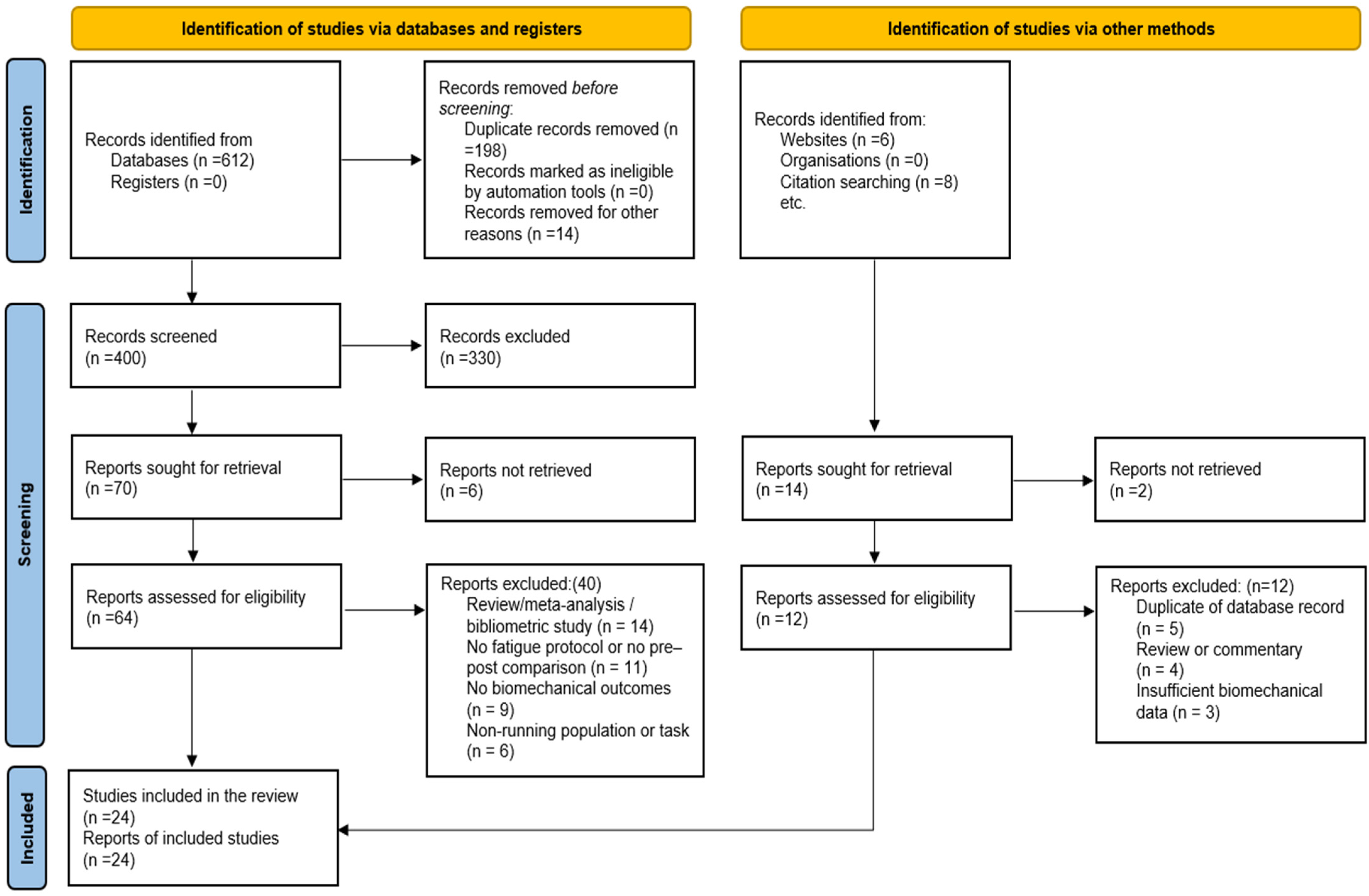
2.1. Study Selection Procedures
2.2. Literature Search: Administration and Update
2.3. Data Extraction
2.4. Methodological Quality of the Included Studies
2.5. Summary Measures
2.6. Synthesis of Results
2.7. Data Synthesis
2.8. Additional Analyses and Publication Bias
3. Results
4. Discussion
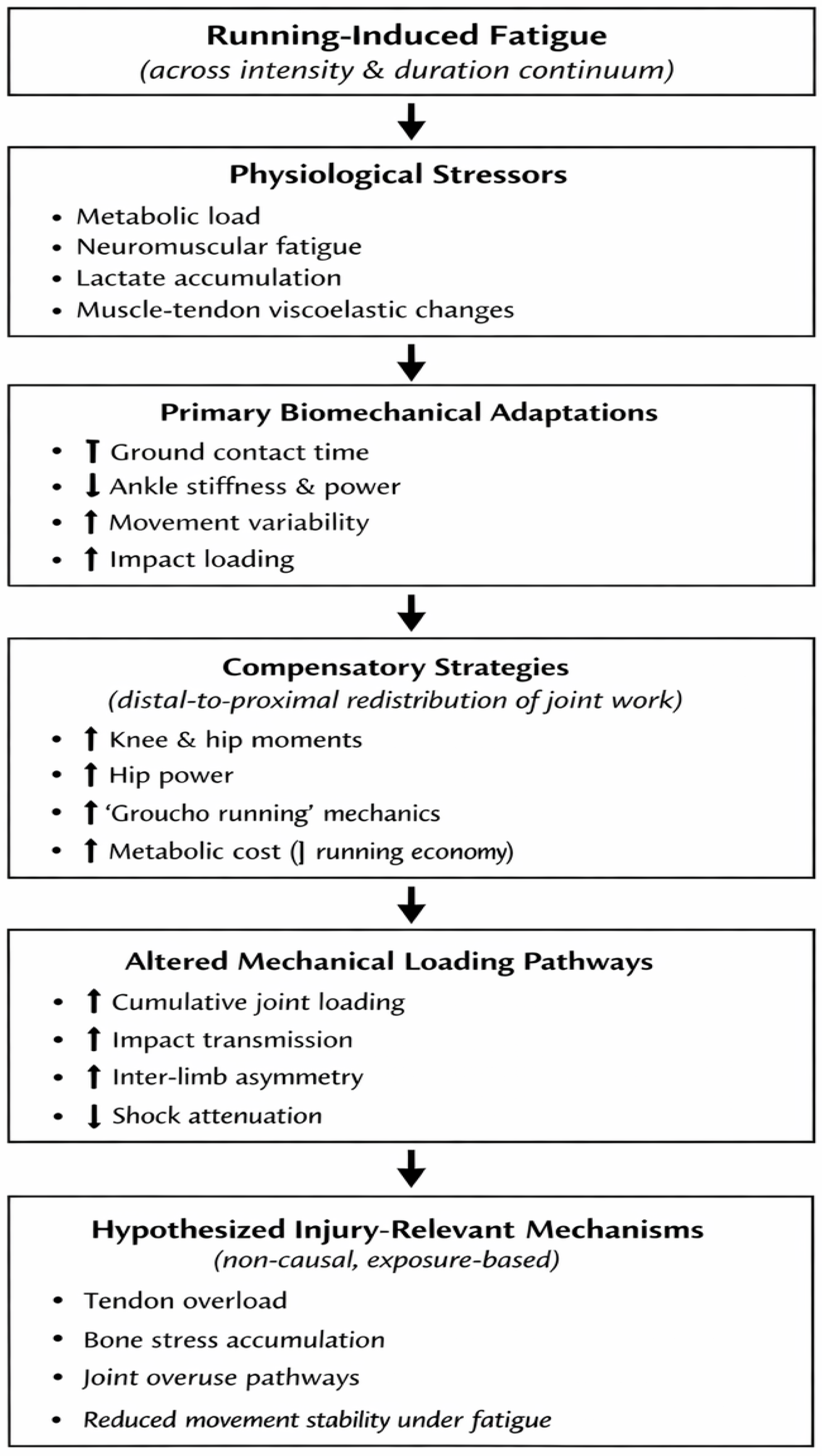
4.1. Overview of Main Findings
4.2. Effects of Fatigue on Spatiotemporal Parameters
4.3. Joint Kinematic Adaptations Under Fatigue
4.4. Joint Kinetic Alterations and Proximal Load Redistribution
4.5. Spring-Mass Behaviour and Mechanical Efficiency
4.6. Impact Loading and Injury-Relevant Mechanical Indicators
4.7. Mechanical Correlates Versus Direct Injury Outcomes
4.8. Coordination Variability and Motor Control Under Fatigue
4.9. Inter-Limb Asymmetry and Bilateral Load Distribution
4.10. Neuromuscular Performance Degradation
4.11. Transfer Effects to Functional Tasks
4.12. Methodological Heterogeneity and Research Gaps
4.13. Practical Implications
4.14. Limitations and Future Directions
5. Conclusions
Author Contributions
Funding
Institutional Review Board Statement
Informed Consent Statement
Data Availability Statement
Acknowledgments
Conflicts of Interest
References
- Hammami, A.; Mahmoudi, A.; Selmi, W.; Negra, Y.; Rebai, H.; Granacher, U.; Hammami, R. Effects of neuromuscular versus plyometric training on physical fitness and mental well-being in male pubertal soccer players. Sci. Rep. 2025, 15, 43393. [Google Scholar] [CrossRef]
- Baghel, B.S.; Patel, D.C.B. Impact of Sports Training On Physical and Psychological Development in Male Athlete. Int. J. Sci. Res. Sci. Eng. Technol. 2025, 12, 198–205. [Google Scholar] [CrossRef]
- Van Hooren, B.; Jukic, I.; Cox, M.; Frenken, K.G.; Bautista, I.; Moore, I.S. The Relationship Between Running Biomechanics and Running Economy: A Systematic Review and Meta-Analysis of Observational Studies. Sports Med. 2024, 54, 1269–1316. [Google Scholar] [CrossRef]
- Figueiredo, I.; Reis ESilva, M.; Sousa, J.E. The Influence of Running Cadence on Biomechanics and Injury Prevention: A Systematic Review. Cureus 2025, 17, e90322. [Google Scholar] [CrossRef]
- Wu, P.P.Y.; Sterkenburg, N.; Everett, K.; Chapman, D.W.; White, N.; Mengersen, K. Predicting fatigue using countermovement jump force-time signatures: PCA can distinguish neuromuscular versus metabolic fatigue. PLoS ONE 2019, 14, e0219295. [Google Scholar] [CrossRef]
- Bahr, R.; Holme, I. Risk factors for sports injuries—A methodological approach. Br. J. Sports Med. 2003, 37, 384–392. [Google Scholar] [CrossRef] [PubMed]
- Girard, O.; Millet, G.P.; Slawinski, J.; Racinais, S.; Micallef, J.P. Changes in running mechanics and spring-mass behaviour during a 5-km time trial. Int. J. Sports Med. 2013, 34, 832–840. [Google Scholar] [CrossRef] [PubMed]
- Möhler, F.; Fadillioglu, C.; Stein, T. Fatigue-Related Changes in Spatiotemporal Parameters, Joint Kinematics and Leg Stiffness in Expert Runners During a Middle-Distance Run. Front. Sports Act. Living 2021, 3, 634258. [Google Scholar] [CrossRef]
- Girard, O.; Micallef, J.P.; Millet, G.P. Changes in spring-mass model characteristics during repeated running sprints. Eur. J. Appl. Physiol. 2011, 111, 125–134. [Google Scholar] [CrossRef]
- Yu, P.; Liang, M.; Fekete, G.; Baker, J.S.; Gu, Y. Effect of running-induced fatigue on lower limb mechanics in novice runners. Technol. Health Care 2021, 29, 231–242. [Google Scholar] [CrossRef]
- Fischer, G.; Storniolo, J.L.L.; Eyré-Tartaruga, L.A.P. Effects of Fatigue on Running Mechanics: Spring-Mass Behavior in Recreational Runners After 60 Seconds of Countermovement Jumps. J. Appl. Biomech. 2015, 31, 445–451. [Google Scholar] [CrossRef]
- Munoz, G.J. Effects of a Fatigue Protocol on Vertical, Leg, and Joint Stiffness During Overground Running. Master’s Thesis, University of Hawaii at Manoa, Honolulu, Hawaii, 2022. Available online: https://hdl.handle.net/10125/104656 (accessed on 20 December 2025).
- Giandolini, M.; Gimenez, P.; Temesi, J.; Arnal, P.J.; Martin, V.; Rupp, T.; Morin, J.B.; Samozino, P.; Millet, G.Y. Effect of the Fatigue Induced by a 110-km Ultramarathon on Tibial Impact Acceleration and Lower Leg Kinematics. PLoS ONE 2016, 11, e0151687. [Google Scholar] [CrossRef] [PubMed]
- Encarnación-Martínez, A.; García-Gallart, A.; Sanchis-Sanchis, R.; Pérez-Soriano, P. Effects of Central and Peripheral Fatigue on Impact Characteristics during Running. Sensors 2022, 22, 3786. [Google Scholar] [CrossRef] [PubMed]
- Möhler, F.; Fadillioglu, C.; Scheffler, L.; Müller, H.; Stein, T. Running-Induced Fatigue Changes the Structure of Motor Variability in Novice Runners. Biology 2022, 11, 942. [Google Scholar] [CrossRef] [PubMed]
- Khaleghi Tazji, M.; Valizadeh Ghale-Beig, A.; Sadeghi, H.; Koumantakis, G.A.; Chrysagis, N.; Abbasi, A. Effects of Running-induced Fatigue on the Trunk-pelvis-hip Coordination Variability During Treadmill Running at Different Speeds. J. Musculoskelet. Neuronal Interact. 2023, 23, 189–195. [Google Scholar]
- Gao, Z.; Fekete, G.; Baker, J.S.; Liang, M.; Xuan, R.; Gu, Y. Effects of running fatigue on lower extremity symmetry among amateur runners: From a biomechanical perspective. Front. Physiol. 2022, 13, 899818. [Google Scholar] [CrossRef]
- Higgins, J.P.T.; Thomas, J.; Chandler, J.; Cumpston, M.; Li, T.; Page, M.J.; Page, M.J.; Welch, V.A. (Eds.) Cochrane Handbook for Systematic Reviews of Interventions, 1st ed.; Wiley: Hoboken, NJ, USA, 2019; Available online: https://onlinelibrary.wiley.com/doi/book/10.1002/9781119536604 (accessed on 20 December 2025).
- Page, M.J.; McKenzie, J.E.; Bossuyt, P.M.; Boutron, I.; Hoffmann, T.C.; Mulrow, C.D.; Shamseer, L.; Tetzlaff, J.M.; Akl, E.A.; Brennan, S.E.; et al. The PRISMA 2020 statement: An updated guideline for reporting systematic reviews. BMJ 2021, 372, n71. [Google Scholar] [CrossRef]
- Rethlefsen, M.L.; Kirtley, S.; Waffenschmidt, S.; Ayala, A.P.; Moher, D.; Page, M.J.; Koffel, J.B.; PRISMA-S Group. PRISMA-S: An extension to the PRISMA statement for reporting literature searches in systematic reviews. J. Med. Libr. Assoc. 2021, 109, 174–200. [Google Scholar] [CrossRef]
- Bartlett, R.; Wheat, J.; Robins, M. Is movement variability important for sports biomechanists? Sports Biomech. 2007, 6, 224–243. [Google Scholar] [CrossRef]
- Horsley, T.; Dingwall, O.; Sampson, M. Checking reference lists to find additional studies for systematic reviews. Cochrane Database Syst. Rev. 2011, 2011, MR000026. [Google Scholar] [CrossRef]
- Sterne, J.A.C.; Savović, J.; Page, M.J.; Elbers, R.G.; Blencowe, N.S.; Boutron, I.; Cates, C.J.; Cheng, H.Y.; Corbett, M.S.; Eldridge, S.M.; et al. RoB 2: A revised tool for assessing risk of bias in randomised trials. BMJ 2019, 366, 14898. [Google Scholar] [CrossRef]
- Campbell, M.; McKenzie, J.E.; Sowden, A.; Katikireddi, S.V.; Brennan, S.E.; Ellis, S.; Hartmann-Boyce, J.; Ryan, R.; Shepperd, S.; Thomas, J.; et al. Synthesis without meta-analysis (SWiM) in systematic reviews: Reporting guideline. BMJ 2020, 368, 16890. [Google Scholar] [CrossRef] [PubMed]
- Popay, J.; Roberts, H.; Sowden, A.; Petticrew, M.; Arai, L.; Rodgers, M.; Britten, N.; Roen, K.; Duffy, S. Guidance on the Conduct of Narrative Synthesis in Systematic Reviews: A Product from the ESRC Methods Programme; Lancaster University: Lancaster, UK, 2006. [Google Scholar]
- Atkinson, G.; Nevill, A.M. Selected issues in the design and analysis of sport performance research. J. Sports Sci. 2001, 19, 811–827. [Google Scholar] [CrossRef]
- Jaime-Lara, R.B.; Koons, B.C.; Matura, L.A.; Hodgson, N.A.; Riegel, B. A Qualitative Metasynthesis of the Experience of Fatigue Across Five Chronic Conditions. J. Pain Symptom Manag. 2020, 59, 1320–1343. [Google Scholar] [CrossRef]
- Koblbauer, I.F.; van Schooten, K.S.; Verhagen, E.A.; van Dieën, J.H. Kinematic changes during running-induced fatigue and relations with core endurance in novice runners. J. Sci. Med. Sport. 2014, 17, 419–424. [Google Scholar] [CrossRef]
- Morin, J.B.; Gimenez, P.; Edouard, P.; Arnal, P.; Jiménez-Reyes, P.; Samozino, P.; Brughelli, M.; Mendiguchia, J. Sprint Acceleration Mechanics: The Major Role of Hamstrings in Horizontal Force Production. Front. Physiol. 2015, 6, 404. [Google Scholar] [CrossRef]
- Basile, S.; Oliver, J.; Geil, M. Effect of Fatigue on Kinematic and Kinetics of Youth Runners: A Pilotstudy. ISBS Proc. Arch. 2017, 35, 266. Available online: https://commons.nmu.edu/isbs/vol35/iss1/266 (accessed on 20 December 2025).
- Riazati, S.; Caplan, N.; Matabuena, M.; Hayes, P.R. Fatigue Induced Changes in Muscle Strength and Gait Following Two Different Intensity, Energy Expenditure Matched Runs. Front. Bioeng. Biotechnol. 2020, 8, 360. [Google Scholar] [CrossRef]
- Yu, P.; Gong, Z.; Meng, Y.; Baker, J.S.; István, B.; Gu, Y. The Acute Influence of Running-Induced Fatigue on the Performance and Biomechanics of a Countermovement Jump. Appl. Sci. 2020, 10, 4319. [Google Scholar] [CrossRef]
- Chalitsios, C.; Nikodelis, T.; Konstantakos, V.; Kollias, I. Sensitivity of movement features to fatigue during an exhaustive treadmill run. Eur. J. Sport Sci. 2022, 22, 1374–1382. [Google Scholar] [CrossRef] [PubMed]
- Huang, C.; Ye, J.; Song, Y.; Kovács, B.; Baker, J.S.; Mao, Z.; Gu, Y. The Effects of Fatigue on the Lower Limb Biomechanics of Amateur Athletes during a Y-Balance Test. Healthcare 2023, 11, 2565. [Google Scholar] [CrossRef] [PubMed]
- Baggaley, M.; Haider, I.; Bruce, O.; Khassetarash, A.; Edwards, W.B. Tibial strains are sensitive to speed perturbations, but not grade perturbations, during running. J. Exp. Biol. 2024, 227, jeb246770. [Google Scholar] [CrossRef] [PubMed]
- Jian, X.; Sun, D.; Xu, Y.; Zhu, C.; Cen, X.; Song, Y.; Li, F.; Fekete, G.; Gu, Y. Effects of Running Fatigue on Lower Limb Joint Kinematics and Kinetics in Female Genu Valgum Individuals: A Comparative Study. Appl. Bionics Biomech. 2025, 2025, 8842670. [Google Scholar] [CrossRef] [PubMed]
- Kember, L.S.; Myer, G.D.; Moore, I.S.; Lloyd, R.S. Effects of Fatigue on Lower Limb Biomechanics and Kinetic Stabilization During the Tuck-Jump Assessment. J. Athl. Train. 2024, 59, 705–712. [Google Scholar] [CrossRef]
- Mitschke, C.; Heß, T.; Milani, T.L.; Kiesewetter, P. Fatigue-Related Biomechanical Changes During a Half-Marathon Under Field Conditions Assessed Using Inertial Measurement Units. Biomechanics 2025, 5, 101. [Google Scholar] [CrossRef]
- Einicke, G.A.; Sabti, H.A.; Thiel, D.V.; Fernandez, M.; Einicke, G.A.; Sabti, H.A.; Thiel, D.V.; Fernandez, M. Maximum-Entropy-Rate Selection of Features for Classifying Changes in Knee and Ankle Dynamics During Running. IEEE J. Biomed. Health Inform. 2018, 22, 1097–1103. [Google Scholar] [CrossRef]
- Derrick, T.R.; Dereu, D.; McLean, S.P. Impacts and kinematic adjustments during an exhaustive run. Med. Sci. Sports Exerc. 2002, 34, 998–1002. [Google Scholar] [CrossRef]
- Heiderscheit, B.C.; Chumanov, E.S.; Michalski, M.P.; Wille, C.M.; Ryan, M.B. Effects of Step Rate Manipulation on Joint Mechanics during Running. Med. Sci. Sports Exerc. 2011, 43, 296–302. [Google Scholar] [CrossRef]
- Schubert, A.G.; Kempf, J.; Heiderscheit, B.C. Influence of stride frequency and length on running mechanics: A systematic review. Sports Health 2014, 6, 210–217. [Google Scholar] [CrossRef]
- Sanno, M.; Willwacher, S.; Epro, G.; Brüggemann, G.P. Positive Work Contribution Shifts from Distal to Proximal Joints during a Prolonged Run. Med. Sci. Sports Exerc. 2018, 50, 2507–2517. [Google Scholar] [CrossRef]
- Quan, W.; Ren, F.; Xu, D.; Gusztav, F.; Baker, J.S.; Gu, Y. Effects of Fatigue Running on Joint Mechanics in Female Runners: A Prediction Study Based on a Partial Least Squares Algorithm. Front. Bioeng. Biotechnol. 2021, 24, 746761. [Google Scholar] [CrossRef]
- McMahon, J.J.; Jones, P.A.; Comfort, P. Comparison of Countermovement Jump-Derived Reactive Strength Index Modified and Underpinning Force-Time Variables Between Super League and Championship Rugby League Players. J. Strength Cond. Res. 2022, 36, 226–231. [Google Scholar] [CrossRef] [PubMed]
- Darch, L.; Chalmers, S.; Wiltshire, J.; Causby, R.; Arnold, J. Running-induced fatigue and impact loading in runners: A systematic review and meta-analysis. J. Sports Sci. 2022, 40, 1512–1531. [Google Scholar] [CrossRef] [PubMed]
- Cabello-Beltrán, M.A.; Pineda-Escobar, S.; Fernández-Seguín, L.M. Biomechanical variations of lower limb as risk factors of groin pain: A systematic review. J. Bodyw. Mov. Ther. 2025, 45, 968–981. [Google Scholar] [CrossRef]
- Wang, C.; Stovitz, S.D.; Kaufman, J.S.; Steele, R.J.; Shrier, I. Principles of musculoskeletal sport injuries for epidemiologists: A review. Inj. Epidemiol. 2024, 11, 21. [Google Scholar] [CrossRef]
- Gołaś, A.; Terbalyan, A.; Gepfert, M.; Roczniok, R.; Matusiński, A.; Kotuła, K.; Pietraszewski, P.; Zając, A. Repeated Sprint Performance and Inter-Limb Asymmetry in Elite Female Sprinters: A Study of Lactate Dynamics and Lower Limb Muscle Activity. J. Funct. Morphol. Kinesiol. 2025, 10, 213. [Google Scholar] [CrossRef] [PubMed]
- Gathercole, R.; Sporer, B.; Stellingwerff, T.; Sleivert, G. Alternative countermovement-jump analysis to quantify acute neuromuscular fatigue. Int. J. Sports Physiol. Perform. 2015, 10, 84–92. [Google Scholar] [CrossRef]
- Buckthorpe, M.; Morris, J.; Folland, J.P. Validity of vertical jump measurement devices. J. Sports Sci. 2012, 30, 63–69. [Google Scholar] [CrossRef]
- Cormack, S.J.; Newton, R.U.; McGuigan, M.R.; Doyle, T.L.A. Reliability of measures obtained during single and repeated countermovement jumps. Int. J. Sports Physiol. Perform. 2008, 3, 131–144. [Google Scholar] [CrossRef]
- Jiang, H.; Wan, K.; Mei, Q.; Gao, Z.; Fernandez, J.; Gu, Y. Alterations of landing biomechanics from an inclined treadmill running-induced fatigue protocol. Acta Bioeng. Biomech. 2025, 27, 61–75. [Google Scholar] [CrossRef]



| Domain | Inclusion Criteria | Exclusion Criteria |
|---|---|---|
| Study design | Original empirical research, including experimental, quasi-experimental, observational, and field-based biomechanical studies | Systematic reviews, meta-analyses, scoping reviews, bibliometric analyses, narrative reviews, editorials, commentaries |
| Publication period | Studies published between January 2010 and December 2025 | Studies published before 2010 |
| Population | Human participants engaged in running or running-related tasks (recreational, trained, elite, youth, or clinical subgroups) | Animal studies; non-running populations (e.g., cycling-only, walking-only, resistance-training-only studies) |
| Age group | Youth, adolescent, and adult participants | Studies exclusively involving children with pathological gait unrelated to fatigue |
| Fatigue exposure | Studies that explicitly induced or quantified fatigue, including running-induced fatigue, sprint-induced fatigue, prolonged running, or task-induced fatigue with relevance to running biomechanics | Studies without a defined fatigue protocol or without pre- vs. post-fatigue biomechanical comparison |
| Primary outcome focus | Lower-limb biomechanics, including kinematics, kinetics, stiffness, impact loading, coordination, variability, asymmetry, or neuromuscular mechanical outcomes | Studies reporting only physiological (e.g., VO2max), metabolic, perceptual, or psychological outcomes without biomechanical measures |
| Biomechanical measures | Quantitative biomechanical data derived from motion capture, force plates, instrumented treadmills, IMUs, accelerometers, pressure sensors, or validated musculoskeletal models | Qualitative assessments, self-report measures, or clinical scores without biomechanical quantification |
| Movement context | Running performed on treadmill, overground, track, field, or simulated competition settings | Non-running movement contexts (e.g., cycling, swimming, resistance exercise) without a running component |
| Transfer tasks | Studies assessing transfer effects of running-induced fatigue on related biomechanical tasks (e.g., countermovement jump, landing, balance tests) | Task-based fatigue studies unrelated to running (e.g., upper-limb fatigue only) |
| Outcome relevance | Outcomes relevant to functional morphology, movement mechanics, performance adaptation, or injury-related mechanical loading | Studies focusing solely on performance time or success without biomechanical explanation |
| Instrumentation quality | Use of validated biomechanical instrumentation with clearly described measurement protocols | Use of non-validated devices or insufficient description of biomechanical methods |
| Language | Articles published in English | Non-English publications |
| Accessibility | Full-text articles available | Abstract-only publications with insufficient methodological detail |
| Author & Year | Study Design | Participants | Sample (Sex; n) | Fatigue Protocol/Task | Primary Outcome Domain | Biomechanical Measures | Instruments | Main Findings (Fatigue Effect) |
|---|---|---|---|---|---|---|---|---|
| Girard et al. (2011) [9] | Experimental (repeated-sprint) | Physically active recreational athletes | Male; n = 16 | 12 × 40 m maximal running sprints with 30 s passive recovery | Spring–mass mechanics and stride characteristics | Vertical stiffness (Kvert), leg stiffness (Kleg), contact time, flight time, stride frequency, stride length, braking and push-off forces | 5-m force-plate system (GRF) + radar speed system | Vertical stiffness significantly decreased across sprints; leg stiffness showed no significant change; contact, flight, and swing times increased; stride frequency and push-off force decreased; center of mass vertical displacement increased |
| Girard et al. (2013) [7] | Experimental (time-trial, repeated measures) | Competitive triathletes | Male; n = 12 | 5-km self-paced running time trial on indoor track | Running mechanics and spring–mass behavior | Kvert, Kleg, contact time, stride length, stride frequency, peak vertical force, braking and push-off forces, CM displacement | 5-m force-plate system (GRF) + radar speed system | Vertical stiffness decreased (~6%); leg stiffness remained unchanged; contact time and total stride duration increased; stride length and frequency decreased; peak vertical and braking forces decreased; CM vertical displacement showed no significant change |
| Koblbauer et al. (2014) [28] | Repeated-measures | Novice runners | Mixed; n = 17 | Borg-controlled run to fatigue | Joint kinematics | Trunk flexion, ankle eversion | Motion capture | Increased trunk flexion and ankle eversion after fatigue |
| Fischer et al. (2015) [11] | Experimental (repeated measures) | Recreational runners | Mixed; n = 11 | 60-s maximal counter-movement jump fatigue followed by overground running at different speeds | Spring–mass mechanics and spatiotemporal parameters | Kvert, COM displacement (ΔZ), peak vertical force, step frequency, step length, aerial time | Force plate integrated in track + 2D video | No significant change in vertical stiffness; COM vertical displacement decreased; step frequency increased and step length decreased; peak vertical force decreased under fatigue |
| Morin et al. (2015) [29] | Experimental (laboratory) | Physically active males including sprint- and team-sport athletes | Male; n = 14 | Single 6-s maximal sprint acceleration on instrumented treadmill | Sprint acceleration kinetics and neuromuscular correlates | Horizontal (FH), vertical (FV), resultant GRF, sprint velocity, EMG of BF, RF, VL, Glut | Instrumented treadmill (force transducers), surface EMG, 2D motion analysis | Greater horizontal GRF was significantly associated with higher biceps femoris EMG during end-of-swing and greater eccentric hamstring torque; vertical GRF was not related to sprint performance; study did not involve fatigue comparison |
| Giandolini et al. (2016) [13] | Field experimental (pre–post race) | Experienced ultramarathon runners | Mixed; n = 23 | 110-km mountain ultramarathon (UTMB) with pre- and post-race treadmill testing | Impact biomechanics and lower-limb kinematics | Peak tibial acceleration, impact frequency content, step frequency, ankle ROM, foot, ankle and tibial angles at contact | Tibial accelerometers, 2D video analysis, treadmill | Step frequency increased (~+2.7%) and ankle ROM decreased (~−4.1%) after the race; impact acceleration magnitude did not change significantly; runners showed a tendency toward flatter foot strike patterns, particularly in non-rearfoot strikers, consistent with protective fatigue-related adaptations |
| Basile et al. (2017) [30] | Experimental (pre–, post–, pilot) | Youth distance runners (12–14 yrs) | Mixed; n = 4 | Prolonged treadmill running at ~70% VO2max with data at start, mid, and end | Impact kinetics and limb acceleration | Peak vertical GRF, heel acceleration, cadence, step length, strike pattern | Instrumented treadmill (dual force plates), 3D motion capture (Vicon) | Fatigue-related changes were highly individual; some runners showed increased peak vertical GRF and development of heel-strike transient, while cadence and step length showed no consistent group-level change. |
| Wu et al. (2019) [5] | Randomized crossover, repeated measures | Recreational athletes | Mixed; n = 10 | Repeated sprint training sessions (low, moderate, high workload) with CMJ testing pre, post, and up to 48 h | Neuromuscular and metabolic fatigue signatures | CMJ concentric force-time variables (relPeakF, relPeakP, concentric time, time to peak force) | Portable force plate (600 Hz) | PCA and fPCA identified distinct fatigue signatures, with metabolic fatigue dominating ≤1 h post-exercise and neuromuscular fatigue evident from 3–48 h; CMJ force-time profiles successfully predicted fatigue state |
| Riazati et al. (2020) [31] | Crossover experimental | Master class runners | Mixed; n = 20 | Energy-expenditure matched HIIT (6 × 800 m) vs. medium-intensity continuous run (MICR) | Muscle strength, gait kinematics, and running variability | Hip and knee isometric strength, sagittal and frontal plane joint angles, coordination variability (CRP, CAV), spatiotemporal parameters | Hand-held dynamometry; 3D motion capture (Vicon) | Significant reductions in hip and knee strength occurred after both run types; hip frontal and sagittal ROM increased, while knee kinematics showed no significant group-level changes; running coordination variability increased, with individual-level analysis indicating greater fatigue effects following HIIT |
| Yu et al. (2020) [32] | Experimental (pre–post) | Physically active novice runners | Male; n = 15 | Progressive treadmill running to volitional exhaustion followed immediately by CMJ testing | Jump biomechanics (kinematics and kinetics) | Joint angles and ROM (ankle, knee, hip), joint moments, peak vertical GRF, jump height | 3D motion capture (Vicon), force platform (Kistler) | Lower-limb joint kinematics and moments changed significantly after fatigue, while jump height and peak vertical GRF remained unchanged. |
| Möhler et al. (2021) [8] | Experimental (repeated measures, treadmill) | Expert middle-distance runners | Male; n = 13 | Constant-speed middle-distance treadmill run at individual fatigue speed until exhaustion (~4 min) | Running mechanics, joint kinematics, and stiffness | Spatiotemporal parameters, leg and vertical stiffness, 3D joint kinematics, COM displacement, ROM | 3D motion capture (Vicon); stiffness estimated from kinematics (no force plates) | Stance time increased and both leg and vertical stiffness decreased, with greater joint ROM and reduced vertical COM displacement under fatigue. |
| Yu et al. (2021) [10] | Experimental (pre post) | Novice runners | Male; n = 15 | Progressive treadmill running to volitional exhaustion | Joint kinetics (3 planes) | Hip, knee, ankle joint moments and powers | 3D motion capture (Vicon), force platform | Joint moments and powers increased at the ankle, knee, and hip, especially in the frontal and transverse planes, indicating higher joint loading after fatigue. |
| Chalitsios et al. (2022) [33] | Experimental (cross-sectional with ML classification) | Recreational runners | Mixed; n = 13 | Exhaustive incremental treadmill run to ventilatory threshold and exhaustion | Movement variability & fatigue sensitivity | Trunk angular range (AP & frontal), GRF loading rate, coordination features | Instrumented treadmill, motion capture | Trunk frontal and AP angular ranges and GRF loading rate were the most sensitive indicators of fatigue; kinetic variability increased non-linearly under fatigue. |
| Encarnación-Martínez et al. (2022) [14] | Experimental (crossover) | Recreational runners | Male; n = 18 | Central fatigue (30-min run at 85% MAS) vs. peripheral fatigue (isokinetic quadriceps–hamstrings) followed by treadmill running | Impact transmission | Tibial and head acceleration, shock attenuation (time & frequency domain) | IMUs (tibia, head), treadmill | Central fatigue increased high-frequency tibial impact power and shock attenuation, whereas peripheral fatigue produced no significant impact changes. |
| Gao et al. (2022) [17] | Experimental (pre post) | Amateur runners | Male; n = 18 | Running-induced fatigue protocol followed by overground running | Gait symmetry | Symmetry angles of hip, knee, and ankle joint angles, moments, and stiffness (3 planes) | 3D motion capture (Vicon), force plates | Fatigue increased asymmetry in knee and hip joint moments and angles, particularly in coronal and transverse planes. |
| Möhler et al. (2022) [15] | Experimental (pre–post, treadmill) | Novice runners | Male; n = 14 | Prolonged treadmill running to exhaustion | Motor variability and CoM control | UCM-based variability of joint configurations stabilising CoM trajectory | 3D motion capture | Step-to-step motor variability increased, and control of the centre of mass decreased, while overall CoM stability was preserved. |
| Munoz (2022) [12] | Experimental (pre -post) | ROTC cadets | Mixed; n = 16 | Graded exercise test followed by exhaustive treadmill run; overground running analysis | Stiffness modulation | Vertical (Kvert), leg (Kleg), and joint stiffness (ankle, knee, hip) | 3D motion capture, force plates | Group means of Kvert and Kleg did not change; runners redistributed stiffness across joints, with increased knee moments and hip excursion under fatigue. |
| Khaleghi Tazji et al. (2023) [16] | Quasi-experimental (pre–post, repeated measures) | Recreational runners | Mixed; n = 24 | Incremental treadmill fatigue (Borg-based) with running at preferred, 80%, and 120% speed | Motor coordination | Continuous relative phase (CRP) and coordination variability (VCRP) of trunk–pelvis–hip couplings | Inertial motion capture (myoMOTION IMUs) | Fatigue reduced inter-segmental coordination and increased coordination variability, with larger effects at higher running speeds. |
| Huang et al. (2023) [34] | Experimental (pre–post) | Amateur athletes | Male; n = 16 | Squat-based fatigue protocol followed by Y-Balance Test | Balance biomechanics | Hip, knee, ankle ROM; joint torques; joint work; COP displacement | 3D motion capture (Vicon) + force plate (Kistler) | Y-Balance scores and hip/knee ROM decreased; hip torque increased (A, PL) and decreased (PM); COP displacement increased after fatigue. |
| Baggaley et al. (2024) [35] | Experimental modelling (repeated measures) | Recreationally active runners | Mixed; n = 17 | Treadmill running at multiple grades (±10°, ±5°, 0°) and speeds (2.50–4.17 m·s−1) | Bone loading (fatigue–failure risk) | 50th & 95th percentile tibial strain, strained volume ≥4000 µɛ | Motion capture, instrumented treadmill, musculoskeletal + finite-element models | Tibial strain and strained volume increased significantly with running speed, but not with grade, indicating higher fatigue–failure risk at faster speeds. |
| Jian et al. (2025) [36] | Comparative experimental (pre–post fatigue) | Female runners with and without genu valgum | Female; n = 16 (8 GV, 8 control) | Running-induced fatigue protocol on treadmill | Clinical biomechanics (ACL loading) | A-ACL and P-ACL stress and strain, knee joint stiffness, hip/knee angles | 3D motion capture, force plates, OpenSim modeling, EMG validation | Fatigue significantly increased anteromedial ACL stress and reduced knee stiffness in the genu valgum group, while controls showed no significant ACL stress changes. |
| Kember et al. (2024) [37] | Cross-sectional experimental (pre–post fatigue) | Female netball athletes | Female; n = 12 | Sport-specific fatigue protocol followed by repeated tuck-jump assessment | Jump kinetics & stabilization | Vertical GRF, COM displacement, leg stiffness, contact and flight time | Force plate, 2D video | Post-fatigue jumping became stiffer (leg stiffness ↑) with reduced jump height, COM displacement, contact and flight time, despite unchanged peak GRF. |
| Mitschke et al. (2025) [38] | Field experimental (repeated measures) | Endurance runners | Mixed; n = 20 | Self-paced half-marathon on flat outdoor course | Field biomechanics & impact loading | Peak tibial acceleration, peak rearfoot eversion velocity, peak sagittal foot angular velocity, stride time, contact time, flight time, duty factor | IMUs (tibia, heel), HR monitor | Peak tibial acceleration, foot angular velocities, and contact time increased, while flight time decreased over the race, indicating fatigue-related impact and spatiotemporal changes. |
| Einicke et al. (2018) [39] | Experimental (field + ML analysis) | Adult recreational runners | Mixed; n = 22 | 5-km overground run to induce fatigue | Wearable biomechanics & fatigue detection | Knee and ankle kinematics, variability features, fatigue classification accuracy | IMUs, machine-learning classifiers | Fatigue-related changes in lower-limb kinematics were detectable using wearable sensors, enabling accurate fatigue state classification. |
| Study (Author, Year) | D1: Randomization | D2: Deviations from Intervention | D3: Missing Data | D4: Outcome Measurement | D5: Selective Reporting | Overall Risk of Bias |
|---|---|---|---|---|---|---|
| Girard et al. (2011) [9] | High risk | Low | Low | Low | Low | High risk |
| Girard et al. (2013) [7] | High risk | Low | Low | Low | Low | High risk |
| Koblbauer et al. (2014) [28] | High risk | Low | Low | Low | Low | High risk |
| Fischer et al. (2015) [11] | High risk | Low | Low | Low | Low | High risk |
| Morin et al. (2015) [29] | High risk | Low | Low | Low | Low | High risk |
| Giandolini et al. (2016) [13] | High risk | Low | Low | Low | Low | High risk |
| Basile et al. (2017) [30] | High risk | Some concerns | High risk (very small n) | Low | Some concerns | High risk |
| Wu et al. (2019) [5] | Some concerns (randomized crossover) | Low | Low | Low | Low | Some concerns |
| Riazati et al. (2020) [31] | Some concerns (randomized crossover) | Low | Low | Low | Low | Some concerns |
| Yu et al. (2020) [32] | High risk | Low | Low | Low | Low | High risk |
| Möhler et al. (2021) [8] | High risk | Low | Low | Low | Low | High risk |
| Yu et al. (2021) [10] | High risk | Low | Low | Low | Low | High risk |
| Chalitsios et al. (2022) [33] | High risk | Low | Low | Low | Low | High risk |
| Encarnación-Martínez et al. (2022) [14] | Some concerns (crossover) | Low | Low | Low | Low | Some concerns |
| Gao et al. (2022) [17] | High risk | Low | Low | Low | Low | High risk |
| Möhler et al. (2022) [15] | High risk | Low | Low | Low | Low | High risk |
| Munoz (2022) [12] | High risk | Some concerns | Some concerns | Low | Some concerns | High risk |
| Khaleghi Tazji et al. (2023) [16] | High risk | Low | Low | Low | Low | High risk |
| Huang et al. (2023) [34] | High risk | Low | Low | Low | Low | High risk |
| Baggaley et al. (2024) [35] | High risk | Low | Low | Low | Low | High risk |
| Jian et al. (2025) [36] | High risk | Low | Low | Low | Low | High risk |
| Kember et al. (2024) [37] | High risk | Low | Low | Low | Low | High risk |
| Mitschke et al. (2025) [38] | Some concerns (group comparison) | Low | Low | Low | Low | Some concerns |
| Einicke et al. (2018) [39] | High risk | Low | Low | Low | Some concerns | High risk |
| Study (Author, Year) | Intervention Type (Fatigue Exposure) | Fatigue Modality | Running Environment | Fatigue Duration / Intensity | Fatigue Termination Criteria | Monitoring of Fatigue | Biomechanical Implications |
|---|---|---|---|---|---|---|---|
| Girard et al. (2011) [9] | Acute fatigue | Repeated sprint running | Instrumented track | High-intensity intermittent | Completion of 12 sprint bouts | Sprint performance, GRF | Vertical stiffness ↓; stride frequency ↓; leg stiffness unchanged |
| Girard et al. (2013) [7] | Acute fatigue | Continuous self-paced running (5 km) | Indoor track | Moderate–high intensity | Distance completion | Time, GRF | Vertical stiffness ↓; contact time ↑; stride length & frequency ↓ |
| Koblbauer et al. (2014) [28] | Acute fatigue | Incremental treadmill running | Laboratory | Progressive to exhaustion | Volitional exhaustion | RPE, HR | Trunk flexion ↑; ankle eversion ↑ |
| Fischer et al. (2015) [11] | Task-induced fatigue | CMJ fatigue before running | Laboratory | Short-duration maximal | Completion of jump protocol | Jump performance, GRF | COM displacement ↓; Kvert unchanged; step frequency ↑ |
| Morin et al. (2015) [29] | Not fatigue-based | Sprint acceleration mechanics | Laboratory | Maximal sprint trials | Trial completion | GRF, EMG | Horizontal force linked to hamstring activation (no fatigue effects) |
| Giandolini et al. (2016) [13] | Extreme fatigue | Ultramarathon running (110 km) | Field | Prolonged endurance (>10 h) | Race completion | Distance, IMUs | Ankle ROM ↓; step frequency ↑; impact magnitude unchanged |
| Basile et al. (2017) [30] | Acute fatigue (pilot) | Continuous treadmill running | Laboratory | Submaximal prolonged | Time completion | Time | Highly individual GRF and strike-pattern responses |
| Wu et al. (2019) [5] | Task-classification study | Repeated sprint sessions + CMJ | Laboratory | Variable workloads | Protocol completion | Force–time PCA | Metabolic vs. neuromuscular fatigue signatures distinguished |
| Riazati et al. (2020) [31] | Acute fatigue | Energy-matched HIIT vs. MICR | Laboratory | Moderate–high intensity | Protocol completion | HR, strength loss | Hip ROM ↑; strength ↓; variability ↑ (greater after HIIT at individual level) |
| Yu et al. (2020) [32] | Acute fatigue | Run-to-exhaustion + CMJ | Laboratory | Submaximal continuous | Volitional exhaustion | Time | Joint loading ↑ despite unchanged jump height |
| Möhler et al. (2021) [8] | Acute fatigue | Middle-distance treadmill run | Instrumented treadmill | High intensity (~4 min) | Exhaustion | Time | Stance time ↑; vertical & leg stiffness ↓ |
| Yu et al. (2021) [10] | Acute fatigue | Continuous treadmill running | Laboratory | Submaximal to exhaustion | Volitional exhaustion | Time | Hip, knee, ankle moments and powers ↑ |
| Chalitsios et al. (2022) [33] | Acute fatigue | Exhaustive incremental treadmill run | Laboratory | Incremental maximal | Volitional exhaustion | RPE, ventilatory threshold | Trunk frontal/AP variability and GRF loading rate most fatigue-sensitive |
| Encarnación-Martínez et al. (2022) [14] | Differential fatigue | Central vs. peripheral protocols | Laboratory | Controlled workloads | Protocol completion | EMG, GRF | Central fatigue ↑ impact power; peripheral fatigue no effect |
| Gao et al. (2022) [17] | Acute fatigue | Prolonged treadmill running | Laboratory | Submaximal time-based | Time completion | Time | Hip and knee asymmetry ↑ post-fatigue |
| Möhler et al. (2022) [15] | Acute fatigue | Prolonged treadmill running | Laboratory | Moderate intensity | Exhaustion | Time | Motor variability ↑; CoM control ↓ but stability preserved |
| Munoz (2022) [12] | Acute fatigue | GXT + exhaustive running | Lab + overground | High intensity | VO2max + exhaustion | HR, time | Kvert & Kleg preserved via joint stiffness redistribution |
| Khaleghi Tazji et al. (2023) [16] | Acute fatigue | Multispeed treadmill running | Laboratory | Speed-dependent | Time-based | Time | Coordination ↓ and variability ↑, greater at higher speeds |
| Huang et al. (2023) [34] | Task-transfer fatigue | Squat fatigue + Y-Balance | Laboratory | Submaximal | Task completion | Balance scores | Joint ROM ↓; COP displacement ↑ |
| Baggaley et al. (2024) [35] | Load-response (not fatigue) | Speed & grade perturbation running | Laboratory | Variable speeds & slopes | Protocol completion | Speed | Tibial strain ↑ with speed (fatigue–failure implication) |
| Jian et al. (2025) [36] | Acute fatigue (comparative) | Continuous treadmill running | Laboratory | Submaximal to exhaustion | Volitional exhaustion | Time | ACL stress ↑ in genu valgum group only |
| Kember et al. (2024) [37] | Task-induced fatigue | Repeated tuck jumps | Laboratory | Short-duration maximal | Task completion | Technique quality | Leg stiffness ↑; stabilization ↓ during landing |
| Mitschke et al. (2025) [38] | Real-world fatigue | Half-marathon race | Field | Prolonged endurance | Race completion | IMU metrics | Tibial acceleration ↑; contact time ↑ |
| Einicke et al. (2018) [39] | Acute fatigue | Distance-induced running | Lab/field | Submaximal continuous | Distance completion | IMU dynamics | Wearables detected fatigue-related joint instability |
| Representative Studies (Refs) | Fatigue Protocol Characteristic | Observed Pattern Across Studies | Methodological and Biomechanical Implications |
|---|---|---|---|
| [7,8,10,11,13,15,16,17,18,31,33,38] | Fatigue type (acute vs. chronic) | Fatigue was operationalised as acute exposure, with biomechanics assessed immediately post-fatigue; no chronic or cumulative fatigue designs. | Findings reflect short-term neuromuscular and mechanical adaptations, not long-term injury mechanisms. |
| Continuous running: [7,8,10,28,31,33] Repeated sprints: [9] Endurance events: [13,38] Task-based: [5,32,37] | Primary fatigue modality | Continuous running dominated; fewer sprint-based, endurance race, or task-transfer protocols. | Different modalities stress distinct neuromuscular pathways, contributing to heterogeneous stiffness, coordination, and impact responses. |
| Laboratory: [8,10,11,15,31,33] Field: [7,9,13,38,39] | Running environment | Most studies were laboratory-based; fewer captured fatigue in real races or track conditions. | Labs improve measurement precision; field studies improve ecological validity but reduce control. |
| Short (<5 min): [5,11,37] Moderate (5–30 min): [7,8,10,31,33] Prolonged (>60 min): [13,38] | Fatigue duration | Exposure ranged from brief neuromuscular exhaustion to prolonged endurance accumulation. | Longer exposure associated with impact accumulation, coordination drift, and asymmetry, not only stiffness loss. |
| Submaximal: [31,33] Near-maximal: [7,8] Maximal/exhaustive: [9,11,14,28] | Fatigue intensity | Wide intensity range across studies. | Higher intensities produced faster reductions in force output and joint control, elevating injury-relevant loading. |
| Volitional exhaustion: [10,28,33] Fixed distance/time: [7,13,38] Protocol completion: [9,11,31] | Termination criteria | Termination criteria were heterogeneous and often non-physiological. | Limits comparability of true fatigue magnitude across studies. |
| RPE/time: [7,28,33] Force–time loss: [5,9,11] IMU metrics: [38,39] | Fatigue verification | Verification used subjective, mechanical, or wearable indicators, rarely standardised. | Non-uniform verification contributes to variability in biomechanical outcomes. |
| Single bout: [7,8,9,10,11,13,15,31,38] | Number of fatigue bouts | Nearly all studies used single-session fatigue exposure. | Prevents inference on residual or cumulative fatigue effects. |
| Immediate testing: [8,9,11,13,15,38] | Recovery allowance | Biomechanics typically recorded immediately post-fatigue. | Reflects peak fatigue state, not recovery-modulated adaptations. |
| CMJ/landing: [5,32,37] Balance: [34] | Transfer tasks | Several studies assessed fatigue transfer to jump or balance tasks. | Indicates fatigue effects extend to functional and screening tasks. |
| Individualised: [7,8,31] Fixed: [10,28,33] | Protocol standardisation | Some studies scaled workloads to individual capacity; others used fixed speeds. | Individualisation improves detection of fatigue-sensitive biomechanical responses. |
| Supervised lab protocols: [7,8,9,10,11,15,33] | Protocol supervision | Fatigue induction usually researcher-controlled. | Improves reliability of fatigue exposure and measurement. |
| Ethical safeguards: [13,30,36,38] | Safety controls | All studies applied ethical fatigue limits, especially in youth and endurance settings. | Ensures fatigue responses remain non-pathological. |
| High repeatability: [8,10,15] Lower repeatability: [13,38] | Repeatability | Treadmill protocols highly repeatable; race-based protocols variable. | Affects reproducibility of fatigue effects. |
| All studies | Intervention heterogeneity | Large heterogeneity in fatigue definition, modality, and verification. | Justifies narrative synthesis and limits meta-analytic pooling. |
| Biomechanical Domain | Specific Variable | Direction and Nature of Change Under Fatigue | Key Supporting Studies (Refs) | Hypothesised Injury-Relevant Mechanical Pathway |
|---|---|---|---|---|
| Spatiotemporal | Ground contact time | Increased consistently | [7,8,10,13,15,28,33,38] | Greater cumulative tissue loading; reduced shock attenuation |
| Step/stride length | Generally decreased | [7,8,10,38] | Higher step count → repetitive loading | |
| Cadence | Often unchanged or slightly reduced | [7,8,10,38] | Longer stance may increase joint load per step | |
| Ankle kinematics | Peak dorsiflexion | Often increased | [10,28,31] | Increased Achilles and plantar fascia strain (theoretical) |
| Ankle ROM | Variable; often slightly reduced | [11,28,31] | Reduced elastic recoil efficiency | |
| Knee kinematics | Knee flexion (stance) | Increased during stance | [10,15,28,36] | Higher patellofemoral joint compression |
| Frontal-plane motion | Variability and excursions increased | [17,33,36] | Elevated ACL and medial knee loading risk | |
| Hip kinematics | Hip flexion | Increased proximal contribution | [10,36] | Greater lumbar–pelvic and hip extensor demand |
| Ankle kinetics | Push-off power | Reduced | [8,10,11,31] | Distal propulsion deficit → proximal compensation |
| Functional stiffness | Often reduced (not universal) | [7,11,15] | Reduced energy storage and impact buffering | |
| Knee kinetics | Knee moment | Often increased | [10,17,36] | Elevated quadriceps and patellar loading |
| Knee work | Increased relative to ankle | [10,36] | Cumulative knee overuse risk | |
| Hip kinetics | Hip power/work | Increased | [10,36] | Overload of hip extensors and trunk stabilisers |
| Impact loading | Vertical loading rate | Increased or poorly attenuated | [13,14,38] | Accelerated bone stress accumulation |
| Tibial acceleration | Increased after prolonged fatigue and speed perturbation | [13,35,38] | Higher tibial bending stress → stress-fracture risk | |
| Coordination & variability | Coordination variability | Increased (trunk–pelvis–hip) | [15,16,33] | Reduced movement stability and control |
| Motor variability structure | Reorganised and less stable | [15,33] | Compromised neuromuscular regulation | |
| Inter-limb asymmetry | Joint moment asymmetry | Increased | [17,38] | Unequal limb loading |
| Stiffness asymmetry | Possible increase (limited evidence) | [12,17] | Uneven shock absorption | |
| Neuromuscular | Force–time impulse | Reduced; altered force profiles | [5,11] | Impaired propulsion and load absorption |
| Rate of force development | Reduced | [5] | Delayed stabilisation under dynamic load | |
| Balance & stability | Postural control | Decreased dynamic balance | [34,37] | Reduced joint stabilisation capacity |
| Landing stability | Impaired kinetic stabilisation | [37] | Increased non-contact injury susceptibility | |
| Spring–mass behaviour | Vertical stiffness (Kvert) | Generally reduced | [7,9,11,12,13,15,38] | Reduced elastic energy storage and damping |
| Leg stiffness (Kleg) | Mostly unchanged; ↓ in prolonged/field fatigue | [7,9,12,38] | Joint-level redistribution rather than global stiffness loss |
Disclaimer/Publisher’s Note: The statements, opinions and data contained in all publications are solely those of the individual author(s) and contributor(s) and not of MDPI and/or the editor(s). MDPI and/or the editor(s) disclaim responsibility for any injury to people or property resulting from any ideas, methods, instructions or products referred to in the content. |
© 2026 by the authors. Licensee MDPI, Basel, Switzerland. This article is an open access article distributed under the terms and conditions of the Creative Commons Attribution (CC BY) license.
Share and Cite
Choudhary, P.K.; Choudhary, S.; Saha, S.; Rajpoot, Y.S.; Ciocan, V.-C.; Nicolae-Lucian, V.; Pavel, S.-I.; Șufaru, C. Lower-Limb Biomechanical Adaptations to Exercise-Induced Fatigue During Running: A Systematic Review of Injury-Relevant Mechanical Changes. Life 2026, 16, 272. https://doi.org/10.3390/life16020272
Choudhary PK, Choudhary S, Saha S, Rajpoot YS, Ciocan V-C, Nicolae-Lucian V, Pavel S-I, Șufaru C. Lower-Limb Biomechanical Adaptations to Exercise-Induced Fatigue During Running: A Systematic Review of Injury-Relevant Mechanical Changes. Life. 2026; 16(2):272. https://doi.org/10.3390/life16020272
Chicago/Turabian StyleChoudhary, Prashant Kumar, Suchishrava Choudhary, Sohom Saha, Yajuvendra Singh Rajpoot, Vasile-Cătălin Ciocan, Voinea Nicolae-Lucian, Silviu-Ioan Pavel, and Constantin Șufaru. 2026. "Lower-Limb Biomechanical Adaptations to Exercise-Induced Fatigue During Running: A Systematic Review of Injury-Relevant Mechanical Changes" Life 16, no. 2: 272. https://doi.org/10.3390/life16020272
APA StyleChoudhary, P. K., Choudhary, S., Saha, S., Rajpoot, Y. S., Ciocan, V.-C., Nicolae-Lucian, V., Pavel, S.-I., & Șufaru, C. (2026). Lower-Limb Biomechanical Adaptations to Exercise-Induced Fatigue During Running: A Systematic Review of Injury-Relevant Mechanical Changes. Life, 16(2), 272. https://doi.org/10.3390/life16020272