Indications, Dwell Time, and Removal Reasons of Standardized Mid-Thigh Lower-Extremity PICCs in Adult ICU Patients: A Retrospective Cohort Study


Abstract
1. Introduction
2. Materials and Methods
2.1. Study Design and Setting
2.2. Participants and Eligibility Criteria
2.3. Standardized Lower-Extremity PICC Placement Protocol and Procedural Variables
2.4. Outcomes and Operational Definitions
2.4.1. Operational Definition of Indications for Lower-Extremity PICC Placement
- Difficult peripheral intravenous access;
- Prolonged intravenous antibiotics;
- Total parenteral nutrition (TPN);
- Vasopressor therapy (e.g., norepinephrine/Levophed).
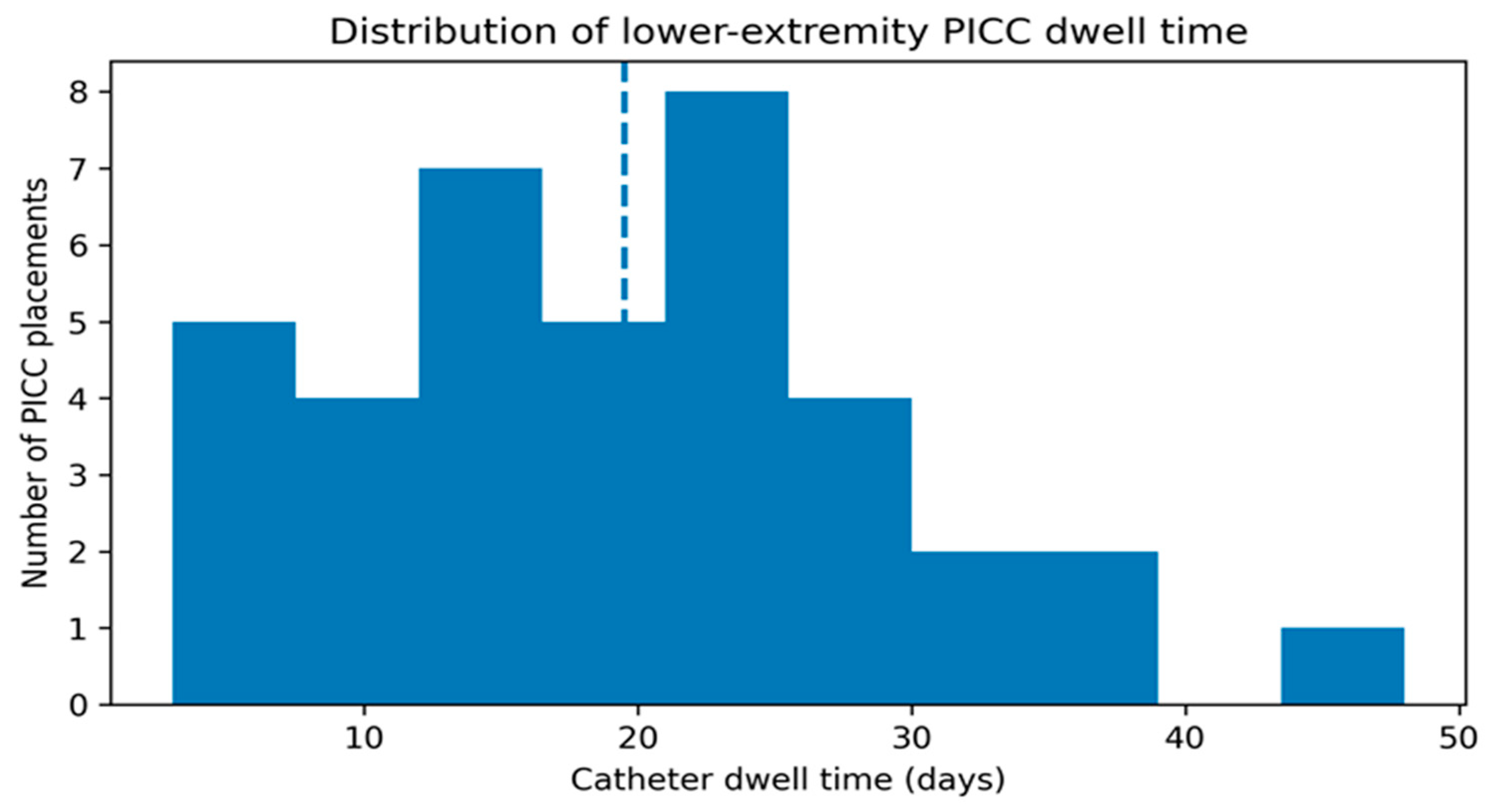
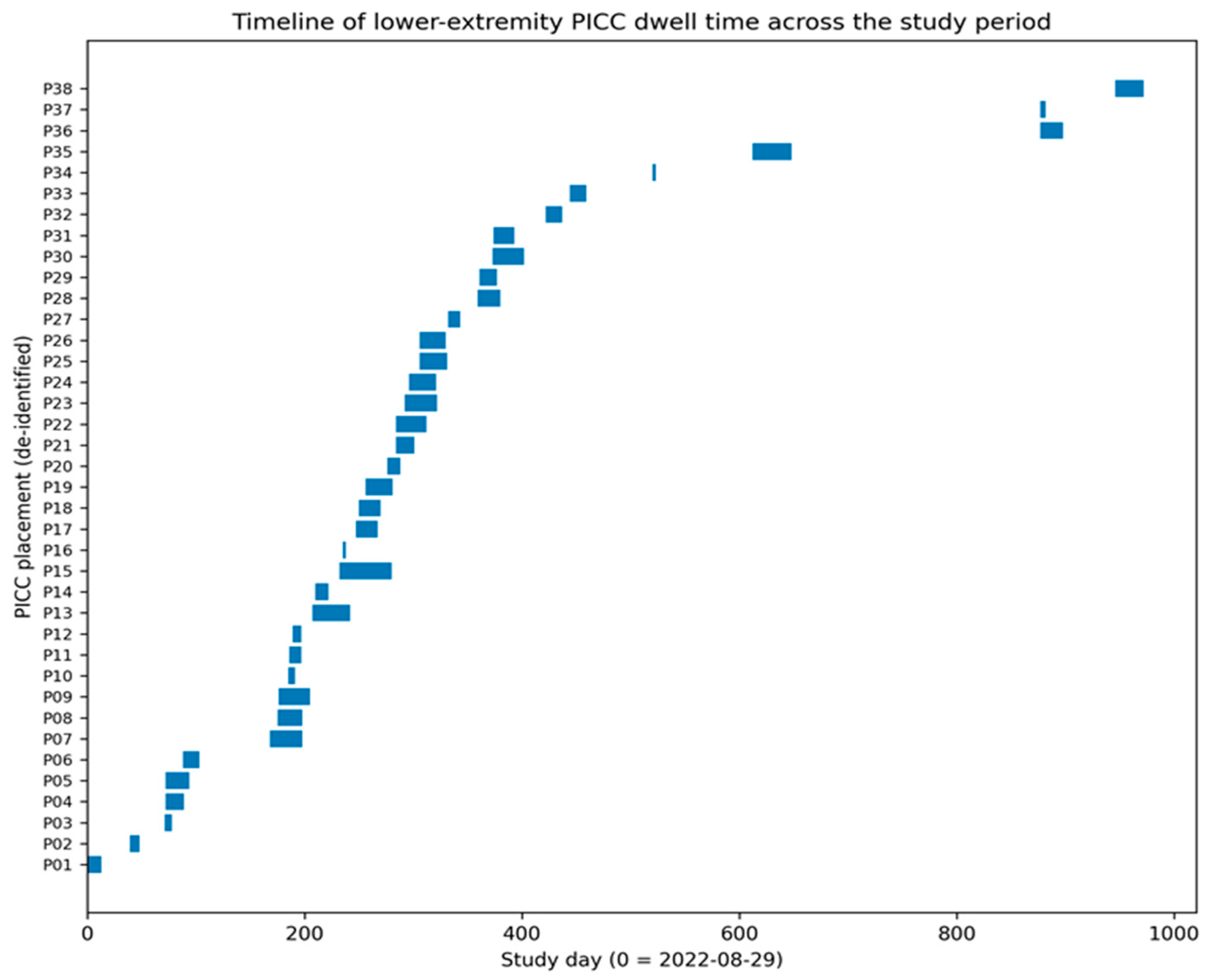
2.4.2. Catheter Dwell Time
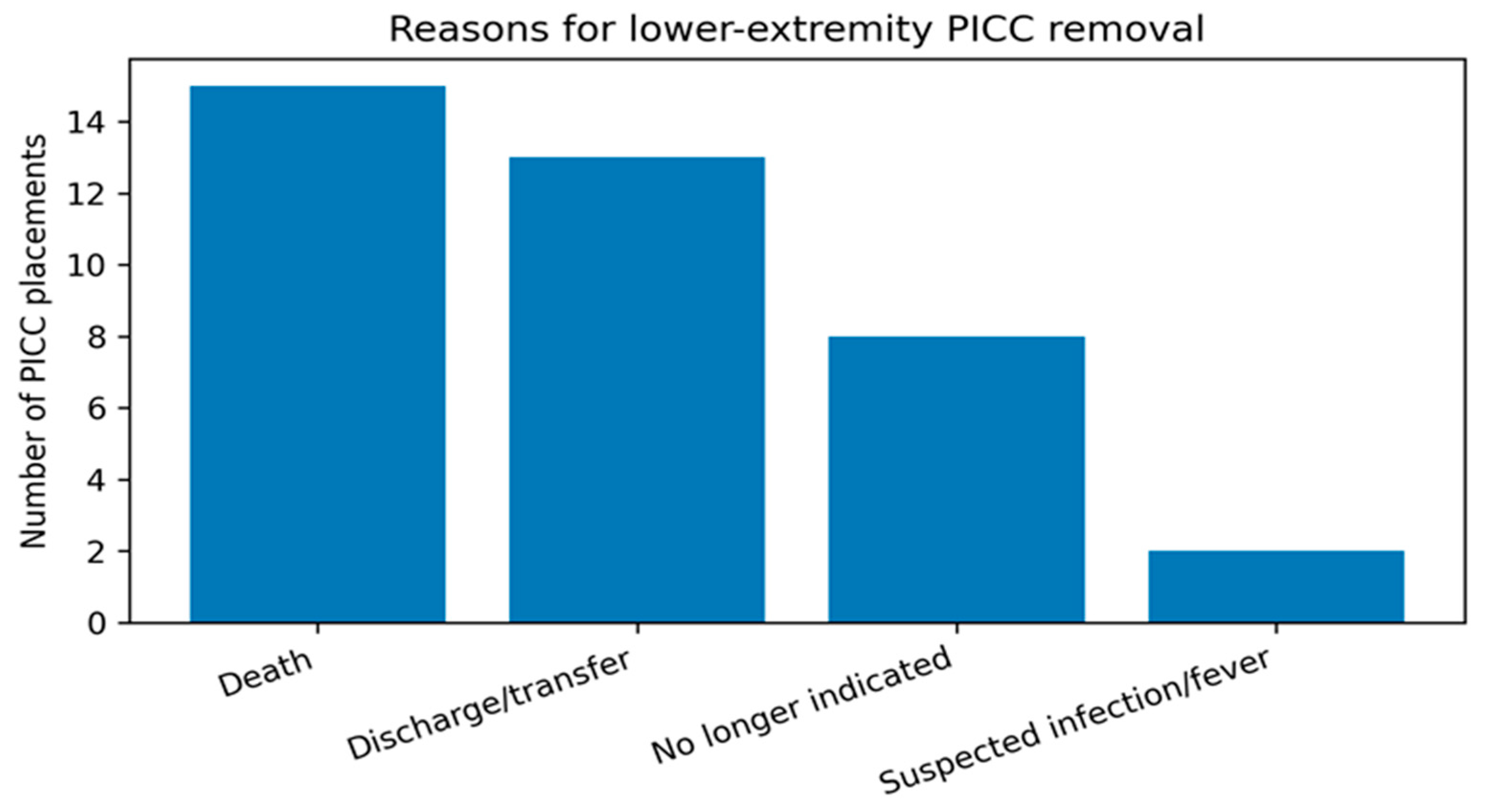
2.4.3. Reasons for Catheter Removal
- Death: catheter removal in the context of in-hospital death.
- Discharge/transfer: catheter removal performed as part of a transition-of-care process (ICU-to-ward transfer, inter-hospital transfer, or hospital discharge), when documentation indicated no immediate device-related complication prompting removal.
- No longer clinically indicated: documentation that the original indication had resolved or that the device was no longer required for ongoing therapy. This category included (i) completion or cessation of intravenous antibiotics, (ii) discontinuation of TPN, and/or (iii) establishment of alternative vascular access making the lower-extremity PICC unnecessary (e.g., upper-extremity access became feasible or a CVC was placed), as explicitly stated in notes.
- Suspected infection/fever evaluation: catheter removed because of suspected catheter-related infection or unexplained fever leading to line evaluation, as documented by the treating team.
2.4.4. Microbiological Findings During PICC Use
- Catheter-drawn (PICC) blood culture results;
- Peripheral blood culture results.
2.5. Data Collection and Variables
2.6. Statistical Analysis
2.7. Ethics Approval
2.8. Data Availability
3. Results
3.1. Baseline and Procedural Characteristics
3.2. Indications for Lower-Extremity PICC Placement
4. Discussion
4.1. Indications: Lower-Extremity PICCs as a Pragmatic ICU Access Strategy
4.2. Dwell Time: A Useful Exposure Metric, Not Just a Calendar Number
4.3. Removal Reasons: The Highest-ROI Target for Improvement Is Often Process, Not Technology
4.4. Microbiological Findings: Signal, Noise, and the ICU Fever Problem
4.5. Clinical Implications: What This Means for ICU Teams Tomorrow Morning
- Clarify indication at insertion and codify it in the chart. Indication drift is common; explicit documentation supports later de-escalation decisions [31].
- Separate “fever evaluation” from “line removal reflex.” In a high-noise ICU environment, removing the line at the first temperature spike may not be the most efficient risk-management strategy; structured evaluation pathways reduce unnecessary removals and reinsertions while maintaining safety [32,33].
- (1)
- Indication today (mandatory): Abx/TPN/vasoactive infusion/poor access/other
- (2)
- Expected remaining duration: ≤3 days/4–7 days/>7 days
- (3)
- De-escalation options: switch to oral therapy; stop TPN; alternative access available (e.g., upper-extremity access feasible); remove if none apply
- (4)
- If no clear indication: assign owner (attending/on-call) and set removal target within 24 h
4.6. Limitations
4.7. Future Directions
5. Conclusions
Author Contributions
Funding
Institutional Review Board Statement
Informed Consent Statement
Data Availability Statement
Acknowledgments
Conflicts of Interest
Abbreviations
References
- McGee, D.C.; Gould, M.K. Preventing complications of central venous catheterization. N. Engl. J. Med. 2003, 348, 1123–1133. [Google Scholar] [CrossRef]
- Marik, P.E.; Flemmer, M.; Harrison, W. The risk of catheter-related bloodstream infection with femoral venous catheters as compared to subclavian and internal jugular venous catheters: A systematic review. Crit. Care Med. 2012, 40, 2479–2485. [Google Scholar] [CrossRef]
- Lorente, L.; Henry, C.; Martín, M.M.; Jiménez, A.; Mora, M.L. Central venous catheter-related infection in a prospective and observational study of 2595 catheters. Crit. Care 2005, 9, R631–R635. [Google Scholar] [CrossRef]
- Amerasekera, S.S.H.; Jones, C.M.; Patel, R.; Cleasby, M.J. Imaging of the complications of peripherally inserted central venous catheters. Clin. Radiol. 2009, 64, 832–840. [Google Scholar] [CrossRef] [PubMed]
- Song, L.; Li, H. Malposition of peripherally inserted central catheter: Experience from 3,012 patients with cancer. Exp. Ther. Med. 2013, 6, 891–893. [Google Scholar] [CrossRef] [PubMed]
- Trerotola, S.O.; Thompson, S.; Chittams, J.; Vierregger, K.S. Analysis of tip malposition and correction in peripherally inserted central catheters placed at bedside by a dedicated nursing team. J. Vasc. Interv. Radiol. 2007, 18, 513–518. [Google Scholar] [CrossRef] [PubMed]
- Zochios, V.; Umar, I.; Simpson, N.; Jones, N. Peripherally inserted central catheter (PICC)-related thrombosis in critically ill patients: A systematic review. J. Vasc. Access 2014, 15, 329–337. [Google Scholar] [CrossRef]
- Evans, R.S.; Sharp, J.H.; Linford, L.H.; Lloyd, J.F.; Tripp, J.S.; Jones, J.P.; Woller, S.C.; Stevens, S.M.; Elliott, C.G.; Weaver, L.K. Risk of symptomatic DVT associated with peripherally inserted central catheters. Chest 2010, 138, 803–810. [Google Scholar] [CrossRef]
- Nicholson, J.; Davies, L.; Chan, V.; Gill, K.; McGowan, S.; Rowbotham, S. Development of an ultrasound-guided peripherally inserted central catheter insertion service—A six-year retrospective analysis. Br. J. Nurs. 2010, 19, S9–S17. [Google Scholar] [CrossRef]
- Subramanian, S.; Moe, D.C.; Vo, J.N. Ultrasound-guided tunneled lower extremity peripherally inserted central catheter placement in infants. J. Vasc. Interv. Radiol. 2013, 24, 1910–1913. [Google Scholar] [CrossRef]
- Gaballah, M.; Krishnamurthy, G.; Keller, M.S.; McIntosh, A.; Munson, D.A.; Cahill, A.M. US-guided placement and tip position confirmation for lower-extremity central venous access in neonates and infants: Comparison with conventional insertion. J. Vasc. Interv. Radiol. 2014, 25, 548–555. [Google Scholar] [CrossRef] [PubMed]
- Wan, Y.; Chu, Y.; Qiu, Y.; Chen, Q.; Zhou, W.; Song, Q. The feasibility and safety of peripherally inserted central catheters via the superficial femoral vein in patients with superior vena cava syndrome. J. Vasc. Access 2018, 19, 34–39. [Google Scholar] [CrossRef] [PubMed]
- Hoang, V.; Sills, J.; Clifton-Koeppel, R.; Modanlou, H.D. Peripherally inserted central catheter inserted from the lower extremity veins: Catheter tip placement. J. Neonatal Perinat. Med. 2010, 3, 27–31. [Google Scholar] [CrossRef]
- Moureau, N.L.; Trick, N.; Nifong, T.; Perry, C.; Kelley, C.; Carrico, R.; Leavitt, M.; Gordon, S.M.; Wallace, J.; Harvill, M.; et al. Vessel health and preservation (Part 1): A new evidence-based approach to vascular access selection and management. J. Vasc. Access 2012, 13, 351–356. [Google Scholar] [CrossRef]
- Chung, H.-Y.; Beheshti, M.V. Principles of Non-Tunneled Central Venous Access. Tech. Vasc. Interv. Radiol. 2011, 14, 186–191. [Google Scholar] [CrossRef]
- Chopra, V.; Flanders, S.A.; Saint, S.; Woller, S.C.; O’Grady, N.P.; Safdar, N.; Trerotola, S.O.; Saran, R.; Moureau, N.; Wiseman, S.; et al. The Michigan Appropriateness Guide for Intravenous Catheters (MAGIC): Results from a multispecialty panel using the RAND/UCLA appropriateness method. Ann. Intern. Med. 2015, 163, S1–S40. [Google Scholar] [CrossRef]
- Chopra, V.; O’Malley, M.; Horowitz, J.; Zhang, Q.; Saint, S.; Bernstein, S.J.; Flanders, S.A. Improving Peripherally Inserted Central Catheter Appropriateness and Reducing Device-Related Complications: A Quasi-Experimental Study in 52 Michigan Hospitals. BMJ Qual. Saf. 2022, 31, 23–30. [Google Scholar] [CrossRef]
- Govindan, S.; Jobe, A.; O’Malley, M.E.; Flanders, S.A.; Chopra, V. To PICC or not to PICC? A cross-sectional survey of vascular access practices in the ICU. J. Crit. Care 2021, 63, 98–103. [Google Scholar] [CrossRef]
- Kwon, S.; Son, S.M.; Lee, S.H.; Kim, J.H.; Kim, Y.J.; Lee, J.H.; Lee, S.H.; Park, J.W. Outcomes of bedside peripherally inserted central catheter placement: A retrospective study at a single institution. Acute Crit. Care 2020, 35, 31–37. [Google Scholar] [CrossRef]
- Duwadi, S.; Zhao, Q.; Budal, B.S. Peripherally inserted central catheters in critically ill patients—Complications and its prevention: A review. Int. J. Nurs. Sci. 2019, 6, 99–105. [Google Scholar] [CrossRef]
- Mavrovounis, G.; Mermiri, M.; Chatzis, D.G.; Pantazopoulos, I. Peripherally inserted central catheter lines for intensive care unit and onco-hematologic patients: A systematic review and meta-analysis. Heart Lung 2020, 49, 922–933. [Google Scholar] [CrossRef] [PubMed]
- Maki, D.G.; Kluger, D.M.; Crnich, C.J. The risk of bloodstream infection in adults with different intravascular devices: A systematic review of 200 published prospective studies. Mayo Clin. Proc. 2006, 81, 1159–1171. [Google Scholar] [CrossRef] [PubMed]
- Raad, I.; Hanna, H.; Maki, D. Intravascular catheter-related infections: Advances in diagnosis, prevention and management. Lancet Infect. Dis. 2007, 7, 645–657. [Google Scholar] [CrossRef] [PubMed]
- Timsit, J.-F.; Bouadma, L.; Ruckly, S.; Schwebel, C.; Garrouste-Orgeas, M.; Bronchard, R.; Calvino-Gunther, S.; Laupland, K.; Adrie, C.; Thuong, M.; et al. Dressing disruption is a major risk factor for catheter-related infections. Crit. Care Med. 2012, 40, 1707–1714. [Google Scholar] [CrossRef]
- Chopra, V.; Ratz, D.; Kuhn, L.; Lopus, T.; Chenoweth, C.; Krein, S.L. PICC-associated bloodstream infections: Prevalence, patterns, and predictors. Am. J. Med. 2014, 127, 319–328. [Google Scholar] [CrossRef]
- Chopra, V.; Smith, S.; Swaminathan, L.; Boldenow, T.; Kaatz, S.; Bernstein, S.J.; Flanders, S.A. Variations in peripherally inserted central catheter use and outcomes in Michigan hospitals. JAMA Intern. Med. 2016, 176, 548–551. [Google Scholar] [CrossRef]
- Pronovost, P.; Needham, D.; Berenholtz, S.; Sinopoli, D.; Chu, H.; Cosgrove, S.; Sexton, B.; Hyzy, R.; Welsh, R.; Roth, G.; et al. An intervention to decrease catheter-related bloodstream infections in the ICU. N. Engl. J. Med. 2006, 355, 2725–2732. [Google Scholar] [CrossRef]
- Marschall, J.; Mermel, L.A.; Fakih, M.; Hadaway, L.; Kallen, A.; O’Grady, N.P.; Pettis, A.M.; Rupp, M.E.; Sandora, T.; Maragakis, L.L.; et al. Strategies to prevent central line-associated bloodstream infections in acute care hospitals: 2014 update. Infect. Control Hosp. Epidemiol. 2014, 35, 753–771. [Google Scholar] [CrossRef]
- O’Grady, N.P.; Barie, P.S.; Bartlett, J.G.; Bleck, T.; Garvey, G.; Jacobi, J.; Linden, P.; Maki, D.G.; Nam, M.; Pasculle, W.; et al. Guidelines for evaluation of new fever in critically ill adult patients: 2008 update from the American College of Critical Care Medicine and the Infectious Diseases Society of America. Crit. Care Med. 2008, 36, 1330–1349. [Google Scholar] [CrossRef]
- Mermel, L.A.; Allon, M.; Bouza, E.; Craven, D.E.; Flynn, P.; O’Grady, N.P.; Raad, I.I.; Rijnders, B.J.A.; Sherertz, R.J.; Warren, D.K. Clinical practice guidelines for the diagnosis and management of intravascular catheter-related infection: 2009 update by the Infectious Diseases Society of America. Clin. Infect. Dis. 2009, 49, 1–45. [Google Scholar] [CrossRef]
- Swaminathan, L.; Flanders, S.A.; Horowitz, J.; Zhang, Q.; O’Malley, M.; Chopra, V. Safety and outcomes of midline catheters vs peripherally inserted central catheters for short-term indications: A multicenter study. JAMA Intern. Med. 2022, 182, 50–58. [Google Scholar] [CrossRef]
- Tomaszewski, K.J.; Ferko, N.; Hollmann, S.S.; Boyd, K.M.; Sterner, S.J.; Smyth, B.N.; Neumann, V.C. Time and resources of peripherally inserted central catheter insertion procedures: A comparison between blind insertion/chest X-ray and a real-time tip navigation and confirmation system. Clin. Outcomes Res. 2017, 9, 115–125. [Google Scholar] [CrossRef]
- Chopra, V.; Anand, S.; Hickner, A.; Buist, M.; Rogers, M.A.M.; Saint, S.; Flanders, S.A. Risk of venous thromboembolism associated with peripherally inserted central catheters: A systematic review and meta-analysis. Lancet 2013, 382, 311–325. [Google Scholar] [CrossRef]
- Zhu, X.-J.; Zhao, L.; Peng, N.; Luo, J.-M.; Liu, S.-X. Lower extremity peripherally inserted central catheter placement ectopic to the ascending lumbar vein: A case report. World J. Clin. Cases 2024, 12, 1430–1436. [Google Scholar] [CrossRef]
- Schults, J.A.; Kleidon, T.; Chopra, V.; Ullman, A.J.; Rickard, C.M. Peripherally inserted central catheter design and material for reducing catheter failure and complications. Cochrane Database Syst. Rev. 2024, 6, CD013366. [Google Scholar] [CrossRef]



| Variable | Value |
|---|---|
| Age, years, median (IQR) | 73 (69–83.75) |
| Sex, n (%) | |
| — Male | 26 (70.3) |
| — Female | 11 (29.7) |
| Laterality of placement, n (%) | |
| — Right lower extremity | 26 (68.4) |
| — Left lower extremity | 12 (31.6) |
| Femoral artery–vein relationship, n (%) | |
| — Artery–vein parallel | 30 (78.9) |
| — Artery on vein | 8 (21.1) |
| Catheter characteristics, n (%) | |
| — Dual-lumen PICC | 38 (100) |
| — Manufacturer: Arrow | 34 (89.5) |
| — Manufacturer: BD | 4 (10.5) |
| Catheter dwell time, days, median (IQR) | 19.5 (12–25) |
| Catheter dwell time, range, days | 3–48 |
| Study period | 29 August 2022–1 April 2025 |
| Indication (Non-Mutually Exclusive) | n | % |
|---|---|---|
| Difficult peripheral intravenous access | 38 | 100.0 |
| Prolonged intravenous antibiotics | 34 | 89.5 |
| Total parenteral nutrition (TPN) | 13 | 34.2 |
| Vasopressor therapy | 2 | 5.3 |
| Removal Reason | n | % | Dwell Time, Days (Median [IQR]) |
|---|---|---|---|
| Death | 15 | 39.5 | 12.0 [7.5–25.0] |
| Discharge/transfer | 13 | 34.2 | 20.0 [15.0–24.0] |
| No longer indicated | 8 | 21.1 | 24.0 [21.8–27.0] |
| Suspected infection/fever | 2 | 5.3 | 14.5 [13.8–15.2] |
| Culture Source | No. of Episodes Sampled (N) | Positive, n/N (%) | Organisms Identified (Positive Episodes) |
|---|---|---|---|
| Catheter-drawn (PICC) blood culture | 38 * | 1/38 (2.6%) | Candida albicans (n = 1) |
| Peripheral blood culture | 38 * | 4/38 (10.5%) | Candida albicans (n = 1); CRAB (n = 1); CRKP (n = 1); Bacillus species (n = 1) |
Disclaimer/Publisher’s Note: The statements, opinions and data contained in all publications are solely those of the individual author(s) and contributor(s) and not of MDPI and/or the editor(s). MDPI and/or the editor(s) disclaim responsibility for any injury to people or property resulting from any ideas, methods, instructions or products referred to in the content. |
© 2026 by the authors. Licensee MDPI, Basel, Switzerland. This article is an open access article distributed under the terms and conditions of the Creative Commons Attribution (CC BY) license.
Share and Cite
Chang, W.-H.; Hu, T.-Y.; Hsieh, H.-F.; Cheng, K.-H.; Yu, K.-P. Indications, Dwell Time, and Removal Reasons of Standardized Mid-Thigh Lower-Extremity PICCs in Adult ICU Patients: A Retrospective Cohort Study. Life 2026, 16, 262. https://doi.org/10.3390/life16020262
Chang W-H, Hu T-Y, Hsieh H-F, Cheng K-H, Yu K-P. Indications, Dwell Time, and Removal Reasons of Standardized Mid-Thigh Lower-Extremity PICCs in Adult ICU Patients: A Retrospective Cohort Study. Life. 2026; 16(2):262. https://doi.org/10.3390/life16020262
Chicago/Turabian StyleChang, Wei-Hung, Ting-Yu Hu, Hui-Fang Hsieh, Kuang-Hua Cheng, and Kuan-Pen Yu. 2026. "Indications, Dwell Time, and Removal Reasons of Standardized Mid-Thigh Lower-Extremity PICCs in Adult ICU Patients: A Retrospective Cohort Study" Life 16, no. 2: 262. https://doi.org/10.3390/life16020262
APA StyleChang, W.-H., Hu, T.-Y., Hsieh, H.-F., Cheng, K.-H., & Yu, K.-P. (2026). Indications, Dwell Time, and Removal Reasons of Standardized Mid-Thigh Lower-Extremity PICCs in Adult ICU Patients: A Retrospective Cohort Study. Life, 16(2), 262. https://doi.org/10.3390/life16020262