Effects of Napping on Cognitive and Physical Performance in Sleep-Deprived Elite Kung-Fu Athletes

 and
and
Abstract
1. Introduction
2. Materials and Methods
2.1. Ethical Considerations
2.2. Participants
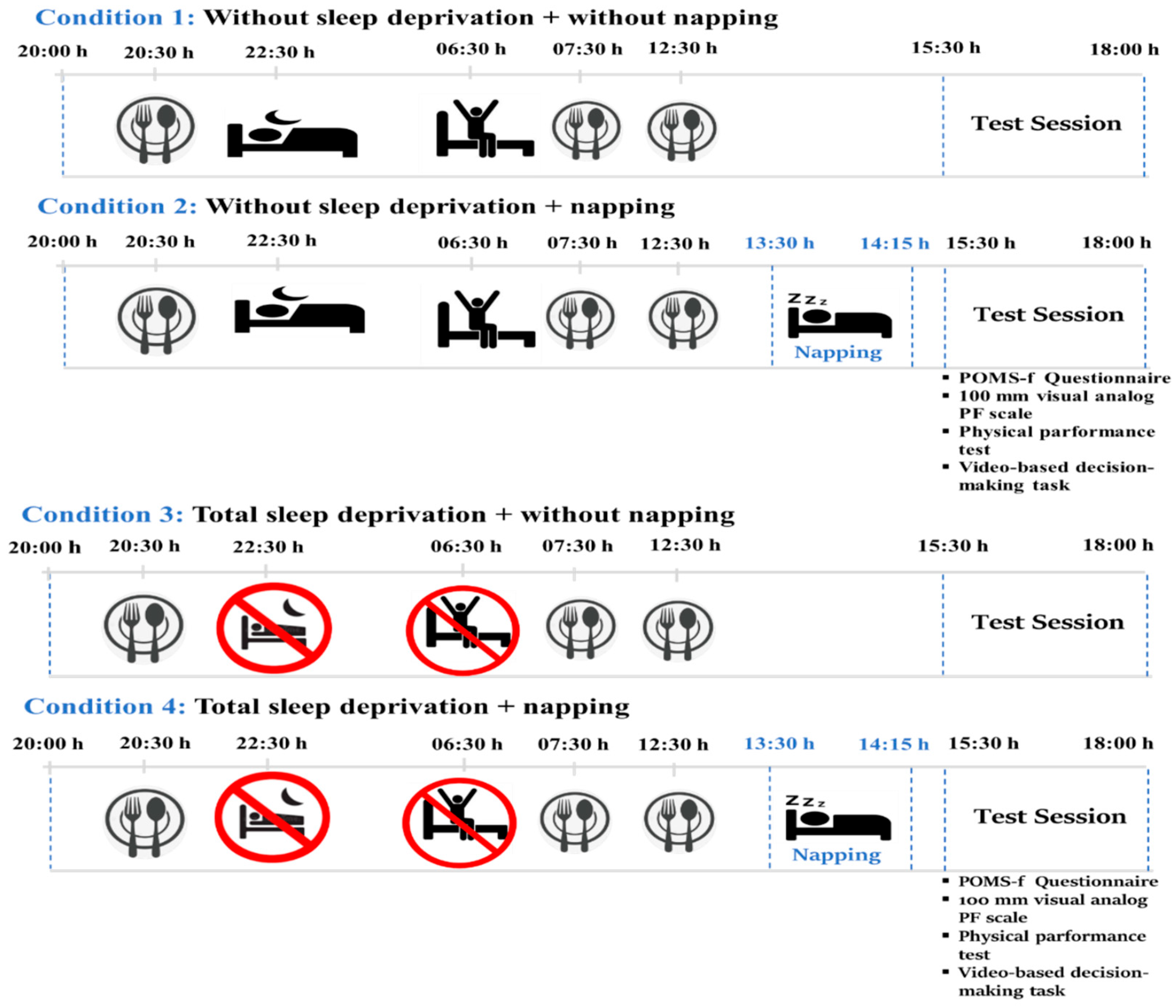
2.3. Experimental Design
2.4. Dependent Measures
2.4.1. Profile of Mood States
2.4.2. Perceptual Responses
- Concentration
- Attention
- Fatigue
- Sleep Quality
2.4.3. Decision-Making Skills
2.4.4. Barrage Test
2.4.5. Anaerobic Performances
2.5. Statistical Analysis
3. Results
3.1. Effects on Psychological Parameters
3.1.1. Profile of Mood States (POMS)
Effects of Sleep Deprivation on Mood States
Effects of Napping on Mood States
Sleep–Nap Interaction Effects on Mood States
3.1.2. Subjective Perceptions of Sleepiness and Recovery
Effects of Sleep Deprivation on Perceived Sleepiness
Effects of Napping on Perceived Recovery
Sleep–Nap Interaction Effects on Subjective Measures
3.2. Effects on Cognitive Function
3.2.1. Decision-Making Performance
Effects of Sleep Deprivation on Decision-Making
Effects of Napping on Decision-Making
Sleep–Nap Interaction Effects on Decision-Making
3.2.2. Sustained Attention Performance (Barrage Test)
Effects of Sleep Deprivation on Sustained Attention
Effects of Napping on Sustained Attention
Sleep–Nap Interaction Effects on Sustained Attention
3.3. Effects on Physical Performance
3.3.1. Effects of Sleep Deprivation on Physical Performance Measures
3.3.2. Effects of Napping on Physical Performance Measures
3.3.3. Sleep–Nap Interaction Effects on Physical Performance
4. Discussion
4.1. Research Problem and Objectives
4.2. Summary of Key Findings
4.3. Interpretation of Results
4.4. Comparison with Previous Research
4.5. Theoretical Implications
4.6. Practical Implications
4.7. Study Limitations
4.8. Future Research Directions
5. Conclusions
Author Contributions
Funding
Institutional Review Board Statement
Informed Consent Statement
Data Availability Statement
Acknowledgments
Conflicts of Interest
References
- Bonnar, D.; Bartel, K.; Kakoschke, N.; Lang, C. Sleep Interventions Designed to Improve Athletic Performance and Recovery: A Systematic Review of Current Approaches. Sports Med. 2018, 48, 683–703. [Google Scholar] [CrossRef]
- Fullagar, H.H.; Skorski, S.; Duffield, R.; Hammes, D.; Coutts, A.J.; Meyer, T. Sleep and athletic performance: The effects of sleep loss on exercise performance, and physiological and cognitive responses to exercise. Sports Med. 2015, 45, 161–186. [Google Scholar] [CrossRef] [PubMed]
- Malhotra, R.K. Sleep, Recovery, and Performance in Sports. Neurol. Clin. 2017, 35, 547–557. [Google Scholar] [CrossRef] [PubMed]
- Cullen, T.; Thomas, G.; Wadley, A.J.; Myers, T. The effects of a single night of complete and partial sleep deprivation on physical and cognitive performance: A Bayesian analysis. J. Sports Sci. 2019, 37, 2726–2734. [Google Scholar] [CrossRef] [PubMed]
- Mesas, A.E.; Nunez de Arenas-Arroyo, S.; Martinez-Vizcaino, V.; Garrido-Miguel, M.; Fernandez-Rodriguez, R.; Bizzozero-Peroni, B.; Torres-Costoso, A.I. Is daytime napping an effective strategy to improve sport-related cognitive and physical performance and reduce fatigue? A systematic review and meta-analysis of randomised controlled trials. Br. J. Sports Med. 2023, 57, 417–426. [Google Scholar] [CrossRef]
- Walsh, N.P.; Halson, S.L.; Sargent, C.; Roach, G.D.; Nedelec, M.; Gupta, L.; Leeder, J.; Fullagar, H.H.; Coutts, A.J.; Edwards, B.J.; et al. Sleep and the athlete: Narrative review and 2021 expert consensus recommendations. Br. J. Sports Med. 2020, 55, 356–368. [Google Scholar] [CrossRef]
- Good, C.H.; Brager, A.J.; Capaldi, V.F.; Mysliwiec, V. Sleep in the United States Military. Neuropsychopharmacology 2020, 45, 176–191. [Google Scholar] [CrossRef]
- Walsh, N.P. Recommendations to maintain immune health in athletes. Eur. J. Sport Sci. 2018, 18, 820–831. [Google Scholar] [CrossRef]
- Copenhaver, E.A.; Diamond, A.B. The Value of Sleep on Athletic Performance, Injury, and Recovery in the Young Athlete. Pediatr. Ann. 2017, 46, e106–e111. [Google Scholar] [CrossRef]
- Alexandre, C.; Latremoliere, A.; Ferreira, A.; Miracca, G.; Yamamoto, M.; Scammell, T.E.; Woolf, C.J. Decreased alertness due to sleep loss increases pain sensitivity in mice. Nat. Med. 2017, 23, 768–774. [Google Scholar] [CrossRef]
- Kusztor, A.; Raud, L.; Juel, B.E.; Nilsen, A.S.; Storm, J.F.; Huster, R.J. Sleep deprivation differentially affects subcomponents of cognitive control. Sleep 2019, 42, zsz016. [Google Scholar] [CrossRef]
- Mao, T.; Dinges, D.; Deng, Y.; Zhao, K.; Yang, Z.; Lei, H.; Fang, Z.; Yang, F.N.; Galli, O.; Goel, N.; et al. Impaired Vigilant Attention Partly Accounts for Inhibition Control Deficits After Total Sleep Deprivation and Partial Sleep Restriction. Nat. Sci. Sleep 2021, 13, 1545–1560. [Google Scholar] [CrossRef]
- Mao, T.; Fang, Z.; Chai, Y.; Deng, Y.; Rao, J.; Quan, P.; Goel, N.; Basner, M.; Guo, B.; Dinges, D.F.; et al. Sleep deprivation attenuates neural responses to outcomes from risky decision-making. Psychophysiology 2024, 61, e14465. [Google Scholar] [CrossRef]
- Bird, S.P. Sleep, Recovery, and Athletic Performance. Strength Cond. J. 2013, 35, 43–47. [Google Scholar] [CrossRef]
- Simon, E.B.; Oren, N.; Sharon, H.; Kirschner, A.; Goldway, N.; Okon-Singer, H.; Tauman, R.; Deweese, M.M.; Keil, A.; Hendler, T. Losing Neutrality: The Neural Basis of Impaired Emotional Control without Sleep. J. Neurosci. 2015, 35, 13194–13205. [Google Scholar] [CrossRef] [PubMed]
- Biggins, M.; Purtill, H.; Fowler, P.; Bender, A.; Sullivan, K.O.; Samuels, C.; Cahalan, R. Sleep, health, and well-being in elite athletes from different sports, before, during, and after international competition. Phys. Sport. 2021, 49, 429–437. [Google Scholar] [CrossRef] [PubMed]
- Faraut, B.; Nakib, S.; Drogou, C.; Elbaz, M.; Sauvet, F.; De Bandt, J.P.; Leger, D. Napping reverses the salivary interleukin-6 and urinary norepinephrine changes induced by sleep restriction. J. Clin. Endocrinol. Metab. 2015, 100, E416–E426. [Google Scholar] [CrossRef] [PubMed]
- Botonis, P.G.; Arsoniadis, G.G.; Platanou, T.I.; Toubekis, A.G. Heart rate recovery responses after acute training load changes in top-class water polo players. Eur. J. Sport Sci. 2021, 21, 158–165. [Google Scholar] [CrossRef]
- Lastella, M.; Halson, S.L.; Vitale, J.A.; Memon, A.R.; Vincent, G.E. To Nap or Not to Nap? A Systematic Review Evaluating Napping Behavior in Athletes and the Impact on Various Measures of Athletic Performance. Nat. Sci. Sleep. 2021, 13, 841–862. [Google Scholar] [CrossRef]
- Brooks, A.; Lack, L. A brief afternoon nap following nocturnal sleep restriction: Which nap duration is most recuperative? Sleep 2006, 29, 831–840. [Google Scholar] [CrossRef]
- Tietzel, A.J.; Lack, L.C. The recuperative value of brief and ultra-brief naps on alertness and cognitive performance. J. Sleep Res. 2002, 11, 213–218. [Google Scholar] [CrossRef] [PubMed]
- Drew, M.; Vlahovich, N.; Hughes, D.; Appaneal, R.; Burke, L.M.; Lundy, B.; Rogers, M.; Toomey, M.; Watts, D.; Lovell, G.; et al. Prevalence of illness, poor mental health and sleep quality and low energy availability prior to the 2016 Summer Olympic Games. Br. J. Sports Med. 2018, 52, 47–53. [Google Scholar] [CrossRef] [PubMed]
- Vitale, K.C.; Owens, R.; Hopkins, S.R.; Malhotra, A. Sleep Hygiene for Optimizing Recovery in Athletes: Review and Recommendations. Int. J. Sports Med. 2019, 40, 535–543. [Google Scholar] [CrossRef] [PubMed]
- World Medical Association. World Medical Association Declaration of Helsinki: Ethical principles for medical research involving human subjects. JAMA 2013, 310, 2191–2194. [Google Scholar] [CrossRef]
- Swann, C.; Moran, A.; Piggott, D. Defining elite athletes: Issues in the study of expert performance in sport psychology. Psychol. Sport Exerc. 2015, 16, 3–14. [Google Scholar] [CrossRef]
- Horne, J.A.; Ostberg, O. A self-assessment questionnaire to determine morningness-eveningness in human circadian rhythms. Int. J. Chronobiol. 1976, 4, 97–110. [Google Scholar]
- Buysse, D.J.; Reynolds, C.F., 3rd; Monk, T.H.; Berman, S.R.; Kupfer, D.J. The Pittsburgh Sleep Quality Index: A new instrument for psychiatric practice and research. Psychiatry Res. 1989, 28, 193–213. [Google Scholar] [CrossRef]
- VanHelder, T.; Radomski, M.W. Sleep deprivation and the effect on exercise performance. Sports Med. 1989, 7, 235–247. [Google Scholar] [CrossRef]
- Belenky, G.; Wesensten, N.J.; Thorne, D.R.; Thomas, M.L.; Sing, H.C.; Redmond, D.P.; Russo, M.B.; Balkin, T.J. Patterns of performance degradation and restoration during sleep restriction and subsequent recovery: A sleep dose-response study. J. Sleep Res. 2003, 12, 1–12. [Google Scholar] [CrossRef]
- Hirshkowitz, M.; Whiton, K.; Albert, S.M.; Alessi, C.; Bruni, O.; DonCarlos, L.; Hazen, N.; Herman, J.; Katz, E.S.; Kheirandish-Gozal, L.; et al. National Sleep Foundation’s sleep time duration recommendations: Methodology and results summary. Sleep Health 2015, 1, 40–43. [Google Scholar] [CrossRef]
- Chaput, J.P.; Dutil, C.; Sampasa-Kanyinga, H. Sleeping hours: What is the ideal number and how does age impact this? Nat. Sci. Sleep 2018, 10, 421–430. [Google Scholar] [CrossRef]
- Alhola, P.; Tallus, M.; Kylmala, M.; Portin, R.; Polo-Kantola, P. Sleep deprivation, cognitive performance, and hormone therapy in postmenopausal women. Menopause 2005, 12, 149–155. [Google Scholar] [CrossRef]
- Grandou, C.; Wallace, L.; Impellizzeri, F.M.; Allen, N.G.; Coutts, A.J. Overtraining in Resistance Exercise: An Exploratory Systematic Review and Methodological Appraisal of the Literature. Sports Med. 2020, 50, 815–828. [Google Scholar] [CrossRef] [PubMed]
- Halson, S.L. Sleep in elite athletes and nutritional interventions to enhance sleep. Sports Med. 2014, 44, S13–S23. [Google Scholar] [CrossRef] [PubMed]
- Burke, L.M.; Castell, L.M.; Casa, D.J.; Close, G.L.; Costa, R.J.S.; Desbrow, B.; Halson, S.L.; Lis, D.M.; Melin, A.K.; Peeling, P.; et al. International Association of Athletics Federations Consensus Statement 2019: Nutrition for Athletics. Int. J. Sport Nutr. Exerc. Metab. 2019, 29, 73–84. [Google Scholar] [CrossRef] [PubMed]
- Guest, N.S.; VanDusseldorp, T.A.; Nelson, M.T.; Grgic, J.; Schoenfeld, B.J.; Jenkins, N.D.M.; Arent, S.M.; Antonio, J.; Stout, J.R.; Trexler, E.T.; et al. International society of sports nutrition position stand: Caffeine and exercise performance. J. Int. Soc. Sports Nutr. 2021, 18, 1. [Google Scholar] [CrossRef]
- Juliano, L.M.; Huntley, E.D.; Harrell, P.T.; Westerman, A.T. Development of the caffeine withdrawal symptom questionnaire: Caffeine withdrawal symptoms cluster into 7 factors. Drug Alcohol. Depend. 2012, 124, 229–234. [Google Scholar] [CrossRef]
- Vlahoyiannis, A.; Aphamis, G.; Andreou, E.; Samoutis, G.; Sakkas, G.K.; Giannaki, C.D. Effects of High vs. Low Glycemic Index of Post-Exercise Meals on Sleep and Exercise Performance: A Randomized, Double-Blind, Counterbalanced Polysomnographic Study. Nutrients 2018, 10, 1795. [Google Scholar] [CrossRef]
- Dunford, M. Fundamentals of Sport and Exercise Nutrition; Human Kinetics: Champaign, IL, USA, 2010. [Google Scholar] [CrossRef]
- Hilditch, C.J.; Centofanti, S.A.; Dorrian, J.; Banks, S. A 30-Minute, but Not a 10-Minute Nighttime Nap is Associated with Sleep Inertia. Sleep 2016, 39, 675–685. [Google Scholar] [CrossRef]
- Cayrou, S.; Dickes, P.; Dolbeault, S. Version française du Profile of mood states (POMS-f). J. Thérapie Comport. Cogn. 2003, 13, 83–88. [Google Scholar]
- Bayard, S.; Lebrun, C.; Maudarbocus, K.H.; Schellaert, V.; Joffre, A.; Ferrante, E.; Le Louedec, M.; Cournoulat, A.; Gely-Nargeot, M.C.; Luik, A.I. Validation of a French version of the Sleep Condition Indicator: A clinical screening tool for insomnia disorder according to DSM-5 criteria. J. Sleep Res. 2017, 26, 702–708. [Google Scholar] [CrossRef]
- Petrowski, K.; Albani, C.; Zenger, M.; Brahler, E.; Schmalbach, B. Revised Short Screening Version of the Profile of Mood States (POMS) From the German General Population. Front. Psychol. 2021, 12, 631668. [Google Scholar] [CrossRef] [PubMed]
- Selmi, O.; Ouergui, I.; Muscella, A.; Levitt, D.E.; Suzuki, K.; Bouassida, A. Monitoring mood state to improve performance in soccer players: A brief review. Front. Psychol. 2023, 14, 1095238. [Google Scholar] [CrossRef] [PubMed]
- McCormack, H.M.; Horne, D.J.; Sheather, S. Clinical applications of visual analogue scales: A critical review. Psychol. Med. 1988, 18, 1007–1019. [Google Scholar] [CrossRef] [PubMed]
- Stubbs, R.J.; Hughes, D.A.; Johnstone, A.M.; Rowley, E.; Reid, C.; Elia, M.; Stratton, R.; Delargy, H.; King, N.; Blundell, J.E. The use of visual analogue scales to assess motivation to eat in human subjects: A review of their reliability and validity with an evaluation of new hand-held computerized systems for temporal tracking of appetite ratings. Br. J. Nutr. 2000, 84, 405–415. [Google Scholar] [CrossRef]
- Sung, Y.T.; Wu, J.S. The Visual Analogue Scale for Rating, Ranking and Paired-Comparison (VAS-RRP): A new technique for psychological measurement. Behav. Res. Methods 2018, 50, 1694–1715. [Google Scholar] [CrossRef]
- Kuhlmann, T.; Dantlgraber, M.; Reips, U.D. Investigating measurement equivalence of visual analogue scales and Likert-type scales in Internet-based personality questionnaires. Behav. Res. Methods 2017, 49, 2173–2181. [Google Scholar] [CrossRef]
- Shahid, A.; Wilkinson, K.; Marcu, S.; Shapiro, C.M. Visual Analogue Scale to Evaluate Fatigue Severity (VAS-F). In STOP, THAT and One Hundred Other Sleep Scales; Shahid, A., Wilkinson, K., Marcu, S., Shapiro, C.M., Eds.; Springer: New York, NY, USA, 2012; pp. 399–402. [Google Scholar] [CrossRef]
- Daaloul, H.; Souissi, N.; Davenne, D. Effects of Napping on Alertness, Cognitive, and Physical Outcomes of Karate Athletes. Med. Sci. Sports Exerc. 2019, 51, 338–345. [Google Scholar] [CrossRef]
- Kendzerska, T.B.; Smith, P.M.; Brignardello-Petersen, R.; Leung, R.S.; Tomlinson, G.A. Evaluation of the measurement properties of the Epworth sleepiness scale: A systematic review. Sleep Med. Rev. 2014, 18, 321–331. [Google Scholar] [CrossRef]
- Chua, E.C.; Sullivan, J.P.; Duffy, J.F.; Klerman, E.B.; Lockley, S.W.; Kristal, B.S.; Czeisler, C.A.; Gooley, J.J. Classifying attentional vulnerability to total sleep deprivation using baseline features of Psychomotor Vigilance Test performance. Sci. Rep. 2019, 9, 12102. [Google Scholar] [CrossRef]
- Hertel, E.; McPhee, M.E.; Petersen, K.K. Investigation of pain sensitivity following 3 nights of disrupted sleep in healthy individuals. Eur. J. Pain 2023, 27, 710–722. [Google Scholar] [CrossRef] [PubMed]
- Gawron, V.J. Overview of Self-Reported Measures of Fatigue. Int. J. Aviat. Psychol. 2017, 26, 120–131. [Google Scholar] [CrossRef]
- Saletin, J.M.; Hilditch, C.J.; Dement, W.C.; Carskadon, M.A. Short Daytime Naps Briefly Attenuate Objectively Measured Sleepiness Under Chronic Sleep Restriction. Sleep 2017, 40, zsx118. [Google Scholar] [CrossRef] [PubMed]
- Snyder-Halpern, R.; Verran, J.A. Instrumentation to describe subjective sleep characteristics in healthy subjects. Res. Nurs. Health 1987, 10, 155–163. [Google Scholar] [CrossRef]
- Alqurashi, Y.D.; Dawidziuk, A.; Alqarni, A.; Kelly, J.; Moss, J.; Polkey, M.I.; Morrell, M.J. A visual analog scale for the assessment of mild sleepiness in patients with obstructive sleep apnea and healthy participants. Ann. Thorac. Med. 2021, 16, 141–147. [Google Scholar] [CrossRef]
- Sousa-Pinto, B.; Eklund, P.; Pfaar, O.; Klimek, L.; Zuberbier, T.; Czarlewski, W.; Bedard, A.; Bindslev-Jensen, C.; Bedbrook, A.; Bosnic-Anticevich, S.; et al. Validity, reliability, and responsiveness of daily monitoring visual analog scales in MASK-air(R). Clin. Transl. Allergy 2021, 11, e12062. [Google Scholar] [CrossRef]
- Zisapel, N.; Nir, T. Determination of the minimal clinically significant difference on a patient visual analog sleep quality scale. J. Sleep Res. 2003, 12, 291–298. [Google Scholar] [CrossRef]
- Saddoud, A.; Khacharem, A.; H’Mida, C.; Trabelsi, K.; Boukhris, O.; Ammar, A.; Clark, C.C.T.; Glenn, J.M.; Chtourou, H.; Jarraya, M.; et al. Ramadan Observance Is Associated with Impaired Kung-Fu-Specific Decision-Making Skills. Int. J. Environ. Res. Public Health 2021, 18, 7340. [Google Scholar] [CrossRef]
- Gutierrez-Santiago, A.; Pereira-Rodriguez, R.; Prieto-Lage, I. Detection of the technical and tactical motion of the scorable movements in taekwondo. Physiol. Behav. 2020, 217, 112813. [Google Scholar] [CrossRef]
- Milazzo, N.; Farrow, D.; Ruffault, A.; Fournier, J.F. Do karate fighters use situational probability information to improve decision-making performance during on-mat tasks? J. Sports Sci. 2016, 34, 1547–1556. [Google Scholar] [CrossRef]
- Janssen, T.; Muller, D.; Mann, D.L. From Natural Towards Representative Decision Making in Sports: A Framework for Decision Making in Virtual and Augmented Environments. Sports Med. 2023, 53, 1851–1864. [Google Scholar] [CrossRef] [PubMed]
- Saddoud, A.; Rekik, G.; Belkhir, Y.; Kammoun, N.; Hidouri, S.; Chlif, M.; Jarraya, M. One night of total sleep deprivation impairs decision-making skills, anaerobic performances, mood states, and perceptual responses in elite Kung-Fu athletes. Biol. Rhythm. Res. 2022, 54, 102–116. [Google Scholar] [CrossRef]
- MacDonald, J.; Duerson, D. Reliability of a Computerized Neurocognitive Test in Baseline Concussion Testing of High School Athletes. Clin. J. Sport Med. 2015, 25, 367–372. [Google Scholar] [CrossRef] [PubMed]
- Wilson, P.J.; Kiely, J. Developing Decision-Making Expertise in Professional Sports Staff: What We Can Learn from the Good Judgement Project. Sports Med. Open 2023, 9, 100. [Google Scholar] [CrossRef]
- Sanchez-Cubillo, I.; Perianez, J.A.; Adrover-Roig, D.; Rodriguez-Sanchez, J.M.; Rios-Lago, M.; Tirapu, J.; Barcelo, F. Construct validity of the Trail Making Test: Role of task-switching, working memory, inhibition/interference control, and visuomotor abilities. J. Int. Neuropsychol. Soc. 2009, 15, 438–450. [Google Scholar] [CrossRef]
- Hackett, D.A.; Davies, T.B.; Ibel, D.; Cobley, S.; Sanders, R. Predictive ability of the medicine ball chest throw and vertical jump tests for determining muscular strength and power in adolescents. Meas. Phys. Educ. Exerc. Sci. 2017, 22, 79–87. [Google Scholar] [CrossRef]
- Sanchez-Medina, L.; Gonzalez-Badillo, J.J. Velocity loss as an indicator of neuromuscular fatigue during resistance training. Med. Sci. Sports Exerc. 2011, 43, 1725–1734. [Google Scholar] [CrossRef]
- Bogdanis, G.C.; Nevill, M.E.; Boobis, L.H.; Lakomy, H.K. Contribution of phosphocreatine and aerobic metabolism to energy supply during repeated sprint exercise. J. Appl. Physiol. 1996, 80, 876–884. [Google Scholar] [CrossRef]
- Harris, R.C.; Edwards, R.H.; Hultman, E.; Nordesjo, L.O.; Nylind, B.; Sahlin, K. The time course of phosphorylcreatine resynthesis during recovery of the quadriceps muscle in man. Pflug. Arch. 1976, 367, 137–142. [Google Scholar] [CrossRef]
- Harris, N.K.; Cronin, J.; Taylor, K.-L.; Boris, J.; Sheppard, J. Understanding Position Transducer Technology for Strength and Conditioning Practitioners. Strength Cond. J. 2010, 32, 66–79. [Google Scholar] [CrossRef]
- Maffiuletti, N.A.; Aagaard, P.; Blazevich, A.J.; Folland, J.; Tillin, N.; Duchateau, J. Rate of force development: Physiological and methodological considerations. Eur. J. Appl. Physiol. 2016, 116, 1091–1116. [Google Scholar] [CrossRef] [PubMed]
- Morral-Yepes, M.; Moras, G.; Bishop, C.; Gonzalo-Skok, O. Assessing the Reliability and Validity of Agility Testing in Team Sports: A Systematic Review. J. Strength Cond. Res. 2022, 36, 2035–2049. [Google Scholar] [CrossRef] [PubMed]
- Drust, B.; Waterhouse, J.; Atkinson, G.; Edwards, B.; Reilly, T. Circadian rhythms in sports performance--an update. Chronobiol. Int. 2005, 22, 21–44. [Google Scholar] [CrossRef] [PubMed]
- Reilly, T.; Atkinson, G.; Edwards, B.; Waterhouse, J.; Åkerstedt, T.; Davenne, D.; Lemmer, B.; Wirz-Justice, A. Coping with jet-lag: A Position Statement for the European College of Sport Science. Eur. J. Sport Sci. 2007, 7, 1–7. [Google Scholar] [CrossRef]
- Periard, J.D.; Racinais, S.; Sawka, M.N. Adaptations and mechanisms of human heat acclimation: Applications for competitive athletes and sports. Scand. J. Med. Sci. Sports 2015, 25, 20–38. [Google Scholar] [CrossRef]
- Shapiro, S.S.; Wilk, M.B. An analysis of variance test for normality (complete samples). Biometrika 1965, 52, 591–611. [Google Scholar] [CrossRef]
- Stevens, J.P.; Stevens, J.P. Applied Multivariate Statistics for the Social Sciences; Routledge: Oxfordshire, UK, 2001. [Google Scholar] [CrossRef]
- Greenhouse, S.W.; Geisser, S. On Methods in the Analysis of Profile Data. Psychometrika 2025, 24, 95–112. [Google Scholar] [CrossRef]
- Kirk, R. Experimental Design: Procedures for the Behavioral Sciences; SAGE Publications, Inc.: Thousand Oaks, CA, USA, 2013. [Google Scholar]
- Benjamini, Y.; Hochberg, Y. Controlling the False Discovery Rate: A Practical and Powerful Approach to Multiple Testing. J. R. Stat. Soc. Ser. B Stat. Methodol. 1995, 57, 289–300. [Google Scholar] [CrossRef]
- Glickman, M.E.; Rao, S.R.; Schultz, M.R. False discovery rate control is a recommended alternative to Bonferroni-type adjustments in health studies. J. Clin. Epidemiol. 2014, 67, 850–857. [Google Scholar] [CrossRef]
- Lakens, D. Calculating and reporting effect sizes to facilitate cumulative science: A practical primer for t-tests and ANOVAs. Front. Psychol. 2013, 4, 863. [Google Scholar] [CrossRef]
- Cohen, J. Statistical Power Analysis for the Behavioral Sciences; Routledge: Oxfordshire, UK, 2013. [Google Scholar] [CrossRef]
- Dutheil, F.; Bessonnat, B.; Pereira, B.; Baker, J.S.; Moustafa, F.; Fantini, M.L.; Mermillod, M.; Navel, V. Napping and cognitive performance during night shifts: A systematic review and meta-analysis. Sleep 2020, 43, zsaa109. [Google Scholar] [CrossRef] [PubMed]
- Mander, B.A.; Winer, J.R.; Walker, M.P. Sleep and Human Aging. Neuron 2017, 94, 19–36. [Google Scholar] [CrossRef]
- Diekelmann, S.; Born, J. The memory function of sleep. Nat. Rev. Neurosci. 2010, 11, 114–126. [Google Scholar] [CrossRef] [PubMed]
- Tempesta, D.; Socci, V.; De Gennaro, L.; Ferrara, M. Sleep and emotional processing. Sleep Med. Rev. 2018, 40, 183–195. [Google Scholar] [CrossRef] [PubMed]
- Gupta, L.; Morgan, K.; North, C.; Gilchrist, S. Napping in high-performance athletes: Sleepiness or sleepability? Eur. J. Sport Sci. 2020, 21, 321–330. [Google Scholar] [CrossRef]
- Adanur, O.; Eken, Ö. Enhancing Anaerobic Performance in Kickboxers: The Strategic Role of Short-Duration Napping. Spor Bilim. Araştırmaları Derg. 2024, 9, 181–194. [Google Scholar] [CrossRef]
- Blanchfield, A.W.; Lewis-Jones, T.M.; Wignall, J.R.; Roberts, J.B.; Oliver, S.J. The influence of an afternoon nap on the endurance performance of trained runners. Eur. J. Sport Sci. 2018, 18, 1177–1184. [Google Scholar] [CrossRef]
- Borbély, A.A.; Achermann, P. Sleep Homeostasis and Models of Sleep Regulation. Princ. Pract. Sleep Med. 2005, 405–417. [Google Scholar] [CrossRef]
- Sirohi, P.; Khan, M.H.; Sharma, S.; Nuhmani, S.; Al Muslem, W.H.; Abualait, T. A systematic review of effects of daytime napping strategies on sports performance in physically active individuals with and without partial-sleep deprivation. PeerJ 2022, 10, e14460. [Google Scholar] [CrossRef]
- Leong, R.L.F.; Lau, T.; Dicom, A.R.; Teo, T.B.; Ong, J.L.; Chee, M.W.L. Influence of mid-afternoon nap duration and sleep parameters on memory encoding, mood, processing speed, and vigilance. Sleep 2023, 46, zsad025. [Google Scholar] [CrossRef]
- Kasiak, P.; Kowalski, T.; Rębiś, K.; Klusiewicz, A.; Starczewski, M.; Ładyga, M.; Wiecha, S.; Barylski, M.; Poliwczak, A.R.; Wierzbiński, P.; et al. Below or all the way to the peak? Oxygen uptake efficiency slope as the index of cardiorespiratory response to exercise—The NOODLE study. Front. Physiol. 2024, 15, 1348307. [Google Scholar] [CrossRef]


| Characteristic | Value |
|---|---|
| Age (years) | 20.67 ± 1.76 |
| Height (m) | 1.71 ± 0.04 |
| BMI (kg/m2) | 21.4 ± 2.1 |
| Training experience (years) | 12.8 ± 2.1 |
| Sex | Male |
| Chronotype | Neutral |
| Outcome Measure | TSD − N | TSD + NAP | WSD − NAP | WSD + NAP | F (Sleep) | p (Sleep) | ηp2 (Sleep) | F (Nap) | p (Nap) | ηp2 (Nap) | F (Sleep × Nap) | p (Sleep × Nap) | ηp2 (Sleep × Nap) |
|---|---|---|---|---|---|---|---|---|---|---|---|---|---|
| Anger | 15.8 ± 2.90 | 8.44 ± 1.96 | 12.36 ± 7.58 | 10.24 ± 7.38 | 0.48 | 0.50 | 0.02 | 23.14 | 0.001 | 0.49 | 9.37 | 0.005 | 0.28 |
| Depression | 4.00 ± 3.75 | 2. 84 ± 1.18 | 9.76 ± 8.07 | 10.28 ± 8.61 | 29.99 | 0.001 | 0.55 | 0.10 | 0.75 | 0.004 | 0.57 | 0.46 | 0.023 |
| Tension | 15.60 ± 2.10 | 9.32 ± 2.08 | 9.36 ± 4.99 | 9.32 ± 4.53 | 15.32 | 0.001 | 0.39 | 19.15 | 0.001 | 0.44 | 26.30 | 0.001 | 0.52 |
| Confusion | 14.32 ± 1.89 | 9.16 ± 1.70 | 7.00 ± 3.52 | 7.32 ± 3.39 | 88.11 | 0.001 | 0.79 | 17.24 | 0.001 | 0.42 | 25.51 | 0.001 | 0.52 |
| Vigour | 9.48 ± 2.24 | 10.72 ± 0.46 | 21.20 ± 2.69 | 22.48 ± 3.63 | 66.58 | 0.001 | 0.97 | 5.95 | 0.02 | 0.20 | 0.001 | 0.97 | 0.000 |
| Fatigue | 17.20 ± 2.74 | 6.68 ± 1.57 | 5.24 ± 4.00 | 4.52 ± 4.10 | 90.31 | 0.001 | 0.79 | 114.41 | 0.001 | 0.83 | 64.03 | 0.001 | 0.73 |
| Outcome Measure | TSD − N | TSD + NAP | WSD − NAP | WSD + NAP | F (Sleep) | p (Sleep) | ηp2 (Sleep) | F (Nap) | p (Nap) | ηp2 (Nap) | F (Sleep × Nap) | p (Sleep × Nap) | ηp2 (Sleep × Nap) |
|---|---|---|---|---|---|---|---|---|---|---|---|---|---|
| Sleep Quality | 1.00 ± 0.00 | 1.08 ± 0.28 | 4.12 ± 0.78 | 3.92 ± 0.73 | 474.04 | 0.001 | 0.95 | 0.38 | 0.543 | 0.016 | 2.76 | 0.11 | 0.10 |
| Fatigue | 87.80 ± 10.81 | 62.60 ± 13.78 | 12.00 ± 7.91 | 12.00 ± 8.54 | 975.59 | 0.001 | 0.98 | 30.06 | 0.001 | 0.56 | 29.14 | 0.001 | 0.55 |
| Sleep Quantity | 8.30 ± 1.73 | 0.00 ± 0.00 | 8.00 ± 1.46 | 7.78 ± 1.75 | 411.89 | 0.001 | 0.94 | 229.64 | 0.001 | 0.95 | 88.29 | 0.001 | 0.89 |
| Concentration | 16.80 ± 9.45 | 34.80 ± 11.13 | 87.00 ± 11.55 | 87.80 ± 10.21 | 641.61 | 0.001 | 0.96 | 35.26 | 0.001 | 0.56 | 14.37 | 0.001 | 0.37 |
| Attention | 15.40 ± 7.63 | 34.20 ± 14.34 | 88.00 ± 12.16 | 86.60 ± 10.77 | 951.78 | 0.001 | 0.98 | 20.87 | 0.001 | 0.47 | 18.04 | 0.001 | 0.43 |
| Outcome Measure | TSD − N | TSD + NAP | WSD − NAP | WSD + NAP | F (Sleep) | p (Sleep) | ηp2 (Sleep) | F (Nap) | p (Nap) | ηp2 (Nap) | F (Sleep × Nap) | p (Sleep × Nap) | ηp2 (Sleep × Nap) |
|---|---|---|---|---|---|---|---|---|---|---|---|---|---|
| DT (s) | 0.92 ± 0.13 | 0.78 ± 0.09 | 0.58 ± 0.08 | 0.60 ± 0.08 | 88.06 | 0.001 | 0.786 | 42.99 | 0.001 | 0.642 | 47.42 | 0.001 | 0.64 |
| DA (%) | 18.44 ± 2.24 | 21.04 ± 2.23 | 24.00 ± 2.16 | 23.40 ± 2.06 | 131.67 | 0.001 | 0.85 | 26.67 | 0.001 | 0.53 | 50.36 | 0.001 | 0.68 |
| Outcome Measure | TSD − N | TSD + NAP | WSD − NAP | WSD + NAP | F (Sleep) | p (Sleep) | ηp2 (Sleep) | F (Nap) | p (Nap) | ηp2 (Nap) | F (Sleep × Nap) | p (Sleep × Nap) | ηp2 (Sleep × Nap) |
|---|---|---|---|---|---|---|---|---|---|---|---|---|---|
| Barrage Score | 49.60 ± 11.32 | 56.68 ± 13.70 | 65.36 ± 9.82 | 62.28 ± 12.18 | 69.70 | 0.001 | 0.74 | 0.82 | 0.37 | 0.033 | 11.97 | 0.002 | 0.33 |
| Outcome Measures | TSD − N | TSD + NAP | WSD − NAP | WSD + NAP | F (Sleep) | p (Sleep) | ηp2 (Sleep) | F (Nap) | p (Nap) | ηp2 (Nap) | F (Sleep × Nap) | p (Sleep × Nap) | ηp2 (Sleep × Nap) |
|---|---|---|---|---|---|---|---|---|---|---|---|---|---|
| HJ (m) | 2.12 ± 0.21 | 1.92 ± 0.18 | 2.08 ± 0.21 | 2.10 ± 0.21 | 12.63 | 0.002 | 0.35 | 76.25 | 0.001 | 0.76 | 56.80 | 0.001 | 0.70 |
| VJ (cm) | 33.23 ± 6.03 | 34.02 ± 6.14 | 37.19 ± 6.47 | 36.45 ± 5.94 | 35.68 | 0.001 | 0.60 | 0.006 | 0.94 | 0.000 | 5.68 | 0.03 | 0.19 |
| ILMS (kg) | 110.10 ± 19.79 | 113.36 ± 23.47 | 117.90 ± 27.87 | 124.30 ± 27.88 | 10.59 | 0.003 | 0.31 | 2.73 | 0.11 | 0.10 | 0.17 | 0.68 | 0.01 |
| IBMS (kg) | 121.48 ± 30.01 | 135.32 ± 36.82 | 142.58 ± 43.94 | 137.42 ± 38.08 | 5.95 | 0.022 | 0.20 | 1.68 | 0.21 | 0.07 | 5.95 | 0.02 | 0.20 |
| SMBT (m) | 4.40 ± 0.69 | 4.04 ± 0.63 | 4.47 ± 0.70 | 4.39 ± 0.66 | 16.52 | 0.001 | 0.41 | 103.06 | 0.001 | 0.81 | 31.50 | 0.001 | 0.57 |
Disclaimer/Publisher’s Note: The statements, opinions and data contained in all publications are solely those of the individual author(s) and contributor(s) and not of MDPI and/or the editor(s). MDPI and/or the editor(s) disclaim responsibility for any injury to people or property resulting from any ideas, methods, instructions or products referred to in the content. |
© 2026 by the authors. Licensee MDPI, Basel, Switzerland. This article is an open access article distributed under the terms and conditions of the Creative Commons Attribution (CC BY) license.
Share and Cite
Saddoud, A.; Frikha, M.; Chlif, M.; Bursais, A.K.; Al-Nuaim, A. Effects of Napping on Cognitive and Physical Performance in Sleep-Deprived Elite Kung-Fu Athletes. Life 2026, 16, 253. https://doi.org/10.3390/life16020253
Saddoud A, Frikha M, Chlif M, Bursais AK, Al-Nuaim A. Effects of Napping on Cognitive and Physical Performance in Sleep-Deprived Elite Kung-Fu Athletes. Life. 2026; 16(2):253. https://doi.org/10.3390/life16020253
Chicago/Turabian StyleSaddoud, Anis, Mohamed Frikha, Mehdi Chlif, Abdulmalek K. Bursais, and Anwar Al-Nuaim. 2026. "Effects of Napping on Cognitive and Physical Performance in Sleep-Deprived Elite Kung-Fu Athletes" Life 16, no. 2: 253. https://doi.org/10.3390/life16020253
APA StyleSaddoud, A., Frikha, M., Chlif, M., Bursais, A. K., & Al-Nuaim, A. (2026). Effects of Napping on Cognitive and Physical Performance in Sleep-Deprived Elite Kung-Fu Athletes. Life, 16(2), 253. https://doi.org/10.3390/life16020253