Progressive Smartphone Restriction Combined with Psychoeducational Guidance and Pre-Sleep Autonomic Regulation Improves Sleep Efficiency and Time-of-Day Cognitive Performance in Physically Active Students with Nomophobia: A Randomized Controlled Trial

 , ,
, ,  , and
, and
Abstract
1. Introduction
2. Methods
2.1. Participants
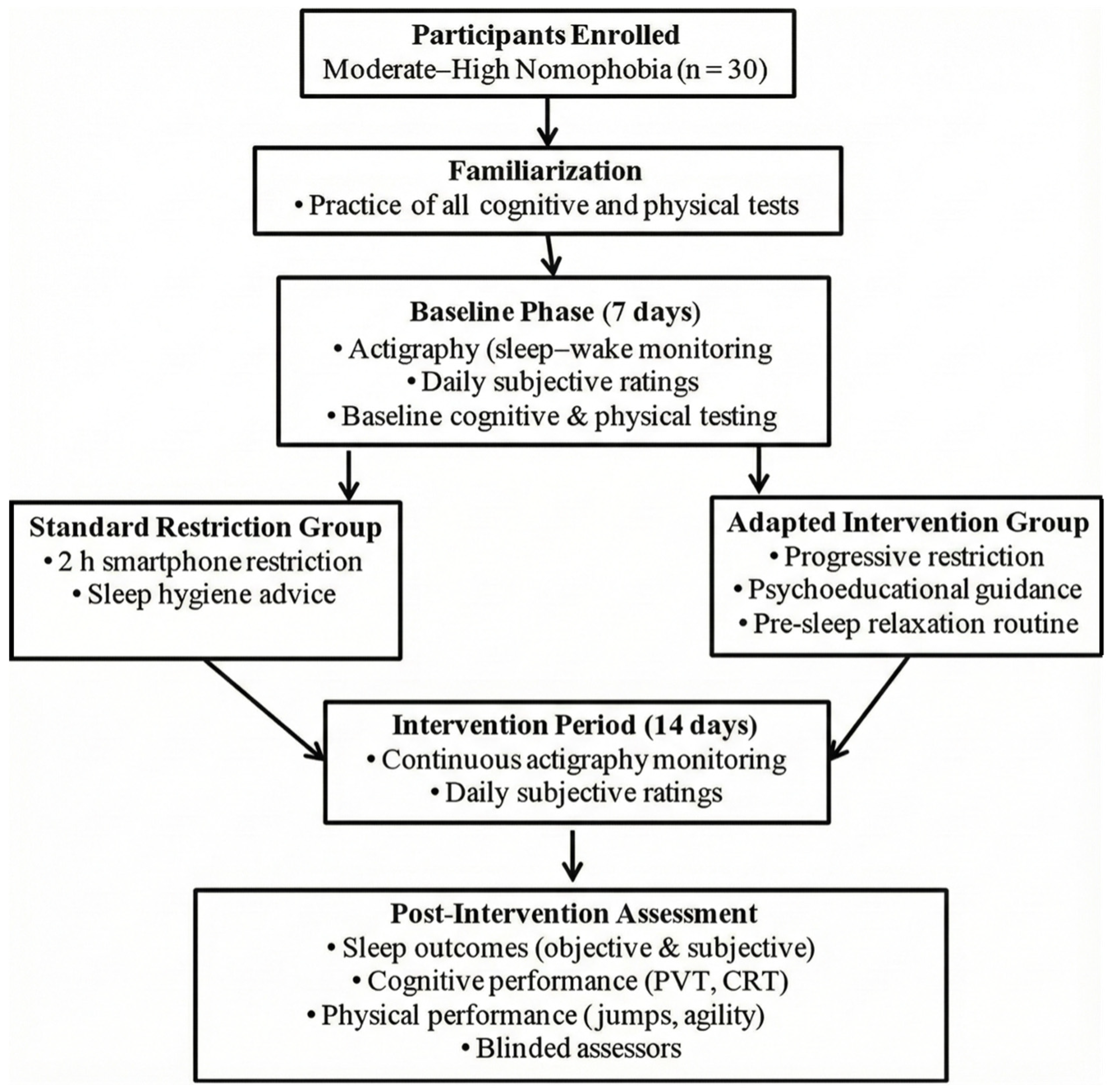
2.2. Experimental Design
2.3. Intervention Protocols
2.3.1. Standard Smartphone Restriction
2.3.2. Adapted Smartphone Intervention
2.4. Data Collection
2.4.1. Objective Sleep Parameters
2.4.2. Subjective Sleep, Anxiety, and Stress
2.4.3. Cognitive Performance Assessment
2.4.4. Physical Performance Assessment
2.5. Statistical Analysis
3. Results
3.1. Baseline Equivalence for Primary Outcome Variables
3.2. Objective Sleep Parameters
3.3. Subjective Sleep Quality
3.4. Pre-Sleep Anxiety and Stress
3.5. Cognitive Performance
3.6. Physical Performance
4. Discussion
Practical Recommendations
5. Conclusions
Author Contributions
Funding
Institutional Review Board Statement
Informed Consent Statement
Data Availability Statement
Conflicts of Interest
References
- Souissi, M.A.; Gouasmia, C.; Dergaa, I.; Faleh, J.; Trabelsi, O.; Weiss, K.; Rosemann, T.; Dhahbi, W.; Souissi, N.; Knechtle, B. Impact of evening blue light exposure timing on sleep, motor, and cognitive performance in young athletes with intermediate chronotype. Biol. Sport 2025, 42, 61–68. [Google Scholar] [CrossRef]
- Killgore, W.D. Effects of sleep deprivation on cognition. Prog. Brain Res. 2010, 185, 105–129. [Google Scholar] [PubMed]
- Lim, J.; Dinges, D.F. A meta-analysis of the impact of short-term sleep deprivation on cognitive variables. Psychol. Bull. 2010, 136, 375. [Google Scholar] [CrossRef]
- Dhahbi, W. Advancing biomechanics: Enhancing sports performance, mitigating injury risks, and optimizing athlete rehabilitation. Front. Sports Act. Living 2025, 7, 1556024. [Google Scholar] [CrossRef]
- Erten, B.; Pehlivan, E.; Yalcin, E. The effect of smartphone use and nomophobia on sleep quality and daytime sleepiness in Turkey. Eur. J. Public Health 2022, 32, ckac131.242. [Google Scholar] [CrossRef]
- Exelmans, L.; Van den Bulck, J. Bedtime mobile phone use and sleep in adults. Soc. Sci. Med. 2016, 148, 93–101. [Google Scholar] [CrossRef] [PubMed]
- Chang, A.-M.; Aeschbach, D.; Duffy, J.F.; Czeisler, C.A. Evening use of light-emitting eReaders negatively affects sleep, circadian timing, and next-morning alertness. Proc. Natl. Acad. Sci. USA 2015, 112, 1232–1237. [Google Scholar] [CrossRef] [PubMed]
- Scott, H.; Woods, H.C. Fear of missing out and sleep: Cognitive behavioural factors in adolescents’ nighttime social media use. J. Adolesc. 2018, 68, 61–65. [Google Scholar] [CrossRef]
- Tu, Z.; He, J.; Li, Y.; Wang, Z.; Wang, C.; Tian, J.; Tang, Y. Can restricting while-in-bed Smartphone use improve sleep quality via decreasing pre-sleep cognitive arousal among Chinese undergraduates with problematic Smartphone use? longitudinal mediation analysis using parallel process latent growth curve modeling. Addict. Behav. 2023, 147, 107825. [Google Scholar] [CrossRef]
- Hong, W.; Liu, J.; Liu, R.-D.; Ding, Y.; Yang, X. A Network Analysis of Nomophobia among Chinese Adolescents: Differences in Gender and Developmental Stages. Comput. Hum. Behav. Rep. 2025, 19, 100739. [Google Scholar] [CrossRef]
- Bragazzi, N.L.; Del Puente, G. A proposal for including nomophobia in the new DSM-V. Psychol. Res. Behav. Manag. 2014, 7, 155–160. [Google Scholar] [CrossRef] [PubMed]
- Morin, C.M.; Bootzin, R.R.; Buysse, D.J.; Edinger, J.D.; Espie, C.A.; Lichstein, K.L. Psychological and behavioral treatment of insomnia: Update of the recent evidence (1998–2004). Sleep 2006, 29, 1398–1414. [Google Scholar] [CrossRef]
- Shaif, N.A.S.; Lim, J.; Reffi, A.N.; Chee, M.W.; Massar, S.A.; Ong, J.L. Sleep Reactivity Amplifies the Impact of Pre-Sleep Cognitive Arousal on Sleep Disturbances. J. Sleep Res. 2025, e70220. [Google Scholar] [CrossRef] [PubMed]
- Hartanto, A.; Lua, V.Y.; Kasturiratna, K.; Koh, P.S.; Tng, G.Y.; Kaur, M.; Quek, F.Y.; Chia, J.L.; Majeed, N.M. The effect of mere presence of smartphone on cognitive functions: A four-level meta-analysis. Technol. Mind Behav. 2024, 5, 1. [Google Scholar] [CrossRef]
- Bouzouraa, E.; Dhahbi, W.; Ferchichi, A.; Geantă, V.A.; Kunszabo, M.I.; Chtourou, H.; Souissi, N. Single-night sleep extension enhances morning physical and cognitive performance across time of day in physically active university students: A randomized crossover study. Life 2025, 15, 1178. [Google Scholar] [CrossRef]
- Lim, J.; Dinges, D.F. Sleep deprivation and vigilant attention. Ann. N. Y. Acad. Sci. 2008, 1129, 305–322. [Google Scholar] [CrossRef]
- Chtourou, H.; Souissi, N. The effect of training at a specific time of day: A review. J. Strength Cond. Res. 2012, 26, 1984–2005. [Google Scholar] [CrossRef]
- Vitale, J.A.; Weydahl, A. Chronotype, physical activity, and sport performance: A systematic review. Sports Med. 2017, 47, 1859–1868. [Google Scholar] [CrossRef] [PubMed]
- He, X.; Pan, B.; Ma, N.; Dan, L.; Kong, W.; Liu, Q.; Liu, X.; Wang, X.; Deng, X.; Yang, K. The association of screen time and the risk of sleep outcomes: A systematic review and meta-analysis. Front. Psychiatry 2025, 16, 1640263. [Google Scholar] [CrossRef] [PubMed]
- Laborde, S.; Allen, M.; Borges, U.; Dosseville, F.; Hosang, T.; Iskra, M.; Mosley, E.; Salvotti, C.; Spolverato, L.; Zammit, N. Effects of voluntary slow breathing on heart rate and heart rate variability: A systematic review and a meta-analysis. Neurosci. Biobehav. Rev. 2022, 138, 104711. [Google Scholar] [CrossRef]
- You, M.; Laborde, S.; Ackermann, S.; Borges, U.; Dosseville, F.; Mosley, E. Influence of respiratory frequency of slow-paced breathing on vagally-mediated heart rate variability. Appl. Psychophysiol. Biofeedback 2024, 49, 133–143. [Google Scholar] [CrossRef]
- Tsai, H.-J.; Kuo, T.B.; Lee, G.S.; Yang, C.C. Efficacy of paced breathing for insomnia: Enhances vagal activity and improves sleep quality. Psychophysiology 2015, 52, 388–396. [Google Scholar] [CrossRef]
- Jerath, R.; Crawford, M.W.; Barnes, V.A.; Harden, K. Self-regulation of breathing as a primary treatment for anxiety. Appl. Psychophysiol. Biofeedback 2015, 40, 107–115. [Google Scholar] [CrossRef]
- Olson, J.A.; Sandra, D.A.; Chmoulevitch, D.; Raz, A.; Veissière, S.P. A nudge-based intervention to reduce problematic smartphone use: Randomised controlled trial. Int. J. Ment. Health Addict. 2023, 21, 3842–3864. [Google Scholar] [CrossRef]
- Shin, J.; Kim, S.; Lee, J.; Gu, H.; Ahn, J.; Park, C.; Seo, M.; Jeon, J.E.; Lee, H.Y.; Yeom, J.W. Efficacy of mobile app–based cognitive behavioral therapy for insomnia: Multicenter, single-blind randomized clinical trial. J. Med. Internet Res. 2024, 26, e50555. [Google Scholar] [CrossRef]
- Kaviani, F.; Robards, B.; Young, K.L.; Koppel, S. Nomophobia: Is the fear of being without a smartphone associated with problematic use? Int. J. Environ. Res. Public Health 2020, 17, 6024. [Google Scholar] [CrossRef] [PubMed]
- Yildirim, C.; Sumuer, E.; Adnan, M.; Yildirim, S. A growing fear: Prevalence of nomophobia among Turkish college students. Inf. Dev. 2016, 32, 1322–1331. [Google Scholar] [CrossRef]
- Roenneberg, T.; Wirz-Justice, A.; Merrow, M. Life between clocks: Daily temporal patterns of human chronotypes. J. Biol. Rhythm. 2003, 18, 80–90. [Google Scholar] [CrossRef] [PubMed]
- Faul, F.; Erdfelder, E.; Lang, A.-G.; Buchner, A. G* Power 3: A flexible statistical power analysis program for the social, behavioral, and biomedical sciences. Behav. Res. Methods 2007, 39, 175–191. [Google Scholar] [CrossRef]
- Tucker, A.M.; Whitney, P.; Belenky, G.; Hinson, J.M.; Van Dongen, H.P. Effects of sleep deprivation on dissociated components of executive functioning. Sleep 2010, 33, 47–57. [Google Scholar] [CrossRef]
- Dinges, D.F.; Powell, J.W. Microcomputer analyses of performance on a portable, simple visual RT task during sustained operations. Behav. Res. Methods Instrum. Comput. 1985, 17, 652–655. [Google Scholar] [CrossRef]
- Ancoli-Israel, S.; Cole, R.; Alessi, C.; Chambers, M.; Moorcroft, W.; Pollak, C.P. The role of actigraphy in the study of sleep and circadian rhythms. Sleep 2003, 26, 342–392. [Google Scholar] [CrossRef]
- Marino, M.; Li, Y.; Rueschman, M.N.; Winkelman, J.W.; Ellenbogen, J.M.; Solet, J.M.; Dulin, H.; Berkman, L.F.; Buxton, O.M. Measuring sleep: Accuracy, sensitivity, and specificity of wrist actigraphy compared to polysomnography. Sleep 2013, 36, 1747–1755. [Google Scholar] [CrossRef]
- Cain, N.; Gradisar, M. Electronic media use and sleep in school-aged children and adolescents: A review. Sleep Med. 2010, 11, 735–742. [Google Scholar] [CrossRef] [PubMed]
- Ancoli-Israel, S.; Martin, J.L.; Blackwell, T.; Buenaver, L.; Liu, L.; Meltzer, L.J.; Sadeh, A.; Spira, A.P.; Taylor, D.J. The SBSM guide to actigraphy monitoring: Clinical and research applications. Behav. Sleep Med. 2015, 13, S4–S38. [Google Scholar] [CrossRef]
- Alqurashi, Y.D.; Dawidziuk, A.; Alqarni, A.; Kelly, J.; Moss, J.; Polkey, M.I.; Morrell, M.J. A visual analog scale for the assessment of mild sleepiness in patients with obstructive sleep apnea and healthy participants. Ann. Thorac. Med. 2021, 16, 141–147. [Google Scholar] [CrossRef] [PubMed]
- Stoet, G. PsyToolkit: A software package for programming psychological experiments using Linux. Behav. Res. Methods 2010, 42, 1096–1104. [Google Scholar] [CrossRef] [PubMed]
- Buysse, D.J.; Reynolds, C.F., III; Monk, T.H.; Berman, S.R.; Kupfer, D.J. The Pittsburgh Sleep Quality Index: A new instrument for psychiatric practice and research. Psychiatry Res. 1989, 28, 193–213. [Google Scholar] [CrossRef]
- Zieliński, G. Effect Size Guidelines for Individual and Group Differences in Physiotherapy. Arch. Phys. Med. Rehabil. 2025, 106, 1844–1849. [Google Scholar] [CrossRef]
- Cohen, J. Statistical Power Analysis for the Behavioral Sciences; Routledge: Abingdon-on-Thames, UK, 2013. [Google Scholar]
- MacKinnon, D.P.; Fairchild, A.J.; Fritz, M.S. Mediation analysis. Annu. Rev. Psychol. 2007, 58, 593–614. [Google Scholar] [CrossRef]
- Tuco, K.G.; Castro-Diaz, S.D.; Soriano-Moreno, D.R.; Benites-Zapata, V.A. Prevalence of nomophobia in university students: A systematic review and meta-analysis. Healthc. Inform. Res. 2023, 29, 40–53. [Google Scholar] [CrossRef] [PubMed]
- Camadan, F.; Uzunoğlu, Ö. The role of FoMO and nomophobia in explaining the relationship between doomscrolling and poor sleep quality. BMC Psychol. 2025. [Google Scholar] [CrossRef]
- Baig, M.G.; Rajini, T. The Influence of Smartphone Addiction and Nomophobia on Lifestyle and Mental Health: Behavioural Disruptions and Intervention Strategies. Int. J. Indian Psychol. 2024, 12, 678–697. [Google Scholar] [CrossRef]
- Boot, W.R.; Simons, D.J.; Stothart, C.; Stutts, C. The pervasive problem with placebos in psychology: Why active control groups are not sufficient to rule out placebo effects. Perspect. Psychol. Sci. 2013, 8, 445–454. [Google Scholar] [CrossRef]
- Borges, U.; Lobinger, B.; Javelle, F.; Watson, M.; Mosley, E.; Laborde, S. Using slow-paced breathing to foster endurance, well-being, and sleep quality in athletes during the COVID-19 pandemic. Front. Psychol. 2021, 12, 624655. [Google Scholar] [CrossRef] [PubMed]
- Küskens, A.; Stricker, J.; Hertrampf, L.S.; Pietrowsky, R.; Gieselmann, A. Perfectionism, perceived stress, and presleep arousal in insomnia: Effects on sleep in a daily life study. J. Clin. Sleep Med. 2024, 20, 433–443. [Google Scholar] [CrossRef] [PubMed]
- Horne, J.A.; Ostberg, O. A self-assessment questionnaire to determine morningness-eveningness in human circadian rhythms. Int. J. Chronobiol. 1976, 4, 97–110. [Google Scholar]
- Montag, C.; Lachmann, B.; Herrlich, M.; Zweig, K. Addictive features of social media/messenger platforms and freemium games against the background of psychological and economic theories. Int. J. Environ. Res. Public Health 2019, 16, 2612. [Google Scholar] [CrossRef]
- Busch, P.A.; McCarthy, S. Antecedents and consequences of problematic smartphone use: A systematic literature review of an emerging research area. Comput. Hum. Behav. 2021, 114, 106414. [Google Scholar] [CrossRef]



| Variable | Standard Restriction Group (n = 15) | Adapted Intervention Group (n = 15) | p-Value |
|---|---|---|---|
| Age (years) | 21.9 ± 1.23 | 21.86 ± 1.20 | 0.886 |
| Height (cm) | 175.94 ± 4.01 | 175.70 ± 4.26 | 0.883 |
| Body mass (kg) | 70.68 ± 2.82 | 71.02 ± 3.52 | 0.784 |
| Sex (men/women) | 10/5 | 9/6 | 0.720 |
| NMP-Q score | 82.80 ± 5.80 | 84.93 ± 9.20 | 0.453 |
| Outcome Variable | Standard Restriction (n = 15) | Adapted Intervention (n = 15) | p-Value |
|---|---|---|---|
| Sleep Parameters | |||
| Sleep efficiency (%) | 82.1 ± 2.3 | 85.2 ± 2.1 | 0.29 |
| Sleep onset latency (min) | 30.3 ± 5.8 | 27.1 ± 5.2 | 0.14 |
| Total sleep time (min) | 403.9 ± 13.4 | 411.2 ± 12.9 | 0.17 |
| Subjective Sleep Quality (VAS) | 5.8 ± 1.1 | 6.1 ± 1.2 | 0.48 |
| Pre-Sleep Anxiety (VAS) | 5.2 ± 0.9 | 5.4 ± 1.0 | 0.58 |
| Pre-Sleep Stress (VAS) | 5.1 ± 0.8 | 5.3 ± 0.9 | 0.52 |
| Cognitive Performance (Morning) | |||
| PVT reaction time [20] | 454.2 ± 14.6 | 456.8 ± 15.2 | 0.64 |
| CRT reaction time [20] | 398.7 ± 12.8 | 401.3 ± 13.1 | 0.6 |
| Variable | Adapted Intervention Group (n = 15) | Standard Restriction Group (n = 15) | Time × Group Interaction |
|---|---|---|---|
| Baseline | Post-Intervention | Baseline | |
| Sleep Efficiency (%) | 85.10 ± 2.30 | 90.60 ± 2.60 ** | 82.50 ± 2.10 |
| Sleep Onset Latency (min) | 27.40 ± 5.30 | 18.20 ± 4.90 * | 30.10 ± 5.60 |
| Total Sleep Time (min) | 410.60 ± 13.20 | 424.10 ± 14.10 | 404.80 ± 12.90 |
| Wake After Sleep Onset (min) | 58.40 ± 7.80 | 49.10 ± 7.10 | 56.20 ± 6.90 |
| Variable | Adapted Intervention Group (n = 15) | Standard Restriction Group (n = 15) | ||||||
|---|---|---|---|---|---|---|---|---|
| Baseline Morning | Post-Intervention Morning | Baseline Afternoon | Post-Intervention Afternoon | Baseline Morning | Post-Intervention Morning | Baseline Afternoon | Post-Intervention Afternoon | |
| PVT RT [20] | 455.00 ± 14.00 | 431.00 ± 13.00 | 439.00 ± 15.00 | 397.00 ± 14.00 ** | 456.00 ± 15.00 | 454.00 ± 14.00 | 446.00 ± 14.00 | 445.00 ± 15.00 |
| PVT Lapses (n) | 7.30 ± 0.80 | 5.80 ± 0.80 | 6.30 ± 0.90 | 3.40 ± 0.90 * | 7.50 ± 0.90 | 7.10 ± 0.80 | 6.80 ± 0.80 | 6.10 ± 0.90 |
| CRT [20] | 404.00 ± 12.00 | 389.00 ± 11.00 | 390.00 ± 12.00 | 358.00 ± 11.00 ** | 402.00 ± 13.00 | 399.00 ± 12.00 | 388.00 ± 12.00 | 386.00 ± 12.00 |
| CRT Accuracy (%) | 95.60 ± 2.10 | 96.10 ± 2.00 | 95.80 ± 2.30 | 96.40 ± 2.10 | 95.40 ± 2.00 | 95.20 ± 2.10 | 95.70 ± 2.20 | 95.50 ± 2.30 |
| Variable | Adapted Intervention Group (n = 15) | Standard Restriction Group (n = 15) | ||||||
|---|---|---|---|---|---|---|---|---|
| Baseline Morning | Post-Intervention Morning | Baseline Afternoon | Post-Intervention Afternoon | Baseline Morning | Post-Intervention Morning | Baseline Afternoon | Post-Intervention Afternoon | |
| Agility (s) | 6.54 ± 0.20 | 6.51 ± 0.20 | 6.45 ± 0.20 | 6.46 ± 0.21 | 6.50 ± 0.15 | 6.49 ± 0.16 | 6.42 ± 0.15 | 6.42 ± 0.16 |
| CMJ (cm) | 38.30 ± 1.90 | 38.40 ± 1.90 | 39.70 ± 2.00 | 39.90 ± 2.00 | 39.00 ± 2.00 | 39.00 ± 2.00 | 40.20 ± 2.10 | 40.10 ± 2.10 |
| SJ (cm) | 35.80 ± 1.60 | 36.00 ± 1.60 | 36.90 ± 1.70 | 37.10 ± 1.70 | 35.40 ± 1.70 | 35.50 ± 1.70 | 36.60 ± 1.80 | 36.70 ± 1.80 |
Disclaimer/Publisher’s Note: The statements, opinions and data contained in all publications are solely those of the individual author(s) and contributor(s) and not of MDPI and/or the editor(s). MDPI and/or the editor(s) disclaim responsibility for any injury to people or property resulting from any ideas, methods, instructions or products referred to in the content. |
© 2026 by the authors. Licensee MDPI, Basel, Switzerland. This article is an open access article distributed under the terms and conditions of the Creative Commons Attribution (CC BY) license.
Share and Cite
Alaya, W.B.; Dhahbi, W.; Souissi, M.A.; Jebabli, N.; Ceylan, H.İ.; Ceylan, N.B.; Muntean, R.I.; Souissi, N. Progressive Smartphone Restriction Combined with Psychoeducational Guidance and Pre-Sleep Autonomic Regulation Improves Sleep Efficiency and Time-of-Day Cognitive Performance in Physically Active Students with Nomophobia: A Randomized Controlled Trial. Life 2026, 16, 212. https://doi.org/10.3390/life16020212
Alaya WB, Dhahbi W, Souissi MA, Jebabli N, Ceylan Hİ, Ceylan NB, Muntean RI, Souissi N. Progressive Smartphone Restriction Combined with Psychoeducational Guidance and Pre-Sleep Autonomic Regulation Improves Sleep Efficiency and Time-of-Day Cognitive Performance in Physically Active Students with Nomophobia: A Randomized Controlled Trial. Life. 2026; 16(2):212. https://doi.org/10.3390/life16020212
Chicago/Turabian StyleAlaya, Wiem Ben, Wissem Dhahbi, Mohamed Abdelkader Souissi, Nidhal Jebabli, Halil İbrahim Ceylan, Nagihan Burçak Ceylan, Raul Ioan Muntean, and Nizar Souissi. 2026. "Progressive Smartphone Restriction Combined with Psychoeducational Guidance and Pre-Sleep Autonomic Regulation Improves Sleep Efficiency and Time-of-Day Cognitive Performance in Physically Active Students with Nomophobia: A Randomized Controlled Trial" Life 16, no. 2: 212. https://doi.org/10.3390/life16020212
APA StyleAlaya, W. B., Dhahbi, W., Souissi, M. A., Jebabli, N., Ceylan, H. İ., Ceylan, N. B., Muntean, R. I., & Souissi, N. (2026). Progressive Smartphone Restriction Combined with Psychoeducational Guidance and Pre-Sleep Autonomic Regulation Improves Sleep Efficiency and Time-of-Day Cognitive Performance in Physically Active Students with Nomophobia: A Randomized Controlled Trial. Life, 16(2), 212. https://doi.org/10.3390/life16020212