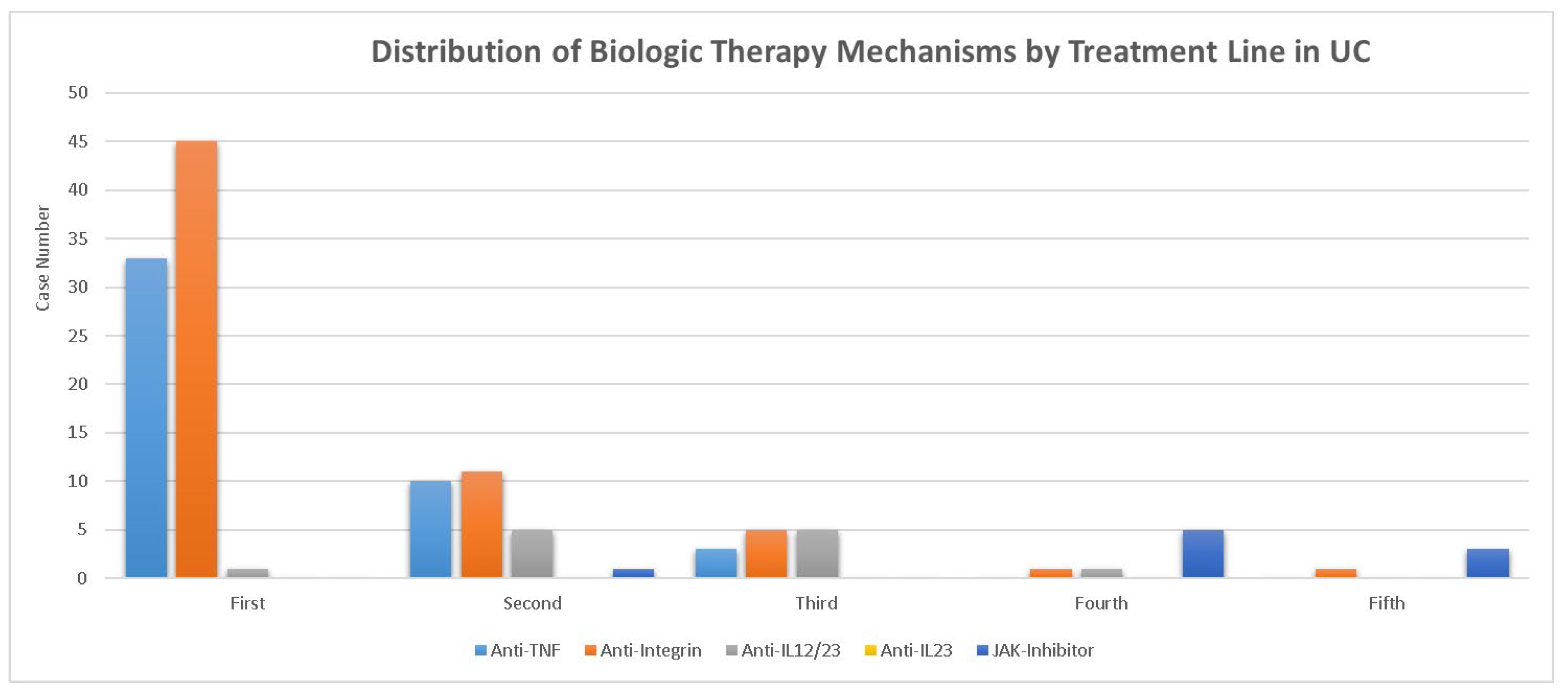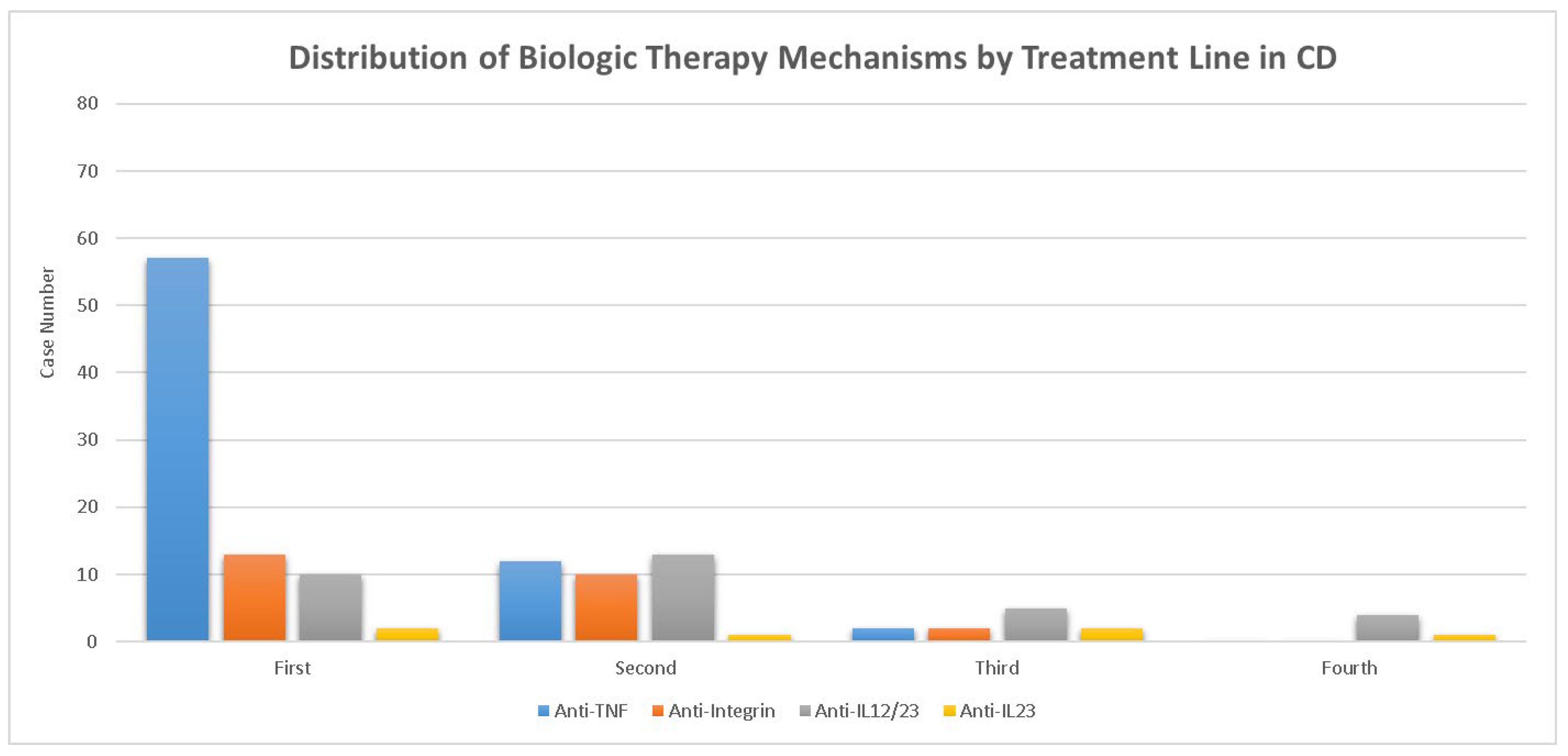

Prevalence, Clinical Characteristics, and Predictors of Difficult-to-Treat Inflammatory Bowel Disease in a Real-World Taiwanese Cohort

 , , and
Abstract
1. Introduction
2. Materials and Methods
2.1. Study Design and Population
2.2. Data Collection
2.3. Definition of Difficult-to-Treat-IBD
2.4. Outcomes
2.5. Statistical Analysis
3. Results
3.1. Clinical Features of the Population with IBD
3.2. Clinical Features and Predictors of Difficult-to-Treat-IBD
3.3. Predictors of Difficult-to-Treat IBD
4. Discussion
5. Conclusions
Author Contributions
Funding
Institutional Review Board Statement
Informed Consent Statement
Data Availability Statement
Acknowledgments
Conflicts of Interest
Abbreviations
| CD | Crohn’s disease |
| UC | Ulcerative colitis |
| IBD | Inflammatory bowel disease |
| DTT | Difficult to treat |
References
- Guan, Q. A Comprehensive Review and Update on the Pathogenesis of Inflammatory Bowel Disease. J. Immunol. Res. 2019, 2019, 7247238. [Google Scholar] [CrossRef] [Scilit] [PubMed]
- Seyedian, S.S.; Nokhostin, F.; Malamir, M.D. A review of the diagnosis, prevention, and treatment methods of inflammatory bowel disease. J. Med. Life 2019, 12, 113–122. [Google Scholar] [CrossRef] [Scilit] [PubMed]
- Yang, T.M.; Lu, F.T.; Yen, H.H.; Chen, Y.Y. Prevalence and association testing of antinuclear antibodies and inflammatory bowel disease in Taiwan. PeerJ 2025, 13, e20474. [Google Scholar] [CrossRef] [Scilit] [PubMed]
- Ardizzone, S.; Bianchi Porro, G. Biologic therapy for inflammatory bowel disease. Drugs 2005, 65, 2253–2286. [Google Scholar] [CrossRef] [Scilit]
- Avedillo-Salas, A.; Corral-Cativiela, S.; Fanlo-Villacampa, A.; Vicente-Romero, J. The Efficacy and Safety of Biologic Drugs in the Treatment of Moderate-Severe Crohn’s Disease: A Systematic Review. Pharmaceuticals 2023, 16, 1581. [Google Scholar] [CrossRef] [Scilit]
- Bressler, B. Is there an optimal sequence of biologic therapies for inflammatory bowel disease? Ther. Adv. Gastroenterol. 2023, 16, 17562848231159452. [Google Scholar] [CrossRef] [Scilit]
- Verstockt, B.; Ferrante, M.; Vermeire, S.; Van Assche, G. New treatment options for inflammatory bowel diseases. J. Gastroenterol. 2018, 53, 585–590. [Google Scholar] [CrossRef] [Scilit]
- Huang, T.C.; Kou, T.; Kuo, C.J.; Chiu, C.H.; Chen, T.D.; Chen, C.M.; Chou, J.W.; Huang, T.Y.; Chang, C.W.; Chiu, C.T.; et al. Enteric opportunistic infections in patients with inflammatory bowel disease receiving biologic therapies: A retrospective cohort study. Gut Pathog. 2025, 18, 7. [Google Scholar] [CrossRef] [Scilit]
- Parigi, T.L.; D’Amico, F.; Abreu, M.T.; Dignass, A.; Dotan, I.; Magro, F.; Griffiths, A.M.; Jairath, V.; Iacucci, M.; Mantzaris, G.J.; et al. Difficult-to-treat inflammatory bowel disease: Results from an international consensus meeting. Lancet Gastroenterol. Hepatol. 2023, 8, 853–859. [Google Scholar] [CrossRef] [Scilit]
- Torres, J.; Caprioli, F.; Katsanos, K.H.; Lobatón, T.; Micic, D.; Zerôncio, M.; Van Assche, G.; Lee, J.C.; Lindsay, J.O.; Rubin, D.T.; et al. Predicting Outcomes to Optimize Disease Management in Inflammatory Bowel Diseases. J. Crohns Colitis 2016, 10, 1385–1394. [Google Scholar] [CrossRef] [Scilit]
- Knowles, S.R.; Keefer, L.; Wilding, H.; Hewitt, C.; Graff, L.A.; Mikocka-Walus, A. Quality of Life in Inflammatory Bowel Disease: A Systematic Review and Meta-analyses—Part II. Inflamm. Bowel Dis. 2018, 24, 966–976. [Google Scholar] [CrossRef] [Scilit] [PubMed]
- Parigi, T.L.; Massimino, L.; Carini, A.; Gabbiadini, R.; Bertoli, P.; Allocca, M.; Bezzio, C.; Dal Buono, A.; D’Amico, F.; Furfaro, F.; et al. Prevalence, Characteristics, Management, and Outcomes of Difficult-to-Treat Inflammatory Bowel Disease. J. Crohn’s Colitis 2025, 19, jjae145. [Google Scholar] [CrossRef] [Scilit] [PubMed]
- Flores, C.; Yamamoto, J.; Fróes, R.; Lasa, J.S.; Balderramo, D.; Martinez, S.B.; Baños, F.J.; Iade, B.; Gomes, T.; Parra Holguín, N.N.; et al. P1257 Difficult-to-treat Inflammatory Bowel Disease in Latin American countries: Prevalence and clinical characteristics. J. Crohn’s Colitis 2025, 19, i2272–i2274. [Google Scholar] [CrossRef] [Scilit]
- Park, S.B.; Yoon, J.Y.; Cha, J.M. What Are the Different Phenotypes of Inflammatory Bowel Disease in Asia? Gut Liver 2022, 16, 676–685. [Google Scholar] [CrossRef] [Scilit]
- Ng, S.C.; Tang, W.; Ching, J.Y.; Wong, M.; Chow, C.M.; Hui, A.J.; Wong, T.C.; Leung, V.K.; Tsang, S.W.; Yu, H.H.; et al. Incidence and phenotype of inflammatory bowel disease based on results from the Asia-pacific Crohn’s and colitis epidemiology study. Gastroenterology 2013, 145, 158–165.E2. [Google Scholar] [CrossRef] [Scilit]
- Lujan, R.; Buchuk, R.; Focht, G.; Yogev, D.; Greenfeld, S.; Ben-Tov, A.; Weisband, Y.L.; Lederman, N.; Matz, E.; Ben Horin, S.; et al. Early Initiation of Biologics and Disease Outcomes in Adults and Children With Inflammatory Bowel Diseases: Results From the Epidemiology Group of the Nationwide Israeli Inflammatory Bowel Disease Research Nucleus Cohort. Gastroenterology 2024, 166, 815–825.E22. [Google Scholar] [CrossRef] [Scilit]
- Ahmed, W.; Galati, J.; Kumar, A.; Christos, P.J.; Longman, R.; Lukin, D.J.; Scherl, E.; Battat, R. Dual Biologic or Small Molecule Therapy for Treatment of Inflammatory Bowel Disease: A Systematic Review and Meta-analysis. Clin. Gastroenterol. Hepatol. 2022, 20, e361–e379. [Google Scholar] [CrossRef] [Scilit]
- Abdullah, I.; AlMojil, K.; Shehab, M. Effectiveness of Dual Biologic or Small Molecule Therapy for Achieving Endoscopic Remission in Refractory Inflammatory Bowel Disease. Diseases 2022, 10, 102. [Google Scholar] [CrossRef] [Scilit]
- Wu, J.F.; Yen, H.H.; Wang, H.Y.; Chang, T.A.; Chang, C.H.; Chang, C.W.; Chao, T.H.; Chou, J.W.; Chou, Y.H.; Chuang, C.H.; et al. Management of Crohn’s disease in Taiwan: Consensus guideline of the Taiwan Society of Inflammatory Bowel Disease updated in 2023. Intest. Res. 2024, 22, 250–285. [Google Scholar] [CrossRef] [Scilit]
- Yen, H.H.; Wu, J.F.; Wang, H.Y.; Chang, T.A.; Chang, C.H.; Chang, C.W.; Chao, T.H.; Chou, J.W.; Chou, Y.H.; Chuang, C.H.; et al. Management of ulcerative colitis in Taiwan: Consensus guideline of the Taiwan Society of Inflammatory Bowel Disease updated in 2023. Intest. Res. 2024, 22, 213–249. [Google Scholar] [CrossRef] [Scilit]
- Danese, S.; Fiorino, G.; Fernandes, C.; Peyrin-Biroulet, L. Catching the therapeutic window of opportunity in early Crohn’s disease. Curr. Drug Targets 2014, 15, 1056–1063. [Google Scholar] [CrossRef] [Scilit]
- Zhang, L.; Jin, Z.; Hao, J. Efficacy of early biologic therapy versus late/conventional therapy in children and adolescents with Crohn’s disease: A systematic review and meta-analysis. Saudi J. Gastroenterol. 2023, 29, 259–268. [Google Scholar] [CrossRef] [Scilit]
- Su, H.; Xiao, S.; Liang, Z.; Xun, T.; Zhang, J.; Yang, X. Systematic review and bayesian network meta-analysis: Comparative efficacy and safety of six commonly used biologic therapies for moderate-to-severe Crohn’s disease. Front. Pharmacol. 2024, 15, 1475222. [Google Scholar] [CrossRef] [Scilit] [PubMed]
- Targownik, L.E.; Bernstein, C.N.; Benchimol, E.I.; Kaplan, G.G.; Singh, H.; Tennakoon, A.; Nugent, Z.; Coward, S.B.; Kuenzig, M.E.; Murthy, S.K. Earlier Anti-TNF Initiation Leads to Long-term Lower Health Care Utilization in Crohn’s Disease but Not in Ulcerative Colitis. Clin. Gastroenterol. Hepatol. 2022, 20, 2607–2618.e14. [Google Scholar] [CrossRef] [Scilit] [PubMed]
- Craig, M.; Ashcroft, C.; Dulaney, D.; Byrne, R.; Weiss, T.; Theigs, C.; Walker, J.H.; Patel, A. S771 Impact of Early Biologic Therapy in Real-World Cohort of Crohn’s Disease Patients. Am. J. Gastroenterol. 2022, 117, e548. [Google Scholar] [CrossRef] [Scilit]
- Long, M.; Dubinsky, M.; Regueiro, M.; Zambrano, J.; Theigs, C.; Griffith, J.; Matthias, W.; Kujawski, M.; Sharma, D.; Pearson, R.; et al. S31 The Impact of Early vs Late Biologic Initiation Among Real-World Patients with Crohn’s Disease in TARGET-IBD. Am. J. Gastroenterol. 2022, 117, S8. [Google Scholar] [CrossRef] [Scilit]
- Penrose, H.M.; Iftikhar, R.; Collins, M.E.; Toraih, E.; Ruiz, E.; Ungerleider, N.; Nakhoul, H.; Flemington, E.F.; Kandil, E.; Shah, S.B.; et al. Ulcerative colitis immune cell landscapes and differentially expressed gene signatures determine novel regulators and predict clinical response to biologic therapy. Sci. Rep. 2021, 11, 9010. [Google Scholar] [CrossRef] [Scilit]
- Tamburini, F.B.; Tripathi, A.; Gold, M.P.; Yang, J.C.; Biancalani, T.; McBride, J.M.; Keir, M.E.; Gardenia Study Group. Gut Microbial Species and Endotypes Associate with Remission in Ulcerative Colitis Patients Treated with Anti-TNF or Anti-integrin Therapy. J. Crohn’s Colitis 2024, 18, 1819–1831. [Google Scholar] [CrossRef] [Scilit]
- Haberman, Y.; Karns, R.; Dexheimer, P.J.; Schirmer, M.; Somekh, J.; Jurickova, I.; Braun, T.; Novak, E.; Bauman, L.; Collins, M.H.; et al. Ulcerative colitis mucosal transcriptomes reveal mitochondriopathy and personalized mechanisms underlying disease severity and treatment response. Nat. Commun. 2019, 10, 38. [Google Scholar] [CrossRef] [Scilit]
- Hassan-Zahraee, M.; Ye, Z.; Xi, L.; Dushin, E.; Lee, J.; Romatowski, J.; Leszczyszyn, J.; Danese, S.; Sandborn, W.J.; Banfield, C.; et al. Baseline Serum and Stool Microbiome Biomarkers Predict Clinical Efficacy and Tissue Molecular Response After Ritlecitinib Induction Therapy in Ulcerative Colitis. J. Crohn’s Colitis 2024, 18, 1361–1370. [Google Scholar] [CrossRef] [Scilit]
- Lee, J.W.J.; Plichta, D.; Hogstrom, L.; Borren, N.Z.; Lau, H.; Gregory, S.M.; Tan, W.; Khalili, H.; Clish, C.; Vlamakis, H.; et al. Multi-omics reveal microbial determinants impacting responses to biologic therapies in inflammatory bowel disease. Cell Host Microbe 2021, 29, 1294–1304.e4. [Google Scholar] [CrossRef] [Scilit]
- Kapizioni, C.; Desoki, R.; Lam, D.; Balendran, K.; Al-Sulais, E.; Subramanian, S.; Rimmer, J.E.; De La Revilla Negro, J.; Pavey, H.; Pele, L.; et al. Biologic Therapy for Inflammatory Bowel Disease: Real-World Comparative Effectiveness and Impact of Drug Sequencing in 13 222 Patients within the UK IBD BioResource. J. Crohn’s Colitis 2024, 18, 790–800. [Google Scholar] [CrossRef] [Scilit] [PubMed]
- Fabisiak, A.; Caban, M.; Dudek, P.; Strigáč, A.; Małecka-Wojciesko, E.; Talar-Wojnarowska, R. Advancements in dual biologic therapy for inflammatory bowel diseases: Efficacy, safety, and future directions. Ther. Adv. Gastroenterol. 2025, 18, 17562848241309871. [Google Scholar] [CrossRef] [Scilit] [PubMed]
- Goessens, L.; Colombel, J.F.; Outtier, A.; Ferrante, M.; Sabino, J.; Judge, C.; Saeidi, R.; Rabbitt, L.; Armuzzi, A.; Domenech, E.; et al. Safety and efficacy of combining biologics or small molecules for inflammatory bowel disease or immune-mediated inflammatory diseases: A European retrospective observational study. United Eur. Gastroenterol. J. 2021, 9, 1136–1147. [Google Scholar] [CrossRef] [Scilit] [PubMed]
- Misselwitz, B.; Juillerat, P.; Sulz, M.C.; Siegmund, B.; Brand, S.; Swiss IBDnet, an official working group of the Swiss Society of Gastroenterology. Emerging Treatment Options in Inflammatory Bowel Disease: Janus Kinases, Stem Cells, and More. Digestion 2020, 101, 69–82. [Google Scholar] [CrossRef] [Scilit]
- Noor, N.M.; Lee, J.C.; Bond, S.; Dowling, F.; Brezina, B.; Patel, K.V.; Ahmad, T.; Banim, P.J.; Berrill, J.W.; Cooney, R.; et al. A biomarker-stratified comparison of top-down versus accelerated step-up treatment strategies for patients with newly diagnosed Crohn’s disease (PROFILE): A multicentre, open-label randomised controlled trial. Lancet Gastroenterol. Hepatol. 2024, 9, 415–427. [Google Scholar] [CrossRef] [Scilit]
- Chang, Y.Y.; Yang, H.P.; Chen, Y.Y.; Yen, H.H. Comparison of the performance between an AI-based vision transformer and human endoscopists in predicting the endoscopic and histologic activities of ulcerative colitis. Digit. Health 2026, 12, 20552076251412694. [Google Scholar] [CrossRef] [Scilit]
- Zeng, Z.; Jiang, M.; Li, X.; Yuan, J.; Zhang, H. Precision medicine in inflammatory bowel disease. Precis. Clin. Med. 2023, 6, pbad033. [Google Scholar] [CrossRef] [Scilit]
- Ananthakrishnan, A.N. Precision medicine in inflammatory bowel diseases. Intest. Res. 2024, 22, 8–14. [Google Scholar] [CrossRef] [Scilit]
- Vieujean, S.; Louis, E. Precision medicine and drug optimization in adult inflammatory bowel disease patients. Ther. Adv. Gastroenterol. 2023, 16, 17562848231173331. [Google Scholar] [CrossRef] [Scilit]
- Stanton, M.B.; Solinski, M.A.; Hanauer, S.B. Genetic polymorphisms impacting clinical pharmacology of drugs used to treat inflammatory bowel disease: A precursor to multi-omics approach to precision medicine. Expert. Rev. Clin. Immunol. 2025, 21, 461–472. [Google Scholar] [CrossRef] [Scilit]
- Mestrovic, A.; Perkovic, N.; Bozic, D.; Kumric, M.; Vilovic, M.; Bozic, J. Precision Medicine in Inflammatory Bowel Disease: A Spotlight on Emerging Molecular Biomarkers. Biomedicines 2024, 12, 1520. [Google Scholar] [CrossRef] [Scilit]
- Ceccato, H.D.; Silva, T.A.O.E.; Genaro, L.M.; Silva, J.F.; de Souza, W.M.; Oliveira, P.S.P.; de Azevedo, A.T.; Ayrizono, M.L.S.; Leal, R.F. Artificial intelligence use for precision medicine in inflammatory bowel disease: A systematic review. Am. J. Transl. Res. 2025, 17, 28–46. [Google Scholar] [CrossRef] [Scilit]
- Chang, Y.C.; Chuang, C.H.; Huang, T.Y.; Chung, C.S.; Kuo, C.J.; Pan, Y.B.; Le, P.H. Early Ustekinumab Use Improves Clinical Outcomes in Biologic-Naive Crohn’s Disease Patients: A Retrospective Multicenter Cohort Study in Taiwan. Biomedicines 2025, 13, 391. [Google Scholar] [CrossRef] [Scilit]
- Chang, C.W.; Wei, S.C.; Chou, J.W.; Hsu, T.C.; Chuang, C.H.; Lin, C.P.; Hsu, W.H.; Yen, H.H.; Lin, J.K.; Fang, Y.J.; et al. Safety and Efficacy of Adalimumab for Patients With Moderate to Severe Crohn’s Disease: The Taiwan Society of Inflammatory Bowel Disease (TSIBD) Study. Intest. Res. 2014, 12, 287–292. [Google Scholar] [CrossRef] [Scilit]



| Variables | Patients with CD (n = 112, 31.64%) | Patients with UC (n = 242, 68.36%) | p-Value |
|---|---|---|---|
| Male sex, n (%) | 80 (71.4%) | 148 (61.2%) | 0.061 |
| Age at diagnosis, year, median (IQR) | 37.29 (27.67–53.05) | 40.00 (30.83–50.50) | 0.634 |
| Time interval from the onset of IBD symptoms to diagnosis, month, median (IQR) | 5.50 (2.00–33.50) | 1 (1.00–6.00) | <0.001 |
| UC extent, E1/E2/E3, n (%) | 44 (18.2%)/82 (33.9%)/116 (47.9%) | ||
| CD phenotype, B1/B2/B3, n (%) | 40 (35.7%)/36 (32.1%)/ /36 (32.1%) | ||
| CD location, L1/L2/L3/L4, n (%) | 37 (33.0%)/11 (9.8%)/ 57 (50.9%)/7 (6.2%) | ||
| History of bowel resection, n (%) | 40 (35.7%) | 3 (1.2%) | <0.001 |
| Perianal disease, n (%) | 16 (14.3%) | 0 (0%) | <0.001 |
| Use of advanced therapy, n (%) | 82 (73.21%) | 79 (32.64%) | <0.001 |
| Anti-TNF, n (%) * | 60 (73.17%) | 41 (51.90) | 0.005 |
| Anti-integrin, n (%) * | 25 (30.49%) | 59 (76.68%) | <0.001 |
| Anti-IL-12/23, n (%) * | 31 (37.80) | 12 (15.19%) | 0.001 |
| Anti-IL-23, n (%) * | 6 (7.32%) | 0 (0%) | 0.015 |
| JAK inhibitors, n (%) * | 0 (0%) | 7 (9.72%) | 0.006 |
| Mechanisms of advanced therapy used | 0.441 | ||
| 1 | 51 (62.2%) | 52 (65.8%) | |
| 2 | 23 (28.0%) | 18 (22.8%) | |
| 3 | 7 (8.5%) | 5 (6.3%) | |
| 4 | 1 (1.2%) | 4 (5.1%) | |
| Difficult-to-treat IBD | 8/82 (9.78%) | 9/79 (11.40%) | 0.736 |
| Variables | DTT-IBD (n-17) | Non-DTT IBD (n = 144) | p-Value |
|---|---|---|---|
| Demographics | |||
| Crohn’s disease, n (%) | 8 (47.1%) | 9 (52.9%) | 0.736 |
| Male sex, n (%) | 11 (64.7%) | 99 (68.7%) | 0.735 |
| Age at diagnosis, y, median (IQR) | 34.17 (19.81–45.44) | 36.30 (27.29–47.91) | 0.180 |
| Disease History | |||
| Symptom onset to diagnosis, mo, median (IQR) | 1.00 (1.00–19.00) | 2.50 (1.00–15.00) | 0.765 |
| Diagnosis to advanced therapy, mo, median (IQR) | 61.00 (18.25–141.50) | 16.50 (3.00–75.00) | 0.182 |
| UC extent, E1/E2/E3, n (%) | 0 (0%)/4 (15.4%)/5 (55.6%) | 6 (8.5%)/22 (31.0%)/43 (60.6%) | 0.538 |
| CD phenotype, B1/B2/B3, n (%) | 1 (12.5%)/3 (37.5%) /4 (50%) | 18 (24.3%)/27 (36.5%)/ /29 (39.2%) | 0.724 |
| CD location, L1/L2/L3/L4, n (%) | 3 (37.5%)/0 (0%)/ 5 (62.5%)/0 (0%) | 23 (31.1%)/7 (9.5%)/ 37 (50.0%)/7 (9.5%) | 0.609 |
| History of bowel resection, n (%) | 4 (23.5%) | 35 (24.3%) | 0.944 |
| Perianal disease, n (%) | 1 (5.9%) | 14 (9.7%) | 0.608 |
| Late biologic therapy (>12 months), n (%) | 14 (82.4%) | 79 (54.9%) | 0.031 |
| Advanced Therapy Exposure, n (%) | |||
| Anti-TNF, n (%) | 16 (94.1%) | 85 (59.0%) | 0.005 |
| Anti-integrin, n (%) | 16 (94.1%) | 68 (47.2%) | <0.001 |
| Anti-IL-12/23, n (%) | 15 (88.2%) | 28 (19.4%) | <0.001 |
| Anti-IL-23, n (%) | 3 (17.6%) | 3 (2.1%) | 0.001 |
| JAK inhibitors, n (%) | 6 (35.3%) | 1 (0.7%) | <0.001 |
| Clinical remission at the last follow-up, n (%) | 9 (52.9%) | 123 (85.4%) | 0.001 |
| Predictor | Odds Ratio (95% CI) | p-Value |
|---|---|---|
| Crohn’s Disease | ||
| Age at diagnosis (year) | 0.991 (0.948–1.035) | 0.682 |
| Female sex | 0.900 (0.168–4.832) | 0.902 |
| CD behavior: B1 vs. B2/B3 | 0.444 (0.051–3.860) | 0.462 |
| Perianal disease | 0.612 (0.070–5.387) | 0.658 |
| Time from symptom onset to diagnosis (per month) | 1.000 (0.983–1.016) | 0.953 |
| Time from diagnosis to advanced therapy (per month) | 1.014 (1.001–1.026) | 0.026 |
| First-line agent: anti-integrin vs. others | 0.738(0.083–6.560) | 0.785 |
| Ulcerative Colitis | ||
| Age at diagnosis (year) | 0.946 (0.886–1.010) | 0.097 |
| Female sex | 1.440 (0.354–5.856) | 0.610 |
| Disease extent: E1/2 vs. E3 | 1.200 (0.296–4.862) | 0.798 |
| Time from symptom onset to diagnosis (per month) | 0.990 (0.944–1.037) | 0.667 |
| Time from diagnosis to advanced therapy (per month) | 1.003 (09996–1.011) | 0.411 |
| First-line biologic: anti-integrin vs. others | 1.767 (0.437–7.153) | 0.425 |
Disclaimer/Publisher’s Note: The statements, opinions and data contained in all publications are solely those of the individual author(s) and contributor(s) and not of MDPI and/or the editor(s). MDPI and/or the editor(s) disclaim responsibility for any injury to people or property resulting from any ideas, methods, instructions or products referred to in the content. |
© 2026 by the authors. Licensee MDPI, Basel, Switzerland. This article is an open access article distributed under the terms and conditions of the Creative Commons Attribution (CC BY) license.
Share and Cite
Hsiao, S.-W.; Su, P.-Y.; Yang, C.-T.; Chen, Y.-Y.; Yen, H.-H. Prevalence, Clinical Characteristics, and Predictors of Difficult-to-Treat Inflammatory Bowel Disease in a Real-World Taiwanese Cohort. Life 2026, 16, 197. https://doi.org/10.3390/life16020197
Hsiao S-W, Su P-Y, Yang C-T, Chen Y-Y, Yen H-H. Prevalence, Clinical Characteristics, and Predictors of Difficult-to-Treat Inflammatory Bowel Disease in a Real-World Taiwanese Cohort. Life. 2026; 16(2):197. https://doi.org/10.3390/life16020197
Chicago/Turabian StyleHsiao, Shun-Wen, Pei-Yuan Su, Chen-Ta Yang, Yang-Yuan Chen, and Hsu-Heng Yen. 2026. "Prevalence, Clinical Characteristics, and Predictors of Difficult-to-Treat Inflammatory Bowel Disease in a Real-World Taiwanese Cohort" Life 16, no. 2: 197. https://doi.org/10.3390/life16020197
APA StyleHsiao, S.-W., Su, P.-Y., Yang, C.-T., Chen, Y.-Y., & Yen, H.-H. (2026). Prevalence, Clinical Characteristics, and Predictors of Difficult-to-Treat Inflammatory Bowel Disease in a Real-World Taiwanese Cohort. Life, 16(2), 197. https://doi.org/10.3390/life16020197