Perianal Crohn’s Disease in Inflammatory Bowel Disease: Diagnosis, Assessment and Treatment

 ,
,  ,
,  , ,
, ,  and
and
Abstract
1. Introduction
2. Materials and Methods
3. Results
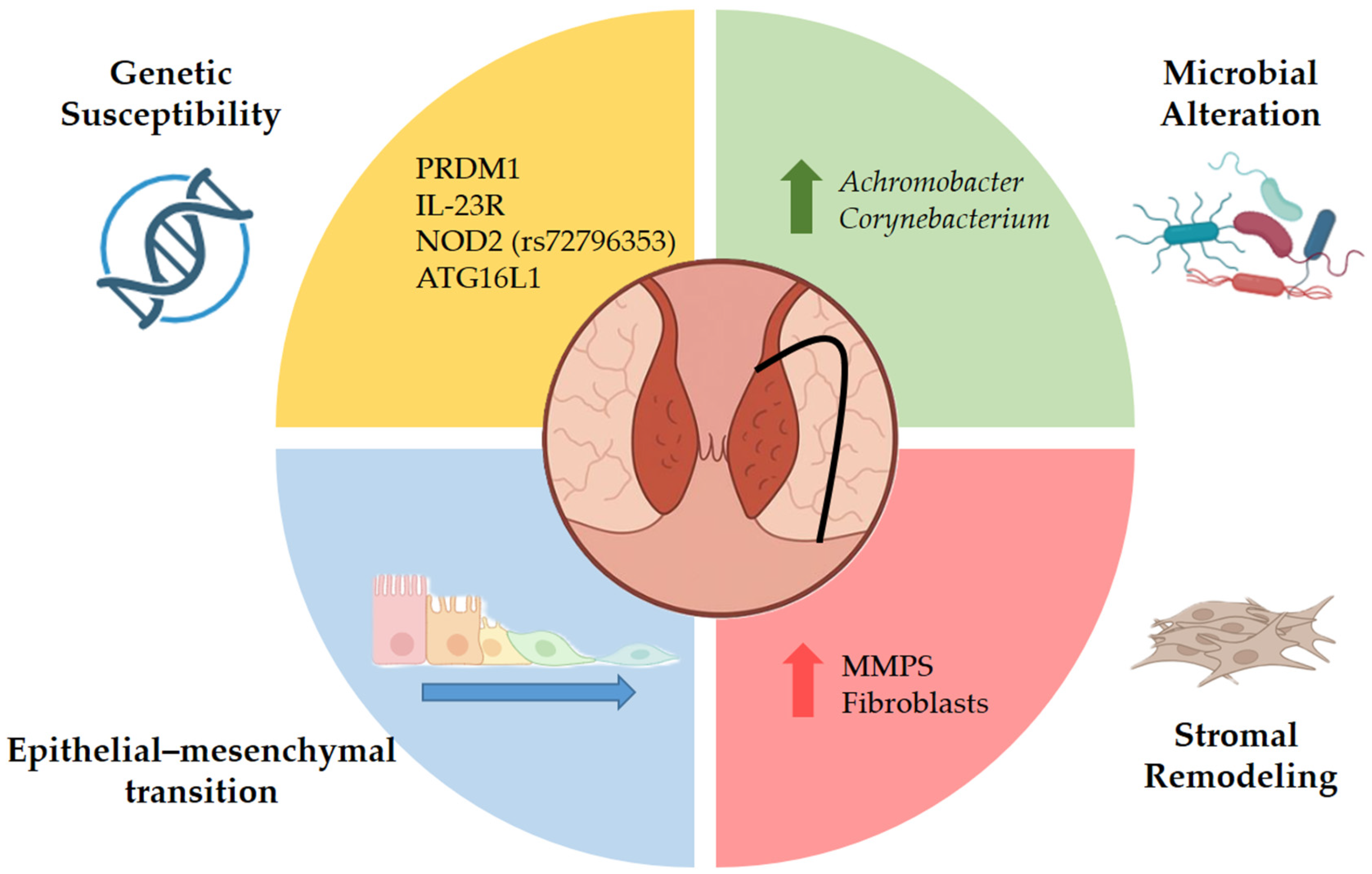
3.1. Pathogenesis
3.2. Classifications
- Intersphincteric: the tract crosses the intersphincteric space but does not traverse the external sphincter
- Transsphincteric: the tract crosses the internal and external sphincters through the intersphincteric space, extending into the ischioanal fossa
- Suprasphincteric: the tract ascends within the intersphincteric space, curves over the puborectalis muscle and through the levator ani into the ischiorectal fossa, and then reaches the perineal skin
- Extrasphincteric: the tract runs from the perineal skin through the ischiorectal fossa and the levator ani to reach the rectum, without involving the internal sphincter
3.3. Diagnosis and Assessment
3.3.1. Proctosigmoidoscopy
3.3.2. Pelvic Magnetic Resonance Imaging
3.3.3. Transrectal Ultrasonography (TRUS)
3.3.4. Transperineal Ultrasound (TPUS)
3.3.5. Other Imaging Modalities and Future Perspectives
3.4. Medical Therapy
- Antibiotics
- Immunomodulators
- Calcineurin Inhibitors
- TNF Antagonist
- Ustekinumab (IL-12/23 Inhibitor)
- Anti IL-23 Agents (p19 Selective Inhibitors)
- Vedolizumab (Integrin α4β7 Inhibitor)
- JAK Inhibitors
- Advanced Combination Therapy

| Therapy | Author, Year | Study Design | N of Patients | Intervention | Comparator | Mean Age ± SD/(Range) | Definition of Response (Time Point) | Definition of Remission (Time Point) | Results (Time Point) | Ref. |
|---|---|---|---|---|---|---|---|---|---|---|
| Anti-TNFα | Present, 1999 (ACCENT II induction) | Prospective | 94 | 63 Induction IFX (5 or 10 mg/kg) | 31 placebo | 37.2 ± 11.4 | ≥50% closure of draining fistulas observed at two or more consecutive study visits based on physical evaluation (week 18) | absence of any draining fistulas at two consecutive visits based on physical evaluation (week 18) | Clinical response 68% (IFX 5 mg/kg) and 56% (IFX 10 mg/kg) vs. 26% placebo (p = 0.002 and p = 0.02, respectively). Clinical remission 55% (IFX 5 mg/kg) and 38% (IFX 10 mg/kg) vs. 13% placebo (p = 0.001 and p = 0.04, respectively). | [66] |
| Sands, 2004 (ACCENT II maintenance) | Prospective | 195 | 96 IFX (5 mg/kg) | 99 placebo | 37.7 ± 38.0 | ≥50% closure in the number of draining fistulas at consecutive visits four or more weeks apart based on physical evaluation (week 54) | absence of draining fistulas based on physical evaluation (week 54) | Response 46% (IFX 5 mg/kg) vs. 23% placebo (p = 0.001); Remission 36% (IFX 5 mg/kg) vs. 19% placebo (p = 0.009) | [46] | |
| West, 2004 | Prospective | 24 | 11 IFX + ciprofloxacin (500 mg×2 die) | 13 IFX + placebo | 34.0 (18.0–61.0) | ≥50% reduction in the number of draining fistulae based on physical evaluation (week 18) | - | Clinical response 73% (IFX + ABX) vs. 39% (IFX + placebo) (p = 0.12). | [39] | |
| Colombel, 2009 (CHARM) | Prospective (Subgroup) | 117 | 70 ADA 40 mg eow | 47 placebo | 37.1 ± 11.9 | - | absence of drainage based on physical evaluation (week 56) | Remission 30% (ADA) vs. 13% placebo (p < 0.05) | [47] | |
| Dewint, 2014 (ADAFI) | Prospective | 70 | 34 ADA 40 mg eow + ciprofloxacin (500 mg×2 die) | 36 ADA 40 mg eow + placebo | 34.7 ± 11.0 ADA + ciprofloxacin; 37.3 ± 12.4 ADA + placebo | ≥50% reduction in the number of draining fistulas based on physical evaluation (week 12) | absence of drainage based on physical evaluation (week 12) | Fistula response 71% (ADA + ciprofloxacin) vs. 47% (ADA + placebo, p = 0.047) Complete fistula closure 65% (ADA + ciprofloxacin) vs. 33% (ADA + placebo, p = 0.009) | [41] | |
| Davidov Y et al., 2017 | Retrospective cohort | 36 | IFX (5 mg/kg) | - | 21.0 (18.0–27.0) | cessation or significant improvement of fistula drainage reported by patient or treating physician (week 14) | No visible fistula opening on physical examination (week 30) | Response 70% of patients Remission 47.2% of patients | [67] | |
| Yarur AJ et al., 2017 | Multicenter retrospective | 117 | IFX | - | 39 ± 15 | - | absence of drainage from the perianal fistula based on physical evaluation (week 24) | Fistula healing 54% of patients | [68] | |
| McCurdy JD et al., 2020 | Retrospective, single-center | 22 | IFX and ADA | - | 38.0 ± 11.2 | closure of at least 50% of external fistula openings with reduction in drainage based on physical evaluation (week 52) | complete closure of all external fistula openings with absence of drainage, sustained for at least two consecutive visits based on physical evaluation (week 52) | Remission 36% of patients and response 54% of patients | [69] | |
| De Gregorio M et al., 2022 | Multicenter retrospective | 193 | 117 IFX and 76 ADA | - | 35.0 (30.0–44.6) IFX; 37.5 (25.5–46.0) ADA | inflammatory subscore ≤ 6 on the Van Assche Index assessed by pelvic MRI | inflammatory subscore of 0 on the Van Assche Index assessed by pelvic MRI | radiologic healing 47.0% (IFX) and 44.7% (ADA); radiologic remission 17.1% (IFX) and 15.8% (ADA) | [51] | |
| Chan M et al., 2023 | Retrospective, single-center | 155 | IFX, ADA and golimumab | - | 34.7 ± 12.5 | - | absence of drainage from all external fistula openings based on physical evaluation (3, 6, and 12 months) | Fistula closure rates: 32% at 3 months, 41% at 6 months, and 47% at 12 months | [70] | |
| Ustekinumab | Chapuis Biron, 2020 (BioLAP) | Multicenter retrospective | 207 | UST Mantainance | - | 37.7 ± 11.4 | - | Treatment success: absence of drainage and no anal ulcers based on physical evaluation(6 months) MRI response: radiologist’s appreciation | Treatment success: 38.5% MRI response: 50% | [71] |
| Yao et al., 2023 | Retrospective cohort | 108 | UST q8w or q12w | - | 29.2 ± 1.0 | Response: decrease of >50% in the number of draining fistulas according to the fistula drainage assessment index based on physical evaluation (week 16/20); Radiological improvement: reduction in the number and volume of fistula, and >10% decrease in the MRI signal | Remission: absence of any draining fistula based on physical evaluation; Radiologic healing: absence of a high-signal track on fat-saturated T2 sequences (week 16/20) | Response: 63%; Remission 40.7%; radiological improvement: 31.4%; radiological fistula healing: 44.8% | [72] | |
| Casanova, 2024 (HEAL study) | Multicenter retrospective | 155 | 136 UST (16 both UST and VDZ) | 35 VDZ (16 both UST and VDZ) | 45.0 (35.0–54.0) UST; 46.0 (41.0–54.0) VDZ | Reduction of 50% or more in the number of draining tracts based on physical evaluation (weeks 24) | Clinical remission: no drainage through the fistula upon gentle pressure based on physical evaluation MRI response: absence of activity in perianal fistulous tracts and the absence of local complications Combined remission: clinical + radiological remission (week 24) | Response 65% and remission 36%; MRI response 50%; combined remission 30% | [57] | |
| Chen et al., 2025 | Retrospective cohort | 143 | UST | - | 28.6 ± 9.0 | - | Clinical remission: absence of pain/drainage based on physical evaluation (2 years); radiological healing: absence of high signal-intensity trajectories on fat-saturated T2-weighted sequences (52 weeks) Deep remission: clinical+ radiological | Clinical remission: 73.9%; Deep remission: 40.0% | [73] | |
| Liu et al., 2025 | Retrospective cohort | 89 | UST | - | 26.0 (22.0–30.0) | MRI improvement: reduction in the number and volume of fistulas and a decrease in MRI signal intensity of >10% | absence of drainage based on physical evaluation; MRI healing: absence of a high-signal tract on fat-saturated T2 sequences (16/20 weeks and 52 weeks) | Absence of drainage: 66.3% (16/20 weeks), 74.2% (52 weeks); MRI improvement 54.7% and MRI healing: 21.8% (52 weeks) | [58] | |
| Vedolizumab | Chapuis-Biron, 2019 | Multicenter retrospective cohort | 151 | VDZ | - | 39.8 (21.0–63.0) | - | Clinical success: no draining fistula at a given visit, and no anal ulcers for primary lesions based on physical evaluation (6 months) | 22.5% clinical success | [60] |
| Schwartz, 2022 (ENTERPRISE) | Multicenter, randomized, double blind trial | 16 VDZ regimen; 18 VDZ + wk10 | VDZ 300 mg IV at weeks 0, 2, 6, 14, and 22 (VDZ regimen) | VDZ 300 mg IV at weeks 0, 2, 6, 14, and 22 + week 10 (VDZ + wk10) | 34.0 (21.0–59.0) | ≥50% closure based on physical evaluation (22 and 30 weeks) | 100% closure based on physical evaluation (30 weeks) | Response: 64.3% VDZ and 42.9% VDZ + wk10 Remission: 50% VDZ and 35.7% VDZ + wk10 | [61] | |
| Casanova, 2024 (HEAL) | Multicenter retrospective cohort | 155 | 136 UST (16 both UST and VDZ) | 35 VDZ (16 both UST and VDZ) | 45.0 (35.0–54.0) UST; 46.0 (41.0–54.0) VDZ | Reduction of 50% or more in the number of draining tracts based on physical evaluation (week 24) | Clinical remission: no drainage through the fistula upon gentle pressure based on physical evaluation MRI response: absence of activity in perianal fistulous tracts and the absence of local complications Combined remission: clinical + radiological remission (week 24) | Response 57%; remission 32%; MRI response 78%; combined remission 22% | [57] | |
| Upadacitinib | Colombel, 2025 (U-EXCEL, U-EXCEED, U-ENDURE) | Post hoc analysis of phase 3 trials | 128 | UPA 45 mg, 30 mg and UPA 15 mg | 42 placebo | 33.9 ± 11.7 UPA; 35.7 ± 9.5 | resolution of drainage based on physical evaluation (weeks 12 and 52) | closure of all external openings based on physical evaluation (weeks 12 and 52) | Response: 44.7% (week 12, upadacitinib 45 mg; 5.6% placebo), 28.6% (week 52, upadacitinib 15 mg; 0% placebo), 23.1% (week 52, upadacitinib 30 mg; 0% placebo); Remission: 22.1% (week 12, upadacitinib 45 mg; 4.8% placebo), 18.8% (week 52, upadacitinib 15 mg; 0% placebo), 16.0% (week 52, upadacitinib 30 mg; 0% placebo) | [62] |
- Hyperbaric Oxygen
- Surgical Therapy
- 1.
- Examination under Anesthesia (EUA): guiding surgical strategy [17]
- 2.
- Seton placement: balancing stabilizations with healing goals
- 3.
- Fistula closure: repairing fistula without compromising function
- Endorectal advancement flap (AF): Removes the epithelized tract and covers the internal opening. Variants (mucosal, partial thickness, full thickness) balance recurrence rates with sphincter safety [84].
- Ligation of the intersphincteric fistula tract (LIFT): Approaches the fistula through the intersphincteric plane, minimizing sphincter injury. Healing rates are comparable to AF, and it is preferred when anatomy limits flap mobility [84].
- Fistulotomy: Reserved only for simple, low tracts due to the risk of incontinence; rarely appropriate in CD.
- Novel techniques: Minimally invasive options such as FiLAC (laser closure) and VAAFT (video-assisted treatment) have reported encouraging but variable success. Evidence is limited by small sample sizes and heterogeneous definitions of healing. Availability is mostly restricted to specialized centers [18].
- Biomaterials such as fibrin glue and fistula plugs have shown inconsistent results and are not routinely recommended for PFCD [40].
- 4.
- Addressing Advanced Disease: From diversion to proctectomy
| NCT Number | Name | Treatment | Phase | Reference |
|---|---|---|---|---|
| NCT05347095 | FUNZION CD | guselkumab | 3 | [86] |
| NCT04847739 | STOMP-II | Seeded Cells on Matrix Plug | 2 | [87] |
| NCT06925594 | - | Human TH-SC01 Cell | 3 | [88] |
| NCT04010526 | ADICROHN2 | Autologous ADSVF | 2 | [89] |
| NCT06918808 | - | DB-3Q | 2a | [90] |
| NCT06059989 | DIRECTCD | Subcutaneous infliximab | 3 | [91] |
| NCT03901235 | MCS | Mesenchymal Stromal Cells | 2 | [92] |
4. Discussion
- Evolving disease classification beyond purely anatomical frameworks to incorporate molecular, cellular, and imaging-derived phenotypes that better capture biological heterogeneity and disease behavior. AI may facilitate standardized interpretation of endoscopic, histological, and radiological data.
- Defining objective and reproducible endpoints, including standardized clinical, radiological, and biological targets.
- Implementing longitudinal assessment strategies through prospective cohort designs with serial sampling of imaging, tissue, and circulating biomarkers.
- Optimizing and personalizing therapeutic approaches, focusing not only on novel biologics and small molecules but also on maximizing the efficacy of existing treatments. AI-driven decision support, therapeutic drug monitoring, pharmacokinetic–pharmacodynamic modeling, and rational combination therapies may be necessary to address complex pfCD phenotypes and improve long-term outcomes.
5. Conclusions
Author Contributions
Funding
Institutional Review Board Statement
Informed Consent Statement
Data Availability Statement
Conflicts of Interest
Abbreviations
| ADA | Adalimumab |
| ADSCs | Adipose-Derived Stem Cells |
| AI | Artificial Intelligence |
| AUC | Area Under the Curve |
| CD | Crohn’s Disease |
| CGF | Cryptoglandular Fistula |
| CT | Computed Tomography |
| ECCO | European Crohn’s and Colitis Organisation |
| EMT | Epithelial–Mesenchymal Transition |
| ESGAR | European Society of Gastrointestinal and Abdominal Radiology |
| EUA | Examination Under Anesthesia |
| FDG-PET/CT | Fluorodeoxyglucose Positron Emission Tomography/Computed Tomography |
| HBOT | Hyperbaric Oxygen Therapy |
| IBD | Inflammatory Bowel Disease |
| IFX | Infliximab |
| IL | Interleukin |
| JAK | Janus Kinase |
| MAGNIFI-CD | Magnetic Resonance Index for Fistula Imaging in Crohn’s Disease |
| MRI | Magnetic Resonance Imaging |
| MMPs | Matrix Metalloproteinases |
| MSC | Mesenchymal Stem Cells |
| pfCD/PFCD | Perianal Fistulizing Crohn’s Disease |
| PRO | Patient-Reported Outcome |
| TNF | Tumor Necrosis Factor |
| TOPClass | Treat-to-Patient-Goal-Oriented Classification |
| TPUS | Transperineal Ultrasound |
| TRUS | Transrectal Ultrasound |
| VAAFT | Video-Assisted Anal Fistula Treatment |
References
- McKay, C.; Bolzani, A.; Kienzle, S.; Geransar, P.; Panés, J. Epidemiology, Treatment Patterns, and Associated Risk Factors in Perianal Fistulizing Crohn’s Disease: A Systematic Literature Review. World J. Gastrointest. Surg. 2025, 17, 101767. [Google Scholar] [CrossRef] [Scilit]
- Cao, S.; Colonna, M.; Deepak, P. Pathogenesis of Perianal Fistulising Crohn’s Disease: Current Knowledge, Gaps in Understanding, and Future Research Directions. J. Crohn’s Colitis 2023, 17, 1010–1022. [Google Scholar] [CrossRef] [Scilit]
- Cleynen, I.; González, J.R.; Figueroa, C.; Franke, A.; McGovern, D.; Bortlík, M.; Crusius, B.J.A.; Vecchi, M.; Artieda, M.; Szczypiorska, M.; et al. Genetic Factors Conferring an Increased Susceptibility to Develop Crohn’s Disease Also Influence Disease Phenotype: Results from the IBDchip European Project. Gut 2013, 62, 1556–1565. [Google Scholar] [CrossRef] [Scilit] [PubMed]
- Panés, J.; Rimola, J. Perianal Fistulizing Crohn’s Disease: Pathogenesis, Diagnosis and Therapy. Nat. Rev. Gastroenterol. Hepatol. 2017, 14, 652–664. [Google Scholar] [CrossRef] [Scilit] [PubMed]
- Scharl, M.; Frei, S.; Pesch, T.; Kellermeier, S.; Arikkat, J.; Frei, P.; Fried, M.; Weber, A.; Jehle, E.; Rühl, A.; et al. Interleukin-13 and Transforming Growth Factor β Synergise in the Pathogenesis of Human Intestinal Fistulae. Gut 2013, 62, 63–72. [Google Scholar] [CrossRef] [Scilit] [PubMed]
- Kirkegaard, T.; Hansen, A.; Bruun, E.; Brynskov, J. Expression and Localisation of Matrix Metalloproteinases and Their Natural Inhibitors in Fistulae of Patients with Crohn’s Disease. Gut 2004, 53, 701–709. [Google Scholar] [CrossRef] [Scilit]
- Haac, B.E.; Palmateer, N.C.; Seaton, M.E.; VanYPeren, R.; Fraser, C.M.; Bafford, A.C. A Distinct Gut Microbiota Exists Within Crohn’s Disease-Related Perianal Fistulae. J. Surg. Res. 2019, 242, 118–128. [Google Scholar] [CrossRef] [Scilit]
- McGregor, C.; Qin, X.; Jagielowicz, M.; Gupta, T.; Yin, Z.; Lentsch, V.; Fawkner-Corbett, D.; Wien Lai, V.; Gomez Castro, P.; Bridges, E.; et al. Spatial Fibroblast Niches Define Crohn’s Fistulae. Nature 2026, 649, 703–712. [Google Scholar] [CrossRef] [Scilit]
- Murthy, S.; Anbazhagan, M.; Maddipatla, S.C.; Kolachala, V.L.; Dodd, A.; Pelia, R.; Cutler, D.J.; Matthews, J.D.; Kugathasan, S. Single-Cell Transcriptomics of Rectal Organoids from Individuals with Perianal Fistulizing Crohn’s Disease Reveals Patient-Specific Signatures. Sci. Rep. 2024, 14, 26142. [Google Scholar] [CrossRef] [Scilit]
- Parks, A.G.; Gordon, P.H.; Hardcastle, J.D. A Classification of Fistula-in-Ano. Br. J. Surg. 1976, 63, 1–12. [Google Scholar] [CrossRef] [Scilit]
- Morris, J.; Spencer, J.A.; Ambrose, N.S. MR Imaging Classification of Perianal Fistulas and Its Implications for Patient Management. Radiographics 2000, 20, 623–635, discussion 635–637. [Google Scholar] [CrossRef] [Scilit] [PubMed]
- Irvine, E.J. Usual Therapy Improves Perianal Crohn’s Disease as Measured by a New Disease Activity Index. McMaster IBD Study Group. J. Clin. Gastroenterol. 1995, 20, 27–32. [Google Scholar] [PubMed]
- Samaan, M.A.; Puylaert, C.A.J.; Levesque, B.G.; Zou, G.Y.; Stitt, L.; Taylor, S.A.; Shackelton, L.M.; Vandervoort, M.K.; Khanna, R.; Santillan, C.; et al. The Development of a Magnetic Resonance Imaging Index for Fistulising Crohn’s Disease. Aliment. Pharmacol. Ther. 2017, 46, 516–528. [Google Scholar] [CrossRef] [Scilit]
- Hindryckx, P.; Jairath, V.; Zou, G.; Feagan, B.G.; Sandborn, W.J.; Stoker, J.; Khanna, R.; Stitt, L.; van Viegen, T.; Shackelton, L.M.; et al. Development and Validation of a Magnetic Resonance Index for Assessing Fistulas in Patients with Crohn’s Disease. Gastroenterology 2019, 157, 1233–1244.e5. [Google Scholar] [CrossRef] [Scilit]
- Hanna, L.N.; Anandabaskaran, S.; Iqbal, N.; Geldof, J.; LeBlanc, J.-F.; Dige, A.; Lundby, L.; Vermeire, S.; D’Hoore, A.; Verstockt, B.; et al. Perianal Fistulizing Crohn’s Disease: Utilizing the TOpClass Classification in Clinical Practice to Provide Targeted Individualized Care. Clin. Gastroenterol. Hepatol. 2025, 23, 914–926. [Google Scholar] [CrossRef] [Scilit]
- Kim, P.H.; Park, S.H.; Jin, K.; Ye, B.D.; Yoon, Y.S.; Lee, J.S.; Kim, H.J.; Kim, A.Y.; Yu, C.S.; Yang, S.-K. Supplementary Anal Imaging by Magnetic Resonance Enterography in Patients with Crohn’s Disease Not Suspected of Having Perianal Fistulas. Clin. Gastroenterol. Hepatol. 2020, 18, 415–423.e4. [Google Scholar] [CrossRef] [Scilit]
- Anand, E.; Pelly, T.; Joshi, S.; Shakweh, E.; Hanna, L.N.; Hart, A.; Tozer, P.; Lung, P. Current Practice and Innovations in Diagnosing Perianal Fistulizing Crohn’s Disease (pfCD): A Narrative Review. Tech. Coloproctol. 2025, 29, 102. [Google Scholar] [CrossRef] [Scilit]
- Adegbola, S.O.; Sahnan, K.; Tozer, P.J.; Strouhal, R.; Hart, A.L.; Lung, P.F.C.; Phillips, R.K.S.; Faiz, O.; Warusavitarne, J. Symptom Amelioration in Crohn’s Perianal Fistulas Using Video-Assisted Anal Fistula Treatment (VAAFT). J. Crohn’s Colitis 2018, 12, 1067–1072. [Google Scholar] [CrossRef] [Scilit]
- Sebastian, S.; Black, C.; Pugliese, D.; Armuzzi, A.; Sahnan, K.; Elkady, S.M.; Katsanos, K.H.; Christodoulou, D.K.; Selinger, C.; Maconi, G.; et al. The Role of Multimodal Treatment in Crohn’s Disease Patients with Perianal Fistula: A Multicentre Retrospective Cohort Study. Aliment. Pharmacol. Ther. 2018, 48, 941–950. [Google Scholar] [CrossRef] [Scilit]
- Zhao, M.; Lo, B.Z.S.; Vester-Andersen, M.K.; Vind, I.; Bendtsen, F.; Burisch, J. A 10-Year Follow-up Study of the Natural History of Perianal Crohn’s Disease in a Danish Population-Based Inception Cohort. Inflamm. Bowel Dis. 2019, 25, 1227–1236. [Google Scholar] [CrossRef] [Scilit]
- Lichtenstein, G.R.; Loftus, E.V.; Afzali, A.; Long, M.D.; Barnes, E.L.; Isaacs, K.L.; Ha, C.Y. ACG Clinical Guideline: Management of Crohn’s Disease in Adults. Off. J. Am. Coll. Gastroenterol. 2025, 120, 1225. [Google Scholar] [CrossRef] [Scilit]
- Kucharzik, T.; Taylor, S.; Allocca, M.; Burisch, J.; Ellul, P.; Iacucci, M.; Maaser, C.; Baldin, P.; Bhatnagar, G.; Ben-Horin, S.; et al. ECCO-ESGAR-ESP-IBUS Guideline on Diagnostics and Monitoring of Patients with Inflammatory Bowel Disease: Part 1. J. Crohn’s Colitis 2025, 19, jjaf106. [Google Scholar] [CrossRef] [Scilit]
- Levy, A.D.; Liu, P.S.; Kim, D.H.; Fowler, K.J.; Bharucha, A.E.; Chang, K.J.; Cilenti, E.; Gage, K.L.; Garcia, E.M.; Kambadakone, A.R.; et al. ACR Appropriateness Criteria® Anorectal Disease. J. Am. Coll. Radiol. 2021, 18, S268–S282. [Google Scholar] [CrossRef] [Scilit] [PubMed]
- Chin Koon Siw, K.; Engel, J.; Visva, S.; Mallick, R.; Hart, A.; de Buck van Overstraeten, A.; McCurdy, J.D. Strategies to Distinguish Perianal Fistulas Related to Crohn’s Disease from Cryptoglandular Disease: Systematic Review with Meta-Analysis. Inflamm. Bowel Dis. 2022, 28, 1363–1374. [Google Scholar] [CrossRef] [Scilit]
- Anand, E.; Devi, J.; Ballard, D.H.; Joshi, S.; Tozer, P.; Hart, A.; Antoniou, A.; Deepak, P.; Stoker, J.; Lung, P.; et al. Defining Radiological Healing in Perianal Fistulizing Crohn’s Disease: A TOpClass Global Expert Delphi Consensus. Clin. Gastroenterol. Hepatol. 2025, 24, 190–200. [Google Scholar] [CrossRef] [Scilit]
- van Rijn, K.L.; Meima-van Praag, E.M.; Bossuyt, P.M.; D’Haens, G.R.; Gecse, K.B.; Horsthuis, K.; Snijder, H.J.; Tielbeek, J.A.W.; Buskens, C.J.; Stoker, J. Fibrosis and MAGNIFI-CD Activity Index at Magnetic Resonance Imaging to Predict Treatment Outcome in Perianal Fistulizing Crohn’s Disease Patients. J. Crohn’s Colitis 2022, 16, 708–716. [Google Scholar] [CrossRef] [Scilit]
- Beek, K.J.; Mulders, L.G.M.; van Rijn, K.L.; Horsthuis, K.; Tielbeek, J.A.W.; Buskens, C.J.; D’Haens, G.R.; Gecse, K.B.; Stoker, J. External Validation of the MAGNIFI-CD Index in Patients with Complex Perianal Fistulising Crohn’s Disease. Eur. Radiol. 2025, 35, 1428–1439. [Google Scholar] [CrossRef] [Scilit]
- Habeeb, H.; Chen, L.; Kock, I.D.; Bhatnagar, G.; Kutaiba, N.; Vasudevan, A.; Srinivasan, A.R. Imaging in Perianal Fistulising Crohn’s Disease: A Practical Guide for the Gastroenterologist. World J. Gastroenterol. 2025, 31, 110611. [Google Scholar] [CrossRef] [Scilit]
- Siddiqui, M.R.S.; Ashrafian, H.; Tozer, P.; Daulatzai, N.; Burling, D.; Hart, A.; Athanasiou, T.; Phillips, R.K. A Diagnostic Accuracy Meta-Analysis of Endoanal Ultrasound and MRI for Perianal Fistula Assessment. Dis. Colon. Rectum 2012, 55, 576–585. [Google Scholar] [CrossRef] [Scilit]
- Luglio, G.; Giglio, M.C.; Rispo, A.; Bucci, C.; Sollazzo, V.; Castiglione, F.; De Palma, G.D.; Bucci, L. Diagnostic Accuracy of 3-Dimensional Endoanal Ultrasound in Identifying Perianal Crohn’s Fistulas. Dis. Colon. Rectum 2018, 61, 931–937. [Google Scholar] [CrossRef] [Scilit]
- Bor, R.; Farkas, K.; Bálint, A.; Szűcs, M.; Ábrahám, S.; Milassin, Á.; Rutka, M.; Nagy, F.; Milassin, P.; Szepes, Z.; et al. Prospective Comparison of Magnetic Resonance Imaging, Transrectal and Transperineal Sonography, and Surgical Findings in Complicated Perianal Crohn Disease. J. Ultrasound Med. 2016, 35, 2367–2372. [Google Scholar] [CrossRef] [Scilit]
- Maconi, G.; Tonolini, M.; Monteleone, M.; Bezzio, C.; Furfaro, F.; Villa, C.; Campari, A.; Dell’Era, A.; Sampietro, G.; Ardizzone, S.; et al. Transperineal Perineal Ultrasound versus Magnetic Resonance Imaging in the Assessment of Perianal Crohn’s Disease. Inflamm. Bowel Dis. 2013, 19, 2737–2743. [Google Scholar] [CrossRef] [Scilit]
- Lim, C.T.; Pruijt, M.; Lim, G.H.; van Etten-Jamaludin, F.; Teichert, C.; de Voogd, F.; Christensen, B.; D’Haens, G.; Maconi, G.; Gecse, K. P1186 Transperineal Ultrasound Is Accurate in Detecting Perianal Complications in Crohn’s Disease: A Systematic Review and Meta-Analysis. J. Crohn’s Colitis 2025, 19, i2155–i2156. [Google Scholar] [CrossRef] [Scilit]
- Soker, G.; Gulek, B.; Yilmaz, C.; Kaya, O.; Arslan, M.; Dilek, O.; Gorur, M.; Kuscu, F.; İrkorucu, O. The Comparison of CT Fistulography and MR Imaging of Perianal Fistulae with Surgical Findings: A Case-Control Study. Abdom. Radiol. 2016, 41, 1474–1483. [Google Scholar] [CrossRef] [Scilit]
- Huang, K.; Garuba, F.; Ganapathy, A.; Bishop, G.; Zhang, H.; Lovato, A.; Itani, M.; Viswanath, S.E.; Fraum, T.J.; Deepak, P.; et al. Quantifying 18F-Fluorodeoxyglucose Uptake in Perianal Fistulas on PET/CT: A Retrospective Analysis. Acad. Radiol. 2024, 31, 2775–2783. [Google Scholar] [CrossRef] [Scilit]
- Jeri-McFarlane, S.; García-Granero, Á.; Ochogavía-Seguí, A.; Pellino, G.; Oseira-Reigosa, A.; Gil-Catalan, A.; Brogi, L.; Ginard-Vicens, D.; Gamundi-Cuesta, M.; Gonzalez-Argente, F.X. Three-Dimensional Modelling as a Novel Interactive Tool for Preoperative Planning for Complex Perianal Fistulas in Crohn’s Disease. Color. Dis. 2023, 25, 1279–1284. [Google Scholar] [CrossRef] [Scilit]
- Zhang, G.; Liu, C.; Ren, W.; Zhao, H.; Shi, H.; Liu, H.; Lu, M.; Yang, H.; Ding, S.; Sun, L. A Predictive Model for Differentiating Perianal Crohn’s Disease Activity with 3D Transrectal Ultrasonography. Eur. Radiol. 2025. [Google Scholar] [CrossRef] [Scilit]
- Zhang, H.; Li, W.; Chen, T.; Deng, K.; Yang, B.; Luo, J.; Yao, J.; Lin, Y.; Li, J.; Meng, X.; et al. Development and Validation of the MRI-Based Deep Learning Classifier for Distinguishing Perianal Fistulizing Crohn’s Disease from Cryptoglandular Fistula: A Multicenter Cohort Study. eClinicalMedicine 2024, 78, 102940. [Google Scholar] [CrossRef] [Scilit]
- West, R.L.; van der Woude, C.J.; Hansen, B.E.; Felt-Bersma, R.J.F.; van Tilburg, A.J.P.; Drapers, J.a.G.; Kuipers, E.J. Clinical and Endosonographic Effect of Ciprofloxacin on the Treatment of Perianal Fistulae in Crohn’s Disease with Infliximab: A Double-Blind Placebo-Controlled Study. Aliment. Pharmacol. Ther. 2004, 20, 1329–1336. [Google Scholar] [CrossRef] [Scilit]
- Adamina, M.; Minozzi, S.; Warusavitarne, J.; Buskens, C.J.; Chaparro, M.; Verstockt, B.; Kopylov, U.; Yanai, H.; Vavricka, S.R.; Sigall-Boneh, R.; et al. ECCO Guidelines on Therapeutics in Crohn’s Disease: Surgical Treatment. J. Crohn’s Colitis 2024, 18, 1556–1582. [Google Scholar] [CrossRef] [Scilit]
- Dewint, P.; Hansen, B.E.; Verhey, E.; Oldenburg, B.; Hommes, D.W.; Pierik, M.; Ponsioen, C.I.J.; van Dullemen, H.M.; Russel, M.; van Bodegraven, A.A.; et al. Adalimumab Combined with Ciprofloxacin Is Superior to Adalimumab Monotherapy in Perianal Fistula Closure in Crohn’s Disease: A Randomised, Double-Blind, Placebo Controlled Trial (ADAFI). Gut 2014, 63, 292–299. [Google Scholar] [CrossRef] [Scilit]
- Gordon, H.; Minozzi, S.; Kopylov, U.; Verstockt, B.; Chaparro, M.; Buskens, C.; Warusavitarne, J.; Agrawal, M.; Allocca, M.; Atreya, R.; et al. ECCO Guidelines on Therapeutics in Crohn’s Disease: Medical Treatment. J. Crohn’s Colitis 2024, 18, 1531–1555. [Google Scholar] [CrossRef] [Scilit]
- Iida, T.; Nojima, M.; Nakase, H. Therapeutic Efficacy and Adverse Events of Tacrolimus in Patients with Crohn’s Disease: Systematic Review and Meta-Analysis. Dig. Dis. Sci. 2019, 64, 2945–2954. [Google Scholar] [CrossRef] [Scilit]
- Salem, G.; Ding, K.; Sakuraba, A.; Cohen, R. Role of Topical Tacrolimus in the Management of Proctitis, Perianal Manifestations in Crohn’s Disease, and Chronic Pouchitis: A Systematic Review. J. Investig. Med. 2021, 69, 796–803. [Google Scholar] [CrossRef] [Scilit]
- Hanauer, S.B.; Smith, M.B. Rapid Closure of Crohn’s Disease Fistulas with Continuous Intravenous Cyclosporin A. Am. J. Gastroenterol. 1993, 88, 646–649. [Google Scholar]
- Sands, B.E.; Anderson, F.H.; Bernstein, C.N.; Chey, W.Y.; Feagan, B.G.; Fedorak, R.N.; Kamm, M.A.; Korzenik, J.R.; Lashner, B.A.; Onken, J.E.; et al. Infliximab Maintenance Therapy for Fistulizing Crohn’s Disease. N. Engl. J. Med. 2004, 350, 876–885. [Google Scholar] [CrossRef] [Scilit]
- Colombel, J.F.; Schwartz, D.A.; Sandborn, W.J.; Kamm, M.A.; D’Haens, G.; Rutgeerts, P.; Enns, R.; Panaccione, R.; Schreiber, S.; Li, J.; et al. Adalimumab for the Treatment of Fistulas in Patients with Crohn’s Disease. Gut 2009, 58, 940–948. [Google Scholar] [CrossRef] [Scilit]
- Aboursheid, T.; Beran, A.; Hijazi, M.; Albuni, M.K.; Sawaf, B.; Guardiola, J.J.; Abdeljawad, K.; McDonald, B.D.; Rubin, D.T. Comparison Between Adalimumab and Infliximab in Perianal Crohn’s Disease: A Systematic Review and Meta-Analysis. Gastro Hep Adv. 2025, 4, 100697. [Google Scholar] [CrossRef] [Scilit]
- Adler, J.; Gadepalli, S.; Rahman, M.; Kim, S. Early Tumour Necrosis Factor Antagonist Treatment Prevents Perianal Fistula Development in Children with Crohn’s Disease: Post Hoc Analysis of the RISK Study. Gut 2025, 74, 539–546. [Google Scholar] [CrossRef] [Scilit]
- Papamichael, K.; Vande Casteele, N.; Jeyarajah, J.; Jairath, V.; Osterman, M.T.; Cheifetz, A.S. Higher Postinduction Infliximab Concentrations Are Associated with Improved Clinical Outcomes in Fistulizing Crohn’s Disease: An ACCENT-II Post Hoc Analysis. Am. J. Gastroenterol. 2021, 116, 1007–1014. [Google Scholar] [CrossRef] [Scilit]
- De Gregorio, M.; Lee, T.; Krishnaprasad, K.; Amos, G.; An, Y.-K.; Bastian-Jordan, M.; Begun, J.; Borok, N.; Brown, D.J.M.; Cheung, W.; et al. Higher Anti-Tumor Necrosis Factor-α Levels Correlate with Improved Radiologic Outcomes in Crohn’s Perianal Fistulas. Clin. Gastroenterol. Hepatol. 2022, 20, 1306–1314. [Google Scholar] [CrossRef] [Scilit]
- Papamichael, K.; Centritto, A.; Guillo, L.; Hier, J.; Sherman, Z.; Cheifetz, A.S.; International Consortium of Therapeutic Drug Monitoring (Spectrum). Higher Adalimumab Concentration Is Associated with Complete Fistula Healing in Patients with Perianal Fistulizing Crohn’s Disease. Clin. Gastroenterol. Hepatol. 2024, 22, 2134–2136.e2. [Google Scholar] [CrossRef] [Scilit]
- Zhu, P.; Sun, J.-F.; Gu, Y.-F.; Chen, H.-J.; Xu, M.-M.; Li, Y.-R.; Yang, B.-L. Combined Therapy with Early Initiation of Infliximab Following Drainage of Perianal Fistulising Crohn’s Disease: A Retrospective Cohort Study. BMC Gastroenterol. 2022, 22, 15. [Google Scholar] [CrossRef] [Scilit]
- Wasmann, K.A.; de Groof, E.J.; Stellingwerf, M.E.; D’Haens, G.R.; Ponsioen, C.Y.; Gecse, K.B.; Dijkgraaf, M.G.W.; Gerhards, M.F.; Jansen, J.M.; Pronk, A.; et al. Treatment of Perianal Fistulas in Crohn’s Disease, Seton Versus Anti-TNF Versus Surgical Closure Following Anti-TNF [PISA]: A Randomised Controlled Trial. J. Crohn’s Colitis 2020, 14, 1049–1056. [Google Scholar] [CrossRef] [Scilit]
- Praag, E.M.M.; Becker, M.A.J.; van Rijn, K.L.; Wasmann, K.A.T.G.M.; Stoker, J.; D’Haens, G.R.A.M.; Ponsioen, C.Y.; Gecse, K.B.; Dijkgraaf, M.G.W.; Spinelli, A.; et al. Short-Term Anti-TNF Therapy with Surgical Closure versus Anti-TNF Therapy Alone for Crohn’s Perianal Fistulas (PISA-II): Long-Term Outcomes of an International, Multicentre Patient Preference, Randomised Controlled Trial. eClinicalMedicine 2023, 61, 102045. [Google Scholar] [CrossRef] [Scilit]
- Attauabi, M.; Burisch, J.; Seidelin, J.B. Efficacy of Ustekinumab for Active Perianal Fistulizing Crohn’s Disease: A Systematic Review and Meta-Analysis of the Current Literature. Scand. J. Gastroenterol. 2021, 56, 53–58. [Google Scholar] [CrossRef] [Scilit]
- Casanova, M.J.; Caballol, B.; García, M.J.; Mesonero, F.; Rubín de Célix, C.; Suárez-Álvarez, P.; Ferreiro-Iglesias, R.; Martín-Rodríguez, M.D.M.; de Francisco, R.; Varela-Trastoy, P.; et al. Persistence, Effectiveness and Safety of Ustekinumab and Vedolizumab Therapy for Complex Perianal Fistula in Crohn’s Disease: The HEAL Study from GETECCU. Dig. Liver Dis. 2024, 56, 1845–1853. [Google Scholar] [CrossRef] [Scilit]
- Liu, X.; Yan, Y.; Yi, J.; Luo, D.; Geng, J.; Huang, H.; Wang, J.; Gu, Y.; Yang, B.; Gong, Y.; et al. Ustekinumab Trough Concentrations Predict Clinical Remission in Perianal Fistulizing Crohn’s Disease: A Real-World Retrospective Cohort Study. BMC Gastroenterol. 2025, 25, 718. [Google Scholar] [CrossRef] [Scilit]
- Fumery, M.; Caron, B.; Hébuterne, X.; Altwegg, R.; Roblin, X.; Stefanescu, C.; Meyer, A.; Nachury, M.; Laharie, D.; Le Berre, C.; et al. Long-Term Outcome of Risankizumab in Crohn’s Disease: A Real-World GETAID Study. Clin. Gastroenterol. Hepatol. 2024, 22, 2451–2458.e1. [Google Scholar] [CrossRef] [Scilit]
- Chapuis-Biron, C.; Bourrier, A.; Nachury, M.; Nancey, S.; Bouhnik, Y.; Serrero, M.; Armengol-Debeir, L.; Buisson, A.; Tran-Minh, M.-L.; Zallot, C.; et al. Vedolizumab for Perianal Crohn’s Disease: A Multicentre Cohort Study in 151 Patients. Aliment. Pharmacol. Ther. 2020, 51, 719–727. [Google Scholar] [CrossRef] [Scilit]
- Schwartz, D.A.; Peyrin-Biroulet, L.; Lasch, K.; Adsul, S.; Danese, S. Efficacy and Safety of 2 Vedolizumab Intravenous Regimens for Perianal Fistulizing Crohn’s Disease: ENTERPRISE Study. Clin. Gastroenterol. Hepatol. 2022, 20, 1059–1067.e9. [Google Scholar] [CrossRef] [Scilit]
- Colombel, J.-F.; Lacerda, A.P.; Irving, P.M.; Panaccione, R.; Reinisch, W.; Rieder, F.; Steinlauf, A.; Schwartz, D.; Feng, T.; Dubcenco, E.; et al. Efficacy and Safety of Upadacitinib for Perianal Fistulizing Crohn’s Disease: A Post Hoc Analysis of 3 Phase 3 Trials. Clin. Gastroenterol. Hepatol. 2025, 23, 1019–1029. [Google Scholar] [CrossRef] [Scilit]
- Richard, N.; Altwegg, R.; Seksik, P.; Nancey, S.; Nachury, M.; Laharie, D.; Amiot, A.; Vuitton, L.; Peyrin-Biroulet, L.; Allez, M.; et al. P0621 Effectiveness and Safety of Induction Therapy with Upadacitinib for the Treatment of Perianal Crohn’s Disease: Real-World Data from a GETAID Multicentre Cohort Study. J. Crohn’s Colitis 2025, 19, i1225–i1227. [Google Scholar] [CrossRef] [Scilit]
- Devi, J.; Quraishi, B.; Dev, B.; Kline, M.; Jaiprada, F.; Huang, K.; Khan, A.; Alanazi, S.; Seeraj, A.A.; Maas, L.; et al. P0864 Real-World Effectiveness of Upadacitinib for Perianal Crohn’s Disease: A Multi-Center Retrospective Study. J. Crohn’s Colitis 2025, 19, i1642–i1644. [Google Scholar] [CrossRef] [Scilit]
- Fathallah, N.; Pagano, M.; Haouari, M.A.; Barré, A.; Atanasiu, C.; Chambenois, E.; Nion-Larmurier, I.; Morisset, S.; Kirchgesner, J.; de Parades, V. Effectiveness and Safety of Advanced Dual-Targeted Therapy in Refractory Perianal Crohn’s Disease. United Eur. Gastroenterol. J. 2025, 13, 1491–1501. [Google Scholar] [CrossRef] [Scilit]
- Present, D.H.; Rutgeerts, P.; Targan, S.; Hanauer, S.B.; Mayer, L.; van Hogezand, R.A.; Podolsky, D.K.; Sands, B.E.; Braakman, T.; DeWoody, K.L.; et al. Infliximab for the Treatment of Fistulas in Patients with Crohn’s Disease. N. Engl. J. Med. 1999, 340, 1398–1405. [Google Scholar] [CrossRef] [Scilit]
- Davidov, Y.; Ungar, B.; Bar-Yoseph, H.; Carter, D.; Haj-Natour, O.; Yavzori, M.; Chowers, Y.; Eliakim, R.; Ben-Horin, S.; Kopylov, U. Association of Induction Infliximab Levels with Clinical Response in Perianal Crohn’s Disease. J. Crohn’s Colitis 2017, 11, 549–555. [Google Scholar] [CrossRef] [Scilit]
- Yarur, A.J.; Kanagala, V.; Stein, D.J.; Czul, F.; Quintero, M.A.; Agrawal, D.; Patel, A.; Best, K.; Fox, C.; Idstein, K.; et al. Higher Infliximab Trough Levels Are Associated with Perianal Fistula Healing in Patients with Crohn’s Disease. Aliment. Pharmacol. Ther. 2017, 45, 933–940. [Google Scholar] [CrossRef] [Scilit]
- McCurdy, J.D.; Parlow, S.; Dawkins, Y.; Samji, K.; Rhee, G.G.; Oliveira, L.; Macdonald, B.; Sabri, E.; Murthy, S. Tumor Necrosis Factor Inhibitors May Have Limited Efficacy for Complex Perianal Fistulas Without Luminal Crohn’s Disease. Dig. Dis. Sci. 2020, 65, 1784–1789. [Google Scholar] [CrossRef] [Scilit]
- Chan, M.; Fung, M.; Chin Koon Siw, K.; Khanna, R.; de Buck van Overstraeten, A.; Sabri, E.; McCurdy, J.D. Examination Under Anesthesia May Not Be Universally Required Prior to Anti-TNF Therapy in Perianal Crohn’s Disease: A Comparative Cohort Study. Inflamm. Bowel Dis. 2023, 29, 763–770. [Google Scholar] [CrossRef] [Scilit]
- Chapuis-Biron, C.; Kirchgesner, J.; Pariente, B.; Bouhnik, Y.; Amiot, A.; Viennot, S.; Serrero, M.; Fumery, M.; Allez, M.; Siproudhis, L.; et al. Ustekinumab for Perianal Crohn’s Disease: The BioLAP Multicenter Study From the GETAID. Am. J. Gastroenterol. 2020, 115, 1812–1820. [Google Scholar] [CrossRef] [Scilit] [PubMed]
- Yao, J.; Zhang, H.; Su, T.; Peng, X.; Zhao, J.; Liu, T.; Wang, W.; Hu, P.; Zhi, M.; Zhang, M. Ustekinumab Promotes Radiological Fistula Healing in Perianal Fistulizing Crohn’s Disease: A Retrospective Real-World Analysis. J. Clin. Med. 2023, 12, 939. [Google Scholar] [CrossRef] [Scilit] [PubMed]
- Chen, Q.; Li, L.; Wang, C.; Qiao, L.; Wu, M.; Zhu, W.; Yang, B.; Gong, Y. Durable Clinical and Deep Remission with Ustekinumab in Perianal Fistulizing Crohn’s Disease: A 2-Year Retrospective Real-World Cohort Study. Dig. Liver Dis. 2025, 57, 2135–2142. [Google Scholar] [CrossRef] [Scilit] [PubMed]
- Dawoud, C.; Widmann, K.M.; Czipin, S.; Pramhas, M.; Scharitzer, M.; Stift, A.; Harpain, F.; Riss, S. Efficacy of Cx601 (Darvadstrocel) for the Treatment of Perianal Fistulizing Crohn’s Disease—A Prospective Nationwide Multicenter Cohort Study. Wien. Klin. Wochenschr. 2024, 136, 289–294. [Google Scholar] [CrossRef] [Scilit]
- Han, X.; Liao, R.; Li, X.; Zhang, C.; Huo, S.; Qin, L.; Xiong, Y.; He, T.; Xiao, G.; Zhang, T. Mesenchymal Stem Cells in Treating Human Diseases: Molecular Mechanisms and Clinical Studies. Signal Transduct. Target. Ther. 2025, 10, 262. [Google Scholar] [CrossRef] [Scilit]
- Garcia-Olmo, D.; Gilaberte, I.; Binek, M.; D’Hoore, A.J.L.; Lindner, D.; Selvaggi, F.; Spinelli, A.; Panés, J. Follow-up Study to Evaluate the Long-Term Safety and Efficacy of Darvadstrocel (Mesenchymal Stem Cell Treatment) in Patients with Perianal Fistulizing Crohn’s Disease: ADMIRE-CD Phase 3 Randomized Controlled Trial. Dis. Colon. Rectum 2022, 65, 713–720. [Google Scholar] [CrossRef] [Scilit]
- Serclova, Z.; Garcia-Olmo, D.; Chen, S.T.; Wexner, S.; Panés, J.; Wu, C.; Fleshner, P.; Zhang, B.; Colombel, J.F.; Song, M.; et al. OP18 Efficacy and Safety of Darvadstrocel Treatment in Patients with Complex Perianal Fistulas and Crohn’s Disease: Results from the Global ADMIRE-CD II Phase 3 Study. J. Crohn’s Colitis 2024, 18, i34–i35. [Google Scholar] [CrossRef] [Scilit]
- Casanova-Martínez, C.; Espino-Paisán, E.; Lema-Oreiro, M.; Álvarez-Sánchez, M.J.; Buján-de-Gonzalo, L. Darvadstrocel: Real-World Clinical Outcomes and Economic Impact in the Spanish National Health System. Ann. Gastroenterol. 2025, 38, 1–6. [Google Scholar] [CrossRef] [Scilit]
- Goulas, P.; Karakwta, M.; Menni, A.-E.; Zatagias, A.; Zevgaridis, A.; Pentara, N.V.; Ioannidis, A.; Panidis, S.; Krokou, D.; Gkouliaveras, N.; et al. Management of Complex Perianal Fistulas Using Platelet-Rich Plasma and Adipose-Derived Mesenchymal Stem Cells: A Case Series. Cureus 2025, 17, e77495. [Google Scholar] [CrossRef] [Scilit]
- Piotrowicz, G.; Kot, J.; Babicki, A.; Banaszkiewicz, P.; Piotrowicz, A.; Rzeszutek, M.; Rudnik, A.; Zientara, P.; Adamska-Mieruszewska, J.; Rydzewska, G. The Effects of Hyperbaric Treatment on Perianal Fistula Activity in Patients with Crohn’s Disease. Prz. Gastroenterol. 2024, 19, 321–332. [Google Scholar] [CrossRef] [Scilit]
- Lansdorp, C.A.; Buskens, C.J.; Gecse, K.B.; D’Haens, G.R.a.M.; van Hulst, R.A. Hyperbaric Oxygen Therapy for the Treatment of Rectovaginal Fistulas in Patients with Crohn’s Disease: Results of the HOT-REVA Pilot Study. BJS Open 2021, 5, zrab042. [Google Scholar] [CrossRef] [Scilit]
- Hajjar, R.; Bews, K.A.; Alaoui, A.A.; Khan, S.; Gleason, L.; Sanchez, E.; Reynolds, I.S.; Kane, S.V.; Perry, W.R.; Mathis, K.L.; et al. Hyperbaric Oxygen Therapy in the Management of Refractory Perianal Crohn’s Disease. J. Clin. Med. 2025, 14, 6843. [Google Scholar] [CrossRef] [Scilit]
- McCurdy, J.; Munir, J.; Parlow, S.; Sambhi, G.; Reid, J.; Yanofsky, R.; Alenezi, T.; Meserve, J.; Yeh, K.-H.; Becker, B.; et al. The Impact of Setons on Perianal Fistula Outcomes in Patients with Crohn’s Disease Treated with Anti-TNF Therapy: A Multicentre Study. Aliment. Pharmacol. Ther. 2025, 61, 1671–1679. [Google Scholar] [CrossRef] [Scilit] [PubMed]
- Stellingwerf, M.E.; van Praag, E.M.; Tozer, P.J.; Bemelman, W.A.; Buskens, C.J. Systematic Review and Meta-analysis of Endorectal Advancement Flap and Ligation of the Intersphincteric Fistula Tract for Cryptoglandular and Crohn’s High Perianal Fistulas. BJS Open 2019, 3, 231–241. [Google Scholar] [CrossRef] [Scilit] [PubMed]
- Singh, S.; Ding, N.S.; Mathis, K.L.; Dulai, P.S.; Farrell, A.M.; Pemberton, J.H.; Hart, A.L.; Sandborn, W.J.; Loftus, E.V. Systematic Review with Meta-Analysis: Faecal Diversion for Management of Perianal Crohn’s Disease. Aliment. Pharmacol. Ther. 2015, 42, 783–792. [Google Scholar] [CrossRef] [Scilit] [PubMed]
- Janssen-Cilag Ltd. A Phase 3, Randomized, Placebo-Controlled, Parallel-Group, Multicenter Study to Evaluate the Efficacy and Safety of Guselkumab in Participants with Fistulizing, Perianal Crohn’s Disease; clinicaltrials.gov; Janssen-Cilag Ltd.: High Wycombe, UK, 2025.
- Avobis Bio, LLC. Seeded Cells on Matrix Plug Treating Crohn’s Perianal Fistulas (STOMP-II); clinicaltrials.gov; Avobis Bio, LLC.: Newark, DE, USA, 2024.
- Jiangsu Topcel-KH Pharmaceutical Co., Ltd. A Randomized, Double-Blind, Placebo-Controlled, Multi-Center Phase 3 Clinical Trial to Evaluate the Efficacy and Safety of Human TH-SC01 Cell Injection in the Treatment of Anal Fistulas in Patients with Non-Active/Mildly Active Crohn’s Disease; clinicaltrials.gov; Jiangsu Topcel-KH Pharmaceutical Co., Ltd.: Nanjing, China, 2025.
- Assistance Publique Hopitaux De Marseille. Double-Blind Randomised Placebo Controlled Study Evaluating Local Co-Administration of Autologous ADIpose Derived Stromal Vascular Fraction with Microfat for Refractory Perianal CROHN’s Fistulas; clinicaltrials.gov; Assistance Publique Hopitaux De Marseille: Marseille, France, 2024.
- Direct Biologics, LLC. A Phase 2a Study of Allogeneic Bone Marrow Mesenchymal Stem Cell Derived Extracellular Vesicle Isolate Product (DB-3Q) in Patients with Perianal Fistulizing Crohn’s Disease; clinicaltrials.gov; Direct Biologics, LLC: Austin, TX, USA, 2025.
- Gecse, K. A Multicenter Randomized, Open-Label Study to Compare the Efficacy of Subcutaneous Infliximab Monotherapy with Subcutaneous Infliximab and Concomitant Immunosuppression in the Treatment of Moderate to Severe Crohn’s Disease; clinicaltrials.gov; 2024.
- Louis, E. Treatment of Refractory Crohn’s Disease Lesions by Local Injection of Mesenchymal Stem Cells; clinicaltrials.gov; 2024.
- Beaugerie, L.; Seksik, P.; Nion–Larmurier, I.; Gendre, J.-P.; Cosnes, J. Predictors of Crohn’s Disease. Gastroenterology 2006, 130, 650–656. [Google Scholar] [CrossRef] [Scilit]
- Kruis, W.; Bokemeyer, B.; Jessen, P.; Hoesl, M.; Mroß, M.; Morgenstern, J.; Reimers, B.; Müller-Grage, N.; Leifeld, L. Prospective Evaluation of the Prediction Score for a Mild Course of Crohn’s Disease (PreMiCC) in Newly Diagnosed Patients with Crohn’s Disease: The PROGNOS Study. Inflamm. Bowel Dis. 2025, 31, 677–685. [Google Scholar] [CrossRef] [Scilit]
- Naim, I.; Greer, C.; Bhatnagar, G.; Hoad, C.; Evans, J.; Poon, D.; Radford, S.; Tucknott, S.; Menys, A.; Moran, G.W. pTRACK-Generated Normalised Average T2 Signal Intensity and Fistula Volume Are Accurate and Sensitive Measures of Perianal Crohn’s Disease Activity. Br. J. Radiol. 2025, tqaf263. [Google Scholar] [CrossRef] [Scilit]
- Gudiño, V.; Cho, J.W.; Caballol, B.; Corraliza, A.M.; Veny, M.; Sanzo-Machuca, Á.; Genaro, L.; Melón-Ardanaz, E.; Masamunt, M.C.; Esteller, M.; et al. OP24 TL1A-Activated T Cells as Upstream Regulators of Perianal Fistulizing Disease-Associated Changes in the Rectum of Crohn’s Disease Patients. J. Crohn’s Colitis 2025, 19, i47–i49. [Google Scholar] [CrossRef] [Scilit]

Disclaimer/Publisher’s Note: The statements, opinions and data contained in all publications are solely those of the individual author(s) and contributor(s) and not of MDPI and/or the editor(s). MDPI and/or the editor(s) disclaim responsibility for any injury to people or property resulting from any ideas, methods, instructions or products referred to in the content. |
© 2026 by the authors. Licensee MDPI, Basel, Switzerland. This article is an open access article distributed under the terms and conditions of the Creative Commons Attribution (CC BY) license.
Share and Cite
Faggiani, I.; Villaseca, I.L.; D’Amico, F.; Furfaro, F.; Zilli, A.; Massironi, S.; Parigi, T.L.; Solitano, V.; Cicerone, C.; Peyrin-Biroulet, L.; et al. Perianal Crohn’s Disease in Inflammatory Bowel Disease: Diagnosis, Assessment and Treatment. Life 2026, 16, 182. https://doi.org/10.3390/life16010182
Faggiani I, Villaseca IL, D’Amico F, Furfaro F, Zilli A, Massironi S, Parigi TL, Solitano V, Cicerone C, Peyrin-Biroulet L, et al. Perianal Crohn’s Disease in Inflammatory Bowel Disease: Diagnosis, Assessment and Treatment. Life. 2026; 16(1):182. https://doi.org/10.3390/life16010182
Chicago/Turabian StyleFaggiani, Ilaria, Isabel Lagos Villaseca, Ferdinando D’Amico, Federica Furfaro, Alessandra Zilli, Sara Massironi, Tommaso Lorenzo Parigi, Virginia Solitano, Clelia Cicerone, Laurent Peyrin-Biroulet, and et al. 2026. "Perianal Crohn’s Disease in Inflammatory Bowel Disease: Diagnosis, Assessment and Treatment" Life 16, no. 1: 182. https://doi.org/10.3390/life16010182
APA StyleFaggiani, I., Villaseca, I. L., D’Amico, F., Furfaro, F., Zilli, A., Massironi, S., Parigi, T. L., Solitano, V., Cicerone, C., Peyrin-Biroulet, L., Danese, S., & Allocca, M. (2026). Perianal Crohn’s Disease in Inflammatory Bowel Disease: Diagnosis, Assessment and Treatment. Life, 16(1), 182. https://doi.org/10.3390/life16010182