Article

Fractional Flow Reserve Implications for Clinical Decision Making in Coronary Artery Disease

by
Andrei Grib
1,*,
Marcel Abras
1,
Artiom Surev
2 and
Livi Grib
1
1
Discipline of Cardiology, State University of Medicine and Pharmacy “Nicolae Testemitanu”, MD 2004 Chisinau, Moldova
2
Institute of Cardiology, MD 2025 Chisinau, Moldova
*
Author to whom correspondence should be addressed.
Life 2024, 14(10), 1326; https://doi.org/10.3390/life14101326
Submission received: 25 August 2024 / Revised: 13 October 2024 / Accepted: 15 October 2024 / Published: 18 October 2024
(This article belongs to the Special Issue Management of Ischemia and Heart Failure—2nd Edition)

Abstract

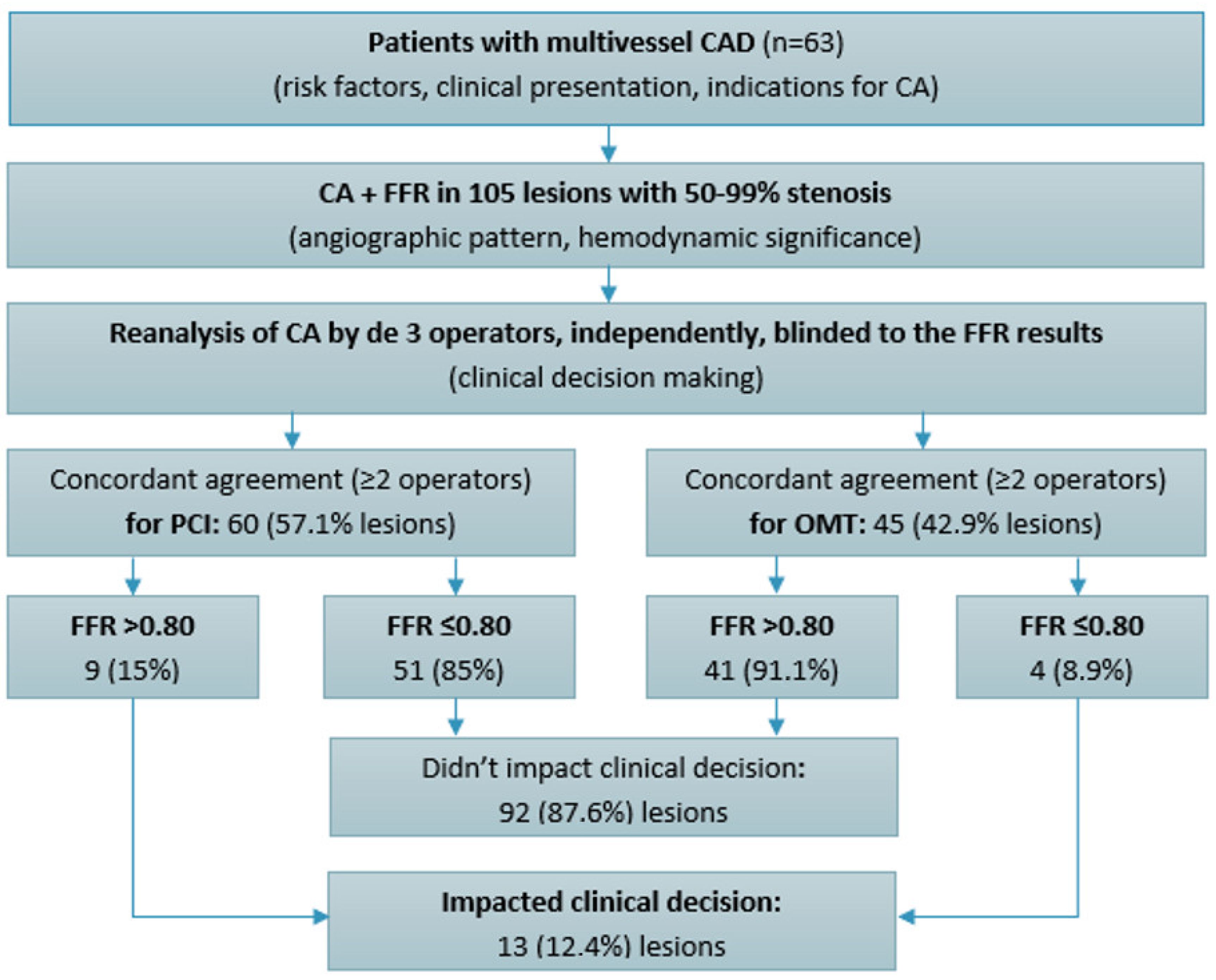
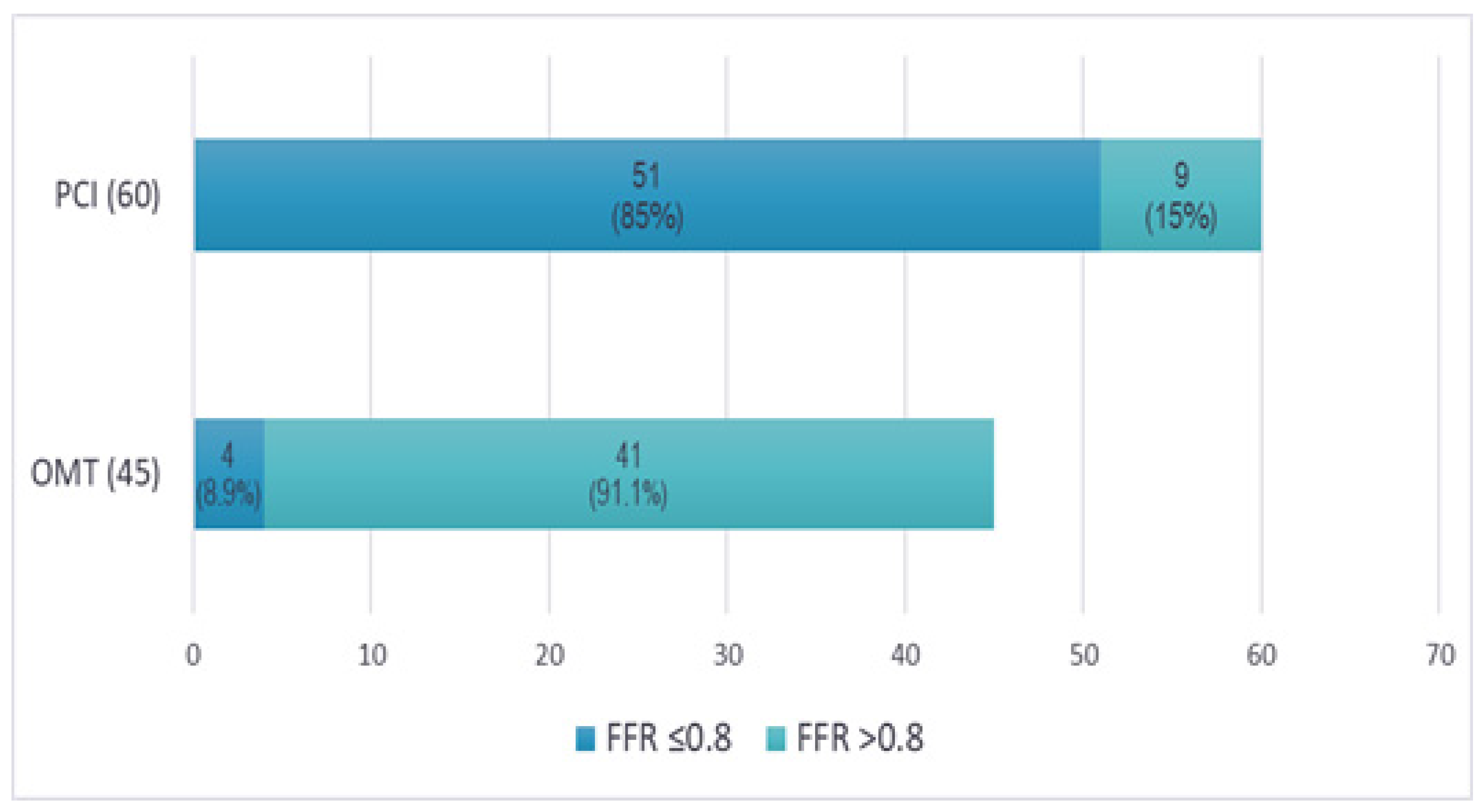
Fractional flow reserve (FFR) is regarded as the gold standard for assessing the functional significance of coronary artery lesions. However, its utilization in clinical practice remains limited. This study aims to determine whether FFR results can influence treatment decisions for coronary artery disease compared to visual assessments of angiographic images. We conducted a retrospective study involving 63 patients diagnosed with either chronic coronary syndrome (n = 39, 61.9%) or acute coronary syndrome (n = 24, 38.1%) who underwent an FFR assessment. Three experienced interventional cardiologists (>300 PCI procedures/year) reevaluated 105 ambiguous coronary lesions in these patients, blinded to the FFR results. The objective was to assess lesion significance and determine the treatment strategy based on a visual angiographic evaluation. The three operators reached concordant agreement (≥two operators) to perform PCI in 60 (57.1%) of the evaluated lesions based on the angiographic assessment. Of these, nine lesions (15%) were deemed functionally non-significant by FFR (FFR > 0.80). Conversely, they agreed to defer PCI in 45 (42.9%) lesions, but 4 lesions (8.9%) were found to be functionally significant (FFR ≤ 0.80) and required a re-evaluation for PCI. Visual-guided decision making by interventional cardiologists shows variability and does not always align with the functional significance of coronary lesions as determined by FFR. Incorporating FFR into routine decision making could enhance treatment accuracy and patient outcomes.
Keywords: fractional flow reserve; coronary artery disease; visual assessment variability; clinical decision making fractional flow reserve; coronary artery disease; visual assessment variability; clinical decision making